Academic Publishing and Open Access
Müller-Langer, Frank and Scheufen, Marc
Max Planck Institute for Innovation and Competition
25 January 2012
Online at
https://mpra.ub.uni-muenchen.de/61807/
Academic Publishing and Open Access
Frank Mueller-Langer
1and
Marc Scheufen
225 January 2012
3
1
Max Planck Institute for Intellectual Property and Competition Law, Marstallplatz 1, D-80539 Munich, Germany. E-Mail: [email protected]. The authors thank Jonas Rathfelder for excellent research assistance.
2
DFG Graduate School in Law and Economics, Institute of Law and Economics, Von-Melle-Park 5 (Room 2165), D-20146 Hamburg, Germany. E-Mail: [email protected].
3
Introduction
With the digital era and the spread of the internet, the academic publishing market is currently
facing just another revolution after the invention of the Xerox copier in 1959. While copyright
was broadened throughout a series of significant reforms after the Xerox copier had been
introduced, new business models, especially Open Access (OA), seem to have recently put
copyright and its role in academia into debate.
Two developments motivate this ‘OA debate’. First, subscription prices for academic journals
have increased, which has forced (university) libraries to significantly cut their journal
portfolios. Second, copyright as an incentive mechanism seems negligible in academia as
researchers are motivated by reputation gains and CV effects rather than direct financial
returns from publishing their works. Consequently, the OA publishing model may be seen as
a superior alternative for the conventional closed access (CA) publishing model.
This paper critically reviews the OA debate by discussing theoretical and empirical arguments
on the role of copyright in academic publishing. A brief historical examination introduces the
altering conditions for scholarly publishing and highlights the new trade-off in the digital age.
By locating the debate within a broader stream of current research, we provide alleys for
further research and a glimpse of possible future scenarios. It is shown that copyright may be
both, a blessing and a curse in establishing an effective framework for scientific progress.
Copyright in Academic Publishing
From an economics perspective, copyright is a simple means to correct the ‘free-rider’
environment that surrounds information goods. It does so by granting excludability and hence
copyright enforces a temporary monopoly creating both benefits (incentives for creative
works) and costs (dead-weight loss) from a social welfare perspective.4
In the academic publishing market, copyright did not play a pivotal role until the mid-20th
century. In fact, the relationship of copyright and scientific journals was ‘merely occasional;
because many of the earliest journal publishers were learned societies and then academic
institutions, copyright was licensed explicitly or implicitly to them, though it did not have a
central role in the business’ (Ramello, 2010, p. 13). In contrast, the presence of pirated copies
may have even laid the foundation for the popularity and reputation of particular journal
articles and journal titles.
This changed dramatically once commercial publishers started to enter the journal publishing
market by launching new or acquiring existing titles in the second half of the 20th century.
After the introduction of the Xerox 914 copier in 1959, academic publishers induced
significant revisions in copyright law. As a result, a series of court cases tackling the practice
of copying journal articles en masse from library collections induced an era that somewhat
revolutionized copyright law. Photocopying changed the trade-off for balancing the interests
in copyright law in two respects. First, the Xerox technology dramatically eased the process
of copying printed material. Second, copying en masse from library collections significantly
dropped article unit costs and hence changed the attractiveness of journal subscription
(Liebowitz, 1985).
The advent of the internet and the development of technologies to digitize information goods,
had at least three far reaching implications for copyright legislation: (1) digitization
supersedes the need for any physical media such as paper or CDs; (2) a digital copy is a
perfect substitute for the original work; (3) digitization has reduced the marginal cost of
copying to virtually zero. Several legislative steps have been trying to adapt copyright to the
new conditions. Arguably, the most significant change is the introduction of technological
4
measures to control the access and use of electronic content (so-called Digital Rights
Management (DRM) Technologies).5 The implications of the steps taken are far reaching and
go beyond the question of who should own intellectual assets. Public protest against recent
proposals for a reform of copyright, like the Stop Online Piracy Act (SOPA), shows the
intensity in this debate. Besides, there has recently been a movement in the academic
publishing market that questioned whether the traditional copyright model solves the trade-off
between creating incentives for scientists to create high quality research output on the one
hand and allowing the public fast access to those works on the other (Eger and Scheufen,
2012a, pp. 49 ff.). In fact, the Internet fostered the emergence of an alternative business model
for publishing academic works – not only by scientific associations, but also by scientists
themselves. The OA model seeks free online access of academic works ‘permitting any user
to read, download, copy, distribute, print, search or link to the full text of these articles, crawl
them for indexing, pass them as data to software, or use them for any other lawful purpose,
without financial, legal, or technical barriers other than those inseparable from gaining access
to the internet itself’ (Budapest Open Access Initiative, 2002). In this regard, OA to scholarly
literature can be achieved by means of two complementary strategies: (1) self-archiving (‘the
green road’); and (2) OA journals (‘the gold road’). The differentiation between the green and
gold road towards OA was introduced by Harnad et al. (2004). While self-archiving provides
with internet platforms to deposit un-/published papers, OA journals provide with the general
services of journal publishing, i.e. peer-review to enable for a quality selection of the works,
but also editing and typesetting tasks. However, Bergstrom (2001) and Mueller-Langer and
Watt (2010) suggest that not only the supply of the principal ingredient to journals, namely
academic articles, is provided by the scientific community, but typically so is the task of
filtering (i.e. refereeing) the articles for quality, editorship tasks, and even (for some cases)
5
the typesetting task.6 Consequently, it may be questionable to what extend publishers actually
add value to the production process and whether profit margins of 25 percent or more seem
reasonable for incentivizing publishers to publish (Ramello, 2010).
The OA movement especially gained momentum throughout the last decade when several
initiatives laid the foundations of OA publishing.7 In addition, scientific associations like the
National Institutes of Health started to promote OA publishing by fostering the development
of OA journals as well as self-archiving platforms. The Directory of Open Access Journals
(DOAJ)8 currently lists more than 8,500 OA journals (December 2012), significantly ranging
in number by discipline and country.9 Despite of this vast number of journals, OA still seems
to play a minor role in academic publishing. OA journals often lack in reputation as compared
to well-established CA journals. While OA journals have an average impact factor of 1.44,
established commercial publishers like Elsevier (2.67) or Wiley-Blackwell (2.58) show
significantly higher reputation measures and hence market power. Table 1 gives an overview
on some market structure characteristics, comparing OA and CA journal publishers.
6
On the latter point see Hilty (2006).
7
In this respect, three initiatives laid the foundations of the OA principle: (1) the Budapest Open Access Initiative (2002), (2) the Bethesda Statement on Open Access Publishing and (3) the Berlin Declaration on OA to Knowledge in the Sciences and Humanities (2003).
8
The DOAJ lists all OA journals that follow the lines of the definition by the Budapest Open Access Initiative, i.e. only pure OA journals are being listed. Not subject are so-called hybrid OA models, i.e. business models that provide with delayed, partial, retrospective OA, or offer an additional Open Choice option to authors subject to the payment of an author fee. Bernius et al. (2009) provide an overview of academic publishing models.
9
Table 1: Comparing the CA Giants with OA Journals
Publisher (numbers for 2011) Elsevier Wiley-Blackwell Springer All OA Journals
# Journals with Impact Factor ≥ 1 609 639 546 373
Market Share (IF ≥ 1) 0.122 0.128 0.110 0.0749
Average Impact Factor 2.668 2.575 1.637 1.437
Min Impact Factor 0.023 0.050 0.033 0
Max Impact Factor 38.278 23.462 11.526 17.462
Average Eigenfactor 0.015 0.013 0.006 0.005
Average Number of Articles* 206.240 171.208 109.252 127.709
* Sum of articles in journals by publisher x divided by the number of journals by publisher x. Note: We generated the matching data via metadata harvesting.
Source: Elaborations from ISI Web of Science Data, Thomson Reuters Journal Citation Report (2011).
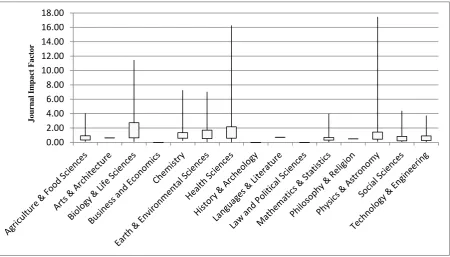
The difference becomes even more significant if we look at the role of OA journals by
disciplines. OA journals may at most be considered as an alternative publishing outlet in
Biology, Physics and Health Sciences, while in most disciplines OA journals are hardly ever
listed by ISI Thomson’s Web of Science. The boxplot in Figure 1 highlights these differences
in the reputation of OA journals by discipline.
Figure 1: Boxplot – Impact Factor of OA Journals by Discipline
Note: A boxplot generally illustrates measures of central tendency and hence the distribution of a variable x. In particular, the vertical line illustrates the minimum and maximum. The height of the rectangle sets the limits for the first and third quartile of the distribution.
Source: Elaborations from ISI Web of Science Data, Thomson Reuters Journal Citation Reports (2011).
[image:7.595.74.525.466.723.2]In addition to the emergence of alternative publishing models, digitization also provides new
opportunities in the context of the traditional publishing model. Digitization offered new
marketing strategies for commercial journal publishers, making bundling of different versions
(electronic and print version) and journals (so-called ‘big deals’) predominant price
discriminating strategies in the academic journal market (Edlin and Rubinfeld, 2004). As a
consequence, serial expenditures10 increased by 273 percent between 1986 and 2004
(Ramello, 2010). Serial unit costs increased by 188 percent as compared to an increase in the
consumer price index of 73 percent for the same time period. In some disciplines, for example
physics and chemistry, journal prices even increased by more than 600 percent from 1984 to
2001 (Edlin and Rubinfeld, 2004). As a consequence of this vast increase in journal
subscription prices together with budget cuts in several countries, libraries were forced to
significantly change their subscription portfolios.11 This serial crisis may be seen as the
driving force behind the OA debate.
Moreover, the role of copyright – necessary for the possibility of exclusion and hence such
pricing strategies – may be questioned, since the rationale of a primarily monetary reward as
an incentive for an author’s creative endeavour seems negligible in scientific research. Other
motivational factors, like cites and reputation (peer-recognition) or labor market signals, may
be significantly more important. Furthermore, authors are hardly ever paid royalties for
publishing an academic work in the first place. Thus, a removal of copyright is currently
being discussed among Law and Economics scholars as a possible policy implication in
shaping the future of academic publishing.
10
A serial is a published work that appears on a regular schedule, also referred to as journal. Thus, serial expenditures mirror the total amount paid by libraries for yearly subscription to a set of journals.
11
Ted Bergstrom provides an extensive overview and links for further reading on the serial crisis on his ‘journal
The Open Access Debate in Science
The literature investigating the impact of digital technologies and the development of new
business models and technologies for scholarly publishing falls into three categories: (1)
comparative studies analyzing the effectiveness of the traditional copyright regime as
compared to alternative publishing models, especially OA; (2) studies investigating the
impact of online and free online access on readership and citations; (3) studies focusing on
researchers’ attitudes towards new business models in academic publishing. This paper
focuses on the first literature stream, critically reviewing the literature on the impact of a
removal of copyright for academic works.
Recently, most attention in the OA debate has been directed to a seminal paper by Steven
Shavell (2010), which asked whether copyright for academic works should be abolished. In a
nutshell, Shavell argues as follows: (1) scientists’ driving motivation is the accumulation of
reputation, which is increasing in readership; (2) OA will most likely increase readership and
hence scholarly esteem; (3) most universities will have an incentive to cover the publishing
costs when moving to an ‘author pays’-principle.
However, McCabe and Snyder (2005) suggest that OA is more likely to be a feature of lower
quality journals. They argue that under OA profit maximizing publishers may accept more
articles than would be socially efficient to internalize author fees. Similarly, Jeon and Rochet
(2010) find that OA forces publishers to set socially inefficient quality thresholds for paper
acceptance. This may raise doubts on the allegedly positive reputation effect of OA on
scientists as brought forward by Shavell (2010). In addition, Mueller-Langer and Watt (2010)
are skeptical regarding Shavell’s modeling assumption that scholarly esteem can be proxied
by readership, i.e. the number of reads, alone. The authors argue that this only holds true if
reputation as a function of readership would be strictly increasing for all values of readership.
However, a journal’s impact factor or reputation may be more important in the scientist’s
well-esteemed journal with only few readers than to a low-esteemed journal with a larger
audience. Mueller-Langer and Watt (2010) raise the question whether copyright may be
important for establishing a certain level of reputation for a journal in the first place. Hence,
copyright may have important implications for the functioning of the market’s inherent
reward system for measuring a scientist’s performance. In a follow-up paper, Mueller-Langer
and Watt (2012) indirectly account for the importance of a journal’s reputation in deciding
where to publish by modeling both author’s and reader’s perspectives in a two-sided model.
In this framework, journals are considered as intermediaries linking authors and readers.
Mueller-Langer and Watt (2012) analyze the effects of a removal of copyright for academic
works. The authors identify countervailing effects of abolishing copyright for academic works
and find scenarios in which quality for journal articles may increase under OA.
Mueller-Langer and Watt (2012) find that the overall welfare effects of a removal of copyright for
academic works are ambiguous. In the light of this finding, we suggest that further empirical
research on the academic publishing market may make an important contribution to the OA
debate.
Several papers have investigated the influence of online or free online access on readership
and citations. The literature provides a rather differentiated picture on a possible citation
advantage of an OA regime, ranging from an OA citation advantage by a factor of three
(Lawrence and Giles, 2001) to the conclusion that OA does not generate a significantly higher
citation rate (Davis et al., 2008; McCabe and Snyder, 2011) or one that is declining by seven
percent per year (Davis, 2009). Despite some doubt in the degree to which OA may induce
higher citation rates, a broad literature stream gives confidence in believing that readership
and citations may be at least weakly higher in an OA regime (Harnad, 2012). Accordingly,
Eysenbach (2006) finds significantly higher citation rates for OA journal articles in the fields
of biology, physics and social sciences. Similar findings are recorded by Norris et al. (2008)
citation advantage ranging between 25 and 250 percent by discipline and year for ten different
disciplines. Furthermore, Bernius and Hanauske (2009) suggest that a scientist may increase
peer-recognition and hence scholarly esteem when switching to OA.
Feess and Scheufen (2011) consider possible distortion effects if not all universities cover the
publication costs when moving towards an ‘author pays’-principle. Assuming that researchers
differ in talent and that only the best universities will most likely cover the publication costs,
Feess and Scheufen (2011) find that researchers’ rent-seeking motives may contradict some of
the conclusions in Shavell (2010). While in Shavell’s model each author only causes positive
externalities (i.e. private quality incentives can never be too high), their model shows that
social welfare may not be strictly increasing in research activity due to rent-seeking motives.
OA may hence create countervailing effects: OA is always superior if and only if we believe
researcher’s private effort levels to be already too high as a larger readership and the
asymmetry in publishing costs will correct some of the distortions in the traditional copyright
model. In the other case, it will depend on the model’s parameters which of the two regimes
may produce a better outcome.
Mueller-Langer and Watt (2010) are interested in the possible effects when charging an
author’s fee for submitted papers. They show that a universal OA regime may be particularly
detrimental for research institutions exhibiting a relatively large publication output.
Accordingly, the best institutions would have to bear relatively higher publication costs as
compared to mediocre institutions with a lower publication output. As a result, they
emphasize the need to assess the pricing scheme within an OA regime more carefully,
especially considering possible distribution effects across institutions. Last but not least, an
emerging literature has been investigating whether the market will enforce an OA regime
anyway (assuming a universal OA regime to be superior) or whether some coordination
Several authors have been emphasizing that authors may in fact be locked-in due to a
reputation advantage of established CA journals. Cavaleri et al. (2009) invoke the picture of a
‘chicken and egg’-problem, where newly launched OA journals will be restricted in
accumulating a decent level of reputation and hence in creating demand. Accordingly, the
dominant strategy of submitting to well-esteemed closed access journals leaves the authors
locked-in to the weak Nash equilibrium and a ‘wait and see’ attitude regarding OA. Mann et
al. (2008) provide evidence for this ‘wait and see’-attitude analyzing 481 scientists from
different disciplines. A survey by Eger, Scheufen and Meierrieks (2013) among 2151
scientists in Germany finds that this attitude may, however, differ considerably between
disciplines. Consequently, in disciplines where it has been more common to publish OA or
where OA journals exhibit higher impact factor levels, authors tend to publish more of their
papers in OA journals and deposit their works on self-archiving platforms.
Hybrid Open Access, Open Access to Data and Retro-Digitization
Publishers, such as Springer and Oxford University Press among others, have recently
introduced the Hybrid Open Access (HOA) business model for academic publications in
peer-reviewed journals (Davis, 2009; Björk, 2012). In contrast to the traditional subscription-based
CA business model, the HOA publication format gives authors the option of paying a HOA
publication fee (up to $3000) to make their paper immediately and freely available online
without any embargo period. Under HOA, the copyright remains with the authors.
Mueller-Langer and Watt (2013) empirically analyze the effect of HOA at the paper level by
comparing citation rates and quality factors for HOA papers to CA papers that appear in the
same journal. This analysis finds that HOA papers generate significantly higher cites than CA
papers. It suggests that commercial HOA publishers may use the HOA publication format as a
second source for revenue on top of the revenue generated from subscription prices
The technological revolution ushered in by the Internet and the increase of possibilities in the
digital environment have not only changed the business model of commercial publishers but
also facilitated and spurred the creation and use of data sets for scientific purposes. For
instance, in Economics, as in many other disciplines, the number of articles for which
researchers have collected their own data or used external data sets has significantly increased
in recent years. The availability of data for scientific purposes is an essential feature for the
scientific principle of self-correction, replication and further research (Dewald, Thursby and
Anderson, 1986; Anderson et al., 2008; McCullough, 2009). Andreoli-Versbach and
Mueller-Langer (2013) analyze the incentives of researchers to voluntarily make their data publicly
available and thus to provide the scientific community with voluntary OA to data. The
analysis suggests that a trade-off arises between the ex post benefits associated with OA to
data and reduced incentives to create the data ex ante. It shows that forced OA to data may
lead to welfare-reducing strategic delays of submission. Finally, Andreoli-Versbach and
Mueller-Langer (2013) find that forced OA to data is welfare enhancing if and only if
researchers have no incentives to postpone the date of submission and if the positive effect of
data availability outweighs the negative effect associated with reduced efforts to create data.
A recent strand of literature studies the Google Book Search (GBS) Project (Lichtman, 2008;
Grimmelmann, 2009; Bechtold, 2010; Samuelson, 2010a). GBS aims at maximizing the
accessibility to books by making digitized books publicly available and searchable worldwide
via an internet book search engine. Beginning in 2004 Google has pursued the
retro-digitization of millions of books en masse from library collections with the vision to create a
digital library that allows worldwide and free access to books. While the supporters of GBS
conceive this as a first reasonable step towards the largest online body of human knowledge
and as a means to promote the democratization of knowledge, its opponents fear negative
effects due to an erosion of copyright law (Samuelson, 2010b and 2010c). Mueller-Langer
a possible fair use argumentation against the claims of copyright infringement. This question
arises as the GBS search engine offers its users a short excerpt of the book containing the
search term, allowing users to browse sample pages in a limited preview. Copyrighted books
are not generally excluded from the digitization and the preview as Google operates on the
premise of passive consent and evades the right holders’ explicit permission. The right
holders may, however, exclude their books from GBS by choosing to opt out. Mueller-Langer
and Scheufen (2011) suggest that GBS may provide a solution for the unsolved dilemma of
orphan works under the condition that Google’s pricing algorithm for orphan works replicates
a competitive market outcome under third-party oversight.12
In fall 2005, the Authors Guild and five publishers initiated litigation over GBS, suing Google
for copyright infringement. Google reverted to the fair-use argument to legitimate GBS. In
particular, Google argued that the limited preview was a fair and thus non-infringing use of
copyrighted book content and that GBS improved the accessibility to knowledge. In October
2008, the proceedings of the litigation resulted in a class action settlement. In November
2009, the parties filed an Amended Settlement Agreement. On March 22, 2011, judge Denny
Chin rejected the proposed settlement (US District Court Southern District of New York,
2011). In particular, Chin suggested that many of the concerns from a copyright law
perspective would be ameliorated if the settlement were converted from an ‘opt-out’ to an
‘opt-in’ settlement.13
Conclusions, caveats and questions for further research
Despite the recent flood of research investigating the impact of a shift towards OA in
academic publishing, many questions remain unsolved. Two future scenarios seem possible:
(1) a universal OA regime; (2) a coexistence of CA and OA business models. Imagining the
first scenario, it may still be questionable whether a change in copyright or alternative
12
See Picker (2009) for a divergent view.
13
legislative steps (e.g. an inalienable right of secondary publication) is reasonable and/or
necessary for promoting OA or whether copyright may have important implications for
academic publishing in the first place (e.g. journal reputation). In fact, a universal OA regime
following a ‘one-size-fits-all’-approach may be far from reaching a first best solution,
especially when considering the immanent differences in the reward systems between
disciplines and countries. In contrast, the coexistence of both regimes in a world with
copyright may raise doubt on the competitiveness of OA journals as compared to
well-established CA journals. Accordingly, the question arises of whether OA journals will be able
to successfully increase reputation and hence their impact factor in the long run. A possible
downside of this ‘reputation advantage’ of established CA publishers may be ‘double dipping’
strategies by using HOA models for discriminating prices and maximizing profits.
Consequently, future studies should investigate which approaches, tools or strategies would
provide institutions with a counter balance against the market power of well-known
commercial publishers.
As for OA to data, the question arises which approaches, tools or strategies research
institutions or external funders of research may choose to increase the (career) incentives of
affiliated academics to share their data with the academic community. In addition, the analysis
of recently established standards of data citations and the concept of data-co-authorship
appears to be a promising path for further research (Altman and King, 2007). Besides, further
research on the impact of GBS on scholarly communication is needed. One may argue that
GBS fills a gap with respect to the accessibility of knowledge as it provides a
retro-digitization in contrast to the Creative Commons and OA movements. Finally, the ongoing
debate on the benefits and cost of GBS and its settlement may induce a substantial impulse for
References
Altman, Micah and Gary King (2007), ‘A proposed standard for the scholarly citation of
quantitative data’, D-Lib Magazine, 13(3/4).
Anderson, Richard G., William H. Greene, Bruce D. McCullough and Hrishikesh D. Vinod
(2008), ‘The role of data/code archives in the future of economic research’, Journal of
Economic Methodology, 15, 99-119.
Andreoli-Versbach, Patrick and Frank Mueller-Langer (2013), ‘Climbing the shoulders of
giants: Open access to data’, European Datawatch Extended Working Paper, Mimeo.
Arrow, Kenneth (1962), ‘Economic welfare and the allocation of resources for invention’, in
Richard Nelson (ed.), The Rate and Direction of Inventive Activity, Cambridge, MA, USA:
Harvard University Press, pp. 609-624.
Bechtold, Stefan (2004), ‘Digital rights management in the United States and Europe’,
American Journal of Comparative Law, 52, 323-382.
Bechtold, Stefan (2010), ‘Google Book Search – A rich field of scholarship’, International
Review of Intellectual Property and Competition Law, 41(3), 1-2.
Bergstrom, Theodore C. (2001), ‘Free labor for costly journals? ’, Journal of Economic
Perspectives, 15(3), 183-198.
Bergstrom, Theodore C. (2013), ‘Journal Pricing Page’, available at:
http://www.econ.ucsb.edu/~tedb/Journals/jpricing.html (accessed 21 January 2013).
Bernius, Steffen and Matthias Hanauske (2009), ‘Open Access to Scientific Literature –
Increasing Citations as an Incentive for Authors to Make their Publications Freely
Accessible’, Hawaii International Conference on Systems Sciences (HICSS-42), Waikoloa,
Hawaii.
Bernius, Steffen, Matthias Hanauske, Wolfgang König and Berndt Dugall (2009), ‘Open
access models and their implications for the players on the scientific publishing market’,
Björk, Bo-Christer (2012), ‘The hybrid model for open access publication of scholarly articles
– A failed experiment?’, Journal of the American Society of Information Sciences and
Technology, 63(8), 1496-1504.
Bosch, Xavier (2009), ‘A reflection on open-access, citation counts, and the future of
scientific publishing’, Archivum Immunologiae et Therapiae Experimentalis, 57, 91-93.
Brody, Tim, Stevan Harnad and Les Carr (2006), ‘Earlier web usage statistics as predictors of
later citation impact’, Journal of the Association for Information Science and Technology,
57(8), 1060-1072.
Cavaleri, Michael, Giovanni B. Ramello and Vottorio Valli (2009), ‘Publishing an e-journal
on a shoe string: Is it a sustainable project?’, Economic Analysis & Policy, 39(1), 89-101.
Davis, Philip M. (2009), ‘Author-choice open access publishing in the biological and medical
literature’, Journal of the American Society for Information Science and Technology, 60(1),
3-8.
Davis, Philip M., Bruce V. Lewenstein, Daniel H. Simon, James G. Booth and Mathew J. L.
Connolly (2008), ‘Open access publishing, article downloads, and citations: Randomised
controlled trial’, BMJ, 337, a568.
Dewald, William G., Jerry G. Thursby and Richard G. Anderson (1986), ‘Replication in
empirical economics: The Journal of Money, Credit and Banking Project’, American
Economic Review, 76, 587-603.
Directory of Open Access Journals (2013), ‘DOAJ by Country’, available at:
http://www.doaj.org/doaj?func=byCountry&uiLanguage=en (accessed 21 January 2013).
Edlin, Aaron S. and Daniel L. Rubinfeld (2004), ‘Exclusion or efficient pricing? The ‘big
deal’ bundling of academic journals’, Antitrust Law Journal, 72, 128-59.
Eger, Thomas and Marc Scheufen (2012a), ‘The past and the future of copyright law.
Technological change and beyond’, in Jef De Mot (ed.), Liber Amicorum Boudewijn
Eger, Thomas and Marc Scheufen (2012b), ‘Das Urheberrecht im Zeitenwandel: Von
Gutenberg zum Cyberspace’, in Christian Müller, Frank Trosky and Marion Weber (eds.),
Ökonomik als allgemeine Theorie menschlichen Verhaltens, Schriften zu Ordnungsfragen der
Wirtschaft, 94, Stuttgart, Germany: Lucius & Lucius, pp. 151-179.
Eger, Thomas, Marc Scheufen and Daniel Meierrieks (2013), ‘Open access awareness and
attitudes in different scientific disciplines’, University of Hamburg, Mimeo.
Eysenbach, Gunther (2006), ‘Citation advantage of open access articles’, PLoS Biol 4(5):
e157. doi:10.1371/journal.pbio.0040157 (accessed 21 January 2013).
Feess, Eberhard and Marc Scheufen (2011), ‘Academic copyright in the publishing game: A
contest perspective’, SSRN-Working Paper, available at:
http://papers.ssrn.com/sol3/papers%20.cfm?abstract_id=1793867 (accessed 21 January 2013).
Gaulé, Patrick and Nicolas Maystreb (2011), ‘Getting cited: Does open access help?’,
Research Policy, 40, 1332-1338.
Grimmelmann, J. (2009), ‘How to fix the Google Book Search settlement’, Journal of
Internet Law, 12(10), 10-20.
Hajjem, Chawki, Stevan Harnad and Yves Gingras (2005), ‘Ten-year cross-disciplinary
comparison of the growth of open access and how it increases research citation impact’, IEEE
Data Engineering Bulletin, 18(4), 39-47.
Harnad, Stevan (2012), ‘The effect of open access and downloads ('hits') on citation impact: a
bibliography of studies’, available at: http://opcit.eprints.org/oacitation-biblio.html (accessed
21 January 2013).
Harnad, Stevan, Tim Brody, Francois Vallières, Les Carr, Steve Hitchcock, Yves Gingras,
Charles Oppenheim, Heinrich Stamerjohanns and Eberhard R. Hilf (2004), ‘The
access/impact problem and the green and gold roads to open access’, Serials Review, 30(4),
Hilty, Reto M. (2006), ‘Five lessons about copyright in the information society: Reaction of
the scientific community to over-protection and what policy-makers should learn’, Journal
of the Copyright Society of the USA, 53(1), 103-38.
Jeon, Doh-Shin and Jean-Charles Rochet (2010), ‘The pricing of academic journals: A
two-sided market perspective’, American Economic Journal: Microeconomics, 2, 222-255.
Lawrence, Steve and C. Lee Giles (2001), ‘Accessibility of information on the web’,
Intelligence, 11(1), 32-39.
Lemley, Mark (2011), ‘Is the sky falling on the content industries?’, Journal of
Telecommunications and High Technology Law, 9, 125-135.
Lichtman, Douglas (2008), ‘Copyright as innovation policy: Google Book Search from a Law
and Economics perspective’, in Josh Lerner and Scott Stern (eds.), Innovation Policy and the
Economy, Vol. 9, Cambridge, MA, USA: National Bureau of Economic Research, pp. 55-77.
Liebowitz, Stan L. (1985), ‘Copying and indirect appropriability: Photocopying of journals’,
Journal of Political Economy, 93(5), 945-957.
Mann, Florian, Benedikt von Walter, Thomas Hess and Rolf T. Wigand (2008), ‘Open access
publishing in science: Why it is highly appreciated but rarely used’, Communications of the
ACM, 51.
McCabe, Mark J. and Christopher M. Snyder (2005), ‘Open access and academic journal
quality’, American Economic Review Papers and Proceedings, 95(2), 453-458.
McCabe, Mark J. and Christopher M. Snyder (2007), ‘Academic journal prices in a digital
age: A two-sided market model’, B.E. Journal of Economic Analysis and Policy, 7(1), Article
2.
McCabe, Mark J. and Christopher M. Snyder (2011), ‘Did online access to journals change
the economics literature?’, SSRN-Working Paper, available at:
McCullough, Bruce D. (2009), ‘Open access economics journals and the market for
reproducible economic research’, Economic Analysis & Policy, 39(1), 118-126.
Mueller-Langer, Frank and Marc Scheufen (2011), ‘The Google Book Search Settlement: A
Law and Economics analysis’, Review of Economic Research on Copyright Issues, 8(1), 7-50.
Mueller-Langer, Frank and Richard Watt (2010), ‘Copyright and open access for academic
works’, Review of Economic Research on Copyright Issues, 7(1), 45-65.
Mueller-Langer, Frank and Richard Watt (2012), ‘Optimal pricing and quality of academic
journals and the ambiguous welfare effects of forced open access: A two-sided market
model’, TILEC Discussion Paper No. 2012-019, available at:
http://papers.ssrn.com/sol3/papers.cfm?abstract_id=2045956 (accessed 21 January 2013).
Mueller-Langer, Frank and Richard Watt (2013), ‘Analysis of the impact of hybrid open
access on journals and authors’, University of Canterbury, Mimeo.
Norris, Michael, Charles Oppenheim and Fytton Rowland (2008), ‘The citation advantage of
open access articles’, Journal of American Society for Information Science and Technology,
59(12), 1963-1972.
Picker, Randal C. (2009), ‘The Google Book Search Settlement: A new orphan-works
monopoly?’, Journal of Competition Law & Economics, 5(3), 383-409.
Ramello, Giovanni B. (2010), ‘Copyright & endogenous market structure: A glimpse from the
journal-publishing market’, Review of Economic Research on Copyright Issues, 7(1), 7-29.
Samuelson, Pamela (2010a), ‘Google Book Search and the future of books in cyberspace’,
Minnesota Law Review, 94(5), 1308-1374.
Samuelson, Pamela (2010b), ‘Legally speaking: The dead souls of the Google Book Search
Settlement’, Communications of the ACM, 53(7), 32-34.
Samuelson, Pamela (2010c), ‘Academic author objections to the Google Book Search
Shavell, Steven (2010), ‘Should copyright of academic works be abolished?’, Journal of
Legal Analysis, 2(1), 301-358.
Suber, Peter (2012), Open Access, Cambridge, MA, USA: MIT Press.
Thomson Reuters Journal Citation Reports (2011), available at:
http://thomsonreuters.com/products_services/science/science_products/a-z/journal_citation_reports/ (accessed 21 January 2013).
Towse, Ruth, Christian Handke and Paul Stepan (2008), ‘The economics of copyright law: A
stocktake of the literature’, Review of Economic Research on Copyright Issues, 5(1), 1-22.
US District Court Southern District of New York (2011) , ‘Authors Guild et al. vs. Google
Inc., Opinion 05 Civ. 8136 (DC)’, available at:
http://amlawdaily.typepad.com/googlebooksopinion.pdf (accessed 21 January 2013).
Further Reading
For a more general review on how new technologies have affected the content industries, see
Lemley (2011). On the history of copyright and its linkages with the invention of new
technologies see Eger and Scheufen (2012a, b) and the herein mentioned literature.
McCabe and Snyder (2007) suggest that OA may most likely be adapted by
low-quality/low-esteemed journal publishers, while publishers of high-quality journals will tend to choose CA.
Bernius et al. (2009) analyze researchers’ attitudes towards new business models in academic
publishing. They also study the implications of OA for publishers, libraries and funding
organizations. Readership and citations may be interrelated as a larger audience increases the
probability of getting cited. Brody et al. (2006) analyze the physics e-print archive ‘arXiv.org’
and find that readership and citations are correlated. Gaulé and Maystreb (2011) suggest that
there is a positive impact of OA on citation rates. Bosch (2009) summarizes the literature on
potential changes in the scientific publishing system. Suber (2012) provides a thorough