0095-1137/03/$08.00⫹0 DOI: 10.1128/JCM.41.7.3246–3251.2003
Copyright © 2003, American Society for Microbiology. All Rights Reserved.
Real-Time PCR Assay for Detection of Fluoroquinolone Resistance
Associated with
grlA
Mutations in
Staphylococcus aureus
Pascal Lapierre,
1,2Ann Huletsky,
1,2Ve
´ronique Fortin,
1Franc¸ois J. Picard,
1Paul H. Roy,
1,3Marc Ouellette,
1,2and Michel G. Bergeron
1,2*
Centre de Recherche en Infectiologie de l’Universite´ Laval, CHUQ (Pavillon CHUL),1Division de Microbiologie,
Faculte´ de Me´decine,2and De´partement de Biochimie et de Microbiologie, Faculte´ des Sciences
et de Ge´nie,3Universite´ Laval, Sainte-Foy, Que´bec, Canada
Received 29 January 2003/Returned for modification 17 March 2003/Accepted 28 April 2003
Resistance to fluoroquinolones among clinical isolates ofStaphylococcus aureushas become a clinical prob-lem. Therefore, a rapid method to identifyS.aureusand its susceptibility to fluoroquinolones could provide clinicians with a useful tool for the appropriate use of these antimicrobial agents in the health care settings. In this study, we developed a rapid real-time PCR assay for the detection ofS.aureusand mutations at codons Ser-80 and Glu-84 of thegrlAgene encoding the DNA topoisomerase IV, which are associated with decreased susceptibility to fluoroquinolones. The detection limit of the assay was 10 genome copies per reaction. The PCR assay was negative with DNA from all 26 non-S.aureusbacterial species tested. A total of 85S.aureusisolates with various levels of fluoroquinolone resistance was tested with the PCR assay. The PCR assay correctly identified 100% of the S. aureusisolates tested compared to conventional culture methods. The correlation between the MICs of ciprofloxacin, levofloxacin, and gatifloxacin and the PCR results was 98.8%. The total time required for the identification ofS.aureusand determination of its susceptibility to fluoroquinolones was about 45 min, including DNA extraction. This new rapid PCR assay represents a powerful method for the detection ofS.aureusand its susceptibility to fluoroquinolones.
In recent years, the clinical efficacy of fluoroquinolones against infections withStaphylococcus aureushas been under-mined by the widespread emergence of decreased susceptibil-ity to these compounds (1, 8). Resistance to fluoroquinolones, and in particular to ciprofloxacin, is considerably higher among methicillin-resistantS. aureus(MRSA) strains than among methicillin-susceptibleS.aureusstrains (8). Indeed, 60 to 90% of the MRSA organisms isolated worldwide are now resistant to ciprofloxacin (3). Recently, considerable efforts have been made to improve the spectra of activity of quinolones againstS.
aureus, including MRSA. New fluoroquinolones, such as levo-floxacin, gatilevo-floxacin, and moxilevo-floxacin, have been developed and are presently on the market. However, despite their im-proved activities, newer fluoroquinolones have been shown to be less active against ciprofloxacin-resistant bacteria, and an increased resistance to these new compounds has been ob-served, especially with MRSA strains (8).
Fluoroquinolone resistance inS.aureushas been well stud-ied and is associated, in most isolates, with single mutations in DNA topoisomerase IV and DNA gyrase (8, 25). Resistance mutations most often occur within the quinolone resistance-determining regions located in thegrlAandgyrAgenes encod-ing the A subunits of topoisomerase IV and DNA gyrase, respectively. InS. aureus, DNA topoisomerase IV is the pri-mary target of fluoroquinolones, and first-step resistance to most of these antimicrobial agents has been associated with
mutations in grlA(8, 25). Indeed, data from various studies have shown that mostS.aureusisolates having decreased sus-ceptibility to fluoroquinolones harbor mutations at codons 80 (Ser-80 to Phe or Tyr) and/or 84 (Glu-84 to Lys or Val or Gly) ofgrlA(23, 26, 27, 30). Single mutations ingrlAappear to be sufficient to reach MICs of ciprofloxacin that exceed the lab-oratory breakpoints for susceptibility (8). On the other hand, for new fluoroquinolones, singlegrlAmutations are associated with a reduced susceptibility to these compounds but are not sufficient for clinical resistance. Additional mutations ingyrA
and, less commonly, ingrlBandgyrB, encoding the B subunits of the DNA topoisomerase IV and DNA gyrase, respectively, will usually generate full resistance to new fluoroquinolones and an increased level of ciprofloxacin resistance (8). In addi-tion to mutaaddi-tions in these loci, altered expression ofnorA, a gene encoding a multidrug efflux pump, can also confer low-level resistance to fluoroquinolones (8, 25). It has been shown thatS.aureusisolates with existing first-stepgrlAmutations are more likely to acquire subsequent mutations that result in clinical resistance to the new fluoroquinolones (5). Therefore, the development of novel methods that can rapidly identify mutations in the S. aureus grlA gene would provide a useful tool for the appropriate use of new fluoroquinolones in clinical settings.
In this study, we describe a rapid real-time PCR assay for the detection ofS.aureusand of mutations in thegrlAgene asso-ciated with fluoroquinolone resistance. We compare this PCR assay with conventional culture methods for identification of
S.aureusisolates and determination of their susceptibility to fluoroquinolones.
(This study was partially presented at the 101st General
* Corresponding author. Mailing address: Centre de Recherche en Infectiologie de l’Universite´ Laval, CHUQ (Pavillon CHUL), 2705 boul. Laurier, Sainte-Foy, Que´bec, G1V 4G2, Canada. Phone: (418) 654-2705. Fax: (418) 654-2715. E-mail: michel.g.bergeron@crchul .ulaval.ca.
3246
on May 15, 2020 by guest
http://jcm.asm.org/
Meeting of the American Society for Microbiology, Orlando, Fla., 20 to 24 May 2001.)
MATERIALS AND METHODS
Bacterial strains.The bacterial strains used in this study were obtained from the American Type Culture Collection (ATCC) (Manassas, Va.) (n⫽2), the Montreal General Hospital (Montre´al, Que´bec, Canada) (n⫽28), Pavillon Centre Hospitalier de l’Universite´ Laval (Sainte-Foy, Que´bec, Canada) (n⫽1), the Mount Sinai Hospital (Toronto, Ontario, Canada) (n⫽5), the Huashan Hospital (Shanghai, China) (n⫽19), Universidad de Buenos Aires (Buenos Aires, Argentina) (n⫽10), Statens Serum Institut (Copenhagen, Denmark) (n
⫽10), Pfizer (Groton, Conn.) (n⫽1), Institut Pasteur (Paris, France) (n⫽2), the Centers for Disease Control and Prevention (Atlanta, Ga.) (n⫽5), and the Biological Research Laboratory, Sankyo Co., Ltd. (Tokyo, Japan) (n⫽4). Confirmation of the identification of theS.aureusclinical isolates was performed by using the MicroScan WalkAway panel type positive breakpoint combo 13 (Dade Behring Canada Inc., Mississauga, Ontario, Canada).
MIC determination.The MICs of ciprofloxacin, levofloxacin, gatifloxacin, and oxacillin were determined by the Etest method (AB Biodisk, Solna, Sweden) according to the manufacturer’s instructions. The results were interpreted ac-cording to the standards of the NCCLS (20).S.aureusATCC 29213 was used as a quality control for antimicrobial susceptibility testing.
Primers and probes.Alignment of publicly available sequences ofgrlAgenes from several staphylococcal species was performed with the program Pileup from the GCG package (version 10; Accelrys). Two primers (grlA205 and grlA396) specific to theS.aureus grlAgene were designed with the help of the Oligo primer analysis software, version 6.65 (Molecular Biology Insights, Cascade, Colo.). Three molecular beacon probes (MBPs) were also designed with a DNA fold program (M. Zuker, http://www.bioinfo.rpi.edu/applications/mfold/old /dna/). The stem of each molecular beacon was formed by adding 5-nucleotide complementary sequences at either end of the probe sequence. To avoid non-specific fluorescence emission, the stem sequence was designed to ensure that the molecular beacons adopt a hairpin structure at the optimal annealing tempera-ture of the PCR, when no target amplicons are present. Two MBPs (S80-FAM and E84-FAM) targeting the wild-type sequence ofgrlAwere used to detect the presence of mutations at codons 80 and 84, respectively. A third MBP (Sau-TET), targeting an invariant region ofgrlA, was used to identifyS.aureusand as a positive amplification control. Resistance to fluoroquinolones was identified when there was a positive signal from theS.aureusprobe and no signal from either or both of the wild-type alleles of the probes targeting the regions poten-tially containing mutations at codons 80 and/or 84 ofgrlA. Primers were synthe-sized with a DNA synthesizer (model 391, PE Applied Biosystems, Foster City, Calif.), and MBPs were obtained either from Stratagene (La Jolla, Calif.) or from Biosearch Technology (Novato, Calif.). PCR primers and probes used in this study are listed in Table 1.
PCR amplification.For all bacterial strains, amplification was performed using either purified genomic DNAs or crude DNA extracts prepared from bacterial suspensions whose turbidity was adjusted to that of a 0.5 McFarland standard, which corresponds to approximately 1.5⫻108
bacteria/ml. Genomic DNA was purified with the G Nome kit (Qbiogene Inc., Carlsbad, Calif.) according to the manufacturer’s instructions. Crude DNA extracts were prepared for PCR by using a rapid DNA extraction kit (Infectio Diagnostic [I.D.I.] Inc., Sainte-Foy, Canada) (13). Either 0.1 ng of purified genomic DNA or 1l of crude DNA extract was transferred directly to a 24-l PCR mixture containing 0.4M concentrations of the primers grlA205 and grlA396, a 0.2M concentration of
each of the MBPs, a 200M concentration of each of the four deoxyribonucle-otide triphosphates (Pharmacia Biotech, Baie d’Urfe´, Que´bec, Canada), 10 mM Tris-HCl (pH 9.1), 50 mM KCl, 0.1% Triton X-100, 3.5 mM MgCl2, 3.3 mg of
bovine serum albumin/ml (Sigma-Aldrich Canada, Oakville, Ontario, Canada), and 0.5 U ofTaqDNA polymerase (Promega, Madison, Wis.) combined with the TaqStart antibody (BD Biosciences Clontech, Palo Alto, Calif.). For each assay, two separate PCRs containing either probes S80-FAM and Sau-TET or probes E84-FAM and Sau-TET were performed. The thermal cycling protocol was 3 min at 96°C for initial denaturation followed by 45 cycles of 3 steps consisting of 5 s at 95°C for the denaturation step, 15 s at 60°C for the annealing step, and 10 s at 72°C for the extension step. Real-time detection of the PCR products was performed on a Smart Cycler (Cepheid, Sunnyvale, Calif.) by measuring the fluorescent signal emitted by the MBPs hybridized to their genetic target at the end of each annealing step. The specificity of the PCR assay was verified by using a panel of 27 bacterial species (31 strains) genetically close toS.aureus(Table 2). For determination of the analytical sensitivity of the PCR assay, serial twofold dilutions of purified genomic DNA were used to determine the minimal number of genomes that can be detected.
DNA sequencing.A 220-bp portion of thegrlAgene encompassing the nucle-otide mutations at codons Ser-80 and Glu-84 of this gene was sequenced for eight
S.aureusstrains that were used as genotype control strains (ATCC 25923, ATCC 29213, CCRI-2024, CCRI-12876, 9015, 9191, 9283, and 9299). Amplification was performed as previously described (14) with primers grlA205 and grlA396 (Table 1). The PCR products were purified and sequenced as previously described (14). Nucleotide sequence accession number.GenBank accession numbers for the 220-bp partial sequence of theS.aureus grlAgene are as follows: AY234038 for strain ATCC 25923, AY214125 for strain ATCC 29213, AY214123 for strain CCRI-2024, AY214124 for strain CCRI-12876, AY214128 for strain 9015, AY214127 for strain 9191, AY214126 for strain 9283, and AY214129 for strain 9299.
RESULTS
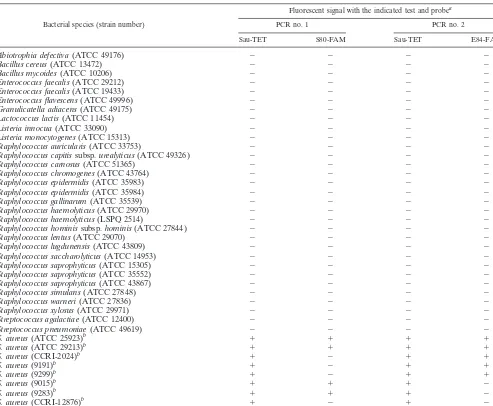
Specificity and sensitivity of the PCR assay.In this study, we have developed a PCR primer pair (grlA205 and grlA396) specific to theS.aureus grlAgene and three fluorescent MBPs that allow the detection of the amplified grlA gene product (Sau-TET) together with mutations at codons 80 (S80-FAM) and 84 (E84-FAM) of this gene. Two PCRs were performed for each assay. In the first reaction, theS.aureus grlA-specific primer pair was combined with the Sau-TET and S80-FAM probes, whereas in the second reaction, this primer pair was combined with the Sau-TET and E84-FAM probes. The spec-ificity of the real-time PCR assay forS.aureuswas first dem-onstrated with a panel of 27 bacterial species (31 strains) ge-netically close toS.aureus(Table 2). DNA from all bacterial species other thanS.aureuswere PCR negative, showing that this assay is specific to S. aureus. The specificity of the PCR assay for the detection of mutations at codons 80 and 84 of the
S. aureus grlA gene was then tested against eight S. aureus
[image:2.603.41.542.81.175.2]strains with or without mutations ingrlA (Table 2). Figure 1
TABLE 1. Amplification primers and molecular beacon probes used in this study
Oligonucleotide Sequence Positiona
Primers
grlA205 (Forward) 5⬘-GAT GTT ATT GGT CAA TAT CAT CCA-3⬘ 205–228
grlA396 (Reverse) 5⬘-AAG AAA CTG TCT CTT TAT TAA TAT CAC GT-3⬘ 396–424
Probesb
S80-FAM 5⬘ (FAM)-CAG CGT ACA CTG AGG AGT CTC CGC TG-3⬘ (DABCYL) 233–248
E84-FAM 5⬘ (FAM)-CGC GAA GTG TAC GAA GCA ATG GTC GCG-3⬘ (DABCYL) 243–259
Sau-TET 5⬘ (TET)-CCG GGT ATC GAT AAT GAT CCG CCA GCC CGG-3⬘ (DABCYL) 324–343 a
Nucleotide positions in thegrlAgene (start codon, 1 to 3) from GenBank accession no. D67075. b
The underlined sequences constitute the stem of each molecular beacon. FAM, 6-carboxylfluorescein; TET, tetrachloro-6-carboxylfluorescein.
on May 15, 2020 by guest
http://jcm.asm.org/
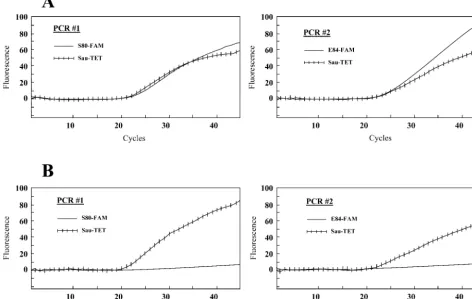
shows an example of the detection of fluoroquinolone-sensitive and -resistant S.aureusstrains on a Smart Cycler. A positive fluorescent signal was detected with the three probes for the fluoroquinolone-sensitive strain with no mutation at codons 80 and 84 ofgrlA, whereas a positive signal was detected with the Sau-TET probe only for the fluoroquinolone-resistant strain with mutations at both codons. The assay correctly identified the sixS.aureusstrains with mutations at codons 80 and/or 84 ofgrlA(Table 2). It also correctly identified the twoS.aureus
strains with no mutation at these codons. The analytical sen-sitivity of the assay was determined by using genomic DNA purified from threeS.aureusstrains with or without mutations at codons 80 and/or 84 ofgrlA. The detection limit was about 10 genomic copies per PCR (data not shown).
Correlation between PCR and conventional culture meth-ods. We have compared the results of conventional culture
methods for identification ofS.aureusand the susceptibility to ciprofloxacin, levofloxacin, and gatifloxacin determined by the Etest method for 85 S. aureus clinical isolates from various geographic areas with those obtained by the PCR assay. For these 85S.aureusstrains, MICs ranged from 0.094 to⬎32g/ ml for ciprofloxacin and levofloxacin and from 0.047 to ⬎32
g/ml for gatifloxacin. AllS.aureusstrains tested were correct-ly identified by PCR. Correlation between fluoroquinolone susceptibility and the presence of mutations ingrlAis summa-rized in Table 3. Of the 85S.aureusstrains tested, 35 (41.2%) were susceptible to ciprofloxacin (MIC,ⱕ1g/ml). All these strains were negative for mutation at codons 80 and 84 based on PCR. Of the 50 ciprofloxacin-resistant strains (58.8%) (cip-rofloxacin MIC, ⱖ2g/ml), 49 had mutations at codons 80 and/or 84 detected by PCR. No mutation was detected ingrlA
[image:3.603.47.540.88.494.2]in one ciprofloxacin-resistant strain. Thirty-seven S. aureus
TABLE 2. Evaluation of the real-time PCR assay for the detection of fluoroquinolone-resistantStaphylococcus aureus
using a variety of bacteria
Bacterial species (strain number)
Fluorescent signal with the indicated test and probea
PCR no. 1 PCR no. 2
Sau-TET S80-FAM Sau-TET E84-FAM
Abiotrophia defectiva(ATCC 49176) ⫺ ⫺ ⫺ ⫺
Bacillus cereus(ATCC 13472) ⫺ ⫺ ⫺ ⫺
Bacillus mycoides(ATCC 10206) ⫺ ⫺ ⫺ ⫺
Enterococcus faecalis(ATCC 29212) ⫺ ⫺ ⫺ ⫺
Enterococcus faecalis(ATCC 19433) ⫺ ⫺ ⫺ ⫺
Enterococcus flavescens(ATCC 49996) ⫺ ⫺ ⫺ ⫺
Granulicatella adiacens(ATCC 49175) ⫺ ⫺ ⫺ ⫺
Lactococcus lactis(ATCC 11454) ⫺ ⫺ ⫺ ⫺
Listeria innocua(ATCC 33090) ⫺ ⫺ ⫺ ⫺
Listeria monocytogenes(ATCC 15313) ⫺ ⫺ ⫺ ⫺
Staphylococcus auricularis(ATCC 33753) ⫺ ⫺ ⫺ ⫺
Staphylococcus capitissubsp.urealyticus(ATCC 49326) ⫺ ⫺ ⫺ ⫺
Staphylococcus carnosus(ATCC 51365) ⫺ ⫺ ⫺ ⫺
Staphylococcus chromogenes(ATCC 43764) ⫺ ⫺ ⫺ ⫺
Staphylococcus epidermidis(ATCC 35983) ⫺ ⫺ ⫺ ⫺
Staphylococcus epidermidis(ATCC 35984) ⫺ ⫺ ⫺ ⫺
Staphylococcus gallinarum(ATCC 35539) ⫺ ⫺ ⫺ ⫺
Staphylococcus haemolyticus(ATCC 29970) ⫺ ⫺ ⫺ ⫺
Staphylococcus haemolyticus(LSPQ 2514) ⫺ ⫺ ⫺ ⫺
Staphylococcus hominissubsp.hominis(ATCC 27844) ⫺ ⫺ ⫺ ⫺
Staphylococcus lentus(ATCC 29070) ⫺ ⫺ ⫺ ⫺
Staphylococcus lugdunensis(ATCC 43809) ⫺ ⫺ ⫺ ⫺
Staphylococcus saccharolyticus(ATCC 14953) ⫺ ⫺ ⫺ ⫺
Staphylococcus saprophyticus(ATCC 15305) ⫺ ⫺ ⫺ ⫺
Staphylococcus saprophyticus(ATCC 35552) ⫺ ⫺ ⫺ ⫺
Staphylococcus saprophyticus(ATCC 43867) ⫺ ⫺ ⫺ ⫺
Staphylococcus simulans(ATCC 27848) ⫺ ⫺ ⫺ ⫺
Staphylococcus warneri(ATCC 27836) ⫺ ⫺ ⫺ ⫺
Staphylococcus xylosus(ATCC 29971) ⫺ ⫺ ⫺ ⫺
Streptococcus agalactiae(ATCC 12400) ⫺ ⫺ ⫺ ⫺
Streptococcus pneumoniae(ATCC 49619) ⫺ ⫺ ⫺ ⫺
S. aureus(ATCC 25923)b ⫹ ⫹ ⫹ ⫹
S. aureus(ATCC 29213)b ⫹ ⫹ ⫹ ⫹
S. aureus(CCRI-2024)b ⫹ ⫺ ⫹ ⫹
S. aureus(9191)b ⫹ ⫺ ⫹ ⫹
S. aureus(9299)b ⫹ ⫺ ⫹ ⫹
S. aureus(9015)b ⫹ ⫹ ⫹ ⫺
S. aureus(9283)b ⫹ ⫹ ⫹ ⫺
S. aureus(CCRI-12876)b ⫹ ⫺ ⫹ ⫺
aAll PCR tests were performed using 0.1 ng of purified genomic DNA.
bThese strains were chosen to represent different mutations at codons 80 and 84 ofgrlA.The quinolone resistance-determining regions ofgrlAfrom these strains were sequenced in this study.S. aureusstrains ATCC 25923 and ATCC 29213 have no mutation at codons 80 and 84; strains CCRI-2024, 9191, and 9299 have a Ser-80-to-Phe (TCC3TTC) mutation; strain 9015 has a Glu-84-to-Gly (GAA3GGA) mutation; strain 9283 has a Glu-84-to-Lys (GAA3AAA) mutation; and strain CCRI-12876 has both Ser-80-to-Tyr (TCC3TAC) and Glu-84 to Gly (GAA3GGA) mutations.
on May 15, 2020 by guest
http://jcm.asm.org/
strains (43.5%) were susceptible to levofloxacin (MIC,ⱕ2g/ ml). No mutation was detected ingrlAfor 36 of these strains. One levofloxacin-sensitive strain had a mutation at codon 84 of
grlAdetected by PCR. Forty-eight strains (56.5%) were resis-tant to levofloxacin (MIC,ⱖ4g/ml), and all had mutations at codons 80 and/or 84 detected by PCR. Of the 37 S. aureus
strains (43.5%) susceptible to gatifloxacin (MIC,ⱕ2g/ml), 36 were negative for mutation at codons 80 and/or 84 by PCR. A mutation was detected at codon 84 ofgrlAby PCR in one gatifloxacin-sensitive strain. Forty-eight S. aureus strains (56.5%) were resistant to gatifloxacin (MIC,ⱖ4g/ml), and all had mutations at codons 80 and/or 84 detected by PCR. Over-all, among the 49S. aureusstrains with mutations in grlA, 26 (53%) had a mutation at codon 80, 2 (4.1%) had a mutation at codon 84, and 21 (42.9%) had mutations at both codons.
DISCUSSION
The emergence of fluoroquinolone resistance inS.aureusis of great concern. In the treatment of staphylococcal infections, fluoroquinolones should not be administered empirically but only after determination of the antimicrobial susceptibility of the clinical isolates. For these reasons, it has become important to develop rapid diagnostic tests to monitor the clinical utility
of fluoroquinolones and also to minimize the emergence of resistance. Many molecularly-based tests have been recently developed to identifyS.aureusand to determine its suscepti-bility to various antibiotics (10, 11, 17, 22). While all these tests detected the presence of a specific gene to establish the anti-biotic susceptibility profile, mutations in the targets of fluoro-quinolones must be detected to determine the susceptibility to this class of antibiotics.
[image:4.603.57.529.78.377.2]In the present study, we developed a rapid real-time PCR
FIG. 1. Example showing the real-time detection on a Smart Cycler of a fluoroquinolone-sensitiveS.aureusstrain (ATCC 25923) containing no mutation in thegrlAgene (A) and a fluoroquinolone-resistantS.aureusstrain (CCRI-12876) containing mutations at both codons 80 and 84 (B). For every sample tested, two separate PCRs, one containing probes S80-FAM and Sau-TET and one containing probes E84-FAM and Sau-TET, were performed. The left graphs show the fluorescence curves for the Sau-TET probe (hatched curve) and the S80-FAM probe (plain curve). The right graphs show the fluorescence curves for the Sau-TET probe (hatched curve) and the E84-FAM probe (plain curve). PCR assays were performed with crude DNA extracts prepared from bacterial suspensions whose turbidities were adjusted to that of a 0.5 McFarland standard.
TABLE 3. Correlation between fluoroquinolone susceptibility and the real-time PCR assay
Fluoroquinolone Etest result (no.)
PCR result
Susceptible (no.)
Resistant (no.)
Ciprofloxacin Susceptible (35) 35 0
Resistant (50) 1 49
Levofloxacin Susceptible (37) 36 1
Resistant (48) 0 48
Gatifloxacin Susceptible (37) 36 1
Resistant (48) 0 48
on May 15, 2020 by guest
http://jcm.asm.org/
[image:4.603.302.542.608.725.2]assay that can be used to simultaneously identifyS.aureusand the first-step mutations associated with decreased susceptibility to fluoroquinolones. This assay is based on the detection of the
S.aureus grlAgene encoding the A subunits of DNA topoisom-erase IV and of mutations at codons Ser-80 and/or Glu-84, which are associated with fluoroquinolone resistance. We have compared the PCR assay for the detection of S. aureus and mutations ingrlAwith classical methods for identification ofS.
aureusand determination of susceptibility to fluoroquinolones. Overall, we found correlations between these methods of 100% for S. aureus identification and of 98.8% for cipro-floxacin, levocipro-floxacin, or gatifloxacin susceptibility testing. Two strains did not show any correlation between the PCR results and the MICs. One ciprofloxacin-resistant strain, for which the ciprofloxacin MIC was 2 g/ml, had no mutation, based on PCR. The decreased susceptibility to ciprofloxacin in this strain may be associated with other resistance mechanisms, such as NorA efflux pump-mediated resistance or mutations in other regions ofgrlA(12, 19, 23, 24). Another strain which was resistant to ciprofloxacin, for which the ciprofloxacin MIC was 4g/ml, had a mutation at codon 80 but was clinically suscep-tible to levofloxacin and gatifloxacin (MICs, 1.5 and 0.75g/ ml, respectively). However, the MICs of these two antibiotics were six to eight times higher than those for the fluoroquino-lone-sensitiveS.aureus control strain ATCC 29213, showing that the former strain exhibits reduced susceptibility to these fluoroquinolones. The low level of resistance to ciprofloxacin and reduced susceptibility to the new fluoroquinolones sug-gested that this strain may have a single mutation at codon 80 ofgrlA. Therefore, these data corroborated those from others which have shown that a singlegrlAmutation is not sufficient to cause clinical resistance to levofloxacin and gatifloxacin but greatly decreased the susceptibility to these antimicro-bial agents (9, 30).
In the method described in this study, mutations in gyrA,
gyrB, orgrlBwere not sought. However, detection of mutations ingrlAprovided an excellent correlation with susceptibility to all the fluoroquinolones tested. The good correlation between
grlAmutations and resistance to gatifloxacin and levofloxacin may be explained by accumulation of mutations in bothgrlA
andgyrAgenes in the strains studied. Indeed, 96% (49 of 51) of the fluoroquinolone-resistantS.aureusisolates tested in this study exhibited high-level resistance to ciprofloxacin (MIC,⬎8
g/ml). This high level of resistance is usually associated with mutations in grlA as well as ingyrA, gyrB, and/or grlBgenes which generate cross-resistance to new fluoroquinolones (4, 9, 26). Among the 85S.aureusisolates studied, 56 were resistant to oxacillin (MRSA strains). Forty-six (82.1%) of the 56 MRSA isolates exhibited resistance to both ciprofloxacin (MIC, ⬎32g/ml) and new fluoroquinolones, whereas only three of the forty (7.5%) methicillin-susceptibleS.aureus iso-lates exhibited this resistance phenotype. Therefore, these data suggest a high prevalence of resistance to the new fluoroqui-nolones among MRSA isolates, as also described recently by other groups (7, 23). The high prevalence of fluoroquinolone resistance among MRSA isolates has been attributed to both selection by quinolone exposure and transmission of clonal strains in health care settings (8). The increasing resistance of
S.aureusisolates to new fluoroquinolones suggests that physi-cians should be cautious when using these antibiotics,
espe-cially against isolates withgrlAmutations, as the potential to acquire subsequent mutations that lead to full resistance is higher in those strains (5). The PCR assay described in this study should therefore provide a useful tool for the appropri-ate use of new fluoroquinolones againstS.aureusinfections.
In the real-time PCR assay developed in this study, fluores-cent MBPs were used to detect theS.aureus grlAgene and the mutations associated with fluoroquinolone resistance. MBPs are fluorescently labeled single-stranded nucleic acid probes that possess a stem-loop structure (28). It has been shown that the structure of MBPs allows a more effective detection of single-nucleotide polymorphisms over a wide range of temper-atures than do the corresponding linear probes, such as Taq-Man probes (2). MBPs have been used in several applications, including detection of mutations associated with antibiotic re-sistance, such as mutations in therpoBgene ofMycobacterium tuberculosis that confer resistance to the antibiotic rifampin (21). Other groups have used adjacent probes or TaqMan probes for the detection of gyrA mutations associated with ciprofloxacin resistance in gram-negative bacteria (15, 16, 29, 31). The present study shows that our MBPs were highly spe-cific for detection of single-nucleotide polymorphisms in theS.
aureus grlAgene associated with fluoroquinolone resistance. Several methodological approaches for the detection of mu-tations in the S. aureus targets of fluoroquinolones, such as sequencing, single-strand conformation polymorphism, restric-tion fragment length polymorphism, and denaturing high-per-formance liquid chromatography, have been developed (6, 18, 27, 30). Because of the complexity and the time required to perform the experiments, these methods are not appropriate for routine use in clinical microbiology laboratories. The use of the real-time PCR assay described here greatly decreased the time required to identify S. aureusisolates and to detect the
grlAmutations associated with reduced susceptibility to fluo-roquinolones compared to conventional methods. The proce-dure, including DNA extraction, can be completed in less than 1 h. Furthermore, this PCR assay was sensitive, as it detected as few as 10 genome copies per PCR, showing that its potential for detection ofS.aureusdirectly from clinical specimens.
With a correlation of 98.8% between the MICs and the PCR assay for all three fluoroquinolones tested, this real-time PCR assay represents a promising diagnostic tool that can replace conventional culture methods for rapid identification ofS. au-reusalong with susceptibility testing against fluoroquinolones.
ACKNOWLEDGMENTS
This study was supported by Infectio Diagnostic (I.D.I.) Inc. (Sainte-Foy, Que´bec, Canada) and by grant PA-15586 from the Canadian Institutes of Health Research (CIHR). M.O. is a CIHR investigator.
We thank Richard Giroux for his excellent technical assistance. We also thank D. Centron (Universidad de Buenos Aires, Buenos Aires, Argentina), D. E. Low (Mount Sinai Hospital, Toronto, Ontario, Can-ada), F. C. Tenover (Centers for Disease Control and Prevention, Atlanta, Ga.), W. Fu (Huashan Hospital, Shanghai, China), L. V. Pallesen (Statens Serum Institut, Copenhagen, Denmark), J. Sutcliffe (Pfizer, Groton, Conn.), P. Courvalin (Institut Pasteur, Paris, France), and T. Takenouchi (Sankyo Co., Ltd., Tokyo, Japan) for providing clinical isolates ofS.aureus.
REFERENCES
1. Acar, J. F., and F. W. Goldstein.1997. Trends in bacterial resistance to fluoroquinolones. Clin. Infect. Dis.24(Suppl. 1):S67–S73.
on May 15, 2020 by guest
http://jcm.asm.org/
2. Bonnet, G., S. Tyagi, A. Libchaber, and F. R. Kramer.1999. Thermodynamic basis of the enhanced specificity of structured DNA probes. Proc. Natl. Acad. Sci. USA96:6171–6176.
3. Diekema, D. J., M. A. Pfaller, F. J. Schmitz, J. Smayevsky, J. Bell, R. N. Jones, and M. Beach. 2001. Survey of infections due toStaphylococcus
species: frequency of occurrence and antimicrobial susceptibility of isolates collected in the United States, Canada, Latin America, Europe, and the Western Pacific region for the SENTRY Antimicrobial Surveillance Pro-gram, 1997–1999. Clin. Infect. Dis.32(Suppl. 2):S114–S132.
4. Fukuda, H., S. Hori, and K. Hiramatsu.1998. Antibacterial activity of gatifloxacin (AM-1155, CG5501, BMS-206584), a newly developed fluoro-quinolone, against sequentially acquired quinolone-resistant mutants and thenorAtransformant ofStaphylococcus aureus. Antimicrob. Agents Che-mother.42:1917–1922.
5. Gootz, T. D., R. P. Zaniewski, S. L. Haskell, F. S. Kaczmarek, and A. E. Maurice.1999. Activities of trovafloxacin compared with those of other fluoroquinolones against purified topoisomerases andgyrAandgrlAmutants ofStaphylococcus aureus. Antimicrob. Agents Chemother.43:1845–1855. 6. Hannachi-M’Zali, F., J. E. Ambler, C. F. Taylor, and P. M. Hawkey.2002.
Examination of single and multiple mutations involved in resistance to quin-olones inStaphylococcus aureusby a combination of PCR and denaturing high-performance liquid chromatography (DHPLC). J. Antimicrob. Che-mother.50:649–655.
7. Hoogkamp-Korstanje, J. A.1997. In-vitro activities of ciprofloxacin, levo-floxacin, lomelevo-floxacin, olevo-floxacin, pelevo-floxacin, sparfloxacin and trovafloxacin against gram-positive and gram-negative pathogens from respiratory tract infections. J. Antimicrob. Chemother.40:427–431.
8. Hooper, D. C.2002. Fluoroquinolone resistance among Gram-positive cocci. Lancet Infect. Dis.2:530–538.
9. Ince, D., and D. C. Hooper.2001. Mechanisms and frequency of resistance to gatifloxacin in comparison to AM-1121 and ciprofloxacin inStaphylococcus aureus. Antimicrob. Agents Chemother.45:2755–2764.
10. Jaffe, R. I., J. D. Lane, S. V. Albury, and D. M. Niemeyer.2000. Rapid extraction from and direct identification in clinical samples of methicillin-resistant staphylococci using the PCR. J. Clin. Microbiol.38:3407–3412. 11. Jonas, D., H. Grundmann, D. Hartung, F. D. Daschner, and K. J. Towner.
1999. Evaluation of themecA femBduplex polymerase chain reaction for detection of methicillin-resistantStaphylococcus aureus. Eur. J. Clin. Micro-biol. Infect. Dis.18:643–647.
12. Kaatz, G. W., S. M. Seo, and C. A. Ruble.1993. Efflux-mediated fluoroqui-nolone resistance inStaphylococcus aureus. Antimicrob. Agents Chemother. 37:1086–1094.
13. Ke, D., C. Me´nard, F. J. Picard, M. Boissinot, M. Ouellette, P. H. Roy, and M. G. Bergeron.2000. Development of conventional and real-time PCR assays for the rapid detection of group B streptococci. Clin. Chem.46:324– 331.
14. Ke, D., F. J. Picard, F. Martineau, C. Me´nard, P. H. Roy, M. Ouellette, and M. G. Bergeron.1999. Development of a PCR assay for rapid detection of enterococci. J. Clin. Microbiol.37:3497–3503.
15. Li, Z., S. Yokoi, Y. Kawamura, S. Maeda, T. Ezaki, and T. Deguchi.2002. Rapid detection of quinolone resistance-associatedgyrAmutations in Neis-seria gonorrhoeaewith a LightCycler. J. Infect. Chemother.8:145–150. 16. Lindler, L. E., W. Fan, and N. Jahan.2001. Detection of
ciprofloxacin-resistantYersinia pestisby fluorogenic PCR using the LightCycler. J. Clin. Microbiol.39:3649–3655.
17. Martineau, F., F. J. Picard, N. Lansac, C. Me´nard, P. H. Roy, M. Ouellette, and M. G. Bergeron.2000. Correlation between the resistance genotype determined by multiplex PCR assays and the antibiotic susceptibility patterns
ofStaphylococcus aureusandStaphylococcus epidermidis. Antimicrob. Agents Chemother.44:231–238.
18. Messina, C., V. Cafiso, F. Campanile, M. Santagati, and S. Stefani.2001. Rapid method for detection ofgyrAandgrlAmutations in unrelated strains of staphylococci susceptible and resistant to levofloxacin. New Microbiol. 24:347–353.
19. Mun˜oz-Bellido, J. L., M. Alonzo Manzanares, J. A. Martı´nez Andre´s, M. N. Guttie´rrez Zufiaurre, G. Ortiz, M. Segovia Herna´ndez, and J. A. Garcı´a-Rodrı´guez.1999. Efflux pump-mediated quinolone resistance in Staphylococ-cus aureusstrains wild type for gyrA,gyrB,grlA, andnorA. Antimicrob. Agents Chemother.43:354–356.
20. National Committee for Clinical Laboratory Standards.2000. Performance standards for antimicrobial susceptibility testing. Eleventh informational supplement. Approved standard M100-S11. National Committee for Clinical Laboratory Standards, Wayne, Pa.
21. Piatek, A. S., S. Tyagi, A. C. Pol, A. Telenti, L. P. Miller, F. R. Kramer, and D. Alland.1998. Molecular beacon sequence analysis for detecting drug resistance inMycobacterium tuberculosis. Nat. Biotechnol.16:359–363. 22. Reischl, U., H. J. Linde, M. Metz, B. Leppmeier, and N. Lehn.2000. Rapid
identification of methicillin-resistantStaphylococcus aureus and simulta-neous species confirmation using real-time fluorescence PCR. J. Clin. Mi-crobiol.38:2429–2433.
23. Schmitz, F. J., A. C. Fluit, S. Brisse, J. Verhoef, K. Kohrer, and D. Milatovic. 1999. Molecular epidemiology of quinolone resistance and comparative in vitro activities of new quinolones against EuropeanStaphylococcus aureus
isolates. FEMS Immunol. Med. Microbiol.26:281–287.
24. Schmitz, F. J., A. C. Fluit, M. Luckefahr, B. Engler, B. Hofmann, J. Verhoef, H. P. Heinz, U. Hadding, and M. E. Jones.1998. The effect of reserpine, an inhibitor of multidrug efflux pumps, on the in-vitro activities of ciprofloxacin, sparfloxacin and moxifloxacin against clinical isolates ofStaphylococcus au-reus. J. Antimicrob. Chemother.42:807–810.
25. Schmitz, F. J., P. G. Higgins, S. Mayer, A. C. Fluit, and A. Dalhoff.2002. Activity of quinolones against gram-positive cocci: mechanisms of drug ac-tion and bacterial resistance. Eur. J. Clin. Microbiol. Infect. Dis.21:647–659. 26. Schmitz, F. J., B. Hofmann, B. Hansen, S. Scheuring, M. Luckefahr, M. Klootwijk, J. Verhoef, A. Fluit, H. P. Heinz, K. Kohrer, and M. E. Jones. 1998. Relationship between ciprofloxacin, ofloxacin, levofloxacin, sparfloxa-cin and moxifloxasparfloxa-cin (BAY 12-8039) MICs and mutations ingrlA,grlB,gyrA
andgyrBin 116 unrelated clinical isolates ofStaphylococcus aureus.J. Anti-microb. Chemother.41:481–484.
27. Schmitz, F. J., M. E. Jones, B. Hofmann, B. Hansen, S. Scheuring, M. Luckefahr, A. Fluit, J. Verhoef, U. Hadding, H. P. Heinz, and K. Kohrer. 1998. Characterization ofgrlA,grlB,gyrA, andgyrBmutations in 116 unre-lated isolates ofStaphylococcus aureusand effects of mutations on cipro-floxacin MIC. Antimicrob. Agents Chemother.42:1249–1252.
28. Tyagi, S., and F. R. Kramer.1996. Molecular beacons: probes that fluoresce upon hybridization. Nat. Biotechnol.14:303–308.
29. Walker, R. A., N. Saunders, A. J. Lawson, E. A. Lindsay, M. Dassama, L. R. Ward, M. J. Woodward, R. H. Davies, E. Liebana, and E. J. Threlfall.2001. Use of a LightCyclergyrAmutation assay for rapid identification of muta-tions conferring decreased susceptibility to ciprofloxacin in multiresistant
Salmonella entericaserotype Typhimurium DT104 isolates. J. Clin. Micro-biol.39:1443–1448.
30. Wang, T., M. Tanaka, and K. Sato.1998. Detection ofgrlAandgyrA muta-tions in 344Staphylococcus aureusstrains. Antimicrob. Agents Chemother. 42:236–240.
31. Wilson, D. L., S. R. Abner, T. C. Newman, L. S. Mansfield, and J. E. Linz. 2000. Identification of ciprofloxacin-resistantCampylobacter jejuniby use of a fluorogenic PCR assay. J. Clin. Microbiol.38:3971–3978.