Available online on www.ijpsr.com 1204
IJPSR (2011), Vol. 2, Issue 5 (Research Article)
Received on 27 January, 2011; received in revised form 06 March, 2011; accepted 06 April, 2011
FREE RADICAL SCAVENGING AND ANTIBACTERIAL EVALUATION OF PTEROCARPUS
SANTALINUS LEAF IN-VITRO STUDY
Jenive Stella 1, P. Krishnamoorthy*2, A. Jamal Mohamed 3, M. Anand 4
Department of Biochemistry, AGM Government Hospital 1, Puthur, Trichy, India Department of Zoology, Rajah Serfoji Government College 2, Thanjavur, India Saudi Pharmaceutical Industries 3, Riyadh, Kingdom of Saudi Arabia
Department of Plant Biology and Biotechnology, St. Joseph’s College 4, Trichy, India
ABSTRACT
The present study was designed to investigate the antibacterial activity and free radical scavenging potential of methanloic extract of Pterocarpus santalinus (PSMExt). Significant MIC was observed against Bacillus subtilis (0.312 mg/ml). Free radical scavenging potential of PSMExt was evaluated by using total antioxidant activity (thiocyanate method), diphenyl-picryl-hydrazyl (DPPH) assay and nitric oxide (NO) assay. Results of the present study disclosed that PSMExt showed remarkable and concentration dependent free radical scavenging activity. Phytochemical analysis showed the presence of flavonoids, terpenoids and steroids. The present work indicated that the methanolic extract of Pterocarpus santalinus was capable of scavenging the free radicals and inhibited the tested bacteria, suggested the potential antibacterial and antioxidant effect.
Keywords:
Pterocarpus santalinus, Free radical,
MIC
Correspondence to Author:
P. Krishnamoorthy
Available online on www.ijpsr.com 1205
INTRODUCTION:Free radicals contribute to more than one hundred disorders in humans including atherosclerosis, arthritis, ischemia and reperfusion injury of many tissues, central nervous system injury, gastritis, cancer and AIDS 1, 2. Free radicals due to environmental pollutants, radiation, chemicals, toxins, deep fried and spicy foods as well as physical stress, cause depletion of immune system antioxidants, change in gene expression and induce abnormal proteins. Oxidation process is one of the most important routes for producing free radicals in food, drugs and even living systems.
Catalase and hydroperoxidase enzymes convert hydrogen peroxide and hydroperoxide to non-radical forms and function as natural antioxidants in human body. Due to depletion of immune system natural antioxidants in different maladies, consumption of antioxidants as free radical scavengers may be necessary 3, 4. Antioxidants are the substances that reduce, neutralize and prevent the damage done to the body by free radicals. Antibacterial substances present in tissues of higher plants have long been regarded as important factors in the resistance of higher plants to various bacteria. Hence researchers have always felt the need for scientifically screening the plants, which may help the pharmacologists and phytochemists. Bioassay screening of natural origin has been the source of innumerable therapeutic agents. In the area of drug discovery, random screening is a tool in discovering new biologically active molecules has been most productive. For a successful outcome the main requirement is access to a large number of compounds/extracts that must be well screened.
Pterocarpus santalinus L.f (Red sanders) belongs to the family Fabaceae, traditionally used in treatment for headache, skin diseases, fever, boils, scorpion-sting and to improve sight 5. Previous chemical constituents revealed the presence of triterpenes, isoflavone glucosides, savinin and calocedrin 6. There is no previous report on free radical scavenging activity. The present study aims to evaluate the free radical
scavenging and antibacterial potential of Pterocarpus santalinus.
MATERIALS AND METHODS:
Chemicals and Reagents: The chemicals Ammonium thiocyanate, DPPH (1, 1-diphenyl-2-picylhydrazyl), and butylated hydroxyl anisole (BHA) were obtained from Sigma, St. Louis, MO, USA. The chemicals sulphanilamide, ferric chloride, phosphoric acid, EDTA (Ethyline diamine tetra acetic acid), dimethyl sulfoxide and naphthyl ethylenediamine dihydrochloride used were of analytical grade.
Plant collection and Extraction: Leaves of Pterocarpus santalinus were collected from Chittor, Andra Pradesh, during June-July 2010. The species was identified and authenticated by a Taxonomist and voucher specimen, was deposited. Shade dried and coarsely powdered leaves of Pterocarpus Santalinus (1kg) were sequentially extracted with methanol at room temperature for 48 hrs. The extracts was filtered and concentrated under reduced pressure using rotary evaporator to get completely dried extracts (PSMExt). The yield of the leaf crude extract was about 80 g. Microorganisms: Gram positive bacteria such as
Staphylococcus aureus ATCC 25923, Staphylococcus epidermidis MTCC 3615, Bacillus subtilis MTCC 441,
Enterococcus faecalis ATCC 29212; Gram bacteria such as Escherichia coli ATCC 25922, Pseudomonas aeruginosa ATCC 27853, Klebsiella pneumoniae ATCC 15380 were tested. All cultures were obtained from Department of Microbiology, Christian Medical College, Vellore, Tamil Nadu and India.
Available online on www.ijpsr.com 1206
CFU/ml of bacteria. The antibacterial agent streptomycin was included in the assay as positive control. The plate with bacteria was incubated 24 hrs at 37°C. After incubation 5μl of tested broth was placed on the sterile MHA plates and incubated at 37°C. MIC was determined as the lowest concentration of the extract inhibiting the visual growth of the test cultures on the agar plate. The experiment was done in triplicates.
Determination of Total Antioxidant activity: The antioxidant activity of PSMExt was determined by thiocyanate method 8. Five different concentrations (5, 10, 25, 50, 100 mg/ml) of PSMExt was prepared in methanol and added to a linoleic acid emulsion (2.5 ml, 40 mM, pH 7.0) and phosphate buffer (2 ml, 40 mM, pH 7.0). The linoleic acid emulsion was prepared by mixing 0.2804 g linoleic acid with 0.2804 g Tween-20 as emulsifier in 50 ml 40 mM phosphate buffer. The mixture was then homogenized. The final volume was adjusted to 5 ml with 40 mM phosphate buffer and pH 7.0. The mixed samples were then incubated at 37°C in a glass flask for 60 hrs, to accelerate the oxidation process 9. One ml of incubated sample was removed at 12 hours interval and 0.1 ml 20 mM FeCl2, and 0.1 ml
30% ammonium thiocyanate was added. The absorbance was measured at 500 nm, using a spectrophotometer (DU640i, Beckman). α-tocopherol was used as a reference compound. To eliminate the solvent effect the control sample that contained the same amount of solvent was added to the linoleic acid emulsion in the test sample Percentage inhibition of lipid peroxide generation was calculated using the following formula.
Control absorbance – Test absorbance % Inhibition = --- X 100
Control absorbance
DPPH assay: The hydrogen donating ability of the extracts was examined by following the method of Blois (1958) 10 with minor modification. Butylated hydroxyl anisole used as a positive control, which was diluted with methanol to prepare sample solution equivalent
to 5, 10, 25, 50 and 100 mg of sample/ml solution. 1 ml of 0.25% DPPH was pipetted into a clean tube followed by various concentrations of the sample solution. The reaction mixture was incubated for 30 minute at 37oC. The absorbance of the reaction mixture was measured at 515 nm in spectrophotometer (Hitachi 2050, Tokyo, Japan) was used. The experiment was done in triplicates. Free radical scavenging activity was calculated by the following equation.
A515 Control – A515 Sample Inhibition % = ---
A515 Control
Nitric Oxide Scavenging Activity: Nitric oxide (NO) generated from sodium nitroprusside in aqueous solution at physiological pH interacted with oxygen to produce nitrite ions, was measured using the Griess reaction 11. About 3 ml of 10 mM sodium nitroprusside in phosphate buffer was added to 2 ml of PSMExt and the reference compound in different concentrations (5, 10, 25, 50 and 100 mg/ml). The resulting solution was then incubated at 25°C for 60 minutes. A similar procedure was repeated with methanol which served as control.
To 5 ml of the incubated sample, 5 ml Griess reagent (1% sulphanilamide, 0.1% naphthylethylene diamine hydrochloride in 2% H3PO4) was added. The absorbance
of chromophore formed during diazotization of nitrite with sulphanilamide and its subsequent coupling with napthylethylene diamine was measured at 546 nm, using curcumin as a reference. The test was performed in triplicates. The percentage inhibition of nitric oxide generated was measured by comparing the absorbance of control and test preparations.
Preliminary Phytochemical screening: Phytochemical screening was carried out by using standard procedure
12
.
Available online on www.ijpsr.com 1207
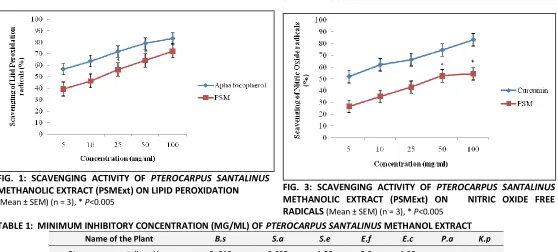
RESULTS AND DISCUSSION: The results of antibacterial activity and free radical scavenging were depicted in (Table 1) and (Figures 1-3). In the present study, the total antioxidant of PSMExt was determined using the ammonium thiocyanate method. PSMExt showed antioxidant property in a concentration dependent manner. The result indicated that the PSMExt significantly (<0.05) inhibited linoleic acid peroxidation. DPPH is an easy, rapid and sensitive method for the antioxidant screening of plant extracts. The present study investigated the scavenging activity of PSMExt, and expressed in percentage of inhibition of DPPH free radicals using BHA as standard reference.
FIG. 1: SCAVENGING ACTIVITY OF PTEROCARPUS SANTALINUS METHANOLIC EXTRACT (PSMExt) ON LIPID PEROXIDATION
(Mean ± SEM) (n = 3), * P<0.005
FIG. 2: SCAVENGING ACTIVITY OF PTEROCARPUS SANTALINUS METHANOLIC EXTRACT (PSMExt) ON DPPH FREE RADICALS
(Mean ± SEM) (n = 3), * P<0.005
FIG. 3: SCAVENGING ACTIVITY OF PTEROCARPUS SANTALINUS METHANOLIC EXTRACT (PSMExt) ON NITRIC OXIDE FREE RADICALS (Mean ± SEM) (n = 3), * P<0.005
TABLE 1: MINIMUM INHIBITORY CONCENTRATION (MG/ML) OF PTEROCARPUS SANTALINUS METHANOL EXTRACT
Name of the Plant B.s S.a S.e E.f E.c P.a K.p
Pterocarpus santalinus Linn. 0. 312 0.625 1.25 5.0 1.25 - -
-; no activity; B.s- Bacillus subtilis; S.a- Staphylococcus aureus; S.e- Staphylococcus epidermidis; E.f- Enterococcus faecalis; E.c- Escherichia coli; P.a-
Pseudomonas aeruginosa; K.p- Klebsiella pneumoniae. Values of three independent experiments (Mean ± SEM)
PSMExt showed significant free radical scavenging activity generated by DPPH. Scavenging activity was observed at the concentrations of 25, 50 and 100mg/ml with 52%, 68%, and 75% of activity respectively. Since more than 50% of DPPH radical inhibition is considered to be significant, the inhibition was observed from 25mg/ml. In Nitric oxide scavenging assay moderate inhibition of nitric oxide formation by PSMExt was observed. Maximum inhibition of PSMExt was observed 72% at 100μg/ml.
Scavengers of nitric oxide compete with the oxygen, leading to reduced production of nitric oxide 13.
[image:4.612.312.587.72.223.2] [image:4.612.30.588.264.516.2]Available online on www.ijpsr.com 1208
reported as scavengers and inhibitors of lipid per oxidation 14. Antibacterial study of Pterocarpus santalinus inhibited the growth of gram positive bacteria and gram negative bacterium. Maximum inhibitory activity was observed against Bacillus subtilis
(0.312 mg/ml), however no activity was found against
Pseuomonas aeuroginosa and Klebsiella pneumonia. Phytochemical analysis showed the presence of flavonoids, terpenoids and steroids, these constituents have diverse pharmacological properties including antioxidant and antimicrobial activity 15. Antioxidant and antimicrobial activity of Pterocarpus santalinus
may be due to the synergetic effect of two or more chemical constituents of the plant extract.
CONCLUSION: Based on our observations, it was confirmed that Pterocarpus santalinus (Leaf) showed strong in vitro free radical scavenging effect in cell free system. Phytochemical research is needed to identify the active principles responsible for this biological activity of this medicinal plant. Further studies are aimed at the isolation and identification of bio-active molecules from the methanolic extract of Pterocarpus santalinus.
REFERENCES:
1. Kumpulainen JT and Salonen: Natural Antioxidants and Anticarcinogens in Nutrition, Health and Disease. The Royal Society of Chemistry, UK 1999; 178- 187.
2. Cook NC, Samman S: Flavonoids- Chemistry, metabolism, Cardioprotective effects, and dietary sources. Nutri. Biochem., 1996; 7: 66- 76.
3. Halliwell B, Gutteridge JM: Free radical in biology and medicine. Clarendon press, Oxford, 2nd edition 1989.
4. Younes M: Inhibitory action of some flavonoids on enhanced spontaneous lipid peroxidation following glutathione depletion. Planta Medica 1981; 43: 240- 245.
5. Chopra RN, Nayar SL and Chopra IC: Glossary of Indian medicinal plants. India, CSIR, 1956; 171.
6. Krishnaveni KS and Srinivasa Rao JV: An isoflavone from Pterocarpus santalinus Phytochem. 2000; 53: 605-606.
7. National Committee for Clinical Laboratory Standards, Reference method for broth dilution antifungal susceptibility testing of filamentous fungi. Approved standard 2002; M38-A.
8. Mistuda H, Yuasumoto K, Iwami J: Antioxidation action of Indole compounds during the auto-oxidation of linoleic acid. Eiyo to Shokuryo, 1996; 19: 210-214.
9. Yen GC, Chen YY: Antioxidant activity of various tea extracts in relation to their antimutagenicity. J. Agric. Food Chem., 1995; 43: 27-32.
10. Blois MS: Antioxidant determinations by the use of stable free radical. Nature 1958; 26: 195.
11. Green LC, Wagner DA, Glogowski J: Analysis of nitrate, nitrite and nitrate in biological fluids. Anal Biochem., 1982; 126: 131 - 138. 12. Edeogal HO, OKWU DE and Mbaebie Bo: Phytochemical constituents
of some Nigerian medicinal plants. African J. Biotechnol., 2005; 4: 685-688.
13. Govindarajan R, Rastogi S, Vijayakumar M, Shirwaikar A, Rawat AK, Mehrotra S: Studies on antioxidant activities of Desmodium gangeticum. Biol. Pharm. Bull., 2003; 26: 1424-7.
14. Formica JV, Regelson W: Review of the biology of quercetin and related bioflavonoids. Food Chem. Toxicol., 1995; 33: 1061-1080. 15. Bhandary MJ, Chandrash Sekar KR, Kaveriappa KM: Medical
ethnobotany of the Siddis of Uttara Kannada District, Karnatha, India. J. Ethno. Pharma, 1995; 4793: 149-58.