4114
ONLINE FAKE NEWS DETECTION ALGORITHM
SAKEENA M. SIRAJUDEEN, NUR FATIHAH A. AZMI, ADAMU I. ABUBAKAR
Department of Computer ScienceInternational Islamic University Malaysia Kuala Lumpur, Malaysia
[email protected],[email protected], [email protected]
ABSTRACT
The widespread of online hoax news is increasing rapidly, especially with the vast number of Microblogging sites allowing disseminating distasteful content. This has become vigorous and nearly unstoppable now. Spreading online fake news has been identified as one of the major top concern of online abuse. Due to the difficulty in preventing and evaluating what does fake news contain prior to publishing it online, if an algorithm is known for detecting fake news, then spreading online fake news wouldn’t exist in the first place, lead this paper to presents an evaluation of the effectiveness of algorithm(s), able to detect and filter to reasonable degree of accuracy what constitute an online fake news. The proposed approach is a multi-layered evaluations technique to be built as an app, where all information read online is associated with a tag, given a description of the facts about the contain. A proof of concept is provided for better understanding of the proposed techniques. This has contributed in providing possible steps to be taken by some popular Microblogging sites to stop the widespread of fake news.
Keywords: Online Fake News, Hoax News, Detection, Filtering
1. INTRODUCTION
Social media were primarily concern with getting together of friends and social groups online to interact and share common objectives. Most recently, the focus of concern has shifted to social media. Social media platforms such as Facebook have a dramatically different structure than previous media technologies. Content can be relayed among users with no significant third-party filtering, fact-checking, or editorial judgment. An individual user with no track record or reputation can in some cases reach as many readers as Fox News, CNN, or the New York Times. Online published text “Fake news” are articles that are intentionally and verifiably false [1]. The Great Moon Hoax is one of the popular hoax story, which reveals the discoveries of animals and the existence of trees, oceans and beaches on the Moon with the aim of increasing sales of the Sun newspaper [2]. Recently news industries that are associated with spreading “Fake News” and “Digital Misinformation” are found to jeopardized journalism Industry [3]. The pivotal point here is “the truth and false”.
Truth might no longer be a virtue, because the emergence of the of a term ‘alternative facts’ when a real fact from online news does not support
individual's view, in many cases we see people regard it as ‘fake news’ [4]. The opposite of truth is lie, there has never been a "thing" that can be consider in-between the truth and lie, what is the truth is a fact and what is not the truth is then a lie. Now that the use of Internet allows everyone to published or post information, then there is tendency that either facts or lies could be disseminated.
4115 such kind of piece do not directly deviate from truth, but are meant to be a substitute for the truth. Fact checking of online content is very important and should be done for public good, although the impact could not be significant if the results reside on those who can’t change their mind and won’t change the subject [6]. In general, there is a need for a reliable set of online tools which can help in facilitating the fact checking process and broadcasting them to those who would accept them [6], because fake news in some certain crucial situation can be a difference between life and dead, crucial to this is on medical reporting cases [7]. Similarly, in business, the effects of fake social information on consumer decision-making in the context of crowdfunding has found to have a very short-term positive effect on campaign funding and the total effect over time is negative [8]. The major aspect where the impact of fake news spread wide is in politics, in which it has been so overused as a political weapon [6].
Owing to the fact that necessary measures should to be taken to addressed the spread of fake news, many aforesaid researches proposes various approaches [4-8]. This has come from the need that widespread of online fake news in circulations negatively impact user’s mind. In the effort to provide a possible solution of combatting the spread of fake news, this paper presents an algorithm and a proof of concept for detection and filtering of fake news. A framework is first proposed, thereafter it was implemented based on the formulated algorithm. This can be helpful to addressing the issues of the spread of fake news especially for Microblogging sites. The decision of the person will be based on more reliable source of news.
This paper is organized as follows: Apart from the current section which presents the overview of the study, the next is Section 2, it discusses the existing related work. Section 3 present the research methodology. Section 4 presents and discuss the algorithm development, while section 5 discusses the assessment of the concept. Section 6 is the discussion and Section 7 concludes this paper.
2. RELATED WORK
Online Fake news sources can be categorized into three namely: Disclosed sources, Anonymous sources, and Bogus sources. The disclosed online fake news sources are easily recognized and hide behind the freedom of speech. Anonymous sources of online fake news tend to always conceal within a newsgroup or bulletin board [5], whereas Bogus online sources of fake news are truly covert
operations. Some previous studies which attempted to provides techniques and viable solutions to the spread of online fake news relies on the systems that are currently available in a public domain. The most notable systems are: Hoaxy, Snopes.com, BotOrNot, and Sebenarnya.my. This are among the few once that are developed to help in addressing online fake news.
Hoaxy system was created to track and visualize the spread of unverified claims and corresponding fact-checking on social media. Real-world data which we can inform our simulated social networks. BotOrNot is a system developed based on the implementation of advanced machine learning algorithm. The techniques dwell on analyzing multiples heterogeneous data sourced from many social media including twitter profile metadata. The most important part of the data used for by this system are the content and topics posted by users and the details account of users under inspection alongside the structure of its social network, the timeline of activity and many more. After considering more than 1000 factors, it generates a likelihood score that the account under scrutiny is a bot. The result from this website is 95% accurate as claimed. Snopes.com also known as the Urban Legends Reference Pages, is a website covering urban legends, Internet rumors, e-mail forwards, and other stories of unknown or questionable origin. Sebenarnya.my is a portal launched for checking validity of news. The purpose of this portal is to curb the spread of false news and ensure the public receive real news.
4116 (IGFCD) that can address the spread of online fake news has been presented in Berghel [5]. Wessel et al [8] examine the effects of fake social information on consumer decision-making in the context of crowdfunding.
Owing to some of these attempt of solving the problem of online fake news by previous research, still there is no general acceptable technique in combating the spread of online fake news. This might be a result of proper evaluation of the available technique or examination of the effectiveness of proposed techniques. As a result, this research proposed and evaluate the effectiveness of online fake news detection algorithm by a proof of concept.
3. METHODOLOGY
This study uses three difference phases and dwells on a proof of concept for detecting an online fake news. The first phase is proposing and designing of a conceptual framework based on source and content of information that makes of a fake news. This framework has been designed to show how to combat the spread of fake news. It also aids explaining some features of the source(s) of online fake news, how it was spread and how it’s been perceived as a fake news. The next step is a formulation of an algorithms necessary to implement the propose framework. The key algorithms involve; detection and filtering of online fake news. Hence, a step-by-step phase of detection and filtering of online fake news given. Finally, the last step is the development of a proof of the concept using a Java programming language. 3.1 Conceptual Framework
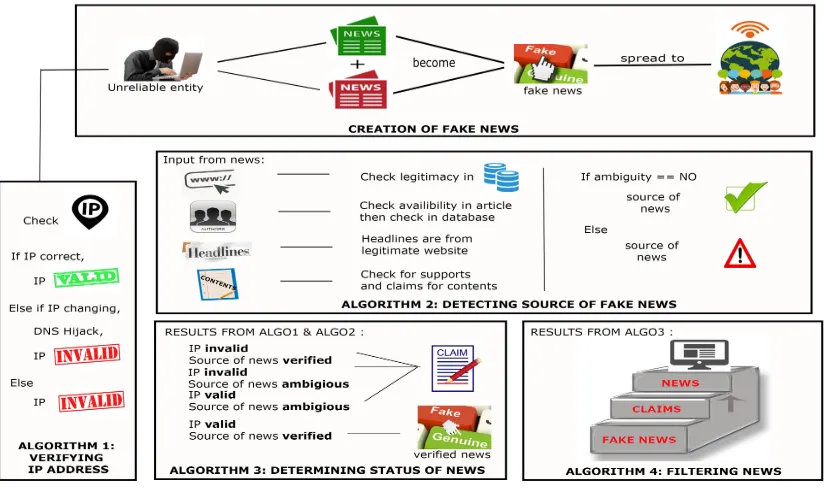
The conceptual framework of this research is presented in Figure 1. This framework combines the entire procedure required for designing a system suitable for detecting a fake news, specifically for combating the spread of fake news. This framework also aids the explanation of who created the fake news, how it was spread and others as well as the algorithm to detect and filter the online fake news. It also presents a general outline that is suitable for designing detection system. Another most important feature of the proposed solution. Therefore, both sources of online fake news and detecting that the news is fake, as well as filtering of the online fake news can be address by this framework. The structure of the framework as presented in Figure 1, comprises of five sections namely: An outline of detecting sources of online fake news; designed technique for use in the
detection; the verifying of source node(s); and the detection of the status of the news.
The first part of the framework is on the approach of determining fake news sources. There is no established network of fake news sources [12], for that reason, the creation of fake news can be seen to be initiated by entity usually unreliable ones. Due to technical constraints, most of the unreliable entities are difficult to be identified. Therefore, barring these entities from further spreading fake news is a challenging method to be implemented. Then, the entity combines fake news and truth to produce the fake news. This news can be published using fake headline and true content, true headline and fake content or combination of fake and true headline and content. The fake article produce will be published online using any website hosted by the entity. In most cases, the website hosted by entity looks similar to reputable, authentic and reliable website. The links from these websites or articles are shared on Microblogging sites because this news is considered credible news by some parties. So, they share this so-called credible news to provide information to other Microblogging site users. Hence the paths followed is outline and then drafted.
Following this path, the nodes identifiers are tags. This are the first point where verification check is required. As a result, a verification function of the legitimacy of the node(s) mostly domain name or IP address is set. Furthermore, the entire work of the function in this verification step is named. A specially name like “the verification of IP address” is most appropriate. In the examination of node(s), network analyzer tools like Wireshark application is used as a preliminary tool. Although, there are online tool that can used to check the information regarding the entered IP address or domain name, but in this framework, a function suitable for direct evaluation of domain and IP address is required for examine the pattern of sources of what constitute a fake news. Thus, examining source identifier is a lead for determining a fake news: For instance, If the IP address is constantly changing, this occurrence is known as DNS hijack. The result will be invalid IP address. If the IP address is static and correct, the system will print valid IP address. If it is otherwise, the result will be invalid.
4117 information of the article. This check is appended with the validity guide and guideline. A dictionary of those guides is provided in a database. Access to the database is open. For each information required to be analyzed from a source, a check function to the database should be invoked. If found in database, return authentic source. If not found in the database, the system returns ambiguous and save the entry in a different database where it will be analyzed by the verification team later. Next, the title of the article is analyzed, the topic is automatically searched online. If the title is found, return true value and the output is ensured that it is from legitimate website. If the title is not found, the title is sent to the verification team for confirmation and return false value.
The content of the article is manually checked by the validation team where the validation is done by supporting the claims. If the content is right, then return true value for the content. If the content is otherwise, return false. On the article, if author’s name is available then check database. If author is found in the database, the system will return true value for author. If author name is not available on the article or not found in the database, then return false. If website value is true, title value is true, content value is true and author value is true, the article is verified or else the article is considered ambiguous.
The next aspect of detections is on how to determine the status of the news. This is based on the result of verification of source and the validity of the content. If result from source verification is legitimate, and content valid, then the status of news is verified. If the source of the news and is ambiguous and the content of the new is valid, then, the news is also valid, and the status of news is now claim. If source of the news is verified and the content of the news is invalid, the status of news is label fake or claim. If the source of the news is ambiguous and the content is invalid, the status of news is as similar stated. Various unforeseen events are possible, but in general a matrix of source node and content of news is the backbone of this proposed conceptual framework.
[image:4.612.99.511.440.685.2]Finally, after labelling a news as either fake or reliable, by the status label, for each, round a tag is appended displaying the status of what has been requested by the user. These tags are now filtered. The sequence of the news is determined. If the status is verified, the news is labelled “verified” by the tag and placed on the top of the newsfeed of Microblogging sites. If the news is considered claim, then the news will be labelled “claim” and below all the verified news. If the news is marked fake news, the news will be labelled “fake” and placed below the list of claim news.
4118 4. ALGORITHM DEVELOPMENT
Algorithm development in the context of this research lies with the principal’s logics in cross-layer optimization of detection. An enhance detection approach in some layers are proposed. The detection is geared to development of a flag, which will raise notification of the potential existence of online fake news. The development of the algorithm is not a hypothesis testing intended to generalized the results. It’s for a proof-of-concept, aimed at exploiting software implementable detection technique that could help in combating the spreading of online fake news. There are four algorithms proposed for this study, namely: verifying a node(s)/source(s) identifier’s algorithm, algorithm for detecting the degree to which news content is fake or not from the source. Algorithm for determining the status of news is either fake or not and finally, algorithm for filtering of the fake news and other news.
Algorithm 1 is for sources node identification. A node refers to any computing device capable of operating in a network environment. Hence its identifier is an IP address based on networking standards. For this algorithm, a function is set on the verification of IP address. The IP address is used as the input to this algorithm. The system verifies the IP address of the source based on the acceptance criteria underlined in the algorithm. After the verification process, the IP address is labelled accordingly. This is applied in different aspect of computer networking and security. While line 2 of Algorithm set the boundary of the of acceptance as binary (0 or 1). Line 3 counts the number of possible IP address across a suspect links that frequently broadcast news. In a crucial security issues, an IP address that is keeps changing is mostly a potential IP that is involve in an attacked. Thus line 4 and 5 of algorithm examine these behaviors and set a tag. Line 6 and 7 marks the tag.
Algorithm 1: Verifying IP Address 1. Begin
2. Initialize check = 0, valid = 1; //the check is binary for every session
3. if(count == IP)
4. while IP. changes("DNS hijack#"); // DNS attack
5.
detect(“IP”). tag(“session”) 6.
else(tag_IP);
7. Mark IP_valid++; 8. end if
Algorithm 2 was formulated for detecting the source of news. Currently people are aware of the
political perspective most news coming from social media or any online source. Therefore, news can come from these two broad categories. However, even is some online platform that were credible, fake news can be mixed in a real news. As a result, algorithm for detecting the source of online fake news is crucial. This algorithm checks website of the article, title of the article, content and the author of the article. To check the validity of website, the algorithm check database. If found or not found appropriate result will be return. The title of the article is also check and analyzed automatically, if found, it returns true value and mark it legitimate otherwise, false title and manually analyzed the next is the content, if it passes suspicious measure, a true value is return, otherwise it returns false. Finally, the author. If author’s name is available then check database, if found, return true value otherwise return false. If all these parameters are true, then, the news is verified.
Algorithm 2: Detecting the Source of Fake News 1. Begin
2. Initialize data_type(DT) //text, video, image, audio 3. Initialize check_sequence (“SQ”)
4. for (SQ = 0; SQ < DT; SQ ++) //overall news check 5. Define Obj fun
1 2 3
( ),i , , , , n
fake news P
P p p p p p p
6. if(DT_indexnews && SQ.content=="Valid")
7.
DT== P. detect(“source_DT”) 8.
do(verified);
9. end if 10. end for
4119 Algorithm 3: Determining the Status of News
1. Begin
2. Initialize data_type(DT) //text, video, image, audio 3. Initialize check_sequence (“SQ”); ambigiuity am;
validIP x; indexnews i
4. for (SQ = 0; SQ < DT; SQ ++) //overall news and check 5. Define Obj fun P pfake news P( ),i p p p p 1, , , ,2 3pn 6. if((am ==0 && x.get(i)==false) || (am ==1 &&
x.get(i)==true) || (am==1 && x.get(i)==false))
7. {
8. statusnews = "a claim";
9. claim.add(valuenews); //add into claim 10. news.remove(valuenews); //remove 11. }
12. else //ambiguity=0,validity = true; //news is verified
13. { statusnews = "a verified news"; 14. verifiednews.add(valuenews);//add 15. news.remove(valuenews);
16. } 17. end if
In Algorithm 4, the news is set to be arranged according to the status they receive after running Algorithm 1, Algorithm 2 and Algorithm 3. The verified news is set to take higher precedential,
followed by claim and later by fake news. In this sense, an order is established.
Algorithm 4: Filtering of News 1. Begin
2. Initialize data_type(DT) //text, video, image, audio 3. Initialize check_sequence (“SQ”)
4. for (SQ = 0; SQ < DT.size(); SQ ++) //overall news 5. Define Obj fun P pfake news P( ),i p p p p1, , , ,2 3 pn 6. ifoutvnews =verifiednews.get(i).toString() ;) //
7. DT==P.detect(“source_DT”)//display //updated
8. for (int j=0;j<claim.size();j++) 9. outclaim = claim.get(j). 10. for (int k=0;k<fakenews.size();k++) 11. outfake = fakenews.get(k) 12. end for
5. ASSESSMENT OF THE CONCEPT
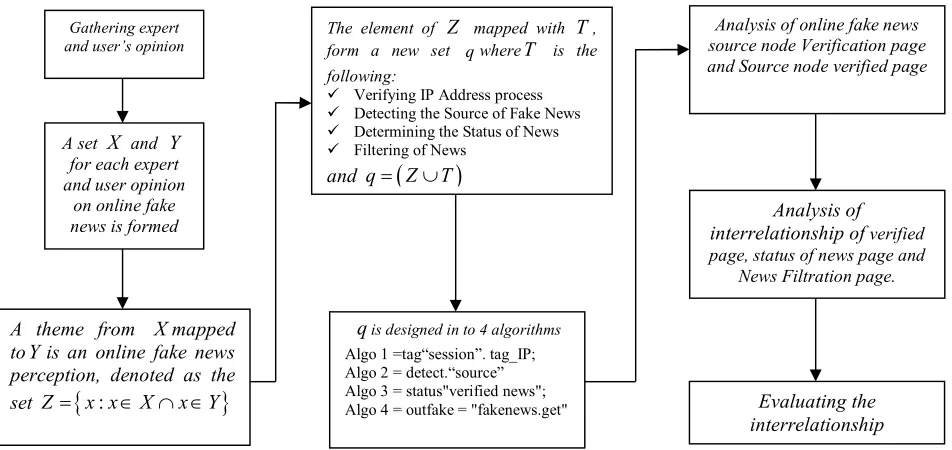
[image:6.612.67.543.428.653.2]To assess the concept proposed, an application was developed in java to primarily display the detection and verification technique proposed. The development approach is presented in Figure 2. Both expert opinion and user perception are gathered in the in the requirement analysis stage.
Figure 2: Algorithmic development and technique. Gathering expert
and user’s opinion
A set X and Y for each expert and user opinion
on online fake news is formed
A theme from Xmapped toYis an online fake news perception, denoted as the set Z
x x X x Y:
The element of Z mapped with T, form a new set qwhereT is the following:
Verifying IP Addressprocess
Detecting the Source of Fake News
Determining the Status of News
Filtering of News
and q
Z T
qis designed in to 4 algorithms
Algo 1 =tag“session”. tag_IP; Algo 2 = detect.“source” Algo 3 = status"verified news"; Algo 4 = outfake = "fakenews.get"
Analysis of online fake news source node Verification page and Source node verified page
Analysis of interrelationship of verified page, status of news page and
News Filtration page.
4120 Both expert and user’s opinion on the perception of the current state of online fake news has been evaluated. The evaluation data obtained are logically categorized into themes. This has enable the research understand that both users and expert concern. The major impact lies with the negative effect online fake news created when it gets spread. The quick solution to this problem is to identify a news as fake, and stop it from spread. That is if it cannot be prevented by policy. Hence, this research logically developed a technique that attempt to handle that (See Figure 2).
For verifying the nodes identifier, a page (see Figure 3) was designed, to call all the available nodes, for which news are published. This simply display a list of news and its corresponding websites.
Figure 3: Source node Verification page
[image:7.612.311.526.130.311.2]After checking the source node identifier of the corresponding websites, the result of the verification will be displayed in a text area as shown in Figure 4.
Figure 4: Source node verified page
The implementation of the routine responsible for detecting the source of news, to analyse the content presented in Figure 5. After detecting the source of news, the attributes of the contents, like the author
[image:7.612.91.301.314.466.2]of the news, the headline of the news and the data content news is detected for authenticity.
Figure 5: Sources Verification page
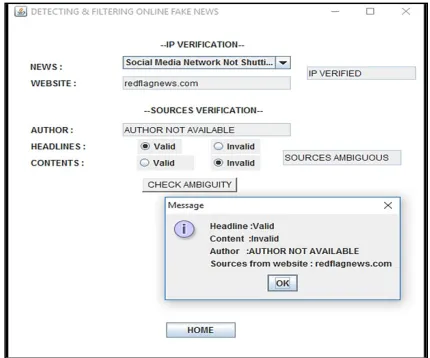
[image:7.612.311.526.438.617.2]The verification of the content covers all the different data types. A content can be text, image, video and audio. Regardless of the medium, and assuming the headlines and contents have been checked and analysed, the results of it need to be manually inserted to check the ambiguity of the sources. Then, the result and summary of the news sources will be displayed as shown in Figure 6.
Figure 6: Sources Verification page
[image:7.612.90.303.549.665.2]4121 Figure 7: Status of News page
The last part of the system is mainly to filter the news, where the sequence of the news will be determined. The verified news will be placed on the top followed by claim and lastly fake news. For example, in Figure 8, the news chosen which has been labelled as a claim will be listed in between verified news and fake news.
Figure 8: News Filtration page
6. DISCUSSION
The main objective of this study is to examine an enhanced approach necessary to prevent the spread of online fake news. This is tied to the fact that both research and law enforcement are required in order to addressed the problems which spread of online fake news created. In terms of law enforcement, it seems very difficult for the fact that most of the online fake news are spread by an anonymous source. Thus, it’s the responsibilities of any Internet web platform to examine the contents of news
circulated through its platform. Currently Germany government tied the responsibilities of any website administrator for spreading fake news. Specifically, to the social media sites. By law, social media networks may be subject to press law. This comes as concern that preventing the growing number of fake news remain helplessness.
In terms research, this study identified some previous research work approaches of avoiding and preventing spread of online fake news [4-8]. Most of the findings of these research relates to the negative impact which online fake news creates. Online user’s decision is seriously affected when a news turns out to be fake. That is why it is very necessary to provide a possible solution of combatting the spread of online fake news.
This paper presents an algorithms and a proof of concept. The algorithm is set out to detect and filter of fake news at any sources platform. A generic framework was formulated to aid the proof-of-concept proposed. Comparing this approach with previous research, it was discovered that most policy iteration are the set of instructions required for a software tool for prevention of online. Therefore, building a software tools for combating online fake news is associated to the policy of the Internet web platform. Despite some attempts of developing software tool for preventing online fake news by previous research, still there is no general acceptable technique. That is why, this study attempts to provide and discuss steps needed to be taken by some Microblogging sites to prevent the dissemination of online fake news.
The assumptions of the undertaken lies with the fact that there are some existing software tools for microblogging sites such as Hoaxy, Snopes.com, BotOrNot and Sebenarnya.my which are mainly build to combat fake news problem. While these tools set out ways to deal with problem of online fake news, new techniques for creating online fake news might emerge. Based on this assumption, this study provides an active technique for preventing spreading of online fake news. Although the study is a proof-of-concept, thus the major limitation lies with implementation. Future research should implement the proposed algorithms outlined. 7. CONCLUSION
[image:8.612.90.303.393.574.2]4122 by its influence thus, causes the necessity to provide the real news to the people increases day by day. The main aim of this study is to presents an algorithms and a proof of concept for detecting and filtering of online fake news. Thus, a combined steps starting from the state of the sources platform of Internet web, the administrator of web portal, the contents of online fake news and the age of the content are considered to be scrutinized to prevent and filter fake news. This was solely focus to the Microblogging sites. Hence, the research proposed a framework for online fake news detection and useful to have a better understanding of the sources of online fake news and algorithm to detect and filter that online fake news. A step-by-step algorithm also has been outlined which detect the spreading of online fake news and filter the news accordingly. This is conceptualized assembled in the newsfeed of Microblogging sites.
ACKNOWLEDGEMENT:
This paper was supported by a Research Initiative Grant Scheme (No. RIGS16-364-0528) from the International Islamic University of Malaysia (IIUM).
REFRENCES:
[1] H. Allcott, and M. Gentzkow. “Social media and fake news in the 2016 election”. Journal of Economic Perspectives, Vol. 31, No. 2, 2017, pp. 211–236.
[2] V.S. Foster, Vincent S. "The Great Moon Hoax." In Modern Mysteries of the Moon,
Springer International Publishing, 2016, pp. 11-44.
[3] V. Pickard, "Media Failures in the Age of Trump." The Political Economy of Communication Vol. 4, No.2, 2017, pp. 118-122.
[4] G. Lee. "The importance of facts in this ‘fake news’ era." International Emergency Nursing, Vol. 31, No. 1, 2017, pp. 1-1.
[5] H. Berghel, “Lies, Damn Lies, and Fake News”,
Computer, Vol. 50, No. 2, 2017, pp. 80-85. [6] H. Berghel, “Alt-News and Post-Truths in the"
Fake News" Era.”, Computer, Vol. 50, No. 4, 2017, pp. 110-114.
[7] G.S. Tillotson, “Keeping the faith—reporting on antimicrobial resistance in an era of fake news”. The Lancet Infectious Diseases, Vol. 17, No. 5, 2017, pp. 473-474.
[8] M. Wessel, F. Thies, and A. Benlian. "The emergence and effects of fake social information: Evidence from crowdfunding"
Decision Support Systems, Vol. 90, 2016, pp. 75-85.
[9] M. Farajtabar, M., Yang, J., Ye, X., Xu, H., Trivedi, R., Khalil, E., Li, S., Song, L. and Zha, H. “Fake News Mitigation via Point Process Based Intervention”. arXiv preprint arXiv:1703.07823, 2017.
[10] O. Batchelor, "Getting Out the Truth: The Role of Libraries in the Fight against Fake News." Reference Services Review Vol. 45, No. 2, 2017.
[11] D.O. Klein, and J.R. Wueller. "Fake News: A Legal Perspective." Journal of Internet Law, 2017
[12] N. Wingfield, M. Isaac, and K. Benner. "Google and Facebook Take Aim at Fake News Sites." The New York Times, Vol. 11, 2016. [13] Wingfield, Nick, Mike Isaac, and Katie Benner.
"Google and Facebook Take Aim at Fake News Sites." The New York Times 11 (2016).