ISSN: 1992-8645 www.jatit.org E-ISSN: 1817-3195
2882
MULTIMODAL PALMPRINT TECHNOLOGY: A REVIEW
INASS SHAHADHA HUSSEIN
*
1, SHAMSUL BIN SAHIBUDDIN2, MD JAN NORDIN 3, NILAMNUR BINTI AMIR SJARIF4
1, 2, 4 Faculty Razak of Technology and Informatics, UTM, Kuala Lumpur, Malaysia 3Faculty of Information Science and Technology, UKM, Bangi, Malaysia
1*[email protected],2[email protected], 3[email protected], 3[email protected]
ABSTRACT
To increase security and accuracy in the systems which are based on biometrics, a multimodal system was suggested. The multimodal biometric systems, are more accurate and effective compared to the unimodal systems which are considered as a wide research field these days. Multimodal biometric system aims to improve the recognition accuracy by minimizing the limitation of the unimodal. This paper focuses on the Palmprint Multimodal system; palmprint biometrics is considered as one of the most popular biometric technologies to authenticate the identity of a human. The aim of this paper is to introduce a comprehensive investigation of a multimodal palmprint that focuses on feature level fusion. Based on the review of the multimodal palmprint system, some suggestions have been made that can be considered for future research to improve palmprint multimodal.
Keywords: Biometric system, Palmprint, Multimodal, Feature level fusion, Feature selection
1. INTRODUCTION
In the last decade, the biometric system has grown as a reliable method for human authentication and the system has attracted significant attention of a number of researchers. The unimodal biometric system uses a single trait but this modal suffers from many limitations, as sensitive to noise, lack of universality as well as being vulnerable to intra-class, illumination and spoof attack [1, 2]. To overcome these limitations, a multimodal biometric system has been introduced. By multimodal we mean combining two or more traits of human physiological or behavior including, face, hand, palmprint, handwriting, signature and other features [3-7]. The review of current literature reveals that numerous researchers have studied the use of biometrics, multimodal and levels of fusion [8-15].
In our previous work [16] we presented a comprehensive review on the unimodal palmprint, while, in this paper, we focus on investigating the multimodal based on the palmprint combined with different traits. We also discussed problems pertaining to this modal, that previous works haven't discussed these problems and introduced some solutions to take into accounts. To the extent
of examining a deeper degree of feature level fusion, by illustrating its scheme and investigating the palmprint database, feature extraction methods based on the different categories of the palmprint images, and briefly presenting various feature selection and classification methods. Finally, this article will make some important suggestions that will help to improve the palmprint multimodal. This study doesn't include any mathematical concepts related to multimodal palmprint.
Palmprint refers to the inner region between the wrist and fingers. It is highly rich in texture pattern (principle lines, wrinkles, and ridges) [17, 18]. A palmprint system is of high interest to both civil and forensic applications, it has some advantages over other biometric technologies, due to its large size which contains various features at different levels. These features make it difficult to forge the palmprints [19-22]. Figure 1 illustrates the palmprint features [23].
2883
Figure 1: Features of the palmprint [23]
The rest of paper is organized as follows. Section 2 introduces a multimodal biometric system. Section 3 presents a literature review of the palmprint multimodal system, Section 4 discusses the limitations of the palmprint multimodal. Section 5 introduces the feature level fusion scheme in detail, and the paper will be concluded in Section 6.
2. MULTIMODAL BIOMETRIC SYSTEM
A multimodal-biometric system combines two or more traits. The problems with the unimodal biometric can be overcome by using the multimodal biometric system that merge indexes from multiple sources [28, 29]. A multimodal biometric system is based on various biometric data traits, such as the iris, fingerprints, hand geometry, face and other features. Non-universal problem processing, improved matching accuracy and reasonable protection against false attacks can be expected from this system [30]. These systems can also meet the stringent performance requirements of various applications. However, such a system takes more time to verify and this causes inconvenience to users. The main challenge in a multimodal system is to determine the information (biometric) sources and their combination strategies. A multimodal biometric can be applied at different levels of fusion [31, 32]:
Sensor level Fusion: The captured templates are combined with multiple biometric sensors, and then the learning phase is implemented in these new templates;
Feature Level Fusion: Many sequential vector features are employed to form simple and superior vectors;
Matching level fusion: The result from multiple matchings applied to the set of
features will be fused to access the final decision;
Decision level fusion: The decision is made for each biometric identification system, and then the final decision is made by merging the previous valves.
3. MULTIMODAL PALMPRINT:
LITERATURE REVIEW
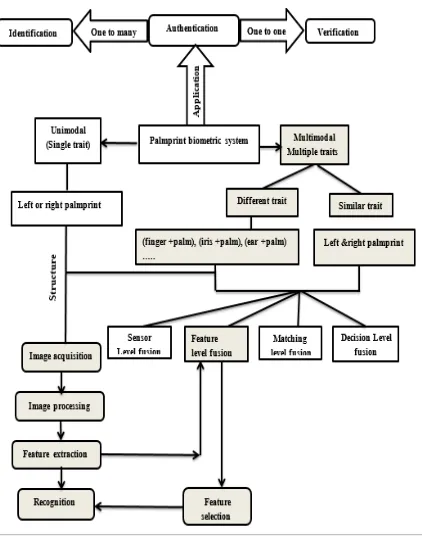
The outline of the palmprint literature review has covered biometric system, unimodal palmprint, multimodal palmprint, and structure of the palmprint system. Figure 2 illustrates the literature review mapping. The highlighted items in figure 2 represent the scope of this study. This section discusses the literature review pertaining to the state-of-the-art methods developed by researchers for palmprint as a multimodal which is combined with different traits at different levels of fusion. Jazzar and Muhammad [33] proposed the fusion of the finger and palmprint. The features extraction was accomplished using the Zernike moments (ZM) invariant algorithm that works under the low-resolution scanning device for fingerprint and palmprint acquisition. In order to calculate the similarities, the Euclidean distance between the test image features and the stored features is used. Apart from that, Bellaaj et al. [34] proposed integrating the fingerprint and palm of the hand based on a possible modeling approach. A set of relevant biometric features extracted from image samples is statistically analyzed and represented by a potential distribution. The biometric templates of the palm of the hand and the fingerprint are used for decision-making by applying a score-level data fusion process.
ISSN: 1992-8645 www.jatit.org E-ISSN: 1817-3195
2884 feature level fusion. Then for the reduction phase, a backtracking search algorithm (BSA) was used to select an optimal subset of the face and palmprint extracted features. After that, a match score-level fusion is performed to show the effectiveness and accuracy of the proposed method.
Several studies have reported the combination of the palmprint with iris as conducted by Naderi et al. [36] who performed the Log Gabor, Discrete Cosine Transform (DCT). Walsh and Haar used to extract features from the images then performed the feature level fusion by concatenating the feature vectors from two modalities and used a combination of the iris and palmprint to achieve the multimodal system. They used the Intuitionistic Fuzzy c-mean (IFCM) technique to extract the features for the palmprint and Ridge energy detection (RED) algorithm for the iris feature extraction. Then they performed the matching level using a hamming distance.
Hezil and Boukrouche [37] investigated the combined ear and palmprint at the feature-level. Local texture descriptors, local binary patterns (LBP), Weber local descriptor (WLD), and binaries statistical image features (BSIF) are used for feature extraction and for the K-nearest neighbor (K-NN) are used as a classifier.
Samai et al. [38] proposed using two bands (grayscale and near infrared) of palmprint images. This is in order to perform a multimodal palmprint verification system using progressive image compression through the famous Set Partitioning in Hierarchical Trees (SPIHT) coder. The images of the palmprint are compressed and decompressed at 0.5 bit per pixel (bpp). The result are three images, an image at 0.25 bpp which represents the image approximation, the other at 0.25 bpp which represents the edges or details, and the third is the global image of the both proceedings. At the stage of the final match, a level fusion is performed after analyzing the features which have been extracted from the different bands.
The combing of a palmprint with more than one trait to increase the accuracy has been studied by many researchers. Deshpande et al. [39], for an example, proposed a method which combined fingerprint, palmprint, and face recognition which are collected and stored in the database at the time of the enrollment. In the recognition phase, the query trait images will be compared to the stored templates then passed
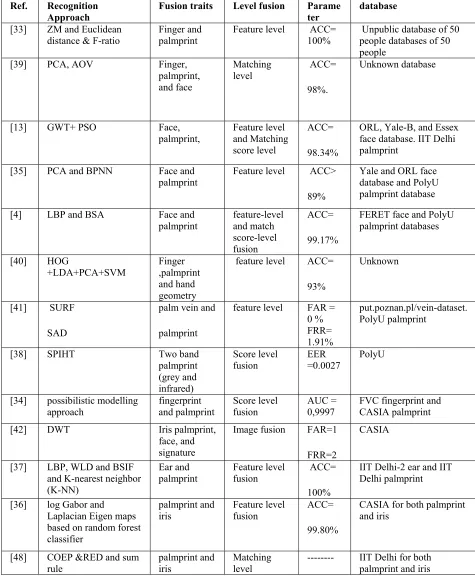
through a matching level fusion. Adjacent Orientation Vector (AOV) based minutiae algorithm was used for features extraction for the fingerprint, PCA analysis was used for both face and palmprint. For the matching phase, they used the Euclidean distance. Srikantaswamy [40] proposed three traits fusion, fingerprint, palmprint and hand geometry. For the purpose of feature extraction, they used the Histogram of Oriented Gradients (HOG) for fingerprint, for palmprint they used PCA and linear discriminant analysis (LDA) algorithms, for the hands geometry the Harris corner detection algorithm (HCDA) was utilized, and a support vector machine (SVM) was used for the matching phase. Gurunathan et al. [41] proposed fusing the palmprint and palm vein images. First, the captured traits images were enhanced with the Adaptive Histogram Equalization (AHE) for feature extraction using Speeded Up Robust Feature algorithm (SURF) for both palmprint and palm vein. The extracted features are stored in the dataset as a feature vector. To perform feature level fusion, the two features vectors were fused together using a sum rule. To calculate the similarities between the test and database, the sum of Absolute Difference (SAD) distance measure was used. Sujatha and Chilambuchelvan [42] designed a multimodal biometric system integrating four traits including the iris, palmprint, face and signature based on the coded discrete wavelet transform (DWT) for image analysis and authentication. The multi-level wavelet-based fusion approach was applied, integrated and encoded in the single composite image for the matching decision. Table 1 presents a summary of the previous work based on the palmprint combined with different traits.
4. LIMITATIONS OF MULTIMODAL
PALMPRINT
2885 matched with the reverse right training palmprint. The multimodal system is evaluated using different recognition approaches such that the Robust Line Orientation Code (RLOC) method, the Competitive Code method, the Binary Orientation Co- Occurrence Vector (BCOV) method, and the sparse multiscale competitive code (SMCC) method for the touch-based dataset from poly U using 3740
Figure 2: Literature review mapping
images from 187 individual with 10 samples for the left palm and 10 samples for the right palm, and method such as SIFT methods and the orthogonal line ordinal feature OLOF + SIFT method for the contact-less method from IITD using 3290 from 235 with 7 images from each individual. They asserted that using the score level corresponding to the sum-weight needs more time, approximately 1.5 times compared to the conventional method. They were the first researchers who identified the similarities between the left palm and right palm.
Leng et al. [44], on the other hand, introduced a multimodal biometric system based on a multi-instance palmprint combination. Two-dimensional discrete cosine transform (2DDCT) for feature extraction from left and right palmprint, dual discriminant power analysis (DDPA) for normalization and the nearest neighbor for recognition phase in this multimodal system. The
experiments were performed in the contactless palmprint database of Multimedia University Malaysia, 202 images were selected from 101 users with 10 samples from each person. 5 samples were used for testing and the rest were used for training. The split training and testing dataset were randomly selected and they were run for 20 times. Both Leng et al. and Xu et al. mentioned the following advantages of the combination of the left and right palmprints.
The palmprint images of the right and left hand of each user are relatively similar;
These similarities were employed to improve the palmprint identification performance;
High accuracy.
On the other hand, the feature level offers a better identification at other levels. It includes the use of a set of the feature through various vector sequence features to the large 1D vector form which, have more information for feature traits [31, 32, 45]. Therefore, we propose to develop the multimodal palmprint scheme by combining the left and right palmprint at feature level fusion. In the following section, we will illustrate the feature level fusion scheme.
5.FEATURE LEVEL FUSION SCHEME
The feature level fusion scheme is illustrated in Figure 3. This scheme consists of five basic steps namely the image capture, feature extraction, feature fusion, recognition and decision. At the feature fusion phase, the features which are extracted from the previous step from the two traits images are fused. This will lead to the high dimension of the feature vector [46]. In this scenario, it is essential to perform feature selection (FS) in order to accomplish the classification task. After proceeding to the recognition phase, and by applying a threshold, the final decision will be accomplished.
5.1 Palmprint image capture
ISSN: 1992-8645 www.jatit.org E-ISSN: 1817-3195
[image:5.612.80.555.119.695.2]2886 Table 1: Summary of the multimodal palmprint previous work
(ACC=accuracy, FAR=false acceptance rate, FRR, false rejection rate, EER= equal error rate)
Ref. Recognition
Approach Fusion traits Level fusion Parameter database
[33] ZM and Euclidean
distance & F-ratio Finger and palmprint Feature level ACC= 100% Unpublic database of 50 people databases of 50 people
[39] PCA, AOV Finger,
palmprint, and face
Matching level
ACC=
98%.
Unknown database
[13] GWT+ PSO Face,
palmprint, Feature level and Matching score level
ACC=
98.34%
ORL, Yale-B, and Essex face database. IIT Delhi palmprint
[35] PCA and BPNN Face and
palmprint Feature level ACC> 89%
Yale and ORL face database and PolyU palmprint database
[4] LBP and BSA Face and
palmprint feature-level and match score-level fusion
ACC=
99.17%
FERET face and PolyU palmprint databases
[40] HOG
+LDA+PCA+SVM
Finger ,palmprint and hand geometry
feature level ACC=
93%
Unknown
[41] SURF
SAD
palm vein and
palmprint
feature level FAR = 0 % FRR= 1.91%
put.poznan.pl/vein-dataset. PolyU palmprint
[38] SPIHT Two band
palmprint (grey and infrared)
Score level
fusion EER =0.0027 PolyU
[34] possibilistic modelling
approach fingerprint and palmprint Score level fusion AUC = 0,9997 FVC fingerprint and CASIA palmprint
[42] DWT Iris palmprint,
face, and signature
Image fusion FAR=1
FRR=2
CASIA
[37] LBP, WLD and BSIF and K-nearest neighbor (K-NN)
Ear and palmprint
Feature level fusion
ACC=
100%
IIT Delhi-2 ear and IIT Delhi palmprint
[36] log Gabor and Laplacian Eigen maps based on random forest classifier
palmprint and
iris Feature level fusion ACC= 99.80%
CASIA for both palmprint and iris
[48] COEP &RED and sum
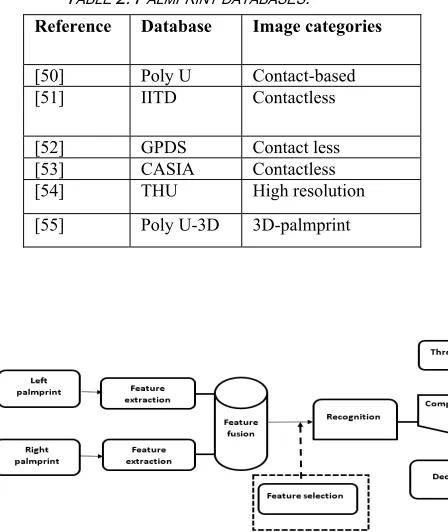
2887 In addition, the captured images need to process. Image processing is a set of process used to enhance the image that is needed for biometric data after collection it to remove noise and extract the only region of interest (ROI) that has significant information. These ROIs are used in the sequential steps of the recognition system .A number of researchers were included the image processing within their works. The table 3 introduced a summary of previous work based on palmprint image processing.
5.2 Palmprint feature extraction
Feature extraction can be defined as the process to extract the higher level information of an image and to transform it into a feature vector (called descriptor), which will be used instead of the original image[49]. The feature extraction is considered as a crucial step in any biometric system, the accuracy of the system depends on how much the features are accurate. Generally, the feature extraction approaches are divided into three approaches: holistic (global), structure (local) and hybrid. Holistic approaches are divided into subspace and representation. A subspace transforms the original data image from the high space onto the lower space. These algorithms are used when there is a need to reduce the dimension which is useful when feature fusion needs to be achieved.
[image:6.612.317.541.103.369.2]TABLE 2:PALMPRINT DATABASES.
Figure 3: Feature fusion scheme
TABLE 3:PALMPRINT IMAGE PROCESSING PREVIOUS WORKS
Reference Database Image categories
[50] Poly U Contact-based
[51] IITD Contactless
[52] GPDS Contact less
[53] CASIA Contactless
[54] THU High resolution
[55] Poly U-3D 3D-palmprint
Ref Method description Data base description ROI pixel Parameter
[56] Median filter to remove noise;
Moore neighbor to tracing boundary;
Using Otsu's to adopted threshold to binaries the image.
Poly U touch based;
7752 image; Size: 640*480 pixel.
166 *166 Method Acc rate = 98%
[57] Active appearance model AAM to segmented palm;
Using least square support vector regression to extract ROI.
KTU contact less;
1752 Image; Size: 768*576.
IITD contact less;
1393- left hand 1376- right hand ; Size: 800*600 pixel.
128*128
128*128
RR= 99.48%; EER=0.277%
RR=99.421; EER= 0.03
ISSN: 1992-8645 www.jatit.org E-ISSN: 1817-3195
2888 [58] Using conventional neural
network CNN
CASIA contact less;
5239 images; Size: 640*480 pixel.
196*147 RR=99.3493%
[59] Using conventional neural network CNN
HKPU contact-based;
7752 images; Size: 384*284 pixel;
2DHKPU;
contact- less; 3540 images;
IITD contact-less;
2601 images; Size: 800*600 pixel.
224*224
224*224
224*224
EER= 0.0125
ACC=0.983
EER= 0.0276
[60] Blob analysis;
Morphological and geometrical
Sfax- Mircal contact less;
1080 image; 1024*768 pixel.
IITD contact less;
2601 image; 800*600 pixel;
Poly U 3D/2D;
1770 images; 640*480 pixel.
--- Extraction error= 0%;0.27%;0.26%
[61] Image thresholding;
Boundary tracing ;
Combination of fingers and valleys from square region;
ROI determined by multiplying the largest and width of segmentation
Data baes acquiring smart phone used image = 5 image
196% ---
[62] Otsu's threshold;
Boundary extraction ;
Smoothing to remove noise ;
Euclidean distance to extract key point
CASIA contact less;
5502 images; Size: 640*480.
150*150 ACC rate of automatic position = 98%
[63] Median filter to remove noise ;
Apply Otsu's threshold ;
Euclidean distance to track boundary;
Poly U contact based;
2000 image; 640*480 pixel
--- Acc rate of automatic position 97.8%
[64] Apply Otsu's threshold;
Canny edge detection;
Morphological operation
CASIA V.1.0;
multispectral; 7200 images; 200*200 pixel.
181*181 ---
[65] Determine three key point in a local area;
Align palmprint image depends on these points;
Extract square sub image of palmprint.
Unknown data base touch base;
1600 images; 292*413 pixels.
2889 The representation approach is based on classification. The local approaches are considered more accurate than the global approaches which in turn are divided into line, coding and texture. The line based and coding approaches are appropriate for contact-based images, the texture-based approach is appropriate of contact less and high resolution.
Hybrid approaches are combine both local and global approaches [66, 67].
A considerable number of the feature extraction methods extracted various palmprint features according to palmprint image category. Contact-based feature extraction methods can be divided into line based and orientation based such as in the principle lines[68], competitive code [69], palm code [70], fusion code [71], ordinal code [72], double orientation code (DOC) [73], binary orientation code vector (BOCV) [74], E-BOCV [75], robust line orientation code (RLOC) [76] and orthogonal line ordinal feature (OLOF) [72]. On the other hand, the most significant features for contactless feature extraction method are scale invariant feature transform (SIFT) [77], local binary pattern (LBP) [78], local line directional pattern (LLDP) [79] and OLOF [72]. For the high-resolution feature, the minutiae points are considered as a significant feature [80], local ridge direction (LRD) [81] and modified finite radon transform (MFRAT) is often used to detect principal lines [82]. On the other hand, the Mean curvature image (MCI), Gaussian curvature image (GCI) [83] and surface type (ST) vector [84] are needed for 3-D palmprint image.
Depending on the category of palmprint, the relevant feature vector will be extracted. This vector (descriptor) will be fused with other vectors at the feature level fusion.
5.3 Feature fusion
In this step, two or more trait features will be fused together as one feature vector. The
concatenate rule is to consider the simple rule which is used to combine different feature vectors [46]. F fused feature will be calculated as the following [46]:
If: First feature set = f1k×m, Second feature set= f2k×n
Then:
F fused = fK× (m+n)
Where m, n are size variable, K= 1.
5.4 Feature Selection
After the fusion of the features have been conducted at the feature level, the feature vector dimension becomes long, which make the feature selection urgent need for feature reduction. Many researchers study the feature reduction methods because of its importance in many fields [85-87] [88] [89] [71-74]. In general, the feature reduction dimension can be divided into feature extraction and feature selection as illustrated in Figure 4. The feature extraction methods include the subspace algorithms such as the principal component analysis (PCA), independent component analysis (ICA) [89]which transforms the dimension into low dimension. For the palmprint recognition, a number of researchers are using a well-known approach of PCA for the feature reduction phase in these works [35, 40, 90, 91]. PCA suffers from the a number of limitations; the search for the samples have bigger variant features when compared with each other and it does not work well with a classifier [92]. To overcome the PCA limitations, it is imperative to shift to the feature selection methods. The goal of the features selection is to reduce the size of the data by looking for a small set of important features that can provide a good classification [93]. The feature selection methods will eliminate the
smallest feature discriminator, leaving a part of the original characteristics that retain enough
information to distinguish between the categories. The function selection algorithms can be categorized into three groups: filtering methods, wrapping methods and embedded methods. The filtering methods focus on the general characteristics of the data to evaluate and select the subsets of the features without including the selected learning algorithm or classifier [93]. While the wrapping methods depends on the predictive performance of the selected features by considering the learning algorithms [86]. The embedded methods on the other hand, is considered as a bridge between the wrapper methods and filter methods [88]. Table 4 illustrates the comparison between these three methods.
ISSN: 1992-8645 www.jatit.org E-ISSN: 1817-3195
2890
Figure 4: Dimension Reduction methods
TABLE 4: FEATURE SELECTION COMPARISON
successfully used in feature subset optimization problems [86]. The applications of the GA-based wrappers for feature selection include speech recognition [97], face recognition [98], image processing [99] and multimodal biometric fusion [100]. On the other hand, the Backtracking Search Optimization is applied to many numerical optimization benchmark problems [101]. GA, PSO and BSA belong to an evolutionary algorithm. After the set of features has been selected, it is put
through the recognition step in order to evaluate the performance quality of these features.
5.5 Classification
The success of any biometric system is measured in this step. In object recognition (classification), Machine learning considers promising performance methods. ML can learn by themselves; when they have the input data, they learn how to solve problems. ML is divided into supervised and unsupervised [102] methods. The
Wrapper methods Filter methods Embedded methods
Description Depends of classifier learning;
Use predictive accuracy of a classifier to evaluate feature set; Optimization algorithms.
Independent from classifier learning; Use Masseur distance information, correlation to evaluate the feature set;
Statistical algorithms.
Bridge between wrapper and filter;
Depends of the classifier; Achieve both wrapper accuracy and filter efficiency.
Pros Good generation;
More accurate.
Robust against over fitting;
Fast.
Less computational than wrapper.
Cons More computational;
Expensive run time.
Sometimes fail to Select best feature.
Much slower than filter.
Example GA,PSO, ASO,BSA Relief,
Fisher score , Information Gain
2891 supervised methods predict the value of the output variables by comparing the N sample of the inputs and the corresponding output value [103]. The most popular supervised methods used in a palmprint recognition are Artificial Neural Network (ANN), Decision Tree, Support Vector Machine (SVM) and recently deep learning [104-107].
In unsupervised methods, in this case, only a set of input vector x is known. The most unsupervised common methods is clustering, which is a process of groping data which share a level of high similarity. A similarity can be achieved by a distance function [103]. K- mean is the well-known clustering method which is widely used in palmprint recognition [108]. The most significant problems faced by any classification model are overfitting and underfitting. The overfitting occurs when the dataset is not too large, and the model is complex. While the underfitting occurs when the model is not complex which is incapable of handling a large data [109].
To measure the performance of the classification model, a dataset is typically set into a training set (70%) and testing test (30%). Another method that can be used is by dividing the data set to a K subset, using each of these subset as a testing and (K-1) as a training set [103]. If the errors on the training set are small and the errors in the testing set are high, this will be overfitting and if both the errors on the training set and testing set are high, this will be the underfitting[109] case.
To avoid the overfitting& underfitting cases, Srivastava et al. [110] introduced a solution using the regularization methods. The regularization means training a range of models, compare the performance on an independent dataset then select the best performance[110].
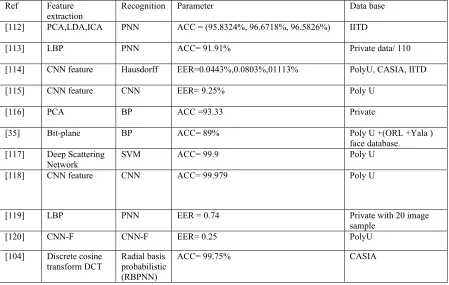
The machine learning is an important methods for the recognition step and performs better than the other approaches [111]. Table 5 introduced previous works based on palmprint recognition.
TABLE 5: PALMPRINT CLASSIFICATION PREVIOUS WORKS
Ref Feature
extraction
Recognition Parameter Data base
[112] PCA,LDA,ICA PNN ACC = (95.8324%, 96.6718%, 96.5826%) IITD
[113] LBP PNN ACC= 91.91% Private data/ 110
[114] CNN feature Hausdorff EER=0.0443%,0.0803%,01113% PolyU, CASIA, IITD
[115] CNN feature CNN EER= 9.25% Poly U
[116] PCA BP ACC =93.33 Private
[35] Bit-plane BP ACC= 89% Poly U +(ORL +Yala )
face database. [117] Deep Scattering
Network SVM ACC= 99.9 Poly U
[118] CNN feature CNN ACC= 99.979 Poly U
[119] LBP PNN EER = 0.74 Private with 20 image
sample
[120] CNN-F CNN-F EER= 0.25 PolyU
[104] Discrete cosine
transform DCT Radial basis probabilistic (RBPNN)
[image:10.612.85.534.412.697.2]ISSN: 1992-8645 www.jatit.org E-ISSN: 1817-3195
2892
6.DISCUSSION
This study is a comprehensive review based on palmprint multimodal. Multimodal can be achieved in four levels of fusion, sensor, feature, matching, and decision. We focused on feature level fusion, we explained in details the steps of this level. Based on this review, the palmprint multimodal system can be improved by combining left and right palmprint in different levels of fusion, especially that the palmprint databases were collected left and right palmprints that belong to the same person. That will increase the level of security. For the limited space, the limitations of this work are focusing on one level fusion, and lacking analysis of the different recognition system. The researchers can introduce different reviews based on different levels of fusion, they also can introduce reviews based on recognition algorithms.
7.CONCLUSION
We introduced in this paper, a multimodal system concept, palmprint multimodal literature review, and an in-depth investigation of the feature level fusion scheme. It is noted that Palmprint recognition still remains as a challenging problem and it is not completely solved. A multimodal is considered a good solution to increase the accuracy, but it still suffers from some problems, as there is yet to be a database that contains two different traits belong to the same person, long-time execution and different form features. Therefore, for the similarity between the left and right palms, future research on palmprint recognition should focus on the field of multimodal which combines pairs of palmprint that belongs to the same person. Feature extraction is considered an important step for any biometric system, for choosing an approach to be used depends on the database images which work with different features. Finally, the literature review indicates that there are no standards or specific feature selection method thus, every researcher selects a method based on their own experience. Generally, Machine learning is a promising development in the classification phase.
ACKNOWLEDGMENTS
The researchers wish to thank Universiti Teknologi Malaysia (UTM) and Universiti Kebangsaan Malaysia (UKM) for supporting this work with research grant DIP-2016-018.
REFRENCES
[1] Jain, A.K., A. Ross, and S. Prabhakar, An introduction to biometric recognition. IEEE Transactions on circuits and systems for video technology, 2004. 14(1): p. 4-20.
[2] Ross, A.A., K. Nandakumar, and A.K. Jain, Handbook of multibiometrics. Vol. 6. 2006: Springer Science & Business Media.
[3] Prabhakar, S., S. Pankanti, and A.K. Jain, Biometric recognition: security and privacy concerns. IEEE Security & Privacy, 2003.
1(2): p. 33-42.
[4] Farmanbar, M. and Ö. Toygar, Feature selection for the fusion of face and palmprint biometrics. Signal, Image and Video Processing, 2016. 10(5): p. 951-958,springer. [5] Savitha, G., L. Vibha, and K. Venugopal,
Multimodal Biometric Authentication System using LDR Based on Selective Small Reconstruction Error. Journal of Theoretical and Applied Information Technology, 2016.
92(1): p. 171.
[6] Nordin, M.J., et al., Radius based block local binary pattern on T-zone face area for face recognition. Journal of Computer Science, 2014. 10(12): p. 2525-2537.
[7] Hamid, A.A.K.A. and M.J. Nordin, Radius Based Block LBP for Facial Expression Recognition. International Information Institute (Tokyo). Information, 2016. 19(9B): p. 4197.
[8] Raghavendra, R., et al., Designing efficient fusion schemes for multimodal biometric systems using face and palmprint. Pattern Recognit, 2011. 44.
[9] Xu, Y., D. Zhang, and J.-Y. Yang, A feature extraction method for use with bimodal biometrics. Pattern Recognition, 2010. 43(3): p. 1106-1115.
[10] Jing, X.-Y., et al., Palmprint and Face Multi-Modal Biometric Recognition Based on SDA-GSVD and Its Kernelization. Sensors, 2012.
12(5): p. 5551.
[11] Yao, Y.-F., X.-Y. Jing, and H.-S. Wong, Face and palmprint feature level fusion for single sample biometrics recognition. Neurocomputing, 2007. 70(7): p. 1582-1586. [12] Jing, X.-Y., et al., Face and palmprint pixel
level fusion and Kernel DCV-RBF classifier for small sample biometric recognition. Pattern Recognition, 2007. 40(11): p. 3209-3224.
2893 Pattern Analysis and Applications 2015.
18(4): p. 921-932, springer.
[14] Eskandari, M. and Ö. Toygar, Fusion of face and iris biometrics using local and global feature extraction methods. Signal, Image and Video Processing, 2014. 8(6): p. 995-1006.
[15] PASRUN, P., LOCAL LINE BINARY
PATTERN AND FUZZY K-NN FOR PALM VEIN RECOGNITION. Journal of Theoretical and Applied Information Technology, 2017.
95(13).
[16] Hussein, I.S., S. Bin Sahibuddin, and N.N.A. Sjarif, The Fundamentals of Unimodal Palmprint Authentication based on a Biometric System: A Review.
INTERNATIONAL JOURNAL OF
ADVANCED COMPUTER SCIENCE AND APPLICATIONS, 2018. 9(11): p. 325-335. [17] Thorogood, P., Embryos, genes and birth
defects. 1997: John Wiley and Sons.
[18] Kumar, A. and H.C. Shen. Palmprint identification using palmcodes. in Image and Graphics (ICIG'04), Third International Conference on. 2004.
[19] Bharadi, V.A. Texture Feature Extraction For Biometric Authentication using Partitioned Complex Planes in Transform Domain. in Proceedings of the International Conference & Workshop on Emerging Trends in Technology. 2012.
[20] Jain, A.K. and J. Feng, Latent palmprint matching. IEEE Transactions on Pattern Analysis and Machine Intelligence, 2009.
31(6): p. 1032-1047.
[21] Putra, D., Palmprint Feature Representation Using Fractal Characteristic. JATITJournal of Theoretical and Applied Information Technology, 2013. 53(2).
[22] Hussein, I.S. and M.J. Nordin, Palmprint verification using invariant moments based on wavelet transform. Journal of Computer Science, 2014. 10(8): p. 1389.
[23] Kong, A., D. Zhang, and M. Kamel, A survey of palmprint recognition. pattern recognition, 2009. 42(7): p. 1408-1418.
[24] Kumar, A. Incorporating Cohort Information for Reliable Palmprint Authentication. in 2008 Sixth Indian Conference on Computer Vision, Graphics & Image Processing. 2008. [25] Han, C.-C., et al., Personal authentication
using palm-print features. Pattern recognition, 2003. 36(2): p. 371-381.
[26] Zhang, D., et al., Online palmprint identification. IEEE Transactions on pattern
analysis and machine intelligence, 2003.
25(9): p. 1041-1050.
[27] Rajeev, S., et al. Forensic print extraction using 3D technology and its processing. in Mobile Multimedia/Image Processing, Security, and Applications 2017. 2017. International Society for Optics and Photonics.
[28] Kumar, Y., et al. An automated multimodal biometric system and fusion. in Computational Intelligence in Biometrics and Identity Management (CIBIM), 2014 IEEE Symposium on. 2014. IEEE.
[29] Eshwarappa, M. and M.V. Latte, Multimodal biometric person authentication using speech, signature and handwriting features. International Journal of Advanced Computer Science and Applications, Special Issue on Artificial Intelligence, 2011: p. 1-10.
[30] EL-SAYED, A., Multi-biometric systems: a state of the art survey and research directions. IJACSA) International Journal of Advanced Computer Science and Applications, 2015. 6.
[31] Lumini, A. and L. Nanni, Overview of the combination of biometric matchers. Information Fusion, 2017. 33: p. 71-85. [32] Charfi, N., et al., Bimodal biometric system
for hand shape and palmprint recognition based on SIFT sparse representation. Multimedia Tools and Applications, 2016.
76(20): p. 20457-20482.
[33] Jazzar, M.M. and G. Muhammad, Feature selection based verification/identification system using fingerprints and palm print. Arabian journal for science and engineering, 2013. 38(4): p. 849-857.
[34] Bellaaj, M., et al. Possibilistic modeling palmprint and fingerprint based multimodal biometric recognition system. in Image Processing, Applications and Systems (IPAS), 2016 International, IEEE. 2016. IEEE. [35] Lee, T.Z. and D.B. Bong. Face and palmprint
multimodal biometric system based on bit-plane decomposition approach. in Consumer Electronics-Taiwan (ICCE-TW), 2016 IEEE International Conference on. 2016. IEEE. [36] Naderi, H., B.H. Soleimani, and S. Matwin.
ISSN: 1992-8645 www.jatit.org E-ISSN: 1817-3195
2894 [37] Hezil, N. and A. Boukrouche, Multimodal
biometric recognition using human ear and palmprint. IET Biometrics, 2017.
[38] Samai, D., et al. Multimodal biometric system based on palmprint using progressive image compression. in Information Technology for Organizations Development (IT4OD), 2016 International Conference on , IEEE. 2016. IEEE.
[39] Deshpande, A.S., et al., A Multimodal Biometric Recognition System based on Fusion of Palmprint, Fingerprint and Face. International Journal of Electronics and Computer Science Engineering, 2015. 16. [40] Srikantaswamy, R. Fusion of fingerprint,
palmprint and hand geometry for an efficient multimodal person authentication system. in Applied and Theoretical Computing and Communication Technology (iCATccT), 2016 2nd International Conference on. 2016. IEEE. [41] Gurunathan, V., T. Sathiyapriya, and R. Sudhakar. Multimodal biometric recognition system using SURF algorithm. in Intelligent Systems and Control (ISCO), 2016 10th International Conference on. 2016. IEEE. [42] Sujatha, E. and A. Chilambuchelvan,
Multimodal Biometric Authentication Algorithm Using Iris, Palm Print, Face and Signature with Encoded DWT. Wireless Personal Communications, 2017: p. 1-12 SpringerPlus.
[43] Xu, Y., L. Fei, and D. Zhang, Combining left and right palmprint images for more accurate personal identification. IEEE transactions on image processing, 2015. 24(2): p. 549-559. [44] Leng, L., et al., Dual-source discrimination
power analysis for multi-instance contactless palmprint recognition. Multimedia Tools and Applications, 2017. 76(1): p. 333-354,springer.
[45] Mokni, R., H. Drira, and M. Kherallah. Fusing Multi-techniques Based on LDA-CCA and Their Application in Palmprint Identification System. in 2017 IEEE/ACS 14th International Conference on Computer Systems and Applications (AICCSA). 2017. [46] Srivastava, S., Accurate Human Recognition
by Score-Level and Feature-Level Fusion Using Palm–Phalanges Print. Arabian Journal for Science and Engineering, 2018.
43(2): p. 543-554.
[47] Fei, L., et al., Feature Extraction Methods for Palmprint Recognition: A Survey and Evaluation. IEEE Transactions on Systems, Man, and Cybernetics: Systems, 2018.
[48] Jain, Y. and M. Juneja, A Novel Approach for Multimodal Biometric System Using Iris and PalmPrint, in Progress in Advanced Computing and Intelligent Engineering. 2018, Springer. p. 79-88, springer.
[49] Kahaki, S.M.M., et al., Invariant feature matching for image registration application based on new dissimilarity of spatial features. PloS one, 2016. 11(3): p. e0149710.
[50] PolyU Palmprint Database (Version 2.0), Multispectral Palmprint Database. [Online]. Available:
http://www.comp.polyu.edu.hk/˜biometrics/. (2010).
[51] IITD Touchless Palmprint Database (Version1.0).
[Online].Available: http://www4.comp.polyu.edu.hk/˜csajaykr/IIT
D/
Database_Palm.htm. (2006).
[52] GPDS Palmprint Image Database. [Online]. Available: http://www.gpds.ulpgc.es. (2011). [53] CASIA Palmprint Image Database /
(http://biometrics.idealtest.org) (2005). [54] THU, THU 500PPI Palmprint Database.
[Online]. Available: http://ivg.au.tsinghua.edu.cn/. 2012.
[55] PolyU 3D Palmprint Database. [Online]. Available:
http://www4.comp.polyu.edu.hk/˜biometrics/. (2008).
[56] Mandeel, T.H., et al., Palmprint Region of Interest Cropping Based on Moore-Neighbor Tracing Algorithm. Sensing and Imaging, 2018. 19(1): p. 15.
[57] Aykut, M. and M. Ekinci, Developing a contactless palmprint authentication system by introducing a novel ROI extraction method. Image and Vision Computing, 2015.
40: p. 65-74.
[58] Bao, X. and Z. Guo. Extracting region of interest for palmprint by convolutional neural networks. in Image Processing Theory Tools and Applications (IPTA), 2016 6th International Conference on. 2016. IEEE. [59] Izadpanahkakhk, M., et al., Deep Region of
Interest and Feature Extraction Models for Palmprint Verification Using Convolutional Neural Networks Transfer Learning. 2018. [60] ELSayed, A.S., et al. A method for contactless
palm ROI extraction. in Computer Engineering & Systems (ICCES), 2016 11th International Conference on. 2016. IEEE. [61] Harun, N., et al. New algorithm of extraction
2895 Journal of Physics: Conference Series. 2017. IOP Publishing.
[62] Mokni, R., R. Zouari, and M. Kherallah. Pre-processing and extraction of the ROIs steps for palmprints recognition system. in Intelligent Systems Design and Applications (ISDA), 2015 15th International Conference on. 2015. IEEE.
[63] Qu, Z. and Z.-y. Wang. Research on preprocessing of palmprint image based on adaptive threshold and Euclidian distance. in Natural Computation (ICNC), 2010 Sixth International Conference on. 2010. IEEE. [64] Maheswari, M. and G. Suresh. Region of
interest extraction using combined segmentation in Multispectral Palm Image. in Advanced Computing (ICoAC), 2013 Fifth International Conference on. 2013. IEEE. [65] Wang, Y., Q. Ruan, and X. Pan. An improved
square-based palmprint segmentation method. in Intelligent Signal Processing and Communication Systems, 2007. ISPACS 2007. International Symposium on. 2007. IEEE. [66] Rida, I., et al., Palmprint recognition with an
efficient data driven ensemble classifier. Pattern Recognition Letters, 2018.
[67] Li, G. and J. Kim, Palmprint recognition with local micro-structure tetra pattern. Pattern Recognition, 2017. 61: p. 29-46.
[68] Malik, J., et al., Accuracy improvement in palmprint authentication system. International Journal of Image, Graphics and Signal Processing, 2015. 7(4): p. 51.
[69] Kong, A.-K. and D. Zhang. Competitive coding scheme for palmprint verification. in Pattern Recognition, 2004. ICPR 2004. Proceedings of the 17th International Conference on. 2004. IEEE.
[70] Fei, L., et al., Palmprint recognition using neighboring direction indicator. IEEE Transactions on Human-Machine Systems, 2016. 46(6): p. 787-798.
[71] Kong, A., D. Zhang, and M. Kamel, Palmprint identification using feature-level fusion. Pattern Recognition, 2006. 39(3): p. 478-487.
[72] Sun, Z., et al. Ordinal palmprint represention for personal identification. in null. 2005. IEEE.
[73] Fei, L., et al., Double-orientation code and nonlinear matching scheme for palmprint recognition. Pattern Recognition, 2016. 49: p. 89-101.
[74] Guo, Z., et al., Palmprint verification using binary orientation co-occurrence vector.
Pattern Recognition Letters, 2009. 30(13): p. 1219-1227.
[75] Zhang, L., H. Li, and J. Niu, Fragile bits in palmprint recognition. IEEE Signal processing letters, 2012. 19(10): p. 663-666. [76] Jia, W., D.-S. Huang, and D. Zhang,
Palmprint verification based on robust line orientation code. Pattern Recognition, 2008.
41(5): p. 1504-1513.
[77] Morales, A., M.A. Ferrer, and A. Kumar, Towards contactless palmprint authentication. IET computer vision, 2011.
5(6): p. 407-416.
[78] Fei, L., et al. Local Orientation Binary Pattern with Use for Palmprint Recognition. in Chinese Conference on Biometric Recognition. 2017. Springer.
[79] Luo, Y.-T., et al., Local line directional pattern for palmprint recognition. Pattern Recognition, 2016. 50: p. 26-44.
[80] Maltoni, D., et al., Handbook of fingerprint recognition. 2009: Springer Science & Business Media.
[81] Jain, A.K. and J. Feng, Latent palmprint matching. IEEE Transactions on Pattern Analysis & Machine Intelligence, 2008(6): p. 1032-1047.
[82] Dai, J. and J. Zhou, Multifeature-based high-resolution palmprint recognition. IEEE Transactions on Pattern Analysis and Machine Intelligence, 2011. 33(5): p. 945-957.
[83] Zhang, D., et al., Palmprint recognition using 3-D information. IEEE Transactions on Systems, Man, and Cybernetics, Part C (Applications and Reviews), 2009. 39(5): p. 505-519.
[84] Hetzel, G., et al. 3D object recognition from range images using local feature histograms. in Computer Vision and Pattern Recognition, 2001. CVPR 2001. Proceedings of the 2001 IEEE Computer Society Conference on. 2001. IEEE.
[85] Abe, S., Feature selection and extraction, in Support Vector Machines for Pattern Classification. 2010, Springer. p. 331-341. [86] Vignolo, L.D. and M.F. Gerard, Evolutionary
local improvement on genetic algorithms for feature selection. Proceedings de XLIII CLEI–46 JAIIO, 2017: p. 1-8.
ISSN: 1992-8645 www.jatit.org E-ISSN: 1817-3195
2896 [88] Lal, T.N., et al., Embedded methods, in
Feature extraction. 2006, Springer. p. 137-165.
[89] De Silva, A.M. and P.H. Leong, Grammar-based feature generation for time-series prediction. 2015: Springer.
[90] Ahmad, M.I., W.L. Woo, and S. Dlay, Non-stationary feature fusion of face and palmprint multimodal biometrics. Neurocomputing, 2016. 177: p. 49-61. [91] Li, H., L. Wang, and Z. Zhang, Robust
Palmprint Recognition Based on Directional Representations. Intelligent Information Processing VI, 2012: p. 372-381.
[92] Skansi, S., Introduction to Deep Learning: From Logical Calculus to Artificial Intelligence. 2018: Springer.
[93] Majidnezhad, V., A novel hybrid of genetic algorithm and ANN for developing a high efficient method for vocal fold pathology diagnosis. EURASIP Journal on Audio, Speech, and Music Processing, 2015. 2015(1). [94] Raghavendra, R., et al., Designing efficient
fusion schemes for multimodal biometric systems using face and palmprint. Pattern Recognition, 2011. 44(5): p. 1076-1088. [95] Aly, O.M., et al., An adaptive multimodal
biometrics system using PSO. International Journal of Advanced Computer Science and Applications, 2013. 4(7).
[96] Arunkumar, M. and S. Valarmathy, PALMPRINT AND FACE BASED MULTIMODAL RECOGNITION USING PSO DEPENDENT FEATURE LEVEL FUSION. Journal of Theoretical & Applied Information Technology, 2013. 57(3).
[97] Moriya, T., et al. Automation of system building for state-of-the-art large vocabulary speech recognition using evolution strategy. in Automatic Speech Recognition and Understanding (ASRU), 2015 IEEE Workshop on. 2015. IEEE.
[98] Vignolo, L.D., D.H. Milone, and J. Scharcanski, Feature selection for face recognition based on multi-objective evolutionary wrappers. Expert Systems with Applications, 2013. 40(13): p. 5077-5084. [99] Nagato, T. and T. Koezuka, Apparatus and
method for producing image processing filter. 2016, Google Patents.
[100] Bansal, N., et al. Multimodal biometrics by fusion for security using genetic algorithm. in Signal Processing, Computing and Control (ISPCC), 2017 4th International Conference on. 2017. IEEE.
[101] Civicioglu, P., Backtracking search optimization algorithm for numerical optimization problems. Applied Mathematics and Computation, 2013. 219(15): p. 8121-8144.
[102] Liu, W., et al., A survey of deep neural network architectures and their applications. Neurocomputing, 2017. 234: p. 11-26.
[103] Musumeci, F., et al., An Overview on Application of Machine Learning Techniques in Optical Networks. IEEE Communications Surveys & Tutorials, 2018.
[104] Dhar, M.K., et al. Palmprint identification using radial basis probabilistic neural network. in 2017 IEEE International Conference on Power, Control, Signals and Instrumentation Engineering (ICPCSI). 2017. IEEE.
[105] Jaswal, G., A. Kaul, and R. Nath. Palmprint and Finger Knuckle Based Person Authentication with Random Forest via Kernel-2DPCA. in International Conference on Pattern Recognition and Machine Intelligence. 2017. Springer.
[106] Agarwal, R., B. Raman, and A. Mittal. Hand gesture recognition using discrete wavelet transform and support vector machine. in Signal Processing and Integrated Networks (SPIN), 2015 2nd International Conference on. 2015. IEEE.
[107] Minaee, S. and Y. Wang, Palmprint recognition using deep scattering convolutional network. arXiv preprint arXiv:1603.09027, 2016.
[108] Kaur, E.R. and M. Kaur, Palm Print Recognition Using K-Means Clustering with Global Features. International Journal of Advanced Research in Computer Science and Software Engineering, 2015. 5(5).
[109] Mukherjee, B., Optical WDM networks. 2006: Springer Science & Business Media. [110] Srivastava, N., et al., Dropout: a simple way
to prevent neural networks from overfitting. The Journal of Machine Learning Research, 2014. 15(1): p. 1929-1958.
[111] Ortiz, N., et al., Survey of Biometric Pattern Recognition via Machine Learning Techniques. 2018.