ORIGINAL RESEARCH ARTICLE
DEVELOPMENT TRANSITION FROM LEAST DEVELOPED COUNTRY (LDC) TO DEVELOPING
COUNTRY: CURRENT PROGRESS AND CHALLENGES OF BANGLADESH
*1
Badiuzzaman,
2Md. Harun Or Rashid,
1,*Md. Sujahangir Kabir Sarkar and
3Md. Takibur Rahman
1
Department of Economics and Sociology, Patuakhali Science and Technology University,
Dumki-8602, Patuakhali, Bangladesh
2
Vice Chancellor, Patuakhali Science and Technology University, Dumki-8602, Patuakhali, Bangladesh
3
Department of Accounting and Information System, Patuakhali Science and Technology University,
Dumki-8602, Patuakhali, Bangladesh
ARTICLE INFO ABSTRACT
Bangladesh has recently (2018) fulfilled the conditions for becoming a developing country from the least developed country which will be further reviewed by the United Nations Committee for Development Policy (UNCPD). If the progress become satisfactory, ECOSOC (Economic and Social Council) of UN will confirm graduation of Bangladesh as a developing country by 2024. Therefore, this study evaluates the development transition including current progresses and challenges ahead of Bangladesh for its smooth graduation by using World Bank and UN data. Bangladesh has achieved all three eligibility criteria such as GNI per capita, Human Assets Index, and Economic Vulnerability Index in 2018 for being a developing country. If graduated, Bangladesh will face some major challenges for getting preferential benefit or concessional opportunity in case of export, foreign aid and grants. Therefore, Bangladesh should focus on export diversity, bilateral relationship with the different countries for getting preferential benefit or concession towards smooth development transition.
Copyright © 2018, Badiuzzaman et al. This is an open access article distributed under the Creative Commons Attribution License, which permits unrestricted use, distribution, and reproduction in any medium, provided the original work is properly cited.
INTRODUCTION
Bangladesh has made some remarkable achievements related to development in the recent times. One of the important achievements was achieved in 2015 when it was upgraded itself to the World Bank's “lower middle income” category by increasing its Gross National Income (GNI). Another milestone was achieved in March 16, 2018 where Bangladesh has fulfilled the conditions for becoming a developing country from the least developed country (LDC). By becoming eligible for graduation from LDC, Bangladesh has taken its status to a new height. The LDC category was introduced by the United Nations in 1971 when there were 25 LDCs. In 2018, the number has increased to 48. It is mentioned that only five countries were able to graduate from the LDC group, including Botswana, Cape Verde, Maldives, Samoa and Equatorial
*Corresponding author: Sujahangir Kabir Sarkar,
Department of Economics and Sociology, Patuakhali Science and Technology University, Dumki-8602, Patuakhali, Bangladesh
Guinea till 2018 (United Nations, 2018). Bangladesh is the only country that met all three criteria for graduation including GNI per capita, Human Assets Index, and Economic Vulnerability Index. However, the country must be met in two consecutive triennial reviews (2021 and 2024) by the UN regarding her performances to be considered for graduation to be a developing country by 2014. Therefore, this article analyses the current progress and challenges of Bangladesh in the path of development transition from LDC to a developing country.
MATERIALS AND METHODS
This study reviews the development transition of Bangladesh by exploring the current progress and achievement of the country. World Bank and United Nations publishes different updates about different countries development progress by measuring several parameters of development. This study has
ISSN: 2230-9926
International Journal of Development Research
Vol. 08, Issue, 09, pp.22812-22818, September,2018
Article History:
Received 14th June, 2018 Received in revised form 17th July, 2018
Accepted 10th August, 2018 Published online 29th September, 2018
Key Words:
Development, least developed country, Developing country, Progress, Challenges and Bangladesh.
Citation: Badiuzzaman, Md. Harun Or Rashid, Md. Sujahangir Kabir Sarkar and Md. Takibur Rahman, 2018. “Development transition from least developed country (ldc) to developing country: current progress and challenges of Bangladesh”, International Journal of Development Research, 8, (09), 22812-22818.
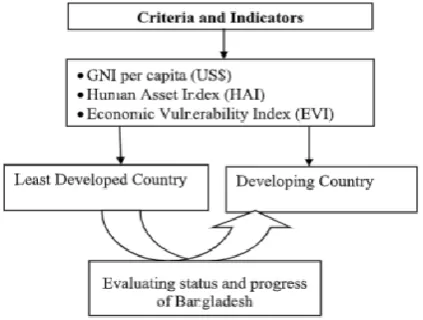
provided the country classification by the World Bank based on GNI (Gross national product) per capita and level of development. However, it extensively reviews and highlights the United Nations process of a country’s transition from least developed country to a developing country with special reference to Bangladesh. Therefore, it evaluates the criteria and performance that has set by the United Nations for the least developed country and developing country. Using the three major criteria and indicators including GNI per capita (US$), Human Asset Index (HAI) and Economic Vulnerability Index (EVI), this study analyses the performance of Bangladesh with possible challenges ahead to be a developing country (Figure 1). Moreover, the development performance of Bangladesh has been evaluated by some major indicators and indexes.
Figure 1. Criteria and indicators of LDCs and Developing country
RESULT AND DISCUSSION
Country Classification: Bangladesh is one of the lower middle-income country whose GNI (gross national income) has reached at $1276 in 2016 (United Nations, 2018). World Bank has classified the countries by their level of development as measured by per capita (GNI). Countries have been divided into four groups such as high-income, upper middle income, lower middle income and low-income. According to World Bank (2017), countries with less than $1,035 GNI per capita are classified as low-income countries, those with between $1,036 and $4,085 as lower middle-income countries, those with between $4,086 and $12,615 as upper middle-income countries, and those with incomes of more than $12,615 as high-income countries. The classification of countries based on GNI per capita with some examples are presented in Table 1. Bangladesh is now a lower middle-income country which has marked this achievement in 2015 where many countries in Asia and Pacific and Africa belong to this category. Table 2 presents the Lower-Middle-Income Economies (GNI per capita $1,006 To $3,955) in the World. Beside the groups, World Bank has also divided the countries into some other groups such as least developed countries (LDCs), developing countries, countries in transition and developed countries and so on. These classification focuses the country’s level of development. Least developed countries are defined as low-income countries characterized by low level of socio-economic development, poor human and institutional capacities, low productivity, political instability that hinders sustainable development. The LDC category was officially established in 1971 by the UN (United Nations) General Assembly. The Purpose was to attract special international support for the most vulnerable and disadvantaged members of the UN
family. Currently, forty-eight (48) countries are designated by the United Nations as "LDCs" entitling them to aid, preferential market access and special technical assistance, among other concessions (UNCTAD, 2016). The LDCs in the world are shown in Table 3. Developing countries are those with low, lower middle or upper middle incomes countries characterized by low income, inequality, poor health and inadequate education. These countries are also called less
developed country, or an underdeveloped country
characterized by low level of living and productivity, less developed and lower industrial base and a low Human Development Index (HDI) relative to developed countries. A transition economy or transitional economy is an economy which is changing from a centrally planned economy to a market economy (Edgar, 1994). Transition economies undergo a set of structural transformations intended to develop market-based institutions. These include economic liberalization, where prices are set by market forces rather than by a central planning organization. Trade barriers are removed and there is a push to privatize state-owned enterprises and resources, state and collectively run enterprises are restructured as businesses, and a financial sector expansion. The European Bank for Reconstruction and Development (EBRD) has developed a set of indicators to measure the progress in transition which has been refined and amended in subsequent Reports (EBRD,
1994). A developed country is also considered as
industrialized country, more developed country, or more economically developed country (MEDC) which have high standard of living, highly developed economy and advanced technological infrastructure. Table 4 presents example of LDC, developing country, transitional economy and developed country in the world.
Inclusion in LDCs and its Graduation Process: The list of the least developed countries (LDCs) is decided upon by the United Nations Economic and Social Council (ECOSOC) based on the recommendations made by the Committee for Development Policy (CDP) which is mandated by General Assembly (GA). The basic criteria for inclusion requires that certain thresholds be met with regard to per capita GNI, a human asset index (HAI) and an economic vulnerability index
(EVI). The CDP and ECOSOC of UN to review the list of
LDCs every three years and to make recommendations on the inclusion and graduation of eligible countries using three criteria such as Income (GNI), Human Assets and Economic Vulnerability (CDP/UN, 2018). Countries are eligible to enter or leave the LDC category if they meet the defined inclusion or graduation thresholds of the criteria. The graduation thresholds are set higher than the thresholds for inclusion. This asymmetry aims to ensure that graduation is sustainable. Each of the three criteria is measured using key indicators that are related to development. These indicators are chosen on the basis that they are methodologically robust, maintain stability of the criteria, ensure equal treatment of countries over time, and are frequently updated for all countries (CDP/UN, 2018). The three criteria with their related indicators are presented in Figure 2. Gross national income (GNI) per capita provides information on the income status and the overall level of resources available to a country. The inclusion as LDC and graduation to developing country thresholds are as follows:
The inclusion threshold for being a LDC is set at the
The graduation threshold is set at 20 per cent above the inclusion threshold. At the 2018 review it was $ 1,230 for being a developing country.
The income-only graduation threshold is twice the
graduation threshold. At the 2018 review, the graduation threshold was $ 2,460 according to income only criteria.
Human Asset Index (HAI) is a composite index of education and health used as an identification criterion of the LDCs by the UNCDP. This index includes three health indicators such as percentage of population under nourished, under five mortality rate, maternal mortality rate and two education indicators such as gross secondary school enrollment rate and adult literacy rate. Human Assets Index (HAI). The HAI is a measure of level of human capital where low levels of human assets indicate major structural impediments to sustainable development. Thus, a lower HAI represents a lower
development of human capital. However, the inclusion and
graduation thresholds are provided below:
The HAI has been set at 60 as the inclusion threshold
for being a LDC.
The graduation threshold from LDC has been set at 10
per cent above the inclusion threshold where HAI should be 66.
Economic Vulnerability Index (EVI) is a measure of structural vulnerability to economic and environmental shocks. High vulnerability indicates major structural impediments to sustainable development.
A higher EVI represents a higher economic vulnerability. However, according to EVI, the inclusion and graduation thresholds are presented as follows:
The EVI threshold for inclusion in LDC has been set at
36
The graduation threshold from LDC has been set at 10
[image:3.595.32.567.75.174.2]per cent below the inclusion threshold at 32
Table 1. Classification of countries based on GNI per capita
Country categories GNI per capita Example of some countries
Low-income economies $1,005 or less Benin, Burkina Faso, Burundi, Democratic Republic of the Congo, Eritrea, Gambia, Guinea, Liberia, Mozambique, Myanmar, Nepal, Rwanda, Sierra Leone, Somalia
Lower middle-income economies
$1,006 - $3,955 Bangladesh, Bhutan, Cambodia, India, Indonesia, Viet Nam, Philippines, Pakistan, Sri Lanka, Morocco, Nigeria, Senegal, Sudan,
Upper middle-income economies
$3,956 - $12,235 Algeria, Belarus, Bosnia and Herzegovina, Brazil, China, Colombia, Costa Rica, Cuba, Iran, Jamaica, Jordan, Lebanon, Lithuania, Malaysia, Mexico, Russia, Serbia, South Africa, Thailand, Tunisia, Turkey
High-income economies $12,236 or more Singapore, Qatar, France, Germany, Italy, United Kingdom, Belgium, Denmark, Sweden, Canada, Japan, United States, Australia
Source: UN, 2017; and World Bank, 2017
Table 2. Lower-Middle-Income Economies in the World ($1,006 To $3,955)
Asia and Pacific Africa Europe Latin America and
Oceania Armenia, Bangladesh, Bhutan, Cambodia, India, Indonesia,
Jordan, Kyrgyz Republic, Lao PDR, Mongolia, Myanmar, Philippines, Pakistan, Sri Lanka, Syrian Arab Republic, Tajikistan, Uzbekistan, Timor-Leste, Vietnam, West Bank and Gaza, Yemen, Kiribati, Solomon Islands
Angola, Cab Verde, Cameroon, Congo, Côte d'Ivoire, Djibouti, Egypt, Ghana, Kenya, Lesotho, Mauritania, Morocco, Moldova, Nigeria, Papua New Guinea, Swaziland, São Tomé and Principe, Sudan, Tunisia, Zambia
Moldova Ukraine Kosovo Georgia
[image:3.595.40.562.213.285.2]Bolivia Guatemala Honduras Nicaragua El Salvador Vanuatu
Table 3. Least developed countries in different regions of the world
Africa Asia Caribbean Pacific
Angola, Benin, Burkina Faso, Burundi, Central African Republic, Chad, Comoros, Democratic Republic of the Congo, Djibouti, Eritrea, Ethiopia, Gambia, Guinea, Guinea-Bissau, Lesotho, Liberia, Madagascar, Malawi, Mali, Mauritania, Mozambique, Niger, Rwanda, Sao Tome and Principe, Senegal, Sierra Leone, Somalia, South Sudan, Sudan, Togo, Uganda, United Republic of Tanzania, Zambia
Afghanistan Bangladesh Bhutan Cambodia Lao PDR Myanmar Nepal Timor-Leste Yemen
Haiti Kiribati Solomon Islands, Tuvalu
Vanuatu
Source: United Nations, 2018
Table 4. Country classification according to their development
Country classification Country example Comment
Least developed countries (LDCs)
Benin, Burkina Faso, Burundi, Democratic Republic of the Congo, Eritrea, Gambia, Guinea, Liberia, Mozambique, Myanmar, Nepal, Rwanda, Sierra Leone, Somalia
Low income and lower middle-income countries
Developing countries Bangladesh (fulfilled condition for eligibility), Bhutan, Cambodia, India, Indonesia, Philippines, Pakistan, Sri Lanka, Ethiopia, Algeria, Egypt, Kenya Mexico, Brazil
Lower middle income and upper middle-income countries
Countries in Transition Albania, Bosnia and Herzegovina, Montenegro, Serbia, Armenia, Azerbaijan, Belarus, Georgia, Russia, Ukraine, Kazakhstan, Tajikistan, Turkmenistan, Uzbekistan
Upper middle-income countries
Developed countries France, Germany, Italy, United Kingdom, Belgium, Denmark, Finland, Sweden, Canada, Japan, United States, Australia, New Zealand
High income countries
[image:3.595.31.565.452.544.2]Figure 2. Criteria and indicator for LDC and its Graduation
[image:4.595.105.489.84.499.2]Source: World Bank, 2018
Figure 3. GNI per capita PPP of the South Asian countries from 2001 to 2016
Source: United Nations, 2018
[image:4.595.100.500.580.776.2]Graduation from LDC to developing country need to fulfill graduation threshold for any two of the three graduation criteria (alternatively income only criterion) which must be met in two consecutive triennial reviews to be considered for graduation. Bangladesh has achieved all three eligibility criteria in 2018 for being a developing country from a least developed country (LDC) which is presented in Table 5. The list of LDCs is reviewed every three years by the Economic and Social Council of the United Nations (ECOSOC), based on recommendations by the Committee for Development Policy (CDP). Since the category was defined forty-five years ago, five countries have graduated from LDC status: Botswana in December 1994; Cabo Verde in December 2007; Maldives in January 2011; Samoa in January 2014 and Equatorial Guinea in June 2017 as shown in Table 6. In March 2015, the CDP recommended the graduation of Vanuatu which will be taken off to the developing country by December 2020. A country will normally qualify for graduation from LDC status if it has met the graduation thresholds of at least two of the three criteria during the period covered by at least two consecutive three-yearly CDP reviews of the list. However, if the per capita GNI of an LDC has risen to a level at least double the graduation threshold, the country will be deemed eligible for graduation regardless of its performance under the other two criteria (the "income only" graduation rule) (UNCTAD, 2016). However, in 2015 triennial review, five countries met the eligibility criteria for graduation for the first time namely Bhutan, Sao Tome and Principe, Solomon Islands, Timor-Leste and Nepal. which will be scheduled for graduation by 2021. Moreover, in 2018 triennial review, some countries such as Bangladesh, Djibouti, Kiribati, Lao People’s Democratic Republic, Myanmar and Tuvalu has met the graduation threshold which will be graduated in 2024 (United Nations, 2018).
Bangladesh Achievement in Millennium Development Goals (MDGs): Bangladesh is one of the leading countries which has achieved very good performance in case of Millennium Development Goals (MDGs) that has set by United Nations (UN). According to Planning Commission of Bangladesh, the country has already achieved the target for reducing the extreme poverty and hunger, child mortality and combating HIV, malaria and other diseases. The country is on track for achieving universal primary education, gender equity and empowering women and improving maternal health. Bangladesh status against the MGD target is shown in Table 7.
Bangladesh performance in development indicators and indexes: The GDP (Gross Domestic Product) per capita of Bangladesh is growing over the year as shown in Figure 3. The GDP per capita based on purchasing power parity (PPP) was estimated to US$1410 in 2001 which was increased at US$3319 in 2016 (World Bank, 2018). However, Bangladesh has possessed the lowest GDP per capita PPP in South Asia followed by Nepal. Within South Asia, Bangladesh has improved its position ahead of India and Pakistan in case of life expectancy, child mortality and universal primary education although its per capita income is still significantly below the regional average (Mahmud 2008). However, the country is in backward position in case of adult literacy, pupil teacher ratio and public expenditure for education and health
compared to other South Asian nations (Sarkar et al., 2013).
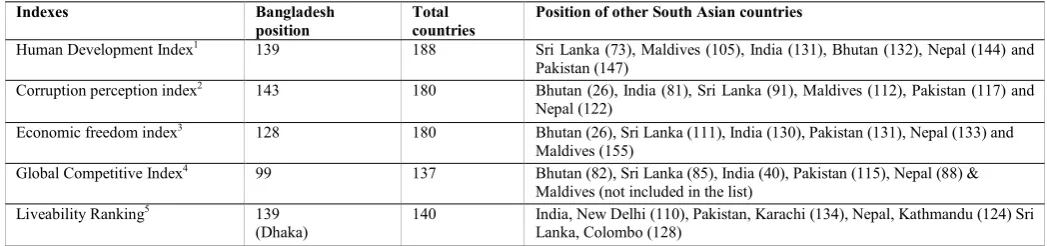
Bangladesh performance in different global indexes is still in the bottom line (see Table 8). In case of Human Development
Index, Bangladesh has occupied 139th position out of 188
countries where the country is only ahead of Nepal (144) and Pakistan (147) (UNDP, 2016). Bangladesh is comparatively good position in terms of Economic Freedom Index. However, the country’s position is quite bad in case of Corruption perception index and Liveability Ranking.
Benefits and Challenges of Graduation: The graduation of Bangladesh will bring dual effect to the economy. If Bangladesh is graduated to a developing country, investors will be interested to invest in the country given its strength in certain areas such as the size of its Gross Domestic Product (GDP), exports and population compared to other LDCs. Credit worthiness of Bangladesh will be increased which will provide more opportunities for taking commercial loans from the international market at a competitive interest rate (The Daily Star, March 20, 2018).
The private sector will also have the opportunity to generate capital from the global financial market (The Daily Star, 2018). Bangladesh has transformed itself from an aid-dependent country into a trade-aid-dependent country over time. However, for poverty alleviation, social sector activities and infrastructural development, the role of official development assistance cannot be undermined. As a lower-middle-income country, Bangladesh is no more eligible for low interest loans. After graduation, Bangladesh has to go for blended finance that includes loans from the development institutions and other sources with a high interest rate and shorter repayment period. However, Bangladesh should also explore more resources from institutions such as the Asian Infrastructure Investment Bank (AIIB), New Development Bank (NDB) and other commercial sources (The Daily Star, 30 March, 2018). Bangladesh will face major challenges in terms of preferential benefit or concessional opportunity due to the LDC graduation. Bangladesh is now entitled to have duty-free access to the European market under the “Everything But Arms” initiative. This is a huge opportunity for the country as more than 60 percent of its export goes to the European market (CPD, 2018). Except for the apparel exports to the USA, Bangladesh receives duty-free market access for all products in all developed countries. Due to the graduation, Bangladesh will lose about 8 percent of its total exports because of the imposition of additional tariff on its exports by 6.7 percent without a preferential treatment. A Centre for Policy Dialogue (CPD) study reveals that the loss will be equivalent to USD 2.7 billion (Khatun, 2018).
Conclusion
Bangladesh is still in transition stages of development as the socio-economic status is improving over time. Though the country has fulfilled the conditions for becoming a developing country from the least developed country (LDC), it will be further reviewed by the United Nations Committee for Development Policy (UNCPD). If all the progress become satisfactory, ECOSOC (Economic and Social Council) of UN will confirm graduation of Bangladesh as a developing country by 2024. It is mentioned that Bangladesh has achieved all three eligibility criteria such as GNI per capita, Human Assets Index, and Economic Vulnerability Index in 2018 for being a developing country. However, the country must be met in two consecutive triennial reviews (2021 and 2024) for confirming whether it will be successfully graduated or not. If Bangladesh is graduated from LDC, it will face some major challenges such as loss of preferential benefit or concessional opportunity
from the developed countries. As a LDC, Bangladesh receives duty-free market access in all developed countries. If graduated, Bangladesh will face an additional tariff on its exports by 6.7 percent which will incur 8% export loss of Bangladesh. Foreign aid and grants will be reduced from the developed countries. Besides, some socio-political problems such as low human development, political instability, huge corruption exist in Bangladesh. However, If Bangladesh is successfully graduated in 2024, there will be a grace period of another 3 years when Bangladesh can enjoy all LDC-specific benefits. Thus, there are approximately 10 years for the country to prepare itself to start the new journey. Therefore, the country should focus on the follows issues to overcome the challenges towards smooth graduation:
Bangladesh should take measures/initiatives to
[image:6.595.35.559.79.151.2]diversify its export baskets as Bangladesh depends on the RMG industry for over 80% of its export earnings.
Table 4. Eligibility criteria for graduation from LDC to developing country
Indicators Inclusion threshold to
become LDCs
Graduation Threshold to become developing country
Bangladesh Score
Average of all developing countries
GNI per capita (US$) 1025 1230
(2460 For income only criteria)
1274 7064
Human Asset Index (HAI) 62 or below 66 or above 73.2 76.4
Economic vulnerability Index (EVI)
36 or above 32 or below 25.2 34.7
[image:6.595.36.562.179.264.2]Source: CPD/UN, 2018
Table 5. Countries graduated and will be graduated from LDC to developing country
Country Year of Graduation Comment
Botswana 1994 Graduated
Maldives 2011 Graduated
Samoa 2014 Graduated
Equatorial Guinea 2017 Graduated
Vanuatu 2020 Will be graduated
Angola, Bhutan, Nepal, Solomon Islands and Timor-Leste 2021 Will be graduated Bangladesh, Myanmar, Lao PDR, Kiribati, Djibouti, Tuvalu 2024 Will be graduated Source: United Nations, 2018.
Table 6. Bangladesh Achievement in Millennium Development Goals (MDGs)
MDGs Target Status Current statistics
Eradicate extreme poverty and hunger 29% of the people living below poverty line Achieved Below poverty line 26.2% (2013)
Achieve universal primary education 100% enrollment ratio On track 97.3% (2013) Promoting gender equity and empowering
women
Gender parity in primary education: 1.0 On track 1.0 (2013)
Reduce child mortality Under five mortality rate 48 per 1000 live birth Achieved 44 per 1000 live birth (2011) Improve maternal mortality Maternal mortality 143 per 100000 On tract 194 (2010)
Combat HIV/AIDS, malaria and other diseases HIV prevalence halting Will achieved HIV 0.1 Ensuring environmental sustainability Forest coverage 20% Need attention 13.2% Developing a global partnership for
development
Develop an open, rule based, predictable, non-discriminatory trading system
Need attention Net ODA $2871 million (2013), Debt service 8.6%
Source: MDG: Bangladesh Progress Report 2013, General Economic Division, Bangladesh Planning Commission
Table 7. Bangladesh current position in different indexes among the countries
Indexes Bangladesh
position
Total countries
Position of other South Asian countries
Human Development Index1 139 188 Sri Lanka (73), Maldives (105), India (131), Bhutan (132), Nepal (144) and Pakistan (147)
Corruption perception index2 143 180 Bhutan (26), India (81), Sri Lanka (91), Maldives (112), Pakistan (117) and Nepal (122)
Economic freedom index3 128 180 Bhutan (26), Sri Lanka (111), India (130), Pakistan (131), Nepal (133) and Maldives (155)
Global Competitive Index4 99 137 Bhutan (82), Sri Lanka (85), India (40), Pakistan (115), Nepal (88) & Maldives (not included in the list)
Liveability Ranking5 139 (Dhaka)
140 India, New Delhi (110), Pakistan, Karachi (134), Nepal, Kathmandu (124) Sri Lanka, Colombo (128)
[image:6.595.34.562.294.419.2] [image:6.595.35.559.448.571.2] Bangladesh has to play a proactive role at the regional and sub-regional initiatives, such as Bangladesh, Bhutan, India, Nepal (BBIN), Bangladesh, China, India and Myanmar (BCIM), and Bay of Bengal Initiative for Multi-Sectoral Technical and Economic Cooperation (BIMSTEC), for more meaningful partnerships.
The country has to build good relationship with more
nations through bilateral relationship and create more market for its products at the global level
For successful graduation from the LDC status,
Bangladesh have to attract more local and foreign investments. In order to attract foreign investment, the economy has to go through structural changes, achieve resource efficiency, and improve productivity.
The government should discover alternative sources of
funding for promoting its development trend as it will no longer be entitled to preferential benefits in global markets once it has become a developing nation
The country must upgrade the agricultural sector,
ensuring employment opportunities for all, and building new industries and factories to enhance the productivity.
Overall capability of the economy need to be improved
through diversification of the economy, technological upgradation, training and skill development of human resources, and institutional strengthening.
REFERENCES
Dhaka Tribune, 2018. Govt’s development efforts: Catalyst for LDC graduation, 22 March 2018. Available at http://www. dhakatribune.com/business/2018/03/22/govts-development - efforts-catalyst-ldc-graduation/
Edgar L.F. 1994. "The Transition to a Market Economy in
Russia: Property Rights, Mass Privatization and
Stabilization" (PDF). In Alexander, Gregory S.; Skąpska, Grażyna. A Fourth way?: privatization, property, and the emergence of new market economics (PDF). Routledge. pp. 57–78. ISBN 978-0-415-90697-5.
Khatun, F. 2018. LDC Graduation: What it means for
Bangladesh. The Daily Star, March 20, 2018.
Mahmud, W. 2008. “Social Development: Pathways, Surprises
and Challenges”, Indian Journal of Human Development,
Vol. 2 No. 1, pp. 79-92.
MDG: Bangladesh Progress Report, 2013. General Economic Division, Bangladesh Planning Commission, Dhaka. Sarkar, M.S.K., Sadeka, S., Feardous, M.A. and Ahmed, S.
2013. Human Development Performance of Bangladesh:
South Asian Perspective. Journal of Applied Sciences
Research, Vol.9 No. 4, pp. 2475-2484.
The Daily Star, 2018. LDC Graduation: What it means for
Bangladesh. Dr. Fahmida Khatun is the executive director of the Centre for Policy Dialogue (CPD).
The Economist, 2015. Liveability ranking and overview, The Economist Intelligence Unit Limited 2015. Available at https://media.heraldsun.com.au/files/liveability.pdf
The Heritage Foundation, 2017. Economic freedom index 2017. Available at https://www.heritage.org/index/
Transparency International, 2017. Corruption Perceptions Index 2017. Available at https://www.transparency.org/ news/feature/corruption_perceptions_index_2017
WEF, 2017. Global Competitive Index 2017-2018. World Economic Forum (WEF), Davos, Switzerland.
UNCTAD, 2016. Least Developed Countries Report 2016. United Nations Conference on Trade and Development. Available at http://unctad.org/en/pages/PressRelease.aspx? OriginalVersionID=385
UNDP, 2016. Human Development Report 2017. United Nations Development Program, New York.
United Nations, 2015. Handbook on the Least Developed Country Category: Inclusion, Graduation and Special Support Measures. Committee for Development Policy and United Nations Department of Economic and Social Affairs. Available at http://www.un.org/en/development/ desa/policy/cdp/cdp_publications/2015cdphandbook.pdf UN (United Nations), 2017. World Economic Situation
and Prospects 2017. United Nations publication, New
York. Available at https://www.un.org/development/
desa/dpad/wp-content/uploads/sites/45/2017wesp_gpr_en. pdf
United Nations, 2018. Graduation from the LDC Category, Development Policy & Analysis Division, United Nations. Available at https://www.un.org/development/desa/dpad/ least-developed-country-category/ldc-graduation.html World Bank, 2017. Country Classification by income (World
Bank 2017). Available at http://www.piscomed.com/wp-content/uploads/2017/03/Income-classification.pdf
World Bank, 2018. World Development Indicators, Access on 05 April 2018.