Findings of the WMT 2016 Bilingual Document Alignment Shared Task
Christian Buck
School of Informatics University of Edinburgh Scotland, European Union
Philipp Koehn
Johns Hopkins University
School of Informatics University of Edinburgh Scotland, European Union
Abstract
This paper presents the results of the WMT16 Bilingual Document Alignment Shared Task. Given crawls of web sites, we asked participants to align documents that are translations of each other. 11 re-search groups submitted 19 systems, with a top performance of 95.0%.
1 Introduction
Parallel corpora are especially important for train-ing statistical machine translation systems, but so far the collection of such data within the academic research community has been ad hoc and limited in scale. To promote this research problem we or-ganized a shared task on one of the core process-ing steps in acquirprocess-ing parallel corpora from the web: aligning bilingual documents from crawled web sites.
The task is to identify pairs of English and French documents from a given collection of doc-uments such that one document is the translation of the other. As possible pairs we consider all pairs of documents from the same webdomain for which the source side has been identified as (mostly) En-glish and the target side as (mostly) French.
Lack of data in some cases has held back re-search. To give an example, there are significant research efforts on various Indic languages (Post et al., 2012; Joshi et al., 2013; Singh, 2013), but this work has been severely hampered, since it uses very small amounts of data. But even for the language pairs tackled in high profile evalua-tion campaigns, such as the ones organized around WMT, IWSLT, and even NIST, we use magnitudes of data less than what has been reported to be used in the large-scale efforts of Google or Microsoft. This diminishes the value of research findings: re-ported improvements for methods may not hold up
once more data is used. Work in reduced data set-tings may also distract from efforts to tackle prob-lems that do not go away with more data, but are inherent limitations of current models.
2 Related Work
Although the idea of crawling the web indiscrimi-nately for parallel data goes back to the 20th cen-tury (Resnik, 1999), work in the academic com-munity on extraction of parallel corpora from the web has so far mostly focused on large stashes of multilingual content in homogeneous form, such as the Canadian Hansards, Europarl (Koehn, 2005), the United Nations (Rafalovitch and Dale, 2009; Ziemski et al., 2015), or European Patents (T¨ager, 2011). A nice collection of the products of these efforts is the OPUS web site1(Skadin¸ˇs et al., 2014).
These efforts focused on individual web sites allow for writing specific rules for aligning doc-uments as well as extracting and aligning content. Scaling these manual efforts to thousands or mil-lions of web sites is not practical.
A typical processing pipeline breaks up parallel corpus extraction into five steps:
• Identifying web sites with bilingual content • Crawling web sites
• Document alignment
• Sentence alignment
• Sentence pair filtering
For each of these steps, there has been varying amount of prior work and for some tools are read-ily available. Since there has been comparatively little work on document alignment, we picked this problem as the subject for the shared task this year, but other steps are valid candidates for future tasks.
1http://opus.lingfil.uu.se/
2.1 Web Crawling
Web crawling is a topic that has not received much attention from a specific natural language process-ing perspective. There are a number of challenges, such as identification of web sites with multilin-gual content, avoiding to crawl web pages with identical textual content, learning how often to re-crawl web sites based on frequency of newly ap-pearing content, avoiding crawling of large sites that have content in different languages that is not parallel, and so on.
We used for the preparation of this shared task the tool Httrack2 which is a general web crawler that can be configured in various ways. Papavas-siliou et al. (2013) present the focused crawler ILSP-FC3 that integrates crawling more closely with subsequent processing steps like text normal-ization and deduplication.
2.2 Document Alignment
Document alignment can be defined as a matching task that takes a pair of documents and computes a score that reflects the likelihood that they are translations of each others. Common choices in-clude edit-distance between linearized documents (Resnik and Smith, 2003), cosine distance of idf-weighted bigram vectors (Uszkoreit et al., 2010), and probability of a probabilistic DOM-tree align-ment model (Shi et al., 2006).
2.3 Sentence Alignment
The topic of sentence alignment has received a lot of attention, dating back to the early 1990s with the influential Church and Gale algorithm that is language-independent and easy to implement. It relies on relative sentence lengths for alignment decisions and hence is not tolerant to noisy input.
Popular tools are Hunalign4(Varga et al., 2005), Gargantua5 (Braune and Fraser, 2010), Bilingual Sentence Aligner (Moore, 2002) Bleualign6 (Sen-nrich and Volk, 2010), and Champollion7 (Ma, 2006). Shi and Zhou (2008) make use of the HTML structure to guide alignment. All of these use bilingual lexicons which may have to be pro-vided upfront or are learned unsupervised.
2https://www.httrack.com/
3http://nlp.ilsp.gr/redmine/projects/ilsp-fc 4http://mokk.bme.hu/en/resources/hunalign/ 5https://sourceforge.net/projects/gargantua/ 6https://github.com/rsennrich/Bleualign 7https://sourceforge.net/projects/champollion/
It is not clear, which of these tools fares best with noisy parallel text that we can expect from web crawls, which may have spurious content and misleading boilerplate.
2.4 Filtering
A final stage of the processing pipeline filters out bad sentence pairs. These exist either because the original web site did not have any actual parallel data (garbage in, garbage out), or due to failures of earlier processing steps.
As Rarrick et al. (2011) point out, a key prob-lem for parallel corpora extracted from the web is filtering out translations that have been created by machine translation. Venugopal et al. (2011) propose a method to watermark the output of ma-chine translation systems to aid this distinction. Antonova and Misyurev (2011) report that rule-based machine translation output can be detected due to certain word choices, and machine transla-tion output due to lack of reordering.
This year, a shared task on sentence pair filter-ing8was organized, albeit in the context of clean-ing translation memories which tend to be cleaner that the data at the end of a pipeline that starts with web crawls.
2.5 Comprehensive Tools
For a few language pairs, there have been indi-vidual efforts to cast a wider net, such as the billion word French–English corpus collected by Callison-Burch et al. (2009), or a 200 million word Czech–English corpus collected by Bojar et al. (2010). Smith et al. (2013) present a set of fairly basic tools to extract parallel data from the pub-licly available web crawl CommonCrawl9.
In all these cases, the corpus collection effort re-invented the wheel and wrote dedicated scripts to download web pages, extract text, and align sen-tences, with hardly any description of the methods used.
Our data preparation for the shared task builds partly on Bitextor10, which is a comprehensive pipeline from corpus crawling to sentence pair cleaning (Espl`a-Gomis, 2009).
8NLP4TM 2016: Shared task
http://rgcl.wlv.ac.uk/nlp4tm2016/shared-task/
9http://commoncrawl.org/
3 Training and Test Data
We made available crawls of web sites (defined as pages under the same webdomain) that have trans-lated content. We also annotated some document pairs to provide supervised training data to the par-ticipants of the shared task.
3.1 Terminology
A quick note on terminology: Unfortunately, the notion of domain is ambiguous in NLP applica-tions, and we use an unusual meaning of the word in this report. To avoid confusion we will in-stead use the term webdomain to refer to content from a specific website, e.g,“This page is from thestatmt.orgwebdomain.” We distinguish be-tween webdomains using their Fully Qualified Do-main Name (FQDN). Thus, www.example.com andexample.com are considered to be different webdomains.
We will usesourceto denote English pages and
target for French ones. This does not imply that
translation was performed in that direction. In fact we cannot know if translation from one side to the other was performed at all, both sides could possi-bly be translations of a third language document.
The task was organized as part of the First Con-ference on Machine Translation (WMT), and all data can be downloaded from its web page11.
3.2 Data Preparation
We crawled full web sites with the web site copyer
HTTrack, from the homepage down, restricted to HTML content. Web sites differed significantly in their size, from a few hundred pages to almost 100,000.
In the test data we removed all duplicates from the crawl12. Duplicates are defined as web pages, whose text content is identical. Duplicates may differ in markup and URL. To extract the text we used a Python implementation of the HTML5 parser to extract text as a browser would see it. As the text is free of formatting, determining whites-pace is important. While generally following the standard, e.g. inserting line breaks after block level elements13, we found that inserting spaces around <span>tags helps tokenization as these are often visually separated using CSS.
11http://www.statmt.org/wmt16/bilingual-task.html 12Because we provide the extracted texts of the training pages
participants were able to do the same
13https://developer.mozilla.org/en-US/docs/
Web/HTML/Block-level_elements
We restricted the task to the alignment of French and English documents, so we filtered out all web pages that are not in these two languages. How-ever, we did not expect that participants would develop language-specific approaches. To detect the language of a document we feed the extracted text into an automatic language detector 14. We note that language detection is a noisy process and many pages contain mixed language context, for example English boilerplate but French content. We take the overall majority language per page as the document language.
We decided to have a large collection of web sites, to encourage methods that can cope with various types of web sites, such as differing in size, balance in the number of French and English pages, and so on.
Given the large number of correct document pairs, we did not even attempt to annotate all of them, but instead randomly selected a subset of pages and identified their corresponding trans-lated page. We augmented this effort with aligned document pairs that are indicated at the web site
Linguee16, a searchable collection of parallel cor-pora, in which each retrieved sentence is annotated with its source web page.
The task then is to find these document pairs. Since this is essentially a recall measure, which can be gamed by returning all possible document pairs, we enforce a 1-1 rule, so that participants may align each web page only once.
3.3 Training Data
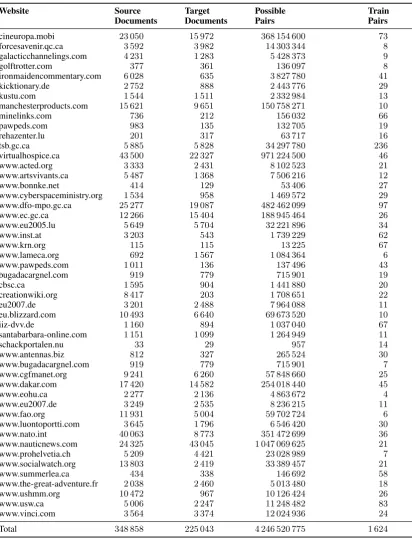
As training data we provide a set of 1,624 EN-FR pairs from 49 webdomains. The number of an-notated document pairs per webdomain varies be-tween 4 and over 200. All pairs are from within a single webdomain, possible matches between two different webdomains, e.g. siemens.deand siemens.com, are not considered in this task.
The full list of webdomains in the training data is listed in Table 1. Webdomains range in size from 33×29 pages (schackportalen.nu) to 24,325×43,045 pages (www.nauticnews.com).
3.4 Test Data
For testing, we provide 203 additional crawls of new webdomains, distinct from the ones in the training data in the same format. No aligned pairs
Website Source Target Possible Train
Documents Documents Pairs Pairs
cineuropa.mobi 23 050 15 972 368 154 600 73
forcesavenir.qc.ca 3 592 3 982 14 303 344 8
galacticchannelings.com 4 231 1 283 5 428 373 9
golftrotter.com 377 361 136 097 8
ironmaidencommentary.com 6 028 635 3 827 780 41
kicktionary.de 2 752 888 2 443 776 29
kustu.com 1 544 1 511 2 332 984 13
manchesterproducts.com 15 621 9 651 150 758 271 10
minelinks.com 736 212 156 032 66
pawpeds.com 983 135 132 705 19
rehazenter.lu 201 317 63 717 16
tsb.gc.ca 5 885 5 828 34 297 780 236
virtualhospice.ca 43 500 22 327 971 224 500 46
www.acted.org 3 333 2 431 8 102 523 21
www.artsvivants.ca 5 487 1 368 7 506 216 12
www.bonnke.net 414 129 53 406 27
www.cyberspaceministry.org 1 534 958 1 469 572 29
www.dfo-mpo.gc.ca 25 277 19 087 482 462 099 97
www.ec.gc.ca 12 266 15 404 188 945 464 26
www.eu2005.lu 5 649 5 704 32 221 896 34
www.inst.at 3 203 543 1 739 229 62
www.krn.org 115 115 13 225 67
www.lameca.org 692 1 567 1 084 364 6
www.pawpeds.com 1 011 136 137 496 43
bugadacargnel.com 919 779 715 901 19
cbsc.ca 1 595 904 1 441 880 20
creationwiki.org 8 417 203 1 708 651 22
eu2007.de 3 201 2 488 7 964 088 11
eu.blizzard.com 10 493 6 640 69 673 520 10
iiz-dvv.de 1 160 894 1 037 040 67
santabarbara-online.com 1 151 1 099 1 264 949 11
schackportalen.nu 33 29 957 14
www.antennas.biz 812 327 265 524 30
www.bugadacargnel.com 919 779 715 901 7
www.cgfmanet.org 9 241 6 260 57 848 660 25
www.dakar.com 17 420 14 582 254 018 440 45
www.eohu.ca 2 277 2 136 4 863 672 4
www.eu2007.de 3 249 2 535 8 236 215 11
www.fao.org 11 931 5 004 59 702 724 6
www.luontoportti.com 3 645 1 796 6 546 420 30
www.nato.int 40 063 8 773 351 472 699 36
www.nauticnews.com 24 325 43 045 1 047 069 625 21
www.prohelvetia.ch 5 209 4 421 23 028 989 7
www.socialwatch.org 13 803 2 419 33 389 457 21
www.summerlea.ca 434 338 146 692 58
www.the-great-adventure.fr 2 038 2 460 5 013 480 18
www.ushmm.org 10 472 967 10 126 424 26
www.usw.ca 5 006 2 247 11 248 482 83
www.vinci.com 3 564 3 374 12 024 936 24
[image:4.595.95.508.130.673.2]Total 348 858 225 043 4 246 520 775 1 624
are provided for the any of these domains. We re-moved exact duplicates of pages, keeping only one instance. Otherwise, we processed the data in the same way as the training data.
3.5 Data Format
The training document pairs are specified as one pair per line:
Source URL<TAB>Target URL
For the crawled data we provide one file per webdomain in.lettformat adapted from Bitex-tor. This is a plain text format with one line per page. Each line consists of 6 tab-separated values:
• Language ID (e.g. en)
• Mime type (always text/html)
• Encoding (always charset=utf-8) • URL
• HTML in Base64 encoding
• Text in Base64 encoding
To facilitate use of the.lettfiles we provide a simple reader class in Python. We make sure that the language id is reliable, at least for the docu-ments in the train and test pairs.
Text extraction was performed using an HTML5 parser. As the original HTML pages are available, participants are welcome to implement their own text extraction, for example to remove boilerplate.
Additionally, we have identified spans of French text in French documents for which we produced English translations using MT. We use a basic Moses statistical machine translation en-gine (Koehn et al., 2007) trained on Europarl and News Commentary with decoding settings geared towards speed (no lexicalized reordering model, no additional language model, cube pruning with pop limit 500).
These translations are not part of the lett files but provided separately. The format for the source segments and target segments is
URL<TAB>Text
where the same URL might occur multiple times if several lines/spans of French text were found. The URLs can be used to identify the cor-responding documents in the .lett files.
3.6 Baseline Method
We provide a baseline systems that relies on the URL matching heuristic used by Smith et al. (2013). Here two URLs are considered a pair
if both can be transformed into the same string through stripping of language identifiers. Strings indicating languages are found by splitting a large number of randomly sampled URLs into compo-nents and manually picking substrings that corre-late with the detected language.
We further improve the approach by allow-ing matches where only one URL contains a strip-able language identifier, e.g. we match x.com/index.htm and x.com/fr index.htm. If a URL has several matching candidates we pick the one that requires the fewest rewrites, i.e. we prefer the pair above overx.com/en/index.htm x.com/fr index.htm.
The baseline achieves roughly60%recall, com-pared to95.0%of the best submission.
4 Evaluation
Our main evaluation metric is recall of the known pairs, i.e. what percentage of the aligned pages in the test set are found. We strictly enforce the rule that every page may only be aligned once, so that participants cannot just align everything. After a URL has been seen as part of a submitted pair, all later occurrences are ignored.
After we released the gold standard alignments, a number of participants pointed out that some predicted document pairs were unfairly counted as wrong, even if their content differed only insignif-icantly from the gold standard.
To give an example, the web pages
www.taize.fr/fr article10921.html?chooselang=1
and
www.taize.fr/fr article10921.html
are almost identical, but the first offers a check-box to select a language, while the second does not. Since the text on the pages differs slightly, these were not detected as (exact) duplicates.
To address this problem, we also included asoft scoring metric which counts such near-matches as correct. We chose that to be a close duplicate, the edit distance between the text of two pages, normalized by the maximum of their lengths (in characters) must not exceed5%.
Acronym Participant
ADAPT ADAPT Research Center, Ireland (Lohar et al., 2016)
BADLUC University of Montr´eal, Canada (Jakubina and Langlais, 2016) DOCAL Vicomtech (Azpeitia and Etchegoyhen, 2016)
ILSP/ARC Athena Research and Innovation Center, Greece (Papavassiliou et al., 2016) JIS JIS College of Engineering, Kalyani, India (Mahata et al., 2016)
MEVED Lexical Computing / Masaryk University, Slovakia (Medved et al., 2016) NOVALINCS Universidade Nova de Lisboa, Portugal (Gomes and Pereira Lopes, 2016) UA PROMPSIT University of Alicante / Prompsit: Bitextor, Spain (Espl`a-Gomis et al., 2016) UEDINCOSINE University of Edinburgh, Scotland — Buck (Buck and Koehn, 2016)
[image:6.595.81.516.60.267.2]UEDINLSI University of Edinburgh, Scotland — German (Germann, 2016) UFAL Charles University in Prague, Czech Republic (Le et al., 2016) YSDA Yandex School of Data Analysis, Russia (Shchukin et al., 2016) YODA Carnegie Mellon University (Dara and Lin, 2016)
Table 2: List of participants
5 Results
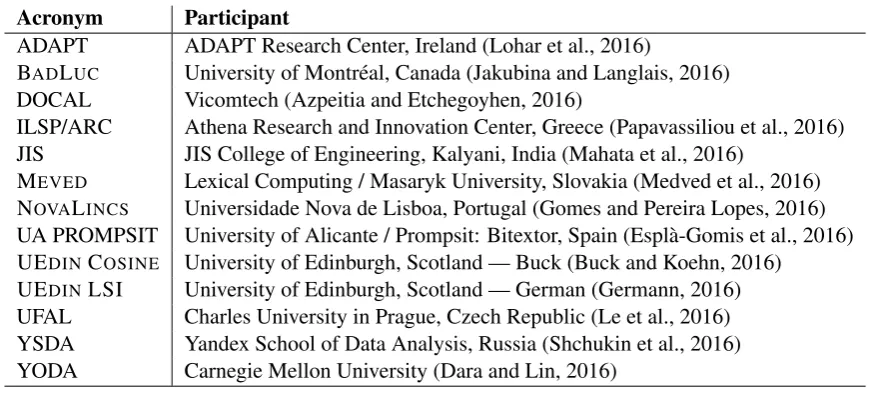
11 research groups participated in the shared task, some with multiple submissions. The list of par-ticipants is shown in Table 2, with a citation of their system descriptions, which are included in these conference proceedings.
Each participant submitted one or more collec-tions of document pairs. We enforced the 1-1 rule on the collections, and scored them against the gold standard. Results are summarized in Table 3. Almost all systems outperformed the baseline by a wide margin. The best system is NOVALINCS -URL-COVERAGE with 2,281 correct pairs, 95.0% of the total.
Note that the submissions varied in the num-ber of document pairs, but after enforcing the 1-1 rule, most submissions comprise about 200,000-300,000 document pairs.
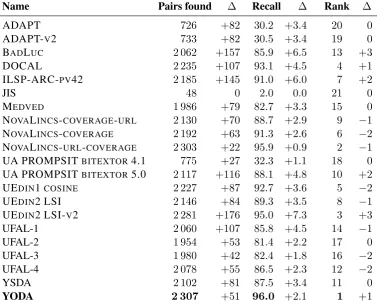
Table 4 displays the results with soft scoring. Essentially, every system improved, mostly by around 3%. The top two performers swapped places, with YODA now having the best showing with 96.0%. We also experimented with a tighter threshold of 1% which gave almost identical re-sults.
6 System Descriptions
NOVALINCS (Gomes and Pereira Lopes, 2016) submitted 3 systems that use a phrase table from a phrase-based statistical machine translation sys-tem to compute coverage scores, based on the ra-tio of phrase pairs covered by a document pair. In addition to the purely coverage-based system,
NOVALINCS-COVERAGE (88.6%), they also sub-mit a system that uses coverage-based matching as a preference over URL matching NOVALINCS -COVERAGE-URL(85.8%) and the converse system that prefers URL matching over coverage-based matching NOVALINCS-URL-COVERAGE(95.0%).
YODA (Dara and Lin, 2016) submitted one system (93.9%) that uses the machine translation of the French document, and finds the English cor-responding document based on bigram and 5-gram matches, assisted by a heuristics based on docu-ment length ratio.
UEDIN1 (Buck and Koehn, 2016) submitted
one system (89.1%) that uses cosine similarity be-tween tf/idf weighted vectors, extracted by collect-ing n-grams from the English and machine trans-lated French text. They compare many hyper-parameters such as weighting schemes and two pair selection algorithms.
DOCAL (Azpeitia and Etchegoyhen, 2016) submitted one system (88.6%) that used word translation lexicons to compute document similar-ity scores based on bag-of-word representations. They expand a basic translation lexicon by adding all capitalized tokens, numbers, and longest com-mon prefixes of known vocabulary items.
UEDIN2 (Germann, 2016) submitted 2
Predicted Pairs after Found Recall
Name pairs 1-1 rule pairs %
ADAPT 61 094 61 094 644 26.8
ADAPT-V2 69 518 69 518 651 27.1
BADLUC 681 610 263 133 1 905 79.3
DOCAL 191 993 191 993 2 128 88.6
ILSP-ARC-PV42 291 749 287 860 2 040 84.9
JIS 323 929 28 903 48 2.0
MEDVED 155 891 155 891 1 907 79.4
NOVALINCS-COVERAGE-URL 207 022 207 022 2 060 85.8 NOVALINCS-COVERAGE 235 763 235 763 2 129 88.6
NOVALINCS-URL-COVERAGE 235 812 235 812 2 281 95.0 UA PROMPSITBITEXTOR4.1 95 760 95 760 748 31.1 UA PROMPSITBITEXTOR5.0 157 682 157 682 2 001 83.3
UEDIN1COSINE 368 260 368 260 2 140 89.1
UEDIN2 LSI 681 744 271 626 2 062 85.8
UEDIN2 LSI-V2 367 948 367 948 2 105 87.6
UFAL-1 592 337 248 344 1 953 81.3
UFAL-2 574 433 178 038 1 901 79.1
UFAL-3 574 434 207 358 1 938 80.7
UFAL-4 1 080 962 268 105 2 023 84.2
YSDA 277 896 277 896 2 021 84.1
YODA 318 568 318 568 2 256 93.9
Baseline 148 537 148 537 1 436 59.8
Table 3: Official Results of the WMT16 Bilingual Document Alignment Shared Task.
Name Pairs found ∆ Recall ∆ Rank ∆
ADAPT 726 +82 30.2 +3.4 20 0
ADAPT-V2 733 +82 30.5 +3.4 19 0
BADLUC 2 062 +157 85.9 +6.5 13 +3
DOCAL 2 235 +107 93.1 +4.5 4 +1
ILSP-ARC-PV42 2 185 +145 91.0 +6.0 7 +2
JIS 48 0 2.0 0.0 21 0
MEDVED 1 986 +79 82.7 +3.3 15 0
NOVALINCS-COVERAGE-URL 2 130 +70 88.7 +2.9 9 −1
NOVALINCS-COVERAGE 2 192 +63 91.3 +2.6 6 −2
NOVALINCS-URL-COVERAGE 2 303 +22 95.9 +0.9 2 −1 UA PROMPSITBITEXTOR4.1 775 +27 32.3 +1.1 18 0 UA PROMPSITBITEXTOR5.0 2 117 +116 88.1 +4.8 10 +2
UEDIN1COSINE 2 227 +87 92.7 +3.6 5 −2
UEDIN2 LSI 2 146 +84 89.3 +3.5 8 −1
UEDIN2 LSI-V2 2 281 +176 95.0 +7.3 3 +3
UFAL-1 2 060 +107 85.8 +4.5 14 −1
UFAL-2 1 954 +53 81.4 +2.2 17 0
UFAL-3 1 980 +42 82.4 +1.8 16 −2
UFAL-4 2 078 +55 86.5 +2.3 12 −2
YSDA 2 102 +81 87.5 +3.4 11 0
[image:7.595.120.478.66.400.2]YODA 2 307 +51 96.0 +2.1 1 +1
[image:7.595.111.489.427.731.2]ILSP/ARC (Papavassiliou et al., 2016) sub-mitted one system (84.9%), which uses boiler-plate removal, and carries out document alignment based on features such as links to documents in the same webdomain, URLs, digits, image filenames and HTML structure. Their paper also describes in detail the open source ILSP Focused Crawler.
YSDA (Shchukin et al., 2016) submitted one system (84.1%) that uses n-gram matches between the machine translation of the French document and the English document. They cluster French and English words into bilingual clusters of up to 90 words, starting with word pairs with high translation probability in both directions, and then adding words that translated well into existing words in a cluster.
UA PROMPSIT (Espl`a-Gomis et al., 2016) submitted 2 systems based on Bitextor and de-scribe improvements to the Bitextor toolkit. Their submissions contrast the old version of the tool, UA PROMPSIT BITEXTOR 4.1 (31.1%), with the recent release, UA PROMPSIT BITEXTOR 5.0 (83.3%). Improved document alignment qual-ity is based on various new features: ratio of shared links, similarity of link URLs, ratio of shared images, binary feature indicating if the doc-uments are linked, and similarity of URLs, in ad-dition to the old features bag of words similarity using a translation dictionary and DOM structure similarity.
UFAL (Le et al., 2016) submitted 4 systems, each using a different method. UFAL-1 (81.3%) uses identical word matches by also consider-ing their position in the text. UFAL-2 (79.1%) matches translations of French documents with English documents based on word occurrence probabilities. UFAL-3 (80.7%) adds Levenshtein distance on URLs to this method. UFAL-4 (84.2%) combines UFAL-1 and UFAL-3.
MEDVED(Medved et al., 2016) submitted one
system (79.4%), which determines the top 100 keywords based on tf/idf scores for each document and uses word translation dictionaries to match them.
BADLUC (Jakubina and Langlais, 2016)
sub-mitted one system (79.3%) that uses the informa-tion retrieval tool Apache Lucene to create two in-dexes, on URLs and text content, and retrieves the most similar documents based on variants of td/idf scores. Both monolingual queries and bilingual queries based on a word translation dictionary are
performed.
ADAPT(Lohar et al., 2016) submitted one sys-tem (and a revision) that combines similarity met-rics computed on ratio of number of sentences in documents, ratio of number of words in the docu-ments, and matched named entities.
JIS(Mahata et al., 2016) submitted one system (2.0%), which uses text matching based on sen-tence alignment and word dictionaries. Their pa-per also described improvements over the original submission.
Acknowledgment
This shared task is partially supported by a Google Faculty Research Award. This work was also sup-ported by the European Union’s Horizon 2020 research and innovation programme under grant agreement 645487 (MMT).
References
Antonova, A. and Misyurev, A. (2011). Build-ing a web-based parallel corpus and filterBuild-ing out machine-translated text. In Proceedings of the 4th Workshop on Building and Using Compa-rable Corpora: CompaCompa-rable Corpora and the Web, pages 136–144, Portland, Oregon. Associ-ation for ComputAssoci-ational Linguistics.
Azpeitia, A. and Etchegoyhen, T. (2016). Docal - vicomtech’s participation in the wmt16 shared task on bilingual document alignment. In Pro-ceedings of the First Conference on Machine Translation.
Bojar, O., Liˇska, A., and ˇZabokrtsk´y, Z. (2010). Evaluating utility of data sources in a large par-allel Czech-English corpus CzEng 0.9. In
Pro-ceedings of LREC2010.
Braune, F. and Fraser, A. (2010). Improved un-supervised sentence alignment for symmetrical and asymmetrical parallel corpora. In Coling
2010: Posters, pages 81–89, Beijing, China.
Coling 2010 Organizing Committee.
Buck, C. and Koehn, P. (2016). Quick and reliable document alignment via tf/idf-weighted cosine distance. InProceedings of the First Conference
on Machine Translation.
Callison-Burch, C., Koehn, P., Monz, C., and Schroeder, J. (2009). Findings of the 2009 Workshop on Statistical Machine Translation.
In Proceedings of the Fourth Workshop on
Athens, Greece. Association for Computational Linguistics.
Dara, A. A. and Lin, Y.-C. (2016). Yoda system for wmt16 shared task: Bilingual document align-ment. InProceedings of the First Conference on Machine Translation.
Espl`a-Gomis, M. (2009). Bitextor: a free/open-source software to harvest translation memo-ries from multilingual websites. InMT Summit
Workshop on New Tools for Translators.
Inter-national Association for Machine Translation. Espl`a-Gomis, M., Forcada, M., Ortiz Rojas, S.,
and Ferr´andez-Tordera, J. (2016). Bitextor’s participation in wmt’16: shared task on doc-ument alignment. In Proceedings of the First
Conference on Machine Translation.
Germann, U. (2016). Bilingual document align-ment with latent semantic indexing. In Proceed-ings of the First Conference on Machine Trans-lation.
Gomes, L. and Pereira Lopes, G. (2016). First steps towards coverage-based document align-ment. In Proceedings of the First Conference
on Machine Translation.
Jakubina, L. and Langlais, P. (2016). Bad luc@wmt 2016: a bilingual document align-ment platform based on lucene. InProceedings of the First Conference on Machine Translation. Joshi, A., Popat, K., Gautam, S., and Bhat-tacharyya, P. (2013). Making headlines in hindi: Automatic english to hindi news headline trans-lation. In The Companion Volume of the Pro-ceedings of IJCNLP 2013: System
Demonstra-tions, pages 21–24, Nagoya, Japan. Asian
Fed-eration of Natural Language Processing. Koehn, P. (2005). Europarl: A parallel corpus for
statistical machine translation. InProceedings of the Tenth Machine Translation Summit (MT Summit X), Phuket, Thailand.
Koehn, P., Hoang, H., Birch, A., Callison-Burch, C., Federico, M., Bertoldi, N., Cowan, B., Shen, W., Moran, C., Zens, R., Dyer, C. J., Bo-jar, O., Constantin, A., and Herbst, E. (2007). Moses: Open source toolkit for statistical ma-chine translation. In Proceedings of the 45th Annual Meeting of the Association for Com-putational Linguistics Companion Volume
Pro-ceedings of the Demo and Poster Sessions,
pages 177–180, Prague, Czech Republic. Asso-ciation for Computational Linguistics.
Le, T., Vu, H. T., Oberl¨ander, J., and Bojar, O. (2016). Using term position similarity and lan-guage modeling for bilingual document align-ment. In Proceedings of the First Conference
on Machine Translation.
Lohar, P., Afli, H., Liu, C.-H., and Way, A. (2016). The adapt bilingual document alignment system at wmt16. InProceedings of the First
Confer-ence on Machine Translation.
Ma, X. (2006). Champollion: A robust parallel text sentence aligner. In International Confer-ence on Language Resources and Evaluation (LREC).
Mahata, S., Das, D., and Pal, S. (2016). Wmt2016: A hybrid approach to bilingual document align-ment. InProceedings of the First Conference on Machine Translation.
Medved, M., Jakub´ıcek, M., and Kov´aˇr, V. (2016). English-french document alignment based on keywords and statistical translation. In Proceed-ings of the First Conference on Machine Trans-lation.
Moore, R. C. (2002). Fast and accurate sentence alignment of bilingual corpora. In Richardson, S. D., editor, Machine Translation: From Re-search to Real Users, 5th Conference of the As-sociation for Machine Translation in the Ameri-cas, AMTA 2002 Tiburon, CA, USA, October
6-12, 2002, Proceedings, volume 2499 ofLecture
Notes in Computer Science. Springer.
Papavassiliou, V., Prokopidis, P., and Piperidis, S. (2016). The ilsp/arc submission to the wmt 2016 bilingual document alignment shared task.
InProceedings of the First Conference on
Ma-chine Translation.
Papavassiliou, V., Prokopidis, P., and Thurmair, G. (2013). A modular open-source focused crawler for mining monolingual and bilingual corpora from the web. InProceedings of the Sixth Work-shop on Building and Using Comparable Cor-pora, pages 43–51, Sofia, Bulgaria. Association for Computational Linguistics.
Post, M., Callison-Burch, C., and Osborne, M. (2012). Constructing parallel corpora for six indian languages via crowdsourcing. In Pro-ceedings of the Seventh Workshop on
Mon-treal, Canada. Association for Computational Linguistics.
Rafalovitch, A. and Dale, R. (2009). United Nations General Assembly resolutions: A six-language parallel corpus. InProceedings of the Twelfth Machine Translation Summit (MT Sum-mit XII). International Association for Machine Translation.
Rarrick, S., Quirk, C., and Lewis, W. (2011). MT detection in web-scraped parallel corpora.
In Proceedings of the 13th Machine
Transla-tion Summit (MT Summit XIII), pages 422–430.
International Association for Machine Transla-tion.
Resnik, P. (1999). Mining the web for bilingual text. InProceedings of the 37th Annual Meeting of the Association of Computational Linguistics (ACL).
Resnik, P. and Smith, N. A. (2003). The web as a parallel corpus. Computational Linguistics, 29(3):349–380.
Sennrich, R. and Volk, M. (2010). MT-based sentence alignment for OCR-generated parallel texts. InProceedings of the Ninth Conference of the Association for Machine Translation in the Americas.
Shchukin, V., Khristich, D., and Galinskaya, I. (2016). Word clustering approach to bilingual document alignment (wmt 2016 shared task).
InProceedings of the First Conference on
Ma-chine Translation.
Shi, L., Niu, C., Zhou, M., and Gao, J. (2006). A dom tree alignment model for mining par-allel data from the web. In Proceedings of the 21st International Conference on Computa-tional Linguistics and the 44th annual meeting of the Association for Computational Linguis-tics, pages 489–496.
Shi, L. and Zhou, M. (2008). Improved sen-tence alignment on parallel web pages using a stochastic tree alignment model. InProceedings of the 2008 Conference on Empirical Methods
in Natural Language Processing, pages 505–
513, Honolulu, Hawaii. Association for Com-putational Linguistics.
Singh, T. D. (2013). Taste of two different flavours: Which manipuri script works bet-ter for english-manipuri language pair smt sys-tems? InProceedings of the Seventh Workshop
on Syntax, Semantics and Structure in Statisti-cal Translation, pages 11–18, Atlanta, Georgia. Association for Computational Linguistics. Skadin¸ˇs, R., Tiedemann, J., Rozis, R., and Deksne,
D. (2014). Billions of parallel words for free: Building and using the eu bookshop corpus. In
Proceedings of the International Conference on
Language Resources and Evaluation (LREC).
Smith, J. R., Saint-Amand, H., Plamada, M., Koehn, P., Callison-Burch, C., and Lopez, A. (2013). Dirt cheap web-scale parallel text from the common crawl. InProceedings of the 51st Annual Meeting of the Association for
Compu-tational Linguistics (Volume 1: Long Papers),
pages 1374–1383, Sofia, Bulgaria. Association for Computational Linguistics.
T¨ager, W. (2011). The sentence-aligned euro-pean patent corpus. In Forcada, M. L., De-praetere, H., and Vandeghinste, V., editors, Pro-ceedings of the 15th International Conference of the European Association for Machine
Trans-lation (EAMT), pages 177–184.
Uszkoreit, J., Ponte, J., Popat, A., and Dubiner, M. (2010). Large scale parallel document min-ing for machine translation. InProceedings of the 23rd International Conference on
Computa-tional Linguistics (Coling 2010), pages 1101–
1109, Beijing, China. Coling 2010 Organizing Committee.
Varga, D., Hala´acsy, P., Kornai, A., Nagy, V., N´emeth, L., and Tr´on, V. (2005). Parallel cor-pora for medium density languages. In
Pro-ceedings of the RANLP 2005 Conference, pages
590–596.
Venugopal, A., Uszkoreit, J., Talbot, D., Och, F., and Ganitkevitch, J. (2011). Watermarking the outputs of structured prediction with an appli-cation in statistical machine translation. In Pro-ceedings of the 2011 Conference on
Empiri-cal Methods in Natural Language Processing,
pages 1363–1372, Edinburgh, Scotland, UK. Association for Computational Linguistics. Ziemski, M., Junczys-Dowmunt, M., and
Pouliquen, B. (2015). The united nations paral-lel corpus v1.0. InInternational Conference on