Available online on www.ijpsr.com 123
IJPSR (2010), Vol. 1, Issue 12 (Research Article)
Received on 24 July, 2010; received in revised form 11 October, 2010; accepted 07 November, 2010
ASPECTS OF VALIDATION IN HPLC METHOD DEVELOPMENT FOR PHARMACEUTICAL ANALYSIS - COMPARISON OF VALIDATION REQUIREMENTS BY FDA, USP AND ICH
R. Suresh*, Sree V. J. Anarthanan, R. Manavalan and K. Valliappan
Department of Pharmacy, Faculty of Engineering & Technology, Annamalai University, Annamalai Nagar, Tamilnadu, India
ABSTRACT
The most important factor in developing pharmaceutical drug substances and drug products today is ensuring that the HPLC analytical test methods that are used to analyze the products generate reliable, reproducible and meaningful results. The US Food and Drug Administration (FDA) and United States Pharmacopeia (USP) have each documented the importance of this to the drug development process and have separately increased validation requirements in recent years. A third source, the International Conference on Harmonization (ICH), has added requirements that, when combined with the previous two sources, have led to three different sets of validation requirements leaving us in ambiguity. This paper gives us a clear understanding over the validation requirements that should be satisfied by FDA, USP and ICH. Keywords:
Validation, Guidelines, Regulatory requirements,
Pharmaceutical analysis, HPLC method development
Correspondence to Author:
R. Suresh
Department of Pharmacy, Faculty of Engineering & Technology,
Available online on www.ijpsr.com 124
INTRODUCTION: We as an analyst face the same situations as method validation is the process of proving that an analytical method is acceptable for its intended purpose. In order to determine this, the analyst refers to regulatory or guidance documents, and therefore the validity of the analytical methods are dependent on the guidance, terminology and methodology, proposed in these documents. It is therefore of prime importance to have clear definitions of the different validation criteria used to assess this validity 1. It is also obligatory to have methodologies in accordance with these documents. The main purpose of this paper is to outline the inconsistency between some definitions of the criteria and the experimental procedures proposed to evaluate those criteria in recent documents dedicated to the validation of analytical methods in the pharmaceutical field. Analytical method validation is completed to ensure that an analytical methodology is accurate, specific, reproducible and robust over the specified range.
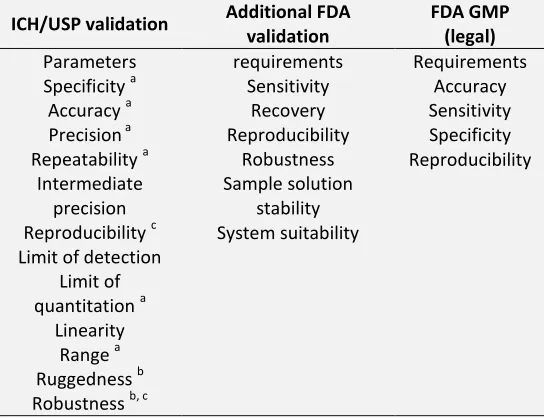
Method validation provides an assurance of reliability during normal use, and is sometime referred to as ‘the process of providing documented evidence that the method does what it is intended to do’. Regulated laboratories must perform method validation in order to be in compliance with US Food and Drug Administration (FDA) regulations. For High-performance liquid chromatography (HPLC) methods validation, guidelines from the FDA 2, 3, US Pharmacopeia (USP) 4 and International Conference on Harmonization (ICH) 5, 6 provide an outline for performing such validation (see Table 2). Method validation has received considerable attention in the literature 9-11 and regulatory agencies. The FDA has added some new sections on method validation to the current Good Manufacturing Practice (cGMP) regulations 7. This would require the manufacturer to establish and document the
accuracy, sensitivity, specificity, reproducibility and any other attribute necessary to validate test methods. Validation is personalized by choosing necessary tests and acceptance criteria for a given method. The comprehensiveness of this kind of validation is based upon the type of method and its requirements. This article begins with a discussion of the overall process of analytical method validation, including instrument qualification as a pre-validation requirement. Then, the theme of validation is taken up on the basis of currently accepted FDA and USP terminology and methodology, incorporating a discussion of the new ICH guidelines.
Procedure to establish method validation plan: The preparation and implementation should follow a validation standard operating procedure (SOP), preferably written in a clear step-by-step instructions design. These include the following possible steps in analytical method validation:
1. Formation of a cross-functional team and assign individual responsibilities.
2. Define the purpose and scope of the method. 3. Determine the validation approach, method
type and corresponding analytical performance characteristics.
4. Prepare a validation SOP.
5. Set the acceptance criteria on the basis of method development data.
6. Write the test method as provisional use only format.
7. Perform pre-validation experiments.
8. Adjust method parameters and/or acceptance criteria if necessary.
9. Approve the validation SOP.
10.Execute the validation SOP and evaluate the results.
11.Prepare the validation report, review and approve.
Available online on www.ijpsr.com 125
Formation of a cross-functional team: Members of the cross-functional team, assembled by the method validation project coordinator, include members from the following departments including analytical development, quality control (end user laboratory management), regulatory affairs, health and safety and the individuals requiring the analytical data. The validation SOP and the validation master plan (VMP) should clearly define the roles and responsibilities of each individual involved in the method validation project, e.g., who will: prepare the validation SOP/guideline, review and approve the SOP, prepare the validation report, review and approve the validation report. All individuals assigned to the validation project should be adequately trained with respect to safety when handling chemicals, biological agents, etc. They should also be trained on the use of the equipment. Training records should be maintained and capability should be assessed.
Pre-validation requirements: In all types of analytical method validation, all required pre-qualification must be performed. The following objects must be evaluated and more extensive evaluation is necessary for those that may have a higher potential to affect the assay.
Analytical equipment qualification: Before undertaking the task of method validation, it is necessary that the analytical system itself is adequately designed, maintained, calibrated and tested. In all cases, proper validation documentation should be archived to support the qualification process. Validation begins at the vendor’s site, in a structural validation stage. During this stage, the analytical instrument and software are developed, designed and produced in a validated environment according to good laboratory practices (GLP), cGMP, and/or International Organization for Standardization (ISO) and others, for example ISO/IEC 17025 12.
Recently, the FDA has published a draft guideline 21-CFR, Part-11 13 which focuses on software validation of computer systems. During the functional validation or qualification stage, the Installation Qualification (IQ), Operational Qualification (OQ), and Performance Qualification (PQ) are performed. The IQ establishes that the instrument is received as designed and specified and that it is properly installed. The OQ process ensures that the specific modules of the system are operating according to the defined specifications for accuracy, linearity and precision.
This process may be as simple as verifying the module self analytical routines, or may be performed by running specific tests to verify, for example, detector wavelength accuracy, flow-rate or injector precision. The PQ step verifies system performance. PQ testing is conducted under actual running conditions across the expected working range. For HPLC, the PQ test should use a method with a well-characterized analyte mixture. It should include the essence of the system suitability section of the general chromatography section (k621l) in the USP 9. After the instrument is placed in the laboratory, and after a set period of use, regulations require maintenance followed by calibration and standardization. A system suitability test provides assurance that a system’s performance is appropriate for use. It is advised to perform a system suitability test before and during analysis studies.
Available online on www.ijpsr.com 126
of components should be determined by comparison to freshly prepared standards. A stability criterion for assay methods is that sample and standard solutions and the mobile phase will be stable for 24 hour under defined storage conditions. Acceptable stability is 2% change in standard or sample response, relative to freshly prepared standards.
The mobile phase is considered to have acceptable stability if aged mobile phase produces equivalent chromatography results (capacity factors, resolution, or tailing factor) and assay results are within 2% of the value obtained with fresh mobile phase. For impurity methods, the sample, standard solutions and mobile phase will be stable for 24 h under defined storage conditions. Acceptable stability is 20% change in standard or sample response at the limit of quantitation, relative to freshly prepared standards. The mobile phase is considered to have acceptable stability if aged mobile phase produces equivalent chromatography and if impurity results at the limit of quantitation are within 20% of the values obtained with fresh mobile phase. If a solution is not stable at room temperature, then reducing the temperature to 2-8oC can improve stability of samples and standards.
System suitability test: Before performing any validation experiments, you should establish that the HPLC system and procedure are capable of providing data of acceptable quality. These tests are used to verify that the resolution and repeatability of the system are adequate for the analysis to be performed. System suitability tests are based on the concept that the equipment, electronics, analytical operations, and samples constitute an integral system that can be evaluated as a whole. System suitability is the examination of a system to ensure system performance before or during the analysis. Parameters such as plate count, tailing factors,
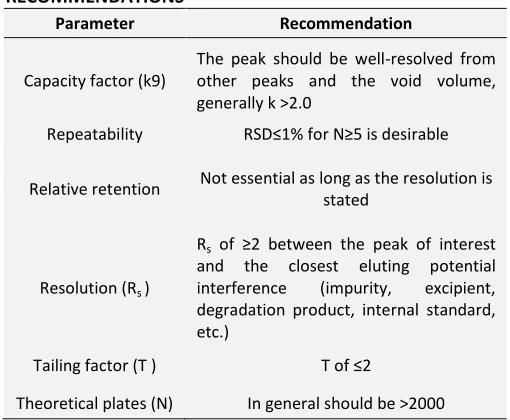
resolution and repeatability (RSD retention time and area for six repetitions) are determined and compared against the specifications set for the method. The parameter to be measured and their recommended limits 3 obtained from the analysis of the system suitability sample are shown in Table 1.
TABLE 1: SYSTEM SUITABILITY PARAMETERS AND RECOMMENDATIONS
Parameter Recommendation
Capacity factor (k9)
The peak should be well-resolved from other peaks and the void volume, generally k >2.0
Repeatability RSD≤1% for N≥5 is desirable
Relative retention Not essential as long as the resolution is stated
Resolution (Rs )
Rs of ≥2 between the peak of interest
and the closest eluting potential interference (impurity, excipient, degradation product, internal standard, etc.)
Tailing factor (T ) T of ≤2
Theoretical plates (N) In general should be >2000
The quality control sample and standard are strongly recommended for the system suitability testing. The sample and standard should be dissolved in the mobile phase. If that is not possible, then avoid using too high level of the organic solvent as compared to the level in the mobile phase. The concentration of sample and standard should be close if not the same and samples should be bracketed by standards during the HPLC analysis.
[image:4.612.310.565.205.415.2]Available online on www.ijpsr.com 127
[image:5.612.34.306.166.375.2]notable exception. ICH treats system suitability as a part of method validation, whereas the USP treats it in a separate section (k621l) chromatography 9.
TABLE 2: COMPARISON OF ICH, USP AND FDA VALIDATION PARAMETERS
ICH/USP validation Additional FDA validation
FDA GMP (legal)
Parameters requirements
Sensitivity Recovery Reproducibility
Robustness Sample solution
stability System suitability
Requirements Accuracy Sensitivity Specificity Reproducibility Specificity a
Accuracy a Precision a Repeatability a
Intermediate precision Reproducibility c Limit of detection
Limit of quantitation a
Linearity Range a Ruggedness b Robustness b, c
As this guideline has reached step 5 of the ICH process, the FDA has begun to implement it, and it is anticipated that the ICH definitions and terminology will eventually be published in the USP. What follows then is a discussion of current USP definitions of the analytical performance parameters compared and contrasted with the ICH definitions. Where appropriate, methodology is also presented according to the ICH guideline on this subject.
Accuracy: Accuracy is the closeness of the test results obtained by the analytical method to the true value. Accuracy is usually determined in one of four ways. First, accuracy can be assessed by analyzing a sample of known concentration (reference materials) and comparing the measured value to the true value. The second approach is to compare test results from the new method with results from an existing alternate well-characterized procedure that is known to be accurate. The third approach, based on the
recovery of known amounts of analyte, is performed by spiking analyte in blank matrices. For assay methods, spiked samples are prepared in triplicate at three levels over a range of 50–150% of the target concentration.
For impurity methods, spiked samples are prepared in triplicate at three levels over a range that covers the expected impurity content of the sample, such as 0.1-2.5% (v/w). The analyte levels in the spiked samples should be determined using the same quantitation procedure as will be used in the final method procedure (i.e., same number and levels of standards, same number of sample and standard injections, etc.). The percent recovery should then be calculated. The fourth approach is the technique of standard additions, which can also be used to determine recovery of spiked analyte. This approach is used if it is not possible to prepare a blank sample matrix without the presence of the analyte.
This can occur, for example, with lyophilized material, in which the speciation in the lyophilized material is significantly different when the analyte is absent. Accuracy criteria for an assay method (FDA) is that the mean recovery will be 100+/-2% at each concentration over the range of 80-120% of the target concentration. For an impurity method, the mean recovery will be within 0.1% absolute of the theoretical concentration or 10% relative, whichever is greater, for impurities in the range of 0.1-2.5% (v/w). To document accuracy the ICH guideline on methodology recommends collecting data from a minimum of nine determinations over a minimum of three concentration levels covering the specified range (for example, three concentrations, three replicates each).
Available online on www.ijpsr.com 128
statistically significant number of samples. According to the ICH 5, precision should be performed at three different levels: repeatability, intermediate precision, and reproducibility. Repeatability is the results of the method operating over a short time interval under the same conditions (intra assay precision). It should be determine from a minimum of 9 determinations covering the specified range of procedure (for example, three levels, three repetitions each) or from a minimum of six determinations at 100% of the test instrument precision or injection repeatability, study should be a minimum of 10 injections of one sample solution is made to test the performance of the chromatographic instrument.
Intermediate precision is the result from within lab variations due to random events such as different day, analysts, equipment, etc. In determining intermediate precision, experimental design should be employed so that the effects (if any) of the individual variables can be monitored. Precision criteria for an assay method is that the instrument precision (RSD) will be≤1% and the intra assay precision will be ≤2%.For impurity assay, at the limit of quantitation, the instrument precision will be ≤5% and the intra assay will be≤10%.Reproducibility 5, which is determined by testing homogenous samples in multiple laboratories, is often a part inter laboratory crossover studies.
The evaluation of reproducibility results often focuses more on measuring bias in results than on determining differences in precision alone. Statistical equivalence often used as a measure of acceptable inter-laboratory results. An alternative, more practical approach is the use of ‘analytical equivalence’, in which a range of acceptable results is chosen prior to the study and used to judge the acceptability of the results obtained from the different laboratories. A n example of the
reproducibility criteria for an assay method could be that the assay results obtained in multiple laboratories will be statistically equivalent or the mean results will be within 10% (relative) of the value obtained by the primary testing lab for impurities,% (w/w) within 25% for impurities from 0.1% to 1.0% (W/W). Documentation should include the SD, RSD, coefficient of variation, and the confidence interval. Reproducibility is not normally expected if intermediate precision is performed.
Specificity: For chromatographic methods, developing a separation involves demonstrating specificity, which is the ability of the method to accurately measure the analyte response in the presence of all potential sample components. The response of the analyte in test mixtures containing the analyte and all potential sample components (placebo formulation, synthesis intermediates, excipients, degradation products, process impurities, etc.) is compared with the response of a solution containing only the analyte.
Other potential sample components are generated by exposing the analyte to stress conditions sufficient to degrade it to 80-90% purity. For bulk pharmaceuticals, stress conditions such as heat (50 to 60oC), light (600 FC of UV), acid (0.1 M HCl), base (0.1 M NaOH), and oxidant (3% H2O2) are typical. For formulated products, heat,
Available online on www.ijpsr.com 129
specificity criteria for an assay method is that the analyte peak will have baseline chromatographic resolution of at least 1.5 from all other sample components. If this cannot be achieved, the unresolved components at their maximum expected levels will not affect the final assay result by more than 0.5%. Examples of specificity criteria for an impurity method is that all impurity peaks that are 0.1% by area will have baseline chromatographic resolution from the main component peak(s) and, where practical, will have resolution from all other impurities.
Limit of detection: The limit of detection (LOD) is defined as the lowest concentration of an analyte in a sample that can be detected, not quantitated. It is a limit test that specifies whether or not an analyte is above or below a certain value. It is expressed as a concentration at a specified signal-to-noise ratio, usually 3:1. The ICH has recognized the signal-to-noise ratio convention, but also lists two other options to determine LOD: visual non-instrumental methods and a means of calculating the LOD. Visual non-instrumental methods may include LOD determined by techniques such as thin-layer chromatography (TLC). LOD may also be calculated based on the SD of the response and the slope (S) of the calibration curve(s) at levels approximating the LOD according to the formula:
LOD=3.3 (SD/S)
The SD of the response can be determined based on the SD of the blank, on the residual SD of the regression line, or the SD of y-intercepts of regression lines. The method used to determine LOD should be documented and sup-ported, and an appropriate number of samples should be analyzed at the limit to validate the level
Limit of quantitation: The limit of quantitation (LOQ) is defined as the lowest concentration of an analyte in a sample that can be determined with acceptable precision and accuracy under the
stated operational conditions of the method. Sometimes a signal-to-noise ratio of 10:1 is used to determine LOQ. This signal-to-noise ratio is a good rule of thumb, but it should be remembered that the determination of LOQ is a compromise between the concentration and the required precision and accuracy. That is, as the LOQ concentration level decreases, the precision in-creases.
The ICH has recognized the 10:1 signal-to-noise ratio as typical, and also, like LOD, lists the same two additional options that can be used to determine LOQ, visual non-instrumental methods and a means of calculating the LOQ. The calculation method is again based on the SD of the response and the slope of the calibration curve(s) according to the formula: LOQ 5:10 (SD/S). Again, the SD of the response can determined based on the SD of the blank, on the residual SD of the regression line, or the SD of y-intercepts of regression lines. The method used to determine LOQ should be documented and supported, and an appropriate number of samples should be analyzed at the limit to validate the level. One additional detail should also be considered; both the LOQ and the LOD can be affected by the chromatography. It shows how efficiency and peak shape can affect the signal-to-noise ratio. Sharper peaks result in a higher signal-to-noise ratio, resulting in lower LOQ and LOD.
Available online on www.ijpsr.com 130
minimum specified ranges. For assay, the minimum specified range is from 80 to 120% of the target concentration. For an impurity test, the minimum range is from the reporting level of each impurity to 120% of the specification (for toxic or more potent impurities, the range should be commensurate with the controlled level). For content uniformity testing, the minimum range is from 70 to 130% of the test or target concentration, and for dissolution testing +/-20% over the specified range of the test. In the literature it is often seen that a range 25-200% of the nominal concentration of analyte is examined
14. In practice the linearity study should be
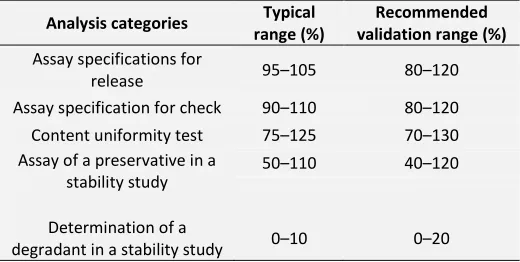
designed to be appropriate for the intended analytical method (Table 3).
TABLE 3: RECOMMENDED VALIDATION RANGES FOR LINEARITY STUDIES
Analysis categories Typical range (%)
Recommended validation range (%)
Assay specifications for
release 95–105 80–120
Assay specification for check 90–110 80–120 Content uniformity test 75–125 70–130 Assay of a preservative in a
stability study 50–110 40–120
Determination of a
degradant in a stability study 0–10 0–20
Acceptability of linearity data is often judged by examining the correlation coefficient and y-intercept of the linear regression line for the response versus concentration plot. A correlation coefficient of 0.999 is generally considered as evidence of acceptable fit of the data to the regression line. The y-intercept should be less than a few percent of the response obtained for the analyte at the target level. In addition, goodness of fit of data to the regression line may be evaluated by a procedure based on the residual sum of squares. Taking the regression line as the mean, a percent RSD is calculated for the data; normally this value should not be greater than 2.0%, but when evaluating this determination, the results of
precision determinations should also be taken into account.
Robustness: The robustness of a method is its ability to remain unaffected by small deliberate variations in method parameters. The robustness of a method is evaluated by varying method parameters such as percent organic solvent, pH of buffer in mobile phase, ionic strength, different HPLC columns (lots and/or suppliers), column temperature, flow-rate etc. These method parameters may be evaluated one factor at a time or simultaneously as part of a factorial experiment
15
. As documented in the ICH guidelines, robustness should be considered early in the development of a method. In addition, if the results of a method or other measurements are susceptible to variations in method parameters, these parameters should be adequately controlled and a precautionary statement included in the method documentation. An example of robustness criteria is that the effects of the following changes in chromatographic conditions will be determined: methanol content in mobile phase adjusted by (+/-2%), mobile-phase pH adjusted by (up to+/-0.5 pH units) and column temperature adjusted by (+/-1 to 5oC). If these changes are within the limits that produce acceptable chromatography, they will be incorporated in the method procedure.
[image:8.612.40.300.341.472.2]Available online on www.ijpsr.com 131 TABLE 4: USP REQUIREMENTS FOR ASSAY VALIDATION
Analytical performance
parameter Assay Category1
Assay Category 2
Assay Category 3 Assay Category 4 Quantitative Limit tests
Accuracy YES YES * * NO
Precision YES YES NO YES NO
Specificity YES YES YES * YES
Limit of detection NO NO YES * YES
Limit of quantitation NO YES NO * NO
Linearity YES YES NO * NO
Range YES YES * * NO
For assays in category 1, LOD and LOQ evaluations are not necessary because the major component or active ingredient to be measured is normally present at high levels. However, since quantitative information is desired, all of the remaining analytical performance parameters are pertinent. Assays in category 2 are divided into two subcategories: quantitative and limit tests. If quantitative information is desired, a determination of LOD is not necessary, but
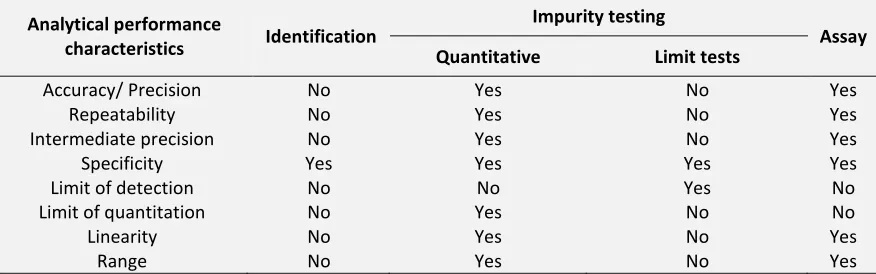
reverses itself for a limit test. Since quantitation is not required, it is sufficient to measure the LOD and demonstrate specificity and ruggedness. The parameters that must be documented for methods in USP assay category 3 are dependent upon the nature of the test. Dissolution testing, for example, falls into this category. The ICH treats analytical methods in much the same manner, as shown in Table 5.
TABLE 5: ICH VALIDATION CHARACTERISTICS Analytical performance
characteristics Identification
Impurity testing
Assay Quantitative Limit tests
Accuracy/ Precision No Yes No Yes
Repeatability No Yes No Yes
Intermediate precision No Yes No Yes
Specificity Yes Yes Yes Yes
Limit of detection No No Yes No
Limit of quantitation No Yes No No
Linearity No Yes No Yes
Range No Yes No Yes
USP categories 1 and 2 match the ICH categories of assay and impurity testing, respectively, and the corresponding discussion above still applies 16. The ICH has not yet chosen to specifically address methods for performance characteristics (USP category 3), but has instead addressed analytical methods for compound identification. In this ICH category, it is only necessary to prove that the method is specific for the compound being identified. A summary of approaches for the statistically similar problem of comparison of
[image:9.612.85.523.381.518.2]Available online on www.ijpsr.com 132
use. By approaching method development, optimization and validation in a logical, stepwise fashion, laboratory resources can be used in a more efficient and productive manner. This paper will provide a complete guide to help you to understand how to perform an analytical method validation that generates both useful and meaningful data that meets all FDA/Center for Drug Evaluation and Research (CDER), USP and ICH validation requirements.
REFERENCES:
1. Eric Rozet a, Attilio Ceccato b, C´edric Hubert a, Eric Ziemons a, Radu Oprean c, Serge Rudaz d, Bruno Boulanger b, Philippe Hubert a, Analysis of recent pharmaceutical regulatory documents on analytical method validation. Journal of Chromatography A, 1158 (2007) 111–125
2. Reviewer Guidance, Validation of Chromatographic Methods, Center for Drug Evaluation and Research, US Food and Drug Administration, 1994.
3. Guideline for Submitting Samples and Analytical Data for Methods Validation. US Food and Drug Administration, February 1987
4. US Pharmacopeia 24, Validation of Compendia Methods, Section k1225l, United States Pharmacopeal Convention, Rockville, MD, 1999, p. 2149.
5. International Conference on Harmonization (ICH) of Technical Requirements for Registration of Pharmaceuticals for Human Use, Topic Q2 (R1): Validation of Analytical Procedures: Text and Methodology, Geneva, 2005.
6. International Conference on Harmonization (ICH), Q2b: Validation of Analytical Procedures: Methodology, US FDA Federal Register, Vol. 62, May 1997, p. 27463. 7. US FDA HSS, 21 CFR Part 211, Current Good
Manufacturing Practice of Certain Requirements for
Finished Pharmaceuticals, Proposed Rule, US Food and Drug Administration, May 1996
8. US Pharmacopeia 23, Chromatography Section k621l, United States Pharmacopeal Convention, Rockville, MD, 1994, p. 1776.
9. Virlichie, J. L. and Ayache, A. A ruggedness test and its application for HPLC validation. S. T. P. Pharma Pratiques, Vol 5(1), pp. 49-60, 1995.
10. J. M. Green, A Practical Guide to Analytical Method Validation, Anal. Chem., 1996, 68, 305A-309A.
11. Maxwell, W. and Sweeney, J., Applying the validation timeline to HPLC system validation. LC/GC, Volume 12(9), September 1994, pg. 678-82W. Maxwell, J. Sweeney, LC: GC 12 (1994) 678.
12. International Standard ISO/IEC 17025: General Requirements for the Competence of Testing and Calibration Laboratories, International Organization for Standardization, 2000.
13. Draft Guidance for Industry: 21 CFR Part 11; Electronic Records; Electronic Signatures, Validation, US Food and Drug Administration (August 2001).
14. Guidelines for collaborative study procedure to validate characteristics of a method of analysis, J. Assoc. Off. Anal. Chem. 72 (1989) 694.
15. Virlichie, J. L. and Ayache, A. A ruggedness test and its application for HPLC validation. S. T. P. Pharma Pratiques, Vol 5(1), (1995) 37.
16. Oscar Quattrocchi,a Greg Martin, a Dennis Runser,a Robert Iser,b Fred Xi. A Horacio Pappac Pharmacopeial Forum 35(5) (Sept.–Oct. 2009) 1382.
17. Ghulam A. Shabir, Validation of high-performance liquid chromatography methods for pharmaceutical analysis: Understanding the differences and similarities between validation requirements of the US Food and Drug Administration, the US Pharmacopeia and the International Conference on Harmonization , Journal of Chromatography A, 987 (2003) 57–66
18. Hauck WW, DeStefano AJ, Cecil TL, Abernethy DR, Koch WF,Williams RL. Acceptable, equivalent, or better: approaches for alternatives to official compendia procedures. Pharmacopeial Forum.35 (3) (2009) 772–778