ISSN: 1992-8645 www.jatit.org E-ISSN: 1817-3195
531
THE LEVEL OF ICT USAGE AND ITS EFFECT ON HRM
FUNCTIONS IN EDUCATIONAL INSTITUTIONS IN ABHA –
SAUDI ARABIA: AN EMPLOYEES' PERSPECTIVE
1Dr. RAID M AL-ADAILEH, 2Dr. MOHAMMAD S. SARAIREH, 3RAJAE A AlOMIS
1
Associate Professor of Management Information Systems, Department of MIS, Mutah University, Jordan 2
Associate Professor of Computer Engineering, Department of CE, Mutah University, Jordan 3
Ministry of Education, Saudi Arabia
:
[email protected], [email protected]ABSTRACT
The present study aimed to identify the level of Information and Communication Technology (ICT) usage and the effect of ICT dimensions on Human Resources Management (HRM) functions in educational institutions in Abha according to employees' point of view. To achieve these goals, the study developed a questionnaire designed for this purpose. Convenient sample was selected consisting of (160) employees working in educational institutions in Abha. The results were as follows: There is a statistically significant effect at (0,05) level for "databases" and "softwar" on HRM functions. The level of agreement with the statements measuring ICT dimensions' usage is medium for all ICT dimensions The study provided some recommendations according to study results, among them: Make more efforts to improve both (Databases and software) as dimensions of ICT since these two dimensions significantly affect the functions of HRM. Educational management must improve the usage levels of ICT to realize the added value of ICT tools
Keywords: ICT Usage, Human Resources Functions, Databases, Software, Hardware, Internet.
1. INTRODUCTION
Organizations are witnessing a vast growth of size and diversification of its activities as a result of the rapid developments in the surrounding environments, especially the technological environment.
The organizations have been facing a new form of competition, not known before; where such status resulted in the need for providing qualified and effectively managed human resources in order to meet the requirements of a technology-led organizations.
This will enhance the maximization of positive impacts of new technologies which will help the management of human resources to maximize its added value through re-engineering of these resources in a way that fits the new conditions created by Information and Communication Technology (ICT) [1].
In the light of these conditions, the need for distinctive human resources increased, to adapt to the high skills needed by the market and to overweigh the competitors. Therefore, the practices of Human Resources Management (HRM) have changed to fit the new age requirements to become
more integrated with the organization strategies through an interactive and integrated relationship. Many studies have concluded that ICT leads to improving the functions of human resources and performance in the company [2][3][4][5][6]. [7] called for the necessity to reformulate the policies of human resources to include the factors related to the technological revolution. The scarcity of the available studies within the context of Saudi organizations and the growing concern in IT investments have provided a motivation to conduct this particular study.
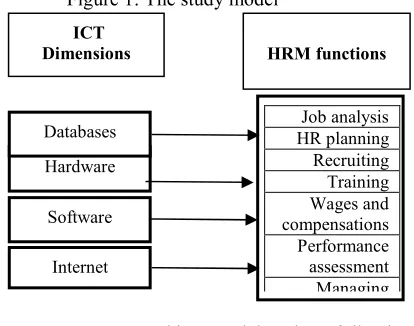
Accordingly, the idea of this study has been ignited to recognize the degree of ICT usage (databases, hardware, software, and internet) and its impact on the functions of HRM (job analysis, human resources planning, recruiting, training, wages and compensations, assessment of performance, and managing the relations with employees), in education institutions in Abha-Saudi Arabia as perceived by the employees.
ISSN: 1992-8645 www.jatit.org E-ISSN: 1817-3195
532 presented. the research methodology (sampling, data instrument) is also outlined. Then, analysis of data, discussion and implications and finally some recommendations are discussed.
2. PROBLEM OF THE STUDY
The modern times witnessed unprecedented and rapid developments in all aspects of life. The most prominent developments was the dynamic changes in technology especially in information processing and transmission. This technology has become the main approach that people depend upon increasingly to manage their activities. Such technology is expected to dominate more activities in the near future.
This new situation has imposed new challenges against organizations. These challenges take different forms and contents than before. These challenges are more intensive against the developing than developed countries due to the less advanced technology in the developing countries especially in the field of ICT.
However, this doesn't mean that the developing countries, including Arab countries, haven't been influenced by the results of such technology in the business. Arab managers including HRM are obliged to bear the responsibility for adaptation and applications of ICT in developing the procedures and measures of the management. The potential impact of the application of ICT must however be investigated in order to identify the nature of interaction and the important concerns that must be considered to maximize the added value of ICT applications with regards to HRM practices. Accordingly this study seeks to answer the following main questions:
1. What is the level of ICT usage (Databases, hardware, software and internet) within the research context from the employees' perspective?
2. What is the impact of ICT (Databases, hardware, software and internet) on the functions of HRM (job analysis, HR planning, recruiting, training, performance assessment, and managing the relations with employees), as perceived by employees?
3. THE IMPORTANCE OF THE STUDY
This study obtains its theoretical importance from the variables included in the study, either for ICT which plays a great role in formulating the present and future as well as building a developed society,
where such technology has become a basic requirement in all aspects of life in general and in HRM in specific as the latter is the most important resource that is able to achieve the targeted levels of performance, especially in the highly competitive environment of today.
This study may also contribute to provide an accurate description of ICT and HRM and to clarify the level of ICT usage and its impact on the functions of HRM. The study provides a description of the state of the art concerning the level and value of ICT in relation to HRM functions within the context of educational institutions of Abha-Saudi Arabia, to enable decision makers to know the existing status of ICT and to determine the shortcomings to eliminate them through suitable plans and programs.
4. OBJECTIVES OF THE STUDY
This study seeks to achieve the following two objectives:
1. Identify the impact of ICT dimensions (databases, hardware, software, and internet) on the functions of HRM as perceived by the employees of educational institutions in Abha-Saudi Arabia.
2. Identify the level of using ICT (databases, hardware, software, and internet) as perceived by the employees of educational institutions in Abha-Saudi Arabia.
5. STUDY MODEL AND HYPOTHESES:
[image:2.612.316.523.503.666.2]Based on the above discussion, the research conceptual model is shown in figure (1) below.
Figure 1: The study model
To test this model, the following hypotheses were proposed:
Ho1: There is no statistically significant impact for ICT dimensions (databases, hardware, software, and internet) on the functions of HRM as perceived by the employees of
ICT Dimensions
Software
Internet
Job analysis HR planning Recruiting Training Wages and compensations Performance assessment Managing Hardware
HRM functions
ISSN: 1992-8645 www.jatit.org E-ISSN: 1817-3195
533 educational institutions in Abha-Saudi Arabia.
Ho2: The level of using ICT (databases, hardware, software, and internet)is low as perceived by the employees of educational institutions in Abha-Saudi Arabia.
6. THEORETICAL FRAMEWORK
The rapid technological growth and the need for rapid achievement and desire of people to obtain services in an accurate and timely manner, with the weakness of the classical management to meet the requirements and needs of clients, a review of the current systems and approaches of services has become a necessity.
Therefore, organizations began to search for ICT tools as the answer for their questions and concerns to compete and survive in a technology-led environment. ICT can greatly contribute to the redaction of production costs, improvement of the price levels; decrease the time for production, improvement of competitive capability and survival [8]. Moreover, technological revolution had paved the road for the transition process from industrial to informational society. Such revolution began to make footprints in economy, society and culture and proved its impacts on the modern society. The basis for ICT revolution is the integration of hardware, software and telecommunication technologies. During the late decades of 20th century these technologies had witnessed huge and rapid advancement that offered speedy and more effective performance[9]. Therefore, investment in ICT has become one of production elements, since it increases the productivity and provides more opportunities for employment.
In this sense, the knowledge economy depends mainly on the efficiency of organization in collecting and using knowledge to increase productivity, generate new products and services that are distributed by the knowledge network in which the information is changed continuously in rapid rates.
Therefore, the relationship between organizational development and ICT usage has become clear, hence the investment in ICT has created a new source of cost economies and raised the production efficiency[10].
ICT Dimensions and HR Functions
The components of ICT are linked together and provide the organization with the best results
[11][12]. These components are detailed as follows: [13]
1. Databases: where large amount of data can be stored to be used for different purposes. 2. Devices (Hardware): These are the devices
used for input, processing, and output of data.
3. Software: These are programs prepared for different purposes such as operating systems, processing, and applications for different purposes. These programs communicate with computers through the operating systems.
4. Telecommunications: This component is a result of technological infrastructure, which helped transmitting the data and information through cables, wireless and satellite data transfer protocols.
5. Networks: These are integrated technologies either locally (LAN) or widely (WAN) or internet.
6. Internet: which links millions of computers and users together in a dedicated environment that serves all purposes of clients and producers.
Many researchers assure that the application of ICT tools affect all activities of organization including HRM. This study will clarify the impact of ICT on some selected HR functions including: job analysis, HR planning, recruiting, training, performance assessment, and managing employees' relations.
ISSN: 1992-8645 www.jatit.org E-ISSN: 1817-3195
534 ICT can also support the development of human competencies as one of the functions of HRM, where some scholars and practitioners focus on this point as the core function of HRM. The programs of development utilize the information system in reviewing the activities and capabilities of employees and find the best methods for training development.
Previous Studies
Through reviewing the previous studies relating to this study variables, the researchers found many similar studies but with different focus. Appendix 1 provides an outline for the most relevant and recent studies.
The previous studies indicated that ICT has impact on the functions of HRM, like the study of
Mouasher and Al-Khasabah (2006), which showed
a statistically significant impact for technology factors on the organizational and administrative factors; the study of Altimiyat (2007), which indicated a statistically significant relationship between using IT and the efficiency of HRM; and Saghior study (2009), which indicated a positive impact for IT on all activities of HRM.
This study is focused on exploring the level of ICT usage and its impact on the functions of HRM in the educational institutions in Abha-Saudi Arabia, as perceived by its employees. The distinction is related to the nature of study population and the importance of recognizing the level of ICT usage in a large sector, the education.
7. METHODOLOGY
This study used the descriptive-analytical methodology, by the questionnaire as the instrument for data collection. The descriptive-analytical methodology focuses on studying the variables and phenomena in real situation. The topic of this study tries to describe and analyze the impact of ICT on HRM functions in order to forecast the possible impact of ICT. The study depended on two types of data:
1. Secondary Data: This data includes textbooks, journals and review of the literature relating to the topic.
2. Primary Data: The study collected the primary data from a sample of the study through the questionnaire. The returned questionnaires were analyzed to measure the variables of the study and to test the hypotheses.
Population and Sample
The population of the study includes all employees of the educational institutions in Abha-Saudi Arabia. This population was targeted due to its direct contact with the variables of the study. The researchers applied the study on Abha educational institutions due to their importance in Aseer Region, additionally, Abha is one of the major cities in Saudi Arabia.
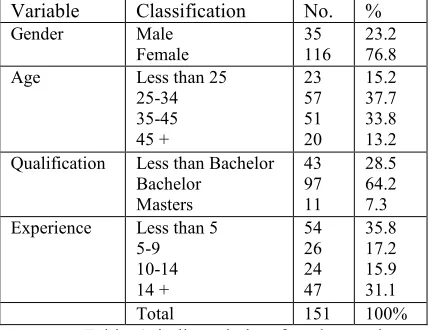
Convenient sample including 160 employees were selected as a sample, 155 responded to the questionnaire(96.88% response rate). After verifying the responses the researchers excluded 4 questionnaires as they did not meet the criteria. The total number of responses subject to analysis were 151 questionnaires, representing 94.38% of the sample size. Table 1 shows the characteristics of the study sample.
Table 1: Characteristics of the Sample
Variable Classification No. % Gender Male
Female
35 116
23.2 76.8 Age Less than 25
25-34 35-45 45 +
23 57 51 20
15.2 37.7 33.8 13.2 Qualification Less than Bachelor
Bachelor Masters
43 97 11
28.5 64.2 7.3 Experience Less than 5
5-9 10-14 14 +
54 26 24 47
35.8 17.2 15.9 31.1 Total 151 100% Table 1 indicated that female employees out weighted male employees, while the age range 25-34 years was the highest percentage. It also shows that bachelor holding employee's had the highest percentages, while the experience of less than 5 years was the highest percentage in the sample.
Data Collection Instrument
A questionnaire was designed for collecting the primary data based on review of the previous studies. Face and contents validity of the questionnaire were initially judged by professionals and academics in the topic in order to assure its validity. The questionnaire contents were a mended according to the advices of judges.
[image:4.612.308.524.328.493.2]
ISSN: 1992-8645 www.jatit.org E-ISSN: 1817-3195
535 second dimension measured the independent variable: the aspects of ICT including hardware, software, databases and internet. The third dimension measured the dependent variable: the functions of HRM including job analysis, the planning of human resources, recruiting, training, wages and compensations, performance assessment, and managing relations with employees. The questionnaire adopted Likert five point scale to measure responses (ranging from 1= greatly disagree to 5= greatly agree).
Cronbach’ alpha as a reliability measure for survey items was used as shown in table 2 and table 3.
Table 2: Coefficients of Chronbach-Alpha for ICT items ad variables
Hardware Internet Software Databases Ite m No. Alp ha Ite m No. Alp ha Ite m No. Alp ha Ite m No. Alp ha
1 0.58 5 0.80 9 0.75 14 0.87 2 0.75 6 0.73 10 0.72 15 0.86 3 0.60 7 0.80 11 0.78 16 0.86 4 0.68 8 0.84 12 0.77 17 0.87 13 0.75 18 0.87 Tot
al
0.72 Tot al
0.84 Tot al
0.79 Tot al
0.89
Table 3: Coefficient of Chronbach-Alpha for the HRM functions
Planning Recruiting Compensatio
ns Job Analysis Item No. Alph a Item No. Alph a Item No. Alph a Item No. Alph a
19 0.88 23 0.80 27 0.70 30 0.81
20 0.83 24 0.83 28 0.74 31 0.74
21 0.85 25 0.82 29 0.77 32 0.79
22 0.85 26 0.81 33 0.73
Tota l
0.88 Tota
l
0.86 Total 0.81 Tota
l
0.82
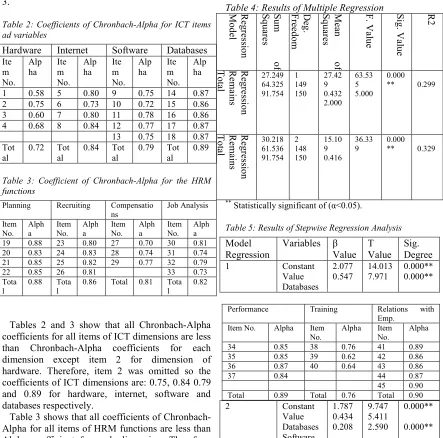
Tables 2 and 3 show that all Chronbach-Alpha coefficients for all items of ICT dimensions are less than Chronbach-Alpha coefficients for each dimension except item 2 for dimension of hardware. Therefore, item 2 was omitted so the coefficients of ICT dimensions are: 0.75, 0.84 0.79 and 0.89 for hardware, internet, software and databases respectively.
Table 3 shows that all coefficients of Chronbach-Alpha for all items of HRM functions are less than Alpha coefficient for each dimension. Therefore, the coefficient values of Chronbach-Alpha for
HRM functions are as shown in table 3: 0.88; 0.86; 0.81; 0.82; 0.89; 0.76; 0.90 respectively.
8. HYPOTHESES TESTING
Results of the First Hypotheses
Ho1: There is no statistically significant impact for ICT dimensions (databases, hardware, software, and internet) on the functions of HRM as perceived by the employees of educational institutions in Abha-Saudi Arabia.
[image:5.612.88.531.259.697.2]Multiple and stepwise regression analysis methods were used to test our proposed model and hypotheses. Table 4 and 5 show the results.
Table 4: Results of Multiple Regression R
eg re ss io n M o d el S u m o f S q u ar es D eg . F re ed o m M ea n o f S q u ar es F . V al u e S ig . V al u e R 2 R eg re ss io n R em ai n s T o ta l 27.249 64.325 91.754 1 149 150 27.42 9 0.432 2.000 63.53 5 5.000 0.000
** 0.299
R eg re ss io n R em ai n s T o ta l 30.218 61.536 91.754 2 148 150 15.10 9 0.416 36.33 9 0.000
** 0.329
**
Statistically significant of (α<0.05).
Table 5: Results of Stepwise Regression Analysis
Model Regression
Variables β Value
T Value
Sig. Degree 1 Constant
Value Databases 2.077 0.547 14.013 7.971 0.000** 0.000**
2 Constant Value Databases Software 1.787 0.434 0.208 9.747 5.411 2.590 0.000** 0.000**
Tables 4 and 5 shows a statistically significant impact at (α<0.05) for the dimensions of
Performance Training Relations with
Emp.
Item No. Alpha Item
No.
Alpha Item
No.
Alpha
34 0.85 38 0.76 41 0.89
35 0.85 39 0.62 42 0.86
36 0.87 40 0.64 43 0.86
37 0.84 44 0.87
45 0.90
ISSN: 1992-8645 www.jatit.org E-ISSN: 1817-3195
536 ICT on the functions of HRM. Such impact was represented in two regression models where the second model (as in table 6) was more comprehensive and consisted of "Databases" and "Software" as dimensions for ICT as independent variables and the functions of HRM as dependent variables.
Table 5 shows that the value of R squire was 0.329 in the regression model which means that databases and software, as dimension of ICT could explain 32.9% of the variation in the depended variable (functions of HRM). This assures the explaining ability of regression model in terms of statistical analysis.
We conclude that both databases and software have significant and positive impact on the functions of HRM.
These findings agree with the study of Mouasher and Al-Khasabah (2006) which indicated statistically significant impact for technological factors on the organizational and administrative factors. They also agree with Altimiyat study (2007) which indicated a statistically significant relationship between using IT and the efficiency of HRM. The study of Saghior (2009), also indicated a positive impact for IT on all activities of human resources.
Results of the Second Hypotheses
Ho2: There is a high level of ICT usage as
perceived by the employees of educational administrative in Abha-Saudi Arabia.
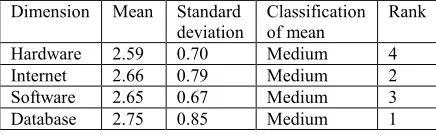
[image:6.612.308.526.142.209.2]To test this hypotheses, the researchers calculated means and standard deviations for the dimension of ICT by using SPSS package. Table 6 shows the classification of the means values.
Table 6: Classification of Mean Values
Sigment* Classification 1-2.49 Low
2.50-3.49 Medium 3.50-5.00 High
If the means value of the variable is more than or equal to 3.5, then the level of agreement with the statements measuring the certain variable is high. If the mean value of the variable ranges between 2.5 and 3.49, then the level of agreement with the statements measuring the certain variable is medium. If the means value of the statement is equal to or less than 2.49, then the level of agreement with the statements measuring the certain variable is low. Table 7 shows the means and standard deviations for each dimension of ICT.
Table 7: Means and Standard Deviations for the dimensions of ICT
Dimension Mean Standard deviation
Classification of mean
Rank
Hardware 2.59 0.70 Medium 4 Internet 2.66 0.79 Medium 2 Software 2.65 0.67 Medium 3 Database 2.75 0.85 Medium 1
The table shows that the level of agreement with the statements measuring ICT dimensions usage is medium for all ICT dimensions. This indicates the need to improve the level of ICT usage in the educational institutions.
9. RECOMMENDATIONS
In the light of the results achieved, the study can recommend the following:
1. Make more efforts to improve both (Databases and software) as dimensions of ICT since these two dimensions significantly affect the functions of HRM. 2. Educational management must improve
the usage levels of ICT to realize the added value of ICT tools.
3. Provide training programs in the field of ICT for employees in the educational institutions in Asser region to develop their skills in this field.
4. More studies are needed to explore some other relevant concerns. Particularly, the study suggest investigation of the impact of ICT application on other organizational functions.
[image:6.612.115.276.540.595.2]ISSN: 1992-8645 www.jatit.org E-ISSN: 1817-3195
537 REFERENCES:
[1] Bouhassan, S. (2011). The Actual Impacts of ICT on the Application of Human Resources Management (Master Thesis). Faculty of Economics and Institutions, University of Qasuntinah, Algeria.
[2] Reis, M. (2005). The Impact of Information Technology on the Human Resources in the Corporate (Master thesis). University of Algeria.
[3] Altimiyat, H. (2007). Uses of Information Technology and its Impact on the Efficiency of Human Resources Management in Saudi Arabia (Master Thesis). Faculty of Graduate Studies, University of Jordan.
[4] Al-Jedaia, M. (2008). The Level of the Use of
Information and Communication
Technologies Tools (ICTs) in Industrial Jordanian Shareholding Companies and its Effect on Organizational Performance: Field Study. Jordan Journal Of Business Institutions, 4(2), 164-192.
[5] Saghior, H. (2009). The Impact of ICT on the Functions of HRM: A Case Study on Syrian Virtual University (Master thesis). Faculty of Economics, University of Damascus, Syria. [6] Cortel, F. (2016). Strategy of Human Resources
Management in the Globalization with an Indication to Arab Countries. In International Conference, Globalization of Management in the Age of Knowledge. Tripoli.
[7] Salih, G. (2003). Challenges Contemporary of Scientific and Technological Revolution and its Impacts in the Obstacles of Human Resources in UAE (Master thesis). College of Commerce, University of Cairo, Egypt.
[8] Alarabi, A. (2010). Usage of Information Technology and its Impact on the Job Performance of Public Sector Employees"; A Field Study in Warqala University, Algeria. Journal Of Researcher, 10, 322-329.
[9] Kawja, B. (2013). The Role of ICT in Improving the Internal Communication in the Public Hospital of Algeria: A Case Study on the Hospital of Mohammad Boudiaf in Warqalah (Master thesis). Faculty of Economics and Institutions, University of Qasid: Meriah, Warqalah.
[10] haj, E., & Hawari, M. (2003). The Role of Information Technology in Improving the Capabilities of Algerian Economic Corporate. In First National Seminar on Algerian Economic Corporate and the Challenges of New Environment. Algeria.
[11] Alqardooh, F. (2009). The Impact of Information on the HRM Performance; Applied Study on the Management of Benghazi Port (Master thesis). The Impact of Information on the HRM Performance; Applied Study on the Management of Benghazi Port.
[12] Aldolaimi, I. (2006). Analyzing the Relationship between Informatics Culture and the Efficiency of HRM and its Impacts on Building Core Competencies";: A Field Study on a Selected Sample of the Faculties of Baghdad University (Doctorate Dissertation). University of Baghdad, Iraq.
[13] Harizi F. (2001). The Role of Modern Telecom Technology in Achieving the Goals of Sustained Human Development Strategy in Algeria:Case Study: Algerian Telecom Corporate (Master thesis). University of Farhat Abbas at Satif, Algeria.
[14] Alfarsi, K. (2006). The Impact of HRM Functions on Achieving the Organizational Change in the Central Ministries in Oman, Field Study (Master). Faculty of Graduate Studies, University of Jordan, Jordan.
[15] Alkhawaldah, R., & Alhnaiti, M. (2008). Uses of Information Technology and its Impact on the Administrative Creativity in the Jordanian organizations. Dirasat Journal For Administrative Sciences, 35(2), 320-342. [16] Alibrahim, A. (2010). The Relationship
between Administrative Perspectives and Information and Telecom Technology and its Role in decision Taking", A Field Study on Directors and Officers of the Vocational Training Counters in Jordan. Journal Of Damascus University, 25(4).
[17] Footah, S., & Alqotob, M. (2013). The Impact of HRM Practices on the learning and Growth of Employees in Jordanian Commercial Banks. Jordan Journal For Applied Sciences, Series Of Humanities, 15(1), 163-178.
[18] AlHazzani, N. (2011). Challenges of Information Technology in the Higher Educational Organizations as Perceived by the Academic and Administrative Leaders in King Saud University. In The 3rd Conference on the E-Learning and Remote Learning. Riyadh, Saudi Arabia.
ISSN: 1992-8645 www.jatit.org E-ISSN: 1817-3195
538 APPENDIX (1) Summary Of The Previous Studies
Author/ Year Title Objectives Instrument Results
1. Alfarsi 2006[14]
The impact of HRM functions on achieving the organizational change in the Central Ministries, in Oman (Field Study)
Recognize the impact of HRM functions on achieving the organizational change in the Central Ministries in Oman.
Questionnaire There is a statistically significant impact for HRM functions on achieving the organizational change.
2. Altimiyat 2007[3]
Impact of using IT on the efficiency of HRM in Saudi Arabia
Recognize the impact of using IT on the efficiency of HRM in Saudi Ministries.
Questionnaire There is a statistically significant
relationship between using IT and efficiency of HRM. 3. Alkhawaldah
and Alhnaiti 2008[15]
The impact of using IT on the administrative creativity in the public organizations, Jordan
Recognize the impact of using IT
on the
administrative creativity in the public
organizations, Jordan
Questionnaire There is a statistically significant
relationship among the following dimensions (using IT and nature of used programs, extent of the suitability of system information; information
integration;
productivity of used IS, training) and administrative creativity. 4. Saghior
2009[7]
The impact of ICT on the functions of HRM
Recognize the impact of ICT on the function of HRM
Investigation &
Questionnaire
There is a positive impact of ICT on all activities of HRM.
5. Alibrahim 2010[16]
The relationship between
administrative doctrines and ICT role in taking administrative decisions; a field study on the manages and officers of vocational training centers in Jordan
Explore the relationship administrative doctrines and ICT role in taking administrative decision by the managers and officers of vocational training centers.
Questionnaire The highest means of managers' responses were to the favor of behaviorism. The use of IT by managers and officers, provide their decisions with transparency and clarity.
6. Bouhassan 2011[1]
The actual impacts of using ICT on the applications of HRM in the institution, a case study on Mobiles and Nedjma, Dasanteena
Attempt to study the modern topics that are related to ICT and methods of utilizing it in HRM.
ISSN: 1992-8645 www.jatit.org E-ISSN: 1817-3195
539 7. Footah and
Alqotob 2013[17]
The impact of HRM practices on learning and growth of employees in Jordan Commercial Banks
Clarification of exist and nature of HRM practices in the banking sector. Clarification of the importance of performance card dimensions in measuring the performance of organization.
Questionnaire All banks apply the HRM 8 practices in a high degree.
8. AlHazzani 2013[18]
Challenges of information
technology in the Organizations of Higher Education as perceived by the administrative and academic leaderships at King Saud University
Recognize the challenges of IT in the Organizations of High Education as perceived by the administrative and academic
leaderships at King Saud University.
Questionnaire Human challenges represent the most important challenges of IT as perceived by the top administrative and academic leadership at the University of King Saud. These challenges includes: Training of staff on operating and maintenance of IT systems.
Awareness to the importance of IT challenges.
9. Mouasher and
Al-Khasabah 2006[19]
The impact of organizational and Technical Factors on the Applications of MIS, Applied Study, Banking Sector, Jordan
Recognize the impact of organizational and technical factors on the applications of MIS in banking sector, Jordan.