IJPSR (2012), Vol. 3, Issue 10 (Review Article)
Received on 16 June, 2012; received in revised form 14 September, 2012; accepted 25 September, 2012
CAUSES AND CONDITIONS ASSOCIATED WITH REDUCED LEVEL OF VITAMIN B12: A REVIEW
Chandrakant Belwal
Sterling Biotech Research Center, Vadodara, Gujarat, India
ABSTRACT
Vitamin B12 plays an important role in building of genetic material, in
development of normal red blood cells and in maintenance of nervous system. Major deficiency symptoms of Vitamin B12 include anemia and
neurological disorders. The daily recommended intake of vitamin B12 for an
adult is 1.5μg a day. Eating a diet containing required amount of vitamin B12
is the best way to treat the conditions associated with its low level. Vitamin B12 found only in animal based foods such as meats, liver, kidney, fish, eggs,
milk and milk products, oysters and shellfish. Hence, vegetarians are more likely to have low level of Vitamin B12.
INTRODUCTION: Vitamins were discovered in the early
part of the twentieth century, In 1912, Polish scientist Cashmir Funk named the special nutritional parts of food as a "vitamine" after "vita" meaning life and "amine" from compounds found in the thiamine he isolated from rice husks. Vitamine was later shortened to vitamin. Funk isolated vitamin B1 (thiamine) from
rice 1.
There are two types of vitamins, fat-soluble (A, D, E, and K) and water-soluble (B and C). Water-soluble vitamins dissolve easily in water and, in general, are readily excreted from the body, to the degree that urinary output is a strong predictor of vitamin consumption 2. Because they are not readily stored, consistent daily intake is important. Many types of water-soluble vitamins are synthesized by bacteria 3. Fat-soluble vitamins are absorbed through the intestinal tract with the help of lipids.
Eight of the water-soluble vitamins are known as the B-complex group: thiamin (vitamin B1), riboflavin
(vitamin B2), niacin, vitamin B6, folate, vitamin B12,
biotin and pantothenic acid. These vitamins are widely
distributed in foods. Their influence is felt in many parts of the body. They function as coenzymes that help the body obtain energy from food. They also are important for normal appetite, good vision, healthy skin, healthy nervous system and red blood cell formation. Beriberi, pellagra and pernicious anemia are three well-known B-vitamin deficiencies.
Vitamin B12 aids in building of genetic material, aids in
development of normal red blood cells and aids in maintenance of nervous system. Major deficiency symptoms of Vitamin B12 include anemia and
neurological disorders. Vitamin B12 found only in
animal based foods such as meats, liver, kidney, fish, eggs, milk and milk products, oysters and shellfish. Hence vegetarians are more likely to have low level of Vitamin B12.
Keywords: Vitamin B12, Cyanocobalamin, Pernicious anaemia, Neurological disorder,
Animal products
Correspondence to Author:
Chandrakant Belwal
Sr. Manager R&D, Sterling Biotech Research Center, Vadodara, Gujarat, India
E-mail: [email protected]
QUICK RESPONSE CODE
IJPSR:
ICV- 4.57
Website:
Vitamin B12 works with the B vitamin folate to make
DNA, our body’s genetic material. B12 is needed to
protect nerve cells from damage. It also helps keep blood levels of the amino acid homocysteine low. This may help to decrease heart disease risk in some people
4
.
Vitamin B12 is essential for two types of enzymatic
reactions in humans; methyl group transfer and transfer of a hydrogen atom from one carbon to an adjacent carbon atom.
Vitamin B12 participates in three essential enzymatic
reactions in the human body. Methionine synthetase requires methylcobalamin for conversion of homocysteine to methionine. Methylmalonyl CoA mutase requires 5’-deoxyadenosylcobalamin to convert L-methylmalonyl CoA to succinyl CoA. Leucine aminomutase requires 5’-deoxyadenosylcobalamin to isomerize L-leucine and beta-leucine
Structure and chemical composition of Vitamin B12:
Vitamin B12 is the largest and most complex of all the
vitamins. The name vitamin B12 is generic for a specific
group of cobalt-containing corrinoids with biological activity in humans. Interestingly it is the only known metabolite to contain cobalt, which gives this water-soluble vitamin its red colour. This group of corrinoids is also known as cobalamins.
The main cobalamins in humans and animals are hydroxocobalamin, adenosylcobalamin and methyl-cobalamin, the last two being the active coenzyme forms. Cyanocobalamin is a form of vitamin B12 that is
widely used clinically due to its availability and stability. It is transformed into active factors in the body.
In 1934, three researchers won the Nobel prize in medicine for discovering the lifesaving properties of vitamin B12. They found that eating large amounts of
raw liver, which contains high amounts of vitamin B12,
could save the life of previously incurable patients with pernicious anaemia. Vitamin B12 was isolated from liver
extract in 1948 and its structure was elucidated 7 years later by A. R. Todd in 1955.
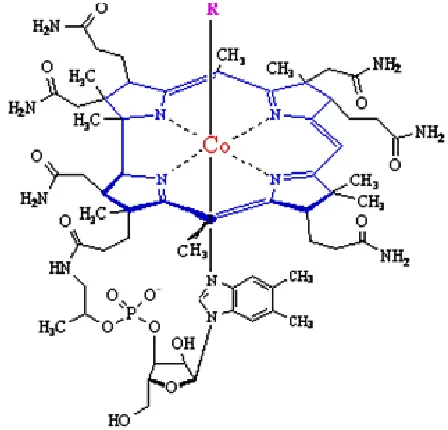
The structure of vitamin B12 (Figure 1) is based on a
corrin ring, which has two of the pyrrole rings directly bonded. The central metal ion is Co (cobalt). Four of the six coordinations are provided by the corrin ring
[image:2.612.337.561.139.354.2]nitrogens, and a fifth by a dimethylbenzimidazole group. The sixth coordination partner varies, being a cyano group (-CN) (cyanocobalamin), a hydroxyl group (-OH) (hydroxocobalamin), a methyl group (-CH3) (methylcobalamin) or a 5'-deoxyadenosyl group (5-deoxyadenosylcobalamin) 5, 6, 7, 8, 9, 10, 11, 12, 13.
FIGURE 1: GENERAL STRUCTURE OF VITAMIN B12
R represent to either a cyano group (-CN) (cyanocobalamin), a hydroxyl group (-OH) (hydroxocobalamin), a methyl group (-CH3) (methylcobalamin) or a 5'-deoxyadenosyl group (5-deoxyadenosylcobalamin)
Vitamin B12 is the only known essential biomolecule
with a stable metal-carbon bond, it is an organometallic compound. The cobalt can link to:
1. A methyl group - as in methylcobalamin
2. A 5'-deoxyadenosine at the the 5' positon - as in adenosylcobalamin (coenzyme b12 )
3. A cyanide group - as in vitamin b12 - as
synthesized and supplied from drug companies
Sources and Daily requirement of Vitamin B12: Most
microorganisms, including bacteria and algae, synthesize vitamin B12, and they constitute the only
source of the vitamin 14. The vitamin B12 synthesized in
microorganisms enters the human food chain through incorporation into food of animal origin. In many animals, gastrointestinal fermentation supports the growth of these vitamin B12 synthesizing
This is particularly true for the liver, where vitamin B12
is stored in large concentrations. Products from herbivorous animals, such as milk, meat, and eggs, thus constitute important dietary sources of the vitamin, unless the animal is subsisting in one of the many regions known to be geochemically deficient in cobalt
15. Milk from cows and humans contains binders with
very high affinity for vitamin B12, though whether they
hinder or promote intestinal absorption is not entirely clear. Omnivores and carnivores, including humans, derive dietary vitamin B12 almost exclusively from
animal tissues or products (i.e. milk, butter, cheese, eggs, meat, and poultry).
It appears that the vitamin B12 required by humans is
not derived from microflora in any appreciable quantities, although vegetable fermentation preparations have been reported as being possible sources of vitamin B1216, 17.
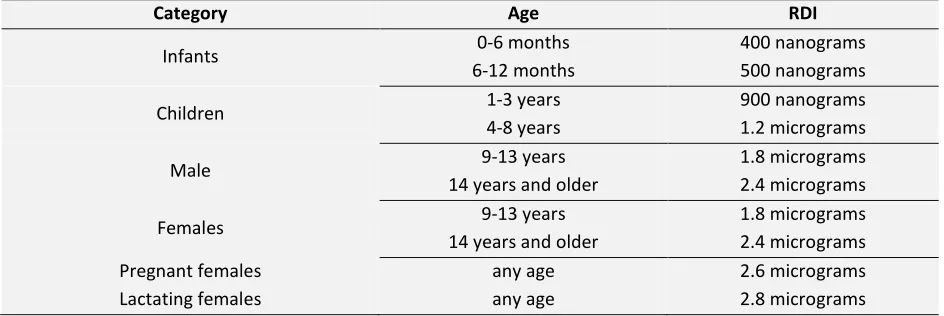
Recommended Dietary Intake (RDI) for vitamin B12
(Table 1)were set in 1998 by the National Academy of
[image:3.612.71.543.247.405.2]Sciences. Recommended Dietary Intake (RDI) for vitamin B12 is summarized in table-1 18, 19.
TABLE 1: RECOMMENDED DIETARY INTAKE (RDI) FOR VITAMIN B12
Category Age RDI
Infants 0-6 months 400 nanograms
6-12 months 500 nanograms
Children 1-3 years 900 nanograms
4-8 years 1.2 micrograms
Male 9-13 years 1.8 micrograms
14 years and older 2.4 micrograms
Females 9-13 years 1.8 micrograms
14 years and older 2.4 micrograms
Pregnant females any age 2.6 micrograms
Lactating females any age 2.8 micrograms
Metabolic processes and Vitamin B12: There are only
two vitamin B12-dependent enzymes 20. One of these
enzymes, methionine synthase, uses the chemical form of the vitamin which has a methyl group attached to the cobalt and is called methylcobalamin. The other enzyme, methylmalonyl coenzyme (CoA) mutase, uses a form of vitamin B12 that has a 5-adeoxyadenosyl
moiety attached to the cobalt and is called 5-deoxyadenosylcobalamin, or coenzyme B12.
In nature, there are two other forms of vitamin B12:
hydroxycobalamin and aquacobalamin, where hydroxyl and water groups, respectively, are attached to the cobalt. The synthetic form of vitamin B12 found in
supplements and fortified foods is cyanocobalamin, which has cyanide attached to the cobalt. These three forms of vitamin B12 are enzymatically activated to the
methyl- or deoxyadenosylcobalamins in all mammalian cells 21.
Measurement techniques of Vitamin B12: There are
several methods to assay and calculate vitamin B12.
Some of these methods are used in medical field, and
some others in pharmacological studies/investigations, these methods are 22, 23:
1. Electroluminescence (ECL)
2. Inductive-coupled plasma (ICP) - mass spectrometry (MS) (ICP-MS)
3. Atomic absorption spectroscopy 4. Radioimmunoassay (RIA)
5. High-performance liquid chromatography (HPLC)
6. Capillary electrophoresis
Causes of low level of Vitamin B12 in humans:
Vegetarian diets can be classified as lacto vegetarian (dairy products), ovovegetarian (eggs), lactoovo-vegetarian (both dairy products and eggs), or vegan (no animal products at all). Vegan diets have very low content of vitamin B12 24. Lack of vitamin B12 may be
Pernicious anaemia: Pernicious anaemia is the most common cause of B12 deficiency. It is an autoimmune
disease. The immune system normally makes antibodies to attack bacteria, viruses and other germs. But if a person is suffering from autoimmune disease, the immune system makes antibodies against certain tissues of body resulting the vitamin cannot be absorbed into the body. Pernicious anaemia usually develops over the age of 50. Women are more commonly affected than men, and it tends to run in families. It occurs more commonly in people who have other autoimmune diseases such as thyroid diseases.
Stomach or Gut Problems: Various problems of the
stomach or gut can be a cause of vitamin B12
deficiency. Such as:
Surgery to remove the stomach or the end of the small intestine. This will mean absorption of vitamin B12 may not be possible.
Some diseases that affect the end of the small intestine where vitamin B12 is absorbed may
affect the absorption of the vitamin. i.e. Crohn's disease.
Drugs: Certain drugs used for other conditions may
affect the absorption of vitamin B12. The most common
example is metformin which is a drug commonly used for diabetes.
Dietary causes: The people who take no animal or
dairy produce are more prone for vitamin B12
deficiency.
Conditions associated with reduced level of Vitamin B12: Vitamin B12 deficiencies manifest primarily as
anemia and neurologic changes, although a deficiency of this vitamin inhibits DNA synthesis, which affects growth and repair of all cells.
Pernicious anemia is a form of megaloblastic anemia caused by either inadequate vitamin B12 intake or
reduced gastric secretion of intrinsic factor, which inhibits absorption. The hematologic effects of vitamin B12 deficiency are indistinguishable from those of
folate deficiency.
These include pallor of skin, tiredness, syncope, headache, shortness of breath, and palpitations. Hematologic complications are completely reversed by treatment with vitamin B12.
Neurologic changes due to vitamin B12 deficiency can
occur in the absence of any hematologic abnormalities. Depending on the duration of symptoms, neurologic complications of vitamin B12 deficiency may or may not
be reversible following treatment.
The main Condition associated with reduced level of Vitamin B12 is Biermer's disease (pernicious anemia). It
is characterized by:
1. Anemia with bone marrow promegaloblastosis (megaloblastic anemia). This is due to the inhibition of DNA synthesis (specifically purines and thymidine)
2. Gastrointestinal symptoms: These are thought to be due to defective DNA synthesis inhibiting replication in a site with a high turnover of cells. This may also be due to the autoimmune attack on the parietal cells of the stomach in pernicious anemia.
3. Neurological symptoms: Sensory or motor deficiencies (absent reflexes, diminished vibration or soft touch sensation), sub acute combined degeneration of spinal cord, or even symptoms of dementia and or other psychiatric symptoms may be present. The presence of peripheral sensorymotor symptoms or subacute combined degeneration of spinal cord strongly suggests the presence of a B12
deficiency instead of folate deficiency.
Pernicious anaemia is a condition where vitamin B12
cannot be absorbed into the body. It is the most common cause of vitamin B12 deficiency. Vitamin B12
deficiency is easily treated by regular injections of vitamin B12, by taking oral supplements of vitamin B12
and by taking diet rich in vitamin B12.
The other condition associated with reduced level of Vitamin B12 is the fact that Vitamin B12 deficiency can
CONCLUSION: Vitamin B12 play an important role in the
formation of blood and in the normal functioning of the brain and nervous system. The daily recommended intake for an adult is 1.5μg a day. Eating a diet containing required amount of vitamin B12 is the best
way to treat the conditions associated with its low level. Vegetarians should consider taking a regular vitamin B12 supplement to prevent the conditions
associated with its low level. REFERENCES:
1. McCollum EV: A History of Nutrition Boston. Houghton Mifflin1957
2. Fukuwatari T and Shibata K: Urinary water-soluble vitamins and their metabolite contents as nutritional markers for evaluating vitamin intakes in young Japanese women. J. Nutr. Sci. Vitaminol 2008; 54 (3): 223–9.
3. Said HM and Mohammed ZM: Intestinal absorption of water-soluble vitamins: an update. Curr. Opin. Gastroenterol 2006; 22 (2): 140–6.
4. Linda B: Facts about Vitamin B12, University of Florida 2008 5. Hodgkin DC: The crystal structureof the hexacarboxylic acid
derived from B12 and the molecular structure of the vitamin. Nature 1955; 176, 325
6. Dodson G, Glusker JP and Sayre D: Structural studies on molecules of biological interest, Clarendon, Oxford 1981 7. Randaccio L, Geremia S and Wuerges J: Crystallography of
Vitamin B12 Proteins. J. Organometal. Chem. 2007; 692, 1198-1215.
8. Chemistry and Biochemistry of B12: John Wiley & Sons; New York, NY, USA 1999
9. Randaccio L, Bresciani-Pahor N, Zangrando E and Marzilli LG: Structural Properties of Organocobalt Coenzyme B12 Models. Chem. Soc. Rev. 1989; 18, 225-250.
10. Sauer K and Thauer RK: The Role of Corrinoids in Methanogenesis. In Chemistry and Biochemistry of B12. John Wiley & Sons. New York, NY, USA 1999
11. Folkers K: History of Vitamin B12: Pernicious Anemia to Crystalline Cyanocobalamin. In Vitamin B12. John Wiley & Sons. New York, NY, USA1982
12. Weir DG and Scott JM: Cobalamins physiology, dietary sources and requirements, Encyclopedia of human nutrition. Volume 1. San Diego, CA, Academic Press 1998; 394–401.
13. Weir DG and Scott JM: Vitamin B12. Modern nutrition in health and disease. Baltimore, MA, Williams & Wilkins 1999; 447–458. 14. Chanarin I: The megaloblastic anaemias, Oxford, Blackwell
Scientific Publications 1979.
15. Smith RM: Trace elements in human and animal nutrition, 5th ed. San Diego, CA, Academic Press 1987;143–184.
16. Van den Berg H, Dagnelie PC and Staveren WA: Vitamin B12 and seaweed. Lancet 1988; 1:242–243.
17. Areekul S and Pattanamatum S: The source and content of vitamin B12 in the tempehs. J Med Assoc Thai 1990; Mar 73(3):152-156 1990.
18. Herbert I: Recommended dietary intakes (RDI) of vitamin B12 in humans. Am J Clin Nutr 1987; 45:671-8
19. Herbert I: Vitamin B12. In: Brown ML, ed. Present Knowledge in Nutrition, 6th ed. Washington, D.C.: The Nutrition Foundation 1990; 170-8.
20. Scott JM and Weir DG: Folate/vitamin B12 interrelationships. Essays in Biochemistry 1994; 28:63–72.
21. Recommended dietary intakes (RDI) of vitamin B-12 in humans: American journal of clinical nutrition. 1987; 45, 671-678 22. Karmi O, Zayed A, Baraghethi S, Qadi M and Ghanem R:
Measurement of vitamin B12 concentration: a review on available methods. IIOAB Journal 2011; Vol. 2; Issue 2: 23-32 23. Manisagar A: Measurement of vitamin B12 concentration: a
review on available methods. International Journal of Pharmaceutical Sciences and Research (IJPSR) 2012; Vol. 3(6): 1846-1852
24. Herrmann W, Schorr H, Obeid R and Geisel J: Vitamin B-12 status, particularly holotranscobalamin II and methylmalonic acid concentrations, and hyperhomocysteinemia in vegetarians. Am J Clin Nutr 2003; 78:131–6.
25. Chanarin I: The Megaloblastic Anaemias. 3rd ed; London: Blackwell Scientific Publications 1990
26. Elmadfa I and Singer I: Vitamin B-12 and homocysteine status among vegetarians: a global perspective. Am J Clin Nutr. 2009; 89: 1693S-1698S.
27. Herrmann W and Geisel J: Vegetarian lifestyle and monitoring of vitamin B-12 status. Clin. Chim. Acta, 326(1-2): 47-59, (2002). 28. Stabler SP and Allen RH: Vitamin B12 deficiency as a worldwide
problem. Ann. Rev. Nutr, 24: 299-326, (2004).
29. Baik HW and Russell RM: Vitamin B12 deficiency in the elderly. Ann. Rev. Nutr, 19: 357-377, (1999).
How to cite this article: