Application of Waste Plastic and Foundry Sand in Concrete Blocks
Akshay T. Gadhave
1Saurabh V. Pise
2Akash S. Vitkar
3Junaid A. Sayyed
4Shivkumar Hallale
51,2,3,4
BE Student
5Assistant Professor
1,2,3,4,5Department of Civil Engineering
1,2,3,4,5
Dr. D.Y. Patil Institute of Engineering, Management & Research, Akurdi-Pune, Maharashtra, India
Abstract— Environmental concerns arising from the over-dredging of sand have led to restrictions on its extraction across India, with direct economic impacts on concrete construction. A suitable environmentally friendly alternative to sand must be found to match the huge demand from the concrete construction industry. At the same time, waste plastic is rarely recycled in India, with as much as 40% left in landfill. The dumping of such materials which degrade at extremely low rates meaning they persist in the environment is a long-term environmental concern. To tackle both issues, it is proposed to process waste plastic to create a partial replacement for fine sand in a novel mix for structural concrete. Plastic waste and its low recycling rate make a significant impact towards the pollution of the environment. Generation of waste foundry sand as by-product of metal casting industries causes environmental problems because of its improper disposal. The parameters such as slump, compressive strength, flexural strength, splitting tensile strength and elastic modulus with replacement of plastic waste and Foundry sand has to be study.
Key words: Recycled Plastic Aggregates, Waste Foundry Sand, Bonding, Concrete Blocks, Waste Plastic
I. INTRODUCTION
Concrete, being the most extensively used construction material in the world, is the backbone of all the construction and development activities around the world. Each of the primary constituent of concrete has an environmental impact, to a different extent. Being used in enormous quantity around the world, it gives rise to different sustainability issues.
There is rising concern about over-exploitation of natural sand and gravels, constituents of concrete. The massive use of concrete due to boom in urbanization and industrialization has resulted in the over-extraction of river sand from the river bed. This has called for several harmful consequences, including increased river bed depth, lowering of the water table, exposure of bridge substructures, major impact on rivers, deltas and coastal and marine ecosystems, loss of land through river or coastal erosion and decrease in the amount of sediment supply. Furthermore, the subsistence of construction industry has been severely affected due to the restrictions in the extraction of sand from the river resulting in rise of the price of sand. Thus, it has become imperative to look for alternative to natural river sand.
Increasing population and advancements in technology have led to increase in waste production. Thus, many researchers and scientists all over the world are finding new ways to reduce these wastes or as a better alternative to use them as resources with added values. Since past several decades, various industrial wastes are being studied extensively as a substitute/replacement material for fine aggregate. Substitution of alternative materials in concrete has been found to improve both the mechanical and durability
properties, and this practice can lead to the sustainable concrete development.
Waste foundry sand (WFS) is one such promising material which needs to be studied extensively as substitute of fine aggregates in concrete. It is a by-product from the ferrous and non-ferrous metal casting industries with ferrous foundries producing the most sand. It is characteristically sub-angular to round in shape and has high thermal conductivity which makes it suitable for moulding, casting operations. Moulding sands are recycled and reused multiple times during casting process. In due course, the recycled sand degrades to the state that it can no longer be reused in the casting process. Then, the old sand is dismissed as byproduct, and new sand is introduced into the cycle.
Metal alloy casting industries only produce several million tons of by-product in the world and waste foundry sand (WFS) is the major by-product. It has been successfully used as a land filling material since many years, but due to rising disposal costs, land filling is also becoming a problem. United States has about 3000 foundries which annually utilizes 100 million tons of sand for its production and about 6–10 million metric tons of waste foundry sand is discarded per year, which goes into landfills. With high national average tipping fee of foundry by-products landfilling has also not remained a feasible option. Indian foundry industry is the third largest casting manufacturer in the world after China and USA. With approximately 5000 foundries and installed capacity of 15 Million metric tons/annum the annual production of nearly 9.3 Million Metric tons is reported for 2012–13. The installed capacity and output could be actually higher than estimate since the sector is majorly (around 85%) unorganized that does not reports in public. Waste produced (WFS) from these foundries is approximately 1,710,000 tons (1.71 MT) per annum.
In an effort to use the waste foundry sand in large volume, research is being carried out for its possible substantial utilization as partial replacement of fine aggregate in concrete. Also, foundries use high quality size-specific silica sands for use in their moulding and casting operations. Usually raw sand is of a higher quality than the typical bank run or natural sands used in fill construction sites. Therefore, this can be a very competent material for sand replacement. Aggregates used in construction are the most mined materials in the world. Modern blasting techniques increased the number of quarries at places wherever competent bedrock deposits are available. Also construction demand at places where neither stone, nor sand and gravel are available is usually satisfied by shipping in aggregate by rail, barge or truck.
are being conducted using alternative for aggregate in the construction field. Focusing on the environment and safeguarding natural resources, new waste materials have been used in the construction industry. In India, due to growing population the quantity of solid waste is increasing rapidly. Among the solid waste materials, plastics represent 8% by weight of the total solid wastes. These non-biodegradable plastic materials will finally end up as earth fill.
For solving the disposal of large amount of plastic materials and to meet the increasing need for aggregates, reuse of plastic in concrete can be considered as a feasible application. Plastic aggregates will not be crushed as easily
as natural aggregate since plastic are polymers made up of long string molecules consisting of carbon atoms bonded with other atoms such as hydrogen, nitrogen, oxygen, fluorine. They develop a crystalline structure which is strong, hard and more resistant to chemical penetration and degradation. Hence it will be a boon to the construction industry, if plastic can be utilized to prepare aggregates.
II. LITERATURE REVIEW
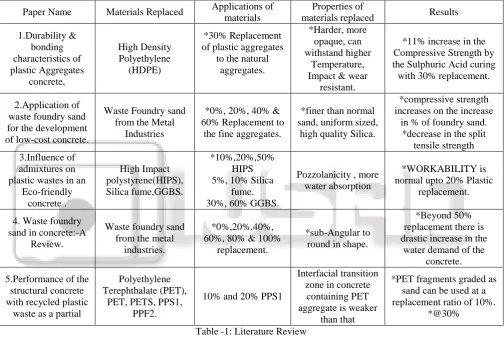
The listed Papers below were studied as the literature review on Application of Waste Foundry Sand and Plastic in the concrete blocks
Paper Name Materials Replaced Applications of
materials
Properties of
materials replaced Results
1.Durability & bonding characteristics of plastic Aggregates concrete, High Density Polyethylene (HDPE) *30% Replacement of plastic aggregates
to the natural aggregates.
*Harder, more opaque, can withstand higher
Temperature, Impact & wear
resistant.
*11% increase in the Compressive Strength by the Sulphuric Acid curing with 30% replacement.
2.Application of waste foundry sand for the development of low-cost concrete.
Waste Foundry sand from the Metal
Industries
*0%, 20%, 40% & 60% Replacement to
the fine aggregates.
*finer than normal sand, uniform sized,
high quality Silica.
*compressive strength increases on the increase
in % of foundry sand. *decrease in the split
tensile strength 3.Influence of
admixtures on plastic wastes in an
Eco-friendly concrete . High Impact polystyrene(HIPS), Silica fume,GGBS. *10%,20%,50% HIPS 5%, 10% Silica
fume. 30%, 60% GGBS.
Pozzolanicity , more water absorption
*WORKABILITY is normal upto 20% Plastic
replacement.
4. Waste foundry sand in concrete:-A
Review.
Waste foundry sand from the metal
industries.
*0%,20%,40%, 60%, 80% & 100%
replacement.
*sub-Angular to round in shape.
*Beyond 50% replacement there is drastic increase in the
water demand of the concrete.
5.Performance of the structural concrete with recycled plastic
waste as a partial
Polyethylene Terephthalate (PET),
PET, PETS, PPS1, PPF2.
10% and 20% PPS1
Interfacial transition zone in concrete
containing PET aggregate is weaker
than that
*PET fragments graded as sand can be used at a replacement ratio of 10%.
[image:2.595.46.551.217.554.2]*@30%
Table -1: Literature Review
III. PROBLEM STATEMENT
Environmental concerns arising from the over-dredging of sand have led to restrictions on its extraction across India, with direct economic impacts on concrete constructions.
At the same time, waste plastic is rarely recycled in India, with as much as 40% left in landfill.
Generation of waste foundry sand as by-product of metal casting industries causes environmental problems because of its improper disposal.
The dumping of such materials which degrade at extremely low rates meaning they persist in the environment is a long term environmental concern. So, by using plastic waste and foundry sand in concrete
as replacement of course and fine aggregate the solid waste management problem can be solved.
IV. OBJECTIVES OF STUDY
To utilize the waste foundry sand and plastic in concrete product to a greater extent.
To increase the strength and mechanical properties of the concrete.
To make the concrete production economical. To compare the strength and density of lightweight concrete with normal concrete.
To examine the uses and application of lightweight concrete blocks in construction.
V. METHODOLOGY
A. Material collection
Materials collected are:-Waste Plastic (HDPE, PET), Waste Foundry sand, Course and Fine Aggregates, Cement, etc.
B. Physical & Chemical Properties of the materials:-
1) PP (Polypropylene)
Following are the properties of polypropylene:- Density:-0.91 gm/cc
[image:3.595.310.548.67.270.2] Melting point:-170 degree Celsius
Figure No. 1 PP (Polypropylene) 2) Foundry sand
Sub angular to round shape
Particle size is lesser than 100micrometer Fineness modulus : 0.9 to 1.6
Silica content depends on various industries
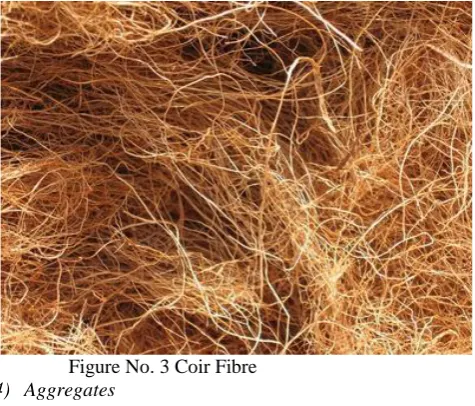
Figure No. 2 Foundry Sand 3) Coir Fibre
Density: 1.2g/cm³
Water Absorption: 130-180% Tensile Strength: 175mpa Aspect Ratio: 130 Diameter: 0.02 mm
Figure No. 3 Coir Fibre 4) Aggregates
Specific gravity: 2.6 – 2.8 Water absorption: less than 3% Fineness modulus- 2.73
Particle size- generally 2.36 mm
C. Design mix
Mix design is prepared As per IS 10262-1982 for M20 grade and same design is used in preparation of test sample. Proportion as per Design 1:1.5:3
D. Casting of concrete blocks
[image:3.595.38.549.70.708.2]Concrete blocks are casted for 7 and 28 days curing with partial replacement of plastic as three cubes for 0, 10, 20, and 25%. Waste Foundry Sand replaced in 10, 20, 30 and 40% Cube size is 150MM X 150MM X 150MM.
Figure No. 4 Cross Section of Cube
E. Testing of Concrete Blocks
Among several test to check the performance of concrete, compressive test is of utmost importance. This single test gives an idea about several characteristics of concrete. Many properties of concrete are directly correlated to its compressive strength.
Figure No. 5 Testing of Cube
VI. RESULT
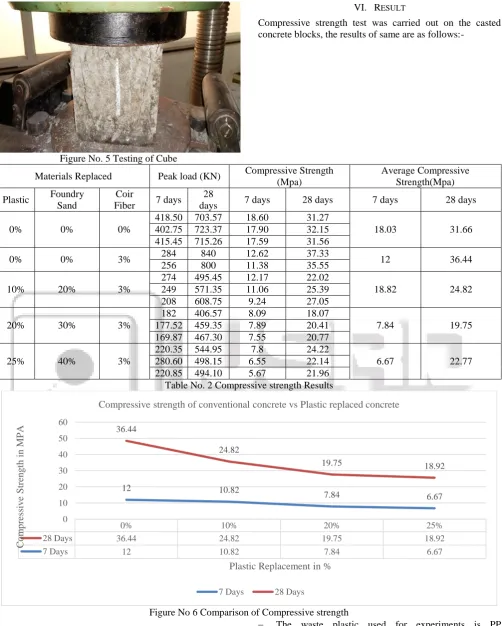
Compressive strength test was carried out on the casted concrete blocks, the results of same are as follows:-
Materials Replaced Peak load (KN) Compressive Strength
(Mpa)
Average Compressive Strength(Mpa)
Plastic Foundry Sand
Coir
Fiber 7 days 28
days 7 days 28 days 7 days 28 days
0% 0% 0%
418.50 703.57 18.60 31.27
18.03 31.66
402.75 723.37 17.90 32.15
415.45 715.26 17.59 31.56
0% 0% 3% 284 840 12.62 37.33 12 36.44
256 800 11.38 35.55
10% 20% 3%
274 495.45 12.17 22.02
18.82 24.82
249 571.35 11.06 25.39
208 608.75 9.24 27.05
20% 30% 3%
182 406.57 8.09 18.07
7.84 19.75
177.52 459.35 7.89 20.41
169.87 467.30 7.55 20.77
25% 40% 3%
220.35 544.95 7.8 24.22
6.67 22.77
280.60 498.15 6.55 22.14
220.85 494.10 5.67 21.96
Table No. 2 Compressive strength Results
Figure No 6 Comparison of Compressive strength
VII. CONCLUSION
The experimental results have shown the use of waste plastic material in making concrete/mortar can provide an alternative solution to minimize the environmental impact due to unscientific disposal of waste plastic. The following conclusions were drawn:
The waste plastic used for experiments is PP (Polypropylene), 1012 mm size and specific gravity of -waste plastic is found to be 0.92.
Compressive strength of plastic replaced concrete is compared with conventional concrete. And it is found that a compressive strength up to 52% is achieved for a mix of waste plastic up to 25% (as a replacement for
0% 10% 20% 25%
28 Days 36.44 24.82 19.75 18.92
7 Days 12 10.82 7.84 6.67
12 10.82
7.84 6.67
36.44
24.82
19.75 18.92
0 10 20 30 40 50 60
C
o
m
p
ress
iv
e
Stre
n
g
th
in
MP
A
Plastic Replacement in %
Compressive strength of conventional concrete vs Plastic replaced concrete
coarse aggregate) in concrete. Hence it is recommended for light-weight concrete structures.
This research also has potential application for the production of lightweight concrete, for minimizing the amount of polymer wastes in landfills, and the creation of decorative, attractive landscaping products.
It has been found that, there is a rapid decrease in the compressive strength of concrete beyond 10% replacement of plastic
REFERENCES
[1] Parvesh Kumar, Gaurav Kumar (2015) ‘Effect of Recycled Plastic Aggregates on Concrete’, ISSN : 2319-7064, IJSR, Vol 5 Issue 6, June 2016, Page No. 912-915 [2] Chien-chung chen, nathan jaffe et al (2015) ‘Concrete Mixture With Plastic As Fine Aggregate Replacement’, ISSN :2394-2827 , Vol 2 Issue 4, Aug 2015, Page No. 49-53
[3] Pathariya Saraswati, Rana Jay krushna et al (2013) ‘Application of Waste Foundry Sand for Evolution of Low-Cost Concrete’ ISSN : 2231-5381, IJETT, Vol 4 Issue 10, Oct 2013, Page No. 4281-4286
[4] Zainab Z. Ismail, Enas A. AL-Hashmiet al (2007) ‘Use of waste plastic in concrete mixture as aggregate replacement’,
[5] Patil Pramod Sambhaji et al (2016) ‘Use of Waste Plastic in Concrete Mixture as Aggregate Replacement’ ISSN : 2349-6495, IJAERS, Vol 3 Issue 12, Dec 2016, Page No. 115-118
[6] Bavita Bhardwaj, Pardeep Kumar et al (2017) ‘Waste foundry sand in concrete: A review’ Construction and Building Materials 156 , Sept 2017, Page No. 661-674 [7] J. Thorneycroft, J. Orr, P. Savoikar, R.J. Ball et al (2017)
‘Performance of structural concrete with recycled plastic waste as a partial replacement for sand’ Construction and Building Materials 161 , Nov 2017, Page No. 63-69 [8] Anju Ramesan, Shemy S Babu, AswathyLal et al (2015)
‘Durability and Bonding Characteristics of Plastic Aggregate Concrete’, ISSN : 2278-1684, IOSR, Vol 12 Issue 5, Oct 2015, Page No. 30-37
[9] Madan Mohan Reddy, K. Ajitha, and Bhawavi R. ‘Melt-Densified Post-Consumer Recycled Plastic Bags Used As Light Weight Aggregates In Concrete