Block-based Watermarking for Color Images
using DCT and DWT
A.F.ElGamal
Department of CS Mansoura UniversityEgypt
N.A.Mosa
Department of CS Mansoura UniversityEgypt
W.K.ElSaid
Department of CS Mansoura UniversityEgypt
ABSTRACT
This paper presents the hybrid image watermarking algorithm for color images based on Discrete Cosine Transform (DCT) and Discrete Wavelet Transform (DWT). The cover image is converted from RGB color space into YCbCr color space, then the luminance component is partitioned into non-overlapping blocks of pixels according to the number of bits of the original watermark; and DCT conversion is performed for each block separately. After DCT transformation, the DWT is performed and vertical component, LH is taken out for embedding the watermark. Finally, the watermark information is embedded using new mathematical formula. Simulation results show that this method is imperceptible and robust with respect to a wide variety of conventional attacks like noise addition, filtering, cropping and JPEG compression.
Keywords
Color Image Watermarking, Discrete Cosine Transform, Discrete Wavelet Transform, Restoration Parameter.
1.
INTRODUCTION
The gradual maturation of multimedia technology and the rapid development of network technology have caused digital information, such as digital images, digital audio, and digital video to be easily distributed, copied and used either legally or illegally. This has made the protection of the intellectual property of digital products a hot issue which requires conducting laborious research. Digital watermarking is considered one of the popular approaches to protect the intellectual property rights of digital media from illegal manipulations [1]. It is one of the techniques of information concealment [2], which embeds separate sub information (watermark information) in certain digital information without significant degradation [3]. Digital watermarking can be used for a wide range of applications such as Copyright Protection, Copy Control, Fingerprinting, Broadcast Monitoring, Secret Communication, Tampering Detection, Authentication, etc[4, 5, 6]. In addition, there are several techniques for hiding watermark in digital images. Such techniques can be classified into different categories based on several criteria as shown in Figure.1. The first criterion is the type of domain in which the watermark embedding is takes place, where the watermarking techniques for the type of domain fall into two classes: spatial domain methods where watermark is embedded directly by changing the pixel value, and frequency domain methods, where the pixel values are transformed into another domain by applying an appropriate transform [6, 7, 8, 9, 10]. The second criterion depends on the type of document to be watermarked, where the watermarking techniques are divided into four categories: Text watermarking, Image watermarking, Audio watermarking, and Video-based watermarking [9, 10]. The third criterion is human perception,
in which digital watermarks can be divided into three basic types: Visible watermark, Invisible watermark and Dual watermark [9, 10]. The fourth criterion is application, where the digital watermarks can be divided into: Source-based watermark, where a unique watermark identifying the owner is introduced to all copies of the particular image being distributed and Destination based watermark, where each distributed copy gets a unique watermark identifying the particular buyer [9, 10].
Generally, an effective watermarking algorithm should satisfy the following basic requirements:
i.Imperceptibility
(
Invisibility)It means that the quality of host image should not be destroyed by the presence of a watermark so that the user cannot distinguish the original from the watermarked version[1, 8, 11, 12].
ii.Robustness
(
Stability)It means that the embedded watermark must have the immunity to various signal processing operations such as noise attacks, lossy compression, filtering, rotation, scaling, resizing, cropping, etc [1, 8, 10].
iii.Capacity
(
DataPayload)
From a quantitative perspective, it means that the amount of information (number of bits) that can be stored into cover data depends on the application. On the other hand, from a qualitative perspective, it refers to the type of information that can be used as a watermark. Thus, the effective watermarking system must have the ability to insert the majority of information [6, 8, 10, 11, 13, 14].
iv. Security
It means that the ability of the watermark to resist attempts by attacker to remove or destroy it without modifying the cover data itself so that unauthorized users cannot detect, read or modify the embedded watermark [1, 11, 13].
v. Effectiveness
It means that the watermark extraction process should be simple and fast [1].
Watermarking
Quasi Invertible According to
Working Domain
According to Type of Document
According to Human Perception
According to Application
Visible Invisible Dual
Video Audio
Image Text
Frequency Domain Spatial
Domain
Fragile Semi-Fragile
Robust
Non-Invertible Invertible
Public
Private Non-Quasi
Invertible
Destination Based Source
[image:2.595.44.548.63.349.2]Based
Fig 1: Classification of Watermarking Techniques [9, 10]
2.
PRELIMINARIES
2.1
Discrete Cosine Transform
Discrete Cosine Transform (DCT) is a transformation algorithm that converts images from spatial domain to frequency domain [15, 16]. It has been widely used in digital image watermarking, because it has great advantages including high energy compaction capability and good robustness. It also provides appropriate trade-off between Human Visual System (HVS) model and the image distortion degree [17, 18]. DCT domain watermarking can be classified into two types: Global DCT watermarking and Block-based DCT watermarking [14, 17]. In the first type, the DCT computation is performed on the whole image [17], whereas in the second type the image is divided into non-overlapping blocks and DCT computation is performed on each block separately [14, 17] to obtain low-frequency, mid-frequency and high-frequency sub-bands[2]. The watermark information is commonly embedded into a mid-frequency sub-band, which provides robustness against common watermarking attacks and which is compatible with HVS model [2, 14]. Given an image f of size M x N, the forward and inverse DCTs are defined as [19]:
Where u=0…M-1, v=0…N-1 and
2.2
Discrete Wavelet Transform
[image:2.595.324.533.616.730.2]Discrete wavelet transform (DWT) is another promising transformation algorithm for digital image watermarking in frequency domain. DWT is a mathematical tool for decomposing an image hierarchically [20]. It separates the image into four sub-bands which are lower resolution approximation image (LL), horizontal (HL), vertical (LH) and diagonal (HH) detail sub-bands [2, 11, 13, 21]. This process of separation can be repeated several times to compute multi-level wavelet decomposition [21]. Conclusion comes out; the LL sub-band is not suitable for the watermark embedding based on HVS model, because it contains important information about the image and causes image distortion. In addition, embedding a watermark in the HH sub-band is not suitable, because this sub-sub-band is less robust against image processing operations such as lossy compression [2, 22]. Thus, the appropriate areas for watermark embedding are the mid-frequency sub-bands LH and HL, where acceptable performance of imperceptibility and robustness could be achieved [2, 8, 23, 24]. Figure.2 illustrates the sub-band decomposition of an image using 2D wavelet transform after 3 levels of decomposition.
Fig 2: Third level wavelet transform [22]
LL3 HL3
HL2
HL1
LH3 HH3
LH2 HH2
LH1 HH1
(2x 1)u
(2y 1)v
F(u, v) c(u)c(v)
f (x, y)cos[
]cos[
]
2M
2N
M-1 N-1
x=0 y=0(1)
(2x 1)u
(2y 1)v
f (x, y)
c(u)c(v)F(u, v)cos[
]cos[
]
2M
2N
M-1 N-1
x=0 y=0(2)
1 , u 0 M c(u)
2
, u 1,..., M 1 M
1 , v 0 N c(v)
2
, v 1,..., N 1 N
DWT is currently used in a wide variety of signal processing applications, like data compression, image recognition, audio denoising, speech synthesis, computer vision, etc[1, 20], because it has a number of advantages over other transforms[1, 11, 22, 23, 25]:
DWT is highly integrable with HVS model. Due to its excellent spatial-frequency localization properties, the DWT is suitable to identify the areas in the host image where a watermark can be embedded effectively.
DWT is compatible with JPEG2000, and MPEG4 compression standards.
DWT provides a progressive and low bit-rate transmission.
DWT provides quality scalability.
DWT improves the region-of-interest (ROI) coding demand.
DWT provides versatile image coding that can be exploited for both image compression and watermarking applications.
3.
PROPOSED ALGORITHM
Transform domains are better for the watermarking than spatial domain for both reasons of robustness under conventional attacks as well as visual impact [1, 2, 3, 7, 9, 11, 12, 14, 20, 27, 28]. This section introduces a novel image watermarking algorithm in the frequency domain using DCT and DWT.The detailed algorithm is as follows:
3.1
Watermark Embedding
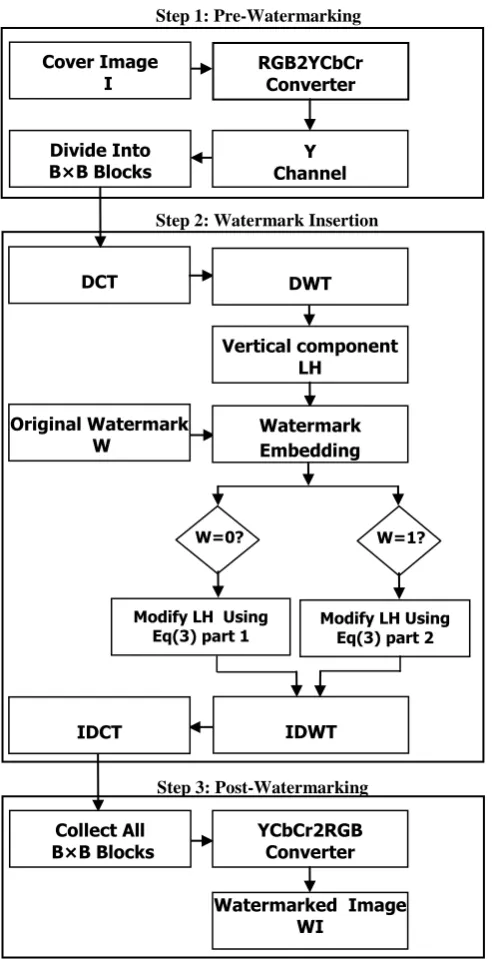
Let the binary watermark of size M1xM2 pixels, to be embedded, be denoted as W=(0 for black and 1 for white) and the original host image of size N1xN2 pixels be denoted as I=(24-bit color). An illustration of the watermark embedding process is shown in Figure.3. The cover image is converted into YCbCr color space and the luminance component Y is selected for watermarking. The Y component is tilled into BxB non-overlapping blocks, then each block is DCT transformed separately. After that, DWT is performed and vertical component LH is taken out for embedding the watermark, because embedding the watermark in vertical regions increases the watermark robustness at a little additional impact on image quality [7, 29]. Finally, the watermark is embedded by using Eq. (3). The concrete embedding procedure can be summarized as follows:
Inputs: Color cover image and binary watermark image.
Outputs: Watermarked color image and the restoration parameter.
Steps:
(1) Read color cover image I & binary watermark image W. (2) Convert I from RGB color space into YCbCr color space
for better watermarking efficiency. Since the pixel values are highly correlated in RGB color space, the watermark embedding in YCbCr color space is preferred.
(3) Select the luminance component Y to embed the watermark, because the human eye is less sensitive to luminance in YCbCr space than other color channels in RGB space.
(4) Divide Y into BxB non-overlapping blocks of pixels according to the number of bits of the original watermark image, where each bit in the watermark image corresponds to one block in the luminance component.
(5) Perform the following steps for each block to embed the watermark information bits:
5.1 Apply DCT calculation, to obtain DCT coefficients DCTb.
5.2 Apply 1-level DWT using daubechies filters to DCTb to decompose it into four sub-bands: LL1(approximation sub-band), HL1(horizontal sub-band), LH1(vertical sub-band) and HH1(diagonal sub-band).
5.3 Find the size of LH1 matrix and store it in S.
5.4 Create a random matrix PRN of size S with the same random number generator.
5.5 Modify the vertical DWT coefficients LH1 by adding the binary watermark bits as in the following equation:
where α1 is the quality factor which can be used for completely controlling the imperceptibility of watermarked image.
To retrieve watermark information, the restoration parameter R is required and calculated for each block as shown in the equation below:
where α2 is the strength factor which can be used to control watermark robustness.
5.6 Compute the inverse DWT into LL1, HL1, LH1*, HH1 using Daubechies filters.
5.7 Compute the inverse DCT to obtain the watermarked block.
(6) Collect the watermarked blocks that obtained from previous steps to get the watermarked image WI. (7) Convert back the watermarked image from YCbCr color
space to RGB.
(8) Calculate the PSNR between original cover image I and watermarked image WI.
(9) Save the watermarked image WI and the restoration parameter R.
*
LH1 (α xPRN), W
0
LH1
LH1 (α xPRN), W
1
1
1
(3)
mean LH1
α x mean(PRN) , W 0
R
mean LH1
α x mean(PRN) , W 1
2
2
Step 2: Watermark Insertion
W=1? W=0?
Modify LH Using Eq(3) part 2 Modify LH Using
Eq(3) part 1
Watermark Embedding Vertical component
LH DWT DCT
Original Watermark W
IDWT IDCT
Collect All B×B Blocks
Watermarked Image WI
YCbCr2RGB Converter
Step 3: Post-Watermarking Step 1: Pre-Watermarking
Y Channel RGB2YCbCr
Converter Cover Image
I
[image:4.595.41.290.66.546.2]Divide Into B×B Blocks
Fig 3: Proposed Algorithm for Embedding Watermark
3.2
Watermark Extraction
An authorized user is permitted to extract the embedded watermarking along with the restoration parameter generated in the embedding process. The extraction of the watermark information is performed in a reverse order to the embedding. The detailed extraction algorithm is listed as follows (refer to Figure.4).
Input: Watermarked image and the restoration parameter.
Output: Binary watermark image.
Steps:
(1) Read the watermarked image WI and the restoration parameter R, which is used as a threshold to rebuild the original binary watermark.
(2) Convert WI from RGB color space into YCbCr color space.
(3) Select the luminance component Y to extract the watermark.
(4) Divide Y into BxB non-overlapping blocks of pixels according to the number of bits of the original watermark image.
(5) Perform the following steps for each block to extract the original watermark bits:
5.1 Apply DCT calculation, to obtain DCT coefficients DCTbw.
5.2 Apply DWT calculation to DCTbw using Daubechies filters to obtain approximation, horizontal, vertical, diagonal DWT coefficients i.e. LL2, HL2, LH2, HH2.
5.3 Calculate the difference value Diff between the mean of the vertical component LH2 and the corresponding value of the R matrix as follows:
5.4 Discriminate the watermark bit as follows:
(6) Collect the resultant bits from previous steps for all blocks to obtain the binary watermark W*.
(7) Measure the NCC of the original watermark W and the extracted watermark W*.
[image:4.595.306.563.405.732.2](8) Output the extracted watermark and the NCC value.
Fig 4: Proposed Algorithm for Extracting Watermark
(5)
Diff=mean LH2 -R(i,j)
(6)
*
1, Diff
0
W
0, Otherwise
Step 1: Pre-Extraction
W=0 Y
Channel RGB2YCbCr
Converter Watermarked Image
WI Divide Into B×B Blocks
Calculate Diff Using Eq (5) Vertical Component
LH DWT DCT
Restoration Parameter R
Diff>=0 ?
W=1
Extracted Watermark
W*
Step 2: Watermark Extraction
4.
EXPERIMENTAL RESULTS
To evaluate the performance of the proposed algorithm, MATLAB simulations are performed by using a variety of popular cover images of size 512*512 (24 bit per pixel) from the USC image database [30] including Lena, Pepper, Baboon, and Sailboat which are shown in Figure.5 and 32x32 size binary watermark image which is shown in Figure.6. The measurement criteria are required to assess the performance of the method used in terms of imperceptibility and robustness. The First criterion is the peak signal to noise ratio (PSNR) given by Eq. (7) which is used to measure the quality of watermarked image. The second criterion is the normalized correlation coefficient (NCC) given by Eq. (9) which is used to measure the similarity and difference between the original and extracted watermarks under various attacks [8, 31].
Where R=256, MSE is the mean square error, which is defined as:
Where W is the cover image and W* is the watermarked
image.
Where,
A
mn is the original watermark,B
mn is the extracted [image:5.595.318.540.144.300.2]watermark, = mean2(A), and = mean2(B).
Fig 5: The cover images(Lena, Peppers, Baboon, and Sailboat)
Fig 6: Binary watermark
4.1
Selection of Control Factors
The selection of the value of the control factors (quality and strength) plays an important role in the watermarking algorithm with respect to the quality of watermarked image and maintaining the robustness of the extracted watermark. In this context, the control factors values should be selected to make a balance between these two requirements. Since the efficiency of the new method depends on the way through which the embedding and extracting control factors have been selected, several experiments have been conducted using variant control factors to get the optimal values. In those experiments, a set of integer values in the range 5 to 50 was generated for quality factor α1 and strength factor α2. For each value, the PSNR value is calculated for all watermarked images without attacking and the NCC value is calculated between the original watermark and the extracted watermark after applying common image attacks on watermarked images
and taking the maximum average value of PSNR and NCC for all test images as desired control factors. The results for effecting α1, α2 on watermark imperceptibility and robustness are illustrated in Figure.7 and Table 1.
Table 1: Average PSNR, NCC Values for different quality and strength factors
Quality Factor
α1
Average PSNR(dB)
Strength Factor
α2
Average NCC
5 48.1236 5 0.8291
15 39.3495 15 0.9336
25 35.3041 25 0.9592
35 32.8093 35 0.9794
45 31.1061 45 0.9997
[image:5.595.45.289.356.583.2]As Table 1 shows, it has been observed that the quality factor α1 plays an important role in the imperceptibility of watermarked image. PSNR has been improved for less quality factor and the value of PSNR has been degraded for the high quality factor. On the other hand, the strength factor α2 plays an important role in the robustness of extracted watermark. In addition, NCC has been improved for the high strength factor and the value of NCC has been degraded for less strength factor.
Fig 7: The relation between control factors and average PSNR, NCC for different test images
(7)
M SE
R)
*
(R
PSNR
10
log
10
r1 j
c
1 k
2 *
c
*
r
k)]
(j,
W
k)
[W(j,
M SE
(8)__ __ mn mn m n
__ __
2 2
mn mn
m n m n
(
-
)(
-
)
NCC
(
-
)
(
-
)
A
A B
B
A
A
B
B
[image:5.595.316.548.406.729.2]4.2
Robustness Test
An important property of the watermarking algorithms is that they should be robust against various typical signal processing operations (attacks). This section conducts some experiments to show the robustness of the algorithm under different types of attacks. Before proceeding, at the very outset, let us mention that the quality factor is 5 and the strength factor is 45 (optimal values). The algorithm will be subjected to the
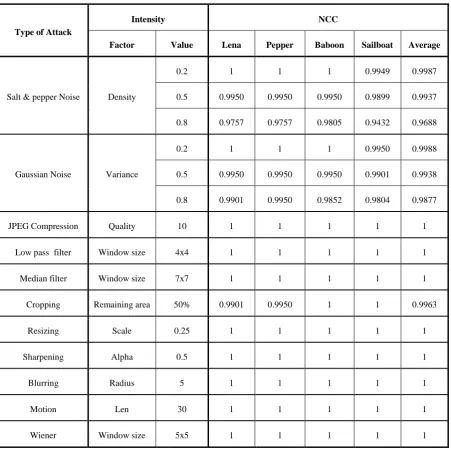
[image:6.595.74.526.195.647.2]following major attacks: robustness against Salt & Pepper Noise, Gaussian Noise, JPEG compression, Low Pass Filter, Median Filter, Cropping, Resizing, Sharpening, Blurring, Motion, and Wiener. The full list of attacks and their result are given in Table 2.Some examples of extracted watermarks after applying various operations on the watermarked Lena image are shown in Figure.8.
Table 2: Robustness of the proposed algorithm against different types of common attacks
From the obtained results, it has been observed that the proposed algorithm gives 100% recovery of watermark when subjected to the following attacks: JPEG Compression, Low Pass Filter, Median filter, Resizing, Sharpening, Blurring, Motion and Wiener. It also gives good results with another group of attacks like noise addition (Salt and Pepper, Gaussian) and geometric distortion (cropping).
These results are due to that applying attacks on the watermarked image leads to variation in the pixel values, but this variation does not represent an obstacle to the extraction algorithm discussed in section III, with respect to extracting the watermark in a correct manner.
Type of Attack
Intensity NCC
Factor Value Lena Pepper Baboon Sailboat Average
Salt & pepper Noise Density
0.2 1 1 1 0.9949 0.9987
0.5 0.9950 0.9950 0.9950 0.9899 0.9937
0.8 0.9757 0.9757 0.9805 0.9432 0.9688
Gaussian Noise Variance
0.2 1 1 1 0.9950 0.9988
0.5 0.9950 0.9950 0.9950 0.9901 0.9938
0.8 0.9901 0.9950 0.9852 0.9804 0.9877
JPEG Compression Quality 10 1 1 1 1 1
Low pass filter Window size 4x4 1 1 1 1 1
Median filter Window size 7x7 1 1 1 1 1
Cropping Remaining area 50% 0.9901 0.9950 1 1 0.9963
Resizing Scale 0.25 1 1 1 1 1
Sharpening Alpha 0.5 1 1 1 1 1
Blurring Radius 5 1 1 1 1 1
Motion Len 30 1 1 1 1 1
Salt & Pepper Noise (D=0.5)
Gaussian Noise (V=0.8)
JPEG Compression
(Q=10)
Low pass filter (4x4)
Median filter (7x7)
Cropping (50%)
Resizing (Scale=0.25)
Sharpening (Alpha=0.5)
Blurring (Radius=5)
Motion (Len=30)
Wiener (5x5)
Fig8: Extracted watermarks after applying different attacks on watermarked Lena image
5.
CONCLUSION
This paper proposes a digital watermarking algorithm for color images in the transform domains utilizing the DCT and DWT features. By applying the algorithm on standard color images, experimental results have demonstrated that the proposed algorithm is imperceptible, because the average PSNR for all test images is 48.12dB. Moreover, the proposed watermarking algorithm is more robust, because it achieves optimal NCC values under different types of attacks such as JPEG compression and filtering. The proposed algorithm can be used for private applications, because the watermark detection is accomplished without the original image by using the statistical detection parameter produced in the embedding process.
6.
REFERENCES
[1] Hui-fang, LI., Ning, C., and Xiao-ming, C., "A study on image digital watermarking based on wavelet transform", Journal of China Universities of Posts and Telecommunications, vol.17, pp. 122-126, July 2010.
[2] Eswaraiah, R., Edara, S. A., and Reddy, E. S., "Color Image watermarking Scheme using DWT and DCT Coefficients of R, G and B Color Components", International Journal of Computer Applications, vol.50, no.8, pp. 0975-8887, July 2012.
[3] Kuribayashi, M., Tanaka, H., "Watermarking Schemes Using the Addition Property among DCT Coefficients", Journal of Electronics and Communications in Japan (Part III Fundamental Electronic Science), vol.86, no.5, pp. 11-23, 2003.
[4] Channapragada, R. S. R., Mantha, A. S, and Prasad, V. N. K., "Study Of Contemporary Digital Watermarking Techniques", International Journal of Computer Science Issues, vol.9, issue.6, no.1, pp. 456-464, November 2012.
[5] Sathawane, M. S., Bora, P. P., "VARIOUS MEDIA TYPES AND ITS APPLICATION USING DIGITAL WATERMARKING", World Research Journal of Pattern Recognition, vol.1, issue.1, pp 09-11, 2012.
[6] Prasad, R. M., Koliwad, S. A, "A Comprehensive Survey of Contemporary Researches in Watermarking for Copyright Protection of Digital Images", International Journal of Computer Science and Network Security, vol.9, no.4, pp. 91-107, April 2009.
[7] Soni, A. M., Metkar, S., and Lande, P. U., "Blind and invisible watermarking techniquies for color images", In Proceedings of the First International Conference on Contours of Computing Technology, Springer India, pp. 227-233, 2011.
[8] Ramamurthy, N., Varadarajan, S., "The Robust Digital Image Watermarking Scheme with Back Propagation Neural Network in DWT Domain", Procedia Engineering, vol.38, pp. 3769-3778, 2012.
[9] Adabala, J. V, Prakash, K. N., "DUAL TREE COMPLEX WAVELET TRANSFORM FOR DIGITAL WATERMARKING", International Journal of Advances in Engineering & Technology, vol.4, issue.2, pp. 482- 492, September 2012.
[10]Kamble, M. V., "Information Hiding Technology-A Watermarking", Golden Research Thoughts, vol.1, issue.10, April 2012.
[11]Masoumi, M., Amiri, S., "A High Capacity Digital Watermarking Scheme for Copyright protection of Video Data based on YCbCr Color Channels Invariant to Geometric and Non-Geometric Attacks", International Journal of Computer Applications, vol.51, no.13, pp. 0975-8887, August 2012.
[12]Divecha, N. H., Jani, N. N., "Image Watermarking Algorithm using Dct, Dwt and Svd", National Conference on Innovative Paradigms in Engineering & Technology, Proceedings published by International Journal of Computer Applications, pp. 13-16, 2012.
[14]Potdar, V. M., Han, S., and Chang, E., "A Survey of Digital Image Watermarking Techniques", 3rd IEEE International Conference on Industrial Informatics(INDIN), pp. 709-716, 2005.
[15]Lin, S. D, Shie, S. C., and Guo, J. Y., "Improving the robustness of DCT-based image watermarking against JPEG compression", Journal of Computer Standards & Interfaces, vol.32, pp. 54-60, 2010.
[16]Jose, S., Roy, R. C., and Shashidharan, S., "Robust Image Watermarking based on DCT-DWT-SVD Method", International Journal of Computer Applications, vol.58, no.21, pp. 0975-8887, November 2012.
[17]Xijin, W., Linxiu, F., "The Application Research of MD5 Encryption Algorithm in DCT Digital Watermarking", International conference on Solid State Devices and Materials Science, Journal of Physics Procedia, vol.25, pp.1264-1269, 2012.
[18]Tao, B., Dickinson, B., "ADAPTIVE WATERMARKING IN THE DCT DOMAIN", IEEE International Conference on Acoustics, Speech, and Signal Processing, pp. 21-24, 1997.
[19]XU, Z. J., WANG, Z. Z., and LU, Q., "Research on Image Watermarking Algorithm based on DCT", 3rd International Conference on Environmental Science and Information Application Technology, Journal of Procedia Environmental Sciences, vol.10, pp. 1129-1135, 2011.
[20]Kashyap, N., SINHA, G. R., "Image Watermarking Using 3-Level Discrete Wavelet Transform", I.J.Modern Education and Computer Science, vol.3, pp. 50-56, 2012.
[21]Tomar, V., Mehrotra, D., and Choudhary, A., "A Statistical Comparison of Digital Image Watermarking Techniques", Special Issue of International Journal of Computer Applications (0975 – 8887), for 3rd International IT Summit Confluence 2012 - The Next Generation Information Technology Summit.
[22]Keyvanpoura, M., Bayat, F. M., "Blind image watermarking method based on chaotic key and dynamic coefficient quantization in the DWT domain", Journal of Mathematical and Computer Modelling, July 2012, In Press.
[23]Al-Haj, A., "Combined DWT-DCT Digital Image Watermarking", Journal of Computer Science, vol.3, no.9, pp. 740-746, 2007.
[24]Pradhan, C., Rath, S., Bisoic, and A. K., "Non Blind Digital Watermarking Technique Using DWT and Cross Chaos", Journal of Procedia Technology , vol.6, pp. 897- 904, 2012.
[25]Keyvanpour, M., Bayat, F. M., "Robust Dynamic Block-Based Image Watermarking in DWT Domain", Journal of Procedia Computer Science, vol.3, pp. 238-242, 2011.
[26]Cox, I., Killian, J., Leighton, T., and Shamoon T., "Secure spread spectrum watermarking for images, audio and video", In Proceedings of the IEEE International Conference on Image Processing ICIP-96, Lausanne, Switzerland, pp 243-246, 1996.
[27]Ellinas, J. N., "A Robust Wavelet-Based watermarking Algorithm Using Edge Detection", World Academy of Science, Engineering and Technology , vol.34, pp. 291-296, 2007.
[28]Tsolis, D., Nikolopoulos, S., Drossos, L., Sioutas, S., and Papatheodorou,T., "Applying robust multibit watermarks to digital images", Journal of Computational and Applied Mathematics, vol.227, pp. 213-220, 2009.
[29]Gunjal, B. L., "WAVELET BASED COLOR IMAGE
WATERMARKING SCHEME GIVING HIGH
ROBUSTNESS AND EXACT CORELATION", International Journal of Emerging Trends in Engineering and Technology (IJETET), vol.I, no.1, pp 21-30, 2011.
[30]The USC-SIPI Image Database, Available from: http://sipi.usc.edu/database/.
![Fig 1: Classification of Watermarking Techniques [9, 10]](https://thumb-us.123doks.com/thumbv2/123dok_us/8083219.782902/2.595.44.548.63.349/fig-classification-watermarking-techniques.webp)