A Novel Cluster-Chain based Routing Protocol to
Prolong the Lifetime of WSN
L. Malathi
AP/CSE, Vivekanandha College of Engg. for Women,
Tiruchengode, Namakkal – 637205, Tamil
Nadu.
M.K. Chandrasekaran
P/CSE, Vivekanandha College of Engg. for Women,
Tiruchengode, Namakkal – 637205, Tamil
Nadu.
R.K. Gnanamurthy
P/CSE, Audi Sankara College of Engg. and Tech,Aravinda
Nager,
Gudur – 524101, Andra Pradesh.
ABSTRACT
In Wireless Sensor Networks life time of the network depends on the energy of the nodes, where energy consumption is mostly used for data transmission rather than sensing and processing. Also, in the WSN, the choice of routing protocol plays an important role in utilizing the energy of nodes efficiently. In this paper, a new novel routing protocol is proposed, which combines the two major categories of hierarchical protocols namely cluster based approach and chain based approach. This proposed algorithm is simulated for weather monitoring application and the results are studied. A comparison of the proposed algorithm with the existing protocols like LEACH, PEGASIS, LEACH-C and CHIRON in the stated application area shows that the proposed algorithm gives better performance in terms of energy utilization, network connectivity and network lifetime.
Keywords: Network lifetime, cluster based approach, chain based approach, Cluster Head, WSN,
1. INTRODUCTION
Wireless sensor networks have been identified as one of the most prominent technologies for the current era [1]. The technological developments of micro-electronics made the sensor networks to be more suitable for the areas where traditional networks fail or are inadequate. WSN are normally deployed in the areas like military applications, science, and industry applications such as smart transportation, health care, weather monitoring, disaster recovery, wildlife monitoring, security systems, industrial and building automation, and space exploration.
Typically, a WSN consists of large number of sensor nodes. A sensor node consists of four important subsystems 1) sensing subsystem, for gathering the data from the environment, 2) processing and memory subsystem, for data processing and data storing, all sensors have limited memory and limited processing speed 3) wireless communication subsystem, for data transmission and reception 4) Energy supply subsystem, which is the non rechargeable power source for the sensor node. Among these, energy supply subsystem plays an important role in the network lifetime because the sensor nodes spend most of their energy in forwarding the data rather than processing and sensing. So the routing protocol running on the WSN should consume the resources very efficiently. There have been many sensor network routing protocols proposed to solve various kinds of problems demanded in sensor networks. Presently, the widely suggested routing techniques are distributed among different classes which are: flat, hierarchical, and location-based techniques. Many energy-efficient solutions have been put out
in each class. An approach that is likely to succeed is the use of a hierarchical structure [2].
To facilitate large scale deployments, complex and critical issues like, energy efficient operation, channel contention, latency, and management of WSNs have to be addressed. Hierarchical organization of large sensor networks is the basis for many techniques that address these issues [13]. Hierarchical organization of sensor network leads to three different kinds of routing protocols based on how they communicate data to the base station, they are Clustering approach, Chain based approach and Tree based Approach. Applications that span large sensor fields and support data aggregation are prime candidates for cluster-based configuration.
In cluster based configuration, the network is decomposed into a set of clusters; each cluster contains set of nodes and a cluster head for managing the cluster. With many solutions based on clustering, the nodes within a cluster communicate only with their CH. The CHs are responsible for coordinating both inter-cluster and intra-inter-cluster communication. Communication among CHs can be via either single or multiple hops. LEACH, LEACH-C, V-LEACH, HEED, CBRP and the TEEN protocols are examples for cluster based configurations. Although many clustering solutions have been proposed [16], only a few combines clustering with a data routing scheme that is appropriate for large-scale WSNs [10, 12, and 14]. The problems with the cluster based approach are, for each round, new cluster head (CH) was elected which increases the cluster formation overhead. In some clustering protocols cluster head directly communicate with base station, which lead to energy wastage.
In chain based approaches, the network may be divided into small regions based on the locations. A single data forwarding chain will be created for forwarding the data to the Base station or multiple small chains are constructed for efficient operations. PEGASIS and CHIRON protocols are the examples for chain based routing. The problem with the chain based approach is formation of long chain for data transmission which leads to communication bottle neck and early death of sensor nodes which are near to base stations.
the sensor using TDMA and aggregates the data. Two or more chains are constructed among the CHs for data transmission to the based station.
2. RELATED WORKS
Many different traditional clustering algorithms for wireless sensor network have been proposed. Low Energy Adaptive Clustering Hierarchy (LEACH) Protocol was proposed by [7, 8]. This protocol is one of the most famous hierarchical routing algorithms for energy efficiency in WSNs. Other algorithms developed thereafter were based on this algorithm. In the LEACH scheme, the nodes organize themselves into a local cluster and one node behaves as a local cluster head. LEACH includes a randomized rotation of the high energy cluster head position such that it rotates among the sensors. This feature leads to a balanced distribution of the energy consumption to all nodes and makes it possible to have a longer lifetime for the entire network. The operation of LEACH protocol is divided into rounds. Each round consists of set up phase and steady state phase. In setup phase a new cluster heads are elected and the steady state phase elected cluster heads collects and forward the data directly to the based station. This leads to clustering overhead and energy wastage in cluster heads.
LEACH-C uses a centralized clustering algorithm and same steady-state protocol [11]. During the set-up phase of LEACH-C, each node sends information about current location and energy level to base station (BS). The BS will determine clusters, CH node and non-CH nodes of each cluster. The BS utilizes its global information of the network to produce better clusters that require less energy for data transmission. The number of CHs in each round of LEACH-C equals a predetermined optimal value, whereas for LEACH the number of CHs varies from round due to the lack of global coordination among nodes.
Power-Efficient Gathering in Sensor Information Systems (PEGASIS) [9] protocol is a LEACH-inspired protocol. PEGASIS is not exactly a cluster-based protocol, as nodes are not explicitly grouped into clusters. PEGASIS is instead a chain based approach, in which each node only communicates with a close neighbor and takes turns to transmit to the BS, thus reducing the amount of energy spent per round. This approach distributes the energy load evenly among the sensor nodes in the network. The basic idea of PEGASIS is to have only one designated node that directly transmits to the BS in each round. Even though the PEGASIS constructs a chain connecting all nodes to balance network energy dissipation, it has following short falls. 1) For large scale applications, the chain may introduce an unacceptable delay. 2) In some cases the algorithm may result in redundant transmission paths and it waste the sensor node energy. 3) The chain leader may be exhausted quickly because it forwards all the node data to the base station. In HEED, author introduces a variable known as cluster radius which defines the transmission power to be used for intra-cluster broadcast [18]. The initial probability for each node to become a tentative cluster head depends on its residual energy, and finally heads are selected according to the intra-cluster communication cost.
Chain-Based Hierarchical Routing Protocol, named as CHIRON [19], the main idea of CHIRON is to divide the sensing environment into a number of smaller areas based on the beam star approach and create a simple chain in each small area. The multiple shorter chains may reduce the data transmission delay and redundant path. So it effectively conserves the node energy and prolongs the network lifetime
3. THE PROPOSED APPROACH
In this paper, a novel clustering algorithm based on probability and remaining energy of the node is proposed which utilize the energy of the node efficiently. Clustering is a method in wireless sensor networks (WSNs) for effective data communication and towards energy efficiency [5]. Clustering involves grouping of sensor nodes together and one node is elected as a Cluster Head(CH), so that nodes in the cluster communicate their sensed data to the CHs. CHs collect the data, aggregate them and transmit the aggregated data to the processing centre called base station for further analysis. Clustering provides better resource utilization and minimizes energy consumption in WSNs by reducing the number of sensor nodes that take part in long distance transmission. The functioning of the proposed approach is given below.
For Simulation, the following assumptions are made:
There are M nodes in the sensor field.
Number of clusters is K.
Average number of sensor nodes in each cluster is N where
K
M
N
/
(1)
After N rounds, each of the nodes must have been a cluster head (CH) once. Each node is assigned with a unique identifier Ni,
for all i = 0, 1, 2, 3, 4………..M-1.
3.1 Algorithm for Cluster Heads Selection
Originally, all nodes are the same, i.e. there is no CHs in each cluster, j = 0 where j is CHs counter. A node qi is selected among all nodes and it continuously executes the following steps:
Firstly, q increments i by 1 and check if i is even, if yes, that node is selected as the CH for that round and announces its new position to all member nodes in the cluster; else, if i is odd, it cannot be a CH for that round and it will wait for the next round and be ready to receive advertisement message from the new CH. A predetermined value is set (threshold value) for the new CH to transmit for that round. When the value has reached the threshold, j will be incremented by 1 and the process of selection of new CH begins. It tests if the following two conditions hold.
1. A sensor node has not become cluster head for the past (1 / p) - 1 rounds.
2. The residual energy of a node is more than the average energy of all the sensor nodes in the clustering.
Thus, the selection value (SV) of a node becoming new cluster head is given as
N
i
E
K
i
E
p
r
P
P
i
SV
avg rem
*
)
(
*
)
(
1
mod
*
1
)
(
(2)Where, P is the probability of the node to became the cluster head, r is the current round number, Erem is the remaining
energy in node i, Eavg is the average energy of all the nodes in a
cluster. It continues until j = K.
sensed data from member nodes, aggregate them, and transmit the compressed data to the next cluster head or base station.
3.2 Cluster Formation
The next step in the clustering phase is cluster formation after CHs have been elected. Below gives the description of new cluster formation.
Step 1: The new cluster heads broadcasts a low cost control messages (INIT) message to all non-cluster nodes in the network using Carrier Sense Multiple Access/Collision Detection (CSMA/CD) MAC Protocol.
Step 2: Based on the RSS (Receiver Signal Strength) each sensor node determines which clusters it will join, by choosing CH that requires minimum communication energy.
Step 3: Each non-cluster node uses CSMA/CD to send message back to the CHs informing them about the cluster it wants to belong.
Step 4: After receiving the messages from all nodes, the cluster head fix the boundary and intimate the CH information to its members. Finally it sends the Route_Request message to the Base station.
Normally, in almost all the clustering algorithm, CHs are elected on each round, this lead to clustering overhead on each round. To overcome this proposed approach keeps the same CHs for several rounds. If the residual energy of the CHs falls below threshold value the new CHs are elected. For simulation, 0.1J is considered as a threshold value, ie if the CH has 0.4J initially, and if node reaches 0.3J then the clustering procedure is again initialized.
[image:3.595.346.502.235.365.2]
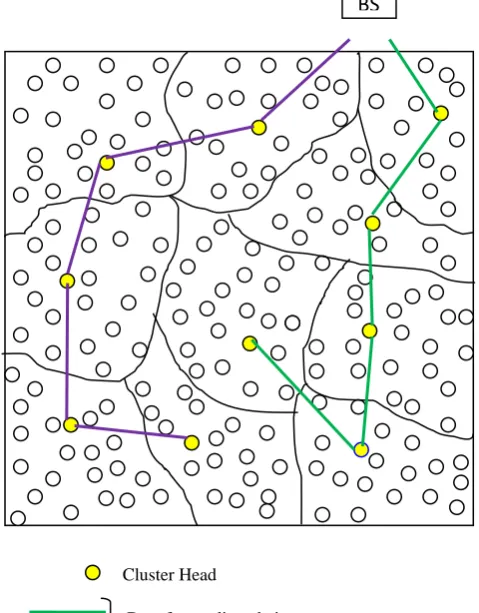
Cluster Head Data forwarding chains
Fig 1: Proposed Architecture
3.3 Sleep Schedule for Cluster Nodes
In WSN, sleep schedule was applied to sensor nodes to save the energy of the node. In a cluster, some nodes are in active state and some nodes are in sleep state. The important issue is to cover the entire cluster with minimum number of sensors. Authors in [12] describe very difficult to guarantee full coverage for a monitored area, even if all sensors are on-active. Coverage mechanism is to choose a subset of active nodes to maintain the coverage expectation. This paper introduces a new intra-cluster coverage, which elects some active nodes within clusters while maintaining coverage expectation of the cluster. Here the nodes are ordered based by their energy's and the distance between the node and the cluster head. Select the nodes that have minimum energy and turn of them.
[image:3.595.31.271.407.714.2]-Active nodes -Cluster head
Fig 2: Intra-Cluster coverage
The active nodes covers the whole network and other member nodes are turned off, as a result, energy consumption in intra-cluster nodes remarkably reduced and network lifetime is extended.
3.3. Data forwarding chains construction
Step1: After cluster formation, cluster heads send their location information to the base station via Route_Request message. Step 2: The base station selects two or more CHs as chain leaders based on the location information (normally CHs closer to Base station). Then it constructs the small chains using the greedy algorithm as in PEGASIS.
Step 3: The base station send the chains to the cluster heads. Step 4: All the cluster heads send their data to the leader node along the chain, finally the leader node transfers the collected data to the base station.
D. Data Collection and Data Forwarding
Step 1: The CH prepares Time Division Multiple Access (TDMA) scheduling table and send it to all nodes in the cluster. This message contains time allocated to each node to transmit to the CH within each cluster.
Step 2: Each sensor node uses TDMA allocated to it to transmit data to the CH with a single- hop transmission and switch off its transceiver whenever the distance between the node and CH is more than one hop to conserve energy.
the data from its all cluster members and R is the random time interval, during that time the CHs transceiver is turned off. Step 4: After all data has been received, the CH performs data fusion function by removing redundant data and compresses the data into a single packet.
4. SIMULATION RESULTS AND ANALYSIS
In order to evaluate the performance of our proposed approach, simulated LEACH, LEACH-C, PRGASIS, CHIRON and the proposed protocol using NS2.34. Here 100 sensor nodes randomly distributed between (0m, 0m) & (100m, 100m) and the base station is located at 50m,150m. The energy model followed for simulation is same as in [9], the node requires ETx(k,d)to send k bits message to destination at distance d, and ERx(k) to receive k bits message. ETx(k,d) and ERx(k) are defined as:
For transmitting,
d
d
k
E
k
E
d
k
E
Tx(
,
)
elect*
amp*
*
*
(3) For Receiving,k
E
k
E
Rx(
)
elect*
(4) Where Eelect = 50nJ/bit and Eamp 0.015 pJ/bit/m2 [image:4.595.308.563.71.472.2]
The distance (d) between sender and receiver determines the energy dissipation by transmitter amplifier.
Fig 3: Network Deployment of 100 Nodes with Clustering
Fig 3 shows the simulated Network in NS2 Simulator. In our simulation the Network is divided in to 5 clusters. The Parameters used for Simulation are given here.
Table1. Simulation Parameters
Number of Sensor Nodes 100
Network Dimension 100 m × 100 m Location of the Sink 50,150 Nodes initial energy (K) 0.5 J
Data Packet size 100 bytes
Broadcast Packet size 20 bytes Maximum child per Node 3 Transmitter circuitry dissipation (ETx-elec)
50 nJ/bit Amplifier dissipation multipath
(Eamp)
25 pJ/bit/m2
[image:4.595.56.273.378.524.2]Cluster radius 20m
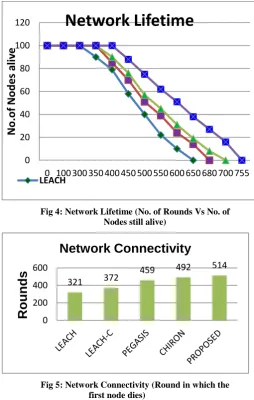
[image:4.595.312.560.499.689.2]Fig 4: Network Lifetime (No. of Rounds Vs No. of Nodes still alive)
Fig 5: Network Connectivity (Round in which the first node dies)
Fig 6: No. of packets Successfully Delivered Vs Location of Base Station
The Fig 4 shows the network life of the simulated network. It shows a number of nodes still alive over number of rounds. As compared with other algorithms, the proposed algorithm gives the better performance and extends the life time of the Network. The Fig 5 shows the network connectivity of the simulated
0 20 40 60 80 100 120
0 100 300 350 400 450 500 550 600 650 680 700 755
No
.of
No
d
e
s
al
iv
e
Network Lifetime
LEACH
321 372
459 492 514
0 200 400 600
Rounds
Network Connectivity
0 200 400 600 800 1000 1200
50,150 50,200 50,250 50,300 50,350 50,400 50,450
P
ac
ke
ts
S
uc
es
sful
ly
D
eli
v
ered
Base Station Location
No. of packets Successfully
Delivered Vs Location of Base
Station
[image:4.595.51.271.592.761.2]network. It shows the round in which the first node dies. The simulation result shows that in LEACH first node dies in 321, in LEACH-C it dies in round 372, in PEGASIS it dies in round 459, in CHIRON it dies in round 492 and in the proposed algorithm the first node dies in 514th round. Normally simulation result varies based on the location of the base station. Fig 6 shows the number of packets successfully delivered to the base station by varying the location of the base station. The simulation result shows that the proposed algorithm successfully delivers more number of packets than in LEACH and PEGASIS.
CONCLUSION
In this paper, a new novel routing protocol algorithm is proposed for prolonging the network life time of a wireless sensor network, based on the cluster and chain approaches. The proposed algorithm divides the sensor field into different clusters and elects a node as the cluster head and constructs the two or more data forwarding chains for sending the data to the sink node. Each node within the cluster sends its data to the cluster head with single hop transmission and cluster heads aggregates the received data and transmits it to the base station through chains. The simulation results shows that the proposed algorithm performs better than the existing algorithms LEACH, LEACH-C, PEGASIS and CHIRON in terms of network life time, network connectivity and packet delivery to the base station.
6. REFERENCES
[1] D. Culler, D. Estrin, and M. Srivastava, “Overview of Sensor Networks,” IEEE Computer, Vol. 37, No. 8, 2004, pp. 41-49.
[2] Ameer Ahmed Abbasia, Mohamed Younisb, A survey on clustering algorithms for wireless sensor networks, Computer Communications, 30(15),October 2007, pp2826-2841.
[3] K. S. Chan, H. Pishro-Nik, and F. Fekri, “Analysis of hierarchical algorithms for wireless sensor network routing protocols,” in Proceedings of the IEEEWireless Communications and Networking Conference (WCNC ’05), vol. 3, pp. 1830– 1835, New Orleans, La, USA, March 2005.
[4] Y.Wang, T. L. X. Yang, and D. Zhang, “An energy efficient and balance hierarchical unequal clustering algorithm for large scale sensor networks,” Information Technology Journal, vol. 8, no. 1, pp. 28–38, 2009. [5] K. Zhou, L. Meng, Z. Xu, G. Li and J. Hua, “A Dynamic
Clustering-Based Routing Algorithm for Wireless Senor Networks,” Information Technology Journal, Vol. 7, No. 4, 2008, pp. 694-697.
[6] A. D. Amis, R. Prakash, T. H. P. Vuong and D. T. Huynh, “Max-Min D-Cluster Formation in Wireless Ad-Hoc Networks,” Proceedings of the IEEE 9th Annual Joint Conference of the IEEE Computer and Communications Societies, Tel Aviv, 26-30 March 2000, pp. 32-41. [7] W. Heinzelman, A. Sinha, A. Wang, and A. Chandrakasan,
"Energy- Scalable Algorithms and Protocols for Wireless Microsensor Networks," International Conference on Acoustics, Speech, and Signal Processing ICASSP, vol.6, Istanbul, Turkey, 2000, pp.3722-3725.
[8] W. B. Heinzelman, A. P. Chandrakasan and H. Balak- rishnan, “An application-Specific Protocol Architecture for Wireless Microsensor Networks,” IEEE Transactions on Wireless Communications, Vol. 1, No. 4, 2002, pp. 660-670. doi:10.1109/TWC.2002.804190.
[9] S. Lindesy and C. Raghavendra, "PEGASIS: Power-Efficient Gathering in Sensor Information System," in Proceedings of the Aerospace Conference,IEEE, vol. 3, Big Sky, Montana, 2002, pp. 9-16.
[10] A. Manjeshwar and D. P. Agrawal, “TEEN: a routing protocol for enhanced efficiency in wireless sensor networks,” in Proceedings of the 15th International Parallel and Distributed Processing Symposium, pp. 2009–2015, San Francisco, Calif, USA, April 2001.
[11] K. Sohraby, D. Minoli and T. Znati, “Wireless Sensor Net- works Technology, Protocols, and Applications,” John Wiley & Sons, Inc. Hoboken 2007.
[12] T. Shu and M. Krunz, “Coverage-time optimization for clustered wireless sensor networks: a power-balancing approach,” IEEE/ACM Transactions on Networking, vol. 18, no. 1, pp. 202– 215, 2010.
[13] A. P. Jayasumana, H. Qi, and T. H. Illangasekare, “Virtual sensor networks—a resource efficient approach for concurrent applications,” in Proceedings of the 4th International Conference on Information Technology-New Generations (ITNG ’07), pp. 111–115, Las Vegas, Nev, USA, April 2007.
[14] M. Maeda and E. D. Callaway, “Cluster tree protocol
(ver0.6),”April 2001,
http://www.ieee802.org/15/pub/2001/
may01/01189r0P802-15TG4-Cluster-Tree- Network.pdf. [15] V. Loscri, G. Morabito and S. Marano, “A Two-Level
Hierarchy for Low-Energy Adaptive Clustering Hierarchy,” 62nd IEEE Vehicular Technology Conference, Vol. 3, No. 2, 2005, pp. 1809-1813.
[16] IEEE Computer Society, “IEEE.802.15.4: Wireless medium access control and physical layer specifications for low-rate wireless personal area networks,” September 2006.
[17] K. Akkaya, F. Senel, and B. McLaughlan, “Clustering of wireless sensor and actor networks based on sensor distribution and connectivity,” Journal of Parallel and Distributed Computing, vol. 69, no. 6, pp. 573–587, 2009. [18]. W. R. Heinzelman, A. Chandrakasan, and H.