Comparison of SOM Algorithm and K-Means Clustering
Algorithm in Image Segmentation
S. Ravikumar
Assistant Professor,Department of Computer Applications, Bannari Amman Institute of Technology,
Sathyamangalam.
A. Shanmugam
Principal,Bannari Amman Institute of Technology, Sathyamangalam.
ABSTRACT
Image segmentation becomes simpler when the image is made up of smooth images. Many real world images are made up of a variety of smooth and textures regions, all of which need to identified in the segmentation algorithm. In such cases the existing methods fail to produce meaningful segmentation, successfully segmenting only the smooth or textured regions depending on the features used.
The segmentation problem can be informally described as the task of partitioning an image into homogeneous regions. But in the textured images one of the main conceptual difficulties is the definition of a homogeneity measure in mathematical terms with of much complexity. By using a clustering algorithm, we can label the pixels of an image to form homogeneous functions or regions. Different clustering algorithms were commonly used in image segmentation algorithms. There are several issues related to image segmentation that require detailed review. The segmentation doesn’t perform well if the grey levels of different objects are quite similar.
This result in complex texture based image segmentation to use higher filter. But in future this technique used for dimensionality reduction to improve the speed.
Keywords
Feature Map, Self Organizing Map, Clustering, Neural Networks, Segmentation.
1. INTRODUCTION
For textured images one of the main conceptual difficulties is the definition of a homogeneity measure in mathematical terms. The segmentation problem can be informally described as the task of partitioning an image into homogeneous regions. Image segmentation is becoming increasingly important in a variety of fields such as video encoding, computer vision and medical imaging. The objective of dividing an image into homogeneous regions remains a challenge, when the image is made up of complex textures. A number of approaches are available for this which includes spatial frequency techniques which is a successful method. Image segmentation becomes simpler when the image is made up of smooth images. Many real world images are made up of a variety of smooth and textures regions, all of which need to identified in the segmentation algorithm. In such cases the existing methods fail to produce meaningful segmentation, successfully segmenting only the smooth or textured regions depending on the features used.
2. LITERATURE REVIEW
Image segmentation has been approached from a wide variety of perspectives, T. Pavlidis[1]. It summerizes different methods such as histogram thresholding, edge based segmentation, tree/graph based approaches, region growing, clustering, probabilistic or Bayesian approaches, neural networks for segmentation, and other approaches.
Ohlander[2] proposed a thresholding technique that is very useful on segmenting outdoor colour images. This is based on constructing colour and hue histograms. The picture is thresholded at its most clearly separated peak. The process iterates for each segmented part of the image until no separate peaks are found in any of the histograms.
Cheriet et al.[3] presented a general recursive approach for image segmentation by extending Otsu’s method[4]. This approach has been implemented in the area of document images, specifically for segmenting bank cheques. This approach segments the brightest homogeneous object from a given image at each recursion, leaving the darkest homogeneous object.
Li et al.[5] propose that the use of two dimensional histograms of an image is more useful for finding thresholds for segmentation rather than just using grey level information in one dimension. In 2D histograms, the information on point pixels as well as the local grey level average of their neighbourhood is used.
Ahuja et al.[6] describe how pixel neighbourhood elements can be used for image segmentation. For each, its neighbours are first identified in a window of fixed size. The paper uses both vector representations.
Prager[7] proposed a set of algorithms used to perform segmentation of natural scenes through boundary analysis. The goal of the algorithm is to locate the boundaries of an object correctly in a scene. First, pre-processing of the images
is done to clean up the raw data by smoothing and noise-removal.
Perkins[8] uses an edge based technique for image segmentation. It is acknowledged that edge based segmentation has not been very successful because of small gaps that allow merging of dissimilar regions.
Chan et al.[9] developed a new adaptive thresholding algorithm for image segmentation using variational theory. The method is a heuristic algorithm, which consists of seven steps.
neighbourhood of a pixel, for every pair of adjacent pixels their collected statistics are used for determining local homogeneity.
Yeung et al.[11] proposed the technique of segmentation of video by clustering and graph analysis. The method is also extended to the Scene Transition Graph (STG) representation for the analysis of temporal structures extracted from a video. Chang and Li[12] proposed a region-growing framework for image segmentation. This process is guided by regional feature analysis and no parameter tuning or a priori knowledge about the image is required. The algorithm is known as Fast Adaptive Segmentation (FAS) algorithm. Adams and Bischof[13] studied the effectiveness of seeded region growing approach for image segmentation of greyscale images where the seeds are manually selected.
Mehnert and Jackway[14] improved the above seeded region-growing algorithm by making it independent of the pixel order of processing and making it more parallel.
Basu[15] developed general sets of semantics for region detection to describe a number of image models using them. The semantic set is established empirically based on simple and intuitive properties of a region.
Gambotto[16] proposed an algorithm that combines the region growing and edge detection methods for segmenting the images. The method is iterative and uses both of these approaches in parallel.
Hojjatoleslami and Kittler[17] proposed a new region growing approach for image segmentation which uses gradient information to specify the boundary of a region. The method has the capability of finding the boundary of a relatively bright/dark region in a textured background.
Lu and Xu[18] proposed a region growing technique for texture segmentation, in which a two-dimensional autoregressive model is used for texture representation. In this technique an artificial neural-network is adopted to implement the parameter estimation process for the autoregressive model and to compute the local texture properties of regions during the segmentation process.
He and Chen[19] propose a resonance algorithm for image segmentation that is not much different from seeded region growing algorithm.
Singh and Al-Mansoori[20] compared region growing and gradient based techniques for detecting regions of interest in digital mammograms. These regions of interest form the basis of applying shape and texture techniques for detecting cancerous masses.
3.1 Digital Image Processing
Images are vital and integral part of everyday life. Images are used to reason, interpret, illustrate, represent, memorize, educate, communicate, evaluate, navigate, survey, entertain etc. Digital Image Processing in its broadest and most literal interpretation aims to address the goal of providing practical, reliable and affordable means to allow machines to cope with images.
The term digital image processing refers to processing of a two dimensional picture by a digital computer. It implies digital processing of any two dimensional data. Any visual image has to be first transformed into a digital image for the purpose of processing through computers. A digital image is an array of real and complex numbers represented by a finite number of bits. Digital image processing encompasses a broad range of hardware, software and theoretical underpinning. This digitized image can then be processed and /or displayed on a high resolution monitor. For display, the image is stored in a rapid access buffer memory.
Digital image processing involves the manipulation and interpretation of digital images. The central idea behind digital image processing is quite simple. The digital image is fed into a computer one pixel at a time. The computer is programmed to insert these data into an equation or series of equations, and then store the results of the computation for each pixel. These results form a new digital image that may be displayed or recorded in pictorial format.
3.2 Digital Image Representation
The term image refers to a two dimensional light intensity function f(x,y), where x and y denote the spatial coordinates and the value of 'f' at any point (x,y) is proportional to the brightness (or gray level) of the image at that point. The digital image is an image f(x,y) that has been discretized both in spatial coordinates and brightness. A digital image can be considered as a matrix whose row and column indices identify a point in the image, and the corresponding matrix element value identifies the gray level of that point. The elements of such a digital array are called as image element, picture elements, pixels or pels.
4.1
Segmentation
To humans, an image is not just a random collection of pixels: it is a meaningful arrangement of regions and objects.
In image analysis and computer vision, by segmentation is meant the “labelling” of pixels as belonging to the same region, where the criteria for the pixel to belong to a particular region are :
Common colour or gray scale (or near
enough via quantization)
Membership of common texture region
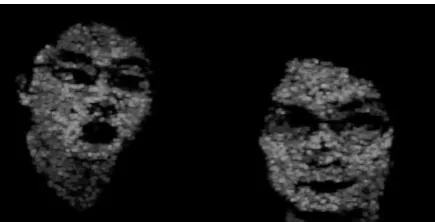
Fig.1: Examples of Segmentation
Fig. 2: An Example of colour based face segmentation
The Segmentation process includes the implementation in Self Organizing Maps Algorithm (SOM) and K-Means Clustering Algorithm.
4.2 K-Means Algorithm
means is a partition based clustering algorithm. K-means’ goal is to partition data D into K parts, where there is little similarity across groups, but great similarity within a group. More specifically, K-means aims to minimize the mean square error of each point in a cluster, with respect to its cluster centroid.
Step 1: Choose k random points as the cluster centroids.
Step 2: For every point p in the data, assign it to the closest centroid. That is compute d(p, Mci) for all clusters, and
assign p to cluster C* where distance
(d(P, Mc*) <= d(P, Mci))
Step 3: Recompute the center point of each cluster based on all points assigned to said cluster.
Step 4: Repeat steps 2 & 3 until there is convergence. (Note: Convergence can mean repeating for a fixed number of times, or until SEnew - SEold <= , where is some small
constant, the meaning being that we stop the clustering if the new squared error objective is sufficiently close to the old SE.)
4.3 Self Organizing Maps Algorithm (SOM)
The Self-Organizing Maps (SOM) is a neural network model that is capable of projecting high dimensional input data onto a low-dimensional array. This nonlinear projection produces a two-dimensional “feature map” that can be useful in detecting and analyzing features in the input space. SOM techniques have been successfully applied in a number of disciplines including speech recognition, image classification and document clustering.
Initialize the weight vectors, wi Rn
t = 0
for epoch = 1 to Nepoch do
interpolate new values for(t) and (t)
for record = 1 to Nrecord do
t = t + 1
for k = 1 to K do
// K - number of Neural Node
[image:3.595.73.291.70.181.2]// compute distance dk
dk = ||x – wk(t)||
endfor
//compute winning node c,
c = min dk(t)
i
for k = 1 to K do
//update weight vectors wk using equation
wi(t + 1) = wi(t) + hck(t)[x(t) - wi(t)]
endfor
endfor
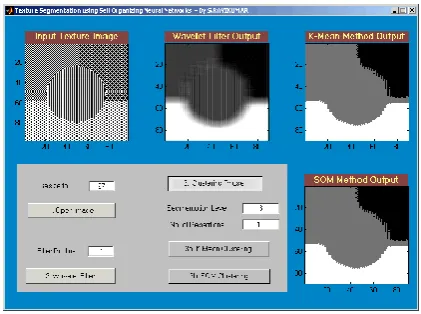
The Following screen was created in Matlab to evaluate the proposed texture segmentation algorithm.
Fig.3: Opening the Textured Image
Fig.4: Segmentation
5.1 Results & discussion
Total Number of Segments : 4 Nos Total Number of Repetitions : 10 The K-Means Algorithm :
The Time Taken for Segmentation : 2.323000 sec The SOM Based Segmentation Algorithm : TRAINR, Epoch 0/10
TRAINR, Epoch 10/10
The Time Taken for Segmentation : 1.672000 sec This result is shown as
Fig.5: The Overall Performance
The following table shows the average performance of the three segmentation algorithms. The numbers were the average values obtained from repeated tests with different Satellite images if uniform size (128 X 128).
The Input Image Size :128 X 128 The Number of Repetitions :10 Time Taken for Data Preparation : 100 Sec
Segmentation Level : 2 to 5
[image:4.595.67.278.110.267.2]Time Taken For Segmentation
Table 1: Segmentation
Sl No
Segmentation Level
Time Taken For Segmentation
k-Means
Method SOM Method
1 2 1.26 1.42
2 3 1.66 1.62
3 4 2.22 1.67
4 5 3.83 1.70
5 6 3.92 1.77
The following chart shows the average performance of the three segmentation algorithms under evaluation. The numbers were the average values obtained from repeated tests with uniform image size (100 X 100). As we see in the chart, obviously, the arrived results were more significant and comparable. The Proposed SOM based algorithm performed very well in terms of speed.
6.1 Conclusion
It was obviously noted that the performance of the algorithm was very much decreased for the higher filter radius. So in this research the algorithm was tested with 4 dimensional data only (ie, 9x9 image blocks were used during applying the
filter). But, if we try to use the algorithm for complex texture based image segmentation, then we have to use higher filter size. So in future works one may address techniques for dimensionality reduction to improve the speed of clustering
process. Table 2: Performance Chart for Clustering
For a 100 X 100 image, the wavelet filter operation took almost 100 seconds (the filter areas is 9 x 9). So the wavelet filter operation consumes most of the time in the whole process time. So future works may address the possibilities of reducing this filter operation time.
The issues involved in improving the performance of the algorithm in terms of speed and using the algorithm for other complex texture based image segmentation may be addressed in future works.
7. REFERENCES
[1] T. Pavlidis, Algorithms for graphics and image processing, Springer, Berlin, 1982.
[2] R.B. Ohlander, Analysis of natural scenes, PhD Thesis, Carnegie Institute of Technology, Dept. of Computer Science, Carnegie-Mellon University, Pittsburgh, PA, 1975
[3] M. Cheriet, J. N. Said and C. Y. Suen, A recursive thresholding technique for image segmentation, IEEE Transactions on Image Processing, 1998.
[4] N. Otsu, A threshold selection method from grey level histograms, IEEE Transactions on Systems, Man and Cybernetics,1978.
[5] L. Li, J. Gong and W. Chen, Gray-level image thresholding based on Fisher linear projection of two-dimensional histogram, Pattern Recognition, 1997.
[6] N. Ahuja, A. Rosenfeld and R.M. Haralick, Neighbour gray levels as features in pixel classification, Pattern Recognition, 1980.
[7] J.M. Prager, Extracting and labeling boundary segments in natural scenes, IEEE Transactions on Pattern Analysis and Machine Intelligence, 980.
[8] W.A. Perkins, Area segmentation of images using edge points, IEEE Transactions on Pattern Recognition and Machine Intelligence, 1980.
0 1 2 3 4 5
2 3 4 5 6
T
im
e
(S
ec
)
Segmentation Level
Performance of SOM Clustering and K-Means Algorithm
[9] F.H.Y. Chan, F. K. Lam and H. Zhu, Adaptive thresholding by variational method, IEEE Transactions on Image Processing, 1998.
[10] K. Cho and P. Meer, Image segmentation from consensus information, Computer Vision and Image Understanding, 1997.
[11] M. Yeung, B.L. Yeo and B. Liu, Segmentation of video by clustering and graph analysis, Computer Vision and Image Processing, 1998.
[12] Y.L. Chang and X. Li, Adaptive image region growing, IEEE Transactions on Image Processing,, 1994.
[13] R. Adams and L. Bischof, Seeded region growing, IEEE Transactions on Pattern Analysis and Machine Intelligence, 1994.
[14] Mehnert and P. Jackway, An improved seeded region growing algorithm, Pattern Recognition Letters, 1997.
[15] S. Basu, Image segmentation by semantic method, Pattern Recognition, 1987.
[16] J.P. Gambotto, A new approach to combining region growing and edge detection, Pattern Recognition Letters, 1993.
[17] S.A. Hojjatoleslami and J. Kittler, Region growing: a new approach, CVSSP Technical Report TR-6/95, University of Surrey, Department of Electronic and Electrical Engineering, 1995.
[18] S.W. Lu and H. Xu, Textured image segmentation using autoregressive model and artificial neural network, Pattern Recognition, 1995.
[19] H. He and Y.Q. Chen, Unsupervised texture segmentation using resonance algorithm for natural scenes, Pattern Recognition Letters, 2000.
[20] S. Singh, R. Al-Mansoori, Identification of regions of interest in digital mammograms, Journal of Intelligent Systems, 2000.
8. AUTHORS PROFILE
S. Ravikumar received his M.Sc., in Bharathiar University,
Coimbatore and M.Phil.,and M.C.A., degree from Periyar University Salem. Currently he is working as Assistant Professor in Bannari Amman Institute of Technology, Sathyamangalam. His area of interest includes Image Processing, Texture segmentation, Clustering. He Presented a Paper in National conferences. He is a Life member of Computer Society of India and a Life member of Indian Society for Technical Education.
Dr. A. Shanmugam received the P. G. degree from Madras