ABSTRACT
A wireless sensor network consists of large number of sensor nodes limited by a small energy spread in a large geographical area. Many algorithm collect information from the network by using clustering. LEACH is the most famous and popular one from this algorithm to maintain the energy efficiency of sensor nodes. In this paper, we propose a new algorithm to choose the cluster head with the highest energy. In our proposed work, we have collected all the nodes in the array and arranged them in descending order and then we select the best three nodes with the highest energy as a main cluster heads.
Keywords
Wireless sensor network, clustering, lifetime.
1. INTRODUCTION
The sensor nodes in the wireless sensor network can send information and cooperate with each other to accomplish some specific tasks through the application of communication for wireless self-organization [1]. Moreover wireless sensor network can be used in many areas, such as the environmental ,medical , agriculture, industry and military monitoring [2]. Because of size, cost and other factors of sensors, each sensor node has an extreme limitation on the bandwidth and the capacity of the battery. And usually the sensor nodes are arranged in very bad condition. In this case, to design any protocol must take into account the limited energy of nodes. A large number of experiments Showed that the strategy of cluster is the mainsolution to this issue. If we looked in the numerous clustering algorithms, Low-Energy Adaptive Clustering (LEACH) [3] is one of the popular and important algorithm to improve Clustering in WSN.. Many of clustering algorithms [3], [4], [5] rely on Leach algorithm is largely dependent. However, the LEACH algorithm mainly depends on the randomly selected cluster-heads (CH), without network energy consumption and to enhance the life time.
2. RELATED WORK
In 2000 Heinzelman [6] designed and implemented Low-Energy Adaptive Clustering Hierarchy (LEACH) protocol for WSN and in 2004 [7] , he assumed the BS is located at thecenter of the sensor fields. Lai [8] in 2007 proposed a genetic algorithm to find an approximate solution for the NP-complete Disjoint Set Covers (DSC) problem and in the same year Chamam [9] addressed the problem of maximizing the WSN that provide different levels of initial energy to a different sensor nodes and a new clustering algorithm ESCAL, which is appropriate for the WSN, which decrease the distance of transmitting between cluster-heads and base station was proposed. In 2008, routing method based on the reconfiguration of an autonomous optimization of neural network dynamics, which reduces energy that used for computing an autonomous
and distributor of about 6.7% [12]. TB-LEACH was introduced [13] to improve LEACH protocol, to form constant number of clusters, by using random-timer, without any global information. A new Protocol for the filtering of the contract and avoid obstacles of LEACH protocol was proposed and different WSN protocol was studied [15] [16]. MS-Leach was combined with LEACH to form a single-hop Transmissions and multi-hop transmissions in the clusters [17].In 2009, a maximum lifetime of a data-gathering sensor network, which is defined as the number of rounds until the first node exhausted its energy, is NP-complete was achieved [18]. To overcome the weakness of the asymmetrical distribution of the cluster heads in LEACH and in selecting the head of the cluster algorithm and the one-hop Routing algorithm, to extend the life of the network was suggested [19][20]. A new plan on the relationship between energy and cluster-head and coverage in sensor networks was discussed[21] and a new teaching to improve LEACH includes three stages: non-balanced clusters, uneven energy distributions, and unnecessary energy has been suggested in [22].In 2010, a program was explored [23] to find optimal clustering program in order to reduce energy consumption for the entire network and using the mathematical and statistics to prove it and a novel protocol called LEACH-B to overcome the shortcoming of the original LEACH by taking optimal cluster heads at each round and consider about residual energy of the nodes was proposed [24] and also peach algorithm that can ensure the organizing of cluster heads, modified LEACH without using the location information of nodes, LEACH-HPR to election cluster head, W-LEACH without considering measuring Accuracy of data aggregation and change in LEACH to a multi-hop to reduce the energy consumption of sensor nodes was proposed [25-28].A heuristic approach to solve the problem of the accumulated data gathering in sensor networks, an improvement in LEACH protocol to overcome the shortcoming of LEACH (FZ-LEACH algorithm), -LEACH to solves the issue of node heterogeneity, Leach-SM protocol, to improve the leach using a protocol selected spare nodes as well as cluster heads and evolutionary algorithm to find an optimal cluster heads in wireless sensor network was proposed and suggested [29-33] in 2011. LEACH [3] [6] [34] is one of the most popular hierarchical routing algorithms for clustering of WSNs. Some clusters heads of leach are formed in a self-organized manner. So it is a suitable solution for the efficient use of energy in the sensor network. Although, Leach is the right solution in the field of data collection, but had some issues and several limitations. LEACH does not address the problem of closer nodes and thus redundant data may be transferred to the base station. Many CHs are located in a specific area that may produce clusters with low energy, because Cluster heads are not selected in a distributed manner. LEACH is a kind of adaptive algorithm to organize the nodes into cluster, every cluster have one node as cluster head. [35][36][37].The process is executed in periodical manner; every round consists of two phases: first phase building a cluster
Abdo Saif Mohammed,
Department of Electronics and Communication Sri Jayachamarajendra Colleges of Engineering
Mysore, Karnataka, India.
A Novel Algorithm to Select Cluster Heads with Highest
and Balanced Energy in Wireless Sensor
Networks
M.N.Shanmukhaswamy
Department of Electronics and Communication Sri Jayachamarajendra Colleges of Engineering,
head and second phase data communication. In the first phase, close nodes make a cluster dynamically, and one node will be selected as cluster head randomly; in the second phase, every node send their data to cluster head, then cluster head collect the data and sends it to the sink node. The cluster heads consume more energy than ordinary nodes, because heads need to fuse the data and communicate with sink node. LEACH algorithm can ensure that each node in one cluster would be selected as cluster head in equal capability, which makes each node consume energy relatively equally. The requirement of selecting cluster head in LEACH is follows:
Each node produces a random number between 0 and 1, and check it with the threshold value T (n)if this number is less than T(n), and then this node represents the number chooses as cluster head. When node has been cluster head, then T (n) is set to 0, to let the possibility of other nodes to select is T (n). As the number of nodes which have been cluster head increases, T (n) will increase, so the possibility for the rest of nodes to be selected will increase. When there is only one node left, T (n) =1, which means this node will be selected for sure. T (n) could be defined as follows [38]:
T(n)=
{
( )
(1)
Where p represent the desired percentage of cluster heads, r represent the current round, and G represent the set of nodes that have not been cluster-head in the last l/p rounds. When the cluster head is selected, it will announce other nodes. Non cluster-head nodes will select a cluster to join with it, according to the distance between them and the cluster heads. When the cluster heads received all messages to share with it, they will produce a message at the time to inform all the nodes in their clusters.
3. PROPOSED WORK
We proposed a new algorithm to extend the lifetime of wireless sensor networks. This proposed build as follows:
3.1 Cluster Head Selection
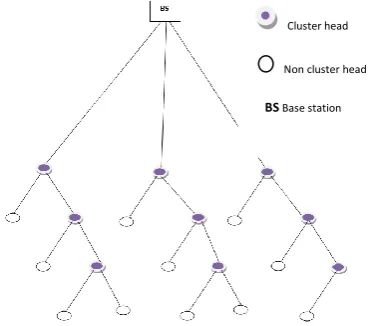
[image:2.595.78.264.541.704.2]We have proposed a new algorithm to choose the cluster head with the largest energy. After identifying the three main cluster heads we have build a binary tree around these three cluster heads as shown in Figure 1.
Figure 1. The Clustered Architecture with 20nodes
Where s1=0 and s2=1, according to the following:
Branches of the first point were building using the n-s1 (where
s2+3 represent the Right side for the first point). Increase s1and s2 by one after the second step, the branches of the second Point was build using the n-s1 (where n-S1 represents the left side for the second point after increasing)and s2+3(where s2+3 represents a part of right side for the second point after increasing).Increase s1 and s2 by one. At the last step, branches of the third point has been billed by using the n-s1(where n-s1 represents the left side for the third point) and s2+3 (represents a part of right side for the third point).If the number of nodes is more than ten, increase s1 and s2 by one and repeat all the five steps. From the proposed algorithm, we can build many levels with binary tree. Always right sides of tree have highest energy than left side. Because the nodes of right side will become the cluster to other nodes, in the other levels. Re-building the tree from the beginning of the rounds by setting s1 and s2 to 0 and 1.
3.2 Cluster Set-up
The proposed algorithm selects, three nodes with highest energy as cluster heads, then these three clusters heads broadcasts an advertisement messages containing information about cluster ’ “ ” T cluster to join according to the nearest of the advertisement signal. Then “ ” “J - ” j -response message contains its own id and id of the nearest cluster head it joins with it.
3.3 Data Transmission
Three cluster heads use TDMA schedule to collect information from all nodes and transmit it to the base station, as in LEACH.
Algorithm:
Pseudo Code of our Algorithm: 1: S10 and s21
2: Build s (n) array include n nodes and Sort it as descending according to Residual energy
3: Build w (n) array include position of S (n) and sort it as descending according to s (n)
4: For every j: 3
5: Select the three nodes with High energy as clusters heads from S (n)
6: For every I: n 7: For every j: 3
8: If w (n-s1)! =w (s2+3) 9: Begin
10: Select s (n-s1) to build Left branch of the tree and select s (s2+3) to build right branch of tree 11: s1s1+1 and s2s2+1 12: End
13: Else select s (n-s1) 14: End for
15: End for
In the above algorithm the number of heads will be specified in each round, where the number of cluster heads is equal to [(n/2)-1] and number of non cluster heads is equal to [(n/2) +1], Where n is the number of nodes.
4. SYSTEM MODEL
We have considered the identical radio model as proposed by W.R.Heinzelman [6], the equations used to calculate Cluster head
Non cluster head
transmission costs and receiving costs for a k-bit message for a distance d, the energy consumed for the sender is:
ETx (L, d) = ETx-elec (L) + ETx-amp (L, d)
=
{
(2) Energy consumed for the receiver is:
ERx (L) = ERx-elec (L) = L.Eelec
√
(3)In Equation 1 and 2, parameter ETx-elec and ERx-elec means the power dissipated to run the transmitter or receiver.
5. SEMULATION RESULTS
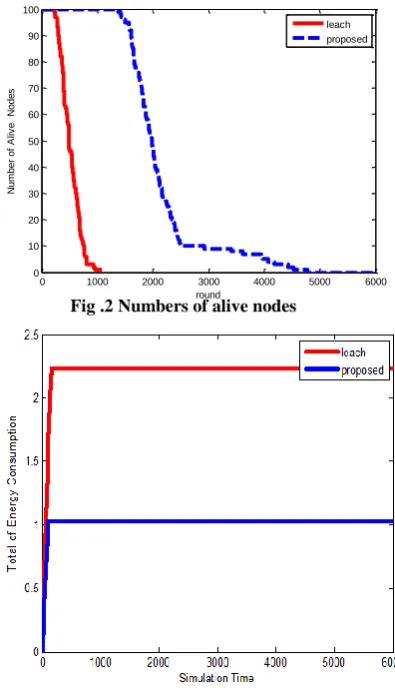
The proposed algorithm is compared with LEACH, considering the same parameters of LEACH as shown in Table.1. Figure 2 shows, proposed algorithm in which the first death node occurs later than LEACH and the network life is prolonged by150%.The sensors are simulated to deploy over a square sized area of l00m x l00m with variable communication range. Simulation is performed using Mat Lab. Figure 2 illustrates the performance comparison of proposed algorithm and LEACH in terms of network lifetime.
Also the performance comparison of proposed Algorithm and LEACH in terms of energy consumption is shown in Figure 3; energy consumption of proposed Algorithm is less when compared to LEACH protocol in all cases. Thus it is energy-efficient and has optimum performance when compared to LEACH. Simulation shows our proposed algorithm can balance the energy consumption of the entire network compared to LEACH protocol. Figure 4 shows; the throughput of proposed algorithm is increased by 150%. Though in the beginning period, the throughput is same as LEACH, after more than 1200 rounds, the throughput of proposed algorithm will exceed LEACH greatly.
As shown in Figure 5 number of packets received at the BS per round in the case of total number of nodes being 100, the initial energy being different, and also Figure 5, proposed algorithm has better performance of data transmission to the BS.
Figure 6 shows number of packets received at the CH per round in the case of total number of nodes being 100 and initial energy being different. From Figure 6, proposed algorithm has better performance of data transmission to the CH (see Figure 6.).
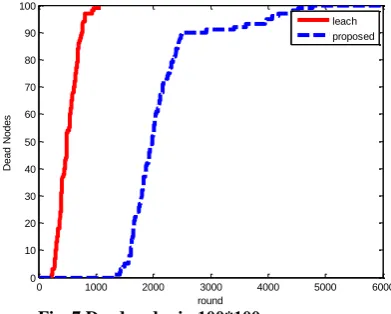
Figure 7 shows, dead nodes will appear much later in our proposed algorithm compared to HCAEL.
Where:
Eelect: Energy consumed in the electronics circuit to transmit or receive the Signal;
Efs: Energy consumed by the amplifier to transmit to a short distance;
Eamp: Energy consumed by the amplifier to transmit to a longer distance;
Eo: Initial energy of each node;
EDA: Data Aggregation Energy;
K: Message Size.
N: Number of nodes.
0 1000 2000 3000 4000 5000 6000 0
10 20 30 40 50 60 70 80 90 100
round
N
u
m
b
e
r
o
f
A
liv
e
N
o
d
e
s
[image:3.595.76.208.284.434.2]leach proposed
Table 1. Simulation parameters
Parameter Value
Eelect 50 nJ/bit
EDA 5 nJ/bit/message
Ε 10 pJ/bit/m2
Emp 0.0013 pJ/bit/m4
Eo 0.5 J
K 4000 Bit
[image:3.595.324.522.363.709.2]N 100
Fig .2 Numbers of alive nodes
6. CONCLUSIONS
In this paper, we have selects three nodes with the highest energy among the nodes deployed, as cluster heads. Each one of the three cluster heads build a set of nodes from the surrounding nodes, where the surrounding nodes with the cluster heads, formed a balanced binary tree, containing high-energy and low-energy at the same time. Each one of the three cluster heads gathered data from the surrounding nodes and send it to the base station. Proposed algorithm ensures that if nodes have different amounts of energy, then the nodes with more energy should be cluster heads more often than the nodes with less energy. We showed that in many cases proposed algorithm is more energy efficient than LEACH. Our simulation results show that the proposed algorithm provides better energy efficiency and longer network lifetime than the LEACH.
7. ACKNOWLEDGEMENTS
The authors wish to acknowledge J.S.S Research Foundation, S.J.C.E Technical institutions campus, Mysore, Karnataka, India for all the facilities provided for this research work.
8. REFERENCES
[1] Li Xunbo, Li Na, Chen Liang, Shen Yan, Wang Zhenlin, Z Z b ” CH for Clustering P k ” International Conference on Measuring Technology and Mechatronics Automation.
[2] H C J “ k P ” B J : Industry Press, 2007, pp.2-12.
[3] W.Heinzelman, A.Chandrakasan, H. Balakrishnan. "Energy-Efficient communication protocol for wireless microsensor network", Proc. of the Hawaii International Conference on System Sciences, IEEE Computer Society, Washington. DC USA, Jan 2000, pp.3005-3014.
[4] S. Lindsey, C. S. Raghavendra, "PEGASIS: Power-Efficient gathering in sensor information systems". In: Proc. of the IEEE Aerospace Conference, Big, Sky, Montana, July 2002, vol.3, pp.1125-1130
[5] A. Manjeshwar and D. P. Agarwal, "TEEN: a routing protocol for enhanced efficiency in wireless sensor networks", In proceedings of the 1st International Workshop on Parallel and Distributed Computing Issues in Wireless Networks and Mobile Computing, IEEE Computer Society, San Francisco, April 2001,
pp.2009-0 1000 2000 3000 4000 5000 6000 0 1000 2000 3000 4000 5000 6000 Round T h ro u g h p u t leach proposed
0 1000 2000 3000 4000 5000 6000 0 5 10 15 20 25 30 35 40 45 50 round N u m b e r o f p a c k e ts r e c e iv e d a t B S leach proposed
0 1000 2000 3000 4000 5000 6000 -20 0 20 40 60 80 100 round N u m b e r o f p a c k e ts r e c e iv e d a t C H leach proposed
0 1000 2000 3000 4000 5000 6000 0 10 20 30 40 50 60 70 80 90 100 round D e a d N o d e s leach proposed
Fig .5 Number of packet received at the BS (different
initial energy and total number of nodes 100)
[image:4.595.63.256.79.417.2]Fig .4 Comparison of number of throughput
Fig .7 Dead nodes in 100*100 area.
[image:4.595.318.514.82.239.2] [image:4.595.64.260.474.623.2][6] B H z “ -Specific Protocol k ”P D D Department of Electrical Engineering and Computer Science, MIT, Cambridge, MA, June 2000.
[7] Georgios Smaragdakis Ibrahim Matta Azer Bestavros" SEP: A Stable Election Protocol for clustered heterogeneous wireless sensor networks" Technical Report BUCS-TR-2004.
[8] B Q Y Y J “O Distribution of Redundant Sensor Nodes for Wireless k ” P C O Industrial Informatics, 2006, pp. 985 – 989.
[9] C P “ -Efficient State Scheduling for Maximizing Sensor Network Lifetime C C “ M b Computing, Networking and Communications, 2007, pp. 63– 63.
[10] L. R Z G R M “P k ” Engineering, Artificial Intelligence, Networking, and Parallel/Distributed Computing, 2008, pp.231 – 236.
[11] G P R C ” C : -Saving Clustering B CH” 9 8-1-4244-3531-9/082008 IEEE
[12] M. Hasegawa, T. Kawamura, H. N. Tran, G. Miyamoto, Y. M H H K “D z optimization of wireless sensor network lifetime based on k ” P IEEE Intl. Conf. on Personal, Indoor and Mobile Radio Communications (PIMRC),2008, p. 1.
[13] CHEN Jian-ming,LU Jian-jun , WANG Qing-hai “R T CH k” 9 8-1-4244-2108-4/08/ 2008 IEEE
[14] H J J Y D “ T -based Cluster-H CCluster-H” 9 / 8 35 H M b K K ” -LEACH: Weighted Low Energy Adaptive Clustering Hierarchy Aggregation Algorithm for Data Streams in Wir k ” Conference on Data Mining Workshops./2008 IEEE
[15] H M k K G “H of a Wireless Sensor Network?” P C Advanced Information Networking and Applications (AINA), 2009, p. 763.
[16] Chong Wang, Jiakang Liu, Jingming Kuang, Abdul Sattar M k H X “ CH P Application- k ” 9 8-1-4244-3693-4/09/2009 IEEE
[17] T q b D z “M -Leach: A Routing Protocol Combining Multi-hop Transmissions and Single- T ” 9 P -Asia Conference on Circuits,Communications and System
[18] X J Y “M x z Data- k ” P Intl. Conf. on Sensor, Mesh and Ad Hoc Communications and Networks (SECON), 2009, p. 1.
[19] Li Xunbo, Li Na, Chen Liang, Shen Yan, Wang Zhenlin, Z Z b “ CH F C
P k ” Conference on Measuring Technology and Mechatronics Automation
[20] U X H G ” R B O CH P ” International Symposium on Distributed Computing and Applications to Business, Engineering and Science. 978-0-7695-4110-5/10 / 2010 IEEE
[21] Y q Q Z J “ C H M k ” 2010 IEEE/ACM International Conference on Green Computing and Communications & 2010 IEEE/ACM International Conference
[22] Lu Tao, Zhu Qing-X Z q ” CH k” 9 8-1-4244-5046-6/10/ 2010 IEEE
[23] G J M Z Z G ”R improvement of routing protocol for wireless sensor k” O Conference on Computer, Mechatronics, Control and Electronic Engineering (CMCE).
[24] M T M T ” CH-B:An Improved CH P k” 9 8-1-4244-3709-2/10/2010 IEEE
[25] H G Y Y ” B LEACH A k ” Seventh International Conference on Information Technology
[26] F " K F z** Z k ” location aware version of modified LEACH algorithm b R b b ” Feb. 7-10, 2010 ICACT 2010
[27] H P R C ” CH-HPR: An Energy Efficient R H ” 9 8-1-4244-6585-9/10/2010 IEEE
[28] Muhamnmad Omer Farooq, Abdul Basit Dogar, Ghalib “MR-LEACH: Multi-hop Routing with Low Energy C H ” F International Conference on Sensor Technologies and Applications 978-0-7695-4096-2/ 2010 IEEE
[29] D K T C R B P ” CD : Efficient Clustering and Data Aggregation Protocol for Heterogeneous k ” J Computers, Communications & Control, ISSN 1841-9836, E-ISSN 1841-9844 Vol. VI (2011), No. 1 (March), pp. 113-124
[30] V k K “ CH P Large- k ”D Computer Science & Engineering National Institute of Technology Hamirpur, HP, INDIA, 978-1-4244-7926-9/11/2011 IEEE
[31] K M J b K ” CH P k ” 9 8-1-4244-6252-0/2011 IEEE
[33] A. Rahmanian, H. Omranpour, M. Akbari, K. Raahemifar “ ovel Genetic Algorithm In LEACH-C Routing Protocol For Sensor Networks” CC C – 001100
[34] T. Anker, D. Bickson, D. Dolev, and B. Hod, Efficient Clustering for Improving Network Performance in Wireless Sensor Networks, in Proceedings of the Springer –Verilag Heridelberg (LNCS 4913),221-236, 2008.
[35] M. J. Handy, M. haase, D. Timmermann. Low energy adaptive clustering hierarchy with deterministic cluster-head selection[C]. Proc. of the 4th IEEE Conf. on Mobile and Wireless Communication Network, Stockholm, 2002: 368~372.
[36] P. Tillapart, T. Thumthawatwon, P. Pakedeepinit, T. Yeophantong, S. Charoenvikrom, J. Daengdej. Method for cluster heads selection in wireless sensor networks[C]. Proc. Of the 2004 IEEE Aerospace Conference, Chiang Mai, 2004:3615~3623.
[37] W. Heinzelman, A. Chandrakasan and
H.Balakrishnan,"Energy-Efficient Communication Protocol for Wireless Micro-sensor Networks," Proceedings of the 33rd Hawaii International Conference on System Sciences (HICSS '00), January. 2000.
[38] Udit Sajjanhar and Pabitra Mitra. Distributive energy efficient adaptive clustering protocol for wireless sensor
networks. In: Proceedings of IEEE International Conference on Advanced Information Networking and Application, 2006.
9. AUTHOR PROFILE
Mr.Abdo Saif Mohammed Completed his B.Sc. degree in Computer Science & Information System from University of Technology-IRAQ in the year 2001, M.Sc. in Computer Communication from Bharathiar University-India in the year 2009. And He is presently working in the Department of Computer Science, Thamar University Yemen, Dhamar, Yemen. He is doing his Ph. D in the area of Wireless sensor networks under the guidance of Dr. M.N Shanmukhaswamy.