Fuzzy Commitment Scheme for Masked Iris Codes
Osama Ouda
Information Technology Department School of Computers and Information Sciences
Mansoura University, Mansoura 35516, Egypt
ABSTRACT
The fuzzy commitment scheme is one of most popular biometric cryptosystems that aim at securing cryptographic keys using bio-metrics. Because of the high recognition accuracy exhibited by the iris, iris-based fuzzy commitment schemes, among other modali-ties, provide the most practical performance rates. Unfortunately, existing iris-based fuzzy commitment schemes do not incorporate noise masks, generated along with iris-codes to highlight unwanted regions of the iris, because there is no way to know the mask of the decoding iris sample in advance. Therefore, the decoding ac-curacy of iris-based fuzzy commitment schemes is much less than the recognition accuracy of the underlying iris recognition system. This paper presents an iris-based fuzzy commitment scheme that uses the noise mask of the encoding iris sample at both encoding and decoding stages. Experimental results show that the proposed scheme provides a remarkable improvement in the decoding accu-racy of iris-based fuzzy commitment schemes.
Keywords:
Biometric Cryptosyatems, Fuzzy Commitment Scheme, Iris Codes
1. INTRODUCTION
Recent advances in biometric technology paved the way for the emergence of several new applications other than the traditional application of personal authentication/identification. Providing se-cure management of cryptographic keys is one of such applications. Systems that employ biometric traits to secure cryptographic keys are often called biometric cryptosystems [13]. The Fuzzy Commit-ment Scheme (FCS) [8] is one of the most popular biometric cryp-tosystems that has been applied successfully to iris [2, 7, 9, 12, 15], fingerprint [10], and face [1] biometrics. FCS binds cryptographic keys, encoded using Error Correction Codes (ECC), to binary bio-metric feature vectors using simple XOR operation.
Due to the high recognition accuracy exhibited by iris biometric [5], iris-code based FCSs provide higher performance rates, com-pared to FCSs applied to other biometric characteristics. Besides, unlike other biometric traits from which real-valued feature vec-tors are extracted, iris-codes are binary feature vecvec-tors extracted from iris texture using the standard iris recognition algorithm of Daugman [3]. That is, the FCS can be applied directly to iris-codes whereas an extra binarization step, that may cause information loss, is required before it can be applied to other biometric traits.
In Daugman’s approach to iris recognition, in addition to the iris-code, a corresponding noise mask of the same size is generated to designate unwanted regions of the iris such as eyelids,
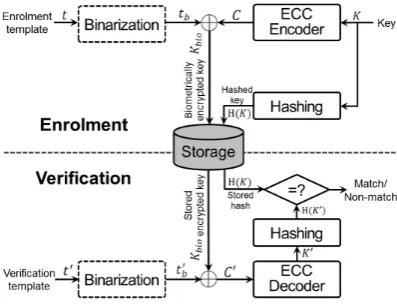
eye-Fig. 1. Illustration of the Fuzzy Commitment Scheme.
lashes, and specular highlights. Incorporating masks of enrolment and authentication iris samples in the matching process improves the recognition accuracy significantly [4]. However, incorporating those masks in iris-code based FCSs would introduce implementa-tion difficulty because only the enrolment iris sample is available at the time of encoding (key binding) [6]. As a result, current iris-based FCSs [2, 7, 9, 12, 15] do not use masking information neither at encoding nor at decoding phases and hence the decoding accu-racy of such schemes is much less than the recognition accuaccu-racy of the underlying iris recognition system.
This paper proposes an iris-code based FCS that benefits from noise masks and hence improves the decoding (key release) accuracy. In this scheme, the noise mask of the enrolment iris sample is em-ployed at both encoding and decoding stages. Experimental results show that the decoding accuracy of the proposed scheme, which in-corporates a single noise mask, outperforms the decoding accuracy of FCS implementation that does not employ any masks.
The rest of this paper is organized as follows: a brief review of the FCS is given in Sect. 2. The proposed scheme is explained in Sect. 3. Experimental results are presented in Sect. 4 and Sect.5 concludes the paper.
2. FUZZY COMMITMENT SCHEME
[image:1.595.336.535.250.404.2]be-(a) (b) (c)
Fig. 2. Genuine and imposter distributions. (a) incorporating noise masks, (b) without noise masks (iris-codes only), and (c) incorporating noise masks of the enrolment samples only.
fore the FCS can be applied. For iris-codes,tbis identical totsince
iris-codes are binary by default. On enrolment, the cryptographic keyK, that we want to secure using the biometric templates, is en-coded using an appropriate ECC(s) into a codewordC of length
n=ktbk. Both the binary template and the encoded key are then
XORed to produce a biometrically secured keyKbio, also called a
biometric key, as follows:
Kbio=C⊕tb (1)
Furthermore, the hash value of the random key H(K)is computed and stored along with the biometric key in a central storage or a user-specific token.
At the time of verification, a binary templatet0bis extracted from a
live biometric sample captured from the person being verified and XORed with the stored biometric key to obtain a possibly corrupted codewordC0:
C0=t0
b⊕Kbio (2)
The obtained codeword is decoded using the ECC(s) employed on enrolment to get the verification keyK0
. Finally, the hash value of the recovered key, H(K0), is computed using the same hashing
function employed on enrolment and compared to the stored hash value, H(K). Only if the two hash values are identical, the key is released; otherwise, the authentication process fails.
3. FCS FOR MASKED IRIS-CODES
Iriscode is a binary representation of discriminative features ex-tracted from an iris image. Thus, the similarity between any two iriscodes,AandB, of lengthncan be measured simply using the normalized Hamming distance as follows:
dH =
k(A⊕B)k
n , (3)
where⊕denotes XOR and k · kthe norm of the binary vector. Typically, iris images include unwanted regions such as eyelashes, eyelids, specular reflections, etc. Therefore, a corresponding binary noise mask, of the same size as the iris-code, is generated in addi-tion to the iris-code to highlight those noisy regions. Hence, the similarity between iris-codes taking into account their correspond-ing noise masks can be measured as follows [4]:
dH =
k(A⊕B)∩M askA∩M askBk
kM askA∩M askBk
, (4)
where∩denotes the AND operation andM askAandM askBare
the binary masks corresponding to iris-codesAandB, respectively.
Incorporating noise masks in the matching process improves the recognition accuracy significantly. We demonstrate this experimen-tally using CASIA-IrisV3-Interval iris database [14] and the open source iris recognition system described in [11]. This database con-tains 2639 8-bit grey scale images, with a resolution of320×280 pixels, collected from 395 different classes (eyes) of 249 subjects. Because the adopted iris recognition system cannot derive iris-codes correctly from poor quality images in this database, we ex-cluded erroneous iris samples and used a dataset of 2422 samples from 393 irises in our experiments. Figures 2(a) and 2(b) show the Hamming distance distributions for comparisons between iris-codes generated from same and different irises with and without noise masks respectively. These figures show clearly that employ-ing masks provides much better separability between genuine and imposter distributions.
Because masking information of the decoding sample is not avail-able a priori (at the encoding stage) iris-based FCSs do not incorpo-rate noise masks. In this paper, we show that using the noise mask of only the enrolment sample at both encoding and decoding stages can improve the decoding accuracy of iris-based FCSs. The Ham-ming distance between a pair of iris-codes, A and B, incorporating only the noise mask of A is:
dH=
k(A⊕B)∩M askAk
kM askAk
, (5)
Figure 2(c) shows same and different Hamming distance distribu-tions computed using Eq. (5). Although the separability between the two distributions is not as good as in the case of using masks of both the encoding and decoding iris codes (Fig. 2(a)), it is much better than the case where no masks are used at all (Fig. 2(b)). Obvi-ously, this is due to the fact that masks generated from the same iris sample are more similar than masks generated from different irises. For CASIA-IrisV3-Interval iris database, we found that, using the above-mentioned setup, the average similarity between masks of same irises is88.57%while the average similarity between masks of different irises is35.14%. This implies that using the mask of the encoding sample at both encoding and decoding stages in iris-based FCSs, instead of doing without any masking information, would improve the decoding accuracy of such schemes significantly.
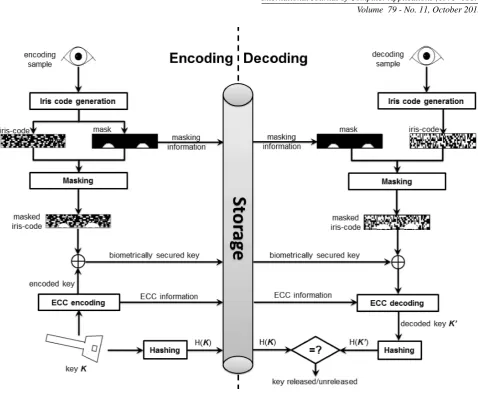
Fig. 3. Proposed iris-based FCS
two-factor scheme. At the encoding stage, an iris sample is cap-tured from the user and both of the iris-code and noise mask are derived from that sample employing the standard iris recognition system proposed by Daugman [3]. Masking information is added to iris features information, represented by the generated iris-code, by ANDing it with the noise mask. Since the noise mask of the encoding sample will be employed at the decoding stage, it must be stored in a user-specific token or card as depicted in Fig. 3. At the same time, the cryptographic keyK, to be committed by the masked iris-code, is prepared by the appropriate ECC(s) to obtain an encoded key of the same size as the iris-code. Finally, the com-mitment step is carried out by XORing the encoded key and the masked iris-code. The result of this step is a biometrically secured key which is stored along with the ECC(s) information and the hash value H(K) of the original key in the user-specific storage. At the decoding stage, an iris sample is acquired, from the user who asks for releasing the key, and iris-code is generated from that sample. The masked version of this sample is obtained by ANDing it with the noise mask of the encoding sample which can be retrieved from the user-specific storage. Once the masked iris-code is obtained, it
is XORed with the biometrically secured key and the result is de-coded using the stored ECC information to obtain the EC dede-coded keyK0
. At the last step of the decoding stage the hash value of thek0
is computed, using the same hashing function employed at the encoding stage, and compared to the hash value of the original key. If both values are identical, the decoded keyK0
is released for further processing; otherwise, the key release process fails.
4. EXPERIMENTS AND DISCUSSION
com-pare the decoding accuracy of FCS implementation for masked and unmasked iris-codes, it is not critical to match their reported per-formance for unmasked iris-codes. As mentioned in the previous section, iris-codes are generated using the open source MATLAB implementation for iris recognition provided in [11]. This imple-mentation generates 9600-bit iris codes, together with their corre-sponding 9600-bit noise masks.
At enrolment, a masked iris-code is obtained from each iris-code via ANDing it with its corresponding noise mask and a crypto-graphic keyK of length l is encoded using the two-layer ECC scheme, described in [7], into annp(= 9600)-bit codeword c.
This concatenated ECC scheme combines Hadamard and Reed-Solomon ECCs to deal with background and burst errors in iris codes, respectively. In the first layer, bits inKare divided intokRS
blocks ofk-bit each. This set of blocks is then represented as a message ofkRSsymbols overF2kand encoded into a codeword of nRSsymbols using a (nRS,kRS,tRS) Reed-Solomon(R-S) code
with a correction capacitytRS = (nRS−kRS)/2. In the second
layer, each of the resultingnRSsymbols is represented as ak-bit
binary word and encoded into a2k−1bit codeword using a (2k−1, k,2k−2) Hadamard code. Such Hadamard code is generated from a
Hadamard matrix of orderk−1and can correct up to2k−3−1
er-roneous bits in each codeword. The following equation shows how the sizenp of the final encoded key and the parameters of both
Hadamard and R-S codes are related:
np=nRS×2k−1 (6)
For instance, a 40-bit key can be encoded into a 9600-bit codeword via encoding it using the R-S(75,5), to get a8×75 = 600-bit code-word and then encoding each 8-bit chunk in this codecode-word using the (128, 8, 64) Hadamard code to obtain the final75×128 = 9600 -bit codeword. In our experiments, the (128, 8, 64) Hadamard code is found to give the best correction results for background errors. Thus, the correction capacity of the implemented ECC scheme de-pends only on the R-S parameters,nRS andkRS. The lowest
cor-rection capacity is obtained whennRS=kRS(i.e., only Hadamard
encoding is employed). In other words, the correction capacity in this case would not exceed25%of the encoded codeword, since the correction capability of sole Hadamard coeds is up to25%. On the other hand, the correction capacity of the overall ECC scheme increases as the difference betweennRS andkRSincreases.
Bio-metrically secured keys are then obtained by XORing the obtained encoded key with each masked iris-code.
At verification, the intra-user decoding accuracy is evaluated us-ing leave-one-out cross-validation strategy. For each class, only one sample is considered as the enrolment sample and its noise mask is used to generate masked codes for the remaining iris samples for that class. Each verification iris-code is then XORed with the bio-metric key generated using the enrolment sample and the obtained result is decoded using ECCs employed at enrolment. Verification templates are shifted circularly up to 10 bits in both directions, to account for misalignment, and the above procedure is repeated af-ter each shift. The overall process is repeated for other iris samples of the same class. On the other hand, to evaluate the inter-user de-coding accuracy, each iris-sample for each class is treated as the enrolment sample and matched against all samples from all other classes.
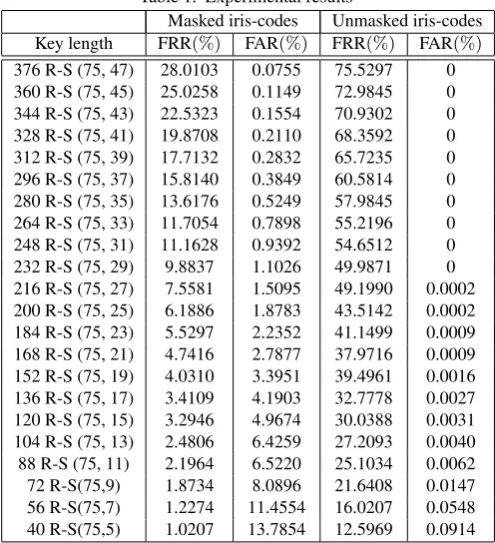
[image:4.595.313.561.128.400.2]Table 1 shows the experimental results obtained using different R-S codes. The results show that, for unmasked iris-codes based
Table 1. Experimental results
Masked iris-codes Unmasked iris-codes Key length FRR(%) FAR(%) FRR(%) FAR(%) 376 R-S (75, 47) 28.0103 0.0755 75.5297 0 360 R-S (75, 45) 25.0258 0.1149 72.9845 0 344 R-S (75, 43) 22.5323 0.1554 70.9302 0 328 R-S (75, 41) 19.8708 0.2110 68.3592 0 312 R-S (75, 39) 17.7132 0.2832 65.7235 0 296 R-S (75, 37) 15.8140 0.3849 60.5814 0 280 R-S (75, 35) 13.6176 0.5249 57.9845 0 264 R-S (75, 33) 11.7054 0.7898 55.2196 0 248 R-S (75, 31) 11.1628 0.9392 54.6512 0 232 R-S (75, 29) 9.8837 1.1026 49.9871 0 216 R-S (75, 27) 7.5581 1.5095 49.1990 0.0002 200 R-S (75, 25) 6.1886 1.8783 43.5142 0.0002 184 R-S (75, 23) 5.5297 2.2352 41.1499 0.0009 168 R-S (75, 21) 4.7416 2.7877 37.9716 0.0009 152 R-S (75, 19) 4.0310 3.3951 39.4961 0.0016 136 R-S (75, 17) 3.4109 4.1903 32.7778 0.0027 120 R-S (75, 15) 3.2946 4.9674 30.0388 0.0031 104 R-S (75, 13) 2.4806 6.4259 27.2093 0.0040 88 R-S (75, 11) 2.1964 6.5220 25.1034 0.0062 72 R-S(75,9) 1.8734 8.0896 21.6408 0.0147 56 R-S(75,7) 1.2274 11.4554 16.0207 0.0548 40 R-S(75,5) 1.0207 13.7854 12.5969 0.0914
FCS implementation, the false acceptance rates (FARs) are gen-erally low (<1%) and they decrease as key length increases. On the other hand, the false rejection rates (FRRs) are high (>12% for 40-bit key) and they increase as key length increases. These re-sults are expected because all the imposter Hamming distances, in case of unmasked iris-codes, are higher than30%which is beyond the correction capacity of the employed ECC scheme. Also, many genuine Hamming distances are high (4669 comparisons>30%) because masking information are not used. This makes correct key decoding for such genuine iris samples not possible even for short key sizes. For masked iris-codes based implementation, both gen-uine and imposter Hamming distance distributions are shifted to the left, as shown in Fig. 2(c). This resulted in an increase in FARs and a decrease in FRRs. As shown in Table.1, as key lengths increase, the correction capacity decreases and hence the FARs decrease and the FRRs increases.
It should also be noted that the disclosure of noise masks to attack-ers may affect usattack-ers’ privacy. However, this effect may not be crit-ical because of two reasons. First, because these masks designate unwanted regions such as eyelid and eyelashes that are common in any iris image, they look similar in most of iris images. Second, since users enrol in different applications using different iris sam-ples, iris masks cannot be identical for the same user. Rather, they differ due to the changing conditions of the acquisition process.
5. CONCLUSION
This paper presented an iris-based fuzzy commitment scheme which, unlike other existing iris-based fuzzy commitment schemes, incorporates noise information in the commitment process. Be-cause the noise mask of the decoding iris sample cannot be avail-able in advance, the noise mask of the encoding sample is employed at both encoding and decoding stages. Experimental results showed that the decoding accuracy of the proposed scheme outperforms ex-isting iris-based fuzzy commitment schemes that do not use noise information.
6. REFERENCES
[1] Meng Ao and Stan Z. Li. Near infrared face based biomet-ric key binding. In Proc of the 3rd Int Conf on Biometrics (ICB’09), pages 376–385, 2009.
[2] Julien Bringer, Herv´e Chabanne, G´erard D. Cohen, Bruno Kindarji, and Gilles Z´emor. Theoretical and practical bound-aries of binary secure sketches.IEEE Transactions on Infor-mation Forensics and Security, 3(4):673–683, 2008. [3] John Daugman. High confidence visual recognition of
per-sons by a test of statistical independence.IEEE Trans. Pattern Anal. Mach. Intell., 15(11):1148–1161, 1993.
[4] John Daugman. How iris recognition works.IEEE Trans. Cir-cuits Syst. Video Techn., 14(1):21–30, 2004.
[5] John Daugman. Probing the uniqueness and randomness of iriscodes: Results from 200 billion iris pair comparisons. Pro-ceedings of the IEEE, 94(11):1927–1935, 2011.
[6] Feng Hao.On using fuzzy data in security mechanisms. PhD thesis, University of Cambridge, April 2007.
[7] Feng Hao, Ross Anderson, and John Daugman. Combining crypto with biometrics effectively.IEEE Trans. Computers, 55(9):1081–1088, 2006.
[8] Ari Juels and Martin Wattenberg. A fuzzy commitment scheme. In6th ACM Conf on Computer and Communications Security, pages 28–36. ACM Press, 1999.
[9] Sanjay Ganesh Kanade, Dijana Petrovska-Delacr´etaz, and Bernadette Dorizzi. Cancelable iris biometrics and using er-ror correcting codes to reduce variability in biometric data. In IEEE Int Conf on Computer Vision and Pattern Recognition (CVPR’09) Workshops, pages 120–127, 2009.
[10] Peng Li, Xin Yang, Hua Qiao, Kai Cao, Eryun Liu, and Jie Tian. An effective biometric cryptosystem combining fin-gerprints with error correction codes. Expert Syst. Appl., 39(7):6562–6574, 2012.
[11] Libor Masek and Peter Kovesi. Matlab source code for a bio-metric identification system based on iris patterns.The School of Computer Science and Software Engineering, The Univer-sity of Western Australia, 2003.
[12] Christian Rathgeb and Andreas Uhl. Systematic construction of iris-based fuzzy commitment schemes. InProc of the 3rd Int Conf on Biometrics (ICB’09), pages 940–949, 2009. [13] Christian Rathgeb and Andreas Uhl. A survey on biometric
cryptosystems and cancelable biometrics.EURASIP J. Infor-mation Security, 2011:3, 2011.
[14] The Chinese Academy of Sciences, CASIA Iris Image Database.http://www.cbsr.ia.ac.cn/IrisDatabase. [15] Sheikh Ziauddin and Matthew N. Dailey. Robust iris