http://dx.doi.org/10.4236/oalib.1100586
Why It Is Necessary to Construct the
Mechanics of Structured Particles and How
to Do It
Vyacheslav M. Somsikov
Institute of Ionosphere, Almaty, Kazakhstan
Email: [email protected]
Received 1 May 2014; revised 3 June 2014; accepted 16 June 2014
Copyright © 2014 by author and OALib.
This work is licensed under the Creative Commons Attribution International License (CC BY).
http://creativecommons.org/licenses/by/4.0/
Abstract
The question why it is necessary to build the mechanics of the structured particles, which are the systems of potentially interacting of the material points, basing on the laws of Newtonian mechan-ics is discussed. We will show how to do it without the restrictive hypotheses and assumptions used in the classical mechanics for construction of the Hamiltonian formalism of the systems. We will show also how concept of entropy appears in the mechanics. Some of important problems in physics, the solution of which can help the mechanics of structured particles, are submitted.
Keywords
Classical Mechanics, Structural Particles, Internal And Motion Energy, Motion Equation, Irreversibility
Subject Areas: Classical Mechanics, Dynamical System, Theoretical Physics
1. Introduction
of hydrodynamics, in particular, empirical Navier-Stokes equations, in solving the many-body problem [6] [7]. Schrödinger equation, which is the basis of quantum mechanics, is obtained based on the Hamilton’s equation. It also led to problems of quantum mechanics [8]. The list of such examples is very long.
The conventional explanation of the mechanism of irreversibility is based on the property of exponential in-stability of Hamiltonian systems and the hypothesis of the fluctuations existence [2]. Essence of the explanation is as follows. According to Poincare theorem on reversibility of Hamiltonian systems, a system in the phase space will approach infinitely close to its starting point in a finite (although it might be very large) period of time [2] [5]. However, if averaged over an arbitrarily small neighborhood of the phase space in which the sys-tem is, due to the exponential instability it will not return to its original state. Such averaging is equivalent to existence of the arbitrarily small fluctuations in the system. Therefore, if to accept the hypothesis of the exis-tence of fluctuations in natural systems, we come to the explanation of irreversibility in Hamiltonian systems. However, hypothesis about fluctuations is alien to the classical mechanics. Moreover, such explanation means the existence of the finite horizon of the deterministic description of the world.
Analyzing of a large number of attempts to find an explanation of the thermodynamics’ second law in the frames of the classical mechanics formalisms led to the idea that this explanation can be not exist [3]. This could mean either that in classical mechanics, in principle, its explanation are absent, or for this explanation, the ex-pansion of the classical mechanics formalisms by removing any restrictions under which formalisms was con-structed, required. Nevertheless, it turned out that if to expand the classical mechanics formalisms’ then within the Newton’s laws the explanation of deterministic irreversibility exists [9]-[12].
To come to deterministic irreversibility explanation, it is necessary to take into account that all natural bodies are systems and have the internal energy. Only thanks to their internal energy and possibilities of its changes in the interactions, the irreversibility exists. Therefore, the dissipative mechanics should construct based upon the motion equations of the structured particles (SP), but not on the base of the material points (MP) or any other nonstructural elements. Only condition about structured bodies is insufficient to describe the irreversible dy-namics. Besides, the hypothesis of holonomic constraints, which is used for obtaining of the canonical of La-grange’s equation [1], should be excluded from the process of deriving the systems’ motion equation.
The main aim of this work is to show how to construct the SP mechanics. It will be explained how the SP mechanics can be built within the laws of classical mechanics based on the expression for the energy, how the time symmetry breaking is appearing in the mechanics of SP, and how the concept of entropy into the frame of clas-sical mechanics can be introduced. We will also consider as in the approach of the local equilibrium, the me-chanics of nonequilibrium systems (NS) can be constructed. Difference of SP meme-chanics from the meme-chanics of MT will be discussed also. Why the system may arise only from those elements that have a structure, will be shown.
2. The SP Dynamics
According to the molecular-kinetic theory, all bodies are NS [6] [7]. In the approach of the local equilibrium, the NS can be submitted, as a set of equilibrium subsystems, which in the motions relative to each other. Each of equilibrium subsystems consists from a large number of potentially interacting MP [6] [7]. Therefore, to find the NS motion equation it is necessary previously to obtain the equilibrium subsystems motion equation. We will call this equilibrium subsystem as SP.
Because the SP have a structure, the work of external forces will spent as on their motion and on the change of the internal energy. The SP motion energy determined by the velocity of the CM and mass, while the internal energy determined by the motion of the MP relative to the CM. Hence, the right-hand side of the SP motion eq-uation, in contrast to the MP motion equations, will contain two terms, which determine the change of the mo-tion energy and the internal energy. Therefore, SP acceleramo-tion uniquely determined by the work of external forces, in contrast to the acceleration MP.It is one of the important differences between SP and MP dynamics.
the SP velocity is due to the amount of the forces applied to each MP. But this sum is less than the sum of abso-
lute external forces applied to the MP as it follows from the next inequality:
1 1
N N
i i
i= F ≤ i= F
∑
∑
. Equality holdswhen all MP move with equal speed for example in case when the SP is solid body.
2.1. The Derivation of the SP Motion Equation
Let us show, how to obtain the SP motion equation. According to Newton’s second law, the SP acceleration is proportional to the sum of potential forces acting on the all MP. Point of application of force is the CM of SP. These forces provide the change of the SP motion energy. From the law of conservation of momentum, it fol-lows that the sum of the interaction forces MP is equal to zero. Therefore, the motion of MP relative to the CM, defining the internal energy, does not contribute to the motion of SP. I.e. the work of the forces, which change the internal energy, not connected with the work, which change of the kinetic energy of the SP. These forces cannot be expressed from the gradient of a scalar function [9]. However, they can be defined in terms of the change in internal energy of SP. To determine these non-potential forces, the energy of SP should be written as the sum of kinetic energy of the SP and internal energy. This can be done in independent macro-variables, which determine the energy motion CM of SP, and micro-variables determining the energy of the MP motion relative to the CM. In these variables, the total energy of the system is equal to [9]:
tr ins env
N N N
E =T +E +U , (1)
where tr 2 2
N N N
T =M V ; MN =mN; m is a mass of MP which we take equal to the unite; N is a number of
MP in SP; RN =
(
∑
iN=1ri)
N,(
1)
N
N i i
V =
∑
=v N are coordinates and velocities of the CM of SP; ri=RN +ri,i N i
v =V +v are coordinates and velocities of the of MP in the laboratory system of the coordinates; v r i,i, are
coordinates and velocities of the i-й MP relative to the CM of SP; ENins=TNins+UN is internal energy; ins N T = 2 1 2 N i i=mv
∑
is a kinetics part of internal energy of SP;( )
1( )
1 1
N N
N ij i j i ij ij
U r =
∑ ∑
=− = +U r is a potential part of in-ternal energy of SP, rij= −ri rj is a distance between i and j MP.
According to (1), the energy conservation law for the system is that the energy of the system changed so that the sum of the kinetic energy of motion of the SP, the internal energy and the energy of the external field is con-stant. Equation (1) follows from the fact that the forces between the MP are not dependent on external forces. Therefore, the internal energy, which is determined by the motion of MP in relative to the CM, independent from the SP motion energy. Differentiating (1) with respect to time we find the equation for the change of ener-gy [10]:
ins env env
N N N N N
V M V +E = −V F − Φ , (2)
where
(
( )
)
1 N ins
N i i i i i
E =
∑
=v mv +F r is s change of the internal energy; F r( )
i i is a force acting on i-th MP;(
)
1 ,
N
env env
i N i
i
F =
∑
= F R r ;(
)
1 ,
N
env env
i i N i
i=v F R r
Φ =
∑
; Fienv = ∂Uenv ∂ri.The first term in the right hand side of Equation (2) determines the change in kinetic energy of the SP, the second term is the change of the internal energy of SP. i.e. forces to implement the changes of a some type of energy is determined from the changes of this type of energy.
Let us we have inequality: Rri. Then the force env
F can be expanded in the small parameter. Leaving in the expansion terms of zero and first order we can write: ienv ienv R
(
i)
ienvR
F ≈F + r⋅∇ F . Taking into account that
1 1 0
N N
i i
i=v = i=r =
∑
∑
, 0 0 01
N env env env
i i
i= F =NF =F
∑
, we will obtain [9] [10]:(
)
0 1(
)
N
ins env env
N N N N N i i i R i
V M V +E ≈ −V F −
∑
= r⋅∇ F v . (3)The second term in (3), which determines the change in internal energy, is a non-linear. It depends on the mi-cro and mami-cro variables and proportional to the difference of the forces acting on different MP. From (3) we can find the motion equation for SP. It has a form [10]:
env
N N N N
where αN= Φ +
(
env ENins)
VN2 is a coefficient determining the efficiency of transformation of the energy of mo-tion into the internal energy. The first term in (4) is a potential force that changes the kinetic energy of the SP. The second term measures the change in internal energy of SP. Since SP is in equilibrium, its dynamics will de-termined by the internal energy, and should not depend on the random motion of individual MP [7]. The first term in (4) is a potent force that changes the kinetic energy of the SP. The second term measures the change in internal energy of SP. Since SP is in equilibrium, its dynamics will be determined by the internal energy, and should not depend on the random motion of individual MP [7].Let us compare the mechanics of MP and mechanics of SP. If for MP the work of external forces is goes only on acceleration, then for SP the work of external forces is goes as on its acceleration, as on the change of the in-ternal energy. The change of the total energy of SP, unlike MP, is ambiguously determined by the position of CM of SP in space. Moreover, the energy of motion of SP varies by the sum of forces acting on all of her MP, but the change of internal energy going due to the difference of these forces. By the law of conservation of mo-mentum, the internal energy cannot transform into the energy of motion. This means irreversible dynamics SP. If we neglect the change in internal energy, Equation (4) becomes reversible equation of Newton. i.e. irreversi-bility of motion SP associated with the “inclusion” of internal degrees of freedom of the system, which deter-mine the internal energy.
The formalism of Hamiltonian of classical mechanics for MP systems created on the base of the Newton and d’Alembert equations with postulate of the potentiality of all forces and hypocrisies about holonomic constraints [1]. However, according to (4) the condition of potentiality all forces is eliminates the work of the force chang-ing the internal energy of the system of MP. This postulate is equivalent to takchang-ing into account only those parts of the forces that change the energy of motion of the body. We also shown that hypothesis about holonomic constraints excludes of the nonlinear terms of the systems’ motion equations, which determine the change of the internal energy [13]. Therefore, it is impossible describe the processes of dissipation in nonequilibrium systems using this formalism because the dissipation is impossible without the change of the internal energy SP. Howev-er, if the formalism to construct basing on the Equation (4) for SP, we obtain the generalized equation Hamilton and Liouville [11]. These equations in the right-hand side will be containing the terms, which determine the transformation of the kinetic energy of the SP into internal energy. Therefore, they are suitable for the descrip-tion of dissipative systems.
2.2. The NS Mechanics and Entropy
Let us consider how we can generalize the mechanics SP on the mechanics NS. As in the case of SP, for NS the work of the external forces goes on NS motion and change of its internal energy. NS energy is the sum of the energies of all SP. Energy SP consists of NS energy of motion in the external field of forces and the energy of SP interaction with each other’s.
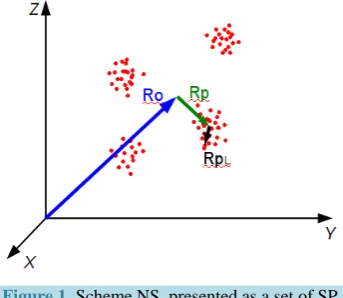
Let us NS consists from N MP. All MP redistributes between K SP. i.e. p=1, 2, 3K, where p is a number of SP. Each p-s SP is consists from Lp number of MP, i.e. l=1, 2, 3Lp; R0 is a coordinates of CM for NS; Rp is coordinates of CM for p-SP relative to the CM of NS; RPL is a coordinates of l-MP relative CM of p-SP.
The velocity of i-MP can be represented from the velocity CM of NS and velocities of SP by the next way:
i N p pl
v =V +V +v , where
(
)
1N
N i i
V =
∑
=v N is a velocity of the CM of NS,(
)
1Lp
p l l p
V =
∑
=v L is a velocity ofthe CM of SP relative CM of NS, vpl is a velocity of the l-MP relative CM of p-SP. Scheme of this NS is shown in Figure 1.
In these variables NS energy can be written as:
{
}
12 2 2
,
1 1 1 1 1 1
2 2 2 I J
I J
K K Lp K K K env
N N p p p p l pl P P P P P P N
E=M V +
∑
= M V +∑ ∑
= =mv +∑
=U +∑ ∑
−= =U +U . (5)Here MN is a sum of mass for all MP; MP is a sum of mass for all MP from p-SP;
( )
1
, ,
1 1
Lp Lp
P ip jp ip ip jp ip jp
U =
∑ ∑
=− = +U r is a potential energy p-SP, which determined by interaction all its MP, rip jp,is a distance between ip and jp MP; , 1 ,
( )
,1 1
P J Pj
I J PI Pj PI PJ Pi Pj
L L
P P l l l l l l
U =
∑
=−∑
=U r is a potential energy for interactionFigure 1. Scheme NS, presented as a set of SP.
1 K
env env
N p p
U =
∑
=U is a sum of the potential energies of all SP in the field of external forces.The first term in (6) is the kinetic energy of the system as a whole. The second term is the sum of the kinetic energy motion of all SP in relative to each other. The third term defines the kinetic component of the internal energy of each SP. The fourth member is the sum of the internal potential energy of all SP. It is determined by summing the indices corresponding for SP. The fifth term is the potential energy due to interaction of SP.
We see that the existence inhomogeneous internal structure in NS leads to a new level of de-composition energy caused by this structure. The internal energy of the NS divided into two types: the energy of motion and internal energy of the SP. The energy of the external field goes on the change of the kinetic energy of the NS, on the change of the motion and internal energy of the SP. The last two types of energy are the internal energy of NS. i.e. a hierarchy of energy NS, is determined by a set of SP. The hierarchy of entropy is also having a place. Entropy connected with the energy of the relative motions SP and with their internal energies. Obviously, as in the case of SP, NS equation of motion can be obtained from Equation (6). However in accordance with the new types of energy the hierarchy of variables and the hierarchy of forces will appeared.
The irreversibility of the transformation of the energy of motion into internal energy of SP allows to use the concept of entropy in the mechanics of SP. The entropy is defines as a value that specifies an increase in the in-ternal energy of SP. i.e. entropy is proportional to those part of the kinetic energy of the SP, which transformed into internal energy of SP. Increase of entropy is given by the formula [12]:
{
}
1 1 d
L
R N L
L ks k L
L k s
S = N = F v t E
∆ =
∑
∑
∫
∑
(6)Here EL is internal energy of L-SP; s is a number of the external elements for L-SP, which interacts with elements k belonging to another SP; FksL is a force, acted on k element from the side of s particle from anoth-er SP; vk is a velocity of the k element. NL is a number particles into L-SP; L=1, 2,3R is a number of SP into NS.
The Equation (5) can viewed as an entropy definition in the classical mechanics. This definition of the entro-py corresponds to Clausius one [6] [14]. The only difference is that classical entroentro-py follows from analytical ex-pression for the change of an internal energy obtained by us based on Newton’s laws. Thus, the internal energy is the energy of the chaos.
Thus, in a non-uniform external field of forces irreversible transformation of the energy of motion SP into its internal energy realized. This transformation is due to a non-linear relationship of two independent groups of macro and micros variables. System comes to equilibrium when the energy of the relative motion SP goes into their internal energy. Rate of increase in the internal energy SP is proportional to the inhomogeneities of exter-nal forces (see (3)). This rate decreases with decries of the motion energy of SP.
2.3. The Symmetry Dualism
interaction energy systems at the appropriate level of the hierarchy, the deeper the hierarchy of forces takes part in a change of the internal energy and the deeper the corresponding restructuring of the system. In any case, at sufficiently high energies the interaction of systems the dynamics of the system at any level will determined by the principle of dualism energy. In accordance with this principle, a quadratic differential form Riemannian line element ds2, in contrast to the corresponding forms, determined by the total amount of energy of all MT [1], splits into two parts:
(
)
2 2 2 2 2 2 tr 2 ins 2
N tr ins
ds = T dt =ds +ds = T + T dt . (7)
where dstr2 is corresponds to the motion energy of SP, dsins2 is corresponds to the internal energy of SP, Ttr
is corresponds to the kinetic parts of the motion energy of SP, Tins is corresponds to the kinetic parts of the in-ternal energy of SP.
2.4. Irreversibility and Paradoxes, Which Connected with Irreversibility
Criticism of the mechanism of the NS equilibration, proposed by Boltzmann in the frame of Hamilton formalism, mainly relies on the well-known paradoxes Zermelo and Loschmidt [2]. Consider how within the SP mechanics these paradoxes can explain.
The essence a Zermelo paradox is as follows. According to the Poincare theorem about reversibility of the Hamiltonian systems, due to the conservation of the phase volume, the NS must eventually pass arbitrarily close near to the beginning point of the phase space [2]. This means that the entropy of the systems, during its motion on the closed loop, can both increase and decrease. It is contradicts to the Boltzmann’s H-theorem.
Recall that the proof of the Poincare obtained under the assumption that the nonequilibrium system is Hamil-tonian. However, for Hamiltonian systems the condition of holonomicity constraints and potentiality of all forces that determine the evolution of the system must have a place. As has been shown here, a non-equilibrium system is not a Hamiltonian system. This means that Poincare theorem for NS not acceptable. The internal energy of the SP in NS increases by the nonlinear manner due to the energy of its relative motion. The transfor-mation of the motion energy into the internal energy leads to disappearance of the relative motion of SP. It is equilibration of NS [10]-[12]. Thus the integral of the SP motion work when it moves through a closed loop, is not equal to zero.
Loschmidt paradox follows from the requirement of reversibility of motion equations of Hamiltonian systems. This means that the system can move from the state of first to the state of second and vice versa. From the re-versibility of the systems’ motion equations must follow that if the system moves from first state to a second state, the entropy increases, but when it moves from second state to the first state, the entropy must decrease. However, this contradicts to the Boltzmann’s H-theorem. However, in generally, the requirement of reversibility, as already mentioned, for SP not performed. It is enough take into account, that all bodies in the nature have a structure. I.e., to describe the dynamics of natural bodies should use the SP motion equation and not the MP mo-tion equamo-tion. However, the SP momo-tion obeys to the Equamo-tion (4). This equamo-tion is not symmetrical with respect to time.
Thus, in the framework of the mechanics of SP, both paradoxes resolved. Consequently, the replacement of the MP on SP is not at all trivial. This substitution allows taking into account the dualism of the body’s symme-try. In accordance with the dualism of the symmetry, two types of energy determine the body’s dynamics. The presence of these types of energy leads to a violation of time symmetry in non-homogeneous space due to the conversion of the motion energy into the internal energy.
The need for using systems as body’s elements confirmed by Klymontovich [15]. His main conclusion is a need to considering the structure of a continuous medium at all levels of description. However, he obtained this conclusion in the frame of the statistical physics.
In accordance with the SP motion equation the equilibration of the NS caused by transformation of the SP energy of relative motion into their internal energy. The internal energy of SP is the energy of chaotic motion. In constraints with the law of momentum conservation, the internal energy cannot go back into the SP motion energy. i.e., the SP motion energy cannot changed due to the SP internal energy.
Hamiltonian systems may also cause irreversibility processes.
3. Conclusions
The ability to describe dissipative processes, responsible for the emergence and evolution of systems is excluded from the classical mechanics in the results of using the models MP and structureless bodies, as well as due to the hypothesis about potentiality of the collective forces. At that stage of development of science, such simplifica-tions were necessary. Without these simplificasimplifica-tions it is almost impossible to discover the nature of the laws of motion of bodies. Indeed, Newton’s second law is strictly valid only for bodies with no internal structure. Therefore, for returning the opportunity of the dissipative processes description into classical mechanics it is necessary to be refused from these simplifications. It turns out that it can be done by replacing the MT on SP. Taking into account the structure of bodies and the possibility of change of the internal energy during bodies in-teractions, the dissipative processes can be included in the description of dynamic processes. Moreover this al-lows being included into the mechanic the entropy concept. As a result, the entropy and the second law of ther-modynamics are finds explanation in the frame of the classical mechanics.
The motion equation of SP follows from the law of conservation of its energy if the Newton motion equation for MP has a place. A necessary condition for obtaining of SP motion equation is the fact that the energy of SP is a sum of the motion energy of SP and its internal energy. This fact can be taken into account through the in-troduction of independent macro-variables that determine the motion of SP and micro-variables that determine the motion of MP in relative to the CM. Since there are two independent types of energy; the two types of forces exist also: the potential forces moving the SP and non-potential forces that change the SP internal energy. As it became clear in the process of obtaining of the motion equations of SP, the dualism of energy and strength is a consequence of the dualism of internal symmetries and symmetry of space for structural bodies. The dualism of symmetry, and that the matter consists of from the systems that obey the universal laws of dynamics are cause of the infinite divisibility of matter and its fractal [14] (seeFigure 2).
Thus, in order to describe evolution in mechanics, one has to assume that every system in nature has a struc-ture. The dynamics of a system is determined by the concept of dualism of symmetry. This statement is funda-mental to the development of physics. Because in nature there are only systems rather than elements, then it fol-lows that the dissipation and thus a violation of the symmetry of time, is an inherent property of matter. This means that many of the problems in mechanics, particle physics and quantum mechanics, should study in terms of interacting systems rather than elements. Indeed, the most important question for physics is, basing on the knowing of the laws of the elements dynamics, how to determine the laws of dynamics of systems. It is well known that the whole is not a simple combination of parts. By the way, Boltzmann, perhaps, was the first who drew serious attention on this issue in classical mechanics, when he made attempt explaining to the irreversibil-ity of the processes in gases. No doubt, that to the solving of the problem of N bodies also needs an approach from the system’s position.
[image:7.595.230.399.547.705.2]Elementary particle physics faced with a problem of symmetry breaking. It is evident that for sufficiently strong interactions the energy of interaction will inevitably lost on structural rearrangement of the particles. If
we do not take into account that the particles have a structure then we obtain the uncertainty in the law of the conservation of the phase space and the difficulty in the explaining of the time break-symmetry.
It is not difficult to see that under the laws of classical mechanics, there is no limit on the increase in the in-ternal energy SP. According to the laws of classical mechanics, the inin-ternal energy can grow to infinity because of transformation of the energy of system motion. However, from the bodies’ radiation law it is followed that the stable state can exist when the balance of absorption and emission energy will appear. But as and when such a condition occurs it is not clear. Hence, the importance for the cosmophysics question is: what is the internal energy for the universe, how this energy changes; as electromagnetic energy converted into mass and vice versa, what the nature of fundamental interactions and why the universe is fractal. Obviously, that for solution of these problems it is necessary to consider the objects of the universe as dynamical systems.
In general, the mechanics of SP can be regarded as a “bridge” that links Newtonian mechanics with thermo-dynamics, statistical physics and kinetics. Mechanics of SP opens the way to study the laws of building dynamic systems basing on the properties of the elements and the laws of their dynamics. In addition, this, in turn, is a prerequisite to the creation of the basic physics of evolution, which is necessary for construction of the modern picture of the world.
References
[1] Lanczos, С. (1962) The Variation Principles of Mechanics. University of Toronto Press, Toronto.
[2] Zaslavsky, G.M. (1999) Chaotic Dynamic and the Origin of Statistical Laws. Physics Today, 52, Part 1, 39. [3] Prigogine, I. (1980) From Being to Becoming. Freeman, San Francisco.
[4] Lebowitz, J.L. (1999) Boltzmann’s Entropy and Time’s Arrow. Physics Today, September, 32-38. [5] Poincare, A. (1983) About Science. Nauka, M.,Moscow, 559 c.
[6] Rumer, Yu.B., Ryvkin, M.Sh. (1977) Thermodynamics. Stat. Physics and Kinematics. M.
[7] Landau, L.D. and Lifshits, Ye.M. (1976) Statistical Physics. M.
[8] Greenstain, G. and Zajone, A.G. (2012) The Quantum Challenge. Modern Research on the Foundation of Quantum Mechanics. Intellect, Dolgoprudny, 432p.
[9] Somsikov, V.M. (2008) The Restrictions of Classical Mechanics in the Description of Dynamics of Nonequilibrium Systems and the Way to Get Rid of Them. New Advances in Physics, 2, 125-140.
[10] Somsikov, V.M. (2011) Principles of Creating of the Structured Particles Mechanics. Journal of material Sciences and Engineering A, 1, 731-740.
[11] Somsikov, V.M. (2004) The Equilibration of an Hard-Disks System. IJBC, 14, 4027-4033.
[12] Somsikov, V.M. (2005) Thermodynamics and Classical Mechanics. Journal of Physics: Conference Series, 23, 7-16. [13] Somsikov, V. and Mokhnatkin, A. (2014) Non-Linear Forces and Irreversibility Problem in Classical Mechanics.
Journal of Modern Physics, 5, 17-22.
[14] Grujić, P.V. and Panković, V.D. (2009) On the Fractal Structure of the Universe. arXiv:0907.2127v1 [physics.gen-ph] 13 Jul.