http://dx.doi.org/10.4236/oju.2015.59027
Urologic Pathologies of Child at
Ouagadougou
Isso Ouédraogo
1*, Toussaint Wendlamita Tapsoba
1, Cyprien Zaré
2, Emile Bandré
1,
Bernadette Bernadette
1, Somkieta Francis Ouédraogo
1, Albert Wandaogo
11Department of Pediatric Surgery, Teaching Pediatric Hospital Charles de Gaulle, Ouagadougou, Burkina Faso 2Department of Surgery, Teaching Hospital Sourô Sanou, Bobo Dioulasso, Burkina Faso
Email: *[email protected]
Received 18 March 2015; accepted 22 September 2015; published 25 September 2015
Copyright © 2015 by authors and Scientific Research Publishing Inc.
This work is licensed under the Creative Commons Attribution International License (CC BY). http://creativecommons.org/licenses/by/4.0/
Abstract
Introduction: Urologic pathologies of children are frequent. Urinary apparatus diseases occupy the third position after those of respiratory and digestive tracts in children. Objectives: The objec-tive of this study was to investigate epidemiologic, diagnostic, and therapeutic aspects of urologic pathologies of children in our hospital. Patients and Methods: This work is a descriptive and ret-rospective study from January 1st 2005 to December, 31st 2012 on children from 0 to 15 years old admitted and treated in Teaching Pediatric Hospital Charles de Gaulle for a urologic pathology. Results: In total, 711 patients had been registered with 7.3 sex-ratio, an average age of 4 years old (0 - 15 years old). Malformative pathologies were represented by the majority (62.7%). They were mainly composed of peritoneovaginal canal pathology, posterior urethra valves (PUV), and Pyelo- ureteral junction anomaly (PUJA). Urolithiasis, infectious, and tumoural pathologies were second, third and fourth with 19.4%, 7.6% and 5.8% respectively. Surgical treatment was necessary for 83.2% of patients. A total nephrectomy has been realized in 5 cases for PUJA with mute kidney. Some post-operative complications have been observed in 2.6% of operated patients. The global mortality rate was 2.9% with Wilms’ tumor predominance in aetiology (58.8%). Conclusion: Uro- logic pathologies of children are dominated by urogenital malformations. The decreasing of their lethality is guided by a MU antenatal diagnosis and a personal qualification to improve the diag-nosis and the treatment.
Keywords
Uropathy, Children, Epidemiology, Diagnosis, Treatment
1. Introduction
Urinary apparatus diseases, among children, are in third position after respiratory ways and digestives patholo-gies [1]. Their annual frequency had been evaluated to 1/200 living births in France and their hospitable fre-quency is 31.8% in Benin [1] [2]. They are dominated by malformations. Their seriousness varies but the major-ity of these pathologies can impair the child’s kidney function. Malformative disorders of the urinary tract and mainly the posterior urethra’s valves are a main cause of terminal renal failure for the child [3]. Considering the frequency and the potential seriousness of these uropathies, we have found appropriate to determine epidemi-ologic, diagnostic, and therapeutic aspects of these pathologies in order to improve their prognosis.
2. Patients and Methods
This work is a descriptive and retrospective study from January 1st 2005 to December 31st 2012 on children from 0 to 15 years old admitted and treated in surgical paediatric service for a urologic pathology. The catch-ment area spread on the whole country peopled with 17 millions inhabitants; and the under 15 years represented 48%; our pediatric hospital is the only one.
We have included all patients admitted in emergency context or normal consulting whose medical documen-tation possessed diagnostic information of uropathy and treatment criteria. The variables collected were pidemi-ologic (age, sex, type and admission mode) diagnosis (consulting delay, clinical and paraclinical information about uropathy), treatment (treatment method, results).
Was defined as a new born, children from 0 to 28 days of live, infants from 29 days to 30 month of live, pre-scholar from 31 month to 5 years old, small child from 6 years to 10 years old and big child from 11 years to 15 years old.
Data have been captured and analysed with the following software: Word and Excel 2010, Epi info 3.5.3.
3. Results
3.1. Epidemiologic Aspects
3.1.1. Frequency
On 8 years, 711 patients have been admitted for urologic pathology with a hospitable frequency of 88.8 cases/year. During the same period 9540 patients have been hospitalized in the department of pediatric surgery and 10,777 surgical interventions have been performed. These data, above mentioned, represented 7.4% of all hospitalizations and 5.5% of operations (592 interventions).
3.1.2. Admission Mode
Patients were admitted on the direct mode in 361 cases (50.9%) and by reference in 350 cases (49.1%). Normal consultion concerned 61.9% and emergency admission 38.1%.
3.1.3. Age and Sex
The average age was 4 years with an interval from 0 to 15 years. The distribution by age bracket showed: 3.3% of new born, 42.3% of infants, 26% of pre-scholar, and 28.3% of big children. It was a question of 88% of boys and 12% of girls, namely a sex-ratio of 7.3. The basic characteristics of these 711 patients was summarized into
Table 1.
3.1.4. Consultion Delay
The average delay for consultation in paediatric surgical service was about 8.43 months with some extremes of 0 to 144 months.
3.2. Diagnostic Aspects
Nosologic Entities
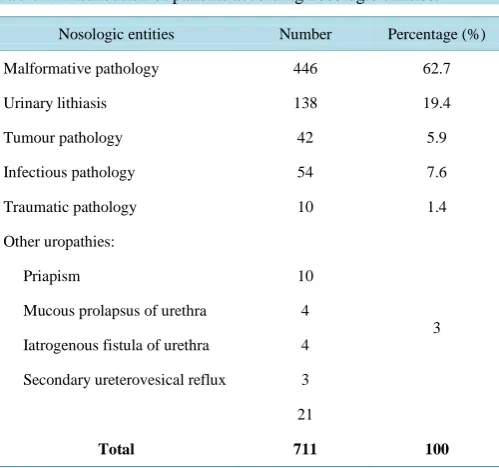
The distribution of patients depending of nosology entities is given inTable 2.
• Malformative uropathies
Table 1. Basic characteristics of patients (sex, age).
Sex
New born (age) Infants (age) Pre-scholar (age) Big children (age)
Male Female
[image:3.595.189.439.173.407.2]626 85 24 301 185 201
Table 2. Distribution of patients according nosologic entities.
Nosologic entities Number Percentage (%)
Malformative pathology 446 62.7
Urinary lithiasis 138 19.4
Tumour pathology 42 5.9
Infectious pathology 54 7.6
Traumatic pathology 10 1.4
Other uropathies:
3
Priapism 10
Mucous prolapsus of urethra 4
Iatrogenous fistula of urethra 4
Secondary ureterovesical reflux 3
21
Total 711 100
High uropathies in 30 cases were dominated by pyelo-ureteral junction anomalies and the kidney multi-cystic dysplasia with respectively 16 and 6 cases. The other high uropathies were represented by polycystic kidney (n = 2), the kidney agenesis (n = 2), the kidney ectopia (n = 2), the horseshoe-shaped kidney (n = 1) and the bifid ureter (n = 1).
○ Low malformative uropathies
Low uropathies were essentially formed by posterior urethra’s valves (n = 23) and hypospadias (n = 24). The other diagnoses were the bladder exstrophy (n = 8), the congenital reflux from urethra to bladder (n = 1), and the congenital urethral stenosis (n = 1). Other low malformative uropathies were represented by urachus cyst (n = 4), the peritoneovaginal canal pathology (n = 254), the testicular ectopia (n = 69), the spermatic cord torsion (n = 15), paraphimosis (n = 3), phimosis (n = 2), and varicocele (n = 2).
• Urolithiasis
Urolithiasis concerned boys principally (89.5%). The age bracket from 5 to 10 years was the more concerned with 39.5%. These lithiasis were happened on pre-existing uropathy in 7 cases (4.3%); it’s PUJA (n = 3), PUV (n = 2), kidney ectopia (n = 1) and bifid ureter (n = 1).
• Kidney and urinary tract tumours
The tumoural pathology was dominated by Wilms’ tumour with 35 cases (83.3% of tumours). The other tu-mours diagnosed were bladder tumour and testicular with 9.5% and 7.1% of tutu-mours, respectively.
• Traumatic pathology
Four (4) cases of kidney contusion, 4 cases of urethral stenosis, 1 case of glans amputation after posthectomia and 1 case of urethral section have been registered.
• Infectious pathology
• Other uropathy
The other uropathies types were the priapism (n = 10), mucous prolapsed of urethra (n = 4), iatrogenic ure-thral fistula (n = 4) and the secondary ureterovesical reflux (n = 3).
3.3. Therapeutics Aspects
3.3.1. Surgical Treatment
The majority of patients (592 = 83.2%) have required a surgical act and took 5.5% of all surgical activity in the service during this period. The therapeutic method applied was specific to each type of uropathy. The radical nephro-ureterectomia concerned 5 cases of PUJA on the 16 registered cases. The indication was the radiologic mute kidney.
3.3.2. Medical Treatment
A medical treatment was applied only in 8.2% and in association with surgery in 91.8% of cases. It concerned administration of antibiotics, anti-inflammatories, analgesics, and chemotherapy drugs.
3.3.3. Hospitalization Length
The average hospital stay was 4.5 days with extremes of 1 and 49 days.
3.3.4. Treatment Results
After treatment, the evolution was good except in 15 patients who presented 19 postoperative complications. It was parietal suppuration (n = 6), suture breaking (n = 2), bladder fistula (n = 4) and urethral (n = 3), peritonitis (n = 2), intestinal occlusion (n = 1) and evisceration (n = 1). Patients repartition according to the exit mode is given inTable 3.
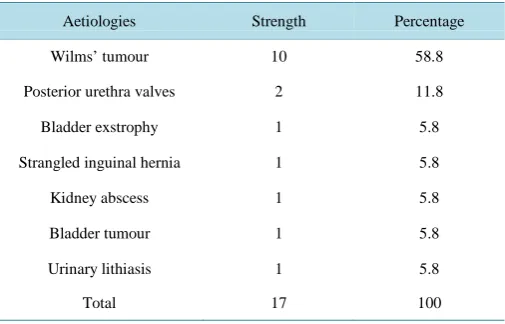
[image:4.595.187.440.398.533.2]Considering the aetiology, dead patients repartition is specified inTable 4.
Table 3. Patients repartition according to the exit mode.
Exit mode Strength Percentage
Better 667 93.8
Against medical advice 8 1
Transfered 15 2.1
Evacuated 4 0.5
Death 17 2.3
Total 711 100
Table 4. Dead patients repartition according to pathology (n = 17).
Aetiologies Strength Percentage
Wilms’ tumour 10 58.8
Posterior urethra valves 2 11.8
Bladder exstrophy 1 5.8
Strangled inguinal hernia 1 5.8
Kidney abscess 1 5.8
Bladder tumour 1 5.8
Urinary lithiasis 1 5.8
[image:4.595.188.441.560.722.2]4. Discussion
4.1. Epidemiologic Aspects
In our study, per year 88.8 cases for hospital frequency of uropathy have been found. It represented 7.4% of the whole hospitalisation. This proportion is superior to the reports of Agossou-Voyeme and Dao who respectively found 4.8% and 2.8% in their series [2] [4]. This difference is relative to the context of the study. The average age of our patients was 4 years. This result is near to those of Agossou-Voyeme and Dao who found 4.4 years and 4 years 11 months respectively [2] [4]. Urologic pathologies predominated on boys with 7.3 as sex-ratio. The predominance of urologic disease at boys has been reported in developed countries’ literature, and this in a similar way as developing countries’ one [1] [4] [5]. It concerned the definition of the paediatric urology which dealt with urinary apparatus pathologies for both sexes (male and female), and particularly male genital organs [6].
4.2. Diagnosis Aspects
Considering nosologic entities, the uro-genital malformation was the most frequent pathology in our series with a proportion of 62.7%. This predominance had been observed in developed countries’ literature which is similar to developing countries’ literature [1] [4] [5]. In our context, this frequency of the malformative pathologies would increase with the development of antenatal diagnosis.
Among these MU, the PUJA was more frequent in terms of high uropathy. His frequency of 2 cases per year (15 cases in 8 years), which is close to the frequency found by Kahloul et al. [7] (15 cases in 8.5 years, namely 1.7 cases/year) is very inferior to those reported by Diarra et al. [8] (13 cases in 1.5 years namely 8.7 cases/ year).
Among low MU, PUV were the most frequent and the most serious. The increasing of creatininemia (average of 133 umol/L) was present at 45% of patients who had PUV. This kidney’s function deterioration in this MU has been also reported by other African authors: Khemakhem and al. (18/38 or 47.4%) and Dami (33.33%) [9] [10]. This kidney function deterioration would be function of the late in diagnosis and the seriousness of the pa-thology. PUV formed the first aetiology of chronic obstructive renal failure to the boy [5]. Another frequent complication in PUV is the urinary infection: about 2/3 of patients in our series (64.5%) and 75% in Dami’s serie [10]. This frequency of urinary tract infections reported by many authors [3] [11] [12] confirms the seri-ousness of this pathology with the risk of septicaemia in pyelonephritis. These complications are able to strike a blow at patients’ vital prognosis underlining the necessity of early diagnosis and adequate treatment.
4.3. Therapeutic Aspects
The total nephrectomy has been indicated for a muted kidney in 5 cases on 16 PUJA; it forms a high rate. In PJUA, the waited nephrectomy rate was about 10% for primary nephrectomy and inferior to 1% for secondary nephrectomy in the western series at the end of years 1980 [13]-[15]. These series were composed of a majority of postnatal diagnosis, with which the primary nephrectomy decreased and secondary nephrectomy become very rare [16] [17]. It’s important in our context to promote the antenatal diagnosis, with obstetrical echography and at default, act to early screening of MU in order to reduce nephrectomy rate.
This screening will have to concern also PUV in particular because of their seriousness. An early and ade-quate treatment, in particular the endoscopic resection, will contribute to the reduction of this pathology’s lethal-ity.
Postoperatives complications have been observed in 15 patients with a morbidity rate of 2.1%. It was about parietal suppuration in 6 cases and fistula in 7 cases after bladder lithotomy or after surgery of hypospadias and bladder exstrophy.
repre-sented by bladder exstrophy, strangled inguinal hernia, kidney abscess, bladder tumour, and urolithiasis. The main problems were the inadequacy of our health system which cannot provide good quality of care and the cultural considerations that urge certain parents to use traditional medicines before their admission to hospital. That situation explained the delay on diagnosis and care thus leading to drawbacks.
5. Conclusions
Urologic pathology of the child is frequent. It is dominated by malformations. The MU are potentially serious because in the major forms like the PUJA and PUV, the principal evolving risk is the deterioration of kidney function.
The decreasing of the infantile morbi-mortality linked to urologic pathology goes through:
• A screening by a complete clinic exam during medical visit or when they are consulting;
• Obstetrical echography promotion;
• A physician continuing education;
• An increasing in number of specialists in paediatric surgery (uro-paediatricians) and medical paediatricians (nephro-paediatricians).
References
[1] Cendron, J. and Schulman, C. (1985) Paediatric Urology. Flammarion Méd Sci, Paris, 1.
[2] Agossou-Voyeme, A.K., Fiogbe, M.A., Goundete, A.B.J., Hounnou, G. and Hodonou, R. (2010) The Urologic Patho- logies Child at the Teaching Hospital of Cotonou: Aetiologic and Therapeutic Aspects. Cames-Série A, 10, 23-27.
[3] Averous, M., Beurton, D., Biserte, J., Doré, B., Lortat-Jacob, S., Muller, F., et al. (1996) Paediatric Urology France: Laboratoires Synthélabo. 200 p.
[4] Dao, P. (1998) Study on Kidney Disease and Urologic Pathologies of Children in the Department of Paediatric at the Teaching Hospital Yalgado Ouédraogo. Ouagadougou, Medecine, 88 p.
[5] Cendron, J. and Faure, G. (2004) Congenital Pathologies of Kidney and Urinary Tract. Grenoble (France) J Urol Pédiatr, 85-250.
[6] Leger, L. (1999) Surgical Semiology. 6th Edition, Masson, Paris, 1-52.
[7] Kahloul, N., Charfeddine, L., Fatnassi, R. and Amri, F. (2010) Malformative Uropathies in Child: About 71 Cases.
Journal de Pédiatrie et de Puériculture, 23, 131-137.
[8] Diarra, A.A. (2006) The Pyelo-Ureteral Jonction in the Department of Urology of Teaching Hospital Point G. Mede-cine, Bamako, 134 p.
[9] Khemakhem, R., Ben Ahmed, Y., Mefteh, S., Jlidi, S., Charieg, A., Louati, H., et al. (2012) The Posterior Urethra Valves: About 38 Cases. Journal de Pédiatrie et de Puériculture, 25, 242-248.
[10] Dami, F. (2012) The Posterior Urethra Valves of Child (about 12 Cases). Medecine: Fès, 143 p.
[11] Cukier, J. (1985) Valves and Diaphragms of the Posterior Urethra. In : Cendron, J. and Schulman, C., Eds., Paediatric Urology, Flammarion Méd Sci., Paris, 203-211.
[12] Mollard, P. (1984) Urology of the Child. Masson, Paris, 385 p.
[13] Galifer, R.B., Veyrac, C. and Faurous, P. (1997) The Congenital Anomalies of the Pyelo-Ureteral Jonction in Child: Multicentric Study of 985 Observations on 883 Children. Ann Urol (Paris), 21, 241-249.
[14] Héloury, Y., Schmitt, P., Allouch, G., Gruner, M. and Bruézière, J. (1986) Treatment of Neonatal Hydronephrosis by Malformation of the Ureteropelvic Junction: Interest of Percutaneous Nephrostomy. European Urology, 12, 224-229.
[15] Salano, F., Pecenco, G., Scabardi, M., Cimaglia, M.L., Salvatori, G. and Belloli, G. (1985) Hydronephrosis Surgically Treated in the 1st Year of Life. Short and Long Term Radiologic and Functional Evaluation. Medical and Surgical Pe-diatrics, 7, 639-642.
[16] El-Ghoneimi, A. (2005) Renal Dysplasia and Cystic Disease Options. In: Docimo, S.G., Ed., Minimally Invasive Ap-proaches to Pediatric Urology, Taylor & Francis, London, 105-118. http://dx.doi.org/10.1201/b14482-11