http://dx.doi.org/10.4236/msa.2014.58055
Evaluation of Mean Crystallite Size on
Magnetic Powder by Scanning Electron
Microscopy and Synchrotron Diffractometry
Eguiberto Galego, Marilene Morelli Serna, Rubens Nunes de Faria Junior
Instituto de Pesquisas Energéticas e Nucleares, IPEN-CNEN, São Paulo, Brazil Email: [email protected]
Received 26 March 2014; revised 4 May 2014; accepted 29 May 2014
Copyright © 2014 by authors and Scientific Research Publishing Inc.
This work is licensed under the Creative Commons Attribution International License (CC BY). http://creativecommons.org/licenses/by/4.0/
Abstract
This paper presents the results of investigations carried out with Pr-based magnetic powders. The magnetically hard powders were produced from homogenised alloys using a high temperature hydrogen pulverization process. Alloys and powders were investigated by scanning electron mi-croscopy and by energy dispersive X-ray analysis. Mean crystallite size of the pulverized material was estimated using synchrotron powder diffractometry and the Scherrer method. A comparison between these two investigation techniques has been carried out. The effects of copper on the properties of the magnetic powders have been studied. It has been shown that the addition of this alloying element had a marked effect on the microstructure of the powders.
Keywords
Rare Earth Alloys, Magnetic Powders, Hydrides, Synchrotron Radiation
1. Introduction
Anisotropic and isotropic magnetic powders have been produced successfully with REFeB-type alloys using hydrogen processing (examples in [1]-[9]). Typical Nd12.5Fe76.1Co5.5B5.9 bonded magnets have shown remanence
(Br) of 0.62 T and coercivity (iHc) of 1.15 T [3]. In these magnets, addition of Ga and Zr resulted in anisotropic powders. Bonded Nd12.6Fe69.4Co11.5B6Ga0.5 magnets showed Br values of 0.89 T and iHc of about 1.33 T [4].
Ad-dition of Zr to these materials induced even higher iHc (1.38 T) [5]. Pr-based powders have also been produced via this process [9]. Br of about 0.67 T and iHc of 0.69 T were reported for a Pr13Fe81B6 powder [7]. Additions of
and reasonable iHc (~1 T), can be produced by this process [9]. However, Ga additions to Pr-based bonded mag-nets induced anisotropy, but with reduced iHc. A magnetic powder based on the alloy Pr13Fe68.9Co24B6Ga1Zr0.1
was reported to have Br of 0.98 T with iHc of only 0.48 T [8].
A number of variables affect the hydrogen pulverization process [9] and, therefore, it is easier to use pro- cessing conditions that have yielded good results in the past and then seek the alloying element that imparts the best properties. The hydrogen treatment used for the Pr-based alloys [9] is very convenient because it uses a moderate temperature and a relatively low hydrogen pressure and finding an alloying element that induces high anisotropy or high iHc is considered to be very important. Copper has always been associated with good mag-netic properties in cast and hot-pressed Pr-Fe-B-based permanent magnets [10]. Grain refinement in the cast al-loys and improvement of hot-workability have also been attributed to this element [11]. Furthermore, Cu has induced high iHc in sintered Pr-based magnets [12]. In this study, copper alloying has been used to change the magnetic properties and microstructures of Pr-based materials. The alloys are represented by the formulae: Pr14FebalCo16B6Nb0.1 and Pr14Fe63.8Co16B6Nb0.1Cu0.1. These materials were investigated by scanning electron
mi-croscopy (SEM) and X-ray diffraction (XRD) using synchrotron radiation. The main advantage of synchrotron diffractometry is the monochromatic radiation with a higher peak definition when compared to conventional XRD. A comparison between these two characterization methods has been carried out. Attempts have also been made to correlate the magnetic properties with the powder microstructures.
2. Experimental Procedures
Two commercial alloys were used in this investigation. The chemical analyses of the as-cast alloys are given in Table 1. As per the supplier’s specification, the alloys contained neodymium (0.2 - 0.7 wt%), aluminium (0.02 - 0.2 wt%) and silicon (0.01 - 0.04 wt%) as impurities. The procedure used to prepare the magnetic powder and bonded magnet has been described in details in a previous work [9]. In this work the powders were isostatically pressed and consolidated by immersion (vacuum impregnated) in low viscosity cyanoacrylate adhesive at 70˚C to form permanent magnets. Magnetic characterization was carried out using a permeameter (accuracy: 2%) af-ter saturation in a pulsed field of 6 T. Br values have been normalized assuming 100% density (7.5 g∙cm−3) for the sample and considering a linear relationship between density and Br [9].
The microstructures of the pulverized material were examined in a (Philips XL 30) scanning electron micro-scope fitted with energy dispersive X-ray analysis (EDX). Data obtained from analysing three regions ~100 μm2
of each phase for count times of 120 s were averaged to improve detection of Cu in the matrix phase. Boron could not be analyzed by EDX.
In order to estimate the mean crystallites size of the pulverized material X-ray diffraction was employed. X-ray was yielded in a synchrotron beam with a tuned wavelength of 2.2912 Å by a double-crystal monochro-mator. The diffractometer used a parallel geometry (slits: 3 mm for scattering and 1 mm for receiving) with a 1 m radius goniometer. Measurements of the instrumental widening were carried out employing an Al2O3 standard.
Step-scanning was carried out at a rate of 0.01 degree per step and the time base was normalized to incident beam monitor counts. Hydrogenated samples were crushed with a mortar and pestle in air, such that all the ma-terial passed through a ≤48 μm sieve. In this study, the (212) and (411) reflections were employed since they have strong relative intensity (I/Io) and are not close to other reflections. The mean crystallite size has been
es-timated by the Scherrer method using the expression:
, cos B K D B λ θ =
where: K it is a constant which depend of the crystal morphology, whether K = 1 the mean crystallite size error approaches ±10% [13]; D is the mean crystallite size; λ is the wavelength; B is difference between angle at the full-width at half-maximum (FWHM) of the XRD peak and; θB is the angle where the peak intensity is maxi-mum.
3. Results and Discussion
Table 1. Composition of the as-cast Pr-based cast ingot alloys.
Nominal composition (at%)
Analyzed composition (wt%)
Pra Fe Co B Nb M
Pr14FebalCo16B6Nb0.1 30.35 54.11 14.34 0.96 0.14 -
Pr14FebalCo16B6Nb0.1Cu0.1 30.51 53.79 14.25 0.99 0.15 0.13 a
Pr +0.2 - 0.7 wt% Nd; +nominal composition: 0.05 wt%.
[image:3.595.89.540.358.503.2]
(a) (b)
Figure 1. Backscattered electron image of the Pr14FebalCo16B6Nb0.1 alloy in the (a) as cast and (b) homogenized condition.
(a) (b)
Figure 2. Backscattered electron image of the Pr14FebalCo16B6Nb0.1Cu0.1 alloy in the (a) as cast and (b) homogenized
condi-tion.
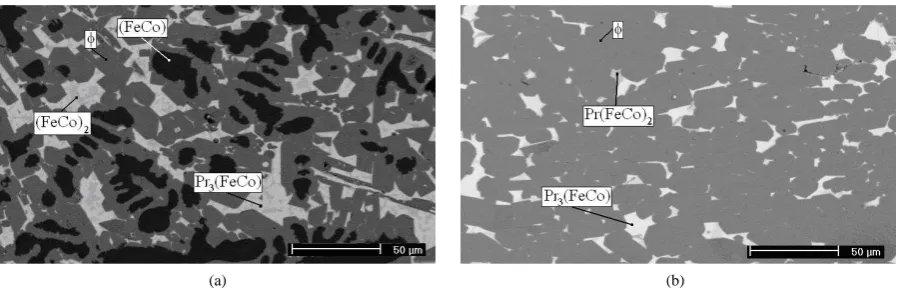
grain boundary phases present in the as-cast alloys, Pr3(FeCo) and Pr(FeCo)2, have also been detected and
re-ported in a previous study [14]. Table 2 summarizes the magnetic properties and density of all the Pr-based bonded magnets prepared using these alloys in the annealed condition. The secondary electron image of the Pr14FebalCo16B6Nb0.1 powder that yielded magnets with enhanced Br is shown inFigure 3(a). The grain size of
the magnetic material prepared with this alloy varied roughly from 0.5 to about 1.5 μm. This secondary electron image is quite similar to that of Nd12.6Fe63.1Co17.4Zr0.1Ga0.3B6.5 and Pr13.7Fe63.5Co16.7B6Zr0.1 powder, which also
yielded good bonded magnets [9] [15] [16].
The addition of copper to the Pr14FebalCo16B6Nb0.1 alloy decreased Br slightly and was very deleterious in
terms of iHc. The secondary electron image of the material that yielded bonded magnets with inferior magnetic properties is shown inFigure 3(b). The grain size of the magnetic material prepared with this copper-containing alloy varied approximately from 1 to around 2 μm. This is consistent to the diminished iHc found with this ma-terial. The fracture surface of the Pr14FebalCo16B6Nb0.1Cu0.1 pulverized material exhibited a very distinct
Table 2. Magnetic properties and density of the cyanoacrylate bonded magnet prepared with the alloy annealed at 1100˚C for 20 h under high vaccum. Permeameter measurement at room temperature after saturation in a 6 T magnetic pulse field.
Composition Br (mT) μo iHc (mT) μo bHc (mT) (BH)max (kJ/m3) SF (ratio) ρ (g/cm3)
Pr14FebalCo16B6Nb0.1 660 ± 10 1080 ± 20 540 ± 10 70.0 ± 1.6 0.37 ± 0.01 5.31 ± 0.01
Pr14FebalCo16B6Nb0.1Cu0.1 620 ± 10 780 ± 20 440 ± 10 54.0 ± 1.1 0.37 ± 0.01 5.24 ± 0.01
(a) (b)
Figure 3. Secondary electron image of hydrogen processed material prepared from the homogenized alloy: (a) Pr14FebalCo16B6Nb0.1; (b) Pr14FebalCo16B6Nb0.1Cu0.1 (both: fracture surface; magnification 8000×; mark: 2 μm).
this has not been observed in the cast or annealed PrFeCoBNbCu alloys (comparison inFigure 1 andFigure 2), although in this investigation Cu had a substantial effect on the pulverized material. At first glance, it might be thought that the eutectic Cu-Pr phase with a low melting point would interfere on the hydrogen process at high temperature (~860˚C). In this process, Pr elements should be tied up with hydrogen after completion of the hy-drogenation-disproportionation stage. Therefore, the eutectic Pr-Cu phase may not be present to interfere on the hydrogen processing, at least, in a direct way.
Br, on the other hand, is affected by the crystallographic alignment of the magnetically hard matrix phase grains. Local microtextural analysis using electron backscattered diffraction (EBSD)was carried out success-fully on the sintered NdFeB magnets [19]. Attempts to use this technique on individual grains of the magnetic powder prepared in this investigation have been unsuccessful so far. Hence, the Br value is still the best indicator of anisotropy in the bonded magnets. This property of a magnet depends directly on the volume fraction (f) and saturation polarization (Is) of the hard magnetic phase (φ), as well as on the degree of easy-axis alignment of the
single crystals φ grains (<cosθ>) and magnet density. In the bonded magnets studied here, the volume fraction can be regarded as a constant, considering that the amount of element added is extremely low (0.1 at%). The packing factor (P = magnet density/theoretical density) for an ideal magnet is unity and in this investigation it has been normalized to this maximum value. Again, since the amount of element added is negligible, the spon-taneous polarization of the Co-containing matrix phase can also be regarded as a constant. The degree of texture of the bonded magnets is also influenced by a possibility of inclusion of multigrain particles in the powders or not.
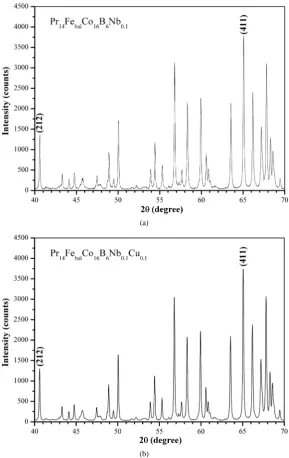
Figure 4andFigure 5 show the (212) and (411) peaks analyzed to determine the mean crystallite size using the Scherrer method and synchrotron radiation. The mean crystallite size of the magnetic powder prepared with the two alloys varies from 0.62 μm to 0.81 μm (error ± 10%). This range is more than two fold the well accepted value (0.3 μm) for Nd-based HDDR material and might explain the slightly lower iHc observed in the Pr-based magnets. It is worth noting that the FWHM method gives only a rough estimate of the mean crystallite size. The XRD result for the magnetic material showed no significant contrast in the mean crystallite size with the pres-ence of Cu in the alloy as the SEM observation of grain size and structure shown previously inFigure 3(a) and Figure 3(b). In the Scherrer method, mean crystallite size will be detected and it is likely that the result repre- sented the average crystallite inside of the matrix phase grains. The XRD pattern shown inFigure 6 is typical for the magnetic material prepared with the Pr14FebalCo16B6Nb0.1 and Pr14Fe63.8Co16B6Nb0.1Cu0.1 alloy. No
sig-nificant differences were found on the patterns of the material produced with the alloy containing Cu.
Figure 4. Close view of the (212) peaks and estimated mean crystallite size (K = 1).
Figure 5. Close view of the (411) peaks and estimated mean crystallite size (K = 1).
thermodynamic stability and microstructure of the parent compound is modified in a specific manner by the ad-dition of a certain element. Cu adad-dition affected slightly Br or degree of alignment. The “memory-cell” model suggests that nano-scale regions of the matrix phase containing the element that was added remained unaffected by the disproportionation reaction and act as nucleation sites during recombination [5] [20] [21].
Nevertheless, it is also known that anisotropy can be achieved by appropriate processing and for 2-14-1 com-pounds, without the addition of dopants. For Pr-based alloys (Pr13.7Fe63.5Co16.7B6Zr0.1 and Pr13.7Fe80.3B6), it has
been reported that the role of the Co and Zr additives is not primarily the stabilization of the 2-14-1 matrix phase against disproportionation but more importantly the stabilization of intermediate boride phases after dispropor-tionation which could lead to an effective inducement of texture on recombination [22] [23].
It was reported that when Cu is added to REFeB-type alloys, it remains preferentially in the grain boundaries as a low melting point eutectic mixture with the rare earth [24]. Further, in Cu-containing magnets, the Cu con-tent in the Pr2Fe14B matrix phase has been found to be negligible [24] or has not been observed in the matrix
phase of Nd-based materials [25]. It has been reported that the solubility of Cu in the Nd2Fe14B is below the res-
40.3 40.4 40.5 40.6 40.7 40.8 40.9
[image:5.595.173.454.317.531.2](a)
[image:6.595.168.458.83.542.2](b)
Figure 6. X-ray diffraction pattern of the hydrogen processed: Pr14FebalCo16B6Nb0.1
(a); and Pr14FebalCo16B6Nb0.1Cu0.1 (b) powder using monochromatic synchrotron
radiation (E = 5.412 keV).
olution of EDX and is about 1 at% in the Nd-rich phase [26]. It might be thought that a matrix phase with few Cu nucleation centers would not maintain the c-axis orientation of the original large φ grain and would therefore yield an isotropic material. According to the previous studies [2] [9], this should not be the case because the present Pr-based alloy contains 16 atomic percent Co, which serves as the principal element to induce texture in the hydrogen processing. On the other hand, if a minimal amount of Cu inside the matrix phase were to provide sufficient nucleation sites, then there would not be sufficient thermodynamic stability to avoid the disproportio-nation reaction of the matrix phase. This also might not be the case for the present PrFeCoBNbM magnets since Cu is present in the matrix phase of the Pr14FebalCo16B6Nb0.1Cu0.1 alloy in about 0.3 at% (because B could not be
over-whelmed by the effects of Co and also by Pr.
Previous work has shown that increase in Nb content from 0.1 to 0.5 at% decreases the Br of the magnets [28]. Increases in the amount of Cu to 0.5 at% also decreased the Br of the magnets prepared in this investigation. In this case, Cu content, also determined by EDX, in the alloy matrix phase were slightly higher. This indicates that only small amounts of these elements are necessary to induce anisotropy, or the right amount of alloying addi-tion is necessary for achieving high anisotropy. It is possible that the addiaddi-tion of large amounts of any element will create a large number of non-disproportionated regions and dilute the matrix phase with the appearance of new phases. The effect of Ti, V, Cr, Mo, Al, Si and P additions on the magnetic properties of bonded magnets have also been reported previously [29].
4. Conclusions
The mean crystallite size determined using synchrotron diffractometry and the Scherrer method were consistent for both (212) and (411) reflections. No significant difference has been found in the mean crystallite size with Cu addition with this method. For both alloys the mean crystallite size of the magnetic powder estimated by this method varied from 0.62 ± 0.06 μm to 0.81 ± 0.08 μm. Scanning electron microscopy clearly showed a distinct variation on the grain structure and size with Cu addition. Typical secondary electron images of the Pr14FebalCo16B6Nb0.1 magnetic powder, that yielded bonded magnets with good magnetic properties, were quite
distinct to that of the Pr14FebalCo16B6Nb0.1Cu0.1 material. It has been also shown that the iHc of the Pr-based
magnets decreased considerably with Cu addition and this addition yielded larger φ grains. It has been inferred that the effect of such a small amount of Cu should not be that of thermodynamics but might be a kinetic effect localized in the vicinity of the reaction front. In the Cu-free powder the φ grains should be constituted by one crystallite whereas in the Cu-containing two crystallites could be inside the φ grains. Scanning electron micro-scopy and synchrotron diffractometry can be complementary in investigations of high temperature hydrogen processed magnetic powders. The former is appropriate for grain morphology (structure/size) and the latter for estimation of the mean crystallite size inside the grains.
Acknowledgements
The authors wish to thank FAPESP and IPEN-CNEN/SP for the financial support and infrastructure made available to carry out this investigation. We also would like to thank the XPD Beamline staff for the help during the experiment at the National Synchrotron Light Laboratory (LNLS), Brazil.
References
[1] Hirosawa, S., Uehara, M., Mino, S., Ishigaki, N. and Tomida, T. (1997) New Aspects of Nd-Fe-B-Based Hydrogena-tion-Disproportionation-Desorption-Recombination Powders and Anisotropic Bonded Magnets Made from Them: Mi-crostructure and Magnetic Properties. Journal of Applied Physics, 81, 4821-4826.http://dx.doi.org/10.1063/1.365472
[2] Gutfleish, O. and Harris, I.R. (1998) Hydrogen Assisted Processing of Rare-Earth Permanent Magnets. Fifteenth In-ternational Workshop on Rare-Earth Magnets and Their Applications,Dresden, September 1998, 487.
[3] Nakayama, R., Takeshita, T., Itakura, M., Kuwano, N. and Oki, K. (1991) Magnetic-Properties and Microstructures of The Nd-Fe-B Magnet Powder Produced by Hydrogen Treatment. Journal of Applied Physics, 70, 3770-3774.
http://dx.doi.org/10.1063/1.349232
[4] Nakayama, R., Takeshita, T., Itakura, M., Kuwano, N. and Oki, K. (1994) Microstructures and Crystallographic Orien- tation Of Crystalline Grains in Anisotropic Nd-Fe-Co-B-(Ga or Zr) Magnet Powders Produced by the Hydrogenation- Decomposition-Desorption-Recombination Process. Journal of Applied Physics, 76, 412-417.
http://dx.doi.org/10.1063/1.349232
[5] Nakayama, R. and Takeshita, T. (1993) Nd-Fe-B Anisotropic Magnet Powders Produced by the HDDR Process. Jour-nal of Magnetism and Magnetic Materials, 193, 259.
[6] Takeshita, T. and Marimoto, K. (1996) Anisotropic Nd-Fe-B Bonded Magnets Made from HDDR Powders. Journal Applied Physics, 79, 5040-5044. http://dx.doi.org/10.1063/1.361567
[7] Pan, W., Cui, L.Y., Wang, P. and Zhou, S.X. (1996) Magnetic Properties of HDDR Processed (Pr1-xNdx)13Fe81B6.
Fourteenth International Workshop on Rare-Earth Magnets and Their Applications, São Paulo, 467.
[9] Faria R.N., Davies, B.E., Brown, D.N. and Harris, I.R. (2000) Microstructural and Magnetic Studies ff Cast and An-nealed Nd and PrFeCoBZr Alloys and HDDR Materials. Journal of Alloys and Compounds, 296, 223-228.
http://dx.doi.org/10.1016/S0925-8388(99)00536-8
[10] Shimoda, T., Akioka, K., Kobayashi, O. and Yamagami, T. (1988) High-Energy Cast Pr-Fe-B Magnets. Journalof Ap-plied Physics, 64, 5290-5292. http://dx.doi.org/10.1063/1.342395
[11] Shimoda, T., Akioka, K., Kobayashi, O. and Yamagami, T. (1990) Development of Hot-Rolled R-Fe-B Magnets. Ele-venth International Workshop on Rare Earth Magnets and Their Applications, Pittsburg, 1990, 17.
[12] Faria, R.N., Abbel, J.S. and Harris, I.R. (1991) High Coercivity Sintered Pr-Fe-B-Cu Magnets Using the Hydrogen Decrepitation Process. Journal of Alloys and Compounds, 177, 311-320.
http://dx.doi.org/10.1016/0925-8388(91)90084-9
[13] Azároff, L.V. and Bueguer, M.J. (1958) The Powder Method in X-Ray Crystallography. McGraw-Hill, New York.
[14] Barbosa, L.P., Takiishi H. and Faria, R.N. (2004) The Effect of Cobalt Content on the Microstructure of Pr-Fe-Co-B- Nb Alloys and Magnetic Properties Of HDDR Magnets. Journal of Magnetism and Magnetic Materials, 268, 132-139.
http://dx.doi.org/10.1016/S0304-8853(03)00487-6
[15] Kawashita, Y., Waki, N., Tayu, T., Sugiyama, T., Ono, H., Koyama, H., Kanno, H. and Uchida, T. (2003) Microstruc-tures and Magnetic Properties of Hydrogenation Disproportionation Desorption Recombination-Processed Nd-Fe-B Materials with Different Nd Content of 11.0 and 12.6 at.%. Journal of Alloys and Compounds, 360, 322-329.
http://dx.doi.org/10.1016/S0925-8388(03)00504-8
[16] Cannesan, N., Brown, D.N., Williams, A.J. and Harris, I.R. (2001) The Production and Characterisation of Highly An- isotropic PrFeCob-Type HDDR Powders. Journal of Magnetism and Magnetic Materials, 233, 209-218.
http://dx.doi.org/10.1016/S0304-8853(01)00212-8
[17] Takahashi, N., Nakamura, H., Paik, C.R., Sugimoto, S., Okada, M. and Homma, M. (1991) Coercivity and Micro-structures in Pr-Fe-B-M Cast Alloys (M = Cu/Ga/Ag/Al/In/Pb). Materials TransactionsJIM, 32, 90-92.
[18] Shimoda, T., Akioka, K., Kobayashi, O., Yamagami, T., Ohki, T., Miyagawa, M. and Yuri, T. (1989) Hot-Working Behavior of Cast Pr-Fe-B Magnets. IEEE Transactions on Magnetics, 25, 4099-4104.
http://dx.doi.org/10.1109/20.42535
[19] Khlopkov, K., Gutfleisch, O., Eckert, D., Hintz, D., Wall, B., Rodewald, W., Muller K.H. and Schultz, L. (2004) Local Texture in Nd-Fe-B Sintered Magnets with Maximized Energy Density. Journal of Alloys and Compounds, 365, 259- 265. http://dx.doi.org/10.1016/S0925-8388(03)00636-4
[20] Harris, I.R. (1992) The Use of Hydrogen in the Production of Nd-Fe-B-Type Magnets and in the Assessment of Nd-Fe-B-Type Alloys and Permanent Magnets. Proceedings of 12th International Workshop on RE Magnets and their Applications, Camberra, 347.
[21] Uehara, M., Tomizawa H. and Hirosawa, S. (1993) Origin of Anisotropy in the HDDR Process of Nd2Fe14B-Based
Alloys, IEEE Transactions on Magnetics, 29, 2770-2772. http://dx.doi.org/10.1109/20.281023
[22] Gutfleisch, O., Teresiak, A., Gebel, B., Muller, K.H., Cannesan, N.B., Brown, D. and Harris, I.R. (2001) Metastable Borides and the Inducement of Texture in Pr2Fe14B-Type Magnets Produced by HDDR. IEEE Transactions on
Mag-netics, 37, 2471-2473. http://dx.doi.org/10.1109/20.951206
[23] Cannesan, N., LeBreton, J.M., Williams, A.J. and Harris, I.R. (2002) The Evolution of the Disproportionated Micro-structure of PrFeB-Based Alloys. Journal of Magnetism and Magnetic Materials, 242, 1372-1374.
http://dx.doi.org/10.1016/S0304-8853(01)01236-7
[24] Kwon, H. W., Bowen, P. and Harris, I.R. (1991) Microstructural and Magnetic Studies on Pr-Fe-B-Cu Alloys. Journal of Applied Physics, 70, 6357-6359. http://dx.doi.org/10.1063/1.349941
[25] Kianvash, A. and Harris, I.R. (1992) The Effect of Heat-Treatment on the Microstructure and Magnetic-Properties of Sintered Magnets Produced From Nd-Fe-B Based Alloys with and without Cu Substitution. Journal of Alloys and Compounds, 178, 325-341. http://dx.doi.org/10.1016/0925-8388(92)90274-D
[26] Knoch, K.G., A. Kianvash, A. and Harris, I.R. (1992) Nd-Fe-B-Cu HD-Processed Sintered Magnets—Properties and Microstructure. IEEE Transactions on Magnetics, 28, 2142-2144. http://dx.doi.org/10.1109/20.179423
[27] Faria, R.N., Takiishi, H., Castro, A.R.M., Lima, L.F.C.P. and Costa, I. (2002) Chemical Microanalysis of Rare-Earth- Transition Metal-Boron Alloys and Magnets Using Scanning Electron Microscopy. Journal of Magnetism and Mag-netic Materials, 246, 351-359. http://dx.doi.org/10.1016/S0304-8853(02)00105-1
[28] Barbosa, L.P., Takiishi, H., Lima, L.F.C.P. and Faria, R.N. (2004) The Effect of Niobium Content on the Magnetic Properties and Microstructures of PrFeCoBNb HDDR Magnets and Alloys. Journal of Magnetism and Magnetic Mate-rials, 283, 263-269. http://dx.doi.org/10.1016/j.jmmm.2004.05.032
currently publishing more than 200 open access, online, peer-reviewed journals covering a wide range of academic disciplines. SCIRP serves the worldwide academic communities and contributes to the progress and application of science with its publication.