Review on STBC coded MISO and MIMO in Frequency
Selective Wireless Fading Channel
Mahesh Shankar Pandey
M-Tech Research Scholar Department of ECE
Bhopal Institute of Technology, Bhopal
Bramha Swaroop Tripathi
Assistant Professor Department of ECE
Bhopal Institute of Technology, Bhopal
ABSTRACT
Diversity methods offer the receiver with separately faded copies of the transmitted signal with the expectation that at least one of these replicas will be received properly. There are ranges of techniques available during which these faded copies can be recovered and used as part of preparations for better reception. Transmit diversity uses multiple transmit antennas to offer the receiver with multiple uncorrelated replicas of the transmitted signal. The advantage is that the difficulty of having multiple antennas is located on the transmitter, which can be common among many receivers for the downlink of a wireless system, even as still providing diversity benefits. This technology is called as MIMO system. Hence the multipath fading channels are measured as an advantage scenario in MIMO. This is the most preferred technique in fourth generation cellular communication, as higher data rates can be achieved. Our objective is to review concatenating various error control codes in the MIMO setting using BER and EDR as performance indicators.
Keywords
MIMO, MISO, STBC; Receive Diversity & BER.
1.
INTRODUCTION
Following the time when the beginning of data hypothesis [1], limit has been an essential metric to assess a correspondence framework. A few definitions of limit exist. The connection, client, or channel limit is alluded to as the most elevated information rate at which dependable correspondence is conceivable between a transmitter and a receiver. In the meantime, framework limit is regularly used to demonstrate the aggregate framework throughput, i.e., the whole of all client information rates, inside a cell or an area. The framework limit can additionally be communicated as far as zone limit essentially by normalizing by the cell size. Moreover, phantom efficiency, defined as the limit for every unit transfer speed, has gotten an alternate key metric by which correspondence frameworks are measured. Fast development in portable interchanges has prompted an expanding interest for high information rate correspondences administrations. Late research in data hypothesis has indicated that expansive increases in the limit and dependability of interchanges over remote channels could be accomplished by abusing the spatial space. One engaging innovation called multiple input multiple output (MIMO)[3], utilizes various reception apparatuses to both transmit and accept data, and guarantees to attain high unearthly efficiency or enhanced vitality efficiency. The
requirement for quick wireless communication joins has become uncommonly over the previous decade so as to help an extensive variety of requisitions [2]. This is a direct result of the way that transmitted signs are accepted through numerous ways which add usefully and ruinously to bring about genuine execution varieties. The medium is typically imparted by numerous distinctive clients, expanding the likelihood of obstruction also. The lack of accessible transmission capacity, exceedingly obliged transmits powers, and additionally equipment many-sided quality and expense prerequisites likewise incorporate among alternate difficulties for high velocity remote provisions [2]. Higher request tweak plan appears to be an approach to enhance the transfer speed proficiency. Notwithstanding, poor dependability connected with it causes one burden of this requisition. A specific result that appears to be a successful method to finish solid correspondence over a remote channel is the utilization of differing qualities. A spatial differing quality, additionally alluded to as transmit and/or accept radio wire differences, speaks to a compelling method for fighting the injurious impacts of blurring. The arrangement of utilizing numerous radio wires at both transmitter and one receiver is, alluded to as multiple input single output and with different reception apparatuses is called multiple input multiple output [7] framework. One of the significant focal points of these frameworks is the generous build in the channel limit, which quickly means higher information throughput. An alternate playing point of MISO/MIMO framework is the noteworthy change in information transmission unwavering quality, i.e., low bit slip rates. These focal points are achievable without any extension in the obliged data transmission or build in the transmit power. The fusion of coding with spatial differences opens up new measurements in remote interchanges, and can offer compelling answers for the difficulties confronted in acknowledging dependable fast remote correspondence joins [3]. The utilization of Space-Time Block Coding (STBC) with differing qualities increases conditional from MISO and MIMO set-up give enhanced execution in blurred remote
2.
SYSTEM MODEL
5 enhance the dependability of information exchange. The way
[image:2.612.102.265.210.313.2]that the transmitted sign must navigate a possibly troublesome environment with dispersing, reflection, refraction along these lines on and might then be further tainted by warm clamor in the collector implies that a percentage of the accepted duplicates of the information will be "better" than others. This excess brings about a higher shot of having the capacity to utilize one or a greater amount of the accepted duplicates to rightly unravel the gained indicator. Actually, space–time coding consolidates all the duplicates of the gained indicator in an ideal approach to concentrate however much data from each of them as could reasonably be expect.
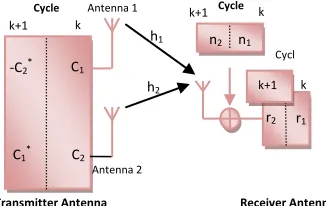
Fig. 1 Transmitted and Received signals in Space-time block code scheme with two transmit and one receive
antenna
Consider a MIMO system with MT transmits antennas and MR
receives antennas as shown in Fig. 2. Denoting the impulse response between the j th (j = 1, 2, ... , MT) transmit antenna
and ith (i = 1, 2, ... , MR) receive antenna by (τ ,t). An STBC is
usually represented by a matrix. Each row represents a time slot and each column represents one antenna's transmissions over time. Here, Sij is the modulated symbol to be transmitted
in time slot i from antenna j. There are to be T time slots and nT transmits antennas as well as nR receives antennas. This
[image:2.612.76.298.477.598.2]block is usually considered to be of 'length' T.
Fig. 2 2x2 MIMO – STBC Channel
The MIMO channel is given by the MR x MT matrix H (τ, t) =
The vector
is the spatio-temporal signature or channel induced by the jth transmit antenna across the receive antenna array.
Here, Sij is the modulated symbol to be transmitted in time slot
i from antenna j. There are to be T time slots and nT transmits
antennas as well as nR receives antennas. This block is usually
considered to be of 'length' T.The code rate of an STBC measures how many symbols per time slot it transmits on average over the course of one block. If a block encodes K symbols, the code-rate is
The two antenna transmit diversity scheme is one example of a general technique known as Space Time Block Coding. Space Time Block Codes are special codes that provide diversity gain while maintaining orthogonality between code words after receiver processing. It maps a block of input symbols into space and time domains, creating an orthogonal sequence or a quasi-orthogonal sequence that will be transmitted from different transmit antennas. The receiver is composed of channel estimation, combining 1 and ML detection 2. Because the transmitter antennas use the same frequency, there is no frequency penalty. The MIMO technique has attracted a lot of attention due to its capability in providing spatial multiplexing and diversity gains [4]. In the spatial multiplexing technique, the data is split into multiple streams, which are transmitted and received by multiple antennas [5]. Indeed, MIMO technique can give additional degrees of freedom to increase channel capacity and data rate by using more transmitting antennas. The diversity coding technique can exploit spatial and temporal transmit diversity and provide coding gains for error correction. As one of the diversity techniques STBC over multiple antenna systems has been studied extensively. It integrates antenna diversity with coding techniques to achieve a higher capacity and has a better capability of resisting the channel impairment for MIMO communications [6]. Nonetheless, in practice, this scheme is still quite complex and there is great interest in investigating the construction of much simpler alternatives for practical use.
Transmit Antenna Array h11 hij Receive Array x2 y1 n1 n2
x1 y2
Transmit Antenna Time-Slots S0
S1*
Tx1
h0
Demux STBC Encoder S1 S1*
Channel Estimator Channel Estimator Channel Estimator Maximum Likelihood Detector STBC Encoder h1 h3 h2 Tx2 Rx0 Rx1 h0 h1 h2 h3 S0*
S1*
Information Bit Sequence Estimated Bit Sequence k C1 C2
-C2*
C1*
r2 r1
k+1
k+1 k
Antenna 1
Antenna 2
Cycle
n2 n1 Cycle
Transmitter Antenna Receiver Antenna
Cycl e k+1 k
h1
Fig.3 MIMO Simple Block Model
ORTHOGONALITY
STBCs as initially presented, and as normally examined, are orthogonal. This implies that the STBC is planned such that the vectors speaking to any pair of segments taken from the coding grid are orthogonal. The consequence of this is basic, straight, ideal deciphering at the beneficiary. Besides, there exists semi orthogonal STBCs that accomplish higher information rates at the expense of between image impedance (ISI). In this way, their bit error rate execution is more level limited by the one of orthogonal rate STBCs, which gives ISI free transmissions because of orthogonality.
3.
LITERATURE REVIEW
K.. Sundaravadivu, S.bharathi, In MIMO numerous transmitting receiving wires are permitted in the SM framework to transmit distinctive images in the meantime moment. Here the Space Time Square Codes are utilized rather than Spatial Modulator. Contrast with SM in STBC the bit lapse likelihood is great and indicators to clamor proportion will be expanded. For 2×2 MIMO and for 4×4 MIMO the bit slip rate is diminished and sign to clamor degree is poor. So to get a Great BER Vs SNR and FER Vs SNR the STBC is utilized rather than spatial modulator. In GSM 16-QAM adjustment is utilized. So here BPSK, QPSK, 16-QAM modulator and 8 PSK are thought about. At the point when Contrast with all regulation methods BPSK tweak is better for great BER Vs SNR and FER Vs SNR[1].
Oussama B. Belkacem, Mohamed L. Ammari, Rafik Zayani, In this paper, author concentrate on HPA nonlinearity in MIMO Space Time Piece Coding (STBC) frameworks. At that point, authors propose a beneficiary plan focused around NN procedure in conjunction with Maximal Proportion Joining together (MRC) to repay HPA nonlinearity. The execution of the proposed plan are assessed in a MIMO-STBC framework, running under uncorrelated Rayleigh blurring channels, in term of framework limit. Water-filling (WF) and more level bound (LB) results are considered [2].
Parismita Gogoi, Kandarpa kumar Sharma, this research work proposes an estimation system focused around piece sort pilot images having an orthogonal nature for utilization in Space-Time Square Coding (STBC) with Various Radio wires set up for utilization in remote channels. Results have been gotten for known channel case and pilot assessed channel data for two different balance plans, specifically Double Stage Movement
Keying (BPSK) and Quadrature Stage Movement Keying (QPSK) individually. The Bit Lapse Rate (BER) execution bends from the estimation strategy demonstrate a result which is nearly approaching the known channel case, demonstrating its viability [3].
Feng Hu, Libiao Jin, Jianzeng Li, in this work, others present a novel get assorted qualities conspire in high-rate, non-orthogonal space-time piece coded (STBC) extensive various information numerous yield (MIMO) frameworks that accomplish high ghostly efficiencies and coding increases. At long last, the numerical results indicate the capability of our outline system, showing that huge upgrades in both limit and BER are achievable. Authors have proposed an MIMO receive architecture based on capacity-approaching space-time codes for systems employing four transmitter antennas [4].
Nguyen Trung Hieu, Nguyen Thanh Tu, Nguyen Viet Ha, Tran Thi Thao Nguyen, Numerous info various yield (MIMO) consolidated with Orthogonal Recurrence Division Multiplexing (OFDM) methods has been accepted an incredible consideration lately. It is likewise well-realized that Space-Time Square Coding (STBC) is the average methodology to fundamentally expand assorted qualities pickup. Authors display our equipment outline of MIMO-OFDM STBC frameworks focused around Simulink stage which comprises of DSP Simulink library, DSP developer for MIMO- OFDM STBC framework on fittings utilizing 4qam adjustment with distinctive amounts of recipient receiving wires in MIMO multipath communication [6].
4.
PROBLEM FORMULATION
As the STBC and MISO/ MIMO provides limited performance infrequency-selective channels with certain modulation schemes. With BPSK, such a combination provides25% improvements in BER values for SNR ranges of-10 dB to +10 dB. Existing work have the limitation, spatial diversity improves the performance but in terms of BER in wireless fading channels. For frequency selective fading channels, the information rates increase (as compared with the flat fading case) due to the additional multipath diversity. The work can be extended to include various faded channels as well with the filtration methodology can be adopted.
5.
PROPSED METHODOLOGY
7
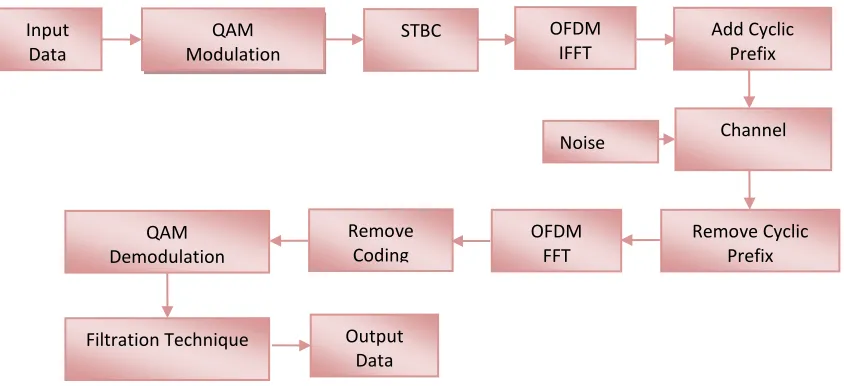
Fig.4 Shows the Proposed Methodology
[image:4.612.80.287.354.513.2]In the proposed methodology the filtration technique and QAM modulation technique with STBC for improving the results of existing work is adopted. As Bit Error Rate with Signal to Noise Ratio must me improved so that the overall system performance will be enhanced by adopting our Methodology it can be assure that the system will perform with optimum value.
Fig. 5 Performance of 2x2 MIMO system with STBC for QPSK modulation
Parameter Existing Result Proposed System
BER 10-1.5 10-2.5
SNR -6 to 6 dB -7 to 7 dB
Table1 Shows BER Performance v/s SNR
6.
CONCLUSION
In this contribution, a MIMO receive architecture based on capacity-approaching space-time codes for systems employing four transmitter antennas have been reviewed. Leveraging the special properties of a family (4, 1) STBC, which is competent
of achieving a significant fraction of the (4, 1) Shannon capacity, a new design criterion involving linear receiver processing and receive diversity-multiplexing with relatively low computational complexity is provided. Certainly, it has been evaluated that receive diversity order can gives other degrees of independence to extensively improve the capacity for Rayleigh fading channels for the same transmit conditions. Consequently, it provides better results in case of BER are offered to demonstrate the performance improvement given by the MIMO system based on the STBC scheme.
7.
REFERENCES
[1]. K.Sundaravadivu, S.Bharathi.,M.E, 2013,“STBC Codes for Generalized Spatial Modulation in MIMO Systems”2013 IEEE International Conference on Emerging Trends in Computing, Communication and Nanotechnology.
[2]. Oussama B. Belkacem, Mohamed L. Ammari, Rafik Zayani And Ridha Bouallegue,2013, “Capacity Analysis of MIMO-STBC System in the Presence of Nonlinear Distortion and Neural Network Compensator”, The Tenth International Symposium on Wireless Communication Systems.
[3]. Parismita Gogoi, Kandarpa kumar Sharma,2012, “Pilot Assisted Channel Estimation Technique for Alamouti STBC- MISO and MIMO Set-up with BPSK and QPSK modulation”,IEEE.
[4]. Feng Hu, Libiao Jin, Jianzeng Li, and Jingwen Ji,2012 “Novel Constructions of MIMO STBC Designs Employing Four Transmit Antennas”,International Conference on Industrial Control and Electronics Engineering.
[5]. Gogoi, P.; Sarma, K.K., 2012,"STBC coded MISO and MIMO set up in frequency selective wireless fading channels for BPSK and QPSK modulation schemes," Computational Intelligence and Signal Processing (CISP).
[6]. Nguyen Trung Hieu, Nguyen Thanh Tu, Nguyen Viet Ha, Tran Thi Thao Nguyen, and Bui Huu Phu,2012 “FPGA Implementation of MIMO-OFDM STBC Systems”
Input Data
QAM Modulation
STBC OFDM
IFFT
Add Cyclic Prefix
Channel Noise
Remove Cyclic Prefix OFDM
FFT Remove
Coding QAM
Demodulation
International Conference on Control, Automation and Information Sciences , IEEE.
[7] Haixia Zhang, Dongfeng Yuan, and Hsiao-Hwa Chen, 2010,“On Array- Processing-Based Quasi-Orthogonal Space–Time Block-Coded OFDM Systems,” IEEE Transactions on Vehicular Technology.
[8]. Kai-Ting Shr, Hong-Du Chen, and Yuan-Hao Huang, 2010, “A Low- Complexity Viterbi Decoder for Space-Time Trellis Codes, IEEE Transactions On Circuits And Systems.
[9]. Mohammad K. Jubran, Manu Bansal, Lisimachos P. Kondi,, and Rohan Grover, 2009, “Accurate Distortion Estimation and Optimal Bandwidth Allocation for Scalable H.264 Video Transmission Over MIMO Systems,” IEEE Transactions On Image Processing. [10]. T. M. Duman and Ali Ghrayeb,2007, “Coding for MIMO
Communication System," John Wiley and sons.
[11]. Shannon CE.,1948, A mathematical theory of communications. The Bell System Technical Journal.
[12]. T. S. Rappaport: “Wireless Communications - Principles and Practice," Pearson Education, 1997.
8.
AUTHOR’S PROFILE
Mahesh Shankar Pandey is a M-Tech.(Digital Comm.) Student and a research scholar in the Department of Electronics & Communication from BIT Bhopal , affiliated to RGPV Bhopal, Madhya Pradesh, India. He received Bachelor of Engineering from Bhabha Engineering Research Institute in 2012. He is interested in the Research areas of Digital Signal Processing & Wi-max Communication.
Prof. Bramha Swaroop Tripathi completed his M-Tech. (VLSI Design) degree from LNCT Bhopal, affiliated to RGPV Bhopal, Madhya Pradesh, India. He received the B.E. degree from RGPV University MP, and the Diploma in Electronics & Tele-comm. from RGPV University MP. He is working as a teaching professional since 2 years in Bhopal Institute of Technology, Bhopal.