An Activity based Selective Paging Scheme for
Reporting Centre in Cellular Mobile Networks
Aakanksha Sharma
C.S.E Department, Radharaman Institute of Technology and Research, Bhopal. (M.P)
Anurag Jain
Head of Department C.S.E Department, Radharaman Institute of Technology and
Research, Bhopal. (M.P)
ABSTRACT
The main aim of cellular mobile communication is to discover existing location of mobile terminals to distribute the service, which is well-known as location management. The LM involves tracking of (mobile terminal's) MT's up-to-date location, which moves freely across different cells in order to provide them services. Every MT undergoes same number of updates when passes through a specific region. One such scheme is reporting centre in which, some of the cells are designated as reporting centres and all close by cells up to the next reporting centre belong to vicinity of same reporting centre. MT updates its location whenever it crosses vicinity of its current reporting centre, which happens no more than when it enters into another reporting centre and therefore a LU is triggered. To deliver a call, network pages current reporting centre and its whole vicinity simultaneously to locate the target MT. We have applied prediction-based selective paging on reporting centre scheme in cellular mobile networks, which reduces paging cost without affecting the location update cost. Paging cost along with LM cost for both the conventional and proposed schemes will be updated consequently which gives the results.
General Terms
Cellular mobile network, reporting center, location management (LM), location update (LU), mobile terminals (MT), registration, paging Keywords are your own designated keywords which can be used for easy location of the manuscript using any search engines.
1.
INTRODUCTION
A solid line of barrier, known as the reporting cells form which means a user will have to enter one of the reporting cells to get to the other side. For example, in Fig.1 (b), cells 1, 5, 8, 9, 10, 11 and 15 are reporting centres. Vicinity of reporting centre 1 consists of cells 0, 2, 3, 4, 6, 7 and 1 itself. Likewise, vicinity of reporting centre 9 consists of cells 0, 4, 12, 13, 14 and 9. An MT in cell 13 must cross a reporting centre to enter into cell 6 and therefore LU will be triggered. A cell may fall under vicinity of more than one reporting centres [11]. For illustration in fig.1 (b), cells 2, 3, 6 and 7 fall under the vicinity of reporting centres 1, 5, 10 and 11. That means whether the reporting centres of an MT is either cell 1, 5, 10 or 11, these four cells will for all time be paged whenever a call arrives of that MT. Under reporting centre scheme, non reporting cells may be bounded or unbounded [12]. Fig.1 (a) and (b) shows bounded and unbounded non reporting cell configurations respectively.
Here an activity based model have been madewhich gives a appropriate scheduled movements to MTs and have applied
prediction-based selective paging on reporting centre scheme in cellular mobile networks, which reduces paging cost without moving the location update cost. Paging cost and LM cost for both the conventional and proposed schemes will be updated as a result [2] [12].
(a) Unenclosed non-reporting cell arrangement
(b) Enclosed non-reporting cell arrangement
Fig.1 Cell Configuration
2.
BACKGROUND STUDY
A number of methodologies have been proposed for location management. Most of these schemes aim to reduce either location update cost or paging cost. Very a small number of them have reduced both location update cost and paging cost [11].
the LA size. Since this algorithm tries to reduce LM cost for individuals, it significantly outperforms static algorithms, but it requires more processing power as compared to stationary algorithms. This algorithm reduces this overhead at the cost of some added logic and memory in the MS and network [1].
An intelligent LM scheme by taking User Profile History to reduce the location update cost by combining Back-Propagation Algorithm and Cascaded Correlation Neural Network. This scheme reduces the LM cost significantly [2].
An algorithm to reduce paging cost using speed adaptive policy. It uses speed distribution and random walk model to develop look-up tables for mobile users. These tables are worn to find out subarea size to be paged. Paging area is further reduced by introduction of 120 degree paging zones. A paging agent was used to store previous VLR address and helps to find out optimal paging zone [3]. Authors propose a hybrid location update scheme in which, movement-based and time based location update approaches are combined for the improvement of QoS. This technique has two parts: first time then movement, and first movement then time. The effectiveness of the proposed scheme is checked with CMR, velocity and time. In Zheng, authors proposed an adaptive location update area design for wireless cellular network under 2D Markov walk model, and this scheme is helpful for LU area design [4].
Authors analysed the performance of various LM schemes such as one step pointer forwarding scheme, IS-41 and pointer forwarding techniques. It was experiential that each LM scheme has its own specialization, utilization and testability and it is based on CMR and threshold values [5].
A location management scheme using mobility in sequence of mobile users in wireless mobile networks. In this scheme, the location registration process caches location information of visited cells to reduce the duplicated registrations, the paging process exploits the zone of user movement patterns to predict the paging area and, therefore to reduce the paging cost in location explore procedure [8].
A application that based on an MT’s movement model that captures mobility behaviour, the network can expect the location of MT at cell level because many trips of MTs follow routinely trajectories. If MT visits an expected cell, the target cell Δ, before a certain movement threshold is reached, its movement counter is reset to zero. Otherwise the mobile terminal will trigger a location update message when the mentioned threshold is reached. This scheme reduces signalling traffic [9].
3.
WORK DONE
Work carried out in this research can be summarized as follows:
We have applied prediction-based selective paging on reporting center scheme in cellular mobile networks, which reduces paging cost without affecting the location update cost.
The activity-based mobility model is implemented using Java (jdk1.7) for simulation purpose [21] [22].
3.1 An Activity Based Mobility Model
Generally, MTs do not move across cells in fully random fashion. The vital principle is an individual’s daily activity pattern, including such activities as going to work-place or school. In activity based mobility model, an MT moves to a particular cell at a particular time (following same or dissimilar paths each time).
3.2 Simulation setup
Number of Cells=49
Number of MTs=100, Every MT is initially assigned a Home randomly
Number of Colleges=5
Number of Work Places=5
Number of Fitness centres=4
3.3 Schedule Movements
6:00 AM Home to Fitness centre (Only FIT MTs)
7:00 AM Fitness centre to Home (Only FIT MTs)
8:00 AM Home to College (Only Students)
10:00 AM Home to Work place (Only Workers)
14:00 PM College to Home (Only Students)
17:00 PM Work place to Home (Only Workers)
Initially, every MT will be assigned a home randomly. Every MT will initially be placedat its home. There will be Fitness centres, work places, colleges and home assigned to MTs [9]. MTs will move from source to destination cell timely. Paging cost and LM cost for both the schemes will be updated accordingly.LU cost will remain same in both the schemes. Path between every source cell to destination cell will be determined at runtime. An MTMover thread will move each MT by one cell towards its destination until it reaches its current destination. On every move, it is checked that if the new cell is a reporting centre. If yes then if it is not the current reporting centre of the moved MT then an LU operation is performed by the MT. The Clock will rise the time 10seconds in each two seconds. Clock thread will invoke MTMover thread. The CallGenerator thread will keep initiating calls to randomly picked MT. Called MT will be paged according to VLR database entry. Its database at VLR level will be restructured if essential.
Movement of MTs will be distinct as follow:
- From17 to 06 O'clock, stay at home
- At 06, leave for Fitness centre (Only fit MTs)
- At 07, leave for Home (Only fit MTs)
- At 08, leave for College (Only students)
- At 14, leave for Home (Only Students)
- At 17, leave for Home (Only Workers)
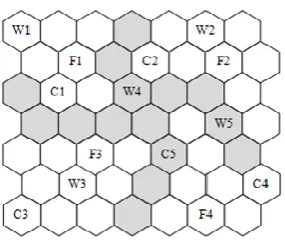
Fig.2 (a) an activity based illustration
Fig.2 (b) an activity based illustration with assigned spaces
This time table will be followed for one week and results will be analysed.
[image:3.595.312.561.71.195.2]At any moment, possible move from a cell (shown in bold) can be determined from following 2D-array:
Table 1. Movements of MT’s
Network 0 1 2 3 4 5 6 7
0 0 0 0 0 0 0 0 0
1(Odd) 0 1 2 3 4 5 6 7
2(Even) 0 8 9 10 11 12 13 14
3(Odd) 0 15 16 17 18 19 20 21
4(Even) 0 22 23 24 25 26 27 28
5(Odd) 0 29 30 31 32 33 34 35
6(Even) 0 36 37 38 39 40 41 42
7(Odd) 0 43 44 45 46 47 48 49
Note: Remember that first row and first column i.e. 0th row and 0th column are not used at all.
Determine row number of source/destination cell:
Let us say source node is 13 and destination cell is 37 (i.e. W3), then
Source cell: ceil(13/7)=2
Destination cell: ceil(37/7) =6
Determine column number of source/destination cell:
Let us say source node is 13, then
Source cell:
ceil(13/7) = 2
=> 7*(2-1) = 7
=> 13-7 = 6
Destination cell:
ceil(37/7) = 6
=> 7*(6-1) = 35
=> 37-35 = 2
Thus row and col. no. of source cell are 2 & 6 i.e. index is [2,6]
And row and col. no. of destination cell are 6 & 2 i.e. index is [6,2]
If x co-ordinates of source & destination are same then- Move vertically, one cell each time so that difference between x reduces every time by 1
The variable sign = '+' or '-' tells whether to decrement or increment at every step
If y co-ordinates of source & destination are same then- Move vertically, one cell each time so that difference between y reduces every time by 1
The variable sign = '+' or '-' tells whether to decrement or increment at every step
[image:3.595.98.241.132.253.2] [image:3.595.48.301.605.746.2] If both change then-
assign values to xsign and ysign where
xsign = '+' or '-' tells x field of MT needs to be incremented or decremented
ysign = '+' or '-' tells y field of MT needs to be incremented or decremented
Now invoke the move_generator method:
while xsource and ysource become equal toxdestination and ydestination
do as follow:
If row number is odd then
If xsign=+ and ysign=+ then Best move will be cell[x+1,y]
If xsign=- and ysign=+ then Best move will be cell[x-1,y]
If xsign=+ and ysign=- then Best move will be cell[x+1,y-1]
If xsign=- and ysign=- then Best move will be cell[x-1,y-1]
If row number is even then
If xsign=+ and ysign=+ then Best move will be cell[x+1,y+1]
If xsign=- and ysign=+ then Best move will be cell[x-1,y+1]
If xsign=+ and ysign=- then Best move will be cell[x+1,y]
If xsign=- and ysign=- then Best move will be cell[x-1,y]
When to perform LU operation:
3.4 Arrays used
Following array contains the IDs of all the reporting cells:
Rep_Cntr_IDs[]=
{4,10,15,18,19,20,22,23,24,25,27,33,35,39,46};
WorkPlace[] = {0,1,6,37,18,27};
It means W1 is located in cell-1 i.e. cell whose cell-id is 1, W2 is located in cell-6, W3 is located in cell-37, W4 is located in cell 18 and W5 is located in cell-27. The 0th index is not used at all so that cell-id of W3 can be determined simply as WorkPlace[3]
Similarly other arrays are:
College [] = {0, 16, 11, 43, 42, 33};
FitnessCenter[] = {0,9,13, 31,48}
4.
CALCULATIONS
4.1 Location management cost
A number of LM schemes have been proposed by various researchers so there must be some structure that can be second-hand to symmetry one scheme by means of the other. LM cost function comprises of two main components: updating cost and paging cost. Updating cost is the cost due to location update performed by MTs in the network whereas paging cost is caused by the network during location inquiries while locating an MT [1]. There are some other parameters that influence the total LM cost such as cost of database management in LU operation, cost in terms of wired line (backbone) network bandwidth used (that connects base stations to each other). Mostly these costs are assumed to be constant for all LM schemes. So combination of LU and paging cost are measured to be sufficient to compare different LM schemes.
Total LM Cost = (C×NLU) + (NP)
Where NLU denotes the number of location updates performed during simulation time T, NP denotes the number of paging operations performed during time T and C is a constant, which is the ratio of single LU cost to the cost of paging solo cell. It is said that the cost of a LU is ten times the cost of a paging operation. In light of this fact, we used C=10. Reporting center scheme decreases LU cost but increases the paging cost. In unbounded non-reporting cell configuration, since the vicinity of reporting centers are not bounded therefore paging cost may enlarge noticeably as compared to bounded non-reporting cell configuration [11]. This paper presents a simple norm for clustering reporting centers in bordered nonreporting cell configuration that decreases total LM cost but since clustering always increases the paging cost therefore a successive paging scheme is proposed which, when combined with clustering technique, curtails both updating cost and paging cost resultant into remarkable reduction in total LM cost.
4.2 Paging
cost
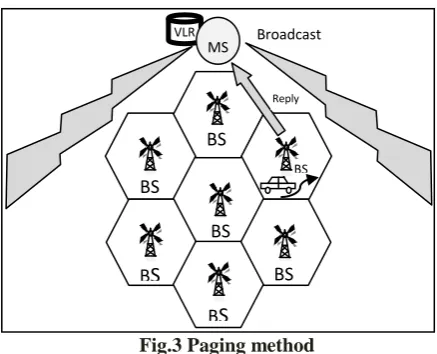
Fig.3 Paging method
Since each MSC is connected with an LA and there are more than one cell in each LA. Therefore on a call arrival, a mechanism is necessary to determine the current cell of the called MT so that the call can be delivered to him. This is achieved by paging process in which, the MSC broadcasts polling signals to all cells contained by the LA of the called MT.
5
.
STUDYING
THE
EFFECTS
OF
SELECTIVE PAGING ON REPORTING
CENTRE
SCHEME
USING
AN
ACTIVITY BASED MODEL
[image:5.595.53.272.94.271.2]5.1
Comparison Of Paging Cost
Table 1. Cumulative Paging Cost involved during the week
Till Day-No.
Conventional scheme
Proposed scheme
Till Day-1 12690 10929
Till Day-2 25449 19669
Till Day-3 38237 25898
Till Day-4 50991 30860
Till Day-5 63644 34510
Till Day-6 76399 37926
Till Day-7 89188 40797
Graphical observation-
5.2 Comparison Of Location Management
Cost
Graphical observation-
Table 2. Cumulative Location Management Cost
Till Day-No.
Conventional
scheme Proposed scheme
Till Day-1 560802190 560800429
Till Day-2 1114202909 1114197129
Till Day-3 1703612697 1703600358
Till Day-4 2282936751 2282916620
Till Day-5 2869448924 2869419790
Till Day-6 3452300879 3452262406
Till Day-7 4009871298 4009822907
M
T
BroadcastPolling
VLRMS
C
Reply
BS BS
BS
BS
[image:5.595.39.294.478.667.2]5.
RESULTS
All the results when number of MTs are 100-
Cumulative statistics till the end of Day-1
Number of calls generated: 716
Number of page Faults: 611
Paging cost in conventional scheme: 12690
Paging cost in proposed scheme: 10929
LU cost: 560789500
LM cost in conventional scheme: 560802190
LM cost in proposed scheme: 560800429
Cumulative statistics till the end of Day-2
Number of calls generated: 1436
Number of page Faults: 1089
Paging cost in conventional scheme: 25449
Paging cost in proposed scheme: 19669
LU cost: 1114177460
LM cost in conventional scheme: 1114202909
LM cost in proposed scheme: 1114197129
Cumulative statistics till the end of Day-3
Number of calls generated: 2156
Number of page Faults: 1418
Paging cost in conventional scheme: 38237
Paging cost in proposed scheme: 25898
LU cost: 1703574460
LM cost in conventional scheme: 1703612697
LM cost in proposed scheme: 1703600358
Cumulative statistics till the end of Day-4
Number of calls generated: 2877
Number of page Faults: 1674
Paging cost in conventional scheme: 50991
Paging cost in proposed scheme: 30860
LU cost: 2282885760
LM cost in conventional scheme: 2282936751
LM cost in proposed scheme: 2282916620
Cumulative statistics till the end of Day-5
Number of calls generated: 3596
Number of page Faults: 1852
Paging cost in conventional scheme: 63644
Paging cost in proposed scheme: 34510
LU cost: 2869385280
LM cost in conventional scheme: 2869448924
Number of calls generated: 4316
Number of page Faults: 2012
Paging cost in conventional scheme: 76399
Paging cost in proposed scheme: 37926
LU cost: 3452224480
LM cost in conventional scheme: 3452300879
LM cost in proposed scheme: 3452262406
Cumulative statistics till the end of Day-7
Number of calls generated: 5037
Number of page Faults: 2140
Paging cost in conventional scheme: 89188
Paging cost in proposed scheme: 40797
LU cost: 4009782110
LM cost in conventional scheme: 4009871298
6.
CONCLUSIONS
The LM involves tracking of (mobile terminal's) MT's up-to-date location, which moves freely crossways different cells in order to supply them services. By applying prediction-based selective paging on reporting centre scheme in cellular mobile networks, which reduces an MT moves towards a destination cell at a specific time (following same or different paths each time). Hence results reveal that the proposed scheme predicts user location with paging cost without affecting the location update cost. Paging cost and LM cost for both the conventional and proposed schemes keep posted accordingly. In this activity based mobility model, high accuracy occurs and reduces paging cost outstandingly.
7.
REFERENCES
[1] Ajit Pal and Digvijay Singh Khati, "Dynamic location management with variable size location areas", IEEE, International Conference on Computer Networks and Mobile Computing, Oct. 2001, pp. 73-78.
[2] Ashish Goel, Navankur Gupta and Prakhar Kumar, "A Speed Based Adaptive Algorithm for Reducing Paging Cost in Cellular Networks", 2nd IEEE International Conference
[3] C. Lee, C. H. Ke and C. C. Chen, "Improving location management for mobile users with frequently visited locations", Elsevier, Performance Evaluation, Vol. 43, 2001, pp. 15-38.
[4] D. W. Huang, P. Lin and C. H. Gan, "Design and performance study for a mobility management mechanism (WMM) using location cache for wireless mesh networks", IEEE Transaction on Mobile Computing, 2008, pp. 546-556.
[image:7.595.94.504.149.469.2][5] Amar Pratap Singh and M. Karnan, "Intelligent Location Management using Soft Computing Technique”, IEEE, 2nd International Conference on Communication Software and Networks, 2010, pp. 343-346.
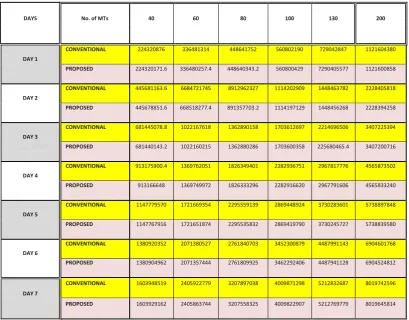
Table 3. Location management cost with conventional and proposed schemes, when no. of MTs are 40, 60, 80,100,130 and 200
DAYS No. of MTs 40 60 80 100 130 200
DAY 1
CONVENTIONAL 224320876 336481314 448641752 560802190 729042847 1121604380
PROPOSED 224320171.6 336480257.4 448640343.2 560800429 7290405577 1121600858
DAY 2
CONVENTIONAL 445681163.6 6684721745 8912962327 1114202909 1448463782 2228405818
PROPOSED 445678851.6 668518277.4 891357703.2 1114197129 1448456268 2228394258
DAY 3
CONVENTIONAL 681445078.8 1022167618 1362890158 1703612697 2214696506 3407225394
PROPOSED 681440143.2 1022160215 1362880286 1703600358 225680465.4 3407200716
DAY 4
CONVENTIONAL 913175900.4 1369762051 1826349401 2282936751 2967817776 4565873502
PROPOSED 913166648 1369749972 1826333296 2282916620 2967791606 4565833240
DAY 5
CONVENTIONAL 1147779570 1721669354 2295559139 2869448924 3730283601 5738897848
PROPOSED 1147767916 1721651874 2295535832 2869419790 3730245727 5738839580
DAY 6
CONVENTIONAL 1380920352 2071380527 2761840703 3452300879 4487991143 6904601768
PROPOSED 1380904962 2071357444 2761809925 3462292406 4487941128 6904524812
DAY 7
CONVENTIONAL 1603948519 2405922779 3207897038 4009871298 5212832687 8019742596
[6] Vicente Casares-Giner and Pablo Garcia-Escalle, "A lookahead strategy for movement based location update in wireless cellular networks", IEEE, 6th International Conference On Information Technology: New Generations, 2009, pp. 1171-1177
[7] Kenneth W. Shum and Chi Wan Sung, "Kalman-filter based predictive location management for PCS networks", The 57th IEEE Semiannual Vehicular Technology Conference, Apr. 2003, pp. 2701-2705.
[8] Karunaharan Ratnam, Sampath Rangarajan and Anton T. Dahbura, "An efficient fault tolerant location management protocol for personal communication networks", IEEE Trans. Vehicular Technology, Nov. 2000, pp. 2359-2369.
[9] Sun-Jin Oh, "The location management scheme using mobility information of mobile users in wireless mobile networks", IEEE International Conference on Computer Networks and Mobile Computing, Oct. 2003, pp. 230-237.
[10]Vijendra S. Bhadauria, Ravindra Patel, Sanjeev Sharma, “Effects of Clustering and Successive Paging on Reporting Center Scheme: A Cost Analysis” International Journal of Computer Applications (0975 – 8887) Volume 37– No.5, January 2012
[11]Vijendra S. Bhadauria, Ravindra Patel, Sanjeev Sharma, “A Comparative Study of Location Management Schemes: Challenges and Guidelines”, Vijendra Singh Bhadauria et al. / International Journal on Computer Science and Engineering (IJCSE)
[Reference Books]
[12]A. Ghosh, J. Zhang, J. G. Andrews and R. Muhamed, “Fundamentals of LTE”, 1st edition, ISBN-10: 0137033117, Prentice Hall.
[13]A. Mukherjee, S. Bandyopadhyay and D. Saha, “Location Management and Routing in Mobile Wireless Networks”, ISBN- 1-58053-355-8, Artech House.
[14]K. Pahlavan and A. H. Levesque, “Wireless Information Networks”, 2nd edition, ISBN-13: 978-0-471-72542-8, Wiley.
[Web Links]
[15]http://
awarenetworks
.com/publications/6.108.10.Cell ularTelephony.pdf[16]http://
creativentechno
.wordpress.com/2012/01/03/the -generations-1g-2g-3g-4g/[17]http://media.johnwiley.com.au/product_data/excerpt/28/0 4714190/0471419028.pdf
[18]http://www.electronicsforu.com/EFYLinux/efyhome/cov er/jun2003/Mobile-tech.pdf
[19]http://books.google.co.in/books/about/Location_Manage ment_And_Routing_In_Mobil.html?id=1DEyhQohDkkC &redir_esc=y
[20]http://onlinelibrary.wiley.com/doi/10.1002/0471224561.c h2/summary
[21]http://scholar.google.co.in/scholar?q=location+managem ent+in+wireless+cellular+networks&hl=en&as_sdt=0&a s_vis=1&oi=scholart&sa=X&ei=nLV7UPypEMX7rAfbs YDYCw&ved=0CB0QgQMwAA