Review of Typical Power Conservation Techniques in
Wireless Sensor Network
Rajalakshmi M
C Research Scholar University of Mysore, MysoreABSTRACT
With the wide range of application, and yet exploring, wireless sensor network has attracted many researcher to design a remotely operated sensing device on such areas, where it is not possible for human to reach. However, in this process, one of the most troubleshooting issue in WSN becomes its power constraint as the nodes are backed up by battery that cannot be change or difficult to recharge in wireless environment. From past decade there has considerable amount of research work addressing towards the power consumption and depletion issues in WSN. Hence, this paper discusses some of the standard techniques that have evolved in the past with a claim of efficient power preservation techniques. The paper has also discussed some of the recent techniques identified that has the potentials of saving the energy depletion. Finally, the trade-offs towards the prior work done and current need is discussed in this paper.
Keywords:
Battery, Conservation, Energy, NetworkLifetime, Wireless Sensor Network
1. INTRODUCTION
The areas of Wireless Sensor Networks (WSN) [1] have witnessed an extensive proliferation of applications and interest in current research and industry. Such networks are usually thickly deployed over a diverse geographic area ranging from 10s of meters to several hundreds of kilometres through deploying small, low cost devices that can observe and influence the physical world around them by gathering status information and then transforming this into radio signals. Such signals are then transmitted to a local base station that may be connected to a gateway to send the data to external network such as internet. The data thus received may be analysed and appropriate decision/action taken depending on the type of application. Typically, a sensor mote is a tiny device that includes three basic components: i) a sensing subsystem for data acquisition from the physical surrounding environment, ii) a processing subsystem for local data processing and storage, and iii) also a wireless communication subsystem for data transmission. In addition, a power source supplies the energy needed by the device to perform the programmed tasks. This power source often consists of a battery with a limited energy budget. Unfortunately, these sensors suffer from resources constraints and power limitation as these sensors are usually deployed in remote places that are not easy to reach [2]. Inevitably, there is a finite life time duration for such devices and new sensors have to be deployed to replace the old ones. It is some of these limitations that has shown an increasing interest from the scientific community to research in such devises that would enhance the longevity and coverage of the devices by using various new technology developments in this field. The main emphasis is on maximizing the life time of sensors and to use the limited resources efficiently by adopting mechanisms, algorithms and protocols that consider these limited resources as main priorities and challenges to produce efficient and reliable networks. Wireless sensor networks utilize
an efficient form of technology that has no structures or rules or adhering to a specific standard. This makes it an interesting area for research and thus significant resources are being placed on its study by research scholars and manufacturer’s alike. There are a number of applications for such devices and networks such as; military, health monitoring, indoor and outdoor fire fighting applications, security applications, and environmental, agricultural, climate changes and studying animal behavior.
Moreover, it could be inconvenient to recharge the battery, because sensor motes may be deployed in a hostile or impractical environment. At the network layer, the intention is to find ways for energy efficient route setup and reliable relaying of data from the sensor motes to the sink, in order to maximize the lifetime of the network. The major differences between the wireless sensor network and the traditional wireless network sensors are very sensitive to energy consumption. Moreover, the performance of the sensor network applications highly depends on the lifetime of the network. In a well-designed network, the sensors in a certain area exhibit similar behaviors to achieve energy balance. In other words, when one sensor dies, it can be expected the neighbors of this sensor mote will run out of energy very soon, since they will have to take over the responsibilities of that sensor and we expect the lifetime of several months to be several years. Thus, energy saving is crucial in designing life time wireless sensor networks. In the proposed research paper, we highlight an extensive review of existing system or mechanism towards energy conservation. In section 2 we give an overview of generic issues in WSN. Section 3 highlights about the power issues in WSN describing some of the prominent attributes considered in previous research work. The technique of energy conservation is discussed in Section 4 followed by comparative analysis illustration in Section 5. Section 6 discusses about tradeoffs while Section 7 makes some concluding remarks.
2. INTRODUCING ISSUES IN WSN
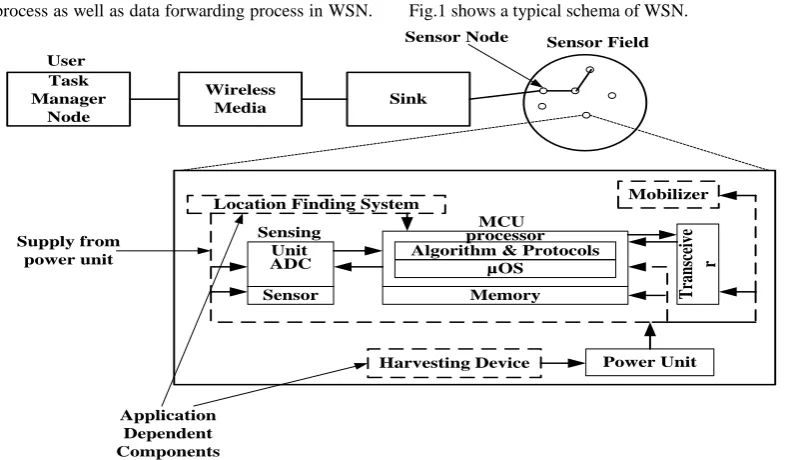
aggregation process as well as data forwarding process in WSN. Fig.1 shows a typical schema of WSN.
Algorithm & Protocols µOS
Memory processorMCU
ADC
Sensor Sensing
Unit
Location Finding System
T
ra
ns
ce
iv
e
r
Mobilizer
Power Unit Harvesting Device
Sensor Field
Sink Wireless
Media Task
Manager Node User
Sensor Node
Supply from power unit
Application Dependent Components
Figure 1 Typical Schema of the Wireless Sensor Network
Depending on various applications, the sensor network is studied in homogeneous mode or may be in heterogeneous mode [3]. Usually in homogenous network, all the sensor nodes are considered to have similar physical and networking properties where in heterogeneous network, all the sensor nodes are considered to have multiple perceptive properties. Example of homogenous sensor network may be cited as-a crop field where it is required to estimate the amount of rainfall. Hence, deploying a sensor which can track down the rate of rainfall is enough. However, heterogeneous network deployments are quite different. An example can be cited as-consider a crop field, which needs to be monitored for its factor affecting its cultivation. Hence, in this case, may be multiple sensors that can sense heat, water, soil pH etc. Also, sensor networks are usually distributed in nature where sensor nodes are placed in short range communication range along with different computational capabilities. Hence, sensor nodes can be distributed either uniformly or in random fashion. Usually, random distribution is done by dropping the sensor nodes from aerial moving objects like airplane on the area where it is difficult for the human to reach. A base station is decided based on the application, where sometimes the base station is either deployed on the center of the distributed region or in some other specific location depending on the needs of applications. The WSN differs from conventional ad-hoc networks in the following way:
number of sensor motes deployed in WSN is higher compared to wireless adhoc network.
sensor motes are densely deployed and usually in harsh environment
sensor motes have finite and limited life span and possibility of node replacement or repair is negligible.
topology of the network may change intermittently.
WSN work in a broadcast fashion, while ad-hoc is point to point
WSN has limited power and range resources
WSN may not have a global ID
After the application is designed and deployed in WSN, the application also undergoes performance test to evaluate its efficiency in operationality. Hence, for effective WSN deployment, it is important that its performance be gauged precisely in scientific manner. Some of the prominent attributes usually considered while scaling the performance of the wireless sensor network are as follows [3][4]:
1. Fault Tolerance: It is the ability to adapt sensor mote failures without affecting the cumulative network function. Fault tolerance could be calculated through the following equation:
Rk(t)=exp(-λkt) (1)
Where Rk is the reliability (fault tolerance), λk is the fault rate for sensor mote k, t is the time period.
2. Scalability: It represents the cumulative network ability to maximize the dimension of the network or adjoin a new number of sensor motes that is very important, but scalability or increasing number of sensor motes has to consider network density as a factor to determine the required number of sensors to cover a certain area, which depends on the nature of application as well. The density can be calculated by [5]:
μ(R) = (NπR2
)/A (2)
Where N is the number of sensors; R is the sensor range. μ(R) is the density function to find the number of sensors within sensor range, A is the area.
3. Product cost: Usually, the core component responsible for sensing a particular physical attribute is quite cost effective and is readily available. However, to build an application, the core component needs to be integrated with various electronic and computing components based upon the usage scenario, which is costly in nature and is not readily available for use.
[image:2.595.102.496.72.302.2]such as; location finding system (e.g., GPS device), power generator (e.g. solar panels) and mobilizer. Hence, there is always a dependency on some specific hardware to perform a specific set of operation thereby posing as hardware constraint.
5. Power Consumption: Power, energy, or lifetime is some of the equivalent technical terms used to study energy efficiency in WSN. The major places where WSNs drains it power are usually in i) Sensing and ii) Data communication. In sensing operation, WSN power consumption is almost fixed, however, data communication consumes maximum proportion of power. A sensor transceiver comprises of: a) Transmitter and receiver which is consumed approximately the same power, b) Mixer, frequency synthesizer, voltage control oscillator, and c) a power amplifier. All these consume sensor mote power in addition to the start up power. The start up power can be calculated by the equation 3 [5]:
Pc=NT [PT (TON+TST) +POUT (TON)] +NR [PR (RON+RST)] (3)
Where PT/ PR are the consumed power by transmitter and
receiver respectively, POUT is the power at transmitted
antenna, TON/RON is transmitter/receiver wake up time, TST
/RST is transmitter/receiver start-up time and NT/NR is
number of times transmitter or receiver is switched on per unit time, which depends on the task and medium access control (MAC) scheme.
6. Data Processing: Data processing is one of the most important operations in WSN, which is mainly used to truncate the possibility of forwarding redundant data. Hence, the processing of unique data forwarding is done by time based, frequency based, or spatial based approach thereby demanding a specific proportion of power from the battery of the sensor motes. The power consumption in data processing is much less than power consumption for data communication. Due to the low cost and size requirements of sensor manufacturing, CMOS technology is usually used for micro-processor and this limits the expended power thus giving greater efficiency.
Although, majority of the studies considers the above 6 attributes to scale the performance of WSN, but there also exists other attributes that influences the design viz. security, network type, quality of service, self organizing network, data rate and throughout, routing, modelling, size and application
3. POWER ISSUES IN WSN
In the area of WSN, energy is a very scarce resource for such sensor systems and has to be managed wisely in order to extend the life of the sensor motes for the duration of a particular mission. Energy consumption in a sensor mote could be due to either “useful” or “wasteful” sources [5]. Useful energy drainage may take place predominantly due to transmitting or receiving data, processing query requests, and forwarding queries and data to neighboring sensor motes. However, wasteful energy drainage has the possibility of occurrence owing to the following factors. Interesting, the literature [6] has highlighted that prominent resource of energy go on loss only to maintain the sensor mote in ‘idle listening’ mode. The idle listening mode allows the sensor node to be passively connected in network by draining battery just to receive possible incoming traffic. Another fact explored in literature [7] is that ‘data packet collision’ is another reason for wasting the limited energy of the sensor node. The state of data packet collision is when multiple data packets which are having equivalent time stamp is received on the other node (base station) for the purpose of data aggregation. All the data packets that
cause the data packet collision have to be rejected and retransmissions of these data packets are highly required thereby maximizing the energy consumption. Literature [8] has explored that ‘overhearing of data packet’ to be another reason of energy drainage in WSN. Overhearing is a phenomenon in WSN where a sensor mote accumulates certain data packets which are meant to be reaching other sensor mote. Literature [9] has shown that ‘control-packet overhead’ to be cause of energy drainage where a various control messages of route discovery process of a sensor node reaches improper sensor nodes. Finally, for energy waste is ‘over-emitting’ [10], which is caused by the transmission of a message when the destination sensor mote is not ready. Considering the above-mentioned facts, a correctly designed protocol must be considered to prevent these energy wastes.
4. ENERGY SAVING APPROACH
There has been an extensive study conducted in the past that targets to address energy issues by various types of approaches. Various techniques [11][12]have been used for minimizing the power consumption in wireless sensor network. However, this paper choose not to discuss the individual work carried out by the researcher but the current paper extracts majority of the standard techniques that has been adopted in the past and still is referred by many upcoming researcher. The paper explored basically two fundamental techniques that are widely adopted for saving power consumption in WSN is viz. i) duty cycling and ii) data-driven techniques. The brief discussions on these two techniques are as below:
A. Duty-cycling: Normally, a sensor radio has 4 operating modes: transmission, reception, idle listening and sleep [13]. Measurements showed that the most power consumption is due to transmission and in most cases; the power consumption in the idle mode is approximately similar to receiving mode. On the contrary, the energy consumption in sleep mode is much lower. Duty-cycling can be achieved through two different and complementary approaches. From one side, it is possible to exploit sensor mote redundancy which is typical in sensor networks and adaptively select only a minimum subset of sensor motes to remain active for maintaining connectivity. Sensor motes that are not currently needed for ensuring connectivity can go to sleep and save energy. Finding the optimal subset of sensor motes that guarantee connectivity is called topology control [15]. On the other hand, active sensor motes (i.e. sensor motes selected by the topology control protocol) do not need to maintain their radio continuously on. They can switch off the radio (i.e. put it in the low-power sleep mode) when there is no network activity, thus alternating between sleep and wakeup periods. Throughout duty cycling operated on active sensor motes as power management will be considered. Therefore, topology control and power management are complementary techniques that implement duty cycling with different granularity. However, the main issue associated with on-demand schemes is how to inform the sleeping sensor mote that some other sensor motes are willing to communicate with it. To this end, such schemes typically use multiple radios with different energy/performance tradeoffs (i.e. a low-rate and low power radio for signaling and a high-rate but more power hungry radio for data communication). Examples are e.g. Geographical Adaptive Fidelity (GAF) [15], Geographic Random Forwarding (GeRaF) [16]. Span [17], Adaptive Self-Configuring Sensor Networks Topologies (ASCENT) [18].
overheads, and idle listening. A wide range of MAC protocols have been proposed to achieve high channel utilization, and energy efficiency. However, both TRAMA [19] and Z-MAC [21] require a random access period and a schedule exchange period. In addition, time synchronization must be achieved in the network. In comparison with other contention-based protocols, TRAMA has higher delay and is suited for applications that are not time sensitive. B-MAC [20] and Z-MAC both adapt well to topology changes while TRAMA does not. B-MAC has higher throughput under low contention environment while Z-MAC performs better in high contention environments. Low power reservation-based MAC, low power distributed MAC, and TRAMA minimize energy with sleep cycles when sensor motes do not have data to transmit or receive. CC-MAC [24], on the other hand, filters correlated information and prioritizes packets. Although various MAC protocols have been proposed, there is possible future work for system performance optimization. Cross-layer optimization is an area that needs to be explored more extensively. Cross-layer interaction can reduce packet overhead
on each of the layers, thereby reducing energy consumption. Interaction with the MAC layer can provide other layers with congestion control information and enhance route selection. Many existing MAC protocols address performance studies of static sensor motes, but there is still a lack of literature for comparing these protocols in a mobile network. By enhancing the MAC protocol, one can significantly improve communication reliability and energy efficiency. MAC protocols usage is shown in Table 1 and the other recent approaches for enhancing cumulative network lifetime of WSN are as following Table 1.
[image:4.595.47.550.295.528.2]C. Data Driven Approach: Data-driven approaches can be used to enhance the energy efficiency even more. In fact, data sensing impacts on sensor motes’ energy consumption in two ways: Unneeded samples. Sampled data generally have strong spatial and/or temporal correlations [25], Therefore, there is no need to communicate the redundant information to the sink causing to decrease the power consumption of the sensing subsystem. Reducing communication is not enough when the sensor itself is power hungry.
Table 1 Major MAC protocols used
Attributes TRAMA [19] B-MAC [20] Z-MAC [21]
Low power reservation-based
MAC[22]
Low power distributed MAC [23]
CC-MAC [24]
Channel access mode
Time-slotted random and scheduled access
Clear channel assessment
(CCA)
Time-slotted random and scheduled access
Time-slotted contention based
slot reservation
Multi-channel access
Time-slotted contention
based slot reservation
Time
Synchronization Yes No Yes No No No
Protocol type TDMA/CSMA CSMA TDMA/CSMA TDMA CSMA/CA CSMA/CA
Energy conservation
Schedule sleep intervals and turn
radio off when idle, collision
avoidance scheduling
Low power listening (LPL) time
for energy efficiency
Low power listening (LPL) time for energy
efficiency
Sensor motes sleep and wake up based on assigned data slot
Power saving mode with low power wake up
radio for channel listening and normal radio
for data transmission
Dropping highly correlated information
packet to reduce energy use in
[image:4.595.50.550.559.762.2]transmission
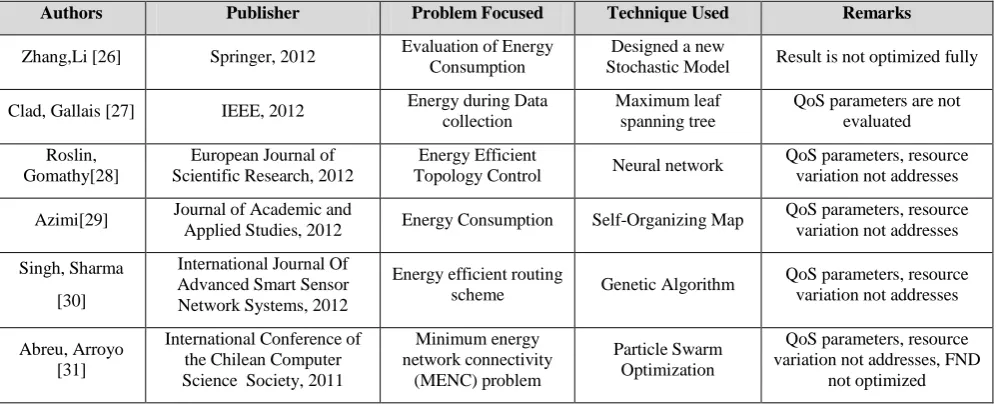
Table 2 Comparative Study of Recent Research work
Authors Publisher Problem Focused Technique Used Remarks
Zhang,Li [26] Springer, 2012 Evaluation of Energy Consumption
Designed a new
Stochastic Model Result is not optimized fully
Clad, Gallais [27] IEEE, 2012 Energy during Data collection
Maximum leaf spanning tree
QoS parameters are not evaluated
Roslin, Gomathy[28]
European Journal of Scientific Research, 2012
Energy Efficient
Topology Control Neural network
QoS parameters, resource variation not addresses
Azimi[29] Journal of Academic and
Applied Studies, 2012 Energy Consumption Self-Organizing Map
QoS parameters, resource variation not addresses
Singh, Sharma
[30]
International Journal Of Advanced Smart Sensor Network Systems, 2012
Energy efficient routing
scheme Genetic Algorithm
QoS parameters, resource variation not addresses
Abreu, Arroyo [31]
International Conference of the Chilean Computer Science Society, 2011
Minimum energy network connectivity
(MENC) problem
Particle Swarm Optimization
QoS parameters, resource variation not addresses, FND
Ray, De [32]
Int. Jr. of Advanced Computer Engineering &
Architecture, 2012
Energy Efficient Cluster Head Selection
Enhanced LEACH version
Works only in static sensor mote scenario, QoS parameters, resource
Rani [33] International Journal of
Computer Applications, 2012 Energy Optimization Fuzzy Logic
Good Results but QoS Parameters are not addressed
[image:5.595.50.548.72.137.2]5. COMPARATIVE STUDY
Table 1 describes major MAC protocol used, with their attributes in consideration. The various attributes like channel access mode, Time synchronization, type of protocol and energy aspects are considered. Table 2 describes various comparative studies by different researchers. The problem focused and the technique used to handle it is described. The method like Stochastic Model, Maximum leaf spanning tree, Neural network, Self-Organizing Map, Genetic Algorithm, Particle Swarm Optimization, Fuzzy Logic. It has found lack of optimization, QoS parameters are not handled by most of researchers. Majority of the study shows that obtained results are not totally optimized to use it for longer deployment of network lifetime in WSN. The recent study conducted by Zhang [26] has presented a good stochastic framework that evaluates the energy consumption, but the obtained outcomes were not found to address the issues of transmitting high density data that requires the expenditure of more energy. Clad and Gallais [27] has used maximum leaf spanning tree for addressing energy consumption during data aggregation, however the study has not evaluated its efficiency with respect to quality of service parameters like bandwidth, packet deliver ratio etc. Moreover, the study is conducted on small test bed of WSN. Roslin and Gomathy [28] has used neural network and fuzzy logic for addressing energy efficiency topology control. The study is more stressed on selection of cluster head where the evaluation has not considered QoS parameters to prove algorithm efficiency. Azimi [29] has used Self-Organizing Map for investigating energy consumption in WSN. However, question still arises in case of multihop usage, applying different structures of Self-organizing map, as well as different criteria of selection of cluster head, which are not addressed in [29]. Singh and Sharma [30] has used evolutionary technique using Genetic Algorithm (GA) for performing energy efficient routing. The study has considered a small scale WSN where the algorithm efficiency was evaluated with respect to network lifetime, whereas packet delivery ratio, inter-arrival time, and delay, which are some of the important parameters to test the algorithm efficiency pertaining to energy consumption is missing. Abreu and Arroyo [31] has used swarm intelligence using Particle Swarm Optimization (PSO) where the significant energy conservation improvement is only 7.68%. Ray and De [32] has used enhanced LEACH protocol for the same cause where there is an improvement of 41.7% compared to conventional LEACH protocol. The accomplished outcome could be more improve if multi-hop communication in data aggregation could have been considered. Moreover, the study doesn’t address the effect of mobility on the energy consumption. Rani [33] has used fuzzy logic for energy optimization for small scale WSN. Although, the outcome of the result was found good but the outcome was never addressed with respect to usually parameters of Quality of Service, just like all the above studies.
6. EXPLORING TRADE-OFFS
As one of the most important assets, energy is one of the most critical resources for WSNs. Majority of works in the literatures about WSN routing have been concentrated on energy conservations as an important optimization goal. However, merely saving energy is not enough to effectively prolong the network lifetime. The uneven energy depletion often results in
network partition and low coverage ratio which deteriorate the performance. Energy saving in wireless sensor networks has attracted a lot of attention in the recent years and introduced unique challenges compared to traditional wired networks. Extensive research has been conducted to address these limitations by developing schemes that can improve resource efficiency. Hence, the any proposed system should be planned only by implementing in order to overcome the following trade-offs that was witnessed in the past research work as illustrated below:
The design of a WSN platform must deal with challenges n energy efficiency, cost, and application requirements. It requires the optimization of both the hardware and software to make a WSN efficient. However, some work which is related to hardware includes using low cost tiny sensor motes while software addresses issues such as network lifetime, robustness, self-organization, security, fault tolerance, and middleware. But in reality the application requirements vary in terms of computation, storage, and user interface and consequently there is no single platform that can be applied to all applications. Sensor motes can fail at any time due to hardware, software, or communication reasons. It is important that there are services to handle these failures before and after they occur.
Cross-layer designs improve performance and optimize interaction between layers. Cross-layer design considers the sharing of information across layers. But very few works are focused on collaboration between all the layers to achieve higher energy saving, network performance, and extend network lifetime.
The physical layer in a WSN must be energy efficient. The physical-layer design starts with the design of the radio. The design or selection of a radio is very important because the radio can impact the performance of the other protocol layers. Minimizing the energy consumption at the physical layer requires that the circuitry energy and transmission energy be optimized. But a few work is actually focused on designing low power radio design with emerging technologies, exploring ultra-wideband techniques as an alternative for communication, creating simple modulation schemes to reduce synchronization and energy cost, determining the optimal transmission power, and building more energy-efficient protocols and algorithms
Provisioning, management, and control services are needed to sustain network connectivity and maintain operations. Efficient algorithms can reduce the cost of localization while sensor motes are able to self-organize and identify themselves in some spatially coordinated system. But no such benchmarked work is found to use optimization technique in extending coverage with energy efficient approach considering QoS parameters.
The recent study conducted by Gilbert [34] has discussed many open research issues e.g. Biological Applications, Commercial Applications, Environmental Applications, Healthcare Applications, Industrial Applications, and Military Applications. Such areas will need to be investigated for evaluating the extent of efficiency that future algorithm will hold in the area of wireless sensor network. Hence, addressing the power issues in WSN is very complicated task which requires to consider various aspects and various other issues to ensure maximum network in WSN for large scale environment.
7. CONCLUSION
This paper highlights an overview of the broad spectrum of various issues, especially power-related issues in the area of WSN. The application of WSN in the multiple real-time area has been witnessed to encounter various critical issues that is usually due to power depletion. Although with the advancement of various techniques explored by previous researchers has yielded some better solution towards preservation of energy consumption in WSN , but the accuracy and reliability of the existing solution cannot be predicted by the various dynamic external scenario in WSN when it comes to real time. Although there are massive number of research work done in past, but this paper has attempted to introduce the prime techniques usually adopted as a standards by majority of the current researchers.
8. REFERENCES
[1] Dargie.W., Poellabauer.C.2010. Fundamentals of Wireless Sensor Networks: Theory and Practice. John Wiley & Sons, - Technology & Engineering, pp.336
[2] Small.C. Capabilities and Limitations of Urban Remote
Sensing, Retreived from
ftp://ftp.ldeo.columbia.edu/pub/small/PUBS/SmallADurban RS.pdf
[3] Buratti.C., Conti.A., Dardari.D., Verdone.R.2009. An Overview onWireless Sensor Networks Technology and Evolution,Vol. 9, pp.6869-6896; doi:10.3390/s90906869, Sensors 2009
[4] Akyildiz,I.F., Su,W., Sankarasubramaniam,Y., Cayirci,E.2002. Wireless sensor networks: a survey, Computer Networks, Vol.38 pp.393–422
[5] Younis,O., Fahmy,S.2003. Distributed Clustering for Scalable, Long-Lived Sensor Networks. Computer Science Technical Reports. Paper 1575
[6] Zhang.X and Kang G.S.2011.E-MiLi: Energy-Minimizing Idle Listening in Wireless Networks, ACM-MobiCom
[7] Halim.A.H.A., Zen.K. 2008.MAC Protocol to Reduce Packet Collision in Wireless Sensor Network, Proceedings of the International Conference on Computer and Communication Engineering
[8] Cano,C., Bellalta,B., Sfairopoulou,A., Oliver,M., Barceló,J.2010. Taking Advantage of Overhearing in Low Power Listening WSNs: A Performance Analysis of the LWT-MAC Protocol, Mobile Netw Appl DOI
10.1007/s11036-010-0280-4, Springer Science+Business Media, LLC
[9] Bhuse,V., Gupta,A., Lilien,L.2006. DPDSN: Detection of packet-dropping attacks for wireless sensor networks, Proc. Trusted Internet Workshop
[10]Youn.K.T.K.H.2012.An Energy-Efficient MAC Protocol Employing Dynamic Threshold forWireless Sensor Networks, International Journal of Distributed Sensor Networks Volume 2012, Article ID 304329, pp.12
[11]Khemapech,I., Miller.A.,Duncan,I.2007. A Survey of Transmission Power Control in Wireless Sensor Networks, Proceedings of the 8th Annual Postgraduate Symposium on the Convergence of Telecommunications, Networking and Broadcasting (PGNet '07), pp. 15–20
[12]Anastasi,G., Conti,M., Francesco,M.D., Passarella,A.2009. Energy Conservation in Wireless Sensor Networks: a Survey, ScienceDirect
[13]Le,H-C. 2007.OBMAC: an Overhearing based MAC Protocols for Wireless Sensor network, IEEE
[14]Papadimitriou.A., Katsaros,D.,
Manolopoulos,Y.2010.Topology control algorithms for wireless sensor networks: A critical survey, ACM
[15]Xu,Y., Heidemann,J. 2001.Geographyinformed Energy Conservation for Ad Hoc Routing, ACM Mobicom
[16]Zorzi,M., Rao,R.R. 2003. Geographic Random Forwarding (GeRaF) for ad hoc and sensor networks: multihop performance, IEEE-GLOBECOM
[17]Chen,B., Jamieson,K., Balakrishnan,H., Morris,R.2002. Span: An EnergyEfficient Coordination Algorithm for Topology Maintenance in Ad Hoc Wireless Networks, ACM
[18]Cerpa,A., and Estrin,D. 2004. ASCENT: Adaptive Self-Configuring sEnsor Networks Topologies, IEEE
[19]Rajendran,V.,Obraczka,K., Garcia-L-A.2003. Energyefficient, collision-free medium access control for wireless sensor networks, in: Proceedings of the First International Conference on Embedded Networked Sensor Systems (Sensys), Los Angeles, CA
[20]Polastre,J.,Hill,J., Culler,D.2004. Versatile low power media access for wireless sensor networks, in: Proceedings of the Sensys’04, San Diego, CA
[21]Ferriere,H.D., Estrin, M., Vetterli. 2005.Packet combining in sensor networks, in: Proceedings of the Sensys’05, San Diego, CA
[22]Mishra,S., Nasipuri,A.2004. An adaptive low power reservation based MAC protocol for wireless sensor networks, in: Proceedings of the IEEE International Conference on Performance Computing and Communications, pp. 316–329.
[23]Guo,C., Zhong, L.C., Rabaey .J.M.2001. Low power distributed MAC for ad hoc sensor radio networks, in: Proceedings of the IEEE Globecom, pp. 2944–2948.
[25]Vuran. M.C., Akan, O.B., Akyildiz I.F.2004.Spatio-temporal correlation: theory and applications for wireless sensor networks, Computer Networks Journal
[26]Zhang, Y., LI,W.W. 2012.Modeling and energy consumption evaluation of a stochastic wireless sensor Network, EURASIP Journal on Wireless Communications and Networking
[27]Clad,F., Gallais,A., Mérindol,P.2012.Energy-Efficient Data Collection in WSN: A Sink-Oriented Dynamic Backbone, IEEE,
[28]Roslin,S.E., Gomathy,C.2012. IBPN: Intelligent Back Propagation Network Based Cluster Head Selection for Energy Efficient Topology Control in Wireless Sensor Network, European Journal of Scientific Research ISSN 1450-216X Vol.79 No.4, pp.541-550
[29]Azimi,M.A., Ramezanpor,M.2012. A Robust Algorithm for Management of Energy Consumption in Wireless Sensor Networks Using SOM Neural Networks, Journal of Academic and Applied Studies Vol. 2(3), pp. 1-14
[30]Singh,V.K., Sharma,V.2012. Elitist genetic algorithm based energy efficient routing scheme for wireless sensor networks, International Journal Of Advanced Smart Sensor Network Systems ( IJASSN ), Vol 2, No.2
[31]Abreu,R.C.,Arroyo,J.E.C.2011.A Particle Swarm Optimization Algorithm for Topology Control in Wireless Sensor Networks, International Conference of the Chilean Computer Science Society
[32]Ray,A., De,D.2012. P-EECHS: Parametric Energy Efficient Cluster Head Selection protocol for Wireless Sensor Network, Int. Jr. of Advanced Computer Engineering & Architecture Vol. 2 No. 2
[33]Sheela.K Rani,S.,Devarajan,N.2012. Fuzzy Based Optimization for Power Management in Wireless Sensor Networks, International Journal of Computer Applications (0975 – 888) Vol. 48– No.4