How to cite this paper: Lu, J.H., Zhang, C.L., Chen, S.N. and Wu, Y.X. (2015) Ship Nonlinear Rolling and Roll Angle Recon-struction Based on FIR. Open Access Library Journal, 2: e2171. http://dx.doi.org/10.4236/oalib.1102171
Ship Nonlinear Rolling and Roll Angle
Reconstruction Based on FIR
Jianhui Lu
1,2*, Chunlei Zhang
2, Shaonan Chen
2, Yunxia Wu
21Shandong Province Key Laboratory of Ocean Engineering, Ocean University of China,
Qingdao, China
2College of Engineering, Ocean University of China, Qingdao, China
Received 3 November 2015; accepted 18 November 2015; published 23 November 2015
Copyright © 2015 by authors and OALib.
This work is licensed under the Creative Commons Attribution International License (CC BY). http://creativecommons.org/licenses/by/4.0/
Abstract
The paper analyzes the nonlinear damping torque and nonlinear restoring moment and estab-lishes the nonlinear motion equation of ship rolling under random sea. The Runge-Kutta method is used in the time domain to solve the equation, and to simulate the time history of random wave excitation ship rolling and free decay process. This paper used the ship attitude inertial mea-surement system and its algorithm technology to construct the ship rolling angle from the accele-ration measuring signals and to simulate the angle acceleaccele-ration measurement signal. To study on test conditions of these parameters and the method to improve the accuracy of parameters, the effect of acceleration measurement noise on angle reconstruction accuracy is studied. Under SNR 20, reconstructed angle RMSE is 0.0019 rad. Studies show that the inertial measurement system and algorithm can effectively reconstruct ship rolling angle from the acceleration measurement signal, and the algorithm has the ability to suppress measurement noise.
Keywords
Ship Rolling, Inertial Measurement, Sensitivity Study, Reconstruction Technology
Subject Areas: Fluid Mechanics
1. Introduction
The important research topic of shipping industry is stability and seakeeping problem,because of interference wave will lead to roll, pitch, yaw, heave, surge and sway motion. To get the angular displacement parameters is the basis of ship roll reduction control. Nayfeh, A.H. and Khdeir, A.A. [1] [2] have used multi-scale method to study in regular waves with steady and non-steady ship inclination angle under rolling motion, to obtain two
OALibJ | DOI:10.4236/oalib.1102171 2 November 2015 | Volume 2 | e2171 der perturbation solutions. Nayfeh, A.H. and Sanchez, N.E. [3] have used multi-scale method to study the ship nonlinear rolling motion in the long wave, and to discuss the parameter resonance and the main parameters of resonant characteristics. Eissa, M. and EI Bassiuny, A.F. [4] have considered the righting moment of the linear, two order terms, three squares, five squares and seven squares and damping torque of the linear and cubic terms and other conditions, using the method of multiple scales to study problem of nonlinear ship rolling in regular beam sea. Feng Tiecheng [5] has studied the parametric excitation of transverse waves rolling to solve the pa-rametric excitation equation of motion in the time domain, and further analyzes the papa-rametric excitation and the relationship between the rolling response and ship security. Based on the concept of static stability, Lin Yan and Ji Zhuoshang [6] have used multi-scale method to calculate the approximate analytical solution of ship rolling motion equation under the condition of transverse wave, and the stability condition of the roll. Yuan Yuan and Yu Yin [7] have studied the resistance of capsizing of ship in regular beam sea from the angle of nonlinear dy-namic stability of the system.
Based on engineering demand, the ship displacement (linear displacement and angular displacement) mea-surement is widely concerned. The ninth reference is studied on ship motion inertial meamea-surement and recon-struction technology for the displacement, providing essential ship maneuvering, dynamic positioning, and ac-tive anti rolling displacement motion parameters. In this paper, ship rolling model is established, and the simula-tion of ship rolling mosimula-tion on the random sea, the building of ships attitude strapdown inertial measurement system and its algorithm, the simulation of ship rolling angle acceleration measurement signal in the reconstruc-tion of rolling angular displacement, the method also can be used in accelerareconstruc-tion of ship heaving and displace-ment measuring signal reconstruction line.
2. Random Wave Excitations of Ship Rolling Modeling and Simulation
Model of random sea waves can be divided into 2-D irregular wave model and 3-D irregular short crested wave model of random sea waves. This paper uses 2-D irregular wave, simulation of ship in random waves on the roll motion. Firstly the obliquity of wave model is established, and simulation of wave obliquity. In this paper, the comparison between 2-D irregular wave model and the 3-D irregular wave model is not the key point.
2.1. The Slope of Wave Surface Model and Spectrum
The ship is sailing in the waves, the waves of disturbance torque is mainly related to the slope of wave surface. The slope of wave surface can be regarded as zero mean stationary random process; the waves in the slope of wave surface between the fixed points can define by the slope of wave surface spectrum
( )
( )
(
)
( )
1 1
2 n d cos sin
n N
e n
n
t ωω sσ t
α ω ω ω ε χ
− =
= +
∑ ∫
(1)where w is the circular frequency; εn is in the
(
0, 2π)
uniformly distributed random phase angle; N is the number of selected harmonic; χ is the course angle, encounter angle frequency speed; sσ( )
ω is the waveslope spectrum function, can be obtained by the wave spectrum function sξ
( )
ω( )
42( )
s s
g
σ ξ
ω
ω = ω (2)
where g is the acceleration of gravity.
2.2. Long Crested Waves Spectrum
By the type of wave obliquity model 2 to build random waves must determine the wave spectrum. The ship wave spectrums have a relationship with the actual environmental conditions. At present, the most application wave spectrum density are Pierson-Moscowitz spectral spectrum (PM) [8], ITTC double parameter spectrum (ISSC spectrum), JONSWAP spectrum, etc., for ITTC recommended JONSWAP is the development of the ocean. PM spectrum is suitable for the full development of infinite depth of the sea, it is widely used in ocean engineering and marine engineering field, this paper uses the PM spectrum. The revised PM spectrum form is
( )
1 325 4 4 4
1 1 173 691 exp h s T T ω ω ω − =
OALibJ | DOI:10.4236/oalib.1102171 3 November 2015 | Volume 2 | e2171 where h1 3 is the significant wave height, T1 is the mean wave period.
2.3. Long Crested Random Waves Spectrum Simulation
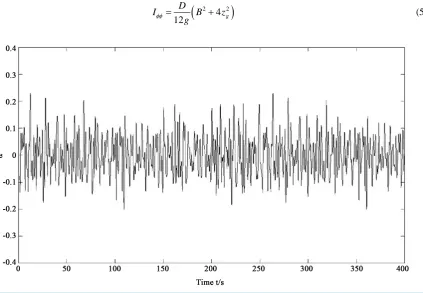
When average water depth is 20 m in Bohai sea area, the long crested random ocean wave angle by simulation in different sea conditions, Figure 1 shows that the significant wave height is 1 m, mean wave period is 7 s, zero speed, heading angle (beam seas) the wave inclination simulation curve.
3. The Mathematical Model of Ship Rolling Motion
Due to the unpredicted rough wave, ship rolling, pitching, yawing angle displacement and swaying, surging, heaving linear displacement motion will occur in the navigation. The rolling is most likely to occur and the am-plitude is large, when the ship rolling damping is small, then the performance of ship rolling is an important in-dex to judge the performance of a ship. Affected by the structural characteristics and wave disturbance, the ship rolling model is nonlinear. When the rolling angle is small, usually the ship’s rolling model is linearization. The purpose of this paper is through the measurement of acceleration (measurable) to reconstruct the displacement, ignoring the ship pitching, yawing motion and sway, surge, heave motion on the coupling effect of ship rolling, establishing the nonlinear ship rolling model. In the two-dimensional long crested random waves, the ship roll-ing motion equation is every moment in the ship rollroll-ing direction balanced results; motion equation of the ship is
(
Iφφ+Jφφ)
φ+R( )
φ,t +K( )
φ,t =M(
χ ω, e,t)
(4) where Iφφ is the hull of its moment of inertia;Jφφ is additional mass moment of inertia;φ
is the ship rollangle; R
( )
φ,t is roll damping moment; K( )
φ,t is roll restoring moment; M(
χ ω, e,t)
is wave excitationmoment, χ is the course angle, ωe is encounter frequency. Iφφ is determined by the hull itself weight
dis-tribution; Jφφ is determined by the center of gravity and the following ship waterline hull configuration. This
paper adopts Duell formula to calculate its moment of inertia of the ship (Iφφ)
(
2 4 2)
12 g
D
I B z
g
[image:3.595.110.534.416.709.2]φφ = + (5)
OALibJ | DOI:10.4236/oalib.1102171 4 November 2015 | Volume 2 | e2171 where D is vessel displacement, B is vessel width, zg is the height of the ship’s center of gravity from the baseline. This formula assumes that the ship is a rectangular parallelepiped, the length is L, width is B, height is 2, and assume the quality of ship is uniformly distributed in the six surface bodies [9]. The formula is simple and certain degree of accuracy, widely used in practice.
When the rolling angle is large rolling damping moment is nonlinear, at present there are mainly two forms. Froude puts forward the linear damping plus square damping and Hadarra [10] puts forward linear damping and cubic damping. Linear damping and cubic damping form
( )
31 3
,
R φt =Bφ+Bφ (6)
Changes of restoring moment are more complex, because there are the ship rolling, pitching, heaving, wave front rise higher and the impact of the change over time, which can be expressed as
( )
,(
, , , ,)
K φ t =DGZ φ γ θ η t (7)
where GZ is the recovery of arm function of ship, γ is the ship heave, θ is the ship pitching angle, η is wave elevation, pitch and heave of the ship, the influence of wave rise mainly is to make the ship’s initial stabil-ity change high, ship righting arm available Francesctto [11]. A formula as following
( )
(
)
3 53 5
GZ= GM+gm t φ+wφ +wφ (8)
where GM is the initial stability of the vessel, gm(t) is pitching, heaving, wavefront increased stability due to the high initial term changes, w3, w5 are nonlinear restoring moment coefficient can be obtained by the static sta-bility curve fitting. This article only considers a single degree of freedom rolling ship, ship ignored coupling ef-fect on freedom of movement of other, and the restoring moment is
( )
3 51 3 5
,
K
φ
t =Kφ
+Kφ
+Kφ
(9)where K1=DGM, K3=Dw3, K5=Dw5. Random wave excitation wave can be expressed as function of slope of wave surface
(
, e,)
( )
M χ ω t =Dhα t (10)
where h is transverse stability; α
( )
t is the slope of wave surface, The above discussion, the various formulas are substituted into Equation (4) to get the ship rolling random wave kinetic equation(
)
3 3 5( )
1 3 1 3 5
Iφφ+Jφφ φ= −Bφ−Bφ −Kφ−Kφ −Kφ +Dhα t (11)
The above formula with both sides divided by
(
Iφφ+Jφφ)
, the transform processing is( )
(
)
3 3 5
1 3 1 3 5
b b k k k Dh t Iφφ Jφφ
φ= − φ− φ − φ− φ − φ + α + (12)
where bi=Bi
(
Iφφ+Jφφ)
,(
i=1, 3)
; ki=Ki(
Iφφ+Jφφ)
,(
i=1, 3, 5)
4. The Ship Rolling Simulation
Taking a fishing boat used in the literature 10 for example [12], to study the ship rolling motion, rolling para-meters obtained from the test, the vessel basic parapara-meters in Table 1 andTable 2.
[image:4.595.89.540.681.716.2]Take the harmonic frequency step size ∆ =ω 0.025 rad s, integration time step ∆ =t 0.01 s, integration time length is 300 s, course angle is χ =π 2. For rolling motion differential equation 12 is solved by Runge-Kutta method in the time domain, getting different significant wave height when rolling response time history [8]. When the significant wave height is 1 m, the average wave period the is 4.76 s, the maximum roll angle of up to
Table 1. The basic parameters of the ship’s structure.
Length overall L/m Moulded breadth B/m Moulded depth H/m Draught T/m Displacement D/t
OALibJ | DOI:10.4236/oalib.1102171 5 November 2015 | Volume 2 | e2171
Table 2. The basic parameters of the ship roll motion.
Total mass moment of inertia
(
)
2/ tm
Iφφ+Jφφ
Initial stability
GM/m
Initial natural frequency of the roll
1 0/ rad s
ω ⋅ −
Damping coefficient / s1
i
b − Restoring moment coefficient / s2
i
k −
3
b b3 k1 k3 k5
1078 0.962 1.32 0.0208 0.0165 2.0327 -0.7430 0.0643
6.3˚, the standard deviation of the roll angle will reach 2.2059˚, when the significant wave height is 4 m, the maximum roll angle of up to 22.4˚, the standard deviation of the roll angle will reach 8.1990˚, because the si-mulation of wave frequency is consistent with the ship rolling natural frequency.
And then we discuss the factors influence the ship rolling, including external excitation and sensitivity analy-sis of empirical parameters.
4.1. The Influence of External Excitation on the Ship Rolling
Figure 2shows that, at the beginning, the value of ship rolling increases gradually with the mean wave period
being increased. When the mean wave period is 5 s, the ship rolling variance is maximal, and then it decreases with the increase of the mean wave period. So the results shown in Figure 2 are achieved.
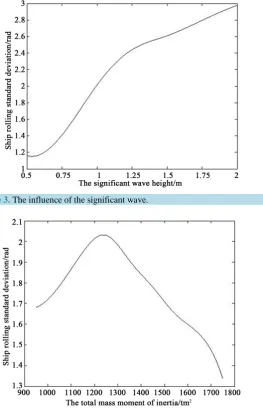
The results of the significant wave height are shown inFigure 3. We notice that the significant wave height will have a significant impact on ship rolling. The ship rolling gradually increases with the increase of the sig-nificant wave height. So we choose the typical parameters to calculate.
4.2. Sensitivity Analysis of Empirical Parameters
Figure 4 shows the influence of the total mass moment of inertia on the ship rolling. We notice that the total
mass moment of inertia will have a significant impact on the ship rolling. When the total mass moment of inertia is 1250/tm2, the ship rolling variance is maximal, and then it decreases with the increase of the total mass mo-ment of inertia, because the total mass momo-ment of inertia influences the natural frequency of ship rolling.
Figure 5shows the influence of b1. We notice that b1 will have a significant impact on the ship rolling. When
b1 is 0.017, the ship rolling standard deviation is maximal, and then it is essentially unchanged.
The results of b3 are shown inFigure 6. The ship rolling increases quickly with the increase of b3. In the cen-ter of 0.0165, the value of 30% range is approximate linear variation, so the estimated value of this paramecen-ter should be very careful, then I studied the relationship between the changes b3 and the mean wave period with the ship rolling. FromFigure 6,we can see that for any mean wave period, b3 has the similar trend.
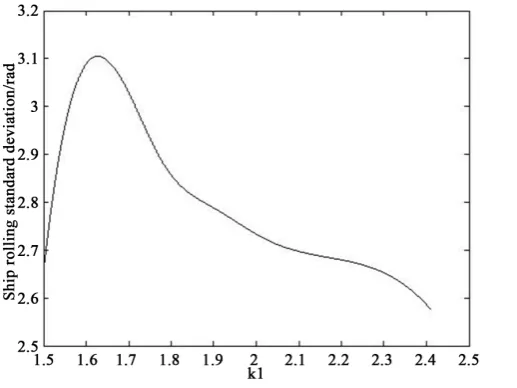
Figure 7 shows the influence of k1 on the ship rolling. When k1 is 1.65, the ship rolling standard deviation is
maximal, and then it decreases with the increase of k1. k1 represents the water displacement of ships and ship the metacentric height, the wavefront of the elevated lead to metacentric height changes, then influence the ship rolling.
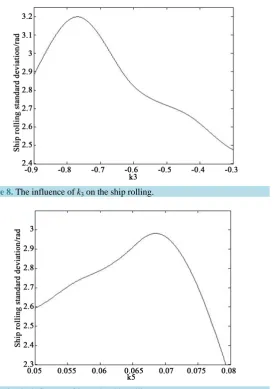
The results of k3 are shown inFigure 8. The ship rolling increases quickly with the increase k3. And when k3 reaches −0.75, the ship rolling standard deviation is maximal. Then, it decreases with the increase of k3.
Figure 9 shows the influence of k5 on the ship rolling. Firstly the ship rolling gradually increases with the
in-crease of k5. When k5 reaches 0.07, the ship rolling standard deviation is maximal, and then it decreases with the increase of k5.
In summary, from the simulation results, the moment of inertia have great influence on ship rolling, in order to get the precise value of the moment of inertia, we must modified calculation moment of inertia based on the actual shipment, In addition to b1, other parameters have significant effects on rolling, therefore, to study on test conditions of these parameters and the method to improve the accuracy of parameters.
5. Rolling Angle Reconstruction Based on FIR
5.1. The Sensor Configuration for Measurement
OALibJ | DOI:10.4236/oalib.1102171 6 November 2015 | Volume 2 | e2171
[image:6.595.191.455.295.704.2]Figure 2. The influence of mean wave period on the ship rolling height.
Figure 3. The influence of the significant wave.
[image:6.595.192.435.485.700.2]OALibJ | DOI:10.4236/oalib.1102171 7 November 2015 | Volume 2 | e2171
[image:7.595.195.431.299.484.2]Figure 5. The influence of b1 on the ship rolling.
Figure 6. The influence of b3 and mean wave period on the ship rolling.
[image:7.595.193.452.512.706.2]OALibJ | DOI:10.4236/oalib.1102171 8 November 2015 | Volume 2 | e2171
[image:8.595.188.463.79.469.2]Figure 8. The influence of k3 on the ship rolling.
[image:8.595.177.450.489.705.2]Figure 9. The influence of k5 on the ship rolling.
OALibJ | DOI:10.4236/oalib.1102171 9 November 2015 | Volume 2 | e2171 The second-order integration filter is the key to design acceleration reconstruction displacement method [13] [14]. The ideal frequency response,
( )
21
E
H ω
ω
= − (13)
The designing method of second order integral filter is included digital filtering method and frequency do-main integral method, the ninth literature studied that the design methods of FIR filter, then filter parameters are obtained.
5.2. Rolling Angle Reconstruction
In the random wave excitation for ship rolling motion, when removed wave interference moment, the ship roll-ing into the free state. Random wave feature wave height is 1m; the mean wave period is the 4.76 s MPM spec-trum, course angle is χ =π 2. In the random wave excitations, ship’s low frequency rolling as shown in
Fig-ure 6, the simulation duration is 600 s, the sampling frequency is fs=25 Hz.
The rolling angle equation of the second derivative is to get ship’s roll angle acceleration information. Ship rolling angular acceleration frequency is 0.23 hz, FIR filter target frequency is fT =0.23 Hz. FIR filter size choosing the coefficient curves of the third zero crossing. Where Nw=7.591. First through angular displace-ment signal reconstruct the rolling angle, and with the dynamics simulation to compare the angular displacedisplace-ment; then the angular acceleration signal by adding white Gaussian noise ratio of 20, the angular acceleration of the noise signal containing heavy structure angular displacement.
[image:9.595.173.461.452.614.2]In the wave excitation of 0 - 300 s and free rolling 300 s - 600 s, there were no significant difference between the FIR reconstruction of angular displacement and dynamic simulation of angular displacement in amplitude and phase, as shown in Figure 11. Table 3lists the angular acceleration of simulation and reconstruction angu-lar displacement under the condition of wave excitation and free roll of root mean square error (RMSE). The signal-to-noise ratio of 20 Gaussian white noise, leading to the random wave excitation rolling acceleration root- mean-square deviation of 0.013 rad·s−2. In the excitation wave rolling, reconstruction of angular displacement of RMSE in with measurement noise for 0.0019 rad, in the absence of measurement noise for 0.0012 rad. Research shows that design of FIR filter can effectively reconstruct displacement from the acceleration signal, and has the strong ability of noise suppression [15]. This article does not give the filter size for filter coefficient curve second zero value, its filtering effect is basically the same.
Figure 11. Simulation of ship rolling angular comparison with FIR reconstruction.
Table 3. Reconstruction of the angular of the root mean square error.
Roll form
Angular acceleration (rad∙s−2) FIR filter reconstruction angular displacement (rad) No measurement
noise
Contain the measurement noise
No measurement noise
Contain the measurement noise
Random waves excitation ship rolling 0 0.0134 0.0012 0.0019
[image:9.595.93.540.658.722.2]OALibJ | DOI:10.4236/oalib.1102171 10 November 2015 | Volume 2 | e2171
6. Conclusion
The ship displacement measurement is the key link to ship attitude control, dynamic positioning, offshore con-struction operation, etc. The paper analyzes nonlinear damping torque and nonlinear restoring moment and es-tablishes the nonlinear motion equation of ship rolling under random sea. The Runge-Kutta method is used in the time domain to solve the equation, and to simulate the time history of random wave excitation ship rolling and free decay process. To simulate the angle acceleration measurement signal, the paper uses the ship attitude inertial measurement system and its algorithm technology to construct the ship rolling angle from the accelera-tion measuring signals. From the simulaaccelera-tion results, the moment of inertia has great influence on ship rolling. In order to get the precise value of the moment of inertia, we must modify calculation moment of inertia based on the actual shipment. Studies show that the inertial measurement system and algorithm can effectively reconstruct ship rolling angle from the acceleration measurement signal, and the algorithm has the ability to suppress mea-surement noise.
References
[1] Nayfeh, A.H. and Khdeir, A.A. (1986) Nonlinear Rolling of Biased Ships in Regular Beam Waves. International Ship- building Progress, 33, 84-93.
[2] Chang, Z.Y., Tang, Y.G., Yang, J.M. and Wang, L. (2012) Analysis for the Deployment of Single Point Mooring Buoy System Based on Multibody Dynamic Method. China Ocean Engineering, 26, 295-506.
http://dx.doi.org/10.1007/s13344-012-0037-x
[3] Ju, S., D., Chang, Y., J. and Chen, G.M. (2012) Envelopes for Connected Operation of the Deepwater Drilling Riser. Petroleum Exploration and Development, 39, 105-110. http://dx.doi.org/10.1016/s1876-3804(12)60022-6
[4] Nayfeh, A.H. and Khdeir, A.A. (1986) Nonlinear Rolling of Ships in Regular Beam Waves. International Shipbuilding Progress, 33, 40-49.
[5] Liu, Q. (2011) Preliminary Study on Simulation for Oil Drilling Rig Hoisting System of AC Conversion Electric Dri-ven Drilling Rig. Oil Field Equipment, 40, 10-15.
[6] Sanchez, N.E. and Nayfeh, A.H. (1990) Nonlinear Rolling Motions of Ships in Longitudinal Waves. International Shipbuilding Progress, 37, 247-272.
[7] Eissa, M. and EI-Bassiuny, A.F. (2003) Analytical and Numerical Solutions of a Non-Linear Hip Rolling Motion. Ap-plied Mathematics and Computation, 134, 243-270. http://dx.doi.org/10.1016/S0096-3003(01)00279-X
[8] Feng, T.C. and Tao, Y.S. (1995) Excitation of Roll and Its Effect to Safety of Ship. Journal of Hydrodynamics, 10, 42- 47.
[9] Hu, J., Tang, Y.G. and Li, S.X. (2013) Vibration Test and Assessment for an Ocean Drilling Rig Derrick: Taking the ZJ50/3150DB Drilling Rig as an Example. Petroleum Exploration and Development, 40, 117-120.
http://dx.doi.org/10.1016/S1876-3804(13)60014-2
[10] Lin, Y. and Ji, Z.S. (1993) A Study of Ship Rolling Motion and Stability in Waves. Shipbuilding of China, 122, 37-46.
[11] Sulaiman, O.O. and Magee, A. (2013) Mooring Analysis for Very Large Offshore Aquaculture Ocean Plantation Floating Structure. Ocean and Coastal Management, 80, 80-88. http://dx.doi.org/10.1016/j.ocecoaman.2013.02.010
[12] Yuan, Y., Yu, Y. and Jin, X.D. (2003) Undesirable Ship Capsizal in Regular Beam Sea. Journal of Shanghai Jiaotong University, 37, 995-990.
[13] Tang, Y.G., Zheng, J.W. and Dong, Y.Q. (1998) Study on Synamic Behavior of Ship’s Internal Resonance. Shipbuild-ing of China, 143, 19-26.
[14] Senjanovic, I., Parunov, J. and Cipric, G. (1997) Safety Analysis of Ship Rolling in Rough Sea. Chaos Solitons & Fractals, 8, 659-680.