S T U D Y P R O T O C O L
Open Access
Person-centered care planning and service
engagement: a study protocol for a randomized
controlled trial
Victoria Stanhope
1*, Janis Tondora
2, Larry Davidson
2, Mimi Choy-Brown
1and Steven C Marcus
3Abstract
Background:Service disengagement is a pervasive challenge the mental health care system faces. Mental health services are of little value should persons with mental illnesses continue to opt out of receiving them. Consumers attribute disengagement from care to an absence of choice in their treatment. In response, the mental health system is adopting a person-centered model, based upon recovery principles, to engage consumers more actively in their care. Person-centered care planning is a promising practice involving collaboration to develop and implement an actionable plan to assist the person in achieving personal recovery goals.
Methods/design:This study design combines a parallel-group randomized controlled trial of community mental health organizations with qualitative methods to assess the effectiveness of person-centered care planning. Participants at 14 sites in Delaware and Connecticut will be randomized to treatment as usual or the person-centered care planning intervention. Participants will be in leadership (n = 70) or supervisory or direct care (n = 210) roles. The person-centered care planning intervention involves intensive staff training and 12 months of ongoing technical assistance. Quantitative survey data will be collected at baseline, 6 months and 12 months measuringperson-centered care planning competency and organizational factors. Consumer outcomes (engagement, medication adherence, functioning and consumer satisfaction) will be assessed by Medicaid and state-level data. Qualitative data focused on process factors will include staff and consumer interviews and focus groups. In this intent-to-treat analysis, we will use mixed-effects multivariate regression models to evaluate the differential impact of the person-centered care planning intervention on each consumer and implementation outcome as well as the extent to which clinician assessments of organizational factors are associated with the implementation outcome. Mixed methods will triangulate and strengthen the interpretation of outcomes.
Discussion:The aim of this study is to generate valuable guidance for state systems engaged in scale-up and
transformation efforts. Targeted staff selection for training to support sustainability will serve to provide further insight into important intervention implementation strategies. Person-centered care planning has the potential to enhance the impact of all evidence-based and recovery-oriented practices and bring practice into line with the emerging national guidelines in health care reform.
Trial registration:This trial was registered with ClinicalTrials.gov (Identifier: NCT02299492) on 21 November 2014 as New York University Protocol Record PCCP-13-9762, Person-Centered Care Planning and Service Engagement.
Keywords:Implementation, Mental health recovery, Mental health services, Mixed methods, Person-centered
care planning, Service engagement
* Correspondence:[email protected] 1
Silver School of Social Work, New York University, 1 Washington Square North, New York, NY 10003, USA
Full list of author information is available at the end of the article
Background
Service disengagement is one of the most pervasive and challenging problems currently facing the mental health care system [1,2]. Epidemiological studies have shown that 33% to 55% of people who meet criteria for an axis I diagnosis (according to the Diagnostic and Statistical Manual of Mental Disorders, Fourth Edition [3]) have received no mental health care in the past year [4]. Of those who do seek care or are hospitalized, an estimated 24% do not attend treatment sessions as scheduled, 20% drop out of treatment before it is completed, and 18% to 67% do not attend outpatient treatment after hospitalization [1,5]. During the Clinical Antipsychotic Trials of Intervention Effectiveness study, 64% to 82% of patients dropped out of treatment within the first year [6]. No matter how effective mental health ser-vices are now or become in the future, they are of little value should persons with mental illnesses con-tinue to choose not to receive them.
Although there are many reasons why people disen-gage from care [7], people’s experience of the treatment process is one significant factor that can be addressed by practice innovation. Consumers have attributed their disengagement from care to having poor alliances with care providers, including experiences of not being lis-tened to and not being offered the opportunity to make decisions and collaborate in their own treatment [5,8]. In response, the mental health system is moving toward a more person-centered model, based upon recovery principles, to engage consumers more actively in their own care [9]. States have embraced this model in theory, and they are now looking for guidance on how best to implement this model in practice, including how to maximize service quality and consumer outcomes, given the limited resources available to them for workforce de-velopment [10]. The proposed study tackles this pressing issue by testing the effectiveness of person-centered care planning (PCCP), a manualized, provider-based intervention that maximizes consumer choice for adults receiving mental health services [11]. By target-ing the service-planntarget-ing process that is shared by all evidence-based practices (EBPs) and mental health services, PCCP embeds a value-added component throughout the agency.
Person-centered care planning
PCCP makes real a service approach that has been championed by the Institute of Medicine and the New Freedom Commission on Mental Health [12,13]. By shifting from an illness and/or deficit focus to a strengths-based, person-centered one, this intervention fundamentally changes a practice culture that has re-sulted in many people walking away from the care they need. Instead, PCCP offers an opportunity for people to
enter into a genuine partnership with the care system to improve the overall quality and effectiveness of care. PCCP emerged from the federal agenda to transform mental health care to a recovery orientation and is now being adopted at the state level [14]. Models of PCCP were initially developed and found effective for use with persons with developmental disabilities in the 1980s [15,16]. With two randomized trials and evaluations at the state level demonstrating positive results, PCCP has been identified as a promising practice [17,18]. PCCP in-volves a collaborative process between the service user and all of those people in the person’s life whom he or she identifies as supportive of his or her recovery, in-cluding clinical practitioners, other mental health staff involved in the person’s care, and any natural supporters (for example, friends, family members, representatives from faith communities). The aim of the planning process is to develop and implement an actionable plan to assist the person in achieving his or her unique per-sonal goals along the journey of recovery. This plan is also intended to address the specific mental health and/ or substance use barriers interfering with the person’s goal achievement, and in this way it is able to meet the rigorous documentation elements required by accredit-ing and fundaccredit-ing bodies (that is, the Joint Commission and Centers for Medicare and Medicaid Services).
Person-centered care plans are (1) oriented toward promoting recovery rather than only minimizing illness and symptoms; (2) based on the person’s own unique life goals and aspirations; (3) focus and build on the person’s capacities, strengths and interests; (4) articulate the per-son’s own role and the role of both paid practitioners and natural supports in assisting the person to achieve his or her own goals; (5) emphasize the use of natural community settings rather than segregated program tings; and (6) anticipate and allow for uncertainty, set-backs and disagreements as inevitable steps on the path to greater self-determination [10]. These principles make PCCP truly transformative and ultimately sustainable, but they also create challenges when implemented in real-world settings. As with other recovery-oriented practices, PCCP demands a profound shift in values and culture that has implications for providers, orga-nizations and systems [19]. Therefore, sustainable changes in provider behavior may be most likely when training is accompanied by corresponding changes in beliefs, attitudes, and organizational culture, policies and structures.
coaching in PCCP [18]. The experimental condition had fewer “no shows”, demonstrating higher levels of consumer engagement, and clinicians reported higher rates of medication adherence as compared with the control sites. In a second randomized controlled trial, PCCP was combined with illness management and re-covery and a peer-run community integration program for low-income adults of Hispanic and/or African ori-gin with psychotic disorders [17]. The intervention was found to be effective in increasing participants’ ac-tive involvement in the care-planning process and in increasing inclusion in the planning process for hous-ing, employment and education. The intervention also increased participants’sense of control and efficacy in their self-care and overall lives, reduced psychotic symptoms and increased family and social support. Al-though both of these studies indicated that PCCP was effective, PCCP was combined with other interven-tions, making its specific impact hard to assess. In addition, researchers have documented concerns spe-cific to implementing recovery-oriented practices, in-cluding PCCP. These include beliefs that recovery oriented practice is not unique or novel, that it is too burdensome for overextended clinicians, that it is not desired by people with severe mental illnesses, that it is not evidence-based or reimbursable, that it devalues provider expertise, and that it is too risky because it
increases provider exposure to incidents and liability [20,21]. Such concerns pose formidable barriers to implementation if not addressed. To address and fur-ther evaluate these concerns, data will be collected on organizational factors to assess if differences in organizational culture impact the implementation of PCCP.
Conceptual framework and causal model
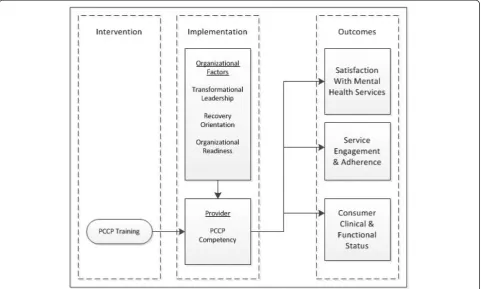
The primary aim of the study is to examine the effective-ness of PCCP while also seeking to assess the influence of organizational variables on the implementation of PCCP and its impact on consumer outcomes. The con-ceptual framework integrates implementation science and mental health recovery to hypothesize causal rela-tionships between the organization, provider and service user.
Organizational factors
[image:3.595.58.540.425.714.2]The organizational level assessment targets three organizational factors: transformational leadership, re-covery orientation and organizational readiness. Posi-tive change in these three factors is hypothesized to bring about the necessary organizational conditions for successful training of providers in PCCP and im-provement in service user outcomes (see Figure 1 for causal model used in this study).
Transformational leadership is a key upstream organizational factor in creating mental health service organizations that are open to change [22], can im-prove client outcomes [23] and are recovery-oriented [24]. The leadership qualities that promote transform-ation are those that inspire providers to adopt the values and goals of their leaders [25]. As opposed to focusing on the completion of specific tasks (transac-tional leadership), transforma(transac-tional leaders motivate providers by conveying a shared sense of mission and heightening expectations for performance. Recovery orientation is the specific values–innovations fit [26] needed to successfully implement PCCP. Moving to-ward genuinely person-centered care involves not sim-ply technical skills but also a paradigm shift in how providers understand and value their work with con-sumers. Nine principles have been identified with re-gard to recovery orientation, including renewing hope and commitment and redefining self and assuming control [27]. Organizational readiness, which captures both motivation and capacity for change, is now rec-ognized as a critical precursor to successful adoption of innovation in behavioral health care settings [28]. This multifaceted construct reflects how the sum of individual attitudes and behaviors operate at a collect-ive level within an organization [29]. First, staff must be motivated to change by a perceived need for new skills and have confidence in their own ability to adapt to, master and share new skills. Second, organizational climates conducive to change must convey a clear sense of mission and goals, promote staff cohesion and cooperation, and reflect an openness to change. Third, change must be supported by the necessary re-sources, which include adequate staffing, training, equipment and alignment of procedures [30].
Person-centered care planning competency
PCCP competency is the extent to which providers ad-here to the intervention (fidelity) and demonstrate the necessary value endorsement and skills to implement PCCP. High-quality PCCP consists of four components: (1) believing people have a right to self-determination, (2) interacting with persons with respect and projecting a hopeful vision for the future, (3) producing a high-quality written service plan and (4) having high expecta-tions for outcomes related to life goals. In accordance with the PCCP manual, the intervention targets provider attitudes and behaviors related to these four areas with training of clinical supervisors and provision of technical assistance (TA) for a 1-year period.
Outcomes
Study outcomes are impacted by the choice and per-ceived relevance of the services offered to consumers.
Increasingly, service engagement and adherence are be-ing understood as a function of choice that operates within the broader context of the myriad decisional and social processes that occur when a person enters care [7]. Therefore, whether people choose to use medication or services is determined in large part by the extent to which people feel that they have had a choice leading up to these specific adherence decisions. Self-determination also requires that choices be directly relevant to an indi-vidual’s values, preferences and life goals rather than just choosing between limited options that are not perceived to increase quality of life [31]. Service engagement that is precipitated by an increase in self-determination has been found to be associated with greater satisfaction with services [32]. PCCP seeks to maximize choice and ownership of the treatment process by engaging people in care that is relevant and responsive to their holistic needs and life goals. This increases the likelihood that they will adhere to and benefit from treatment. Making decisions, considered a fundamental “capability” needed in order to pursue a meaningful life [33], nevertheless may not be a readily accessible skill for those who have not had control over their lives for many years. PCCP also addresses what Deegan referred to as“learned help-lessness” [34] by offering consumers not only choices but also the supports and skills they need in order to achieve higher functional status and regain a sense of control over their lives.
Methods
This trial has three aims. Aim 1 and Aim 2 utilize quan-titative methods and Aim 3 utilizes qualitative methods.
Aim 1 is to assess the effectiveness of PCCP. Aim 2 is to assess organizational factors in the implementation and effectiveness of PCCP.
Participants
We randomly selected 14 research sites from among all community mental health clinics (CMHCs) in Delaware and Connecticut. These agencies serve approximately 8,000 consumers. We used the Power and Precision soft-ware package (Biostat, Englewood, NJ, USA) to calculate sample sizes needed to achieve 80% power (α= 0.05) to detect these effects in our two-level hierarchical design where clinicians and patients are nested within CMHCs. The software accounts for this nesting using the intracluster correlation coefficient (ICC), a measure of the relatedness of clustered data that compares the vari-ance within and between clusters. The ICC in our pilot data was 0.013. To achieve the study aims, we will need 280 participants (20 per site). We will need 1,125 med-ical record reviews (75 per site).
psychiatric evaluation, medication management, case management, community support programs and re-habilitation services. A total of 280 providers will be recruited for the study. Within each research site, five clinical supervisors, ten direct care staff and five lead-ership staff will be recruited to participate in the study. The supervisors are clinical staff who are dir-ectly responsible for supervising the direct care staff. Direct care staff are clinicians who provide frontline services to consumers without any supervisory duties. The supervisors and direct care staff work in the out-patient mental health programs listed above. They come from a variety of disciplines, including social work, psychology, psychiatric rehabilitation, counsel-ing and peer support. The leadership staff are in ad-ministrative positions and do not directly supervise direct care staff. Their titles include executive director, medical director, administration direction, operations director, quality improvement director, clinical services directors, peer support or consumer affairs director, training and staff development director, rehabilitation services director, human resources director, and repre-sentatives from the agency’s consumer advisory council. Each supervisor will nominate two direct care staff who report to them. They will nominate individuals based on whether they fulfill the criteria of change agents, which are that they have worked at the agency for more than 1 year, have demonstrated leadership po-tential, are open to change and adoption of new prac-tices and are perceived as a resource and/or role model by other direct care staff.
Secondary data will be used to assess consumer out-comes. Consumers eligible for this study will be adults who have received services at the CMHCs continuously for 1 year prior to the study. We will use the Medicaid and state mental health data of all eligible consumers.
Randomization
The 14 sites (8 in Connecticut and 6 in Delaware) se-lected for the study will be randomized into the 2 study arms, yielding 7 sites per condition, balanced by state. A research team member will use SAS 9.3 soft-ware to generate the allocation sequence assigning sites to condition. The software will generate randomized lists blocked by state, ensuring three experimental sites and three control sites in Delaware and four experimental sites and four control sites in Connecticut. The responsible team member will be blinded to site-specific information during randomization. Blinding is not possible, given the circum-stances of the intervention.
Intervention
PCCP provides a framework for the collaborative cocreation of a recovery-oriented treatment plan that is
driven by an individual’s most valued life goals. Providers will learn how to elicit and empathize with their client’s subjective experiences as a whole person and how to help the consumer identify and articulate interests, pref-erences and personal recovery goals. Challenges include reframing symptoms and impairments as barriers to goal attainment; reframing the use of medications as tools for overcoming these barriers and moving ahead in one’s life; instilling hope and encouraging the person’s incremental ef-forts in the face of fear, uncertainty and demoralization; identifying short-term, realistic and measurable objectives that can be achieved within the plan period of 3 to 6 months while keeping these objectives explicitly connected to longer-term aspirations that might span years; and expand-ing a person’s network to include natural supporters as well as professional care providers.
The PCCP implementation strategy targets change in direct service provider behavior by providing train-ing and follow-up TA to clinical supervisors and nom-inated direct care staff over a yearlong period. This targeted staff selection is aimed at contributing strat-egies for scaling up and sustaining practices in large mental health systems. This strategy serves to inte-grate ongoing, knowledgeable supervision of direct care staff from onset. Additionally, the nominated direct care staff are selected in part for their demonstrated leader-ship potential. Clinical supervisors and direct care staff will employ this interpersonal influence and formal and infor-mal leadership roles as“change agents”within their teams and programs [35,36].
short-term objectives), delivery of services consistent with an established plan, and monitoring of both the quality of the planning process and its impact on consumer out-comes. In each of these areas, opportunities to maximize the person-centered nature of both the process (that is, how roles, relationships and planning meetings look differ-ent in PCCP) and the documdiffer-entation (that is, the resultant written recovery plan) are highlighted. Significant emphasis is placed on the changing roles of both the consumer and the practitioner in PCCP, with tools provided to support the development of competence and confidence in these shifting roles.
Trainees will be given the provider training manual as well as a consumer toolkit. The provider manual is a published 154-page guide developed by the Yale Program for Recovery and Community Health. The consumer toolkit, also developed by Yale Program for Recovery and Community Health, is a 24-page guide designed to explain to consumers the process of person-centered care planning. Designed for administrators and pro-viders, the manual gives detailed step-by-step guidance on how to write person-centered plans for people receiv-ing behavioral health plans. To strengthen the transfer of learning from the initial training to participants’daily work, clinical supervisors will be asked to participate in two follow-up TA telephone calls per month. The first call of each month will be a case presentation and con-sultation call. The supervisor’s team will be invited to participate in the call, and training consultants will offer live modeling of how supervisors should conduct these PCCP feedback sessions with their supervisees. The sec-ond monthly call will involve the clinical supervisors only and will be fully dedicated to supporting supervi-sors with implementation issues they encounter as they encourage the adoption of PCCP by their team mem-bers. The training team will keep logs of the training and record process notes of TA calls to measure the fre-quency and intensity of training given to each provider.
Measurement
The intervention will be conducted over a period of 12 months and will be staggered across experimental sites. Organizational factors and PCCP competency will be measured by surveys of the leaders, clinical supervi-sors and direct care staff because reliable assessment requires multiple perspectives [30]. These surveys will be administered at baseline, 6 months and 12 months. Chart reviews will also be used to measure PCCP com-petency. Service engagement and consumer outcomes will be measured using state mental health data and Me-dicaid claims data.
Online assessment measures will be administered to all study participants, regardless of treatment condition. Researchers will collaborate with each CMHC to identify
the leadership staff, clinical supervisors and direct care staff. An e-mail with an embedded URL linking partici-pants to the online consent form and survey will be sent to each provider individually. Depending on their role in the agency, staff will receive one of the three surveys for direct care staff, clinical supervisors or executive leader-ship. The surveys are substantively equal with variation in the measurement versions and included language. Surveys will be completed at three time points: baseline, the midpoint of the intervention period (6 months) and postintervention (12 months). Each research site in the control condition will be paired with a site in the experi-mental condition, and the surveys will be e-mailed to pairs 1 month prior to the experimental site’s receipt of the PCCP intervention. Chart reviews will assess 75 ser-vice plans per site before and after the intervention.
Person-centered care planning competency
Person-Centered Care Questionnaire, administrative
and provider versions The Person-Centered Care
Questionnaire (PCCQ), created in 2009 by Tondora and Miller of the Yale Program for Recovery and Community Health, is a 32-item measure designed to assess the de-gree to which service planning is person-centered, with higher scores associated with a more person-centered service plan. This measure has not been validated. The PCCQ has been used to measure intervention fidelity by the investigative team in their work with multiple states. Respondents rate either their service-planning processes or the staff processes on a 5-point scale ranging from “strongly disagree”to“strongly agree”.
Person-centered care planning Documentation
Qual-ity Review Tool This tool lists ten key indicators of
person-centered care values and principles that can be applied to clinical record documentation. The measure generates a score from 0 to 10 (yes-or-no answers to ten indicators), with a higher score reflecting more person-centeredness. The PCCP Documentation Quality Review Tool was developed by the investigators in collaboration with the New York Association of Psychiatric Rehabilita-tion Services. This is not a validated measure, but an ini-tial pilot administration of the tool in one large New York CMHC was positively received by the agency ad-ministration, both for its breadth of content and for its ease of administration.
Organizational factors
leadership, which is composed of five subscales: idealized influence (belief of leadership character;α= 0.91), ideal-ized influence (observed leadership behavior; α= 0.86), inspirational motivation (α= 0.94), intellectual stimula-tion (α= 0.93) and individual consideration (α= 0.87) [25]. Clinical supervisory and direct care staff were asked to rate the executive leadership, and the executive lead-ership were asked to rate themselves, on a 5-point fre-quency scale ranging from “not at all” to “frequently, if not always”, with higher ratings indicating a higher de-gree of idealized influence, inspiration, intellectual stimulation and individual consideration.
Organizational Readiness for Change Scale, director
and staff versions The Organizational Readiness for
Change Scale [30] is used to assess provider perceptions of the readiness for change. This self-administered measure has four domains: motivational factors, staff attributes, program resources and organizational climate. This study focuses on the 30-item organizational climate domain with six subscales that correspond to organizational features associated with implementation of innovative prac-tices [40,41]. The selected subscales include mission, cohe-sion, autonomy, communication, stress and change. Each subscale has acceptable internal consistency values ranging from 0.76 to 0.82 [30]. Respondents are asked to rate the working environment at their agency on a 5-point scale ranging from “strongly disagree” to “strongly agree”, with higher ratings indicating higher degrees of climate for change.
Recovery Self-Assessment–Revised, administrator
and provider versions The Recovery Self-Assessment–
Revised scale (RSA) [42] is a 36-item measure assessing the degree to which recovery-oriented practices are im-plemented in an agency. Respondents are asked to rate the agency as a whole on a 5-point scale ranging from “strongly disagree” to“strongly agree”with items related to the scale’s five components: life goals, involvement, diversity of treatment options, choice and individually tailored services. Higher scores indicate a higher inte-gration of recovery-oriented practices. The RSA has been used as a quality improvement and/or research tool in over 35 states and in several different countries. In previous research, the RSA has been demonstrated to have excellent internal consistency, reliability and validity [42-44].
Consumer outcomes
Community mental health visits Mental health visits
at each agency are reported via the CMHC Service Ticket Form, which is completed by providers after each scheduled appointment or unscheduled visit. Visits are coded as no show, canceled, unscheduled or scheduled.
Outpatient mental health service use Medicaid claims
data will be used to measure use of medication manage-ment, case managemanage-ment, individual and group psycho-therapy services, and rehabilitative services. Relevant claims will be identified based on presence of an Inter-national Classification of Diseases, Ninth Revision, Clin-ical Modification (ICD-9-CM), mental health diagnostic code as primary diagnoses on evaluation and manage-ment visit claims or by corresponding Current Proced-ural Terminology (CPT) codes in all outpatient settings except emergency departments.
Medication adherence Medicaid claims data will be
used to measure adherence to psychiatric medications. We will calculate adherence to newly initiated and on-going use of antidepressants, antipsychotics and mood stabilizers using the medication possession ratio (MPR) [45]. The MPR is a continuous measure of the usable days supplied from all prescriptions in each period di-vided by the number of days in each period.
Psychiatric hospitalizations and emergency department use Medicaid claims data will be used to measure psychi-atric hospitalizations and emergency department use identi-fied by relevant ICD-9-CM diagnostic codes (290 through 314), CPT codes, place of service and revenue center codes. The occurrence of any psychiatric hospitalization, the num-ber of hospitalizations and the length of stay for each will be coded.
Employment, housing and forensic involvement status
This information will be extracted from the state Annual Consumer Reporting Form, which contains questions about (1) primary employment, secondary employment and hours worked per week during the past 90 days; (2) residence and whether the consumer has been homeless in the past 30 days; and (3) current legal involvement.
Consumer satisfaction with services, social
connect-edness and improved functioning These domains will
be measured by using state data from the Consumer/Client Satisfaction Survey, which consists of the state version of the Mental Health Statistics Improvement Program Con-sumer Survey, version 1.2 [46]. This 43-item measure has 23 items that measure consumer satisfaction with services, 13 items that measure functioning, and 4 items that meas-ure social connectedness. Higher scores reflect greater sat-isfaction, functioning and connectedness.
Consumer demographic and clinical characteristics
Quantitative Data analysis
All analyses will be done by intent to treat (ITT). Differ-ences across the two arms of the study (PCCP and treat-ment as usual) will be analyzed using the PROC MIXED statement in SAS statistical software (SAS Institute, Cary, NC, USA) to create mixed-effects multivariate re-gression models. Mixed-effects models will permit the appropriate analysis of nesting of study subjects within sites and repeated measurement of outcomes for sub-jects over time. Descriptive statistics will be examined for treatment groups and for additional groups as needed (for example, treatment completers versus drop-outs). In addition, individual and average trajectories will be plotted for all repeated measures over time according to assigned treatment.
Bivariate analyses will be conducted using χ2 tests for categorical variables andt-tests for continuous dependent variables at each time point to evaluate the differential impact of the PCCP intervention on each consumer and implementation outcome. All models will control for, as fixed effects, baseline consumer factors as appropriate (diagnosis, comorbid medical and substance abuse diagno-ses, sex, age, race and psychiatric hospitalization rates). Models will be conducted separately for outcomes from leadership staff, clinical supervisors, chart reviews, state mental health data and Medicaid claims. The unit of ob-servation in all models will be, as appropriate, clinical su-pervisors, organizational leaders or consumers.
In the analyses for aim 1, we will assess the effective-ness of PCCP on service engagement and clinical out-comes. We will use each outcome as the dependent variable and a dichotomized measure of the PCCP inter-vention (any interinter-vention versus no interinter-vention) as our independent variable. Controlling for relevant baseline characteristics and including a fixed effect for state, we will use separate mixed linear regression models to de-termine the impact of the intervention on each of the outcomes at each time point. The primary ITT test and estimation will be done at the 24-month time point with tests at earlier time points. We will then conduct a growth curve analysis with repeated observations repre-senting measures at baseline, 12 months and 24 months. The analysis will include variables for time, treatment and their interaction, but it will be focused on the mag-nitude and statistical significance of the time × treatment interaction to quantify the relative difference in the rate of outcome change between the treatment groups. All models will include random intercepts and slopes for CMHC and state. We will repeat these analyses to com-pare each intervention arm to treatment as usual.
The analyses for aim 2 are limited to only clinicians and consumers in agencies exposed to the intervention. Within this population, we will use linear mixed-effects regression models to determine the extent to which
clinician assessments of organizational factors, including transformational leadership, recovery orientation and organizational readiness (independent variables), are as-sociated with our primary implementation outcome, which is clinician PCCP competency (dependent vari-able). Competency will be measured as change from baseline to 12 and 24 months and examined separately at each time point. Our first model will include one ob-servation per clinician and will include a random inter-cept for organization, but no independent variables. This will allow us to calculate the maximum proportion of variance attributable to the organization (that is, the ICC). A second model will also include our three independent variables as fixed effects. This model will allow us to examine the individual contribution of each organizational factor to explaining competency and also to understand how much of the total explainable organizational variation in our dependent variable from the first model is explained by the three organizational factors in this model. In subsequent models, we will use these same techniques to assess the impact of organizational factors on patient outcomes, including consumer satisfaction with services, service engage-ment and adherence and consumer clinical and func-tional status.
Aim 3 is to use qualitative methods to understand how care planning impacts service engagement and how implementation processes influence organization and provider level behavior.
Participants
The seven experimental research sites will be selected for qualitative inquiry. Leadership staff, clinical supervi-sors participating in the training, their direct care staff, and consumers receiving services from them will be re-cruited for the study. Researchers will contact CMHC staff to explain the study and identify providers and con-sumers for recruitment. Flyers describing the study to providers and consumers will be distributed to each CMHC to explain the study and give a toll-free tele-phone number with which potential participants can contact researchers directly.
Procedures
consumers. We will recruit 8 to 12 participants per group. The interviews and focus groups with staff will be guided by a review of the RSA and PCCQ–provider ver-sion scores obtained at baseline and 6 months. Staff will be asked about service planning and its influence on en-gagement and consumer outcomes. The consumer focus group will be guided by the Person-Centered Care Plan-ning Quality Indicator, which has seven items about consumers’ experience of service planning. Consumers will then be asked about their engagement in services and how this relates to the service-planning process. The research team will coordinate with the CMHC dir-ector or designee to schedule interviews and focus group meetings.
Qualitative data analysis
Data will be analyzed according to grounded theory, one of the most systematized of the qualitative methods [48]. Grounded theory encourages inductive thinking and use of the constant comparative method [49]. Our goal is to gain an in-depth understanding of the barriers to, facili-tators of and consumer and provider perceptions of ser-vice planning, implementation of PCCP and how serser-vice planning relates to service engagement and consumer outcomes. Focus group transcripts will be analyzed for themes and divergent opinions with commonly used qualitative data analytic procedures [50]. These methods will include a component of independent review by more than one person, a discussion and convergence of themes and consensus development. To ensure a max-imum degree of trustworthiness and minimize bias, we will deploy strategies for rigor, which will include team debriefings, negative case analysis and audit trail.
Mixed methods
The purpose of mixing methods in this study is to use qualitative data to (1) triangulate and expand on the quantitative data on implementation outcomes and (2) interpret the quantitative data on PCCP outcomes. First, focus groups and key informant interviews will triangu-late the findings from the implementation outcome mea-sures by allowing us to examine whether participants perceived the implementation strategies to result in the successful uptake of PCCP. Triangulation enhances rigor by providing more than one source of data to examine whether findings are congruent [51]. The qualitative data can compensate for the potential lack of power in this study to conduct hypothesis testing on implementation outcome variables. The qualitative data will also provide more in-depth data on the implementation process, par-ticularly on unanticipated facilitators and barriers. Second, the focus groups and key informant interviews will generate data on the effectiveness of the PCCP intervention, giving us insight into why PCCP is effective
or is not, and they will explain potential variation across sites in PCCP outcomes.
Ethical issues
For the quantitative component of the study, potential risks are minimal for providers participating in the inter-vention and completing the surveys. The interinter-vention involves training and consultation that are part of on-going quality improvement activities instigated by the state. Informed consent will take place prior to partici-pants’completing surveys. We will initially send the pro-viders a notification e-mail, briefly describing how the study is an examination of PCCP and inviting their par-ticipation. If they choose to continue, they will be pre-sented with the informed consent statement form to complete. The online survey does not ask for sensitive information, but subjects will be able to refuse to answer any survey question. Confidentiality will be protected for both the individual respondents and the CMHCs; CMHCs will not have access to employees’responses.
For the qualitative component of the study, potential risks to participants are minimal. Informed consent will be obtained prior to the interviews and focus groups. The content of the interviews and focus groups will be confidential and will not be reported to CMHCs. The study has been approved by the New York University Institutional Review Board (number 13–9762). These methods adhere to the Consolidated Standards of Report-ing Trials guidelines.
Discussion
able to report on more nuanced outcomes related to re-lationships with providers and subjective mental health recovery.
Conclusions
Designed to bridge the science to services gap, this study is focused on how agencies can bring about the whole-sale transformation needed to deliver sustainable person-centered care. The PCCP intervention is de-signed to address a pressing public health problem—the high rates of disengagement from public mental health services. The aim is to generate valuable guidance on how state systems engaged in the transformation process can best use their limited resources during times of sig-nificant fiscal constraint. The study has support from both state policy makers and individual agencies, mean-ing that that the findmean-ings will likely inform future pol-icies and practice. PCCP has the potential to enhance the impact of all EBPs and recovery-oriented practices and bring practice in line with national guidelines that have emerged as a result of health care reform.
By focusing on training supervisors in addition to dir-ect care staff, the study can increase its external validity and build CMHC internal capacity. Training supervisors based upon our experience of conducting statewide training is the most efficient and feasible way to promote agency-wide transformation. We can considerably ex-tend the reach of PCCP with this strategy, allowing for large-scale replication implemented at the state level. Also, training supervisors increases the sustainability of PCCP by building internal skills and capacity among a more stable clinical leadership group, as opposed to fo-cusing efforts on a direct service provider group, which tends to suffer from high rates of turnover within public sector mental health systems. The study addresses im-plementation by measuring organizational factors to as-sess both whether the intervention is effective and under what conditions it is effective. In addition, in the qualita-tive inquiry, we will examine the implementation process from the perspective of multiple stakeholders. By paying attention to organizational factors, we aim to inform the next step in PCCP research, which is to design and test implementation strategies to ensure the successful adop-tion of PCCP in real-world settings.
Trial status
Recruitment, baseline data collection and training of ex-perimental site personnel have been initiated at the re-search sites. Recruitment of staff began in October 2014.
Abbreviations
CMHC:Community mental health clinic; CPT: Current Procedural
Terminology code; EBP: Evidence-Based Practice; ICC: Intracluster correlation coefficient; ICD-9-CM: International Classification of Diseases, Ninth Revision, Clinical Modification; ITT: Intent to treat; MPR: Medication possession ratio;
PCCP: Person-centered care planning; PCCQ: Person-Centered Care Questionnaire; RSA: Recovery Self-Assessment–Revised; TA: Technical Assistance.
Competing interests
The authors declare that they have no competing interests.
Authors’contributions
VS conceived of the study, participated in its design and drafted the manuscript. LD, JT, SCM and MCB participated in the design and implementation of the study and drafted the manuscript. All authors read and approved the final manuscript.
Acknowledgments
This study is funded by the National Institute of Mental Health (grant R01 MH099012-01A1). Kendall Atterbury contributed to the drafting of the manuscript.
Author details
1Silver School of Social Work, New York University, 1 Washington Square
North, New York, NY 10003, USA.2Department of Psychiatry, Program for
Recovery and Community Health, Yale University School of Medicine, 19 Peck Street, Building One, New Haven, CT 06513, USA.3Penn School of Social
Policy & Practice, University of Pennsylvania, 3701 Locust Walk, Caster Building, Room C16, Philadelphia, PA 19104-6214, USA.
Received: 26 November 2014 Accepted: 9 April 2015
References
1. Kreyenbuhl J, Nossel IR, Dixon LB. Disengagement from mental health treatment among individuals with schizophrenia and strategies for facilitating connections to care: a review of the literature. Schizophr Bull. 2009;35:696–703.
2. Olfson M, Mojtabai R, Sampson NA, Hwang I, Druss B, Wang PS, et al. Dropout from outpatient mental health care in the United States. Psychiatr Serv. 2009;60:898–907.
3. American Psychiatric Association. Diagnostic and statistical manual of mental disorders. 4th ed. Washington, DC: Author; 1994.
4. Kessler RC, Demler O, Frank RG, Olfson M, Pincus HA, Walters EE, et al. Prevalence and treatment of mental disorders, 1990 to 2003. N Engl J Med. 2005;352:2515–23.
5. O’Brien A, Fahmy R, Singh SP. Disengagement from mental health services: a literature review. Soc Psychiatry Psychiatr Epidemiol. 2009;44:558–68. 6. Lieberman JA, Stroup TS, McEvoy JP, Swartz MS, Rosenheck RA, Perkins DO,
et al. Effectiveness of antipsychotic drugs in patients with chronic schizophrenia. N Engl J Med. 2005;353:1209–23.
7. Corrigan PW, Angell B, Davidson L, Marcus SC, Salzer MS, Kottsieper P, et al. From adherence to self-determination: evolution of a treatment paradigm for people with serious mental illnesses. Psychiatr Serv. 2012;63:169–73. 8. Priebe S, Watts J, Chase M, Matanov A. Processes of disengagement and
engagement in assertive outreach patients: qualitative study. Br J Psychiatry. 2005;187:438–43.
9. US Department of Health and Human Services. National Consensus Statement on Mental Health Recovery. Rockville, MD: Substance Abuse and Mental Health Services Administration; 2004. http://store.samhsa.gov/shin/ content/SMA05-4129/SMA05-4129.pdf. Accessed 15 Apr 2015.
10. Tondora J, Pocklington S, Gorges AG, Osher D, Davidson L. Implementation of person-centered care and planning: from policy and practice to evaluation. Substance Abuse and Mental Health Services Administration: Washington, DC; 2005. http://www2.dsgonline.com/web_documents/rtp/ Contributions/Contribution358.pdf. Accessed 15 Apr 2015.
11. Adams N, Grieder D. Treatment planning for person-centered care: the road to mental health and addiction recovery. Burlington, MA: Elsevier Academic Press; 2005.
13. Institute of Medicine. Crossing the quality chasm: a new health system for the 21st century. Washington, DC: National Academies Press; 2001. 14. Davidson L, Rowe M, Tondora J, O’Connell MJ, Lawless MS. A practical
guide to recovery-oriented practice: tools for transforming mental health care. New York: Oxford University Press; 2008.
15. O’Brien J. A guide to lifestyle planning: using the activities catalog to integrate services and natural support systems. In: Wilcox B, Bellamy GT, editors. A comprehensive guide to the activities catalog: an alternative curriculum for youth and adults with severe disabilities. Baltimore: Paul H. Brookes Publishing; 1987. p. 175–89.
16. Butterworth J, Hagner D, Heikkinen B, Faris S, DeMello S, McDonough K. Whole life planning: a guide for organizers and facilitators. Cambridge, MA: Institute for Community Living; 1993. ERIC number: ED411616. 17. Tondora J, O’Connell M, Miller R, Dinzeo T, Bellamy C, Andres-Hyman R,
et al. A clinical trial of peer-based culturally responsive person-centered care for psychosis for African Americans and Latinos. Clin Trials. 2010;7:368–79. 18. Stanhope V, Ingoglia C, Schmelter B, Marcus SC. Impact of person-centered
planning and collaborative documentation on treatment adherence. Psychiatr Serv. 2013;64:76–9.
19. Borg M, Karlsson B, Tondora J, Davidson L. Implementing person-centered care in psychiatric rehabilitation: what does this involve? Isr J Psychiatry Relat Sci. 2009;46:84–93.
20. Tondora J, Miller R, Davidson L. The top ten concerns about person-centered care planning in mental health systems. Int J Pers Cent Med. 2014;2:410–20.
21. Davidson L, O’Connell M, Tondora J, Styron T, Kangas K. The top ten concerns about recovery encountered in mental health system transformation. Psychiatr Serv. 2006;57:640–5.
22. Aarons GA, Sommerfield DH. Leadership, innovation climate, and attitudes toward evidence-based practice during a statewide implementation. J Am Acad Child Adolesc Psychiatry. 2012;51:423–31.
23. Corrigan PW, Diwan S, Campion J, Rashid F. Transformational leadership and the mental health team. Adm Policy Ment Health. 2002;30:97–108. 24. Olmos-Gallo PA, Starks R, Lusczakoski KD, Huff S, Mock K. Seven Key
strategies that work together to create recovery based transformation. Community Ment Health J. 2012;48:294–301.
25. Aarons GA. Transformational and transactional leadership: association with attitudes toward evidence-based practice. Psychiatr Serv. 2006;57:1162–9. 26. Klein KJ, Shora JS. The challenge of innovation implementation. Acad
Manag Rev. 1996;21:1055–80.
27. Davidson L, Tondora J, O’Connell MJ, Kirk Jr T, Rockholz P, Evans AC. Creating a recovery-oriented system of behavioral health care: moving from concept to reality. Psychiatr Rehabil J. 2007;31:23–31.
28. Proctor EK, Landsverk J, Aarons G, Chambers D, Glisson C, Mittman B. Implementation research in mental health services: an emerging science with conceptual, methodological, and training challenges. Adm Policy Ment Health. 2009;36:24–34.
29. Weiner BJ. A theory of organizational readiness for change. Implement Sci. 2009;4:67.
30. Lehman WEK, Greener JM, Simpson DD. Assessing organizational readiness for change. J Subst Abuse Treat. 2002;22:197–209.
31. O’Connell M. Self-determination, beneficence, choice, and adherence. Research and Practice Brief 2. Center on Adherence and Self-Determination. 2011. http://www.yale.edu/prch/documents/CASDRPBNo2.pdf. Accessed 15 Apr 2015. 32. Davidson L, Roe D, Stern E, Zisman-Ilani Y, O’Connell M, Corrigan P. If I
choose it, am I more likely to use it? Int J Pers Cent Med. 2012;2:577–92. 33. Hopper K. Rethinking social recovery in schizophrenia: what a capabilities
approach might offer. Soc Sci Med. 2007;65:868–79.
34. Deegan PE. The independent living movement and people with psychiatric disabilities: taking back control over our own lives. Psychosoc Rehabil J. 1992;15:3–19.
35. Greenhalgh T, Robert G, Macfarlane F, Bate P, Kyriakidou O. Diffusion of innovations in service organizations: systematic review and
recommendations. Milbank Q. 2004;82:581–629.
36. Fixsen DL, Naoom SF, Blase KA, Friedman RM, Wallace F. Implementation research: a synthesis of the literature. Tampa, FL: National Implementation Research Network, Louis de la Parte Florida Mental Health Institute, University of South Florida; 2005. http://ctndisseminationlibrary.org/PDF/ nirnmonograph.pdf. Accessed 15 Apr 2015.
37. Beidas RS, Kendall PC. Training therapists in evidence-based practice: a crit-ical review of studies from a systems-contextual perspective. Clin Psychol (New York). 2010;17:1–30.
38. Powell BJ, McMillen JC, Proctor EK, Carpenter CR, Griffey RT, Bunger AC, et al. A compilation of strategies for implementing clinical innovations in health and mental health. Med Care Res Rev. 2011;69:123–57.
39. Avolio BJ, Bass BM, Walumbra FO, Zhu W. Multifactor Leadership Questionnaire: manual and sampler test. Mind Garden: Menlo Park, CA; 2004.
40. Glisson C, Schoenwald SK. The ARC organizational and community intervention strategy for implementing evidence-based children’s mental health treatments. Ment Health Serv Res. 2005;7:243–59.
41. Aarons GA, Sawitzky AC. Organizational culture and climate and mental health provider attitudes toward evidence-based practices. Psychol Serv. 2006;3:61–72.
42. O’Connell M, Tondora J, Croog G, Evans A, Davidson L. From rhetoric to routine: assessing perceptions of recovery-oriented practices in a state mental health and addiction system. Psychiatr Rehabil J. 2005;28:378–86. 43. Kidd SA, George L, O’Connell M, Sylvestre J, Kirkpatrick H, Browne G, et al.
Fidelity and recovery-orientation in assertive community treatment. Community Ment Health J. 2010;46:342–50.
44. Salyers MP, Tsai J, Stultz TA. Measuring recovery orientation in a hospital setting. Psychiatr Rehabil J. 2007;31:131–7.
45. Duncan JC, Rogers R. Medication compliance in patients with chronic schizophrenia: implications for the community management of mentally disordered offenders. J Forensic Sci. 1998;43:1133–7.
46. Mental Health Statistics Improvement Program (MHSIP), Center for Mental Health Services, Substance Abuse and Mental Health Services
Administration, US Department of Health and Human Services. MHSIP Consumer Survey (Version 1.1). 2000. https://dhs.iowa.gov/sites/default/files/ MHSIP_Adult_Survey.pdf. Accessed 15 May 2015.
47. Rapp CA, Etzel-Wise D, Marty D, Coffman M, Carlson L, Asher D, et al. Barriers to evidence-based practice implementation: results of a qualitative study. Community Ment Health J. 2010;46:112–8.
48. Strauss A, Corbin J. Basics of qualitative research: grounded theory procedures and techniques. 2nd ed. Newbury Park, CA: Sage Publications; 1990. 49. Glaser BG, Strauss AL. The discovery of grounded theory: strategies for
qualitative research. New York: Aldine de Gruyter; 1967.
50. Boyatzis RE. Transforming qualitative information: thematic analysis and code development. Thousand Oaks, CA: Sage Publications; 1998. 51. Padgett DK. Qualitative methods in social work research. 2nd ed. Thousand
Oaks, CA: Sage Publications; 2008.
Submit your next manuscript to BioMed Central and take full advantage of:
• Convenient online submission
• Thorough peer review
• No space constraints or color figure charges
• Immediate publication on acceptance
• Inclusion in PubMed, CAS, Scopus and Google Scholar
• Research which is freely available for redistribution