http://dx.doi.org/10.4236/cs.2014.53008
DAPSO and PSO-VAF in Linear Phase Digital
Low Pass FIR Filter Design
Mudit Shukla, G. R. Mishra
Department of Electronics & Communication Engineering, Amity University Uttar Pradesh, Lucknow, India Email: [email protected], [email protected]
Received 4 January 2014; revised 4 February 2014; accepted 14 February 2014
Copyright © 2014 by authors and Scientific Research Publishing Inc.
This work is licensed under the Creative Commons Attribution International License (CC BY). http://creativecommons.org/licenses/by/4.0/
Abstract
Digital filters play a key role in the field of digital signal processing. This paper presents a linear phase digital low pass finite impulse response (FIR) filter design using particle swarm optimiza-tion and its two new variants, dynamic and adjustable particle swarm optimizaoptimiza-tion (DAPSO) and particle swarm optimization with variable acceleration factor (PSO-VAF) and illustrates the supe-riority of the PSO-VAF method over PSO based methods. Two fitness functions are considered. The fitness1 is used to find the possible minimum ripples in pass band and stop band in case of PSO, DAPSO and PSO-VAF. Fitness2 is able to control the ripples in both bands separately. A comparison of simulation results demonstrates the performance of PSO and its methods in designing digital low pass FIR filters.
Keywords
Digital Filters Design; Low Pass FIR Filters; PSO; DAPSO; PSO-VAF
1. Introduction
linear phase filters, making them a better choice in phase sensitive application [2].
There are many different techniques available for the design of digital filters, such as window methods, frequency sampling methods and Parks-McClellan equiripple algorithm. The simplest and most popular way to design FIR fil-ter is by windowing. In this method, ideal impulse response is multiplied with different window functions, such as Butterworth, Chebyshev, Kaiser and Hamming etc., depending on the requirements of ripples on the pass and stop band, stop band attenuation and transition width. But this method does not allow controlling the approximation er-rors in different bands. In frequency sampling method, any kind of frequency response can be approximated. But in this method, there is no direct formula to calculate the filter order [3]. Parks-McClellan (PM) method based on Re-mez Exchange algorithm provides an optimum equiripple approximation to the desired frequency response. But in this method, the relative values of the amplitude error in the frequency bands are specified by weighting function and not by deviations themselves [4]. In these methods, designer always has to compromise on one or more of the design specifications.
The intelligent optimization techniques have been successfully implemented in the design of digital filters and provide better parameter control as well as better approximate the ideal filter. Simulated annealing, Tabu search, Differential evolution and artificial bee colony algorithm are some intelligent optimization techniques, which have proved their capability of designing digital filters. Simulated annealing (SA) was used to design linear phase digital filter, Nyquist filter and cascade form FIR filter. However, in this approach computation time is quite long (espe-cially for higher order filter) and does not guarantee finding the global optimum [5]. The tabu search was applied to design approximation problem of FIR digital filter with quantized coefficients using a flexible realization of the filter taps, which allows getting higher accuracy [6]. Another population based algorithm, differential evolution (DE), was applied to design with different order FIR filter. However, this approach is computationally less expensive than Ge-netic algorithm [7]. A new design method based on artificial bee colony algorithm (ABC) was used to design IIR filters [8].
The particle swarm optimization (PSO) is population based intelligent optimization technique that has proven to be effective in multidimensional nonlinear environment; all of the constraints of filter design can be effectively taken care of by the use of PSO. PSO and its several modifications have been successfully implemented in digital filter de-signing problems [9]-[14]. In this paper, we propose two new variants of PSO for designing linear phase low pass FIR (LP FIR) filter.
2. FIR Filter Design Issues
The transfer function of FIR digital filter is given by
( )
( )
0
, 0,1, ,
N
n
n
H z h n z− n N
=
=
∑
= (1)And the frequency response of FIR digital filter is given by
( )
( )
0
e e
N
j j n
n
H ω h n −ω
=
=
∑
(2)In this paper we design an even order, odd length and even symmetry low pass FIR filter. For this the symme-try condition is given as
( )
(
2)
h n =h N+ −n (3)
where N is the order of the filter and from (3) it is clear that the number of coefficients is to be optimized (N/2 + 1). The main objective of FIR filter design is to find the filter coefficients in optimized way that results in opti-mum filter. The filter is optiopti-mum, when maxiopti-mum weighted error is minimized. In the PM algorithm [15], an approximate error function is defined by
( )
( )
d( )
ej i( )
ejE ω =G ω H ω −H ω (4)
where Hd
( )
ej ωand Hi
( )
ej ωare the frequency responses of the designed approximate filter and ideal filter respectively. The weighting function, G
( )
ω , is used to provide the approximation error differently in different frequency bands. For an ideal LP filter, Hi( )
ejω
( )
e 1 for 0 0 otherwisej
i c
H ω = ≤ ≤ω ω
(5)
where ωc is the cutoff frequency. In this paper we consider two fitness functions for designing LP FIR Filter [16]. The first fitness function is used to design optimum filter, means finding the possible minimum ripples in both, pass band
( )
δp and stop band( )
δs . This fitness function is given as( )
(
)
1 max p s F F fitness Eω∈ ω
=
(6)
where Fp and Fsare the closed subsets 0≤ ≤ω ωp and ωs≤ ≤ω 1, respectively. The other fitness function is used to control the ripples in pass band and stop band separately, and is given as
( )
(
)
(
( )
)
2 max max
p s
p s
fitness E E
ω ω≤ ω δ ω ω≥ ω δ
= − + − (7)
where ωp and ωs are the pass band and stop band normalized cutoff frequencies.
3. Intelligent Optimization Techniques
3.1. Particle Swarm Optimization (PSO)
PSO is inspired by the observation of social behavior of bird flocking and fish schooling. This powerful global optimization technique was first found by Kennedy (a social psychologist) and Eberhart (an electrical engineer) in 1995 [17]. PSO is simple, fast, requires less storage and can be coded in few lines. In PSO every particle re- members its best solution
(
best)
i
X as well as the group’s best solution
(
Xbest)
. It means that PSO have goodmemory. The PSO is worked on the concept of “constructive cooperation” between particles, so that it is easily able to solve multidimensional optimization problems. In PSO global optimum is achieved by an iterative pro-cedure. The PSO technique is based on the five basic principles of the swarm intelligence [18]. These are,
Proximity, i.e., the swarm must be able to perform simple space and time computations. Quality, i.e., the swarm should be able to respond to quality factors in the environment. Diverse response, i.e., the swarm should not commit its activities along excessively narrow channels. Stability, i.e., the swarm should not change its behavior every time the environment changes. Adaptability, i.e., the swarm must be able to change its behavior, when the computation cost is affordable.
PSO starts with a population of random particles (potential solution) in a D-dimension space. A position ‘X’ and velocity ‘V’ are associated with each particle. The position and velocity of the th
i particle are given as
(
1, 2, ,)
i i i iN
X = X X X (8)
(
1, 2, ,)
i i i iN
V = V V V (9)
The velocity and position are updated according to the formula given as
(
)
(
)
1
1 1 2 2
n n n best best
i i i i i
V + =ωV +C∗rand ∗ X −X +C ∗rand ∗ X −X
1 1
n n
i i i
X + =X +V + (11)
where best i
X and best
X is the individual best and global best positions respectively, Xi is the current position
of the ith particle, n+1 and n denote the current and the previous iterations, rand1 and rand2 are random numbers in the range [0,1]. These random numbers are update every time they occur. C1 and C2 are the two positive
con-stants, called cognitive and social acceleration factors respectively and ωn is the inertia weight in the nth ite-ration. A linearly damped inertia weight is preferred for better convergence [19].
The PSO algorithm for filter designing is as follows:
1) Define the filter specifications, fitness function, and population size and set the boundaries, i.e. maximum and minimum value of coefficient.
2) Initialize a population array of particles with random positions and velocities in the problem space. 3) For each particle, Compare particle’s fitness evaluation with its best
i
fitness
(
best)
iX then best
i i
X =X (current value) and if fitness(x) better than fitness
(
Xbest)
then besti X =X .
4) Update the velocity according to (10) and Move each particle to new position according to (11). 5) Loop from 2 - 4 until stopping criterion is satisfied.
6) Output is the coefficient of the desired filter (N/2 + 1).
3.2. Dynamic and Adjustable Particle Swarm Optimization (DAPSO)
In order to improve the performance of PSO and maintain the diversities of the particles, a novel algorithm called Dynamic and Adjustable Particle Swarm Optimization (DAPSO) is proposed [20]. The distance from each par-ticle to the Xbest
position is calculated in order to adjust the velocity suitably of each particle by using following function
(
best)
di di
X X X
∆ = − (12)
(
)
d di
FD =Max ∆X (13)
where Xdi is the position of th
i particle, and FDd is the furthest distance from the particle to best X .
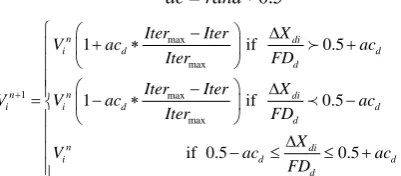
This algorithm follows the same steps as PSO but a little change at step 4. In this algorithm velocity is updated according to the formula given as
0.5
ac=rand∗ (14)
max
max
1 max
max
1 if 0.5
1 if 0.5
if 0.5 0.5
n di
i d d
d
n n di
i i d d
d
n di
i d d
d
Iter Iter X
V ac ac
Iter FD
Iter Iter X
V V ac ac
Iter FD
X
V ac ac
FD + + ∗ − ∆ + − ∆ = − ∗ − ∆ − ≤ ≤ +
Then this new velocity value put into (11) and updates the position. Finally it gives the desired filter coeffi-cients.
3.3. Particle Swarm Optimization with Variable Acceleration Factor (PSO-VAF)
A novel PSO with variable acceleration factor (PSO-VAF) has been proposed [21]. In this algorithm a modifica-tion has been made with C1 and C2, acceleration factors appears in (10). C1 has been allowed to decrease from its
initial value of C1i to C1f while C2 has been increased from C2i to C2f using the following equation
(
)
1 1 1 1
max
t f i i
Iter
C C C C
Iter
= − + (16)
(
)
2 2 2 2
max
t f i i
Iter
C C C C
Iter
= − + (17)
Then in this case velocity update formula is given by
(
)
(
)
1
1 1 2 2
n n n best best
i i t i i t i
V + =ωV +C ∗rand ∗ X −X +C ∗rand ∗ X −X
The rest of the algorithm follows the same steps as given in PSO.
4. Design Examples and Discussion
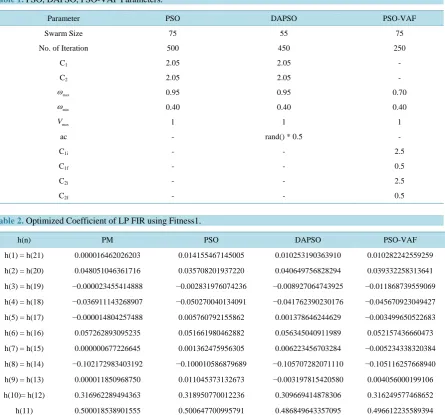
In this section, we demonstrate the use of the PSO, DAPSO and PSO-VAF to design a 20 order low pass FIR fitter. All the simulation results shown in this paper, has been made on MATLAB 7.10. The specifications of the filter to be designed using these algorithms are: δp =0.1, δ =s 0.01, ωp =0.45 and ω =s 0.55. Table 1 shows the
[image:4.595.213.414.316.404.2]parameters and its corresponding value consider during this work.
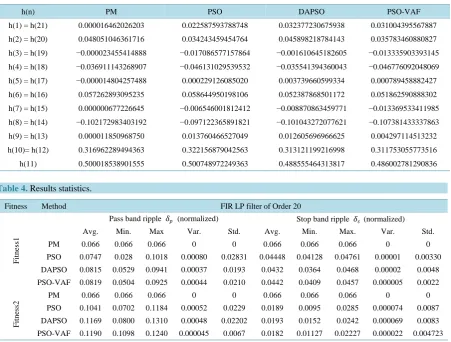
VAF in the case of fitness1. On the same plot, the same filter designed using the PM is also shown. The main purpose behind using the fitness1 is to find the possible minimum ripples in pass band and stop band in case of PSO, DAPSO and PSO-VAF.Figure 2 shows the frequency response in dB of the LP FIR filter in the case of fitness2. Fitness2 is able to control the ripples in both bands separately. Table 2 and Table 3 show the optimized coefficients of LP FIR using fitness1 and fitness2, respectively.Figure 3 shows the normalized plot of LP FIR using fitness2. Figure 4 and Figure 5 shows the normalized plot of pass band and stop band ripples, respective-ly in case of fitness2. The simulation results for fitness2 shows that PSO gives 30.90dB stop band attenuation and DAPSO gives 32.32dB stop band attenuation. PSO-VAF results in 33.07dB stop band attenuation. Hence result quality is improved as indicated inTable 4.
4.1. Convergence of PSO, DAPSO and PSO-VAF
[image:5.595.94.540.301.716.2]Figures 6-8 shows the convergence behavior of PSO, DAPSO and PSO-VAF respectively. These plots provide the error fitness value of the algorithms with number of iterations. PSO converges to the minimum error fitness value of 0.9392 in 55.39 sec. DAPSO converges to the minimum error fitness value of 1.129 in 35.92 sec. PSO- VAF converges to very low error fitness value of 0.0581 in 17.38 sec. PSO-VAF converges very fast as compare to the PSO and DAPSO in finding the desired filter coefficients.
Table 1. PSO, DAPSO, PSO-VAF Parameters.
Parameter PSO DAPSO PSO-VAF
Swarm Size 75 55 75
No. of Iteration 500 450 250
C1 2.05 2.05 -
C2 2.05 2.05 -
max
ω 0.95 0.95 0.70
min
ω 0.40 0.40 0.40
max
V 1 1 1
ac - rand() * 0.5 -
C1i - - 2.5
C1f - - 0.5
C2i - - 2.5
C2f - - 0.5
Table 2. Optimized Coefficient of LP FIR using Fitness1.
h(n) PM PSO DAPSO PSO-VAF
h(1) = h(21) 0.000016462026203 0.014155467145005 0.010253190363910 0.010282242559259
h(2) = h(20) 0.048051046361716 0.035708201937220 0.040649756828294 0.039332258313641
h(3) = h(19) −0.000023455414888 −0.002831976074236 −0.008927064743925 −0.011868739559069
h(4) = h(18) −0.036911143268907 −0.050270040134091 −0.041762390230176 −0.045670923049427
h(5) = h(17) −0.000014804257488 0.005760792155862 0.001378646244629 −0.003499650522683
h(6) = h(16) 0.057262893095235 0.051661980462882 0.056345040911989 0.052157436660473
h(7) = h(15) 0.000000677226645 0.001362475956305 0.006223456703284 −0.005234338320384
h(8) = h(14) −0.102172983403192 −0.100010586879689 −0.105707282071110 −0.105116257668940
h(9) = h(13) 0.000011850968750 0.011045373132673 −0.003197815420580 0.004056000199106
h(10)= h(12) 0.316962289494363 0.318950770012236 0.309669414878306 0.316249577468652
Figure 1. Frequency Response of LP FIR using Fitness 1.
Figure 3. Normalized Plot of LP FIR using fitness 2.
Figure 5. Normalized Stop Band ripples using fitness 2.
Figure 7. Convergence plot for DAPSO using fitness 2.
Table 3. Optimized Coefficient of LP FIR using Fitness 2.
h(n) PM PSO DAPSO PSO-VAF
h(1) = h(21) 0.000016462026203 0.022587593788748 0.032377230675938 0.031004395567887
h(2) = h(20) 0.048051046361716 0.034243459454764 0.045898218784143 0.035783460880827
h(3) = h(19) −0.000023455414888 −0.017086577157864 −0.001610645182605 −0.013335903393145
h(4) = h(18) −0.036911143268907 −0.046131029539532 −0.035541394360043 −0.046776092048069
h(5) = h(17) −0.000014804257488 0.000229126085020 0.003739660599334 0.000789458882427
h(6) = h(16) 0.057262893095235 0.058644950198106 0.052387868501172 0.051862590888302
h(7) = h(15) 0.000000677226645 −0.006546001812412 −0.008870863459771 −0.013369533411985
h(8) = h(14) −0.102172983403192 −0.097122365891821 −0.101043272077621 −0.107381433337863
h(9) = h(13) 0.000011850968750 0.013760466527049 0.012605696966625 0.004297114513232
h(10)= h(12) 0.316962289494363 0.322156879042563 0.313121199216998 0.311753055773516
h(11) 0.500018538901555 0.500748972249363 0.488555464313817 0.486002781290836
Table 4. Results statistics.
Fitness Method FIR LP filter of Order 20
Fitn
es
s1
Pass band ripple 𝛿𝛿𝑝𝑝 (normalized) Stop band ripple 𝛿𝛿𝑠𝑠 (normalized)
Avg. Min. Max Var. Std. Avg. Min. Max. Var. Std.
PM 0.066 0.066 0.066 0 0 0.066 0.066 0.066 0 0
PSO 0.0747 0.028 0.1018 0.00080 0.02831 0.04448 0.04128 0.04761 0.00001 0.00330
DAPSO 0.0815 0.0529 0.0941 0.00037 0.0193 0.0432 0.0364 0.0468 0.00002 0.0048
PSO-VAF 0.0819 0.0504 0.0925 0.00044 0.0210 0.0442 0.0409 0.0457 0.000005 0.0022
Fitn
es
s2
PM 0.066 0.066 0.066 0 0 0.066 0.066 0.066 0 0
PSO 0.1041 0.0702 0.1184 0.00052 0.0229 0.0189 0.0095 0.0285 0.000074 0.0087
DAPSO 0.1169 0.0800 0.1310 0.00048 0.02202 0.0193 0.0152 0.0242 0.000069 0.0083
PSO-VAF 0.1190 0.1098 0.1240 0.000045 0.0067 0.0182 0.01127 0.02227 0.000022 0.004723
5. Conclusion
In this paper, the application of PSO and its two new variants, DAPSO and PSO-VAF, to design linear phase low pass FIR filter, have been carried out. Comparison of results of PM, PSO, DAPSO and PSO-VAF has been made. It is analyzed that the performance of DAPSO is better than PSO in context of stop band attenuation. On the other hand, PSO-VAF provides better stop band attenuation as compared to both, PSO and DAPSO. The convergence behavior of the algorithms is also compared and it is examined that PSO-VAF quickly converge with very low error fitness value. Two fitness functions are considered. The obtained results show that fitness2 is the better choice for designing optimal digital low pass FIR filter.
References
[1] Shenoi, B.A. (2006) Introduction to Digital Signal Processing and Filter Design. John Wiley & Sons, Inc., Hoboken.
[2] Oppenheim, A.V., Schafer, R.W. and Buck, J.R. (1999) Discrete-Time Signal Processing. Prentice Hall, Englewood Cliffs.
[3] Proakis, J.G. and Manolakis, D.G. (2007) Digital Signal Processing: Principles, Algorithms, and Applications. 4th Edi-tion, Pearson EducaEdi-tion, Inc., New Delhi.
[4] Parks, T.W. and McClellan, J.H. (1972) A Program for the Design of Linear Phase Finite Impulse Response Filters.
IEEE Transactions on Audio and Electroacoustics, 20, 195-199. http://dx.doi.org/10.1109/TAU.1972.1162381
[5] Benvenuto, N., Marchesi, M. and Uncini, A. (1992) Applications of Simulated Annealing for the Design of Special Digital Filters. IEEE Transactions on Signal Processing, 40, 323-332. http://dx.doi.org/10.1109/78.124942
[7] Nurhan, K. and Cetinkaya, B. (2006) Design of Digital FIR Filters Using Differential Evolution Algorithm. Circuits,
Systems and Signal Processing, 25, 649-660. http://dx.doi.org/10.1007/s00034-005-0721-7
[8] Nurhan, K. (2009) A New Design Method Based on Artificial Bee Colony Algorithm for Digital IIR Filters. Journal of
the Franklin Institute, 346, 328-348. http://dx.doi.org/10.1016/j.jfranklin.2008.11.003
[9] Mondal, S., Ghoshal, S.P., Kar, R. and Mandal, D. (2012) Novel Particle Swarm Optimization for Low Pass FIR Filter Design.2012 IEEE Symposium on Humanities, Science and Engineering Research (SHUSER), Kuala Lumpur,24-27 June 2012, 413-418.
[10] Mukherjee, S., Kar, R., Mandal, D., Mondal, S. and Ghoshal, S.P. (2011) Linear Phase Low Pass FIR Filter Design Using Improved Particle Swarm Optimization. 2011 IEEE Student Conference on Research and Development
(SCOReD), Cyberjaya, 19-20 December 2011, 358-363.
[11] Archana, S., Mahapatra, R.K. and Panigrahi, S.P. (2011) DEPSO and PSO-QI in Digital Filter Design. Expert Systems
with Applications, 38, 10966-10973. http://dx.doi.org/10.1016/j.eswa.2011.02.140
[12] Zhao, Z.K. and Gao, H.Y. (2009) FIR Digital Filters Based on Cultural Particle Swarm Optimization. Proceedings of
2009 International Workshop on Iriformation Security and Application (IWISA 2009), Qingdao, 21-22 November 2009,
252-255.
[13] Meisam, N. and Ayatollahi, A. (2008) A Comparison between Genetic Algorithm and PSO for Linear Phase FIR Digi-tal Filter Design. 9th International Conference on Signal Processing, Beijing, 26-29 October 2008, 2134-2137.
[14] Luitel, B. and Venayagamoorthy, G.K. (2008) Particle Swarm Optimization with Quantum Infusion for the Design of Digital Filters. IEEE Swarm Intelligence Symposium, St. Louis, 21-23 September 2008, 1-8.
[15] Parks, T.W. and McClellan, J.H. (1972) Chebyshev Approximation for Non Recursive Digital Filters with Linear Phase. IEEE Transactions on CircuitsTheory, 19, 189-194. http://dx.doi.org/1109/TCT.1972.1083419
[16] Ababneh, J.I. and Bataineh, M.H. (2008) Linear Phase FIR Filter Design Using Particle Swarm Optimization and Ge-netic Algorithms. Digital Signal Processing, 18, 657-668. http://dx.doi.org/10.1016/j.dsp.2007.05.011
[17] Kennedy, J. and Eberhart, R.C. (1995) Particle Swarm Optimization. Proceedings of IEEE International Conference on
Neural Networks, Perth, 27 November 1995-1 December 1995, 1942-1948.
http://dx.doi.org/10.1109/ICNN.1995.488968
[18] Kennedy, J. and Eberhart, R.C. (2001) Swarm Intelligence. Morgan Kaufmann, San Francisco.
[19] Robinson, J. and Rahmat-Samii, Y. (2004) Particle Swarm Optimization in Electromagnetics. IEEE Transactions on
Antennas and Propagation, 52, 397-402. http://dx.doi.org/10.1109/TAP.2004.823969
[20] Liao, C.-Y., Lee, W.-P., Chen, X.H. and Chiang, C.-W. (2007) Dynamic and Adjustable Particle Swarm Optimization.
Proceedings of the 8th WSEAS International Conference on Evolutionary Computing, Vancouver, 23-25 September
2008, 301-306.
[21] Tripathi, P.K., Bandyopadhyay, S. and Kumar Pal, S. (2007) Multi Objective Particle Swarm Optimization with Time Variant Inertia and Acceleration Coefficients. Information Sciences, 177, 5033-5049.