Munich Personal RePEc Archive
A Model of Vacancy Chains as a
Mechanism for Resource Allocation
Fioretti, Guido
University of Bologna
7 March 2007
A Model of Vacancy Chains as a Mechanism
for Resource Allocation
Guido Fioretti
∗University of Bologna
March 7, 2007
Abstract
Vacancy chains can be tracked in any context where a the availability of a desirable resource triggers a cascade of occupations through which the scarce resource flows through different owners. However, under certain con-ditions vacancy chains, rather than markets or other forms of competition, determinethe allocation of the resource. This article develops a formal and computational model of vacancy chains as a mechanism for resource alloca-tion in order to find out their properties with respect to organizaalloca-tional forms. We find that hierarchies with few middle managers are particularly prone to make use of vacancy chains in order to allocate resources that originate at the top, such as employment positions. In fact, vacancy chains often dis-appear when information is widely available, because information is likely to attract applicants who engage in a competition. Thus, the many middle managers of a thick organization may compete for a resource that originates at the top. On the contrary, organizations that are thick at the bottom and at the top, but thin in the middle, are most likely to regulate resource allocation by means of vacancy chains.
1
Introduction
Allocation of scarce resources may be achieved by means of monetary compro-mises enabled by market interactions, by means of open fights, or by means of a
∗Contact address: Guido Fioretti, Department of Management Science, via Capo di Lucca 34,
combination of incomplete information and idiosyncratic needs engendered by a particular organization. Both market interactions and open combats involve competition. However, resource allocation does not require competition if only one subject is able to fulfill certain requirements with respect to the knowledge of those who assign the resource. Eventually, considerable efforts may be made in order to be considered just a unique candidate. However, no competition, in the sense in which two merchants compete on price or two warriors compete on strength, takes place.
Consider for instance internal labor markets. Most of the times, promotion of subordinates does not take place by posting available positions and hiring the one who offers the longest working hours for the lowest wage. Most of the times, managers observe subordinates long enough to know their abilities and eventually offer a position to the one they deem is most able to do a particular job. In this par-ticular example, substantial efforts may have been made by subordinates in order to be deemed the only candidate able to cover that position. However, the position was not allocated by means of an open competition between several candidates, but simply because only one person with the required qualities was around when the position became available.
Note also that in the above example a labor market does exist, in the sense that the managers and the selected subordinate exchange work for wage. However, this market did not govern the allocation of the scarce resource. The scarce resource — the position — was allocated by focusing on a sufficiently narrow information set — i.e. the employees of a particular section at a particular plant — and by requiring sufficiently idiosyncratic competences. We shall see examples where the same mechanism of resource allocation operates without any residual role for the market.
It is important to realize that the above view of the labor market is opposite to that of neoclassical economics. In fact, the latter assumes willful accumulation of human capital in order to obtain certain positions. On the contrary, the above view assumes that positions are available independently of the capabilities of ap-plicants, and that a position is only assigned if it becomes vacant [12] [14] [8]. Since a vacant position is eventually occupied by someone who makes another position available, chains of vacancies are triggered whenever an incumbent dies or retires [25] [24]. Thus, the possibilities of employment for the youngest gen-eration depend on the dynamics of previous gengen-erations, rather than on its own capabilities.
va-cancy chain may stop to operate as a mechanism for resource allocation well be-fore its end. Consider again the case of internal labor markets. A vacancy may be triggered by a retirement, which triggers a chain of vacancies through subor-dinates. At the beginning only one subordinate is available to replace the retired employee, so the vacancy chain acts as a means for allocating the resource. How-ever, by descending the hierarchy jobs may become less idiosyncratic, until two or more equally qualified persons apply for the same position. From that point on-wards, the resource is allocated by the labor market. However, the vacancy chain can still be traced through employees of decreasing status, and eventually through the external labor market as well.
Thus, the fact that a vacancy chain is identified does not imply that it is the prime mover of resource allocation. Likewise, the fact that a monetary transaction takes place does not imply that a resource is allocated by the market.
This distinction has never been explicitly stated in empirical research on va-cancy chains. However, all empirical investigations have focused on situations where vacancy chains, at least in their initial steps, did operate as allocation mech-anisms. A closer examination of the empirical literature will shed light on this issue:
• A housing market does exist, but houses and apartments of good quality are very different from one another, so their value depends so much on personal taste. Thus, prospective renters or owners do not base their decisions merely on price. Rather, they generally wait until a house or apartment that satisfies their aspirations becomes avalaible before leaving the one they are occupy-ing. Also in this case, a scarce resource is allocated by means of vacancy chains. On the contrary, low-quality apartments are likely to be allocated by the market on the basis of price. The vacancy chain model has been success-fully applied to the housing market [10] [7], though no effort has been made to ascertain at what point the vacancy chains cease to operate as allocation mechanism. However, it is interesting to remark that an economic model of chains in the housing market had to assume idiosyncratic and discontinuous preferences in order to reproduce empirical data [17]. Alternatively, one could have assumed that information was so scarce that only one prospec-tive buyer was available for each item in the higher segment of the market; consequently, the vacancy chains would allocate the resources, rather than the preferences of buyers.
• Hermit crabs use abandoned gastropod shells as shelters, which they carry with them once they entered one. Crabs of increasing age need shells of increasing size. Thus, an empty shell released in the environment triggers a chain of vacancies of smaller shells. Experiments have been made where one shell at a time was released in a pond where the density of crabs was sufficiently low for there being only one crab in the proximity of a shell [5] [4]. Thus, in this case the vacancy chain acts as a mechanism for resource allocation. Note also that in this experiment no competition takes place, not even for the selection of the prospective occupier. However, if two or more hermit crabs are in the proximity of an empty shell which both of them like, they fight for it [4]. In this case, albeit a vacancy chain can still be traced, it does not operate as allocation mechanism. The combat does.
ensure that only one candidate is ready to occupy a vacancy. If this is not the case, some form of competition is in order to resolve the question, be it market competition or physical fight. In the case of robots, impairing competition was simpler than endowing them with a criterium to establish a winner.
Both empirical experiences and theoretical considerations have suggested con-ditions for the existence of vacancy chains. According to Chase, vacancy chains require that i) The resource units are reusable, discrete, identifiable and utilized by one individual or social group at a time;ii)A unit must be vacant before it can be taken by a new occupant; iii) Individuals must need or want new and usually “bigger” or “better” units;iv)Vacant units must be scarce;v)Most individuals in a group already must have units so they can leave one behind when they move to a new one [3]. According to Sørensen, vacancy chains require that a) The pre-determined and well specified nature of positions; b) The indefinite duration of matches between people and positions;c)Allocations that represent the outcomes of authority decisions rather than market exchanges [13].
While not contradictory to one another, only the condition(c)among the eight listed above cares that vacancy chains allocate resources rather than just tracking the allocation of resources made by the market. The formulation adopted in this paper is more general, for it does not require that allocations “represent the out-comes of authority decisions” but simply that only one candidate is there for a certain role, as it happened in the experiments with hermit crabs. Furthermore, the alternatives to vacancy chains considered in this paper include all means of allocating scarce resources based on competition, including the market but not limiting to it.
Once it is recognized that vacancy chains may act as a means for the allocation of scarce resources if information is sufficiently restrained, one may ask which organizational structures, whose members are characterized by different informa-tion sets, are most conducive of vacancy chains. Secinforma-tion 2 illustrates a model of vacancy chains in organizational structures. Section 3 explores its properties and identifies one particular structure where vacancy chains are particularly likely to be used as a resource allocation mechanism. Finally, section 4 concludes.
2
Vacancy Chains in Organizational Structures
vacancy chains in organizational structures.
Let us consider a set of positions arranged in strata, which may represent hierarchical levels in an organization, or degrees of quality of houses, or size of shells, or path lengths in a routing problem, or else. Strata are ordered by decreasing importance, top to bottom of a hierarchy. It is a partial ordering, i.e. two or more agents may belong to the same stratum.
Let pi j denote the probability that a vacancy in stratumimoves to stratum j, withi,j=0,1,2, . . .swheresis the number of strata over the zero level. In par-ticular, since stratum 0 represents the outer world, the probability that a vacancy moves from stratumito the outside is pi0.
Let us arrange probabilities pi j in a(s+1)×(s+1)matrixP. Let us assume that hierarchical ladders are climbed one step at a time, which implies that va-cancies can only move one stratum lower at each step. Thus,Phas the following form: P=
1 0 · · · 0
p10 p11 0 · · · 0
0 p21 p22 0 · · · 0
..
. ...
0 · · · 0 ps(s
−1) pss
where the (0,0)element is 1 because vacancies cannot move once they reached stratum 0.
Probabilitiespi j are such that∑jpi j=1. Since∀ithe only non-zero elements are pi(i
−1)andpii, and sincepii=1−pi(i−1), probabilities pi(i−1)are sufficient to
determineP.
By means of this matrix we want to investigate the length of vacancy chains from their origin to the point where they cease to operate as a mechanism for resource allocation, depending on starting stratum and organizational structure. The length of our vacancy chains depends on:
• The origin of a vacancy chain. The higher the stratum where a vacancy first occurs, the longer the ensuing chain can be (though the length of vacancy chains depends on many factors). Let us denote byo, the origin of a vacancy chain, witho∈N , 1≤o≤s.
only one actor in the neighborhood qualifies for the vacant position, this is assigned to the only applicant. It is in this case that we say that the vacancy chain operates as a mechanism for resource allocation. Letndenote the size of the neighborhood, withn∈N .
• The number of strata, or hierarchical levels. Vacancy chains apply to any organization whose positions are stratified; eventually, strata may represent hierarchical levels if relations of subordination exist. Since we are only interested in vacancy chains as long as they operate as devices to allocate scarce resources, and since this can only happen if an organizational struc-ture limits the diffusion of information (see above), we consider that va-cancy chains do not propagate outside the organization. We have denoted the number of strata by s, withs∈N . The outer world is represented by s=0.
• The distribution of positions on strata. If we are considering hierarchies, the distribution of positions on strata tells the fraction of middle managers, workers and top managers. In more general terms, a non-uniform distribu-tion of posidistribu-tions on strata characterizes non-homogeneous structures. Let us denote the distribution of positions by f(k), withk=0,1,2, . . .s.
Let us first consider the case of a uniform distribution of strata. The number of ways of arranging any number of (s+1)different strata in npositions is the number of dispositions with repetition ofs+1 elements of classn, which is equal to(s+1)n. This will be the denominator of the fraction that yields the pi(i−1)s.
The number of dispositions where a particular position is on a particular stra-tum, all others being on any different strastra-tum, issn−1. The number of dispositions
where any position is on a particular stratum, all others being on any different stratum, is n sn−1. Thus, the probability of finding exactly one position on the
required stratum in a neighborhood of sizenis:
pi(i−1)=
n sn−1
(s+1)n ∀i (1)
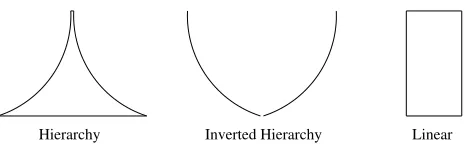
Hierarchy Inverted Hierarchy Linear
Figure 1: Left to right, the structures obtained with a hierarchical, inverted hierar-chical and linear distribution of positions, respectively.
i-th one. On the denominator, this integral extends over alls+1 strata. Further-more, then at the numerator should be corrected by f(i−1). In conclusion, we obtain:
pi(i−1)=
n f(i−1) [∑i−1
k=0 f(k) +∑
s
k=i+1f(k)]n− 1
[∑sk=0f(k)]n
∀i (2)
which reduces to eq. 1 if f(k) =1,∀k.
Let us consider the matrixPs. Its(i,j)-th element is the sum of the probabili-ties of all chains that start at stratumo=iand end at stratum jinsmoves.
MatrixPs can be used to derive statistics about the length of vacancy chains. For instance, ∀i>0 the sum of the elements ofPs for j<irepresents the prob-ability that a chain starting at stratum ihas a length greater than one. This is the main indicator that will be observed in § 3.
3
Experimental Results
Let us investigate the properties of vacancy chains depending on their origin, the size of the neighborhood where they are known, the number of strata, and the distribution of positions on strata. Organizational structure, specified by the dis-tribution of positions on strata, is our main concern. Figure 1 illustrates three basic organizational structures: hierarchical, inverted hierarchical, and linear.
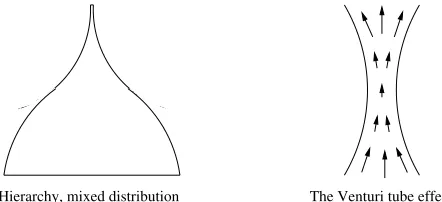
Hierarchy, mixed distribution The Venturi tube effect ✁ ✂✁✂ ✄✁✄ ✄✁✄☎ ☎ ✆✝✞ ✞✟ ✠✁✠✡ ☛✁☛☞ ✌✁✌ ✍✁✍ ✎✁✎✏ ✑✁✑ ✑✁✑ ✑✁✑ ✒✁✒ ✒✁✒ ✒✁✒ ✓✔ ✕✁✕✁✕ ✕✁✕✁✕ ✖✁✖✁✖ ✖✁✖✁✖
Figure 2: Left, the structures obtained with a mixed distribution of positions. Right, the corresponding ratio of the number of positions in neighboring strata and the ensuing Venturi tube effect.
Let us first explore hierarchical organizations (the leftmost part of figure 1) with different number of strata, where vacancy chains originate at different levels and are influenced by neighborhoods of different size. All results stem from the numerical model illustrated in appendix A.
Figure 3 illustrates the distribution of chain length in a hierarchical organiza-tion with 5 strata, where vacancies originate at stratum 5 (the highest stratum), for various sizes of the neighborhood. It is clear that larger neighborhoods pro-duce longer vacancy chains, evidently because it is easier to find an agent who is occupying a position exactly one stratum lower than the one where a vacancy occurred.
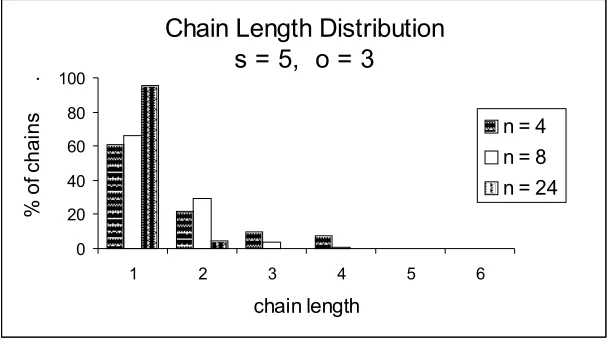
Figure 4 illustrates the distribution of chain length in a hierarchical organi-zation with 5 strata, where vacancies originate at stratum 3, for various neigh-borhood sizes. Here the picture is opposite to that of figure 3. In fact, larger neighborhoods produce shorter chains. Evidently, at low hierarchical levels the positions are so many that by increasing the neighborhood more than one agent able to fill the vacancy and the chain stops.
The difference between figures 3 and 4 is interesting because it suggests that for certain organizations and when vacancy chains originate at particular levels, more information (a larger neighborhood) does not create markets or other forms of competition. Rather, more information fosters resource allocation by means of vacancy chains. However, for other organizations and starting strata it is just the opposite. Thus, it is interesting to analyze which parameters originate dis-tributions like in figure 3 as opposed to those that originate disdis-tributions like in figure 4.
Chain Length Distribution
s = 5, o = 5
0 20 40 60 80 100
1 2 3 4 5 6
chain length
%
o
f
c
h
a
in
s
.
[image:11.595.151.459.154.323.2]n = 4 n = 8 n = 24
Figure 3: Chain length distributions in a hierarchical organization with s =5, o=5 andn=4,8,24. All values have been averaged over 1,000 runs.
Chain Length Distribution
s = 5, o = 3
0 20 40 60 80 100
1 2 3 4 5 6
chain length
%
o
f
c
h
a
in
s
.
n = 4 n = 8 n = 24
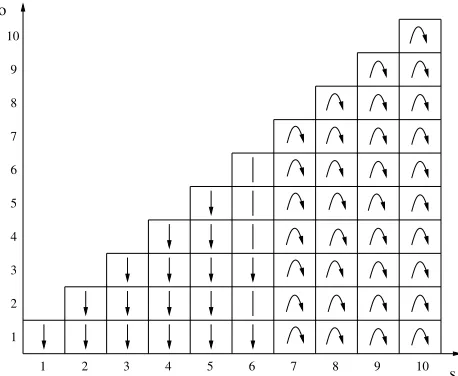
[image:11.595.153.459.433.604.2]combinations of the number of strata and the origin of vacancy chains. Vacancy chains of length one are isolated vacancies. Thus, the proportion of vacancy chains of length greater than one over total vacancy chains denotes the proportion of vacancies that actually originate a chain before competitive allocation intervenes. This will be calledthe proportion of vacancy chainshenceforth.
Parameter combinations such that the proportion of vacancy chains increases with neighborhood size (like in figure 3) have been denoted by an upward arrow. Parameters combinations such that the proportion of vacancy chains decreases with neighborhood size (like in figure 4) have been denoted by a downward arrow. Finally, curve arrows denote combinations of parameters where the proportion of chains increases when the size of the neighborhood passes from 4 to 8 but decreases when the size of the neighborhood passes from 8 to 24.
Figure 5 highlights that there exists a region where vacancy chains are facili-tated by more information (larger neighborhood), separated from a region where vacancy chains are impaired by more information (larger neighborhood). The area between these two regions is rather thin, and almost horizontal. Thus, the effect of information on the proportion of vacancy chains does not depend on the num-ber of strata. On the contrary, the origin of the vacancy chain is crucial. Only vacancy chains originating sufficiently high in the hierarchy are favored by more information.
Let us consider inverted hierarchies, i.e. organizations where there are far more high-ranked positions than low-ranked ones. This is the case illustrated in the center of figure 1. All else remains as above.
Figure 6 shows quite a different pattern from figure 5. Contrary to the previous case, vacancy chains are impaired by more information if they originate close to the top of the inverted hierarchy, whereas they are favored by more information if they are sufficiently far from it. Furthermore, note that the separating region is not horizontal. Thus, the effect of information on the proportion of vacancy chains depends onboththe number of strata and the stratum where the chain originates.
Let us consider the intermediate organizational structure considered in this model, the linear organization. This is the case illustrated on the right of figure 1. All else remains as above. Figure 7 illustrates the corresponding table.
This intermediate organizational form does not exhibit intermediate properties between the hierarchy and the inverted hierarchy. Since it has the same number of positions in any stratum, the stratum where vacancies originate does not affect the outcome.
4 8
1 2 3 5 6 7 9 10 1
5
4
3
2 6 7 8 9 10
o
[image:13.595.190.418.220.406.2]s
4 8
1 2 3 5 6 7 9 10 1
5
4
3
2 6 7 8 9 10
o
[image:14.595.190.419.137.325.2]s
Figure 6: Inverted hierarchy, variation of the proportion of vacancy chains with increasing neighborhood size (s: number of strata; o: stratum where vacancy chains originate). All else as in figure 5.
4 8
1 2 3 5 6 7 9 10 1
5
4
3
2 6 7 8 9 10
o
s
[image:14.595.190.419.415.603.2]4 8
1 2 3 5 6 7 9 10 1
5
4
3
2 6 7 8 9 10
o
[image:15.595.190.419.126.313.2]s
Figure 8: Organizations giving rise to a Venturi tube in upward mobility, variation of the proportion of vacancy chains with increasing neighborhood size (s: number of strata; o: stratum where vacancy chains originate). Since this organization requires at least four hierarchical levels in order to be implemented, the first three columns are blank. All else as in figures 5, 6 and 7.
a very different number of positions (at the top of a hierarchy, at the bottom of an inverted hierarchy). In the linear organization, any two strata have the same number of positions. Thus, larger neighborhoods — i.e. more information — never has a positive impact on the proportion of vacancy chains. The impact is generally negative or, if there are sufficiently many strata first positive and then negative. These are the curve arrows on the right of figure 7.
Finally, let us consider organizations with less middle managers than purely pyramidal organizations (see figure 2). Figure 8 shows that this organizational form is such that in any case a small increase of information always favors the allocation of resources by means of vacancy chains (curve arrows). Furthermore, most of the times even a large increase of information favors the allocation of resources by means of vacancy chains (upward arrows). Thus, organizations with shapes as in figure 2 are likely to make a frequent use of vacancy chains in order to allocate resources.
va-cancies become shorter and by increasing it further they become longer. It is so because larger neighborhoods may allow longer chains to the extent that they pro-vide more actors able to fill a vacancy, and this effect is most prominent when the neighborhood is still small and does not include one instance of each stra-tum. Conversely, larger neighborhoods may force chains to be short to the extent that they include several instances in the same stratum, and this effect becomes prominent when the neighborhood becomes very large.
4
Conclusions
The numerical results of this paper highlighted that organizations have a large influence on the ability of vacancy chains to act as a device for allocating scarce resources. In particular, hierarchical organizational forms with fewer middle man-agers than straight pyramids are most likely to be regulated by vacancy chains. Considering that since decades most organizations tend to reduce the size of mid-dle management, this finding makes vacancy chains a very relevant issue.
Also, compare this result with the conclusions of neoclassical economic the-ory and its variations. According to this thethe-ory, the more information is available, the better the markets work. Eventually, markets fail because information is asym-metric or incomplete. According to the economics of information, if information asymmetries would be removed from the labor market, from the loan market or from the “market for lemons”, then prices would suffice to allocate resources op-timally.
Economic theory reaches this result because it is based on structureless mar-kets. On the contrary, we have found that within certain organizational forms more information cause the market to be superseded by vacancy chains. Since these organizational forms are quite common, the finding that information may limit the power of markets should not be taken as acuriosum.
A
The Computational Model
A computational model is built on theNetLogoplatform.1 Its purpose is to inves-tigate the properties of the equations expounded in § 2.
The world is a torus, depicted as a square. On the square, a grid identifies positions. Trials have shown that the number of positions (the size of the square) does not influence the results.
Each position on the square belongs to a stratum. Strata are ordered by de-creasing importance, e.g., high to low positions in a hierarchy, shells or apart-ments of decreasing size, or else. White positions rank highest, followed by grays of increasing darkness.
It is a partial ordering, i.e., two or more agents may belong to the same stratum. Strata may represent hierarchical levels in an organization, or degrees of quality of houses, or size of shells, or path lengths in a routing problem, or else.
The model is initialized by producing vacancies at all positions belonging to a particular stratum. Subsequently, vacancies propagate to the lower strata. Trials have shown that if vacancies produce only on a portion of the positions belonging to a particular stratum, results do not change.
At each step, an actor is eligible for a vacancy if it is close enough to it and if it belongs to a stratum that is just one grade lower. If there is only one such actor, occupation of the vacancy is made by private agreement so the vacancy chain acts as an allocation mechanism. The actor moves up, a new vacancy is produced and the chain proceeds. If, on the contrary, several actors are able to fill the vacancy, the resource must be allocated competitively. At this point, chains are truncated.
The number of strata can be selected by means of the slider n-of-strata, which takes values between 1 and 10. If the number of strata is 1, then vacancy chains take place in an organization that is perfectly flat. Thus, the model area will entail positions of only two colors: white positions inside the organization, and black positions outside the organization. If the number of hierarchical levels is 2, the model area will entail positions of three colors: white positions for the managers, grey positions for their subordinates, and black positions outside the organization. And so on, obviously.
The distribution of positions on strata can be assigned as follows (see § B):
of the hierarchy. This representation is consistent with classical accounts of the span of control [6] as well as with mathematical applications of vacancy chains to organizations [12].
2. A decreasing exponential distribution from high to low strata, if the pa-rameterstrata-distribution is set to 2. The functional form is f(k) = e−α(s−k), α∈R , where s∈N is the number of strata andk=0,1,2. . .s.
This distribution corresponds to an inverted hierarchy with many more man-agers than subordinates. It is a clearly irrealistic organizational form, that has been considered in order to evaluate the effect of an assumptions that is opposite to the usual one.
3. A uniform distribution, if the parameterstrata-distributionis set to 3. The functional form is simply f(k) =1 fork=0,1,2. . .s. This distribution corresponds to an organization where there are just as many managers as subordinates. The corresponding linear organization chart is not necessarily a set of independent sequences of units, for the lines of command may still cross one another. This organizational form is just as irrealistic as No. 2, but also a midpoint between No. 1 and 2. It has been included in order to evaluate the linearity of the properties of vacancy chains with respect to organizational form.
4. Half the positions assigned to strata according to a decreasing exponential distribution from low to high strata as in the above point (1), half the po-sitions assigned to strata according to a poisson distribution from high to low strata, if the parameterstrata-distribution is set to 4. In this sec-ond case the functional form is f(k) =e−αα(s−k)/(s−k)!,α∈R , where
s∈N is the number of strata and k=0,1,2. . .s. This mixed distribution generates a hierarchy with proportionately less middle managers than a sim-ple pyramid. This structure is such that upward movement is more difficult for middle managers than for both top managers and low-level employees, the so-called “Venturi tube” effect [23] [22].
Positions are placed in a space of acquaintances. This means that a vacancy in a certain position is known to its neighbors but not to other agents in the orga-nization. The button “neighborhood” can be either set to 4, 8 or 24 depending on the number of neighbors each agent is supposed to be acquainted with. Vacancies propagate if in the neighborhood of a vacancy on stratum ithere is one and only one position at stratumi−1.
In order to run the model, the following buttons should be pressed:
1. TheSetup Positionsbutton assigns each position on the model area to a stratum, which is denoted by a shade of grey;
2. TheSetup Vacancies button creates vacancies at all positions belonging to the “starting stratum”, which become green;
3. The Go button makes the vacancies diffuse down the hierarchy, creating yellow stripes.
B
The Organizational Structures
The hierarchical organization has been modeled by means of a truncated expo-nential distribution decreasing from low to high strata. Note that NetLogodoes not require to set the exponent but the mean:
set elevation n-of-strata + 1
while [elevation > n-of-strata]
[set elevation round random-exponential (1 + n-of-strata)/4]
The inverse hierarchical organization has been modeled by means of a trun-cated exponential distribution decreasing from high to low strata:
set elevation -1
while [elevation < 0]
[set elevation n-of-strata - round random-exponential (1 + n-of-strata)/4]
set elevation random (1 + n-of-strata)
Finally, the organization with few middle strata has been obtained by combin-ing an exponential distribution decreascombin-ing from low to high strata with a poisson distribution from high to low strata:
ifelse (random 2 = 0)
[
set elevation n-of-strata + 1
while [elevation > n-of-strata]
[set elevation round random-exponential (1 + n-of-strata) / 4]
]
[
set elevation -1
while [elevation < 0]
set elevation n-of-strata - round random-poisson (1 + n-of-strata) / 4]
]
References
[1] Andrew Abbott. Vacancy models for historical data. In Ronald L. Breiger, editor,Social Mobility and Social Structure, chapter IV, pages 81–102. Cam-bridge University Press, CamCam-bridge, 1990.
[2] Yosef Blum, Alvin E. Roth, and Uriel G. Rothblum. Vacancy chains and equilibration in senior-level labor markets. Journal of Economic Theory, 76(2):362–411, 1997.
[3] Ivan D. Chase. Vacancy chains. Annual Review of Sociology, 17:133–154, 1991.
[5] Ivan D. Chase and Theodore H. De Witt. Vacancy chains: A process of mobility to new resources in humans and other animals. Social Science In-formation, 27(1):83–98, 1988.
[6] David D. Van Fleet and Arthur G. Bedeian. A history of the span of man-agement. Academy of Management Review, 2:356–372, 1977.
[7] Ray Forrest and Alan Murie. The dynamics of the owner-occupied housing market in southern england in the late 1980s: A study of new building and vacancy chains. Regional Studies, 28(3):275–289, 1994.
[8] Peter Hedstr ˝om. Organizational vacancy chains and the attainment process. Journal of Mathematical Sociology, 17(1):63–76, 1992.
[9] Suresh L. Konda and Shelby Stewman. An opportunity labor demand model and markovian labor supply models: Comparative tests in an organization. American Sociological Review, 45(2):276–301, 1980.
[10] Sam Marullo. Housing opportunities and vacancy chains. Urban Affairs Quarterly, 20(3):364–388, 1985.
[11] Lawrence T. Pinfield. The Operation of Internal Labor Markets. Plenum Press, New York, 1995.
[12] Aage B. Sørensen. The structure of inequality and the process of attainment. American Sociological Review, 42(6):965–978, 1977.
[13] Aage B. Sørensen. Processes of allocation to open and closed positions in social structure. Zeitschrift f ˝ur Soziologie, 12(3):203–224, 1983.
[14] Aage B. Sørensen and Nancy Brandon Tuma. Labor market structures and job mobility. In Donald J. Treiman and Robert V. Robinson, editors, Re-search in Social Stratification and Mobility, volume 1, pages 67–94. JAI Press, Greenwich (CT), 1981.
[16] Torbjørn S. Dahl, Maja J. Matari´c, and Gaurav S. Sukhatme. Distributed multi-robot task allocation through vacancy chains. Autonomous Robots, 2005. submitted.
[17] Leslie Rosenthal. Chain-formation in the owner-occupied housing market. The Economic Journal, 107(441):475–488, 1997.
[18] D. Randall Smith. Mobility in professional occupational-internal labor mar-kets: Stratification, segmentation and vacancy chains. American Sociologi-cal Review, 48(3):289–305, 1983.
[19] D. Randall Smith and Andrew Abbott. A labor market perspective on the mobility of college football coaches. Social Forces, 61(4):1147–1167, 1983.
[20] Shelby Stewman. An application of job vacancy chain model to a civil ser-vice internal labor market. Journal of Mathematical Sociology, 4(1):37–59, 1975.
[21] Shelby Stewman. Two markov models of open system occupational mobil-ity: Underlying conceptualizations and empirical tests. American Sociolog-ical Review, 40(3):298–321, 1975.
[22] Shelby Stewman. Demographic models of internal labor markets. Adminis-trative Science Quarterly, 31(2):212–247, 1986.
[23] Shelby Stewman and Suresh L. Konda. Careers and organizational labor markets: Demographic models of organizational behavior. The American Journal of Sociology, 88(4):637–685, 1983.
[24] Harrison C. White. Chains of Opportunity. Harvard University Press, Cam-bridge (MA), 1970.