Effects of rolling parameters on the shape of cold rolled
strip.
BENSTEAD, Philip James.
Available from Sheffield Hallam University Research Archive (SHURA) at:
http://shura.shu.ac.uk/19347/
This document is the author deposited version. You are advised to consult the publisher's version if you wish to cite from it.
Published version
BENSTEAD, Philip James. (1993). Effects of rolling parameters on the shape of cold rolled strip. Masters, Sheffield Hallam University (United Kingdom)..
Copyright and re-use policy
See http://shura.shu.ac.uk/information.html
Sheffield Hallam University
ProQuest Number: 10694228
All rights reserved
INFORMATION TO ALL USERS
The quality of this reproduction is dependent upon the quality of the copy submitted.
In the unlikely event that the author did not send a com plete manuscript and there are missing pages, these will be noted. Also, if material had to be removed,
a note will indicate the deletion.
u
est
ProQuest 10694228
Published by ProQuest LLC(2017). Copyright of the Dissertation is held by the Author.
All rights reserved.
This work is protected against unauthorized copying under Title 17, United States C ode Microform Edition © ProQuest LLC.
ProQuest LLC.
789 East Eisenhower Parkway P.O. Box 1346
E
ffects of Rolling Parameters on the
Shape of Cold Rolled Strip.
Philip James Benstead
A thesis submitted in partial fulfilment of the
requirements of the Sheffield Hallam University
for the degree of Master of Philosophy.
February 1993
COLLABORATING ORGANISATION
LEE STEEL STRIP LTD.,
MEADOWHALL,
SHEFFIELD.
PREFACE
The work described in this thesis was carried out as part of a "Teaching Company
Scheme" programme. The programme was joint funded by SERC/DTI and Lee Steel
Strip Ltd. of Sheffield.
Sheffield City Polytechnic and Lee Steel Strip Ltd. were jointly involved in the work
which was carried out between the October 1989 and October 1991.
Dr. R. P. Stratton of Sheffield Hallam University was the academic supervisor and Dr.
R. A. Hooper the industrial supervisor, for the teaching company programme.
Mr. A. G. Evans of Sheffield Hallam University and Mr K. Meadows of Lee Steel Strip
also assisted with supervision.
Supporting Studies continued during the work, these included personal tuition in the use
of "Taguchi" statistical experimental design techniques by Mr J. Callender of Sheffield
City Polytechnic, and attendance at the conferences:
"Rolling" hosted by The Institute of Metals at Imperial College, London. 1990 and
"Mathematical Modelling of Rolls", hosted by the Institute of Metals, London 1991.
DECLARATION
During the period of registration for the CNAA degree of MPhil. the candidate has not
been registered for any other CNAA award of for a university degree.
The results and theories presented in this thesis are original except where reference is
made to previous work.
Signed: Date:
ACKNOWLEDGEMENTS
The author would like to thank the sponsoring establishment Sheffield City Polytechnic,
and particularly Dr. R.P. Stratton for his advice, encouragements, and diligence with the
paperwork necessary for this work.
I would also like to thank Mr. A.G. Evans, Mr. J. Callender and Dr. T.P. Campbell of
Sheffield City Polytechnic for their special advice and availability. Thanks to the School
of Engineering staff, many of who gave freely of time and advice, especially Mr. B.E.
Dodds.
Thanks are also due to the sponsoring establishment Lee Steel Strip Ltd., for all their
resources, individual help, and allowing disruption to day to day production. Particular
thanks to Dr. R. Hooper for his time in organising the programme and his personal
interest.
We aknowledge Fulmer Materials Technology, formerly BNF(metals) (British
Non-Ferrous Metals) for advice, and help with measuring equipment for measuring strip
shape.
Special thanks to my wife Diane who was supportive and patient during our first year of
marriage.
EFFECTS OF ROLLING PARAMETERS ON THE FLATNESS
AND SHAPE OF COLD ROLLED STRIP.
ABSTRACT
Various experimental methods have been used to show the effect of different Sendzimir
mill rolling parameters on stainless steel strip shape. Experiments using sister coils,
noting the effects of change over a number of coils, and using the "Taguchi" statistical
experimental design techniques have been carried out. Work has been carried out on
individual rolling presses and on complete rolling sequences.
Strain measurements have been used to show the behaviour of a statically loaded work
roll, and the vertical and horizontal bending of a roll were investigated. From this work
the effects of the axially adjustable first intermediate rolls on the strip shape have been
further investigated.
The parameters that affect strip shape have been identified and stated in order of the
magnitude of their effect. The adjustments that are needed to improve specific strip shape
defects have been identified. It has been established where rolling parameter alterations
have an interacting effect with other rolling parameters. Recommendations have been
made that will improve the rolling process to enable a more consistent and better product,
over a limited material range, to be rolled.
Consideration has been given to new roll shapes and roll bending has been related to
specific strip shape. Recommendations have been made to improve the rolling process so
as to attain flatter strip.
CONTENTS PAGE
1.0 Introduction 11
2.0 Literature survey 14
2.1 Strip shape measurement 14
2.2 Modelling of Sendzimir Mills for strip shape control 19
2.3 Rolling parameter effects on strip shape 21
2.4 Experimental design using Taguchi Experimental Design Techniques 30
2.5 Work roll strain 31
3.0 Application of Taguchi techniques to design of experiments 33
4.0 Applications of statistical experimental design techniques to a single
part of a rolling sequence 34
4.1 Introduction 34
4.2 Planning and design 35
4.3 Critique of the experiments 36
4.4 Results 37
4.5 Analysis 39
4.5.1 Edge wave 39
4.5.2 Full centre 40
4.5.3 Ripple (Herringbone) 41
4.5.4 Quarter buckle 42
4.5.5 Visual representation 43
4.5.6 Profile differences 45
5.0 Investigation into the effects of different work roll parameters on strip
5.2 Design of experiments 47
5.3 Results 48
5.4 Analysis 48
5.4.1 Edge wave (loose edge) 48
5.4.2 Full centre 49
5.4.3 Visual scaling 49
5.4.4 Profile difference 50
5.5 Discussion 50
6.0 Investigation into the effect of saddle (mill load pattern)
adjustments of strip shape 51
6.1 Introduction 51
6.2 Design of experiment 53
6.2.1 Altering saddles over short test runs 53
6.2.2 Setting the saddle configuration over
a complete rolling press 53
6.2.3 Altering saddles through a complete
rolling sequence 54
6.3 Results 55
6.3.1 Altering saddles over short test runs 55
6.3.2 Altering the saddle configuration over
a complete rolling pass 55
6.3.3 Altering saddles through a complete
rolling sequence 56
7.0 Effects of rolling parameters on strip shape through a
rolling sequence 57
7.1 Introduction 57
7.2 Experimental technique 58
7.3 Results 59
7.4 Critique of the experiment 61
7.5 Analysis 62
8.0 Work roll strain 73
8.1 Introduction 73
8.2 Experimental technique 75
8.3 Mill parameter effects investigated 77
8.4 Results 79
8.4.1 Typical strain result plots 79
8.4.2 Individual effects of mill parameters 80
8.5 Interpretation of the results 84
8.6 Analysis by parameter and shape 88
9.0 Investigation into the effects of first intermediate roll
position and load on work roll bending 92
9.1 Introduction and experimental procedure 92
9.2 Results 93
9.3 Analysis 94
10.0 Individual tests on the effects of rolling parameters on
strip shape 96
10.1 Introduction 96
10.2 Methods of investigation 97
10.3 Results 98
10.3.2 Work rolls 104
10.3.3 Saddle adjustments 106
10.3.4 Offset casters 107
10.3.5 Speed 108
10.3.6 Tensions 108
10.4 Analysis 110
10.4.1 Strip shape produced by first intermediate
roll profile 110
10.4.2 Strip shape produced by complex first
intermediate roll profile 111
10.4.3 Strip shape produced by bored work rolls 111
10.4.4 Strip shape produced by saddle adjustments 112
10.4.5 Strip shape produced by offset casters 112
10.4.6 Strip shape produced by speed 112
10.4.7 Strip shape produced by tensions 112
11.0 Discussion 113
11.1 Major strip shape affecting variables 114
11.2 Detail of the effects of work roll parameters on
strip shape 116
11.3 Saddle adjustment effects 117
11.4 Effects of rolling parameter through a sequence 119
11.5 Work roll strain 120
12.0 Conclusions 125
13.0 Suggestions for further work 128
Table 1. Parameter Description. Table 2. L16 Orthogonal Array.
Table 3. Relative Effects of Rolling Parameters on Strip Shape According to Visual Appearance.
Table 4a. Relative Effects of Rolling Parameters on Strip Shape According to Fullness Results.
Table 4b. Relative Effects of Rolling Parameters on Strip Shape According to Quarter Buckle Results.
Table 4c. Relative Effects of Rolling Parameters on Strip Shape According to Ripple (herring-bone) Results.
Table 4d. Relative Effects of Rolling Parameters on Strip Shape According to Edge Wave Results.
Table 5. Relative Effects of Rolling Parameters on Strip Shape According to Profile Difference
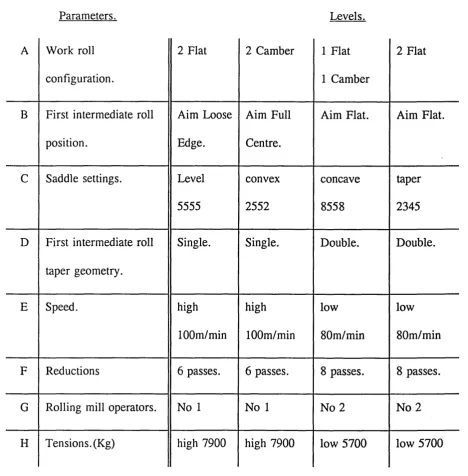
Table 6. Work Roll Parameters Tested and there Settings. Table 7. Parameters Tested for Assessing the Effects of Saddle
Adjustments on Strip Shape.
Table 8. Parameters Tested and Levels for Assessing the Effects of Rolling Parameters Throughout a Rolling Sequence.
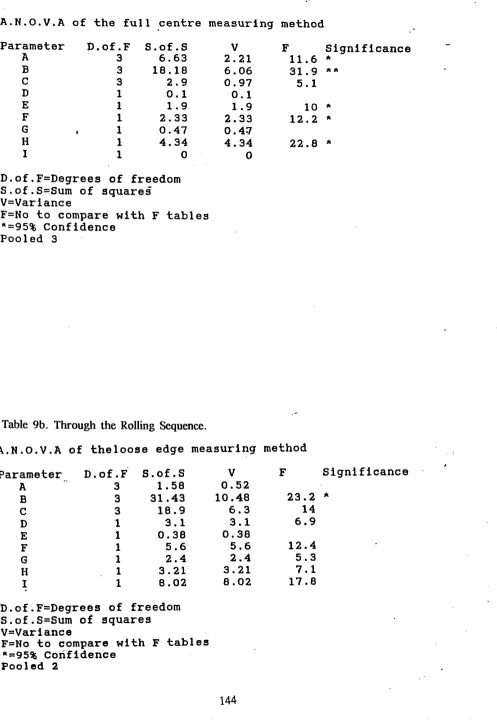
Table 9a. Through the Rolling Sequence A.N.O.V.A. of the Full Centre Measuring Method.
Table 9b. Through the Rolling Sequence A.N.O.V.A. of the Loose Edge Measuring Method.
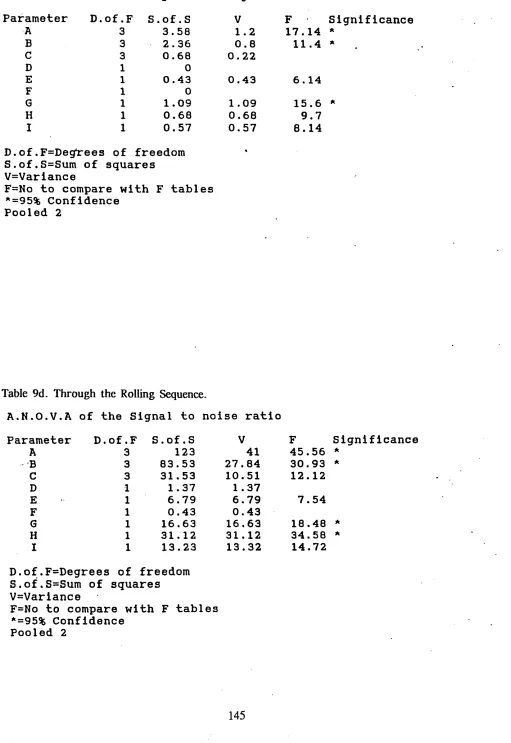
Table 9d. Through the Rolling Sequence A.N.O.V.A. of the Signal to Noise Ratio.
Table 10. Parameter Settings to Reduce Strip Shape Defects and Process Variability.
Figure la-d Typical Strip Shape Defects Produced by Differential Reductions with their Associated Stress Patterns.
Figure 2a-i
Figure 3
Figure 4
Figure 5
Figure 6
Figure 7
Typical Strip Shape Defects Produced by Through the Thickness Stress Differentials.
Sendzimir Mill Roll Cluster.
Experiment Plan Flow Chart.
Mean Response Plots and Results for the Edge Wave Strip Shape Defect, from A Single Part of A Rolling Sequence.
Mean Response Plots and Results for the Full Centre Strip Shape Defect, from A Single Part of A Rolling Sequence.
Figure 8 Mean Response Plots and Results for the Quarter Buckle Strip Shape Defect, from A Single Part of A Rolling Sequence.
Figure 9
Figure 10
Figure 11
Figure 12
Figure 13
Mean Response Plots and Results for the Visual Appearance Method of Recording Strip Shape Defects, from A Single Part of A Rolling Sequence.
Mean Response Plots and Results for the Profile Difference Method of Recording Strip Shape
Defects, from A Single Part of A Rolling Sequence.
Mean Response Plots and Results for the Edge Wave Strip Shape Defect, Measuring the Effects of Work Roll Parameters on Strip Shape.
Mean Response Plots and Results for the Full Centre Strip Shape Defect, Measuring the Effects of Work Roll Parameters on Strip Shape.
Figure 14
Figure 15
Figure 16
Figure 17
Figure 18
Figure 19
Mean Response Plots and Results for the Profile Difference Method of Recording Strip Shape Defects, Measuring the Effects of Work Roll Parameters on Strip Shape.
Technique Used for Measuring Strip Shape. Off Line Optical Shapemeter.
Positions of Saddle Adjusters for Tests on Rolling Short Lengths of Strip.
Saddle Adjuster Settings for Various Tests.
Strip Shape Samples Showing the Effects of Altering the Saddles and the Work Roll Configuration Through A Rolling Sequence.
Mean Response Plots of the Effects of Work Roll Profile and Saddle Settings on Strip Shape. Tests Carried out through A Complete Rolling Sequence.
Figure 21
Figure 22
Figure 23
Figure 24
Mean Response Plots and Results for the Full Centre Strip Shape Defect. Measuring the Effects of Rolling Parameters on Strip Shape Throughout A Complete Rolling Sequence.
Mean Response Plots and Results for the Average Measure Method of Recording Strip Shape.
Measuring the Effects of Rolling Parameters on Strip Shape Throughout A Complete Rolling Sequence.
Mean Response Plots and Results for the Edge Wave Strip Shape Defect. Measuring the Effects of Rolling Parameters on Strip Shape Throughout A Complete Rolling Sequence.
Mean Response Plots and Results for the Signal to Noise Ratio. Measuring the Effects of Rolling Parameters on Strip Shape Throughout A Complete Rolling Sequence.
Figure 26
Figure 27
Figure 28
Figure 29
Figure 30
Figure 31
Figure 32
Figure 33
Stain Gauged Work Rolls With Their Positions in the Roll Gap Whilst Measuring Strains.
Strain Graphs Showing the Effects of First Intermediate Roll Position on Work Roll Strain.
Strain Graphs Showing the Effects of First Intermediate Roll Profile on Work Roll Strains.
Strain Graphs Showing the Effects of Loading Differences on Work Roll Strain.
Strain Graphs Showing the Effects of Strip in or Strip out of the Roll gap on Work Roll Strain.
Strain Graphs Showing the Effects of Work Roll Profile Differences on Work Roll Strain.
Strain Graphs Showing the Effects of Saddle Settings on Work Roll Strain.
Figure 34
Figure 35
Figure 36
Figure 37
Figure 38
Figure 39
Figure 40
Strain Graphs Showing the Effects of Flat Ground First Intermediate Rolls on Work Roll Strain.
Estimates of the Way in Which A Work Roll
Under Load Changes Shape Based on Strain Results.
Graphs of Vertical Work Roll Bending Strains Using 50T Mill Load and Different First Intermediate Roll Positions.
Graphs of Vertical Work Roll Bending Strains Using 100T Mill Load and Different First Intermediate Roll Positions.
Graphs of Horizontal Work Roll Bending Strains Using 100T Mill Load and Different First
Intermediate Roll Positions.
Estimates of the Roll Gap Profile with Associated Strip Shape Defects Based on Work Roll Strain Results.
Figure 41
Figure 42
Figure 43
Figure 44
Figure 45
Figure 46
Figure 47
Different First Intermediate Roll Profiles Used to Improve Strip Shape.
Graphs Showing Examples of Typical Strip Shape Rolled Using Ordinary Tapered First Intermediate Rolls.
Graphs Showing Examples of Strip Shape Rolled Using Double Taper First Intermediate Rolls.
Graphs Showing Examples of Strip Shape Rolled Using Triple Tapered First Intermediate Rolls.
Graphs Showing Examples of Strip Shape Rolled Using Curved First Intermediate Rolls,
Graphs Showing Examples of Strip Shape Rolled Using Complex Tapered First Intermediate Rolls.
Figure 48 Graphs Showing Examples of Differences in Strip Shape caused By Differences in Saddle Settings.
Figure 49 Graphs Showing Examples of Differences in Strip Shape Caused By Offset Castors.
1.0 INTRODUCTION
Strip shape, also referred to as strip flatness, is becoming more of a concern for all
involved in the rolling industry. Poor strip shape can increase scrap because, products
made from strip with poor shape can be defective. With the increasing speed and
sophistication of process lines, poor shape feed stock can damage machinery or slow
down production.
Strip shape becomes increasingly difficult to control as the width to thickness ratio
increasesfl] and also as the material becomes harder.
It is generally accepted that strip shape defects are caused by a differential percentage
reduction across the strip width. This causes a differential elongation of adjacent portion
of strip, which sets up internal stresses, leading to buckling [2].
There are four major strip shape defects produced be differential reductions, these are
termed:
Loose (wavy) edges.
Quarter buckle.
Centre fullness.
Herringbone (ripple).
Examples of these defects and their associated stress patterns are shown in Figure 1.
There are three types of strip shape defects not generally associated with the differential
Cross camber.
Coil set.
Twist.
Examples of these defects and their associated stress patterns are shown in Figure 2.
In all rolling mills there are a large number of variables (parameters) which can affect
strip shape. Most individual rolling mills have slightly different operating characteristics.
Much work published with regards to strip shape control is concerned with individual
mills. [3]
The aims of this work are:
a) To investigate the major parameters which affect strip shape on a Sendzimir
20-high cluster mill used to roll thin, hard stainless steel.
b) To optimised the rolling parameters so that the "best" strip shape is
available.
Use is made of a "Taguchi" statistical experimental design technique [4] as an aid to
highlighting the major parameters affecting strip shape. This technique is also used to
predict the best rolling parameter settings that optimise flatness.
Static strain analysis of a loaded work roll was carried out to understand the bending
behaviour of a work roll. This bending is related to strip shape defects. From the
understanding gained, ideas for optimising rolling parameters will be drawn.
The mill on which the research has been carried out is a Sendzimir rolling mill ZR23B-19
situated at Lee Steel Strip Ltd., Meadowhall, Sheffield.
The mill rolls Stainless, and Special Texture steel, the mill width is 483mm (19") and its
range of gauge is 3.0 - 0.05mm. Reductions of up to 90% are often given to the
materials.
Research has been carried out on a variety of material types. Initial work concentrated on
a steel of type 301S21 Cr Ni 17/7 Austenitic Stainless. This steel was chosen because of
its rapid work hardening characteristics due to its ease of transformation to martensite, it
being a semi stable austenitic steel.
Because of its hardness and the thin gauge often required from this product, it was more
sensitive to strip shape problems. Typical dimensions are:
Widths up to 460mm (18")
Thicknesses down to 0.05mm (0.002")
Work was also conducted on other austenitic material. Due to the lack of sufficient
301S21 stainless processed. Other materials tested are 314S16 CR Ni 18/10, 0.06C and
316S16 Cr Ni Mo 17/11/2.5, 0.07C.
Tests were carried out on a variety of widths depending on the availability of material.
Each set of tests were kept within a narrow range of dimensional differences and these
2.0 LITERATURE SURVEY
2.1 STRIP SHAPE MEASUREMENT
The two major definitions of strip shape are a follows:
a) Strip shape is "a variation in reduction across the width of a strip, this leads to
a mismatch in elemental strip lengths such that distortion occurs when these
lengths have to fit into their boundary conditions”.[1] ___
b) Strip shape is "the difference in longitudinal speed of the metal, as it leaves the
roll bite, across the width of the strip".[5]
Most of the work which has been carried out by researchers, uses the first definition
stated. A quantitive evaluation of strip shape was forwarded by Pearson [6] in which
shape was defined in dimensionless units referred to as the "MON". The "Mon" is the
fractional difference in lengths of adjacent width sections.
Shape MONS x 10^ L=length of the shortest portion of strip
difference in length between the shortest
and longest portions of strip
Later work [7] introduced a more sensitive quantification of strip shape, the I unit, this is
based on the same formula forwarded by Pearson. The "I-unit" is a factor of ten times
more sensitive than the "Mon".
101 units = 1 Mon
Strip shape may be "Latent" or "Manifest". Latent shape is that which is not visible.
Strip shape can be described as latent if the strip is held under tensions of such a
magnitude that it is pulled flat. When the tension is released, the strip will resume its
manifest shape. Strip shape is sometimes referred to as latent when the second moment
of area of the strip (I) , and Youngs modulus (E) are large enough to enable the internal
stress distribution to be held without causing buckling [8,9]. In this case subsequent
slitting of the strip may release the latent shape to cause "Manifest" shape due to the strip
geometry alteration.
There are two basic areas of stress patterns which can affect strip shape [10]:
a) Longitudinal stress patterns across the width of the strip.
b) Through the thickness stress patterns.
The longitudinal stress patterns are created by a mismatch between the cross-sectional
profile of the strip and the roll gap. These stress patterns produce poor strip shape, of
which typical defects are:
Loose edges.
Full centre.
Quarter buckle.
Herringbone
Through the thickness stress patterns which are not symmetrical will give rise to typical
strip shape defects [11] of:
Coilset
Crosscamber
(Figure 2)
Strip shape measurement can be subdivided into two areas, those of off-line and on-line.
Off-line measurement quantifies strip shape in its relaxed form. On-line techniques
measure in a dynamic situation. The measurement techniques are varied to suit the
particular need of the involved parties. Various Standards Institutes have lists of flatness
tolerances for different gauge and width materials [12-15]. Certain measures of flatness
are taken using devices such as Straight Edges, Rulers, and Feeler Gauges. These
methods are not very accurate and are only really of value on thicker materials which are
not distorted by contact. Shape measurements taken in such a manner can be related to
the out of flatness measure of "I units" by a simple formula [16]:
Shape = — x 100% steepness L*
I units =2Lx H^.105
2 L
where H = height of buckles
L = space between buckles
Off-line measuring techniques can be used to measure strip shape caused by both
longitudinal stress patterns and through the thickness stress patterns. A variety of devices
have been developed to accurately measure strip shape off-line.
These devices are useful both as a research aid, and as a device to corroborate and
calibrate on-line measuring systems. The measuring techniques can be applied on-line
where the strip being measured is not under tension, that is, when it exhibits manifest
shape. The main devices at present are:
-The shapemaster R-100 [16], a device using contact LDVT’s (Linear
Displacement Voltage Transducers). (These become less accurate as strip gauge
gets thinner)
-The Vollmer shapemeter table [17], which uses non-contact proximity
transducers.
-The Laser flatness Table [18], which uses laser triangulation.
-The BNF (Fulmer Research) Shapemeter [19] which uses reflected light.
On-line measuring techniques can be used to measure strip shape caused by longitudinal
stress patterns only.
In recent years a number of on-line shapemeters have been developed. All of the
shapemeters use contact systems. The shapemeters measure the differences in stress at
particular points across the strip width, these stress differences are related to strip shape.
The main devices at present are:
-ASEA-BB Stessometer [20], continuous roll with transducers working on the
magneto-elastic principle.
-Vollmer shapemeter [17], LDVT contact probes under pressure.
-Davy-Mckee Vidimon [21], segmented roll with Air Bearing Pressure
-Clecim-Plancim [22], continuous roll with LDVT’s placed spirally around the
roll.
-Broner Strainweb [23], segmented roll with strain gauges on a beam.
-Sundwig-Monitoring roll [24], segmented roll with piezo electric load
transducers.
2.2 MODELLING OF SENDZIMIR MILLS FOR STRIP SHAPE CONTROL
Mathematical modelling is becoming increasingly important as a means to controlling
strip shape. With the increasing power of computers, highly complex models can be run.
Mill models can be static or dynamic. The complexity of models and the methods used in
modelling are dependent on the end use of the model. Some models are used to control
rolling parameters that affect strip shape. These model need to be fast acting, hence they
are often simplified and large assumptions are made. Some models are used to
investigate the behaviour of the rolling process, these models are complex, and
increasingly finite element (FE) methods are being used.
FE models require a lot of computing power and accurate models take considerable
amounts of time to run. This major drawback prohibits the use of such models as part of
an integral on-line control system. The models can be used for research or to check other
non-FE models.
The models can generally be split into two areas, the first aspect is that of roll force
modelling and the second is that of total mill modelling.
Models of rolling are limited in that the behaviour of basic parameters such as the
behaviour of the strip, the behaviour of the rolls and the lubrication are still poorly
understood [25].
A Static model of a sendzimir mill has been produced by G.W.D.M. Gunawardene et al
[26]. The model takes into account "roll bending" using beam and elastic foundation
theory [27]. Roll flattening and inter-roll pressure is modelled using Timoshenko and
Roll force is calculated using Bryant and Osborns explicit roll force formula [29]. No
firm conclusions have been drawn as to the ability of the model to aid in improving strip
shape.
Takao Kawanami et al [30] dealt more accurately with the behaviour of strip, in that
plane stain conditions were not assumed, ie a three dimensional stress analysis was
carried out. Roll deformation was based on beam bending theory and use was made of
finite element techniques. Roll flattening based on work by Tozawa [3 l]~was employed.
The roll deformation of a Sendzimir mill was modelled by T. Matsucha et al [32]. The
analysis was used to predict the best profile for rolls, which would enhance strip shape.
The work is based on previous models which use a method of dividing rolls and strip into
multi-portions [33]. Definite conclusions from this work are that:
a) Except for extremes of shape such as full centre of long edge then using the
control parameter of first intermediate roll shift complex shape must be
produced.
b) Using Saddle adjustments there is no condition in which good shape can be
obtained, however, slight improvements can be made.
c) Work on improving strip shape must concentrate on roll profiles.
2.3 ROLLING PARAMETER EFFECTS ON STRIP SHAPE
On a Sendzimir 20 High rolling mill there are a large number of parameters which can
affect strip shape. These are as follows;
a) Lubrication and cooling.
b) Rolling speed.
c) Rolling tensions.
d) Roll profiles.
e) Incoming strip profile.
f) First intermediate roll position.
g) Saddle settings.
h) Rolling load.
2.3.1 Lubrication and Cooling
Although the effects of lubrication and cooling are very different, they cannot be isolated
from each other. Lubrication and cooling are vital in cold rolling to reduce the rolling
load, ensure the strip finish is satisfactory, and remove the heat due to metal deformation.
Mineral oils with additives are used in Sendzimir mills.
Improved lubrication reduces the rolling load. Many models have been forwarded which
estimate the lubrication effects, but understanding is still limited. There are two types of
lubrication thought to occur during rolling, "boundary" and "hydrodynamic" lubrication
[34]. With a reduction in the rolling load required to deform the material being rolled,
the mill bending characteristics change. The mill housing and rolls flex differently so
Associated with this is a change in strip shape.
If there is non-uniform lubrication across the strip width, then there will be a non-uniform
load distribution. There will also be differences in the speed of material passing through
the roll bite.
These differences can significantly affect the rolled strip shape [35].
Non-uniform cooling will result in differential expansion of the mill rolls. This will give
rise to loading differences across the strip width which results in strip shape changes.
Temperature changes affect lubrication characteristics which in turn affects mill load and
hence strip shape [36]. The heat transfer characteristics of a mill ensure that a thermal
crown is built up on the rolls. That is, at the centre of the mill higher temperatures are
built up which means that the rolls expand to form a barrel shape.
2.3.2 Rolling Speed.
Rolling speed directly affects the mill temperature build up and the lubrication. Nearly
all of the energy supplied to a rolling mill is converted into thermal energy. The energy
is dissipated in deformation of the strip and in friction effects. When looking at strip
deformation the following factors need to be considered [37]:
a) Yield strength of the strip.
b) Strain rate during deformation.
c) Strain rate effect.
d) The sideways constraint to material flow.
Friction effects have been mentioned in "lubrication and cooling".
Mill temperature build up affects mill load, as does the lubrication effects. Mill load
affects the bending of the mill which in turn affects strip shape.
2.3.3 Rolling Tensions
On modem Sendzimir mills extremely high rolling tensions are used. Tensions reduce
the rolling load required for material deformation. Tensions also keep the strip running
on line through the mill when the strip is too thin to be guided mechanically. A
differential between the front and back tensions will affect the position of the neutral
point, that is the point of no slip, which changes the frictional effects.
Rolling load is affected more by back tension, but strip shape is affected more by the
front tension [39]. Sendzimir mill manufacturers recommend that rolling tensions of one
third ultimate tensile strength (UTS) should be used.
There is a complex relationship between tensions and strip shape. When the mill load is
affected the mill will bend in a different manner hance altering the strip shape. If the
neutral point is affected, both the mill load, and the ironing effect of the rolls on strip
shape change. The strain rate at different points in the roll gap is affected by the neutral
point position, as is the lubrication.
Work has been carried out attempting to use tensions to control strip shape. A
differential tension which affects the strip shape is created across the width of the strip.
The application of this technique assumes that plane strain conditions do not exist in the
roll bite, but that lateral material flow takes place [40]. Various methods of creating a
i) Localised heating of the strip.
ii) Cambering the pass line rolls.
iii) Applying differing load through segmented rollers.
Some evening out of stresses occurs at a distance from the mill roll bite. This
phenomenon is known as the Saint-Venant principle [41]. This limits the effectiveness of
these methods of shape control.
There is a theory that strip shape attenuation occurs when rolling under high tensions.
Localised differences in tension occur across the strip width, caused by differential
reduction of the strip. These tension differences affect the localised roll bite load, In an
over rolled section of strip there is a reduction in tension and hence stress. The mill rolls
experience an increase in rolling load which is translated into an increased roll
deformation. Increased roll deformation means that less localised over rolling occurs on
the strip, and strip shape attenuation has occurred [42].
2.3.4 Roll Profiles.
A large amount of work concerned with roll profile has been carried out an 4 and 6 high
mills, but little progress has been made on cluster mills. The, as ground, roll profiles
have a significant part to play in matching the incoming strip profile to the roll gap
profile. In a cluster mill the following rolls can be profiled (Figure 3);
i) Work rolls.
ii) First intermediate axially adjustable rolls.
iii) Second intermediate rolls.
The further set of rolls are Castor Bearings which can be independently adjusted via
saddles to give strip shape control.
Experience plays the major part in deciding which roll profiles should be employed. The
type of material rolled, the reduction given, the mill, and the rolling staff, all contribute
to the choice of roll profile.
Work rolls are generally ground flat or cambered, although they can be ground concave.
+ V
The first intermediate axially adjustable rolls have a Taper ground over a portion of their
length. The length of taper is dictated by the width of material rolled. Taper angle is
dictated by the material type, mill characteristics, and experience.
Some recent work has been carried out on trying to optimise the first intermediate roll
profile. Mill manufacturers "Sundwig" recommend that a curve is ground on the roll
rather than a straight taper.
Recent work [32] suggests that a double taper on the roll end will help to produce better
strip shape. The shape defect of quarter buckle should be reduced with this roll profile.
The second intermediate roll’s profile is again dependant on the material rolled, the
2.3.5 Incoming Strip Profile.
The effects of incoming strip profile on finished strip shape can be broken down into two
areas:
i) The supplied strip profile and whether this determines the finished strip shape.
ii) The intermediate rolled strip profile and whether the profile can be changed
significantly during rolling.
---There is no published work which proves the relationship between the incoming strip
profile and final strip shape. There is work which suggests that the final strip shape is
not as severe as can be calculated from the differential in percentage reduction across the
strip [43]. Bemsman suggests that lateral material flow takes place in the roll gap,
which reduces significantly the effects of incoming strip profile on final strip shape. The
assumption that plane strain rolling conditions exist are questioned. If plane strain
conditions do not exist during cold rolling, then much of the work on strip shape which is
based on differential percentage reductions is not valid.
In order to effect automatic control of strip shape based on differential percentage
reductions, the incoming strip profile needs to be described. Hot rolled strip usually has
a slightly convex cross-sectional profile.
The size of crown allowed is dealt with in regulations [44]. Strip can be supplied in a
variety of profiles. Flat, wedge, concave, and offset crown profiles are known, for
narrow mills hot roll wide coils need to be split into three or four sections. If the wide
parent coil has a convex profile then the small coils will exhibit wedge and convex
profiles.
The incoming strip profile is described for computational purposes in the form of a
polynomial equation [45]
h(z) = hm + KjZ2 + K2Z3
where hm = centreline thickness
K1?K2 = constants
hz = thickness of the strip at a set distance from the centreline
2.3.6 First Intermediate Roll Position.
On a Sendzimir cluster mill the first intermediate rolls (Figure 3) are axially adjustable.
The rolls have a profile ground on them and adjustment of the roll positions enables the
mill operator to control the strip shape, and the strip line.
The first intermediate roll position is closely linked to its geometry in its effect on strip
shape. The first intermediate roll position is the most powerful means of strip shape
control on a narrow cluster mill [43].
Rolling thin gauge material means that the strip cannot be held centrally in the mill by
guides. Guides would damage the strip edge and cause strip breaks. The only means
available for keeping the strip on line (running centrally) are tensions, saddle adjustments,
paper interleaving (paper builds a crown on the coils which centralises the strip), and first
intermediate roll positions. Rolling tensions are normally high so little can be done to
help steer the strip other than normal rolling practice. The mill loading pattern can be
altered by adjusting the saddles. This adjustment will help in steering the strip but its
Inserting narrow paper into the coil as it is building up helps to keep the strip on line.
Using the first intermediate roll position to hold the strip on line is the major means
available. The drawback to using the first intermediate rolls to control strip steer is that
they also control strip shape. Often a compromise position must be accepted.
The most advanced feedback automatic strip shape control systems utilise the first
intermediate roll positions. Movement of the roll positions are limited because of the risk
of causing strip breakages.
2.3.7 Saddle Settings.
The individual casters (back up bearings), (Figure 3), can be adjusted on a Sendzimir mill
to give a change in the mill loading pattern. Each saddle, which transmits the rolling
force to the mill housing, can be adjusted. This alters the mill loading. The saddles are
eccentric so that by turning screws located in them the saddle is rotated slightly in its
housing. This alters the inclination and relative positions of the Castor (back up bearing).
Primarily, the saddles were designed to enable control over strip steerage. Now that strip
shape is of greater concern, saddle adjustments are used to give some degree of strip
shape control.
Modem mills incorporate hydraulic or electro-mechanical means of saddle adjustments.
Older mills are often retro-fitted with similar means of saddle adjustments.
There is conflicting evidence at present over the success of improving strip shape via
saddle adjustment alone [47,48,32].
Some researchers claim that they have only a slight effect on strip shape, others that the
major benefits of controlling saddles have been increased productivity and others that they
are controlling shape successfully.
The measure of success is usually that control of shape is better than that effected
manually. There is little published evidence that proves real strip shape improvements,
strip shape control using saddle adjustments will be more effective on wide mills than
narrow mills.
2.3.8 Rolling Load.
Mill load affects a large number of rolling variables. These are the variables affected:
i) The behaviour of the material will alter with load differences. That is, the
strain rate, and phase transformations can alter.
ii) The lubrication conditions alter. With changes in lubrication there will be a
change in the position of the neutral point.
iii) The thermal conditions change. Higher rolling loads will increase
temperatures due to the increased strain rate. The cooling may be less
effective due to oil vaporisation.
iv) Mill bending changes. The roll cluster and mill housing will curve in a
concave manner.
v) Roll flattening changes. All of the rolls flatten to some extent. With increased
mill load then more roll flattening will occur.
Each of the itemised variables effected will cause strip shape changes. It is clear that
2.4 EXPERIMENTAL DESIGN USING TAGUCHI EXPERIMENTAL DESIGN
TECHNIQUES.
Due to the large number of rolling variables and their interactive effects, statistical
techniques of experimental design were researched and used. The techniques employed
were "Taguchi Experimental Design Techniques” [49,50]. Taguchi popularised the use of
experiment design for engineers. He put statistical methods in engineers language. The
emphasis of the experimental procedure is on parameter design, and not tolerance design.
That is, adjusting the product parameters or process factor levels such that the product is
optimised with minimum sensitivity to "noise", "noise" being the sensitivity of the
optimum product attributes to variations. Whereas, tolerance design means spending
money on better materials etc..
Emphasis is placed on the planning stage of the experimental procedure (Figure 4). The
size of the overall experiment is reduced by choosing to neglect some interactions.
Experiments are designed using balanced arrays which dictate the settings for process
variables and linear graphs which enable interactive effects to be allocated. After the
design and set up of the experiment controlled execution is carried out. The results can
be analyzed in a number of ways. Most relevant information is obtained by looking at
the mean response graphs [4,49]. A method used to confirm the significance of the
results is an analysis of variance [4]. More complex analyses are available [50] but were
not appropriate for this project.
The Taguchi Philosophy means that observation is taken of the process variability. This
is analyzed by looking at the signal to noise ratio. A strong signal and weak noise means
that the process is robust ie, not subject to variability [4].
2.5 WORK ROLL STRAIN
Strain measurement is used to find the bending characteristics of a loaded work roll. The K
-bending of work rolls is related to specific strip shape defects. By observing the severity
of work roll bending due to changes in rolling parameters, the different magnitudes of
effects and characteristics of effects of such parameters can be examined. No previous
experimental work has been referenced in this area.
Theories about roll flattening and bending have been made [51].
According to Fappols formula, mutual flattening of a pair of mating rolls is proportional
to the contact load over the working range.
Flattening in given by the displacement of the roll axis in the direction of contact.
Experimental evidence [52] reveals a close connection between the calculated and real
displacements. Models are available which predict roll bending. These generally use
Elastic Foundation Theory [28]. Finite Element (FE) work can predict roll flattening and
bending but it is difficult to corroborate the results. Corroboration can be carried out by
testing the ability of the model to predict shape, roll force and torque etc. This
corroboration has not been carried out conclusively.
To understand the behaviour of work rolls their strain can be measured directly, the
limitation of this is that because of the harsh and dynamic environment strain
measurements can only be measured with the mill static (ie, not rolling).
Strain can be measured using a variety of techniques but the most robust and reliable is
Techniques for strain measurement have been used for a long time and are well
established. Strain gauges alter in resistance when they are extended or compressed. The
value of strain can be related to stress. Directions of principle strains can be found if
required. Gauges are robust and sensitive and can be used to accurately measure very
small changes in strain. Measurements of strain can be made by Wheatstone bridge
balancing units but now more commonly by electronic means.
The rolls of which the bending characteristics were measured are work roll in contact
with the strip during rolling. Their dimensions vary between 48.26mm (1.9") to
43.18mm (1.7").
The rolls are 2%C 12%Cr die steel
hardness 62 Rockwell C.
0
3.0 APPLICATION OF TAGUCHI TECHNIQUES TO DESIGN OF.
EXPERIMENTS
V
The experimental work followed a logical sequence and the steps taken are shown in
Figure 4.
Although the objectives of the programme were clear the experimental work was results
driven in the sense that data acquisition determined the next step. A number of
experimental objectives related to strip flatness followed, some required large
programmes of work but others smaller programmes. The major areas are considered
4.0 APPLICATIONS OF STATISTICAL EXPERIMENTAL DESIGN
TECHNIQUES TO A SINGLE PART OF A ROLLING SEQUENCE.
4.1 INTRODUCTION
The cold rolling process involves a large number of variables (Table 1) which can affect
the final strip shape. It was not feasible to exaustively test each variable because of the
cost considerations and the difficulty of producing the same specification of strip for fixed
rolling conditions.
The complexity of the rolling process means that, to affect adequate control over strip
shape, an intimate knowledge of the combined and individual effects of all of the rolling
variables is necessary. Experimental design techniques known as "Taguchi" techniques
were employed:
-To find the major strip shape affecting variables
-To optimise the controllable process variables (parameters) which give the best
strip shape.
4.2 PLANNING AND DESIGN
To keep the rolling experiments to an acceptable number of coils which could be tried ,
and to build in experimental consistency the following were kept constant: %■
a) Lubrication -temperature
-spray pattern
-specifications
b) Strip thickness and width
c) Two sister coils were used to eliminate slight material differences (these were
assumed to have negligible effect on strip shape within material qualities).
d) The mill roll sizes.
e) The mill rolling team. Differences due to experience or operating practices
were eliminated.
The number of parameters was reduced to ten, shown in Table 2. It was considered that
four of the parameters interacted.
The number of parameters and interactions dictates the size of the experiment. Following
recommended procedures to apply Taguchi techniques an experimental plan of sixteen test
runs was required. The plans are known as orthogonal arrays. The array required was
an L16 [4].
Parameters and interactions are assigned to columns in the experiment plan. Use is made
of linear graphs to assign the assumed interactions to their appropriate columns.
Experiments were carried out on one full working shift. Rolling reductions, speeds,
Strip shape samples were taken from steady state rolling conditions.
The experimental techniques handle a limited number of parameter settings. The number
s-of settings can be chosen and the experiment designed to take account s-of them.
More settings mean more tests, and hence a much larger experiment. Since the aims of
this experiment are broad then two settings or levels of each parameter were used. The
actual levels are shown in Table 2.
4.3 CRITIQUE OF THE EXPERIMENTS
The nature of the rolling process meant that certain of the parameter settings could not be
chosen prior to the strip being placed on the mill. If there was any combination of
settings that would not allow "safe" rolling the whole set of tests would be wasted. All
sixteen of the tests needed to be carried out, if any test was not completed then the
analysis of results would be incomplete. This is due to the statistical balance of the
array.
Between the two coils used for the tests there was a slight width difference which could
not be avoided.
No accurate measure could be taken of the previous strip shape because the tests had to
be carried out on a specific rolling pass.
The range of parameter setting chosen is important. There is difficulty in assessing what
differences to use but ranges and setting were chosen to be compatible with normal
operating conditions. Some parameters were considered to be less significant and were
not taken into account. These were as follows;
a) Process route of the coil.
b) Differences in material composition or profile throughout the length of a coil.
c) Thermal effects (although held constant as far as possible).
d) The accuracy of the mill settings.
e) Work rolls needed changing occasionally and so there were slight differences in
diameters.
4.4 RESULTS
The strip shape samples were measured in three different ways. A scale of 1-10 was
given for visual shape appearance. A score of 10 was awarded for extremely poor shape
and 1 for good shape.This measurement did not take account of any specific strip shape
defect. The results are shown in Table 3.
A scale of 1-4 was given for specific strip shape defects. A score of 4 represented poor
strip shape and 1 good shape. The defects were edge wave, full centre, ripple
(herringbone), quarter buckle and coilset. The results are shown in Table 4 a-d.
A measurement of the difference in gauge profile across the strip was taken. The results
are shown in Table 5. The lowest value given indicates the best strip shape.
Mean response plots [4,49] are used to illustrate the effect of each parameter for each
method of measuring shape. The mean response plot is the average response of strip
shape to the parameter under investigation. Lowest mean response indicates the best strip
To obtain the mean response for each parameter the average results at each parameter
level was obtained. These average results are plotted for each level. The severity of the
slope of the graph indicates the extent to which a parameter affects the measured variable
(strip shape).
The interaction plots show how the specified parameters affect each other. Parallel plots
indicate that no interaction exists. Non-parallel plots indicates that there is an interaction.
The severity of interaction is given by the amount that the lines are out of parallel. There
can be positive and negative interactions. A positive interaction occurs when the
interactions combine to improve the measured variable and vice-versa.
To confirm the significance of the results and their spread required analysis of the
variance [4].
A wide spread of the results would mean that the slope of the graph could vary
dramatically and therefore confidence in the results would be low.
To carry out an "analysis of variance" the variations of each parameter were found. The
least significant parameters are then pooled. These parameters were those having a low
sum of squares value [4]. The pooled parameters give a value called the error mean
square (EMS). The values which have not been pooled are divided by their specific
degrees of freedom, this gives a result termed the mean square (MS). The MS values are
divided by the EMS to give a value of significance.
Statistical confidence Tables published by "Fisher" known as "F" Tables, give values for
different percentage confidences based on the degrees of freedom of the numerator and
If the MS divided by the EMS values are higher than the numbers obtained from the "F"
Table, then the specified percentage confidence shown in the results is attributed to the
result.
*-4.5 ANALYSIS
Inspection of the mean response results and the analysis of variance enables parameters to
be placed in order of significance. That is, the level of effect that each one has on strip
shape. Taking each strip shape measuring method, parameters have been placed in order
of magnitude. Comments are made as to how the results compare to rolling experience.
This experience is based on interviews with rolling staff.
4.5.1 Edge Wave.
The mean response plots and results for edge wave are shown in Figure 5 a-c.
Significant parameters which are obtained from the mean response plots are shown in
order:
a) First intermediate roll position.
b) Work roll geometry.
c) Strip geometry and first intermediate roll position interaction.
d) Strip geometry.
e) First intermediate roll position and strip geometry interaction.
f) Work roll size difference.
These results were confirmed by knowledge of rolling experience:
The first intermediate rolls positions, the most significant parameter, is the key to
affecting strip shape. Moving the first intermediate rolls so that there is less taper
K-covering the strip (flat) means that edge wave is created. Rolling with flat work rolls
gives more likelihood of producing edge wave.
Findings which are new:
a) Strip geometry, although important, is not the key shape affecting or controlling
parameter.
b) Wedge strip and shallow tapered first intermediate rolls are the preferred
combination in that if the use of wedge strip is unavoidable then use shallow
tapers.
c) Flat strip and steeper tapered first intermediate roll are the preferred
combination in that if rolling flat strip then use steep tapers.
d) Keeping the work rolls the same size reduces the amount of edge wave.
e) Front tension has more effect on strip shape than back tension [56].
4.5.2 Full Centre.
The mean response plots and results for full centre are shown in Figure 6 a-c.
Significant parameters in order of significance are:
a) First intermediate roll position.
b) Work roll geometry.
c) First intermediate roll geometry and strip geometry interaction.
d) Reduction.
e) Strip geometry.
f) First intermediate roll position and strip geometry interaction. %■
These findings were confirmed by rolling experience:
The first intermediate roll position is the key strip shape affecting parameter. Rolling
with less flat on the strip causes "full centre" to be rolled.
The work roll geometry is important in the production of strip shape. Cambered rolls
encourage full centre strip shape.
The amount of reduction alters the amount of full centre.
New findings:
a) for wedge strip, shallower tapers are preferred. For flat strip steep tapers are
preferred.
b) Strip geometry does not play a major part in producing strip shape.
c) Within the small changes of first intermediate roll geometry tried, there are
only minor strip shape effects.
4.5.3 Ripple (Herringbone).
The mean response plots and results are shown in Figure 7 a-c.
a) First intermediate roll position.
b) Front tension.
c) Reduction.
d) First intermediate roll geometry.
e) Work roll size.
f) Back up roll (saddle) configuration.
These findings are confirmed by rolling experience:
The first intermediate roll position is the key strip shape affecting parameter.
Increasing the front tension will reduce the amount of ripple.
Increasing the rolling load reduces ripple.
New findings:
a) A shallow first intermediate roll taper will reduce ripple.
b) Keeping the work rolls the same size will reduce ripple.
c) The mill loading pattern from the saddle setting will affect the creation of
ripple.
4.5.4 Quarter Buckle.
The mean response plots and results are shown in Figure 8 a-c.
Significant parameters in order of significance:
a) Work roll geometry.
b) First intermediate roll geometry.
c) Speed.
V
d) Back up roll (saddle) configuration.
New findings:
Roll geometries are key quarter buckle affecting parameters. To remove quarter buckle
the roll geometries must be altered.
Work roll geometry differences tested were more severe than the first intermediate roll
geometry differences.
This accounts for the work roll geometry being more significant.
Rolling speed which affects load, lubrication, neutral point and temperature is seen to
affect quarter buckle.
4.5.5 Visual Representation.
The mean response plots and results are shown in Figure 9 a-c.
Significant parameters in order of significance:
a) First intermediate roll position.
b) Strip geometry and first intermediate roll geometry interaction.
c) Work roll size.
d) Reduction and back tension interaction.
f) Reduction.
g) Reduction and work roll size interaction.
h) First intermediate roll and strip geometry interaction. *•
i) Front tension.
The visual assessments do not differentiate between shape defects. This means that
parameters which are significant to individual shape defects, are also significant to this
method of shape measuring. When comparing the significance of parameters, the visual
assessment results are similar to the full centre results.
These findings are confirmed by rolling experience:
a) The first intermediate roll position is the key strip shape affecting parameter.
b) There are many parameters that affect the visual appearance of strip shape. An
intimate knowledge of the rolling process is necessary to effect control of strip
shape.
New findings:
a) Different first intermediate roll geometries should be used with different strip
geometries.
b) Improvements can be made to strip shape if the work rolls are kept the same
size.