Volume 2010, Article ID 458563,6pages doi:10.1155/2010/458563
Research Article
The
3
x
1
Problem as a String Rewriting System
Joseph Sinyor
Quatronet Corporation, 50 Almond Ave, Thornhill, Ontario, Canada L3T 1L2
Correspondence should be addressed to Joseph Sinyor,[email protected]
Received 11 May 2010; Accepted 31 December 2010
Academic Editor: Kenneth Berenhaut
Copyrightq2010 Joseph Sinyor. This is an open access article distributed under the Creative Commons Attribution License, which permits unrestricted use, distribution, and reproduction in any medium, provided the original work is properly cited.
The 3x1 problem can be viewed, starting with the binary form for anyn∈ N, as a string of
“runs” of 1s and 0s, using methodology introduced by Bła ˙zewicz and Pettorossi in 1983. A simple system of two unary operators rewrites the length of each run, so that each new string represents the next odd integer on the 3x1 path. This approach enables the conjecture to be recast as two assertions.IEvery oddn∈ N lies on a distinct 3x1 trajectory between two Mersenne numbers
2k−1or their equivalents, in the sense that every integer of the form4m1withmbeing odd is equivalent tombecause both yield the same successor.IIIfTr2k−1 → 2l−1for anyr, k, l >0, l < k; that is, the 3x1 function expressed as a map ofk’s is monotonically decreasing, thereby ensuring that the function terminates for every integer.
1. Introduction
The 3x1 problem is also known under various other names including Collatz’s problem, Ulam’s problem, and the Syracuse problem. It considers the following transformation of integers:
fx
⎧ ⎪ ⎨ ⎪ ⎩
3x1 ifxis odd,
x
2 ifxis even.
1.1
The conjecture has been verified up to 26×255 as of April 2010 in independent
computations by Oliveira e Silva1and Roosendaal2. In this paper we will use another version of the problem
fxi 3xi−11
2mi−1 , x0n, 1.2
such that 2mi−1 |3xi
−11 but 2mi−11does not divide it.
This version iterates directly from one odd integer to another, and the conjecture states thatxi 1 for some finite value ofi. However, this form is less often used by researchers
because of the difficulty of determining a priori the values ofmi−1.
For a comprehensive review of the research to date, see Lagarias’ annotated bibliography and generalizations of the problem3–5and Chamberland’s 2003 update6. Wirsching’s lecture notes7consider the dynamical system generated by the function. Shallit
8treats the function from the viewpoint of finite automata.
Our approach builds on Bła ˙zewicz and Pettorossi’s 1983 paper 9 in which they introduce the notion of viewing the binary representation as an alternating series of “runs” of 1s and 0s. These can be rewritten using two unary operators and include appending a carry 1 as necessary to the output string to achieve the iterations correctly according to the 3x1 algorithm.
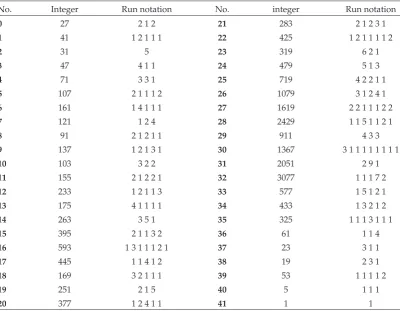
Clearly the binary notation can be expressed as lengths of runs. For example, we express n 27 as 120112. We point out that this particular starting point is especially
interesting because—as noted by several writers—it generates one of two of the longest trajectories for values ofn <103. AsTable 1shows, 41 steps are required to reach 1 in terms of odd integers. The other long trajectory in that range is forn703.
We will dispense with explicitly showing 1s and 0s unless otherwise indicated because, as we will show, the same rewriting rules apply to both. Hencen27 becomes{2 1 2}, and all positive odd integers are represented in this way, the only constraint being that the string is of odd length. Even values ofnappear as trailing 0s and are simply deleted in the rewriting process.
2. The String Rewriting System (SRS) for the
3
x
1
Problem
We will now list the String Rewriting SystemSRSprocess specific to the 3x1 problem and then prove that it replicates the algorithm for odd integers. Since the rewriting will involve deletions as well as additions, for convenience, we will invert the normal sequence, so that deletions occur on the leftleast significant digitsand additions of carry 1s at rightmost significant digits.
iAt the start of each iteration, we delete any leading 1s in pairs. This action corresponds to the removal of4k1factors whenever k is odd, which has no impact on the calculation.
Table 1: 3x1 pathodd integersforn27 expressed in integer and run notations.
No. Integer Run notation No. integer Run notation
0 27 2 1 2 21 283 2 1 2 3 1
1 41 1 2 1 1 1 22 425 1 2 1 1 1 1 2
2 31 5 23 319 6 2 1
3 47 4 1 1 24 479 5 1 3
4 71 3 3 1 25 719 4 2 2 1 1
5 107 2 1 1 1 2 26 1079 3 1 2 4 1
6 161 1 4 1 1 1 27 1619 2 2 1 1 1 2 2
7 121 1 2 4 28 2429 1 1 5 1 1 2 1
8 91 2 1 2 1 1 29 911 4 3 3
9 137 1 2 1 3 1 30 1367 3 1 1 1 1 1 1 1 1
10 103 3 2 2 31 2051 2 9 1
11 155 2 1 2 2 1 32 3077 1 1 1 7 2
12 233 1 2 1 1 3 33 577 1 5 1 2 1
13 175 4 1 1 1 1 34 433 1 3 2 1 2
14 263 3 5 1 35 325 1 1 1 3 1 1 1
15 395 2 1 1 3 2 36 61 1 1 4
16 593 1 3 1 1 1 2 1 37 23 3 1 1
17 445 1 1 4 1 2 38 19 2 3 1
18 169 3 2 1 1 1 39 53 1 1 1 1 2
19 251 2 1 5 40 5 1 1 1
20 377 1 2 4 1 1 41 1 1
iiiApply the following rewriting rules, one integer at a time, and concatenate to the output string, using the unary operatorsfandg. Every iteration starts withf:
ifork1 f1 → 1g or g1 → 1f,
iifork2 g2 → 2g or f2 → 1 1g,
iiifork≥3 gk → 1k−21g or fk → k−11g,
ivforkφend of input string, gφ−→1f.
2.1
Note that, while in general we concatenate to the output string, thesignfirst rulerequires that we add 1 to the last integer on the output string. If there is no previous integeroutput string is empty, then the 1 is simply discarded.
iA runρof 1s is translated by the function into 0ρ0, and a run of 0s changes to 1ρ1, so long as the length ofρsatisfies|ρ| ≥2. For example, runs of|ρ| 5 are shown pictorially as follows; the operationf5 is on the left andg5 is on the right:
000111111 00011111 01011110
110000011 11000001
1001000100 2.2
iiAn alternating series of 1 and 0 results in a string of 0s
010101011 101010101
1000000000 2.3
this corresponds to a succession of4k1factors which can be removed if they occur at right.
iiiSingle 0s or 1s disappear into the structures of their neighbors
1110111 1110111 1100111
0001000 0001000
00011000 2.4
ivIt is easily seen that the rewriting rulesiiandiiimaintain the parity of the string for operatorgand change it to even forf. Rule 1 has no effect on the parity. Hence, if the output stringwhich always starts withfends withg, we must add a 1the carry bitto it to preserve the requirement that its length be odd.
Ruleiican similarly be proved. Using the above, one can confirm that the rewriting rules
2.1satisfy all the requirements of the 3x1 algorithm.
The above SRS has some useful properties.
A Mersenne number2k−1which in binary is a row of k 1s is represented in our notation simply as{k}.
It is easy to see that every integer of the form4m1withmbeing odd is equivalent to mbecause both yield the same successor. In binary, the string for an odd integer m is followed by a 0 and a 1 to produce4m1. In our notation this translates even more simply as a pair of leading 1s. Given any odd integer one can write or immediately recognize an infinite number of equivalents simply by addingor removingpairs of 1s. Only adding 1s in pairs will maintain the correct parity of the string.
3. The
3
x
1
Problem and Mersenne Numbers
2 3 8
10 9
12
15 16
7 13
14
19
4 5
6 11
20 17
[image:5.600.201.402.98.244.2]18
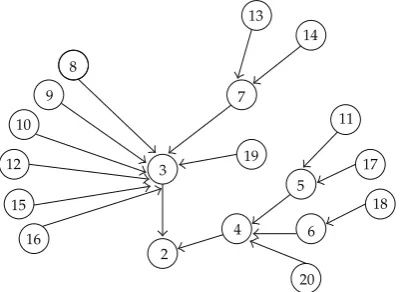
Figure 1: The 3x1 map expressed as values ofk≤20 for endpoints2k−1.
However, if we complete the numerical evidence for small values ofk≤20, an interesting structure emerges.Figure 1shows each vertex containing thekth Mersenne number and each edge representing the 3x1 trajectory from that kth Mersenne number to the next. For example, the trajectory forn 27 is largely represented by the single edge betweenk 5 and k 4, that is, n 31 andn 61, where the latter is the equivalent ofn 15 which cannot have a predecessor since it is 0mod 3. Note that all the values ofkinFigure 1are monotonically decreasing in the direction of the arrows.
Define as usual the stopping time ofn, denoted byσn, as being the leastksuch that
Tkn< n. It is easy to verify, as in Garner11, the following stopping times; theσnhave
been adjusted to count odd integers only:
σn 1 ifn≡1 mod 4,
σn 2 ifn≡3 mod 16,
σn 3 ifn≡11 or 23mod 32,
σn 4 ifn≡7, 15 or 59mod 128,
σn 5 ifn≡39,79,95,123,175,199, or 219mod 256.
3.1
Equivalentlysee12,σn≤5 unlessnis congruent mod 256 one of the following:
27 31 47 63 71 103 111 127 155 159 167 191 207 223 231 239 251 255. 3.2
iFirst we must show that every oddn ∈ N lies on the map described byFigure 1, either on the path between two Mersenne numbers 2k −1 or as the Mersenne numbers themselves. While we cannot predict where a particular n will fall on the map, we can say that this corresponds to the hypothesis that every n or an equivalent must have a Mersenne number as a predecessor. This condition is met if we can always find a valid predecessor ofnsmaller thann; that is,T−kn < n, identical to the stopping time condition except in the reverse direction. Note that, ifnis 0mod 3, we can convert it to an equivalentin fact an infinite number of themwhich has a valid predecessor.
iiThe second proposition is that ifTr2k−1 → 2l−1for anyr, k, l >0,l < k; that is, the 3x1 function expressed as a map ofk’s is monotonically decreasing, thereby ensuring that the function terminates for every integer. Note that we need only to concern ourselves here with Mersenne numbers, not all the points in between.
Hence a counterexample must satisfyTkn> nfor allk’spositive and negative; that is,n must be a minimum with respect to its successor trajectory as well as its infinite number of predecessor paths.
It remains to be seen whether the String Rewriting SystemSRSapproach can lead to further advances in the 3x1 problem.
References
1 T. Oliveira e Silva, “Maximum excursion and stopping time record-holders for the 3x1 problem: computational results,” Mathematics of Computation, vol. 68, no. 225, pp. 371–384, 1999.
2 Eric Roosendaal,http://www.ericr.nl/wondrous/index.html.
3 J. C. Lagarias, “The 3x1 problem: an annotated bibliography1963–1999,”http://arxiv.org/abs/ math/0309224.
4 J. C. Lagarias, “The 3x1 problem: an annotated bibliography, II2001–2009,”http://arxiv.org/ abs/math/0608208.
5 J. C. Lagarias, “The 3x1 problem and its generalizations,” The American Mathematical Monthly, vol. 92, no. 1, pp. 3–23, 1985.
6 M. Chamberland, “An update on the 3x1 problem,” Butllet´ıde la Societat Catalana de Matem`atiques,
vol. 18, no. 1, pp. 19–45, 2003.
7 G. J. Wirsching, The Dynamical System Generated by the 3n+1 Function, vol. 1681 of Lecture Notes in
Mathematics, Springer, Berlin, Germany, 1998.
8 J. O. Shallit, “The 3x1 problem and finite automata,” Bulletin of the AETCS, no. 46, pp. 182–185, 1992.
9 J. Bła ˙zewicz and A. Pettorossi, “Some properties of binary sequences useful for proving Collatz’s conjecture,” Foundations of Control Engineering, vol. 8, no. 2, pp. 53–63, 1983.
10 J. R. Kuttler, “On the 3x1 problem,” Advances in Applied Mathematics, vol. 15, no. 2, pp. 183–185, 1994.
11 L. E. Garner, “On the Collatz 3n1 algorithm,” Proceedings of the American Mathematical Society, vol. 82, no. 1, pp. 19–22, 1981.
12 V. Klee and S. Wagon, Old & New Unsolved Problems in Plane Geometry & Number Theory, vol. 11 of The