Chang, V and Walters, RJ and Wills, G (2013) The development that leads to the Cloud Computing
Business Framework. International Journal of Information Management. ISSN 0268-4012 DOI:
https://doi.org/10.1016/j.ijinfomgt.2013.01.005
Link to Leeds Beckett Repository record:
http://eprints.leedsbeckett.ac.uk/222/
Document Version:
Article
The aim of the Leeds Beckett Repository is to provide open access to our research, as required by
funder policies and permitted by publishers and copyright law.
The Leeds Beckett repository holds a wide range of publications, each of which has been
checked for copyright and the relevant embargo period has been applied by the Research Services
team.
We operate on a standard take-down policy.
If you are the author or publisher of an output
and you would like it removed from the repository, please
contact us
and we will investigate on a
case-by-case basis.
The development that leads to the Cloud Computing
Business Framework
Victor Chang
1, 2, Robert John Walters
2, Gary Wills
21. School of Computing and Creative Technologies, Leeds Metropolitan University, Leeds, UK. 2. School of Electronics and Computer Science, University of Southampton, Southampton, UK.
Correspondence: Victor Chang, School of Computing and Creative Technologies, 204 Caedmon Hall, Headingley Campus, Leeds Metropolitan University, Leeds LS6 3QR, UK.
Abstract
The Cloud Computing Business Framework (CCBF) is proposed to help organisations achieve good Cloud design, deployment, migration and services. There are four key areas to be addressed: (i) Classification; (ii) Organisational Sustainability Modelling (OSM); (iii) Service Portability and (iv) Linkage. Each area’s focus is described, and we explain how each fits into the CCBF and work altogether. The process that leads the CCBF is supported by literature, case studies, where examples in each CCBF key area are used to illustrate its effectiveness and contributions to organisations adopting it. CCBF has been used in several organisations offering added values and positive impacts.
Keywords: Cloud Computing Business Framework (CCBF); Classification; Organisational Sustainability Modelling; Service Portability; Linkage; Relations between Business Models and IT Services.
1. Introduction
Cloud Computing provides a compelling value proposition for organisations to outsource their Information and Communications Technology (ICT) infrastructures (Haynie, 2009). Cloud Computing (CC) has transformed the way many organisations work. It offers a variety of benefits including cost-saving, agility, efficiency, resource consolidation, business opportunities and green IT (Foster et al; 2008; Weinhardt et al. 2009 a; 2009 b; Schubert, Jeffery and Neidecker-Lutz, 2010; Chang et al., 2011 a; 2011 b; Kagermann, 2011). This brings technical and business challenges in many organisations. To address increasing requirements from Industry and Academia, a structured framework is necessary to provide for business needs, recommendations for best practices and which can be adapted in different domains and platforms. Our proposal is called the Cloud Computing Business Framework (CCBF).
The objective of this paper is to demonstrate the development that leads to the CCBF, and explain how different areas within the CCBF work, including the relationships between Business Models and IT Services, and added values CCBF offers.
Computing Clouds are commonly classified into Public Clouds, Private Clouds and Hybrid Clouds (Ahronovitz et al., 2010; Boss et al., 2007; Sun Microsystems, 2009). Their definitions are summarised as below:
Public Cloud – This includes Cloud services offered in public domains such as Amazon EC2
and S3. This approach is for organisations wishing to save costs and time without obligations of deployment and maintenance. For organisations without cloud computing deployment, this is the quickest way to make use of cloud computing. Drawbacks range from concerns for data security in public domains including data loss and conflicts concerning legal and ethical issues.
Private Cloud – Here bespoke cloud services are deployed within the organisation, thus data and accessibility are only for internal users. This approach is suitable for organisations focusing on privacy and data security, or to change or simplify the way people work. The downside is that implementations can be complicated, time-consuming or costly to complete.
Hybrid Cloud – The alternative approach here is to use part public cloud and part private cloud to deliver a solution. This approach is suitable for organisations wishing to reduce costs, whilst maintaining privacy and data security. The downside is that integrating different architectures is not easy, and it is likely that this model ends up either as a public cloud, or a private cloud due to complexity and time involved.
public, it then adds the private cloud into public domains. It is not a hybrid cloud, as eventually it is used by internal community members to provide knowledge sharing, research analysis and discussions. It is an ideal platform for test beds, or proof of concepts. Ahronovitz et al (2010) from the National Institute of Standard and Technology (NIST) proposes four types of Cloud. The fourth is the Community Cloud, which the NIST define as “A cloud which is controlled and used by a group of organisations that have shared interests, such as specific security requirements or a common mission.” The downside is that it takes years to establish a working community for sharing and mutual learning. However, the added values and benefits for the Academic Community could be worth far more than the time and effort spent. Briscoe and Marinos (2009) propose that the concept of the Community Cloud draws from Cloud Computing, Digital Ecosystems and Green Computing, with these five major characteristics: Openness; Community; Graceful Failures; Convenience and Control; and Environmental Sustainability.
2. Main Stream Cloud (Computing)
Frameworks
This section presents selected frameworks and architectures relevant to Service Oriented Architecture (SOA) and Cloud Computing, which confirm the top-down relationship between Business Models and IT Services. Additionally four frameworks are used to explain thetop-down relationship between Business Models and IT Services.
The majority of literature reviews define a Cloud Computing Framework as a SOA (Foster et al; 2008; IBM 2008; Sun Microsystems, 2009; Leighton, 2009; Schubert, Jeffery and Neidecker-Lutz, 2010; Chang et al. 2010 b) with three types of services:
Infrastructure as a Service(IaaS) is divided into Compute Clouds and Resource Clouds. Compute Clouds provide access to computational resources such as CPUs, hypervisors and utilities. Resource Clouds contain managed and scalable resources as services to users – in other words, they provide enhanced virtualisation capabilities. Hypervisor is one of many virtualisation techniques which allow multiple operating systems, termed guests, to run concurrently on a host computer.
Platform as a Service (PaaS): provides computational resources via a platform upon which applications and services can be developed and hosted. PaaS typically makes use of dedicated APIs to control the behaviour of a server hosting engine that executes and replicates the execution according to user requests (e.g., access rate).
Software as a Service (SaaS), referred to as Service or Application Clouds, offer implementations of specific business functions and business processes that are provided with cloud capabilities. Therefore, they provide applications and/or services using a cloud infrastructure or platform, rather than providing cloud features themselves.
Lin et al. (2009) provides an overview of industrial solutions for Cloud Computing, and summarise the list of challenges for the enterprise. They state that cost and flexibility benefits are enterprise-ready, but security, performance and interoperability need significant improvement.
There are other frameworks that define Cloud architecture and operations management together, so both are not only integrated but also maximizing the positive impacts
2.1 A Reference Model for Cloud (RMC) for integrating Cloud Computing and operation Chen et al. (2010) present a comprehensive overview of Cloud Computing, and this includes (i) the types of clouds, and key benefits (ii) definition of research clouds, and the proposal of six research cloud use cases; (iii) a review of commercial solutions and cases; and (iv) a review of open source solutions and cases and (v) key recommendations. They include extensive case studies to support their research output, where their Reference Model for Cloud (RMC) is an Enterprise Cloud Architecture for research and industrial practices, and plays a central role in defining research clouds, use cases and added values.
RMC defines Cloud Computing as a tower architecture, where the virtualization layer sits directly on top of hardware resources and sustains high-level cloud services. Similar to Buyya et al. (2009) and Schubert, Jeffery and Neidecker-Lutz (2010), their RMC divides clouds into Infrastructure as a Service (IaaS), Platform as a Service (PaaS) and Software as a Service (SaaS) on top of the Virtualisation and Hardware layers presented in Figure 1. The three core layers in the RMC are summed up as follows:
• The IaaS layer provides an infrastructural abstraction for self-provisioning, controlling, and management of virtualised resources.
• In PaaS, consumers may leverage the
development platform to design, develop, build, and deploy cloud applications.
planning hides complex infrastructural management tasks from users by automatically scaling in and out virtualized resource instances in order to enforce established SLA commitments.
• Security applies at each of the service delivery
[image:4.595.315.519.485.671.2]layers to ensure authenticated and authorized cloud services, and features include identity management, access control, single sign-on and auditing.
Figure 1: RMC Cloud Architecture
2.2 The IT Infrastructure Library (ITIL) Version 3 Service Framework
ITIL V3 (Office of Government Commerce, 2007; Hanna et al., 2009) is a framework that describes Best Practice in IT service management. It provides a framework for the governance of IT, and focuses on continual measurement and improvement of the quality of IT services delivered, from both a business and a customer perspective. This includes five processes, each of which is closely related to the others:
(i) Service Strategy - this provides guidance on how to design, develop and implement Service Management.
(ii) Service Design – this is concerned with the design and development of IT Services. (iii)Service Transition – this process focuses on
the deployment of IT services.
(iv)Service Operation – this ensure that IT services are delivered effectively and efficiently.
(v) Continual Service Improvement – this process focuses on improving the quality of existing services on continuous basis.
In Service Design, Service Level Management (SLM) is a particular area which facilitates a Service Level Agreement (SLA) with the
customers and to design services in accordance with the agreed service level targets. In other words, SLA is part of SLM, which belongs to Service Design. In contrast, cloud papers presented by Buyya et al. (2009) and Brandic et al. (2009) classify SLA under Service Operation. In ITIL V3, SLA is part of Service Design, since it is important to define the right agreements between customers and providers and reinforce the relations between business models, business processes and IT services. ITIL V3 classifies Service Strategy as a strategic aspect of IT services, and categorizes Service Design as the interface between strategy and delivery. It also classifies Service Transition and Service Operation as delivery aspects of IT services and also defines the relationship between the business model and process (Service Strategy), interface (Service Design) and IT service delivery (Service Transition and Operation), where Continuous Service Improvement is useful for interface and service delivery. Despite the cyclic relationships, it still has a top-down IT strategy for delivery relations throughout the use of the framework.
2.3 Service Oriented Architecture by Papazoglou and Georgakopoulos (2003)
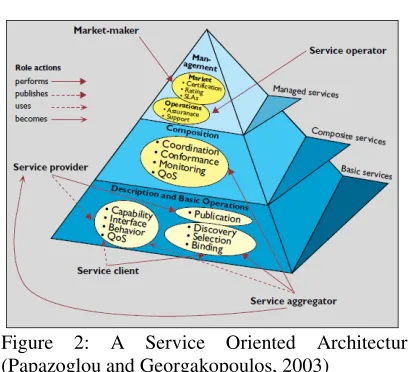
• Papazoglou and Georgakopoulos (2003) explain the concept of Service-Oriented Computing and present an overview of Service-Oriented Architecture (SOA) with Service layers, functionality and roles. Each role is related to its respective services, and all services and roles are linked in the SOA. See Figure 2.
Figure 2: A Service Oriented Architecture (Papazoglou and Georgakopoulos, 2003)
There are core functionalities with SOA as follows:
• Co-ordination: controls execution of the component services, and manages dataflow between services.
• Conformance: ensures the integrity of the
composite service and performs data fusion.
• Quality of Service (QoS): deals with the composite service’s overall cost, performance, security, authentication, privacy, integrity, reliability, scalability and availability.
2.4 IBM SOA framework
The IBM SOA framework (Chen 2006, IBM Certification, 2010) defines the business processes, and explains the relations between the business model and IT services in the form of service computing. SOA is also influential in Cloud Computing, as it helps in defining IaaS, PaaS and SaaS. The IBM SOA framework also establishes linkages between business and IT which have a single goal to offer the maximum level of benefits for the organization. Key benefits include:
(i) Agility to complete business requirements and processes, including automation and optimization to improve efficiency.
(ii) The use of SOA can present IT for business opportunities and revenues as well as for services to increase profits.
(iii)Resources within the organisation can be managed better, including improved control of processes and the reuse of resources to reduce costs.
(iv)Integration of different services and technologies is easier.
2.5 The Top-Down relationship between Business Models and IT Services
Several industry-led frameworks have emphasised the importance of business models, business processes and business project management that can significantly influence the success of IT projects in terms of management, execution and control. There are several examples, including Projects In Controlled Environments version 2 (PRINCE2) (OGC, 2009), ITIL V3 (OGC, 2007; Hanna et al., 2009) and IBM Service Oriented Architecture (SOA) framework (IBM, 2008; IBM Certification Programme, 2010).
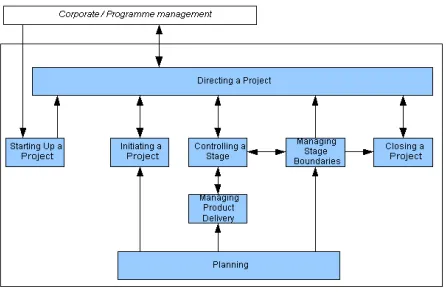
Projects In Controlled Environments version 2 (PRINCE2) is a widely-used industry framework and methodology, which covers the management, control and organisation of a project, particularly for IT-based projects. PRINCE2 2009 edition (Office of Government Commerce, 2009) describes procedures to coordinate people and activities in a project, how to design and supervise the project, and what to do if the project has to be adjusted. Divided into manageable stages, PRINCE2 enables an efficient control of resources. This is relevant to Cloud Computing, since control of resources does not just relate to Quality of Services (QoS) and the Service Level Agreement (SLA), but needs to be addressed from the strategic point of view also.
Figure 3 shows the PRINCE2 Framework. The Corporate and Programme Management set up a Board in “Directing a Project”, and appoint a Project Manager (PM) at the same time. Corporate management and the Board start up the project. Then the PM takes care of the project development, which includes (i) Initialising a Project; (ii) Controlling a Stage; (iii) Managing Product Delivery; (iv) Managing Stage Boundaries and (v) Closing a Project, where Planning is useful for (i), (iii) and (iv). At any stage, any major faults and risks need to be reported back to the Corporate management to make decisions. This requires top-down strategic decisions and directions from Corporate executives in the development of IT projects and services.
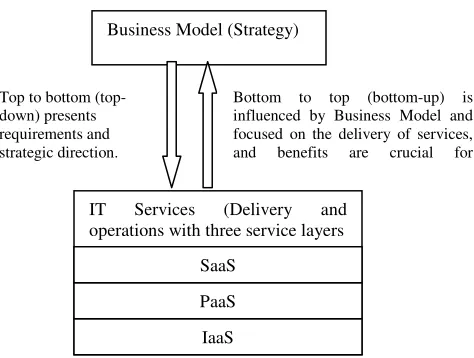
[image:5.595.187.410.606.753.2]Frameworks presented between Sections 2.2 and 2.3 also follow a top-down structure. ITIL V3 (Office of Government Commerce, 2007; Hanna et al., 2009) is another framework that focuses on the top-down relationship between Business Models and IT Services. The original SOA outlined by Papazoglou and Georgakopoulos (2003) offers stacks of top-down services and architecture. In addition, the IBM SOA framework defines top-down relations between business strategies and IT operations.
Figure 4: The simplified relationship between Business Model and IT Services
Chang et al. (2011 c) present four major IT service frameworks adopted by industry, and discuss their similarities in terms of IT service delivery, and then demonstrate that they have top-down and bottom up relationships between the Business Model and IT Services, including specifying what the top component and bottom components are for each framework.
Luo et al. (2010) propose a SOA-oriented value-at-risk (VAR) approach to measure service assurance and QoS of Cloud Computing. They assert that the Business Model is the enterprise layer at the strategic level that links to the detailed technical services. They use the Insurance Model to demonstrate their VAR approach and use the Zachman Framework (1987) to support their rationale. They also confirm that the rise of Cloud Computing has taken over those key benefits offered by SOA. Nevertheless, PRINCE2 2009, ITIL V3, IBM SOA and Luo et al. (2010) have demonstrated that the business model is strategic and acts on the top of operational levels of IT Services such as Cloud Computing. See Figure 4.
3. Cloud Computing Business Overview
Business Computing is an area linking both computing and businesses, and provides insights into how challenges can be resolved in the business context with improvements in efficiency, profitability and customer satisfaction (IBM SOA, 2008). Business Computing is closely related to Cloud Computing, since Cloud Computing offers business opportunities and incentives (Schubert, Jeffery and Neidecker-Lutz, 2010). To understand how Cloud businesses can perform well with long-term sustainability, having the right business models will be essential (Chou, 2009; Weinhardt et al., 2009 a). Thus, this section describes the relevance of Business Models and their influences.
Extensive work has been carried out on investigating business models empowered by Cloud technologies (Lohr 2007; Madhavapeddy et al., 2010; Molen 2010; Kagermann 2011). There is an increasing number of organisations investing more in Cloud technologies, deployment and services. Cloud computing adoption continues to grow in the economic downturn, particularly in Green IT and data centre consolidation to cut operational costs (Dunn, 2010; Minoli, 2010). In addition, it is essential to have winning strategies for profit-making before starting any cloud investment and project management. There is a literature about Service Level Agreements (SLA) but this focuses on billing calculations. Having winning strategies is critical (Mitchell, 2008). For example, some SME have adopted SAP and have managed well to control their risks and cost saving by the use of SAP Cloud services to consolidate their resources and improve their efficiency (Chang et al., 2011 e). This illustrates the importance of classifying and adopting the right business strategies and models for long-term sustainability.
Lazonick (2005) presents comprehensive details for a business model and is an influential researcher in this area. Lazonick states that the US government played a critical role in consolidating the US economy after the Second World War, and encouraged collaboration between the academia and industry. In addition, numerous active start-ups in Silicon Valley have helped in improving the economy in the past decades. Many of those start-ups were recipients of venture capital, which helped growth and expansion of their businesses. Some start-ups have become small and medium enterprises (SME), and they have done well by offering a “support and services contracts” model. There were exceptional SMEs such as HP and Cisco who outperformed other businesses, and expanded into global firms through adopting the right strategies for investments, merger and acquisition and integrating their products and services. Lazonick also argues that although IBM is not from Silicon Valley, it has obtained asimilar level of achievement to HP and Cisco, and those companies are considered as “All-In-One Enterprises”, as part of this “New Economy” model applicable to all sectors. Based on Lazonick’s insight, there are four business models which can be identified: (i) Government Funding; (ii) Venture Capital; (iii) Support and Services Contracts and (iv) All-In-One Enterprises. There are researchers supporting Lazonick’s points. Firstly, Educause (2008) explains the use of the Cloud in Higher Education is an initiative from Government Funding. Secondly, Hunt et al. (2003) demonstrated how the venture capital model has helped technological and Grid-based companies in
Business Model (Strategy)
IT Services (Delivery and operations with three service layers
IaaS PaaS SaaS
Bottom to top (bottom-up) is influenced by Business Model and focused on thedelivery of services, and benefits are crucial for businesses.
[image:6.595.53.290.93.272.2]sustaining their businesses. Thirdly, Etro (2009) investigates the EU SMEs that focus on Cloud Computing, and those SMEs who follow Support and Services Contracts models. Lastly, Weinhardt et al. (2009 a; 2009 b) have proposed an Enterprise Cloud model that perfectly explains and fits the “All-In-One Enterprises” model.
Chang, Mills and Newhouse (2007) explain the open source business models and ways to achieve long-term sustainability with several case studies to present and support their arguments. They propose a Support Contracts model, which is very similar to “Support and Services Contracts” in Lazonick’s definition. They also propose a Community model, which acts as a “One-Stop Resources and Services” for vendors, users, stake-holders, resellers and collaborators to interact and gain mutual benefits in a single platform. This allows the building up ofa community to consolidate each other’s strength and provide a resource sharing platform. They further propose a“Macro R&D Infrastructure”, where the source of funding is from Government for selected R&D projects, and is considered as a Government Funding model. Their proposal about “Valued-added closed source” (VACS) is similar to the SaaS business model. However, VACS also includes emerging technologies outside open source domains such as cloud computing. Between 2007 and 2010, the rise of gaming, mobile and entertainment industries has made significant impact on the development of ICT. TheiPhone and iPad have made phenomenal sales between Year 2009 and 2010, and the mobile and gaming industry has generated billions of income (Brennan and Schasfer, 2010; Turilin, 2010). Facebook has reached more than 1 billion users from Year 2009 and 2010, and is in the stage for initial public offering (IPO). Thus, a new business model,
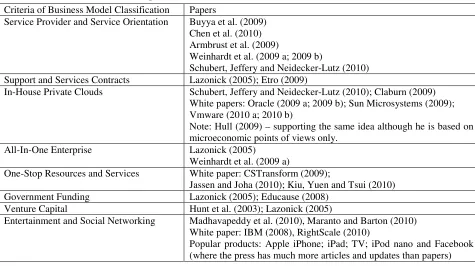
[image:7.595.68.543.522.788.2]“Entertainment and Social Networking” is available. Based on their work, “One-Stop Resources and Services”, “Government Funding” and “Entertainment and Social Networking” are another three models on top of Lazonick’s proposed model. Moreover, there are industrial solutions supporting their statements. Firstly, CSTransform (2009) is a SME integrating both Cloud Computing and Web 2.0 to deliver a joint solution (known as Marketplace 2.0) to help the governments of the United Kingdom, South Australia, Hong Kong and Croatia to provide a “One-Stop Resources and Services” model for their citizens, and have provided added-values in an e-Government point and administrative efficiency. Jassen and Johan (2010) propose Cloud shared services to act like one-stop resources and services. Kiu, Yuen and Tsui (2010) demonstrate a similar concept from an e-Government point of view. Secondly, IBM (2008) supports the vision of integrating entertainment products and services for Cloud Computing to generate more business value and customer demands. Thirdly, the rise of social networking and mobile cloud products has greatly influenced the general public’s perception of the Cloud, which is strongly supported by extreme popularity and demands from Facebook and Apple products (iPhone, IPad, TV and iPod nano). Madhavapeddy et al. (2010) define social networking sites as “Personal Containers” of Clouds, which are further assisted by mobile devices and scientific computing. Maranto and Barton (2010) present detailed descriptions about the social networking and entertainment industry, and highlight privacy issues and opportunities for social management. Table 1 summarises papers about the criteria of Business Model Classification.
Table 1: Papers for Criteria of Business Model Classification Criteria of Business Model Classification Papers
Service Provider and Service Orientation Buyya et al. (2009) Chen et al. (2010) Armbrust et al. (2009)
Weinhardt et al. (2009 a; 2009 b)
Schubert, Jeffery and Neidecker-Lutz (2010) Support and Services Contracts Lazonick (2005); Etro (2009)
In-House Private Clouds Schubert, Jeffery and Neidecker-Lutz (2010); Claburn (2009) White papers: Oracle (2009 a; 2009 b); Sun Microsystems (2009); Vmware (2010 a; 2010 b)
Note: Hull (2009) – supporting the same idea although he is based on microeconomic points of views only.
All-In-One Enterprise Lazonick (2005)
Weinhardt et al. (2009 a)
One-Stop Resources and Services White paper: CSTransform (2009);
Jassen and Joha (2010); Kiu, Yuen and Tsui (2010)
Government Funding Lazonick (2005); Educause (2008)
Venture Capital Hunt et al. (2003); Lazonick (2005)
Entertainment and Social Networking Madhavapeddy et al. (2010), Maranto and Barton (2010) White paper: IBM (2008), RightScale (2010)
3.1 Cloud Computing for Business Use
Several papers have explained IaaS, PaaS and SaaS as the cloud business model (Buyya et al. 2009; Chen et al., 2010; Armbrust et al., 2009; Weinhardt et al., 2009 a; Schubert, Jeffery and Neidecker-Lutz, 2010). Despite all having a slightly different focus, all of them are classified under “Service Provider and Service Orientation”, regardless of whether they are IaaS, PaaS, or SaaS service providers, or their focus is on billing, or SLA or CRM, since this is a mainstream model that still has areas of unexploited opportunities. In addition, CC can offer substantial savings by reducing costs whilst maintaining high levels of efficiency (Oracle 2009 a; Schubert, Jeffery and Neidecker-Lutz, 2010). In Oracle (2009 b) and VMware (2010 a; 2010 b) scenarios, both propose “In-House Private Clouds” to maximise use of internal resources to obtain added value offered by CC while keeping costs low. This allows organisations to build their own Cloud to satisfy IT demands and maintain low-costs, and is a new model from a micro economic point of view (Claburn, 2009; Hull, 2009). Successful business models are not restricted to particular sectors or areas of specialisation and can be applicable for businesses including CC businesses. Table 1 on page 6 gives a summary of criteria and supporting papers.
3.2 Cloud Challenges in business Context Armbrust et al. (2009) described technical Cloud challenges, and considered vendors’ lock-in, data privacy, security and interoperability as most important challenges. Security and privacy being areas that require regular improvement, there are also other critical business challenges (Weinhardt et al., 2009 a; 2009 b). There are three business challenges described as follows. Firstly, all cloud business models and frameworks proposed by leading researchers are either qualitative (Briscoe and Marinos, 2009; Chou, 2009; Weinhardt et al., 2009 a; Schubert, Jeffery and Neidecker-Lutz, 2010) or quantitative (Brandic et al., 2009; Buyya et al., 2009; Armbrust et al., 2009). Excluding SLA-based research, there are few whose frameworks or models can demonstrate linking both quantitative and qualitative aspects and for those that do, the work is still at an early stage.
Secondly, there is no accurate method for analysing cloud business performance other than the stock market. A drawback with the stock market is that it is subject to accuracy and reliability issues (Chang, et al., 2010 b; 2011 a). There are researchers focusing on business model classifications and justifications for why cloud business can be successful (Chou, 2009; Weinhardt et al., 2009 a;
2009 b). But these business model classifications need more cases to support them and more data modelling to validate them for sustainability. Ideally, a structured framework is required to review cloud business performance and sustainability in systematic ways.
Thirdly, communications between different types of clouds from different vendors are often difficult to implement. Often work-arounds require writing additional layers of APIs, or an interface or portal to allow communications. This brings interesting research questions such as portability (Beaty et al., 2009; Armbrust et al., 2009). Portability refers to moving enterprise applications and services which can be challenging, and not just files or VM over clouds.
4. Our Proposal: Cloud Computing
Business Framework
As has been highlighted earlier inn the paper there are technical and business challenges for organisational Cloud adoption, and to help organisations achieving Cloud design, deployment, migration and services, the Cloud Computing Business Framework (CCBF) is proposed. CCBF is designed to help businesses to maximise added value offered by Cloud Computing, and also deliver solutions, recommendations and case studies to businesses. The CCBF is proposed to deal with four key areas for organisations adopting a Cloud solution:
• Classification of business models to offer
Cloud-adopting organisations the right strategies and business cases.
• Offer a structured framework to review cloud
business performance accurately.
• Deal with application portability from desktops to clouds and, later on, between clouds offered by different vendors.
• Provide linkage and relationship between
different cloud research methodologies, and between IaaS, PaaS, SaaS and Business Models.
Table 2: List of selected frameworks
Methods Strength Weakness Selected?
Reference Model for Cloud (RMC) (Chen et al., 2010)
It has IaaS, PaaS and SaaS in its architecture
and explains
components in each layer. It has six different use cases.
It does not have many components in the SaaS layer. RMC provides guidelines only and does not have case studies that involve real data or organisations using them.
Yes – only essential components in IaaS and PaaS are selected. The six use cases are adopted as part of the CCBF.
ITIL V3 (Office of Government Commerce, 2007; Hanna et al., 2009)
ITIL V3 is a very
well-defined in the
framework. ITIL V3 has been used in industry as one of the frameworks for best practices.
Similar to RMC, it provides guidelines and generic recommendations for IT; it does not guide
organizations in
achieving good Cloud design, deployment, migration and service.
Yes. CCBF has guidelines and best practices for Service Strategy, Service Design, Service Transition, Service Operation and Continuous Service Improvement, specially for organisaitons keen in Cloud adoption and migration. Original SOA
proposed by
Papazoglou and Georgakopoulos (2003)
They define core components essential for SOA, and explain why, what and how linkage is in their conceptual model.
They do not use any quantitative methods, which are crucial for Sustainability Modelling
and ROI. Some
components are still not fully completed although it was first proposed in 2003.
Yes. CCBF offers stack of layers for different services, and each service is able to connect to and integrate with other services.
IBM SOA
Framework (IBM,
2008; IBM
Certification Programme, 2010).
It is a comprehensive framework addressing business opportunities and revenues, and also agility to complete business requirements and processes. They use Enterprise Service Bus (ESB) to link different processes.
ESB is the main technology, and the rise of Cloud Computing has offered more options for
technologies and
methodologies. All these key benefits are taken into account for designing and implementing a framework.
Yes. Technologies,
techniques and concepts to link different processes and services are adapted to the CCBF.
Risk Assessment Framework (RAF) (Li, 2010)
It provides linkage between different aspects of risk analysis,
which can work
together in a linkage-oriented framework.
RAF is in development, and information about statistical distribution and choice of risk models with case studies will be available.
Yes. This will be useful for risk analysis and its conceptual framework can be used for Supply Chain and relevant areas.
There are five groups of targeted audience for the CCBF. The rationales are explained as follows:
• Financial Services: Applications are created to
simulate and model assets which include pricing calculations and risk analysis. CCBF can help to quantify risks and present them in visualisation so that stake holders can understand easily.
• Researchers and practitioners working in cloud business, PaaS, SaaS, health research, financial services and consultancy. This allows the exchange of ideas and reviews of publications with researchers working in similar or related
areas. This will include an interdisciplinary group of experts from academia (engineering, computing, business and law) and industry. One collaborator is IBM US where the Director of Cloud Initiatives has jointly worked on this initiative.
• Participating organisations for organisational
• Directors and investors seeking to evolve
business models. Cloud business models are fast-paced and evolving, and are not confined to the pay-as-you-go or Service Level Agreement (SLA) billing systems, but require a careful and well-planned approach.
• Organisations which plan to design, deploy, migrate to Cloud platforms and services.
4.1 Relationship within Services
Weinhardt et al. (2009 a; 2009 b) propose their Cloud Business Model Framework (CBMF) as a strategic way for all organisations to be successful in cloud businesses. They present four core business cloud elements: Infrastructure, Platform, Applications and Business Model. Each main layer is supported by its core functions and service providers, and is also stacked on top of others.
Research questions can be posed and discussed within the Service Level, and can be independent of whether they are Infrastructure as a Service (IaaS), Platform as a Service (PaaS) and Software as a Service (SaaS). This is confirmed by Truong and Dustdar (2010), who demonstrate that work-in-progress and completed work such as classification, modelling, and experiments can be performed at the same time. This means work on each research question is considered as a key area in the framework. Similarly, these can be performed in each of IaaS, PaaS and SaaS. This fits in with Weinhardt et al. (2009 a) suggestions.
Challenges in the business context are discussed by Chang et al. (2011 a) and there are research issues associated with Classification, Organisational Sustainability Modelling, Service Portability and Linkage. Each area is relevant to each of IaaS, PaaS and SaaS. Each key area is described as follows.
4.1.1 The first key area: Classification
Classification provides Cloud-adopting organisations with theright strategies and business cases, and is often presented as business models. Table 1 sums up that there are eight business models essential for organisations adopting Cloud Computing, and have been useful for collaborators adopting them. Chang et al (2010a, 2010b) also use the Cloud Cube Model (CCM) to demonstrate Classification (Jericho Forum, 2009).
4.1.2 The second key area: Organisational Sustainability Modelling
Organisational Sustainability in this research is about reviewing cloud business performance and includes Return on Investment (ROI) measurement. Organisational Sustainability is a systematic and innovative methodology based on (i) The Capital Asset Pricing Model (CAPM) (Sharpe, 1990); (ii)
the use of economic and statistical computation for data analysis; (iii) 3D Visualisation to present cloud business performance and finally (iv) a unique way to use Quality Assurance (QA) to improve the quality of data and research outputs. This leads to the development of Organisational Sustainability Modelling (OSM) which is designed to measure cloud business performance. Using OSM has the following two advantages: (i) it allows performance reviews at any time; and (ii) it provides strategic directions and added-values for adopting the right types of cloud business for sustainability.
There are extensive case studies to support OSM. Data from Apple/Vodafone, NHS, SAP, Oracle, Salesforce, VMware, HP, KCL, Universities of Southampton and Greenwich, and several Small and Medium Enterprises (SME) are presented and analysed in the form of statistical computing and 3D Visualisation. ROI results and discussions have proven to be valuable not only for publications but also for collaborators. Organisational Sustainability is not restricted to any problem domain.
Measurement of return and risk can be a difficult and a huge task without prior focus. The proposed approach is to divide return and risk into three areas: Technical, Costs (Financial) and Users (or clients) before and after deploying cloud solutions, products or services. In some contexts, it can be defined as expected return and actual return. The data to be collected are dependent on organisational focus, which is flexible and dependent upon different characteristics for any type of technical or business cloud solution.
domains are used for demonstration: Finance and Health. They are summed up as follows.
Finance: Financial Software as a Service (FSaaS) is our proposal for dealing with issues caused by the global economic downturn (Chang et al., 2011 a). FSaaS is designed to improve the accuracy and quality of both pricing and risk analysis. Different models are explained, and Monte Carlo Methods (MCM) and the Black Scholes Model (BSM) are used for investigation. Simulations and experiments are performed on different clouds to demonstrate enterprise portability. This work is in collaboration with IBM (US) and the Commonwealth Bank Australia (CBA), with published results.
Health: Dynamic 3D modelling and simulations with DNA, genes, proteins, tumour and brain images have been used to demonstrate service portability in Clouds, and results will be discussed along with Cloud Storage as another area to demonstrate portability. There is collaboration with Guy’s and St Thomas NHS Trust (GSTT) and King’s College London (KCL) associated with this.
4.1.4 The fourth key area: Linkage. Linkage between different Services, and between Business and Services
In the IBM SOA framework, services are exported by an Enterprise Service Bus (ESB), which links different aspects of business processes and also provides flexibility that allows business process inefficiencies to be corrected rapidly. The ESB has major advantages over point-to-point solutions in terms of versatility and adaptability because service mediation and routing logic within the ESB are adaptable for different needs. The drawback with the ESB is that defining, writing and validating business processes is complex. One work-around is to use both Business Process Execution Language (BPEL) and Business Process Model and Notation (BPMN) for definition and validation, but this does not simplify the linkage between different services. It also needs personnel with business analyst backgrounds to interpret the problems fully and understand the best route for linkage. In addition, there is a conceptual mismatch between BPEL and BPMN since each was initially created for different purposes (Recker and Mendling, 2006).
4.2 What does linkage mean?
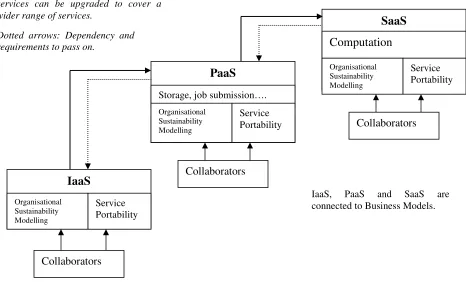
As previously indicated there are three types of Cloud service: IaaS, PaaS and SaaS. A cloud project often has a particular focus, and as the project develops over a period of time, factors such as customer requirements, business opportunities and evolution from existing projects may push the type of services upwards, such as upgrading from
IaaS to PaaS. Two examples which illustrate this are the experiences of Guy’s and St Thomas NHS Trust (GSTT) and a Small and Medium Enterprise (SME) that does not wish to reveal its identity.
GSTT and KCL have started a Private Cloud project (Cloud Storage) to build and consolidate infrastructure. With increasing research needs and user demands, it needs to upgrade to PaaS to provide three different services. The first service is 3D Bioinformatics to develop applications for 3D genes, proteins, DNA, tumour and brain images. The second service is Computational Statistics for researchers to write statistical applications and perform high performance calculations. The third service is the extended Cloud storage project that allows writing and improving applications and functionality. These three services have been successfully upgraded from IaaS to PaaS, and have satisfactory user feedback. Figure 5 shows a result computed by 3D Visualisation.
Figure 5: 3D Visualisation for an insulin molecule.
The second example is a participating Small and Medium Enterprise (SME) that does not wish to reveal its identity. This SME offers broadband, networking and telecommunication services, and has adopted virtualisation for cost-saving. It has consolidated its infrastructure and moved from physical to virtual servers. Later, they had strong customer demands for storage, and fast video and music downloads, which meant they needed to make rapid changes. This SME has developed in-house applications and third-party tools with their business partners to allow their customers to archive files on their storage and also to have faster downloads of video and music. It is a good example of upgrading services from IaaS to PaaS.
Figure 6: The relationship within the Services
The downward arrows in Figure 6 mean another direction of linkage. Often a Cloud project is dependent on the QoS of the infrastructure and virtual machines. This is particularly true where PaaS projects need to rely fully on the IaaS which needs to provide high availability and a reliable quality of service. PaaS projects in GSTT and KCL depend on the availability and reliability of IaaS. Requirements from PaaS do occasionally need to be imposed on IaaS. These include techniques and code for automation and virtual machine management. Similarly, for the participating SME speed of download and storage services depend on IaaS reliability and high availability, and often need to extract code for further development of services. In the case of MyExperiment, the SaaS platform depends on PaaS running smoothly with high user satisfaction in order to maintain and expand their SaaS services and offers.
4.3 Linkage between different Cloud adoption and between different methods
This section explains the linkage between different Cloud adoption and between different methods. There are Cloud economics and business model papers where there are several interesting challenges to be addressed. Firstly, all cloud business models and frameworks proposed by several leading researchers are either qualitative (Briscoe and Marinos, 2009; Chou, 2009;
Weinhardt et al., 2009 a; 2009 b; Schubert, Jeffery and Neidecker-Lutz, 2010) or quantitative (Brandic et al., 2009; Buyya et al., 2009; Armbrust et al., 2009). Qualitative research focuses on defining the right strategies, business model classifications and support from case studies and user feedback. Quantitative research focuses on billing and pay-as-you-go models, Return on Investment (ROI) calculations and validation supported by experiments or simulations. Each business model, either qualitative or quantitative, is self-contained. Each contains a series of proven hypotheses and methods supported by case studies and/or experimental results. Generally there is no interaction or collaborative work between different models, except the SLA approach. However, costs per usage deals with operational levels and there is a lack of recommendations proposing or standardising the strategic levels. In addition, different schemes, policies and measurements of pricing may differ between SLA techniques. It would be sensible therefore to provide linkage between SLA and research focusing on strategic levels. Therefore, linkage between different Cloud adoptions is required.
Etro (2009) and Schubert, Jeffery and Neidecker-Lutz (2010) also state that Cloud strategies and adoption in the EU are different from their peers in the US. Thus, linkage between Cloud business strategies, core businesses, billing models and core technologies need to be strongly established. This
IaaS
PaaS
SaaS
Storage, job submission….
Computation
Organisational Sustainability Modelling
Service Portability
Organisational Sustainability Modelling
Organisational Sustainability Modelling
Service Portability
Service Portability
Collaborators
Collaborators
Collaborators
Arrows move upwards so that existing services can be upgraded to cover a wider range of services.
Dotted arrows: Dependency and requirements to pass on.
also leads Etro (2009) to investigate Cloud Computing economic impacts for the EU, and he develops his own model, using dynamic stochastic general equilibrium (DSGE), to calculate CC economic values and its impacts for the EU economy. DSGE takes on the social and economic factors and SME business models as the foundation of this model. Etro then defines his econometric-based model, and defines what to measure and how to collect data. After data collection, Etro explains his computational results and their impact on the EU, based on calculations and analysis of his data. Thus, he offers linkage between qualitative and quantitative methods, and also links EU SME interests and current status to econometric models.
Linkage is important for Cloud adoption. There is an approach for linkage - Buyya et al. (2010) demonstrate linkage in the form of interoperability and integration. They demonstrate this by consolidating their approaches, resources and techniques. Therefore, implementing linkage requires the review and investigation of approaches, resources and techniques that can be made to be more coherent and compatible with each other, before going ahead into details of interoperability.
As discussed earlier, linkage between different types of services is required, and is dependent on factors such as business needs, user demands and further development from existing problems. However, the question for upgrade is when and how. To determine the best timing and best practice is a common concern to businesses based on ITIL V3 and IBM SOA. Therefore, a structured way to determine the best timing and practice will be helpful. There are some methods such as PRINCE2, but the drawback is that it relies on highly experienced project managers to co-ordinate and manage. Problems will arise if the project is new and the project manager has not previously managed a similar project. This structured method should also be easy to understand and use at any time to review business performance. It should also link both qualitative and quantitative research methods.
4.4 Characteristics for linkage
Linkage must have the following characteristics (Chang et al., 2011 c, 2012 a):
• Easy to follow.
• Able to review Cloud business performance at any time
• Have dynamic, versatile and adaptable
characteristics. Linkage should translate different requirements from one domain to
another, such as that between IT and business. It should fit into any type of cloud business and any cloud technology. It should fit into any stage of the project, and any situations, status, resources and deployment.
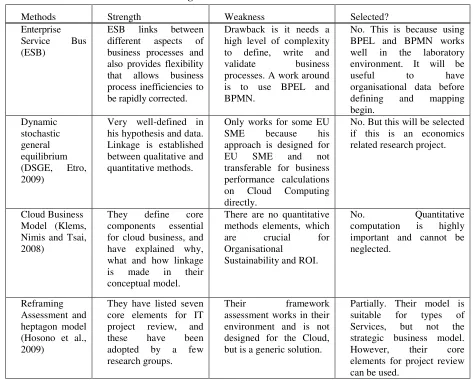
• It should reflect the core elements for success. Before selecting the best approach, a number of techniques and methods are studied. Etro (2009) started from a qualitative approach, since user requirements and problems can be useful to decide which techniques are to be deployed. A similar approach is adopted by Klems, Nimis and Tsai (2008), who define core components essential for cloud business, and explain where the linkage is necessary. In regard to all these, Table 3 shows the list of studied methods.
Reframing Assessment and the Heptagon models (Hosono et al., 2009) partially fulfil the requirement to establish easy-to-use linkage. They have presented seven elements, in which cost is an element but normally is funded from Corporate management. Frameworks such as ITIL V3, IBM SOA and PRINCE2 2009 define cost as the top-level business challenge rather than at the operational level, although it is influential on the way operational services can work. The other six elements to review IT projects and determine their status of success can be used for IaaS, PaaS and SaaS. Due to the strategic focus, a different set of six elements for cloud business success will be identified and supported by the literature review. This means in the business model layer, different elements for review will be used.
4.5 The proposal for Linkage
The previous section describes the process which leads to linkage. A number of selected methods only fulfil part of the research requirements. This means a further proposal is necessary to fulfil the characteristics of linkage. Ideally, the core elements essential for businesses and IT services can be reviewed at any time and inherit dynamic characteristics. One such example to fulfil all requirements is Sun Tzu’s Art of War (STAW), which has been extensively studied, researched and applied into business strategies, operations, negotiations, sales and leadership (Wee et al., 1995). The proposal includes the following steps:
• Identify six core elements of success for the
Business Model layer, and use STAW.
• Use six elements (except cost) from Reframing
Table 3: List of studied methods for linkage
Methods Strength Weakness Selected?
Enterprise Service Bus (ESB)
ESB links between different aspects of business processes and also provides flexibility that allows business process inefficiencies to be rapidly corrected.
Drawback is it needs a high level of complexity to define, write and validate business processes. A work around is to use BPEL and BPMN.
No. This is because using BPEL and BPMN works well in the laboratory environment. It will be
useful to have
organisational data before defining and mapping begin.
Dynamic stochastic general equilibrium (DSGE, Etro, 2009)
Very well-defined in his hypothesis and data. Linkage is established between qualitative and quantitative methods.
Only works for some EU
SME because his
approach is designed for
EU SME and not
transferable for business performance calculations on Cloud Computing directly.
No. But this will be selected if this is an economics related research project.
Cloud Business Model (Klems, Nimis and Tsai, 2008)
They define core components essential for cloud business, and have explained why, what and how linkage is made in their conceptual model.
There are no quantitative methods elements, which
are crucial for
Organisational Sustainability and ROI.
No. Quantitative
computation is highly important and cannot be neglected.
Reframing Assessment and heptagon model (Hosono et al., 2009)
They have listed seven core elements for IT project review, and these have been adopted by a few research groups.
Their framework
assessment works in their environment and is not designed for the Cloud, but is a generic solution.
Partially. Their model is suitable for types of Services, but not the strategic business model. However, their core elements for project review can be used.
By reviewing the proposal requirement, the Hexagon Model (Chang et al., 2010 b) is the most suitable for the following reasons:
• Six core elements can be displayed against each other, and their score can be reviewed within the Hexagon model. The shape of the Hexagon model has been used in military tactics and then in business strategies. The shape within the Hexagon model can represent the formation of an army, which can be changed dynamically from time to time.
• The Hexagon Model can be used to review the business and technical performance of Cloud Computing in industry and academia and will be presented as case studies, which will include Facebook, Apple, Amazon, Microsoft, Google and so on.
• The Hexagon Model can be used for
sustainability to demonstrate its added values.
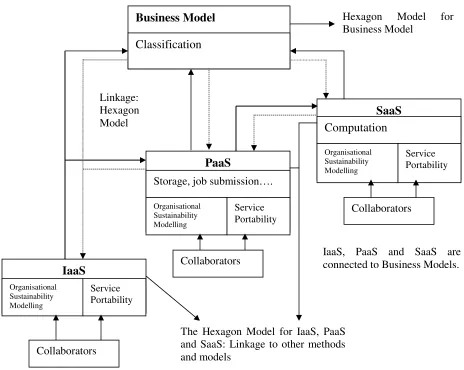
4.6. The Updated Architecture in the Cloud Computing Business Framework (CCBF) A framework is the most suitable approach to sum up all different areas and present them as a single, hybrid conceptual solution. This then leads to the development of the Cloud Computing Business Framework (CCBF), which includes all the work from each key area which can be performed independently and collaboratively with other areas within the CCBF. Refer to Figure 7.
portability and migration. In summary, the CCBF aims to deal with the following issues:
1. Classification: Business Model Classification to provide top-down strategies and case studies.
2. Organisational Sustainability Modelling: To measure cloud business performance systematically and coherently.
3. Service Portability: To ensure services are fully functional and operational after moving
platforms or applications to clouds, or after building new platforms or applications directly on clouds.
[image:15.595.79.543.194.564.2]4. Linkage: To provide linkage and guidelines for when and how to upgrade from a lower type of IT services to the next level, and to provide linkage and guidelines for IT services to Business, and to link to other research methods and models.
Figure 7: The Top Level Cloud Computing Business Framework (CCBF) in place
5. How four key areas are connected
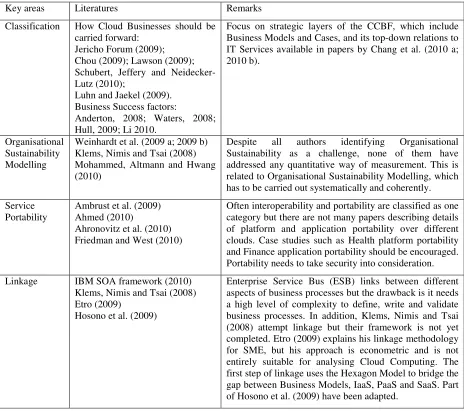
This section explains how the four key areas are connected to one another with the support from literatures. The summary of literature review, and
identification of any gaps or type of work which has not been carried out by others, are in Table 4. Figure 7 also presents the architecture which show how these four areas are connected.
IaaS
PaaS
SaaS
Storage, job submission….
Computation
Organisational Sustainability Modelling
Service Portability
Organisational Sustainability Modelling
Organisational Sustainability Modelling
Service Portability
Service Portability
Collaborators
Collaborators
Collaborators
IaaS, PaaS and SaaS are
connected to Business Models.
Business Model
Classification
Linkage:
Hexagon
Model
The Hexagon Model for IaaS, PaaS
and SaaS: Linkage to other methods
and models
Table 4: The current status for the CCBF four key areas
Key areas Literatures Remarks
Classification How Cloud Businesses should be carried forward:
Jericho Forum (2009); Chou (2009); Lawson (2009); Schubert, Jeffery and Neidecker-Lutz (2010);
Luhn and Jaekel (2009). Business Success factors:
Anderton, 2008; Waters, 2008; Hull, 2009; Li 2010.
Focus on strategic layers of the CCBF, which include Business Models and Cases, and its top-down relations to IT Services available in papers by Chang et al. (2010 a; 2010 b).
Organisational Sustainability Modelling
Weinhardt et al. (2009 a; 2009 b) Klems, Nimis and Tsai (2008) Mohammed, Altmann and Hwang (2010)
Despite all authors identifying Organisational Sustainability as a challenge, none of them have addressed any quantitative way of measurement. This is related to Organisational Sustainability Modelling, which has to be carried outsystematically and coherently.
Service Portability
Ambrust et al. (2009) Ahmed (2010)
Ahronovitz et al. (2010) Friedman and West (2010)
Often interoperability and portability are classified as one category but there are not many papers describing details of platform and application portability over different clouds. Case studies such as Health platform portability and Finance application portability should be encouraged. Portability needs to take security into consideration.
Linkage IBM SOA framework (2010) Klems, Nimis and Tsai (2008) Etro (2009)
Hosono et al. (2009)
Enterprise Service Bus (ESB) links between different aspects of business processes but the drawback is it needs a high level of complexity to define, write and validate business processes. In addition, Klems, Nimis and Tsai (2008) attempt linkage but their framework is not yet completed. Etro (2009) explains his linkage methodology for SME, but his approach is econometric and is not entirely suitable for analysing Cloud Computing. The first step of linkage uses the Hexagon Model to bridge the gap between Business Models, IaaS, PaaS and SaaS. Part of Hosono et al. (2009) have been adapted.
6. Research contributions: How does the
CCBF help organisations adopting it?
Each key area has helped different types of organisation in their pursuit of Cloud adoption and migration. Some of the selected examples are presented in each sub-section as follows.
6.1 Classification
There are three examples. Firstly, a number of Small and Medium Enterprises (SME) have followed the classification of the appropriate business models, and even adopt a combination of different business models to improve their business performance. One such SME is Anastaya, which adopts “Service Provider and Service Orientation”, “Support and Services Contracts”, “One-Stop Resources and Services”, “Venture Capital”, and “Entertainment and Social Networking”. This allows them to adopt different strategies and focus to suit different business requirements and customer demands. Secondly, the Guy’s and St Thomas NHS Trust (GSTT) and King’s College
London (KCL) have worked together in private cloud storage development to allow storage, exchange and interaction of data in a safe environment, where they have adopted “In-House Private Clouds” for a full private cloud development. Thirdly, the University of Southampton has several cloud projects and initiatives, and they have followed “Support and Services Contracts”, In-House Private Clouds” and “One-Stop Resources and Services” to improve their services for staff and students.
computed into 3D Visualisation, and not only there is no hidden data, but it also makes interpretation much easier and more time-saving than before, as those without prior backgrounds can understand the process (Chang et al., 2011 c). Secondly, the GSTT and NHS Trusts UK have worked with the authors in private Cloud projects, which were divided into NHS Infrastructure and NHS Bioinformatics. NHS Infrastructure confirms that using Cloud infrastructures can improve efficiency. It also results in raising the benchmark, the minimum acceptance level to complete concurrent tasks. NHS Bioinformatics shows that there is always an incremental improvement in the project. The low risk-free discount rate may imply code development allows reduced time to complete, and the objective is clearly met and project delivery is straightforward (Chang et al., 2011 b).
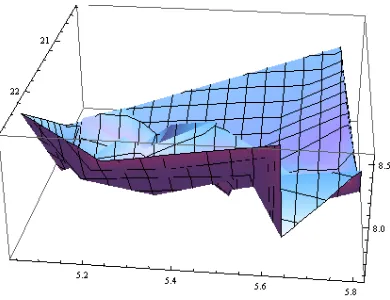
[image:17.595.73.268.514.664.2]Figure 8: 3D Visualisation for SME cost-saving
Figure 9: 3D Visualisation for SME cost-saving, 90 degrees rotation.
Thirdly, a SME in broadband service has used the CCBF to upgrade their services from IaaS to PaaS. It has provided data for our modelling, and Figure 8 and Figure 9 are our results in 3D Visualisation. It helps management to make the right decisions
and also understand the level of cost-saving in their Cloud migration.
6.3 Service Portability
Service Portability has helped several organisations in the migration and portability to Clouds. Firstly, the Commonwealth Bank of Australia (CBA) and IBM (US) has worked with the authors in Financial Software as a Service (FSaaS) that price fast, accurate and reliable pricing and risk modelling on Clouds. Advanced 3D risk modelling techniques using Least Square Methods (LSM) are presented, and allow 100,000 simulations to happen in between 4 to 25 seconds depending on the level of complexity. Security has been demonstrated to show Cloud portability in the Finance domain can be enhanced and integrated (Chang et al., 2011 a). Secondly, there are three projects at the University of Greenwich that adopt the CCBF for Cloud migration and portability. These three case studies include Sharepoint, Media Server and Supply Chain private cloud development. Status, benefits of adoption and progress are reported (Chang and Wills, 2013). Thirdly, the NHS Bioinformatics project offers two advantages:
(i) A PaaS for developers to simulate dynamic 3D modelling and visualisation for proteins, genes, molecules and medical imaging, where results can be instantaneous and data can be visualised, stored and shared securely.
(ii) Any complex modelling, such as growth of tumour and segmentation of brains, can be presented with the ease.
3D Bioinformatics simplifies the process of analysis, and also presents complex modelling in an interactive and easy to use source of knowledge engineering. For instance, firstly, high performance Cloud resources to simulate the growth and formation of tumours, and this allows scientists and surgeons to diagnose possibilities of tumour growth and gain a better understanding about treatment. Secondly, another project is the study segmentation of brains, which divides the brain into ten major regions. The Cloud platform has these two functions: (i) it can highlight each region for ten different segments; and (ii) it can adjust intensity of segmentation to allow basic study of brain medicine (Chang et al., 2011 d). See Figure 10.
Figure 10: Selected screenshots in Tumour modelling and segmentation of brain
x-axis: the return of anonymous SME cost-saving (20% - 23%) y-axis: risk premium for the market (7.5% - 8.5%)
6.4 Linkage
There are descriptions between Section 5.2 and 5.4 related to Linkage and its current status. Our work has lead to the proposal and development of Business Integration as a Service (BIaaS) allowing different services, roles and functionalities to work together in a linkage-oriented framework where the outcome of one service can be input to another, without the need to translate from one domain or language to another. The current status is BIaaS 1.0, and the further development to BIaaS 2.0 is in progress (Chang et al., 2011 c). There are three examples. Firstly, BIaaS conceptual framework is used in Scientific Workflow focusing on MyExperiment (an e-Science platform to share and analyse data), and how Linkage can help to achieve the following:
• Understand how developers, users, reviewers and musicians use MyExperiment for digital research and activities, and to suggest any improvements for BIaaS.
• Establish case studies based on users’ success
stories and to disseminate knowledge in highly-rated conferences and journals.
Secondly, the University of Southampton has adopted BIaaS 1.0/2.0 for Linkage, where Figure 11 shows a generic BIaaS that the University adopts. The explanation is as follows. The University has followed the appropriate business models advised by Classification. It also provides data for cost saving and technical added values, which are computed by Organisational Sustainability Modelling (OSM). Our major
[image:18.595.73.463.462.684.2]contribution in this aspect is to present complex statistical analysis using 3D Visualisation, so that no data can be missed for analysis, and also those without advanced statistical backgrounds can understand the results. This is useful for many decision-makers and directors who need to know business analytic results quickly but do not wish spend too much time in understanding them. The next step involves cost-saving for risk modelling, where the Least Square Methods (LSM) can be used to compute up to 100,000 simulations in one go to ensure a high level of accuracy. This ensures speed and performance are acquired via Cloud computation. To perform risk modelling, American and European options are used, as both models are popular choices within MCM for financial risk analysis. When work for Service Portability has been completed the result is passed onto the CCBF Review. This allows the University policy makers to decide the best use of Cloud Computing and its impacts for Operations Management. They can understand what is the best business model and operational model for the university private cloud, the extent of the cost-saving involved, and the exact risk analysis of the private cloud can offer, and whether all of these operational and risk events are under control. The entire analysis takes a short time. In addition, BIaaS 1.0/2.0 can work as an independent solution, or jointly work with ERP and CRM. This provides a greater flexibility. Figure 11 shows how BIaaS works for Classification, Organisational Sustainability Modelling and Service Portability for the the University of Southampton.
Figure 11: A generic Business Integration as a Service (BIaaS) that the University of Southampton adopts Second
research area
Statistics and Computa tion
Resource Activity Process
CCBF Review
and Recomme
ndation (ERP/CRM equivalent)
mitigate impacts
Risk analysis and modelling
Risk Mitigates
Data from
collaborators
Risk Controls & Risk Management
- Process & Technology Counter measures Third research area (Service Portability)
manage Technical and Business
Challenges
Identify which areas in the CCBF fit the most.
Use Cloud Computing Business Framework (CCBF) to design, deploy and review
3D Modelling
(stand alone projects)
Risk Modelling
(stand alone projects) First research area
6.5 How CCBF can help practitioners
The CCBF is a dynamic framework that identifies the organisational needs and then designs Cloud systems, applications or services based on user requirements. CCBF deploys, migrates and supports services using Cloud strategies, technologies and resources. How CCBF can help practitioners can be summed up as follows:
• Classification: The lead author spent a period
of time in fieldwork and presentations where he met several Directors and senior managers from large organisations and SME. Some of them have either considered or have used the recommendation from Classification in their Cloud business models and strategies.
• Organisational Sustainability Modelling (OSM): This provides a systematic and structured way to measure ROI in technical, or cost or user aspects of Cloud adoption. Organisations with data and 3D analysis include NHS UK (Chang et al., 2011 b), Vodafone/Apple (Chang et al., 2011 e; 2012 a), SAP (Chang et al., 2011 e), and University of Southampton (Chang et al., 2011 c).
�