Journal of Chemical and Pharmaceutical Research, 2014, 6(12):706-710
Research Article
ISSN : 0975-7384
CODEN(USA) : JCPRC5
Preparation and characterization of metal complexes of
Tungsten(VI) with biologically active Schiff bases
Zamir Ahmed Mirza*, Mohd Saleem, Mohd Sadeeq, Farkhana Kosser and Saima Irm Mirza
Faculty of Research and Development, Sainath University, Ranchi
_____________________________________________________________________________________________
ABSTRACT
A new series of complexes of the type, [WO(NCS)4 L-L] (where L-L are amine substituted biologically active Schiff bases with general formula , R1N = CHR2. Here R1 is 4-aminosalicylic acid & R2is 4-chloro-benzaldehyde, 2-chloro-benzaldehyde, salicyladehyde, vanillin and benzaldehyde) have been prepared by reaction of ammonium tetra-isothiocyato-oxotungstate(VI) with the corresponding ligand in aqueous medium in the presence of hydrochloric acid. The complexes have been characterized by elemental analysis, molar conductivity, magnetic susceptibility, infrared spectroscopy and 1HNMR spectroscopy. The metal complexes have been screened for their biological activities against bacteria Micrococcus luteus, Enterococcus faecalis, Alcaligenes denitroificans & Klebsiella pneumoniae. The metal complexes show more potent activities compared with Schiff base ligands.
Keywords: Schiff bases, Benzaldehyde, IR, 1HNMR, Elemental analysis, Biological activities.
_____________________________________________________________________________________________
INTRODUCTION
The chemistry of metal complexes with Schiff base ligands have attracted continuous attention for the synthetic chemists due to their ease of synthesis, stability under a variety of oxidative and reductive conditions especially in aqueous medium [1]. However oxo-tungsten complexes are few, probably because of non-availability of suitable starting material. The tungsten containing oxo-transferase enzymes have been found in some acetate and methane producing micro-organisms as well as hyper-thermophilic bacteria [2,3].
Schiff bases have been reported for their biological properties, such as, antibacterial, anti-fungal activities [4-7]. Their metal complexes have been widely studied because they have anticancer and herbicidal applications [8,9].
O-phenylenediamine Schiff bases show clinical properties [10]. Isatin Schiff bases were reported to possess antiviral, anti HIV, anti-protozoan, anti-helminthic activities [11]. They also exhibit significant anti-convulsion activity, apart from other pharmacological properties[12]. Certain Cobalt Schiff base complexes are potent antiviral agents[13]. Schiff bases derived from 4-dimethyl amine benzaldehyde shows anti-bacterial activities. In medicines they are used as antibodies and anti-inflammatory agents [14-19].
EXPERIMENTAL SECTION
4-Amino-salicylic acid (Himedia), 4-Chloro-benzaldehyde (Himedia), 2-Chloro- benzaldehyde(Himedia), Salicylaldehyde(Aldrich), Vanillin(Himedia) and Benzaldehyde (Himedia) were used as supplied. The analysis of tungsten (VI) was carried out by gravimetric method. Carbon, hydrogen, nitrogen and sulphur were analyzed micro-analytically using CHNS analyser of Leco- model 932. Melting points for the prepared complexes were obtained by electric melting point apparatus. Molar conductivity in DMF at room temperature was measured by an Elico conductivity bridge of type CM82T having a conductivity cell with a cell constant of 0.90 using 10-3mol L-1solution of complexes. IR spectra of complexes over the region 4000-400 cm-1 were recorded on an FTIR spectrophotometer made by Perkin-Elmer, using KBr discs. 1HNMR of the complexes were determined in DMSO on Bruker spectrophotometer. Antimicrobial activity was studied against the bacterial strain viz. M.luteus, E.faecalis, A.
dinitroificans & K. pneumoniae
RESULTS AND DISCUSSION
Sodium tungstate dihydrate (0.00363mol) and ammonium thiocyanate (0.38mol) were dissolved in water (30ml) at room temperature and 7.5 ml of 11M HCl was added to the reaction mixture. The resulting yellow solution was cooled in an ice bath and an equimolar solution of the corresponding ligand (L-L) (where L-L= bidentate Schiff bases) was added to the solution. The reaction mixture was left undisturbed for one hour in an ice bath. The precipitates formed were filtered under suction, washed three to four times with water containing a few drops of HCl and dried in vacuo.
NaWO4.2H2O + 4NH4SCN → (NH4)2[WO2 (NCS)4] + 2NH4OH +2Na+
[image:2.595.53.565.404.699.2](NH4)[WO2(NCS)4] + L-L → [WO(SCN)4L-L] + NH4OH
TABLE 1: Physical data of Complexes
S.No. Compound Colour Melting point
(0C )
Elemental analysis, found (calculated)
W C H N S
1 W(SCN)4-L1 Dark yellow 230
27.80 (28.00) 32.57 (32.87) 1.45 (1.52) 10.50 (10.65) 19.30 (19.48)
2 W(SCN)4-L2 Dark red 245 (26.21) 26.00 (32.47) 32.20 (1.70) 1.60 (9.97) 9.85 (18.23) 18.10
3 W(SCN)4-L3 Light green 264 (26.66) 26.30 (31.30) 31.00 (1.30) 1.20 (10.14) 10.00 (18.55) 18.40
4 W(SCN)4-L4 brown 242 26.40
(26.66) 30.90 (31.30) 1.15 (1.30) 10.05 (10.140 18.30 (18.55)
Conductance Measurement
Molar conductance is in the range 15-21 mho cm2mol-1, when molar conductance of these complexes was measure in 10-3 M DMF, which is much less than the value for 1:1 electrolytes in DMF. Thus these complexes are non-electrolytic in nature.
Infrared spectra
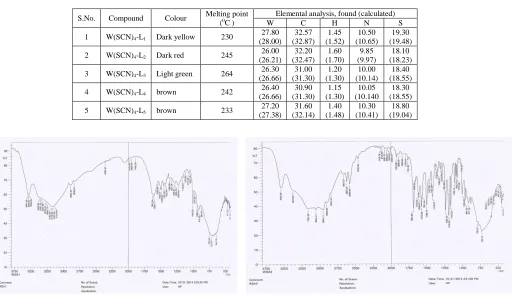
The IR spectra of ligands and their respective complexes were compared, it has been found that all the complexes exhibit a band due to ν (W=0) in the region 938-977 cm-1which was absent in the free ligands, indicates the presence
of oxo group in all the complexes. The band for ν (C=N), ν(CS) and ν(NCS) were observed in the spectra of the
complexes at 2043-2083 cm-1, 750-795 cm-1 and 471- 490 cm-1. The bands in the region 1639 cm-1is attributed to the v (C=N) in the spectras of all the complexes, Figs a and b.
1
HNMR spectra
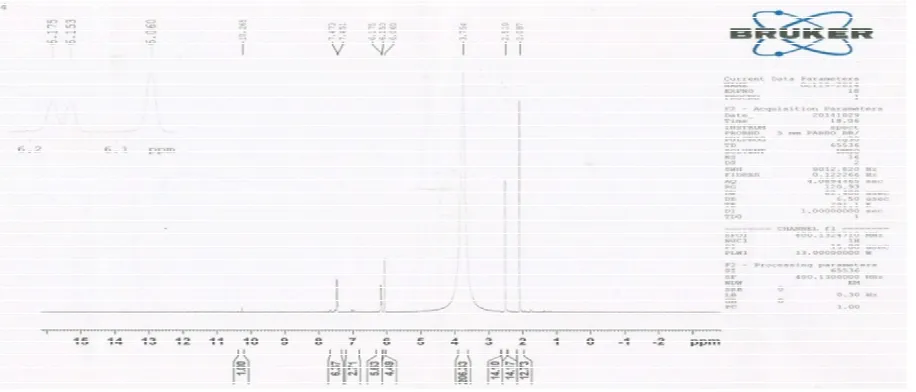
The 1HNMR spectra of ligands and their respective complexes in DMSO solution were also compared. The free NH2 protons usually show a broad singlet peak in a region of 4-6 ppm[19]. This signal is absent in the observed
spectra of Schiff bases which indicates the formation of Schiff bases. The peaks for aromatic proton exhibits signals in the region6.06 - 7.42 ppm. The 1HNMR spectra of all the complexes exhibits signals at 10.26 and 10.35 ppm due to CH=N- group. (Fig.c)
Fig. c
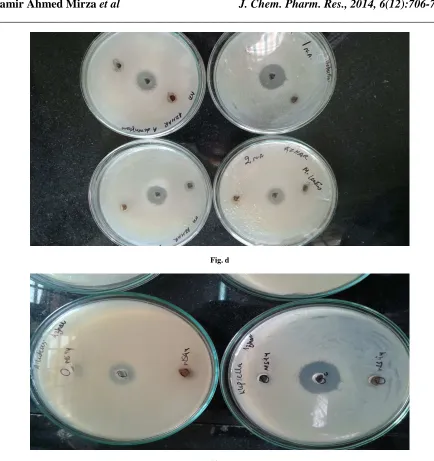
Antibacterial activity
[image:3.595.77.535.317.513.2]Fig. d
Fig. e
CONCLUSION
On the basis of above studies it was found that all the complexes were monomeric with general formula WO(SCN)4L-L( Where L-L =Bidentate biologically active Schiff bases) having +6 oxidation state of tungsten.
REFERENCES
[10] AM Mahindra, JM Fisher.Rabinovitz, Nature (London), 1983,303, 64.
[11] SN Pandeya; P Yogecswari; D. Sriram. Chemotherapy,1999,45,192.
[12] WJ Sawodny; M. Riederer.Angew. Chem. Int. Edn. Engi.1999, 16, 859.
[13] A Bottcher; T Takeuchi; MI Simon; TJ Meade; HB Gray. J. Inorg. Bio-Chem.,1995, 59, 221.
[14] GLP Britovsek; VV Gibson; S Mastroianni; DCH Oakes; C Redshaw; GA Solan; AJP White; DJ Williams. Eur. J. Inorg. Chem.,2001, 431, 2.
[15] B Sun; J Chen; JY Hu Lix.J. Chin. Chem. Soc.,2001, 12, 1043.
[16]DMBoghaei; S Mohebi. Tetrahederon.,2002, 58, 5357.
[17] SY Liu;DGNocera. Tetrahedron Lett.,2006, 4, 1923.
[18] A Budakoti; M Abid ; A Azam. Eur. J.Med. Chem.,2006, 41, 63.