Journal of Chemical and Pharmaceutical Research, 2014, 6(6):2816-2822
Research Article
CODEN(USA) : JCPRC5
ISSN : 0975-7384
Research of X-ray image fast de-noising method of power
equipment based on GFNL algorithm
Zhanjie Lv
1,3*, Jin Wang
2, Guiji Tang
1, Zhangqin Wu
2and Guodong Han
1,31
School of North China Electric Power University, Baoding, China
2
Electric Power Research Institute
,
Yunnan Electric Power Test & Research Institute Group
Co Ltd, Kunming, China
3
Graduate Workstation of North China Electric Power University & Yunnan Power Grid
Corporation, Kunming, China
_________________________________________________________________________________________
ABSTRACT
The method of X-ray fault detection is more widely in power equipment, for the effects of irradiation environment detection systems and X-ray images are subject to a variety of imaging noise disturbance, there will be a variety of poor contrast, poor uniformity background, ambiguity and large shortcomings. Currently used in the Poisson noise into white Gaussian noise methods and the use of wavelet shrinkage method will result in a large number of image detail is lost, the optimal parameters studied gradient X-ray image blur fast non-local means filtering de-noising (GFNL) method, which retain the original image details while effectively removing image noise, power failure has important implications for diagnostic equipment.
Keywords: GFNL algorithm, Power equipment, X-ray, Image de-noising.
___________________________________________________________________________
INTRODUCTION
In modern society, X-ray detection plays an integral role in security, medical, industrial testing, etc., to promote economic development has become an important force. With the rapid development of computer technology, image processing technology and a variety of peripheral technology, the X-ray inspection of the traditional NDT methods to get great progress [1]. X-ray digital imaging system in the detection of electrical equipment has convenient, real-time, without disassembly, the image processing, etc., and gradually get more power fault detection.
THEORETICAL SECTION
Studies have shown that X-ray imaging system image degradation is mainly due to the system of random noise. X-ray generation and interaction with matter, in both time and space to satisfy Poisson random process. For fast X-ray imaging systems, due to the exposure time is short, X-ray quantum noise generated more prominent, seriously affecting the quality of the image. Currently on the X-ray image de-noising There are two methods: one is the square root image noise, the Poisson noise into Gaussian white noise, and then use the more mature Gaussian noise reduction algorithm; Another using wavelet shrinkage method [3-6]. However, these methods will result in a large number of image detail is lost. To solve this problem, we studied the X-ray image gradient optimal parameters of fuzzy non-local means filtering rapid de-noising methods.
NL-means algorithm originated in the neighborhood filtering algorithm is a generalization of neighborhood filtering algorithm, its similarity to get the whole weight distribution of gray area surrounding pixels, reducing image noise while maintaining a strong image spatial resolution capabilities. While this method of calculating the capacity, processing speed, particularly when dealing with larger image, this problem is more prominent; Moreover, the method can introduce artificial image artifacts in smooth regions, the image becomes blurred, the spatial resolution is affected.
For the digital image,
v
=
v i
( ).(
i
∈
I
)
,theI
is set of pixel, the algorithm NL case expression is:)
(
)
,
(
)
(
i
w
i
j
v
j
NL
I j
∑
=
∈ (1)
Wherein the weight:
) ) ( ) ( (
2 2 2
)
(
1
)
,
(
hN V N v
a j i
e
i
Z
j
i
w
− −
=
(2)2 2 2 ( ) ( )
( )
i j a
v N V N h
Z i
e
− −
= Σ
(3)Where 2
2
(
i)
(
j)
a
v N
−
v N
is the weighted distance of i and j pixels located two gray level neighborhoodGaussian. In Buades theoretical analysis and experimental results show that the recent studies, NL-Means algorithm on both subjective and objective performance than common image de-noising algorithms, such as Gaussian filtering, anisotropic filtering, the total error is minimized, neighborhood filtering, etc. it originated in the neighborhood filtering algorithm is a generalization of neighborhood filtering algorithm, its similarity to get the whole weight distribution of gray area surrounding pixels, reducing image noise while preserving image has a strong spatial resolution capacity rate [7].
When using a conventional image NL complex algorithm, the calculation amount is large, the processing speed is slow, especially when dealing with large image, this problem is more prominent; Moreover, the method can introduce artificial image artifacts in smooth regions, the image blurred, the spatial resolution is affected. In order to solve the above problems, this paper the traditional NL-means method to improve, Prewitt operator to introduce the use of gradient information of the image, this can effectively reduce the correlation between neighboring pixels of the image, making the smoothing smoother, you can eliminate the artificial artifacts, and the image has not been a place rich texture blur. While the original NL denoising algorithm to reduce complexity and save computing time to adapt to industrial production tasks testing needs. NL algorithm based on the principles of traditional bilateral filter, consider not only the gray image attributes, but also consider its geometric properties, therefore, a study of the proposed algorithm can achieve similarity measure gray and geometric properties, and combining traditional NL-Means filtering algorithm, making filtering method not only for the cycle repeating pattern images more images have excellent de-noising effect, for redundancy is not high image processing can achieve better results.
artificial artifact, but not where the rich texture are blurred in practice ∆ν can inhibit the effects of noise Prewitt
operator to calculate, the main principle is to first use Prewitt operator to introduce gradient information, combined with image variance to determine the approximate optimal filter parameters h, due to the gradient operator can be introduced to reduce the correlation between image pixels, so the original NL de-noising algorithm complexity reduction, to save computation time [8].
In order to solve the above problems, this paper the traditional NL-means method to improve the use of information contained gradient Prewitt operator to extract the image gradient information, effectively reducing the correlation between neighboring pixels of the image, making the smoothing smoother, you can eliminate artificial artifacts, and the image has not been a place rich texture blur. Meanwhile fuzzy gradient optimization algorithms, and adjust filter parameters adaptively according to the noise model, optimal denoising effect [9].
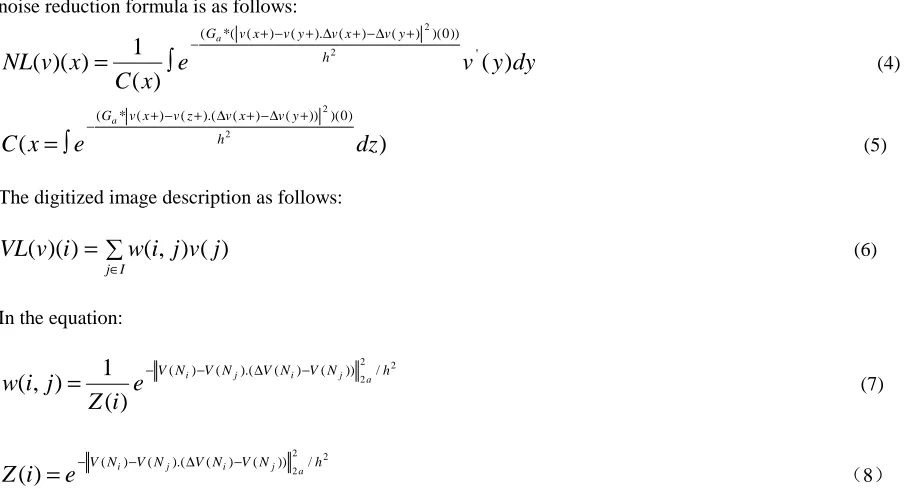
NL-means algorithm for the shortcomings, the project studied the NL-means algorithm gradient correction, image noise reduction formula is as follows:
dy
y
v
e
x
C
x
v
NL
h y v x v y v x v Ga)
(
)
(
1
)
)(
(
' )) 0 )( ) ( ) ( ). ( ) ( ( * ( 2 2 + ∆ − + ∆ + − + −∫
=
(4))
(
2 2 ) 0 )( )) ( ) ( ).( ( ) ( * (dz
e
x
C
h y v x v z v x vGa +− + ∆ +−∆ +
−
∫
=
(5)The digitized image description as follows:
∑
=
∈I jj
v
j
i
w
i
v
VL
(
)(
)
(
,
)
(
)
(6)In the equation:
2 2 2 / )) ( ) ( ).( ( ) (
)
(
1
)
,
(
e
V Ni V Nj V Ni V Nj a hi
Z
j
i
w
=
− − ∆ − (7)2 2 2 / )) ( ) ( ).( ( ) (
)
(
i
e
V Ni V Nj V Ni V Nj a hZ
=
− − ∆ − (8)Where the
∆
V
is the gradient information of the image. Prewitt use has the effect of suppressing noise operator to calculation methods. Prewitt operator, which is a discrete differential operator for gradient approximation of computing the image brightness function. Use this image at any point operator, will produce a corresponding gradient vector or its normal vector.Assuming gray image satisfy the following relation:
γ
β
α
+
+
=
x
y
y
x
I
(
,
)
(9)Wherein the gradient is a, then each pixel value of eight neighboring pixels can be obtained in a matrix of 3*3, a weighted average, taking the horizontal and vertical components of base sub-template, the two templates were convolved with the original image , get directions layers are:
max
2 2
(
f
)
x yg
g
g
r
∂
=
=
+
[image:3.595.73.526.228.476.2]∂
(10)(a) Original picture (b) Sobel handling (c)Roberts handling (d)prewitt handling
Fig. 1 Different gradient operator to extract the results
NL-Means algorithm FNL conventional algorithm, the complexity of the maximum weighted distance between the two Gaussian pixel, because each pixel should be calculated for all pixels in the region around the value of its distance, and calculates the weighted distance here weights. Algorithm based on the principle of pixel neighborhood and search the entire image should be calculated over the entire image area, then the efficiency is too low, poor usability engineering, which increases the complexity of computation [10,11].
Therefore, in order to improve the computational efficiency, the window select two parallel computing by providing two window size, a window size is the pixel neighborhood K × K, a neighborhood of pixels in the search window, the window size L × L, i.e. L × L-size region inside the neighborhood of the selected pixel size K × K execution NL-means algorithm, K × K in the region of the sliding window of size L × L, the region is determined based on the similarity of the central pixel area contribution of the right gray value. For larger common noise image, and generally K = 7, it is sufficient to take L = 21, and for low-noise image K = 3, L = 7 can satisfy the basic requirements of noise. K and L. Projects to take to set the window size according to the noise level, noise level for different input is divided into several levels of five levels, namely, low noise, low noise, medium, high, and high noise, different settings for different noise processing window.
EXPERIMENTAL SECTION
When a high voltage circuit breaker system equipment repair and maintenance workload of the largest equipment in recent years, many researchers dedicated to fault diagnosis of high voltage circuit breaker. Implementation of digital X-ray imaging detection, you can not open the device will be able to understand its internal fault defects for early detection of potential failure, the failure to determine the location and type is important, and work more efficiently [12].
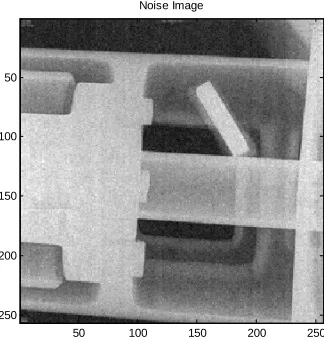
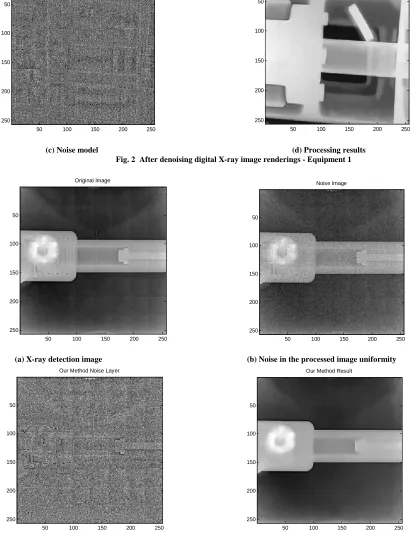
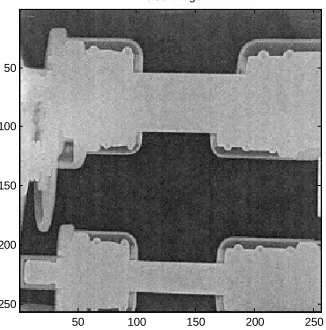
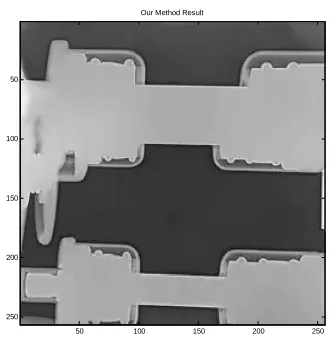
Fig. 2 shows the X-ray detection circuit breaker scanned image, the image clearly see objects in a rectangular circuit breaker foreign object. Figure 3 X-ray digital images contain horizontal and vertical noise, you can clearly see the movement of the contact position of the breaker. Figures 4 and 5 for the noise-canceling effect diagram containing varying degrees of vertical noise.
Original Image
50
100
150
200
Noise Image
50
100
150
Nonlocal Means Noise Layer
50 100 150 200 250
50
100
150
200
250
Nonlocal Means Result
50 100 150 200 250
50
100
150
200
250
[image:5.595.345.508.74.258.2](c) Noise model (d) Processing results Fig. 2 After denoising digital X-ray image renderings - Equipment 1
Original Image
50 100 150 200 250
50
100
150
200
250
Noise Image
50 100 150 200 250
50
100
150
200
250
(a) X-ray detection image (b) Noise in the processed image uniformity
Our Method Noise Layer
50 100 150 200 250
50
100
150
200
250
Our Method Result
50 100 150 200 250
50
100
150
200
250
[image:5.595.92.511.114.658.2]Original Image
50 100 150 200 250
50
100
150
200
250
Noise Image
50 100 150 200 250
50
100
150
200
250
(a) X-ray detection image (b) Noise in the processed image uniformity
Our Method Noise Layer
50 100 150 200 250
50
100
150
200
250
Our Method Result
50 100 150 200 250
50
100
150
200
250
[image:6.595.351.514.491.656.2](c) Noise model (d) Processing results Fig. 4 After denoising digital X-ray image renderings - Equipment 3
Original Image
50 100 150 200 250
50
100
150
200
250
Noise Image
50 100 150 200 250
50
100
150
200
250
Our Method Noise Layer
50 100 150 200 250
50
100
150
200
250
Our Method Result
50 100 150 200 250 50
100
150
200
250
[image:7.595.347.513.75.252.2](c) Noise model (d) Processing results Fig. 5 After denoising digital X-ray image renderings - Equipment 4
RESULTS AND DISCUSSION
X-ray system of random noise is present in a digital image, the study shows, X-ray generation and interaction with material at the time and space Poisson random process. A digital imaging device for the power system based on a perspective X-ray detector, since the exposure time is short, X-ray quantum noise generated more prominent, affecting image quality. Accordingly, the first uniform noise model using GFNL algorithm extracts the noise model, the noise reduction processing scanned images, while reducing image noise has a strong ability to maintain spatial resolution, while the smoothing smoother eliminate system with noise, and the image has not been a place rich texture blur, electrical equipment maintenance tasks can be adapted to the testing needs, can be seen from Figure 2-5, using the proposed algorithm can get an X-ray picture noise is good deal.
CONCLUSION
Through the traditional NL-means method to improve the use of information contained gradient Prewitt operator to extract image gradient information developed GFNL algorithm, making filtering method not only for the cycle repeating pattern images more images have excellent denoising effect, for redundancy is not high image processing can achieve better results, effective treatment of the noise problem X-ray image of the X-ray detection power after equipment failure has important reference value.
REFERENCES
[1] B Xiaoyan; T Yongping; ZH Zhaodong. NDT., 2002, 24(5), 191-193. [2] H Lei; Z Wei; T Qingyan. Information Technology., 2007, 18(7), 81-83. [3] L Zhengfei. Mechanical Engineering & Automation., 2010, 13(2), 64-66. [4] Z Li; W Like; Y Feng. Image Processing., 2006, 10(3), 293-295.
[5] D Tangren; T Jingquan; DM Qingduo. Acta Electronica Sinica., 2004, 32(6), 977-979.
[6] D Tangren; T Jingquan; LYe. Journal of Changchun University of Science and Technology., 2003, 26(2), 26-28.
[7] L Yanmei; R Yunbo; C Leiting. Journal of Computational Information Systems., 2012, 21(6), 8065-8073. [8] Z Lixin; W Pingan; X Deshen. Journal of Computer Research and Development., 2007, 44(8), 1390-1398. [9] W Ying; Z Guangyu. Computer and Information Technology., 2001, 19(4), 8-12.