Civil Engineering Journal
Vol. 4, No. 2, February, 2018
Mechanistic Approach for Reducing the Thickness of Asphalt Layer
Incorporating Steel Slag Aggregate
Adham Alnadish
a*,
Yusri Aman
aa Faculty of Civil and Environmental Engineering, Universiti Tun Hussein Onn Malaysia- 86400 Parit Raja, Malaysia. Received 17 January 2018; Accepted 27 February 2018
Abstract
This study aimed to evaluate the possibility of reducing the thickness of asphalt layer as a novel solution for the high density of asphalt layer incorporated with steel slag aggregate, which increase the cost of transportation. Mechanistic-Empirical Pavement Design (MEPDG) approach was employed to evaluate the benefits of introducing polyvinyl alcohol fiber in terms of reducing the thickness of asphalt layer as well as the extension service life of asphalt layer. On the other hand, the correlation between creep strain slope (CSS) and secant creep stiffness modulus (SCSM) were assessed to provide a better evaluation and understanding concerning of the outputs of the dynamic creep test. The findings of this study showed that introducing polyvinyl alcohol fiber into the mixtures at the optimum content (0.5 kg/ton) have reduced the thickness of asphalt layer by approximately 10%. Additionally, polyvinyl alcohol fiber has increased the performance of the asphalt mixtures concerning of resilient modulus and dynamic creep. Furthermore, the correlation between CSS and SCSM was strong, which indicates that evaluation of permanent deformation using CSS and SCSM parameters provides better actual assessment than accumulation strain.
Keywords: Shear Stress; Asphalt; Steel Slag; Polyvinyl Alcohol; Fiber; Reduce Thickness; Creep Strain Slope; Secant Creep Stiffness.
1.
Introduction
Asphalt mixture is a composite material containing coarse and fine aggregate, filler, and bitumen [1]. However, consumption of the natural aggregate has been increased due to the increasing projects in pavement applications [2]. As a result, there have been considerable efforts by researchers over the last two decades to reduce the increasing demand for the natural resources in the civil applications by using plants wastes as an alternative [3]. In this regard, steel slag is considered as a well-known by-product of steelmaking, which is used in the civil applications. Steel slag is produced by two manufacturing processes, which are basic oxygen furnace (BOF) and electric arc furnace (EAF) [4, 5]. Moreover, steel slag aggregate has been used for many decades due to its ability to enhance the performances of asphalt layer. Above that, the production of asphalt mixtures from slag instead from natural aggregate would decrease the amount of raw material extraction and enable further environmental benefit since less industrial by-products would be disposed in landfills [6].
Several studies have evaluated the utilization of steel slag aggregate in the asphalt mixtures as a partial or total replacement to the natural aggregate. Based on their finding, replacing the natural coarse aggregate by steel slag (EAF) exhibited better performances in contrast to control asphalt mixtures that containing 100% of the natural aggregate in connection with resilient modulus, dynamic creep, cracking resistance, fatigue resistance and moisture susceptibility. These enhancements were attributed to the properties of the steel slag aggregate (EAF) with reference to roughness, angularity, hardness, as well as it provides better interlocking and durability [6-13]. On the other hand, steel slag
* Corresponding author: [email protected]
http://dx.doi.org/10.28991/cej-030995
This is an open access article under the CC-BY license (https://creativecommons.org/licenses/by/4.0/).
aggregate has disadvantages concerning of its high specific gravity, which is considered as a main concern due to the transportation cost [14]. Additionally, replacing the natural aggregate by 100% of steel slag requires higher amount of bitumen due to its high porosity thus leads to compatibility problems during paving [15]. Furthermore, steel slag consists of free lime (Cao) and free magnesia oxide (Mgo), which reacts with water, thus expansion volume may have occurred, the amount of those chemicals depends on the production process. Free lime content should be less than 4%, so that the asphalt layer is not exposed to cracking due to the expansion, if quantity of the free lime exceeds 4% the steel slag should be weathering in order to reduce free lime content [16, 17].
Conversely, rapid increase in traffic volume with heavy loading and environmental impact has cause early damages, which deeply affect the service life of pavement layer [18]. Therefore, engineers have provide evidence that the weak tensile strength of asphalt layer as major concern, which brings about adverse effect on the asphalt mixture performances, which reduces the service life of asphalt layer and requires a full depth maintenance, thus consumption of additional costs [19]. The major issue regarding the tensile properties includes the failures related to the fatigue cracking at moderate and low temperature; therefore, the asphalt layer required rehabilitation instead of regular maintenance. Additionally, increasing costs of material and rising consumption of natural resources have prompted engineers and researchers to find alternatives for road construction or rehabilitation [20].
Consequently, introducing fiber in the asphalt mixture is one of the distinctive alternatives for enhancing the efficiency of asphalt layer to resist loads inflicted upon it. Besides, adding fibers to asphalt mixtures may reduce asphalt layer thickness and increase the services life of pavement, thus minimizing transportation cost of the material, particularly for the materials that have a high density, as well as reducing the demand for the natural aggregate [21-23]. Hence, introducing fiber into asphalt mixtures that containing steel slag aggregate may reduce transportation costs as well as provide high performances of asphalt mixture, with regard to the resistance of cracking that developed at the bottom of the surface layer (wearing layer) due to the applied stress by vehicles. In other words, the higher asphalt mixture performance, the higher service life of asphalt layer [24].
2.
Materials and Experimental
2.1. Materials
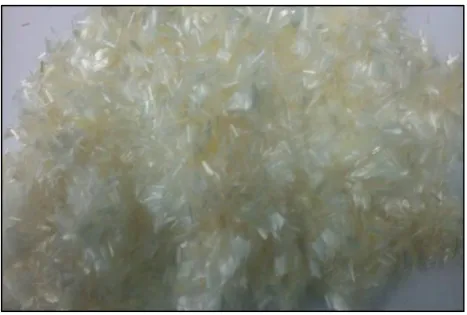
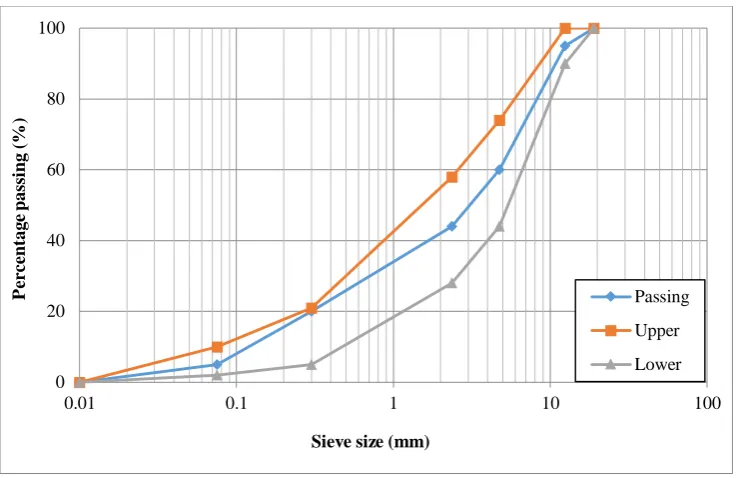
[image:2.595.187.421.527.684.2]A 80/100 grade of bitumen produced by Petronas, Malaysia was used in the experimental. Conventional tests were conducted to identify the properties of the binder such as penetration, ductility, softening point and viscosity. The physical properties of the binder are summarized in Table 1. Two types of aggregate were used in this study; Electric Arc Furnace (EAF) steel slag aggregate obtained from NSL, Singapore and crushed granite aggregate supplied by Hanson quarry located in Batu Pahat, Johor, Malaysia. In addition, Polyvinyl Alcohol supplied from Mainland, China was used; Table 2 displays the physical properties of the Polyvinyl Alcohol, which is provided by the supplier and Figure 1. shows shape of the fibers, respectively. A dense fine graded with 12.5 nominal maximum size aggregate was selected. Table 3. presents the properties of the steel slag and granite aggregate. In addition, Figure 2 describes the selected gradation of the aggregate within Superpave specification.
Figure 2. Gradation of designed aggregate
Table 1. Physical properties of the bitumen
Table 2. Polyvinyl Alcohol physical properties
Table 3. Physical properties of the aggregate
properties EAF Granite Specification Standard
Loss Angeles Abrasion 17.8 19.75 ≤ 25% ASTM C 131
Aggregate Crushing Value 22.6 25.4 ≤ 25% IS: 2386 (Part IV)
Bulk S.G 3.22 2.75 n/a ASTM C127
Water absorption (%) 2.75 0.843 ≤ 3% ASTM C127
Free CaO content (%) < 4% n/a 4% -
0 20 40 60 80 100
0.01 0.1 1 10 100
P
er
ce
n
tag
e
p
as
si
n
g
(%
)
Sieve size (mm)
Passing Upper Lower
Properties Test value Standard
Penetration at 25°C, 1/10 mm 87 ASTM D 36 - 06
Ductility at 25°C (cm) > 100 ASTM D 113 - 07
Softening point 49 ASTM D 36 - 06
Specific gravity at (25°C) (g/cm3) 1.02 ASTM D 70 - 09
Viscosity @ 135 °C (cP) Viscosity @ 165 °C (cP)
487
144 ASTMD44
Mixing temperature Compaction temperature
160 °C
150 °C ASTM D4402
Material Property Measure
Material Polyvinyl Alcohol (PVA)
Density 1.29 (g/cm3)
Tensile Strength >1200 MPa
Modulus >28 (GPa)
Melting Point > 200 °C
Colour Light yellow
Length 6 mm
[image:3.595.149.446.496.632.2] [image:3.595.108.488.660.749.2]2.1.Mixtures Design
In this study, the asphalt mixtures containing coarse steel slag aggregate were incorporated with Polyvinyl Alcohol fibers at different proportions; i.e. 0.05, 0.15 and 0.3% by the total weight of the aggregate in order to produce reinforced asphalt mixtures. Mix0 and Mix1 represents the asphalt mixtures that containing 100% of granite and coarse steel slag aggregate, respectively. Meanwhile, Mix2, Mix3 and Mix4 corresponds to the asphalt mixtures containing coarse steel slag aggregate and incorporating of Polyvinyl Alcohol at different content; i.e. 0.05, 0.15 and 0.3% by total weight of the aggregate, respectively. The asphalt mixtures were prepared based on the Superpave specification [25]. Prior mixing, the aggregate was heated in the oven at the mixing temperature of 160 °C for four hours to ensure uniform temperature distribution within the aggregate. Then, the heated aggregate and bitumen were mixed in automatic mixer for one minute; then the fibers were introduced to the mixture and thoroughly mixed for another two minutes. This method called composite mixing. Thereafter, the mixtures were kept in the oven for two hours at the compaction temperature (150 °C) to simulate short-term aging, which represents producing, transportation and placing of the mixture in the field [1].
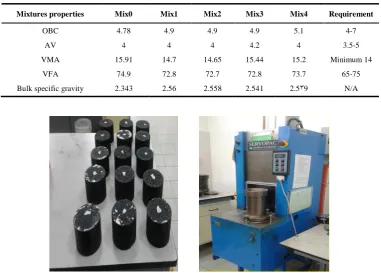
[image:4.595.107.489.357.630.2]The Superpave gyratory compactor was used to produce the compacted asphalt mixtures by adopting 600 kPa pressure with 1.25° angle and speed of 30 rpm. 100 gyrations were employed, which based on the traffic load in the range of 3 to 30 million ESALs. Therefore, the volumetric properties of the mixtures were determined to meet the requirements of Superpave specifications. However, Figure 3 displays the Servopac Superpave Gyratory Compactor (SGC) and some of the produced samples. Table 4. shows the volumetric properties of the mixtures. As can be observed in Table 4, the asphalt mixtures comprising of polyvinyl alcohol fiber showed slightly lower bulk specific gravity as compared to the control mixtures. This was attributed to the slight increase in the thickness of the samples (0.5-1 mm). Thus, the samples weight in the water was increased in which the weight of the samples in water depends on the weight of the water displaced by the sample and the sample dimensions (volume).
Table 4. Volumetric properties of the asphalt mixtures
Mixtures properties Mix0 Mix1 Mix2 Mix3 Mix4 Requirement
OBC 4.78 4.9 4.9 4.9 5.1 4-7
AV 4 4 4 4.2 4 3.5-5
VMA 15.91 14.7 14.65 15.44 15.2 Minimum 14
VFA 74.9 72.8 72.7 72.8 73.7 65-75
Bulk specific gravity 2.343 2.56 2.558 2.541 2.539 N/A
Figure 3. Servopac Superpave Gyratory Compactor and the produced specimens
2.2.Resilient Modulus
compressive load of 1000 N with haversine wave pulse was adopted, this load is non-destructive, and it was selected based on the 10% of indirect tensile strength. The frequency of the applied load was 1HZ, which represents the load width of 0.1 second and 0.9-second rest period to simulate the vehicle movement on the road. Moreover, every sample was tested at two angles (0 and 90°) and the average results per three specimens were calculated. UTM-5P machine’s software computed the results by automatically calculating the resilient modulus of the mixture based on the applied load and the deformation that occurred. In addition, the deformation was measured using two set of Linear Variable Displacement Transducers (LVDTs).
2.3.Dynamic Creep
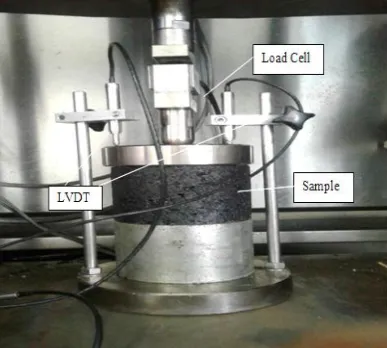
[image:5.595.206.400.369.543.2]The accumulation of non-recoverable strain is generated due to the repeated load of the vehicle on the road, leading to the occurrence of permanent deformation. However, the permanent deformation is occurred at the top of 100mm due to the lateral movement of the layer [28]. Dynamic creep test was carry out in accordance with British standard BS DD 226 [29], in respect of assesses the resistance mixtures to the permanent deformation (rutting). Before testing, the specimens were conditioned in the climate chamber for four hours at 40 °C, to ensure that the temperature of the test has been equilibrated within the samples. The servo hydraulic machine (UTM-5P) was used to measure the permanent deformation of the specimens. The parameter of the test that include a stress of 12 kPa as a preload for 120 second to ensure the contact between the load and the specimen, thereafter the sample is subjected to repeated axial stress of 100 kPa. The wave pulse of the axial applied load is squared with a frequency of 0.5 HZ, the pulse loading comprising 1-second load width and 1-1-second rest period. The duration of the test is 3600 1-seconds, and the total numbers of the cycles are 1800, which is enough to compare the permanent deformation among the mixtures as well as to predict the permanent deformation. The result of the test consists of dynamic creep, accumulation strain and strain slope obtained from the machine’s software and calculated based on the deformation that occurred due to the applied load. This deformation is measured using two sets of Linear Variable Displacement Transducers (LVDTs). Figure 4 shows the dynamic creep experimental setup.
Figure 4. Dynamic creep experimental setup
2.4.Mechanistic–Empirical Design Approach
Nd = 1.365 × 10⁻⁹ εv −4.477 (1)
Where Nd is the number of repetition load to produce a rut of 12.7 mm with a reliability of 85%, while εv is the vertical compressive strain at the top subgrade layer.
Additionally, fatigue-cracking failure due to the repeated load of the axles is calculated as follow:
Nf = 1.66 × 10⁻¹⁰ εt −4.32 (2)
Where Nf is the allowable number of axles load until fatigue failure, and εt is the horizontal tensile strain at the bottom asphalt layer. For the thin asphalt layers (less than 100 mm), Yang [30] suggested that the calculated allowable number of axles load until fatigue failure should be reduced by 20%.
Equations 3 and 4 are used to calculate the service life extension of pavement (TBR) and the possibility of reducing the thickness of asphalt layer (LTR), respectively.
TBR = Nfm/Nfu (3)
Where Nf is the number passes of axels until fatigue failure; while m and u the reinforced mixture and unreinforced mixtures, respectively.
LTR = (Tu − Tm)/Tu (4)
Where Tu and Tm = Thickness of the asphalt layer with and without fiber, respectively.
Table 5. The proposed pavement layers (conventional pavement)
3.
Results and Analysis
3.1.Resilient Modulus
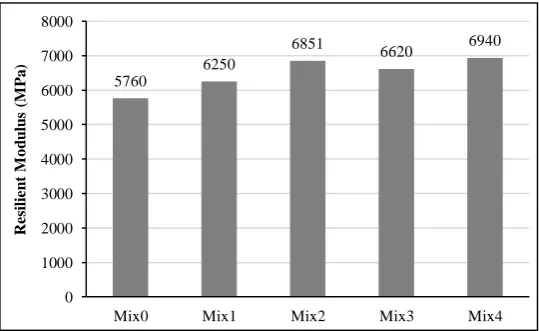
[image:6.595.160.430.590.755.2]Results of the resilient modulus test for the mixtures are presented in Figure 5 The mixtures containing coarse steel slag aggregate and reinforced by Polyvinyl Alcohol fibre showed higher resilient modulus in comparison with the reference mixtures (Mix0 and Mix1) that containing 100% granite and coarse steel slag aggregate, respectively. In addition, the mixes that containing coarse steel slag aggregate (Mix1) showed higher resilient modulus than mixes that containing 100% granite aggregate. This is attributed to the mechanical properties of the steel slag aggregate concerning of its durability. On the other hand, Mix2 have the highest resilient modulus compared to Mix0 and Mix1 by approximately 16 and 9.4%, respectively. This is because Polyvinyl Alcohol fibres have enhanced the performance of the asphalt mixture by increasing the asphalt mixtures resistance to the indirect tensile strength. Conversely, Mix3 and Mix4 have higher resilient modulus than control asphalt mixtures (Mix0 and Mix1), while it showed less resilient modulus compared to Mix2. This was attributed to the high content of the fibre in the mixtures, which increased the samples thickness by approximately 0.5-1 mm, thus slightly higher deformation occurred.
Figure 5. Results of the resilient modulus for the mixtures
Layer Thickness (mm) Resilient Modulus (MPa) Poisson's ratio (ν)
HMA 100 Various 0.35
Base 250 350 0.4
Sub-base 300 200 0.4
Subgrade - 100 0.45
5760
6250
6851 6620 6940
0 1000 2000 3000 4000 5000 6000 7000 8000
Mix0 Mix1 Mix2 Mix3 Mix4
R
e
si
li
e
n
t
M
o
d
u
lu
s
(M
P
a
3.2.Dynamic Creep
3.2.1.Accumulation Strain
The dynamic creep curve of the samples was obtained after 1800 cycles. This curve is shown in the Figure 6, which represents accumulated strain of Mix0, Mix1, Mix2, Mix3 and Mix4, respectively. Furthermore, each accumulated axial strain curve consisting of two stages, the first stage called primary, while the second stage called secondary. In addition, the recoverable elastic strain occurs at the primary stage due to the compaction method and the gradation of the mixtures and not caused by the cumulative axial strain, while the viscoelastic strain occurs at the secondary stage because of the load cycles [32]. On the other hand, the terminated stage that represents failure of the specimen did not occur for all mixtures due to the limit of cycles. Moreover, the higher accumulated strained the lower permanent deformation resistance. As observed in Figure 6, Mix1 showed higher resistance to the permanent deformation as compared to the control mixtures (Mix0); this is attributed to the mechanical properties of the steel slag aggregate in terms of angularity and porosity. Moreover, Mix2 exhibited better permanent deformation resistance than Mix0 and Mix1 (control mixtures) by around 20 and 14%, respectively. This is because polyvinyl alcohol fibre has enhanced the mixture resistance to the permanent deformation. On the other hand, Mix3 and 4 showed slightly lower resistance to the permanent deformation as compared to the Mix2, due to high content of the fiber, which dramatically increased the permanent deformation at the primary stage, thus the permanent deformation is highly affected by the densification. Additionally, as shown in Figure 6. the correlation coefficient 𝑅2 is approximately above 75% for the all curves, which indicates that the correlation between number of the cycles and the accumulated strain is good in terms of evaluating the permanent deformation.
[image:7.595.122.467.300.513.2]
Figure 6. The accumulated strain against number of the cycles
3.2.2.Creep Strain Slope (CSS) and Secant Creep Stiffness Modulus (SCSM)
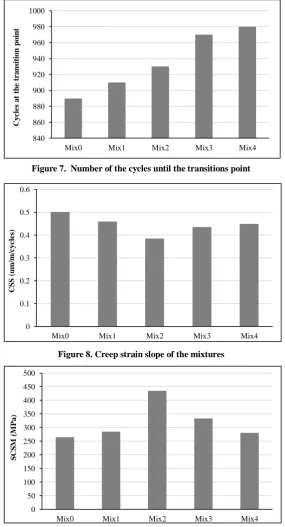
CSS is defined as the slope of the secondary stage, which caused by the accumulated strain. The cycles number is shown in Figure 7 at which the cycles start from the first stage to the transition point and this point is determined based on the slope of curve where the accumulated strain has same rate as well as linear with time, which is different from the primary stage. Moreover, the transition point deviated further from the initial axial strain, which negatively affect the results of stiffness dynamic creep due to the densification [33-36]. As can be observed in Figure 7, number cycles of the mixtures at the primary stage are approximately similar to each other with slight differences at the mixtures, which reinforced with fibers. This was attributed to the limitation of the test related to applied stress and temperature, which were fixed. In addition, Mixes 3 and 4 showed higher cycles number compared to the other mixtures, because of the high content of fibre, which required an increasing in the cycles number to avoid the primary stage that affected by the increment in the thickness of the samples due to the high content of polyvinyl alcohol fibre. CSS was employed to assess the susceptibility of the mixtures to the permanent deformation as it offers a better understanding of the dynamic creep behaviour. The higher CSS indicates that asphalt mixture is less resistant to the permanent deformation. In addition, CSS at the transition point was adopted to evaluate the resistance of the mixtures to the rutting (permanent deformation). It can be concluded from Figure 8, that Mix2 exhibited higher resistance to the permanent deformation compared to the other mixtures, while Mix3 and Mix4 exhibited slightly higher resistance than control mixtures. Additionally, Mix1 showed less CSS as compared to the control mixture without coarse steel slag aggregate (Mix0). The resistance of the mixtures to the rutting with respect to secant stiffens creep modulus is shown in Figure 9. The Secant stiffens creep modulus is defined as the ratio of the applied stress to the difference of axial strain at the transition point and the ultimate number of the cycles (1800). This is to ensure that stiffens creep modulus was determined based on the actual axial strain not by the initial axial strain that occurs by densification at the primary
0 0.05 0.1 0.15 0.2 0.25 0.3 0.35 0.4 0.45
0 200 400 600 800 1000 1200 1400 1600 1800
A
c
c
u
m
a
lte
d
S
tr
a
in
(%
)
Number of Load Cycles
Mix 0 Mix1 Mix2 Mix3 Mix4
stage. Hence, the SCSM at the secondary stage describes the susceptibility of the mixtures to permanent deformation. Therefore, the secant stiffens creep modulus is calculated using. Equation 5:
SCSM = εx− εyσ (5)
Where σ is the applied stress, 100 kPa, while εx and εy are the accumulated strain at the transaction point and the ultimate cycle, respectively.
[image:8.595.156.442.230.758.2]As clearly shown in Figure 9, the SCSM range from 270 to 285 MPa for the control mixtures (Mix0 and Mix1), which were relatively lower than Mix3 and Mix4, respectively. While, Mix2 achieved the highest value 420 MPa. Moreover, Figure 10. delineates the correlation between CSS and SCSM. It can be inferred that there is a strong correlation between CSS and SCSM. The relationship coefficient of the fitted curve, 𝑅2, is 0.91 for the data of CSS and SCSM. In addition to that, when the CSS increases the SCSM decreases. Thus, the CSS and SCSM are considered helpful parameters to evaluate susceptibility of the mixtures to the permanent deformation, along with accumulated strain.
Figure 7. Number of the cycles until the transitions point
[image:8.595.160.440.230.390.2]Figure 8. Creep strain slope of the mixtures
Figure 9. Secant stiffens creep modulus of the mixtures
840 860 880 900 920 940 960 980 1000
Mix0 Mix1 Mix2 Mix3 Mix4
C y c le s a t th e tr a n si ti o n p o in t 0 0.1 0.2 0.3 0.4 0.5 0.6
Mix0 Mix1 Mix2 Mix3 Mix4
C S S (u m /m /c y c le s) 0 50 100 150 200 250 300 350 400 450 500
Mix0 Mix1 Mix2 Mix3 Mix4
CSS= -0.0007 (SCSM) + 0.6708 R² = 91
0.2 0.25 0.3 0.35 0.4 0.45 0.5 0.55
250 300 350 400 450
C
S
S
[image:9.595.135.454.60.248.2]SCSM
Figure 10. The correlation between SCSM and CSS
3.3.Benefit of Reinforced Asphalt Mixtures
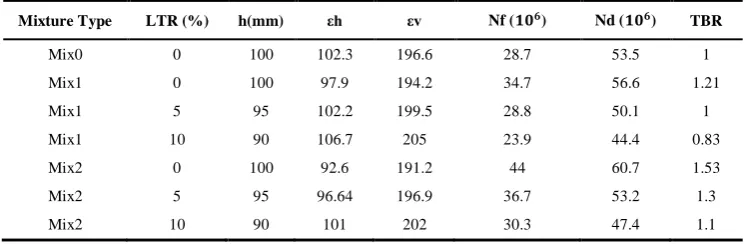
Fatigue cracking and rutting (permanent deformation) are considered as the major failure in asphalt layer. Fatigue cracking occurs at the bottom of the surface layer due to the repetition load by vehicles, while rutting developed at the top of the subgrade layer [30]. The horizontal and vertical strain at the bottom of the surface layer (AC) and top of the subgrade layer are used to calculate the allowable repetition load. Mix0, Mix1, Mix2 are the mixtures that were assessed as a surface layer using mechanistic empirical design pavement approach. Mix0 and Mix1 represent the mixtures that containing 100% of granite aggregate and coarse steel slag aggregate, respectively. Mix2 was incorporated with coarse steel slag aggregate and the optimum content of the polyvinyl alcohol fibre (0.05% by total weight of the aggregate). Table 7. summarized the outputs of Bisar software, which it can be observed that the allowable number of repetition load until fatigue failure was the critical damage. However, Mix1 had extended the service life of asphalt layer by around 1.21 time compared to Mix0. While Mix2 improved the service life by 1.53 compared to the Mix0. In terms of the advantages of introducing fiber to reduce the asphalt layer thickness, it can be observed that Mix2 showed better service life than Mix0 by 1.3 and 1.1time longer after reducing the thickness by 5% and 10%, respectively. Furthermore, the thickness of asphalt layer that will be prepared by Mix2, which containing coarse steel slag aggregate and polyvinyl alcohol fibre at the optimum content (0.5kg/ton) can be reduced by around 10%. In addition, it will provide an extension in the service life by 1.1 times longer compared to the conventional asphalt layer, if prepared by Mix0 (granite aggregate).
Table 7. The outputs of the mechanistic empirical design pavement analysis
4.
Conclusions
This study aimed to evaluate the asphalt mixture containing coarse steel slag aggregate in regard to the resilient modulus and permanent deformation. In addition to that, the study focused on the investigating the possibility of reducing the asphalt layer thickness by introducing polyvinyl alcohol fiber at different percentages. The following outputs were made:
Using steel slag as a coarse aggregate in the asphalt mixtures have improved the performance of the asphalt mixtures in terms of resilient modulus and permanent deformation.
Utilization of steel slag as a coarse aggregate does not affect the bitumen content. In addition, selection of the gradation as finer-gradation has reduced the impact of steel slag porosity on the bitumen content.
Mixture Type LTR (%) h(mm) εh εv Nf (𝟏𝟎𝟔) Nd (𝟏𝟎𝟔) TBR
Mix0 0 100 102.3 196.6 28.7 53.5 1
Mix1 0 100 97.9 194.2 34.7 56.6 1.21
Mix1 5 95 102.2 199.5 28.8 50.1 1
Mix1 10 90 106.7 205 23.9 44.4 0.83
Mix2 0 100 92.6 191.2 44 60.7 1.53
Mix2 5 95 96.64 196.9 36.7 53.2 1.3
[image:9.595.111.485.502.624.2] The compacted asphalt mixtures that incorporating coarse steel slag aggregate have higher specific gravity than conventional mixtures (granite aggregate) by around 8%, which may increase the transportation costs by 8%. Introducing polyvinyl alcohol into the asphalt mixtures containing coarse steel slag aggregate have increased
the resilient modulus of the mixtures as well as exhibited higher resistance to the permanent deformation in contrast with the mixtures that containing 100% of granite aggregate and coarse steel slag aggregate, respectively. However, the optimum content of the polyvinyl alcohol was at 0.05% by total weight of the aggregate (0.5 kg/ton). In addition, the other proportion achieved better permanent deformation in comparison with the control mixtures in terms of CSS and SCSM.
With respect to the permanent deformation, there is a strong correlation between CSS and SCSM at the transition point, which represents the number of cycles required to avoid the primary stage. However, these parameters provide a better evaluation than accumulation strain in terms of the mixtures resistance to the permanent deformation, due to the fact that the permanent deformation after the primary stage corresponds to the actual value, while the accumulation strain considered the total deformation.
Based on the outputs of Bisar software, the asphalt mixtures containing coarse steel slag aggregate exhibited higher service life than conventional mixtures by 1.21 time longer, while the mixtures that incorporating coarse steel slag aggregate and the optimum content of polyvinyl alcohol fibre (0.5 kg/ton) showed the highest service life. On the other hand, the thickness of the asphalt layer containing coarse steel slag and the optimum content of polyvinyl alcohol can be reduced by around 10%, as well an extension of the life service by 1.1 as compared to the conventional layer with granite aggregate.
The optimum content of the fibre in this study was 0.5 kg/ton, proving that introducing polyvinyl alcohol at the optimum content has the ability to reduce the cost by around 10% per ton in terms of the aggregate and the bitumen costs. Furthermore, adding polyvinyl alcohol fiber may also reduce the transportation cost by approximately 10% .However, the transportation costs depends on the distance between the quarry and site of the road construction.
5.
Acknowledgements
This work was partly sponsored by the Centre for Graduate Studies, Universiti Tun Hussein Onn Malaysia (UTHM).
6.
References
[1] Roberts, Freddy L., Prithvi S. Kandhal, E. Ray Brown, Dah-Yinn Lee, and Thomas W. Kennedy. "Hot mix asphalt materials, mixture design and construction." (1991), ISO 690.
[2] Horvath, Arpad. "Life-cycle environmental and economic assessment of using recycled materials for asphalt pavements." (2003).
[3] Robinette, Christopher, and Jon Epps. “Energy, Emissions, Material Conservation, and Prices Associated with Construction, Rehabilitation, and Material Alternatives for Flexible Pavement.” Transportation Research Record: Journal of the Transportation Research Board 2179 (December 2010): 10–22. doi:10.3141/2179-02.
[4] Chesner, Warren H., Robert J. Collins, and M. H. MacKay. User guidelines for waste and by-product materials in pavement construction. No. FHWA-RD-97-148. 1998.
[5] Skaf, Marta, Juan M. Manso, Ángel Aragón, José A. Fuente-Alonso, and Vanesa Ortega-López. “EAF Slag in Asphalt Mixes: A Brief Review of Its Possible Re-Use.” Resources, Conservation and Recycling 120 (May 2017): 176–185. doi:10.1016/j.resconrec.2016.12.009.
[6] Hainin, Mohd Rosli, Gatot Rusbintardjo, Mohd Azizi Abdul Aziz, Asmah Hamim, and Nur Izzi Md. Yusoff. “Laboratory Evaluation on Steel Slag as Aggregate Replacement in Stone Mastic Asphalt Mixtures.” Jurnal Teknologi 65, no. 2 (November 25, 2013). doi:10.11113/jt.v65.2185.
[7] Ahmedzade, Perviz, and Burak Sengoz. “Evaluation of Steel Slag Coarse Aggregate in Hot Mix Asphalt Concrete.” Journal of Hazardous Materials 165, no. 1–3 (June 15, 2009): 300–305. doi:10.1016/j.jhazmat.2008.09.105.
[8] Arabani, M., and A.R. Azarhoosh. “The Effect of Recycled Concrete Aggregate and Steel Slag on the Dynamic Properties of Asphalt Mixtures.” Construction and Building Materials 35 (October 2012): 1–7. doi:10.1016/j.conbuildmat.2012.02.036. [9] Ameri, Mahmoud, Saeid Hesami, and Hadi Goli. “Laboratory Evaluation of Warm Mix Asphalt Mixtures Containing Electric
Arc Furnace (EAF) Steel Slag.” Construction and Building Materials 49 (December 2013): 611–617. doi:10.1016/j.conbuildmat.2013.08.034.
doi:10.1155/2015/623245.
[11] Kavussi, Amir, and Morteza Jalili Qazizadeh. “Fatigue Characterization of Asphalt Mixes Containing Electric Arc Furnace (EAF) Steel Slag Subjected to Long Term Aging.” Construction and Building Materials 72 (December 2014): 158–166. doi:10.1016/j.conbuildmat.2014.08.052.
[12] Hainin, Mohd Rosli, Gatot Rusbintardjo, Mohd Anwar Sahul Hameed, Norhidayah Abdul Hassan, and Nur Izzi Md. Yusoff. “Utilisation of Steel Slag as an Aggregate Replacement in Porous Asphalt Mixtures.” Jurnal Teknologi 69, no. 1 (June 20, 2014). doi:10.11113/jt.v69.2529.
[13] Wang, George C. “Slag Use in Asphalt Paving.” The Utilization of Slag in Civil Infrastructure Construction (2016): 201–238. doi:10.1016/b978-0-08-100381-7.00010-0.
[14] Wang, George, Yuhong Wang, and Zhili Gao. “Use of Steel Slag as a Granular Material: Volume Expansion Prediction and Usability Criteria.” Journal of Hazardous Materials 184, no. 1–3 (December 2010): 555–560. doi:10.1016/j.jhazmat.2010.08.071.
[15] Grubeša, I. N., Barisic, I., Fucic, A., & Bansode, S. S. “Characteristics and Uses of Steel Slag in Building Construction” (2016): xi. doi:10.1016/b978-0-08-100368-8.11001-2.
[16] Gumieri, Adriana G., Denise CC Dal Molin, and Antônio CF Vilela. "Characteristics of steel slag granulated in a steel plant— Valuation of the microstructure through electron probe micro analysis." In International RILEM Conference on the Use of Recycled Materials in Building and Structures, vol. 2, pp. 1067-1075. 2004.
[17] Fronek, Brad A. "Feasibility of expanding the use of steel slag as a concrete pavement aggregate." (2012).
[18] Huang, Yue, Roger N. Bird, and Oliver Heidrich. “A Review of the Use of Recycled Solid Waste Materials in Asphalt Pavements.” Resources, Conservation and Recycling 52, no. 1 (November 2007): 58–73. doi:10.1016/j.resconrec.2007.02.002. [19] Goh, Shu Wei, Michelle Akin, Zhanping You, and Xianming Shi. “Effect of Deicing Solutions on the Tensile Strength of Micro- or Nano-Modified Asphalt Mixture.” Construction and Building Materials 25, no. 1 (January 2011): 195–200. doi:10.1016/j.conbuildmat.2010.06.038.
[20] McDaniel, Rebecca S. “Fiber Additives in Asphalt Mixtures” (March 11, 2015). Doi: 10.17226/22191.
[21] Al-Hadidy, A.I., and Yi-qiu Tan. “Mechanistic Analysis of ST and SBS-Modified Flexible Pavements.” Construction and Building Materials 23, no. 8 (August 2009): 2941–2950. doi:10.1016/j.conbuildmat.2009.02.023.
[22] Al-Hadidy, A.I., and Tan Yi-qiu. “Mechanistic Approach for Polypropylene-Modified Flexible Pavements.” Materials & Design 30, no. 4 (April 2009): 1133–1140. doi:10.1016/j.matdes.2008.06.021.
[23] Mokhtari, Ali, and Fereidoon Moghadas Nejad. “Mechanistic Approach for Fiber and Polymer Modified SMA Mixtures.” Construction and Building Materials 36 (November 2012): 381–390. doi:10.1016/j.conbuildmat.2012.05.032.
[24] Ye, Qunshan, Shaopeng Wu, and Ning Li. “Investigation of the Dynamic and Fatigue Properties of Fiber-Modified Asphalt Mixtures.” International Journal of Fatigue 31, no. 10 (October 2009): 1598–1602. doi:10.1016/j.ijfatigue.2009.04.008. [25] “Volumetric Requirements for Superpave Mix Design” (December 7, 2006). doi:10.17226/13999.
[26] Papagiannakis, A. T., and E. A. Masad. “Pavement Design and Materials” (July 19, 2012). Doi: 10.1002/9780470259924. [27] “Test Method for Determining the Resilient Modulus of Bituminous Mixtures by Indirect Tension Test” (n.d.).
doi:10.1520/d7369-09.
[28] Zhang, J, ER Brown, PS Kandhal, and R West. “An Overview of Fundamental and Simulative Performance Tests for Hot Mix Asphalt.” Performance Tests for Hot Mix Asphalt (HMA) Including Fundamental and Empirical Procedures (n.d.): 3–3–15. doi:10.1520/stp37620s.
[29] “Method for Determining Resistance to Permanent Deformation of Bituminous Mixtures Subject to Unconfined Dynamic Loading” (n.d.). doi:10.3403/00617787.
[30] Yang HH. “Pavement Analysis and Design”. University of Kentucky: Prentice-Hall Inc, (1993).
[31] Malaysia, P. W. D. "Standard specification for road works, section 4, flexible pavement." Jabatan. Kerja Raya Malaysia, Kuala Lumpur (2008).
[32] Zhou, Fujie, and Tom Scullion. “Discussion: Three Stages of Permanent Deformation Curve and Rutting Model.” International Journal of Pavement Engineering 3, no. 4 (December 2002): 251–260. doi:10.1080/1029843021000083676.
doi:10.1016/j.conbuildmat.2006.05.024.
[34] Zhou, Fujie, Tom Scullion, and Lijun Sun. “Verification and Modeling of Three-Stage Permanent Deformation Behavior of Asphalt Mixes.” Journal of Transportation Engineering 130, no. 4 (July 2004): 486–494. doi:10.1061/(asce)0733-947x(2004)130:4(486).
[35] Gokhale, Salil, Bouzid Choubane, Tom Byron, and Mang Tia. “Rut Initiation Mechanisms in Asphalt Mixtures as Generated Under Accelerated Pavement Testing.” Transportation Research Record: Journal of the Transportation Research Board 1940 (January 2005): 136–145. doi:10.3141/1940-15.