ANALYSIS OF VARIOUS RAPID PROTOTYPING TECHNIQUES FOR INVESTMENT CASTING
OMAR MOHD FAIZAN BIN MARWAH
ANALYSIS OF VARIOUS RAPID PROTOTYPING TECHNIQUES FOR INVESTMENT CASTING
OMAR MOHD FAIZAN BIN MARWAH
A thesis submitted in fulfilment of the requirements for the award of the degree of Doctor of Philosophy (Mechanical Engineering)
Faculty of Mechanical Engineering Universiti Teknologi Malaysia
To my parents, my dearest wife and beloved children,
Dr.CDM Elmy Johana Mohamad, Muhammad Hafiy Darwis,
Muhammad Harris Haikal, Airis Adreana and Dhiya Amanda
ACKNOWLEDGEMENT
A multitude thanks to Allah the Almighty for best owing upon me this opportunity to embark on a journey that I have never done before. Indeed, the lessons learnt have widened my horizons of knowledge and opened me up to new perspectives. In the name of Allah, most benevolent, ever-merciful, all praises be to Allah, Lords of all the worlds. Thank you Allah.
First and foremost, I would like to extend my utmost appreciation to my supervisor Prof. Dr. Safian Sharif for his enthusiasm, support and endless advice towards my development as a researcher. His guidance and constant encouragement have given me valuable inputs from time to time through out my study. He puts a tremendous amount of effort into providing opportunities for me to learn and to grow. His friendly personality also makes my working experience with him very useful for my future research activities and career. I would also like to give my sincerely thanks to Prof. Dr. Mohd Hasbullah and Assoc. Prof. Dr. Mustaffa as my co-supervisor who have spent his valuable time reviewing few of my research papers and giving his valuable suggestions and constructive critiques. A million thanks to the Additive Manufacturing Group members and technician at Rapid Manufacturing Lab, Foundry Lab, Polymer Lab and Metrology Lab at UTHM for their help, moral and spiritual support toward the completion of this PhD work.
My deepest gratitude and appreciation also goes to my beloved father and mother for their blessings, patience and unconditional love. The very special person, my dearest wife Dr. Elmy Johana Mohamad, who has given me her absolute and endless love, constant encouragement and infinitive support from beginning to the end of this study, always took care of my heart, spirit and who has been greatly supportive, I humbly express my deep sense of gratitude. For my beloved sons and daughter Darwis, Harris, Airis and Dhiya thank you for your great patience and for being my internal support. May this thesis be an inspiration for your future studies and achievements. The same also goes to my sisters and mentoring group Smart Tycoon Group member.
ABSTRACT
ABSTRAK
Teknologi pembuatan deras (Rapid Prototyping - RP) mendapat perhatian amat besar masa kini sebagai alternatif yang bakal menggantikan bahan lilin konvensional sebagai paten utama dalam proses tuangan lilin (Investment Casting – IC). Ini adalah kerana teknologi RP membolehkan paten yang mudah dan rumit dihasilkan secara terus daripada model komputer dalam masa yang singkat tanpa menggunakan mana-mana perkakasan keras. Walaubagaimanapun, kualiti paten RP mempunyai kekurangan yang perlu diatasi disebabkan kesan tangga berpunca dari kaedah pembinaan secara lapisan. Tambahan pula, penetapan parameter proses RP yang tidak sesuai dan pembolehubah proses IC seperti reka bentuk struktur, penyediaan cengkerang dan suhu pembakaran boleh menyebabkan kecacatan serius pada acuan seramik. Kajian ini dijalankan untuk mengkaji penggunaan paten RP daripada tiga teknologi RP dalam proses IC. Teknologi RP ini termasuk ‘fused
TABLE OF CONTENTS
CHAPTER TITLE PAGE
DECLARATION ii
DEDICATION iii
ACKNOWLEDGEMENTS iv
ABSTRACT v
ABSTRAK vi
TABLE OF CONTENTS vii
LIST OF TABLES xi
LIST OF FIGURES xiii
LIST OF ABBREVIATIONS xvi
LIST OF SYMBOLS xviii
LIST OF APPENDICES xix
1 INTRODUCTION 1
An Overview of Rapid Prototyping in Investment 1.1
Casting 1
Research Background 3
1.2
1.3 Problem Statements 6
1.4 Aims and Objectives of the Study 7
1.5 Scope of the Study 8
1.6 Significant Research Contribution 9
1.7 Organisation of Thesis 9
2 LITERATURE REVIEW
2.1 Introduction 11
2.2.1 Limitations of Investment Casting 14
2.3 RP Technology 16
2.3.1 Research Routes for Direct RP in IC 20 2.3.2 Direct RP Solid Based Materials Fabricated
IC Pattern 22
2.3.3 Direct RP Powder Based Materials Fabricated
IC Pattern 29
2.3.4 Direct RP Liquid Based Materials Fabricated
IC Pattern 32
2.3.5 RP Part Internal Structure 36
2.4 RP Pattern Quality 37
2.4.1 Design of Experiment (DOE) for RP
Process Parameters 41
2.4.2 RP Process Parameter Evaluation 44
2.5 Summary 47
3 METHODOLODY 51
3.1 Introduction 51
3.2 Pattern Design and Fabrication 53
3.2.1 Internal Structure Design 55
3.2.2 RP Part Fabrication 57
3.3 Selection of RP Process Parameters 62
3.3.1 Experimental Design 65
3.4 Experimental Procedure and Measurement 69 3.4.1 Measurement of Dimensional Accuracy 69 3.4.2 Measurement of Surface Roughness 71 3.4.3 Measurement of Part Build Time 73 3.5 Experimental for Direct Investment Casting 75
3.5.1 Thermogravimetric Analysis 75 3.5.2 Thermal Expansion Analysis 76
3.5.3 Void Ratio Analysis 77
3.6 Summary 83
4 RP PROCESS PARAMETERS AND DIRECT
CASTING EVALUATIONS 85
4.1 Introduction 85
4.2 Model Adequacy Checking 87
4.2.1 Significance Parameters Analysis for
ABSP400 FDM Prodigy WSS 89
4.2.1.1 Main Effect Plot Analysis for
ABS P400 FDM Prodigy WSS 93 4.2.2 Significance Parameters Analysis for
Acrylate Visijet SR200 MJM 96 4.2.2.1 Main Effect Plot Analysis for
Visijet SR200 Acrylate MJM 99 4.2.3 Significance Parameters Analysis for
3DP 310 ZP150 Powder 101
4.2.3.1 Main Effect Plot Analysis for
3DP 310 ZP150 Powder 105
4.3 Prediction Analysis Based on Significant
Variables 108
4.3.1 Best Setting of the RP Process 112 4.4 Verification and Confirmation Runs of Responses 116 4.5 Evaluation ofDirect Investment Casting Process
using RP Patterns 125
4.5.1 Thermogravimetry Analysis 125 4.5.2 RP Pattern Decomposition with Different
Shell Mould Thickness 128
4.5.3 Direct Pouring Metal with Thicker Shell
Ceramic Mould 132
4.5.4 Coefficient Thermal Expansion for Shell
Cracking Evaluation 135
4.5.5 Collapsibility Analysis 140
4.5.6 Shell Cracking Analysis 148
4.6.1 Shrinkage Measurement from Dimensional
Deviation 153
4.6.2 Surface Roughness Evaluation for Casting
Part 156
4.7 OverallProduction Time 158
4.8 Summary 160
5 CONCLUSION AND RECOMMENDATIONS 162
5.1 Conclusions 162
5.2 Main Contributions 164
5.3 Recommendations For Future Work 165
REFERENCES 167
LIST OF TABLES
TABLE NO. TITLE PAGE
2.1 Materials in rapid prototyping 20
2.2 Percentage of void ratio comparison 37
2.3 RP techniques and pattern quality 40
2.4 Direct non wax pattern evaluation for IC process 50
3.1 Process parameters in FDM Prodigy Plus 63
3.2 FDM process parameters and their levels 63
3.3 3DP ZP310 process parameters 64
3.4 MJM Projet SD3000 process parameters 64
3.7 Experimental design for FDM Prodigy Plus 68
3.8 Experimental design for 3DP ZP310 Plus 68
3.9 Experimental design for MJM Projet SD3000 69
3.10 Dimensional reference point measurements 71
3.11 Ceramic shells preparation procedure 79
4.1 Data on ABS P400 FDM Prodigy 90
4.2 ANOVA of ABS P400 FDM Prodigy for DA 91
4.3 ANOVA of ABS P400 FDM Prodigy for SR 92
4.4 ANOVA of ABS P400 FDM Prodigy for BT 92
4.5 Data on Visijet SR200 acrylate Projet SD3000 96 4.6 ANOVA of Visijet SR200 MJM for DA with
two replication 98
4.7 ANOVA of Visijet SR200 MJM for DA with
three replication 98
4.8 ANOVA of Visijet SR200 MJM for SR 99
4.9 ANOVA of Visijet SR200 MJM for BT 99
4.10 Experimental data for 3DP 310 ZP150 powder 102
4.12 ANOVA of 3DP Z310 ZP150 powder for SR 103
4.13 ANOVA of 3DP Z310 ZP150 powder for BT 104
4.14 Regression equation for DA, SR and BT for RP materials 109
4.15 Confirmation run for ABS P400, Visijet SR200
and ZP150 materials 118
4.16 Slurry procedure for different layer thickness 128
4.17 CTE result comparison 138
LIST OF FIGURES
FIGURE NO. TITLE PAGE
1.1 Approaches for rapid casting solutions in rapid
investment casting 3
2.1 Typical thermal expansion curves for wax and polystyrene 13 2.2 General overview of investment casting process 14
2.3 Process chain for ceramic cell process 15
2.4 Basic stages in rapid prototyping process 18
2.5 RP product applications 19
2.6 Rapid investment casting approaches 21
2.7 Schematic of FDM 23
2.8 Schematic design of MJM 24
2.9 Schematic of 3D Printer 25
2.10 Metal part after direct IC process 27
2.11 FDM fabricated pattern 28
2.12 RP pattern design with hollow and solid internal structure 29 2.13 Three levels for QuickCast 2.0 offset hexagon structure 33
2.14 Shell crack during heating 34
2.15 New structure after auto-claving 34
2.16 Ceramic shell fracture at higher stress zone 35
2.17 Staircase orientation by layer process 39
2.18 Process model 43
3.1 Experimental flow chart for direct investment casting 52 3.2 Detail drawing of stairstep features for hollow
internal structure 53
3.3 Stairstep features for different internal structure 56
3.4 RP pattern fabrication process 58
3.6 Part internal structure for MJM and 3DP 61
3.7 Selected fractional factorial design 66
3.8 Test pattern for dimensional measurement 70 3.9 Carl-Zeiss Calypso coordinate measuring machine 71 3.10 Surface roughness measurement device
(Perthometer Concept V7.1) 72
3.11 Direction of roughness measurement 73
3.12 Comparison of conventional IC and RP process chain 74 3.13 Schematic diagram of a typical balance and furnace
assembly 76
3.14 Orton dilatometer 77
3.15 Firing furnace for RP pattern burnout 80
3.16 Furnace for melting LM25 aluminum 81
3.17 Open air gravity pouring for metal cast 82
3.18 Shell ceramic moulds condition in electrical furnace 83 4.1 Main effect analysis of ABS P400 FDM Prodigy for DA 93
4.2 Main effect analysis of ABS P400 FDM Prodigy for SR 94
4.3 Main effect analysis of ABS P400 FDM Prodigy for BT 95
4.4 Main effect analysis of Visijet SR200 acrylate for DA 100
4.5 Main effect analysis of Visijet SR200 acrylate for SR 100
4.6 Main effect analysis of Visijet SR200 acrylate for BT 101
4.7 Main effect analysis of 3DP 310 ZP150 powder for DA 105
4.8 Main effect analysis of 3DP 310 ZP150 powder for SR 106
4.9 Main effect analysis of 3DP 310 ZP150 powder for BT 107
4.11 Optimized solutions for ABS P400 fabrication by FDM
Prodigy machine 113
4.12 Optimized solutions for Visijet SR200 fabrication by
MJM Projet3000 machine 115
4.13 Optimized solutions for ZP150 fabrication by 3DP 310
machine 116
4.14 Result on overall accuracy comparison 119
4.15 Experimental results different internal structure for
dimensional accuracy 121
4.17 Surface roughness analysis for different internal structure 123
4.18 RP part build time comparison 124
4.19 TGA results for P400 ABS and Visijet SR200 acrylate 126
4.20 TGA results for ZP150 powder material 127
4.21 Ceramic mould graph analysis with three different
thickness 129
4.22 Shell mould (ST1) for ABS P400 130
4.23 Shell mould (ST1) for Visijet SR200 acrylate 131
4.24 Shell mould (ST2) for ZP150 powder 132
4.25 Ceramic mould with different thickness 133
4.26 Ceramic mould condition after firing and pouring process 134
4.27 CTE and delta L for ABS 136
4.28 CTE and delta L for Visijet SR200 acrylate 137
4.29 CTE and delta L for ZP150 powder 138
4.30 Shell ceramic for CTE analysis 139
4.31 Experimental results for Visijet SR200 acrylate
collapsibility 141
4.32 Experimental results for ABS part collapsibility 142 4.33 Experimental results for 3DP ZP150 collapsibility 143 4.34 ZP150 part remain in ceramic shell before burnout 144
4.35 ZP150 pattern removal after burnout 144
4.36 Part volume collapsibility for Visijet SR200 145
4.37 Part volume collapsibility for ABS P400 146
4.38 Part volume collapsibility for ZP150 part 147 4.39 Effect of ceramic shell cracking for Visijet SR200 149 4.40 Effect of ceramic shell cracking for ABS P400 150 4.41 Comparison of shrinkage percentages obtained by
experimental 155
4.42 Comparison of shrinkage percentages obtained for different
internal structure 156
LIST OF ABBREVIATIONS
3D - 3D Printing
3DP - Three dimensional Printing ABS - Acrylonitrile butadiene styrene ANOVA - Analysis of variance
AM - Additive manufacturing
AG - Air gap
BT - Build time
CAD - Computer aided design
CF - Castform
CMM - Coordinate measuring machine CTE - Coefficient thermal expansion
CR - Cross
DIC - Direct investment casting DDM - Direct digital manufacturing DOE - Design of experiment
DA - Dimensional accuracy
DTA - Dilatometer
FDM - Fused deposition modeling
H - Hollow
HCH - Hatch
IC - Investment casting
LM - Layer manufacturing
LT - Layer thickness
LOM - Laminated object manufacturing MJM - Multijet modeling
PL - Part location
PO - Part orientation
PP - Part position
PS - Polystyrene
Ra - Roughness accuracy
RA - Raster angle
RC - Rapid casting
RP - Rapid prototyping
RM - Rapid manufacturing
RIC - Rapid investment casting
RT - Rapid tooling
Rv - Void ratio
RW - Road width
RTV - Room temperature vulcanizing
SFF - Solid free form
SR - Surface roughness
SQ - Square
SLA - Stereolithography SLS - Selective laser sintering STL - Stereolithography file SVc - Saturation value core SVs - Saturation value shell TGA - Thermogravimetric analysis
Tg - Glass temperature
Tm - Melting temperature
LIST OF SYMBOLS
α - Type I error (α risk)
β - parameter
°C - degree Celcius
µ - Mean
µm - Micrometer
D - Desirability
k - regressor coefficient
K - Kelvin
Lo - Original length
R2 - R square
R2adj. - R square adjusted
P - Probability
ΔL - Change length in specimen
ΔT - Temperature change during test
LIST OF APPENDIX
APPENDIX TITLE PAGE
A Example of drawing for internal patterns structure 176 B List of data obtained for different internal structure
for FDM ABS, MJM acrylic and 3DP powder such as dimensional accuracy, surface roughness and
part build time. 179
Lead Time obtained for three different RP processes 195 Surface roughness using Perthometer concept V7.1 196 C Ceramic mould preparation for three types of RP process 208
CHAPTER 1
INTRODUCTION
An Overview of Rapid Prototyping in Investment Casting 1.1
Research Background 1.2
Generally, RP parts have been used in exchange of the traditional wax patterns, resulting in improved quality, less time consuming and cost saving. Hence, it has become crucial tool for shortening new product design and optimising cycles time. Consequently, it significantly speeds up the production lead times (Ian Gibson, 2009; Bartolo, 2011) from simulated to physical prototyping, meeting the contemporary approach to alter product development (Shan et al., 2003; Xing Ai et al., 2004). However, RP processes inherit low accuracy and roughness issues contributed from the staircase effect and tessellation of Computer-Aided Design (CAD) data. Warpage and shrinkage are examples of quality issues that were investigated by many researchers. Beside the slicing method, statistical tool such as Design of Experiment (DOE) and post processing method were used to obtain the best setting parameters. Thus, there are requirements to further assess the RP process parameters in the early stages due to the IC part quality is directly related to the RP master pattern fabricated from RP process. The parameters related to the RP final qualities of the parts are parts are layer thickness, raster angle, air gap, part
[image:22.595.175.524.75.248.2]orientation and material properties. Further evaluations through process optimization have resulted in a better RP pattern quality and shorten the production lead time.
Currently, materials such as polymer blends, paper and ceramics are being utilised to directly or indirectly fabricate the ceramic mould preparation in the RP patterns for the IC process as they have the same ability as sacrificial patterns for the IC process. Direct methods are mainly considered due to the fact that a pattern of any material either wax or non wax can be melted or burnout from the ceramic mould patterns. These include Multijet Modeling (MJM) wax and acrylate, Selective Laser Sintering (SLS) with CastForm (CF) polystyrene material or other plastics, Fused Deposition Modeling (FDM) ICW06 wax, Laminated Object Manufacturing (LOM) process and Three Dimensional Printing (3DP) wax.
coefficient of thermal expansion (CTE) to reduce the transient thermal stress and to eliminate shell cracking (Wang et al., 2010). Despite its advantages, FDM, 3DP and MJM did not provide facilities for inner design compared to SLA process. One of the primary objective, this study is conducted the different inner resin aimed at providing a process with different inner design structures.
Powder-based material from 3DP is known to produce poor surface quality with high porosity. It has been reported that polystyrene powder-based materials with high melting temperature and high melting viscosity contributes to carbonization residues due to incomplete combustion (Yang et al., 2009). The application of sealants or infiltration (e.g. wax, acrylate) on porous surfaces is essential to prevent slurry penetration during shell production and throughout the dewaxing procedure. A study on the evaluation of the shell wall thickness revealed that the ZCast process has the ability of decreasing material cost and production time with different shelling strategies (Volpato and Childs, 2003). Munish Chhabra and Singh (2011) found that for Aluminum, a 5 mm shell thickness has better accuracy than 12 mm shell thickness. Most of the previous studies incorporating direct method practically used current foundry practice of shell thickness. Therefore, there is also a need to optimize the shell thickness with different zirconium size and slurry preparations.
found that thermal stress is most sensitive to the glass transition temperature, followed by CTE of plastic patterns (Wang et al., 2010). Therefore, thermal expansion with different RP patterns needs to be analyzed. In contrast, the reluctance of materials in thermal expansion prediction will bring about the vital view in order to get the best burning temperature of this study.
1.3 Problem Statements
melting. It is vital to make sure that the every RP processes has similar or minimum ash residues despite the different materials used as different materials have different ash residue properties.
It is not economical to produce small number of parts (Chua et al., 2005). According to Cheah et al. (2005), ceramic shell cracks are caused by excessive thermal expansions, incomplete collapsibility of pattern during burnout, residual ash and poor surface finish as seen in non wax pattern that is fabricated for the IC process. Most RP materials have CTE values that are larger than ceramic materials which impose significant amount of stress on the ceramic shell. Previous researches reported that numerous inner build design strategies for SL process pattern and simple hollow design can be used to decrease the stress and improve the pattern drainage. However, the research on different inner patterns for ABS FDM, ZP150 3DP and Visijet SR200 acrylate MJM processes are still lacking and many of the previous studies are focused on the SL QuickCast process. Powder-based RP techniques (such as 3DP) is characterised by distortions, porosity, poor surface finish, material entrapment and shell cracking.
1.4 Aims and Objectives of the Study
The main aim of the study is to evaluate the sacrificial patterns for IC process fabricated using different RP processes. The specific objectives of this study are as follows:
(i) To assess the significant parameters using DOE method for various RP process on the quality of the RP patterns produced.
(ii) To develop empirical models correlating dimensional accuracy, surface roughness and build time.
(iii) To evaluate and access of different inner designs of RP pattern for the IC based on the significant RP parameters.
(iv) To investigate the optimum shelling strategies and burning temperature for the patterns used in the IC process.
1.5 Scope of the Study
The research will be conducted within the following limitation and scope:
(i) RP materials and processes involved FDM Prodigy WSS ABS P400, MJM Projet SD3000 Visijet SR200 acrylate and 3DP 310 ZP150 powder based materials.
structures are investigated including hollow, quasi hollow, hatch and square form.
(iii) The responses of the fabricated RP parts evaluated include dimensional accuracy, surface roughness and part build time. Benchmarking part quality is compared between RP part and cast pattern.
(iv) TGA and DTA equipment were used to investigate the behaviour and CTE works.
(v) Collapsibility analysis of the pattern materials of the IC mould using electrical furnace.
(vi) This research is based on fabricated RP part shapes and size.
1.6 Significant Research Contribution
The outcome of the study will be a great assistance for investment casting manufacturers to enhance the production based on this pattern so it can be done precisely and rapidly using FDM, 3DP and MJM technologies. The finding is expected to eliminate the hard tooling process that uses RP as master pattern based on research shaped and size component. Designing the inner structure of the prototype can be employed accordingly to facilitate the rapid production of high quality IC mould.
1.7 Thesis Organization
CHAPTER 2
LITERATURE REVIEW
2.1 Introduction
This chapter highlights the principal of IC, the limitation of IC, RP technologies and research routes for direct sacrificial pattern fabrication using RP technologies in the IC process. The last section ends with a brief summary of different topics covered in this chapter.
2.2 Investment Casting Process
The IC process is often referred to as “lost wax casting” in which produces net shape parts with exceptional surface finish and good dimensional accuracy of metal parts for almost any alloy. These metals range from ferrous (commonly stainless steel, and tool steel) to non-ferrous (aluminum, copper and brass). The process has the ability to produce geometrical complex shape without the machining process, assemble and finish the works to reach reproduction in near-net shape. Blind pockets, thin wall, radii, internal seats and fillets can be produced for difficult internal and external features.
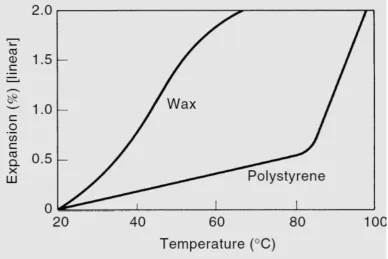
Figure 2.1 Typical thermal expansion curves for wax and polystyrene
Figure 2.2 General overview of investment casting process (www.custompartnet.com/wu/investment-casting)
2.2.1 Limitations of Investment Casting
Figure 2.3 Process chain for ceramic cell process
.
IC application usually involves the manufacturing of geometrically complex and high quality net-like shaped final metal parts with acceptability. However, this conventional practice intensifies high cost when producing low and single volume productions. An economical advantage of the IC is restricted when employed to mass production. Among the constraint of conventional IC include:
(i) The need to produce tooling ;
Yield sacrificial patterns during the injection moulding process to produce sacrificial patterns from wax material, leading to cost justification challenge for small to medium production or prototyping of customised or single casting.
(ii) Process lead time is mostly consumed during metal fabrication; The tooling needed for wax part production. The numbers of design pattern iterations are accomplished by a mold designer which further incorporated with additional lead time and cost before being submitted for manufacturing (Joseph Beaman, 1997).
volume production but further aims for mass production (Cheah et al., 2005; Vaezi et al., 2011) of any geometrical part shape complexity. In the new part design, IC suffers long lead time due to the initial tooling fabrication. Actually, it is even elongated due to the time to market of the product to be accepted by end users (Pedro Vasconcelos, 2002; Patri Venuvinod, 2004). Therefore, shortening the process build time by incorporating a simpler set up has improved the IC requirements in the advancement of RP technologies. Furthermore, designers and user can significantly optimise the production time (Ian Gibson, 2009; Bartolo, 2011) by directly prototyping parts instead of simulation parts in order to improve product development (Shan et al., 2003; Xing Ai et al., 2004) .
The overall cost was driven by the need of special equipment, binder materials, and multiple labour intensives steps to make a mould and occurrence of small defects which give implication to the typical IC approach. Therefore, the IC process can be integrated into the system to implement the full-scale production phase. Low and single volume production suffers high tooling cost and prohibitively expensive for wax pattern moulding fabrication which prefers mass production (Cheah et al., 2005; Vaezi et al., 2011). From a single pattern development, now it is extended to serve the tooling production whereby the process without tool from early inception motivates the RP technology to be concurrently relevant to the IC process. Furthermore, the significant reduction in lead time and cost is associated with single or small quantity production (Chua et al., 2005; Lee et al., 2004; Bassoli et al., 2007; Society, 2005). Therefore, it motivates the RP technology to be concurrently relevant to the IC process.
2.3 RP Technology
Manufacturing (LM) and RT are the range of technologies considered under Rapid Manufacturing (RM). The term ‘additive’ manufacturing is used in reference to LM as some future RM systems will operate in a multi-axis fashion as opposed to the current layer manufacturing (Neil Hopkinson, 2006). AM which uses a range of laser-based or advanced printing techniques to build up models layer by layer, has a number of compelling advantages over traditional manufacturing techniques. Currently, RP has opened up new avenues for fabricating functional prototypes to the fabrication tools and moulds for direct metal castings. Now, RP techniques are commercially available to fabricate prototypes and casting tooling directly from a computer model (Munish Chhabra and Singh, 2011).
The RP is the part fabrication of physical prototype product using automatic AM techniques. In late 1980s, there was few RP technologies available and were used to fabricate prototype parts and models. Currently, the applications used are much wider in relatively small numbers to manufacturer quality parts. AM refer to the additive freeform fabrication and LM which takes virtual designs from computer aided design (CAD) or simulation modeling software, transforms them into virtual, thin and horizontal cross-sections and then fabricates successive layers by layers until the model is completed. These situations significantly shorten the product development time. Furthermore, with the use of high power laser technology in the recent years it has enabled parts to be directly made in variety of metals, and thus extends the application range even further (Ian Gibson, 2009).
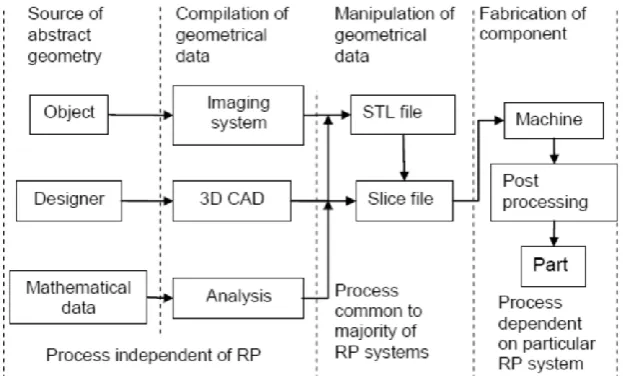
Figure 2.4 Basic stages in RP process (Chua, 1997)
In contrast, the RP technique begins with a graphic model designed using CAD software, whereby the model is sliced from the 3D graphic model into 2D contours. In order to transfer the 3D CAD data into the RP machines, a stereolithography file (STL) is generated which has the most interface between CAD and RP system. Then the data must be manipulated to generate the instructions required to control the final stage of actual fabrication of the component. The final step varies differently from the RP processes and depends on the basic deposition principle used in the RP machines (Wang et al., 2000). These techniques are contrary to the material removal process in which parts are build by gradually adding materials layer by layer in automatic mode.
process build time and has improved the IC requirements. Furthermore, production lead times can significantly be boosted by users and designers (Ian Gibson, 2009; Bartolo, 2011) from virtual design CAD design to physical prototyping and encounter the concurrent approach to improve product fabrication (Shan et al., 2003; Xing Ai et al., 2004) .
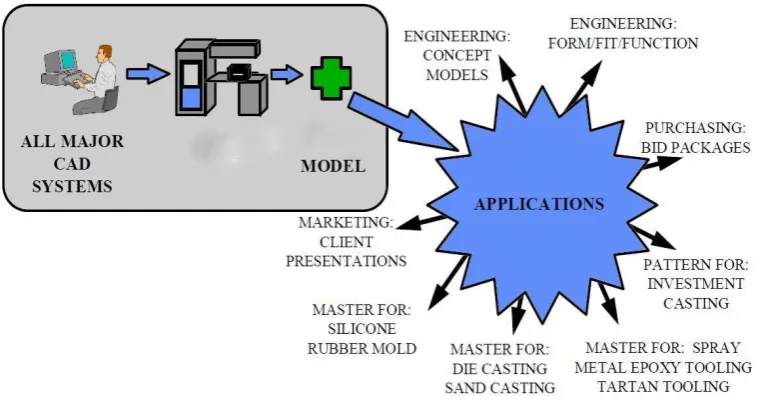
Figure 2.5 RP product applications
2.3.1 Research Routes for Direct RP in IC
[image:39.595.130.511.487.714.2]RP provides robustness to the materials so that geometrical features of various complexities can be produced, especially for low-volume production. The employment of RP-fabricated patterns in the IC process enables the RP parts as a sacrificial pattern to be melted and burn out during the cleaning process from the ceramic shell without any cracking defect. Direct method for RP pattern fabrication for IC is applied with either with wax or non-wax materials (plastics, ABS, acrylic, etc.). The successes of this method depends on the complete burn out of the RP material and have no residual ash content left inside the ceramic mould. Generally, current RP system can be classified as solid based, liquid based or powder based systems (Chua, 1997; Kruth, 1998; Chee, 2003; Neil Hopkinson, 2006; Noorani, 2006; Frank Liou, 2008; Groover, 2011) as shown in Table 2.1. According to Daniel and Krassimir (2010), it is more practical to classify and list the viable RP technologies only on the basis of the material used in the process and their capabilities to meet design requirements.
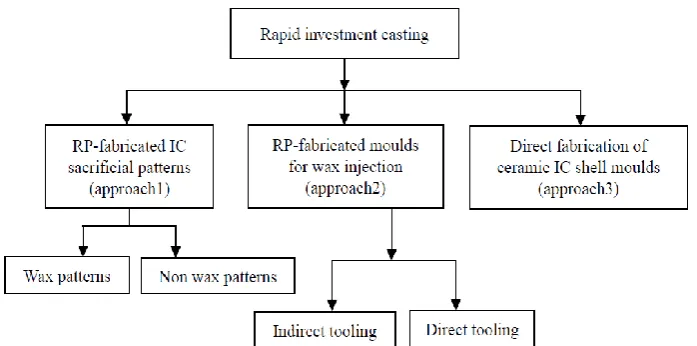
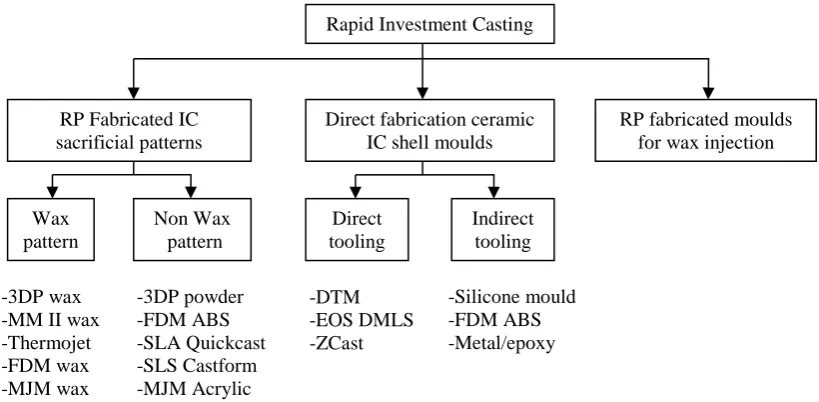
Conventional wax materials are often used as an expendable or sacrificial pattern in the IC process. RP techniques in which have same ability as conventional injection moulding process are able to fabricate parts as sacrificial patterns with many different materials including paper, ceramic, resins, polymer blends and metals directly or indirectly. Most of the RP techniques can produces patterns directly and indirectly with different materials including polymer blends, paper, ceramics and metals which have the ability same as sacrificial patterns for IC process. Currently, there are numerous RP technologies available for the manufacture of IC as a sacrificial patterns such as Thermojet MJM and Projet wax, SLA Quick Cast (http://printin3d.com/3d-printer-materials 2010), LOM process, CF polystyrene or other plastic material from SLS, FDM ICW06 wax etc. Designers can transfer the 3D CAD data easily and efficiently when merging IC with wax printing. Wax printing can produced directly wax pattern including risers and runners for metal pouring. Figure 2.6 shows the various RIC patterns in preparation for IC patterns.
Figure 2.6 Rapid investment casting approaches Rapid Investment Casting
RP Fabricated IC sacrificial patterns
RP fabricated moulds for wax injection Direct fabrication ceramic
IC shell moulds
[image:40.595.116.526.391.592.2]2.3.2 Direct RP Solid Based Materials Fabricated IC Pattern
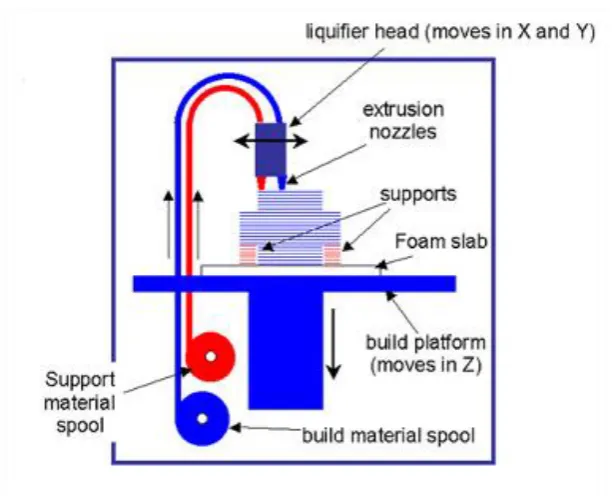
This research focuses on three types of RP technology to evaluate the capability of direct IC sacrificial patterns which consist of ABS materials from FDM, acrylate materials from MJM and ZP150 powder based materials from 3D Printer. The materials used in the FDM are thermoplastic such as ABS, polycarbonate and polyphenylsulfone which builds the parts in the same robust, stable plastics used in injection moulding and other traditional manufacturing processes. The overall concept of FDM uses two different materials in the building process. A primary part material is used to fabricate the model geometry and the secondary support material, or release material, is used to produce the support structures. FDM constructs the parts by movable temperature controlled head which extrude thermoplastic material onto a platform. The heated nozzles are used to lay down the molten part build filaments and support the materials in the desired cross sectional geometries as shown in Figure 2.7. FDM has been directly or indirectly used in investment casting. The direct investment casting application uses the FDM ABS plastic parts which are treated with metal spray as the investment casting patterns. Meanwhile the indirect investment casting application produces RTV moulds from FDM plastic parts first; then create wax investment casting patterns from RTV moulds (Lee et al., 2004). The surface finishing of FDM parts is not very smooth. Therefore, the surface of the final investment casting parts is also influenced. The combination of strength for FDM parts between each layer is weak, which hinders FDM technology to be used in sand casting pattern manufacturing. FDM technology also consumes longer time to fabricate a large part.
Figure 2.7 Schematic of FDM
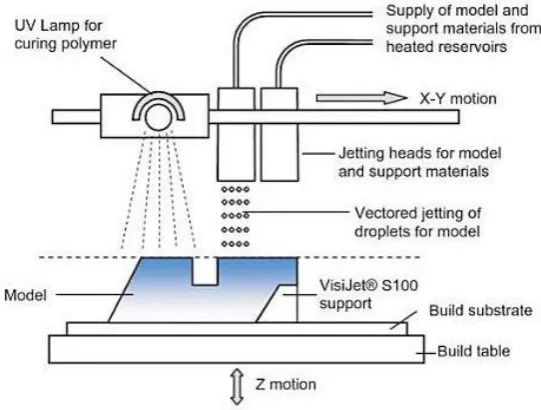
Figure 2.8 Schematic design of MJM (Lim, 2010)
[image:43.595.182.453.86.291.2]REFERENCES
Ahn, D., Kweon, J.-H., Kwon, S., Song, J. and Lee, S. (2009). Representation of surface roughness in fused deposition modeling. Journal of Materials Processing Technology, 209(15–16): 5593-5600.
A.Farzadi, V.Waran, M.Solati, Z.A.Rahman, M.Asadi and N.A.Osman, (2015). Effect of layer printing delay on mechanical properties and dimensional accuracy of 3D printed porous prototypes in bone tissue engineering. Journal of Ceramics International, 41(7), 8320-8330.
Anitha, R., Arunachalam S. and Radhakrishnan P. (2001). Critical parameters influencing the quality of prototypes in fused deposition modelling:Journal of Materials Processing Technology, Vol. 118, 385-388.
Arumaikkannu, G., Kumar N. A., and Saravanan R. (2008). Study on the influence of rapid prototyping parameters on product quality in 3d printing. 19th Annual International Solid Freeform Fabrication Symposium, SFF. August 4-6, 2008. Austin, TX, United states.
Azanizawati Ma'aram, Safian Sharif, Khidzir Zakaria, Jafri Mohamed Rohani. (2003). Quality assessment of hollow prototypes model in fused deposition modeling.
Proceedings of 19th International Conference on CAD/CAM, Robotics and Factories
of The Future (CARs & FOF), Kuala Lumpur, Malaysia. 215 – 223.
Bartolo, P. J. (2011). Stereolithography Materials. Processes and Applications. First Edition. US: Springer Science.
Bassoli, E. and Atzeni, E. (2009). Direct metal rapid casting: Mechanical optimization and tolerance calculation. Rapid Prototyping Journal. 15: 238-243.
Bassoli, E., Gatto, A., Iuliano L., and Violante, M. G. (2007). 3D printing technique applied to rapid casting. Rapid Prototyping Journal. 13: 148-155.
Beeley, P. (2001). Foundry Technology. Second Edition: Butterworth-Heinemann.
Bharath, V., Dharma M., and Henderson. (2000). Sensitivity of RP surface finish to process parameter variation. Solid Free Form Fabrication Proceedings.
Blake, P. (1997). FDM of ABS patterns for investment casting. Proc Solid Freeform Fabrication Symposium, Austin,TX.
Campbell, R. I., M. Martorelli and H. S. Lee, (2002). Surface roughness visualisation for rapid prototyping models. Computer-Aided Design, 34(10), 717-725.
Caulfield, B., P. E. McHugh and S. Lohfeld, (2007). Dependence of mechanical properties of polyamide components on build parameters in the SLS process. Journal of Materials Processing Technology, 182, 477-488.
Cazón, A., P. Morer and L. Matey, (2014). PolyJet technology for product prototyping: Tensile strength and surface roughness properties. Proceedings of the Institution of Mechanical Engineers, Part B: Journal of Engineering Manufacture.
Charmeux, J.-F. (2007). Capabilities of the Investment Casting process for producing meso/micro metal castings using Rapid Prototyping manufacturing routes. PhD, Cardiff University.
Cheah, C. M., C. K. Chua, C. W. Lee, C. Feng and K. Totong, (2005). Rapid prototyping and tooling techniques: A review of applications for rapid investment casting.
International Journal of Advanced Manufacturing Technology, 25, 308-320.
Chee Kai Chua, K. F. L., Chu Sing Ling (2003). Rapid prototyping:principles and applications. Third Edition. Singapore. World Scientific.
Chen, X., D. Li, H. Wu, Y. Tang and L. Zhao, (2011). Analysis of ceramic shell cracking in stereolithography-based rapid casting of turbine blade. The International Journal of Advanced Manufacturing Technology, 55(5-8), 447-455.
Chhabra, M. and R. Singh, (2011). Rapid casting solutions: A review. Rapid Prototyping Journal, 17(5), 328-350.
Chua, C. K., C. Feng, C. W. Lee and G. Q. Ang, (2005). Rapid investment casting: Direct and indirect approaches via model maker II. International Journal of Advanced Manufacturing Technology, 25, 26-32.
Chua, C.K. (1997). Rapid Prototyping Principles and Applications in Manufacturing.First Edition. Singapore: John Wiley & Sons.
Colin Gouldsen, P. and Blake. (1998). Investment Casting Using FDM/ABS Rapid Prototype Patterns. USA.
Daniel, E. and D. Krassimir, (2010). Technology review for mass customisation using rapid manufacturing. Assembly Automation, 30(1), 39-46.
Dimitrov, D., W. v. Wijck, K. Schreve and N. d. Beer, (2006). Investigating the achievable accuracy of three dimensional printing. Rapid Prototyping Journal, 12(1), 42-52. Dotchev, K. and S. Soe, (2006). Rapid manufacturing of patterns for investment casting:
Improvement of quality and success rate. Rapid Prototyping Journal, 12, 156-164. Dotchev, K. D., S. S. Dimov, D. T. Pham and A. I. Ivanov, (2007). Accuracy issues in rapid
Ferreira, J. C. and A. Mateus, (2003). A numerical and experimental study of fracture in RP stereolithography patterns and ceramic shells for investment casting. Journal of Materials Processing Technology, 134, 135-144.
Galantucci, L. M., F. Lavecchia and G. Percoco, (2009). Experimental study aiming to enhance the surface finish of fused deposition modeled parts. CIRP Annals - Manufacturing Technology, 58(1), 189-192.
Galantucci, L. M., F. Lavecchia and G. Percoco, (2010). Quantitative analysis of a chemical treatment to reduce roughness of parts fabricated using fused deposition modeling.
CIRP Annals - Manufacturing Technology, 59, 247-250.
Gill, S. S. and M. Kaplas, (2009). Comparative study of 3D printing technologies for rapid casting of aluminium alloy. Materials and Manufacturing Processes, 24, 1405-1411. Groover, M. P. (2011). Fundamentals of Modern Manufacturing. Fifth Edition. John Wiley
& Sons.
Hague, R., G. D'Costa and P. M. Dickens, (2001). Structural design and resin drainage characteristics of QuickCast 2.0. Rapid Prototyping Journal, 7, 66-72.
Hague, R. and P. M. Dickens, (2001). Improvements in investment casting with stereolithography patterns. Proceedings of the Institution of Mechanical Engineers, Part B: Journal of Engineering Manufacture, 215, 1-11.
Hague, R. and P. M. Dickens (1995). Stresses created in ceramic shells using QuickCastTM models. Proceedings of the Solid Freeform Fabrication Symposium. H. Marcus. University of Texas at Austin, Austin. 242-252.
Harun, W. S. W., S. Safian and M. H. Idris (2009)," Evaluation of ABS patterns produced from FDM for investment casting process", 4th International Conference on Computational Methods and Experiments in Materials Characterisation, Materials
Characterisation 2009, May 17, 2009 - May 19, 2009, New Forest, United kingdom, WITPress.
Harun, W. S. W., S. Sharif, M. H. Idris and K. Kadirgama (2009)," Characteristic studies of collapsibility of ABS patterns produced from FDM for investment casting, Suite 1C, Joseph's Well, Hanover Walk, Leeds, LS3 1AB, United Kingdom, Maney Publishing. Hendricks M., Wang M. and F. R. (2002). The effect of seal dips on ceramic shell properties and performance. 50th Technical Conference and Expo. Investment Casting Institute, Chicago, IL. 2: 22-27.
Ian Gibson, David W. Rosen., Brent Stucker (2009). "Additive Manufacturing Technologies; Rapid Prototyping to direct digital manufacturing." New York Heidelberg Dordrecht London, Springer.
Idris, M. H. (2001). Processing and evaluation of an investment cast magnesium-base alloys. Doctor of Philosophy, Universiti Teknologi Malaysia.
Jacobs (1993). Epoxy resins, improved accuracy and investment casting. Proceedings of the 1994 International Conference on Rapid Prototyping. Albuquerque, New Mexico, March 7, 1994.
Jacobs, P. F. (1995). QuickCast TM1.1 and Rapid Tooling. Proceedeng of the 4th European Conference on Rapid Prototyping and Manufacturing. Universiti of Nottingham: 1 - 25.
Jain, P. (2009). Principle of Foundry Technology. Fifth Edition. Tata McGraw Hill.
Jones, S. and C. Yuan, (2003). Advances in shell moulding for investment casting. Journal of Materials Processing Technology, 135(2–3), 258-265.
Joseph J. Beaman, J. W. B., David L. Bourell, Richard H. Crawford, Harris L. Marcus, Kevin P. McAlea (1997). "Solid Freeform Fabrication: A New Direction in Manufacturing." Springer.
Jurrens, K. K., (1999). Standards for the rapid prototyping industry. Rapid Prototyping Journal, 5(4), 169-178.
Kai Yang and B. El-Haik (2009). Design for Six Sigma: A Roadmap for Product Development. Second Edition. New York, McGraw-Hill.
Karapatis, N. P., J. P. S. Van Griethuysen and R. Glardon, (1998). Direct rapid tooling: A review of current research. Rapid Prototyping Journal, 4, 77-89.
Kawola, J. (2008). "ZCast direct metal casting from data to cast aluminum in 12 hours." from www.3dprint.no.
Kim, G. D. and Y. T. Oh, (2008). A benchmark study on rapid prototyping processes and machines: Quantitative comparisons of mechanical properties, accuracy, roughness, speed, and material cost. Proceedings of the Institution of Mechanical Engineers, Part B: Journal of Engineering Manufacture, 222, 201-215.
Kim, G. D. and Y. T. Oh, (2008). A benchmark study on rapid prototyping processes and machines: Quantitative comparisons of mechanical properties, accuracy, roughness, speed, and material cost. Proceedings of the Institution of Mechanical Engineers, Part B: Journal of Engineering Manufacture, 222(2), 201-215.
Kruth, J. P., M. C. L., (1998). Progress in additive manufacturing and rapid prototyping. Journal of CIRP Annals Manufacturing Technology, 47(2), 525-540.
Kulkarni P, D. D., (2000). On the Integration of Layered Manufacturing and Material Removal Process. International Journal of Machine Science and Engineering, 122, 100–108
Lee, B. H., J. Abdullah and Z. A. Khan, (2005). Optimization of rapid prototyping parameters for production of flexible ABS object. Journal of Materials Processing Technology, 169(1), 54-61.
Lee, C. W., C. K. Chua, C. M. Cheah, L. H. Tan and C. Feng, (2004). Rapid investment casting: Direct and indirect approaches via fused deposition modelling. International Journal of Advanced Manufacturing Technology, 23, 93-101.
Li, H., K. Chandrashekhara, S. Komaragiri, S. N. Lekakh and V. L. Richards, (2014). Crack prediction using nonlinear finite element analysis during pattern removal in investment casting process. Journal of Materials Processing Technology, 214(7), 1418-1426.
Lim, C. C. K. L. C. (2010). Rapid Prototyping Principle and Applications. Second Edition. World Scientific Publishing Co Pte Ltd.
Low, D. and T. Mori, (1999). Titanium full crown casting: thermal expansion of investments and crown accuracy. Dental Materials, 15(3), 185-190.
McKeen, L. W. (2014). The Effect of Temperature and Other Factors on Plastics and Elastomers. Third Edition. United State of America. Elsevier.
Montgomery, D. C. (2003). Design and Analysis of Experiments. Fifth Edition. Singapore, John Wiley & Sons.
Montgomery, D. C. (2008). Design and Analysis of Experiments. Seventh Edition. Singapore, John Wiley & Sons.
Montgomery, D. C. (2009). Design and Analysis of Experiments. Eight Edition. Singapore. John Wiley & Sons.
Munish Chhabra, R. and Singh., (2011). Experimental Investigation of Pattern less Casting Solution Using Additive Manufacturing Technique. MIT International Journal of Mechanical Engineering, 1, 16-24.
Neil Hopkinson, R. J. M. H., P.M. Dickens (2006). Rapid Manufacturing An Industrial Revolution for The Digital Age. First Edition. John Wile & Sons.
Noorani, R. (2006). Rapid Prototyping Principles and Applications. First Edition. John Wiley & Sons,INC
Pal, D. K., T. K., B. Raychaudhuri, K. Ravi and Subburaj, (2007). Rapid tooling route selection and evaluation for sand and investment casting. 13th International Conference on Advanced Research in Virtual and Rapid Prototyping, 455-463. Pandey, P. M., N. V. Reddy and S. G. Dhande, (2003). Improvement of surface finish by
staircase machining in fused deposition modeling. Journal of Materials Processing Technology, 132, 323-331.
Patri K. Venuvinod, W. M. (2004). Rapid Prototyping Laser based and other technologies. First Edition. Kluwer Academic Publishers.
Pedro Vasconcelos, F. J. l., Rui J. Neto, (2002). The importance of Rapid Tooling in Product Development. Key Engineering Materials, 230-232, 169-172.
Peng, A., X. Xiao and R. Yue, (2014). Process parameter optimization for fused deposition modeling using response surface methodology combined with fuzzy inference system. The International Journal of Advanced Manufacturing Technology, 73(1-4), 87-100.
Pennington, R. C., N. L. Hoekstra and J. L. Newcomer, (2005). Significant factors in the dimensional accuracy of fused deposition modelling. Proceedings of the Institution of Mechanical Engineers, Part E: Journal of Process Mechanical Engineering, 219(1), 89-92.
Pintat, T., Sindel, M.,Greul, M. (1994)," Integration of numerical modeling and laser sintering with investment casting", Solid Freeform Symposium, Austin. pp 175-180 Richard Hague and P. M. Dickens (1996). Requirement for the successful autoclaving of
stereolithography models in investment casting process. Proceedings of the Second National Conference on Rapid Prototyping and Tooling Research. Buckinghamshire College: 77-92.
Richard Hague, S. M., N.Saleh, (2004). Material and design considerations for rapid manufacturing. International Journal of Production Research, 42(22), 4691-4708. Raghunath, N. and P. M. Pandey, (2007). Improving accuracy through shrinkage modelling
by using Taguchi method in selective laser sintering. International Journal of Machine Tools and Manufacture, 47(6), 985-995.
Ramos, A. M., C. Relvas and J. A. Simoes, (2003). Vacuum casting with room temperature vulcanising rubber and aluminium moulds for rapid manufacturing of quality parts: A comparative study. Rapid Prototyping Journal, 9, 111-115.
Rosochowski, A. and A. Matuszak, (2000). Rapid tooling: the state of the art. Journal of Materials Processing Technology, 106, 191-198.
Ross, P. J. (1996). Taguchi Techniques For Quality Engineering.Second Edition. McGraw-Hill.
S.Jones, M.R. Jolly and K. Lewis, (2002). Development of techniques for predicting ceramic shell properties for investment casting. Advances in Applied Ceramics, 101(3), 106-113.
Sarkis BE, K. and S. (1994)," Rapid prototyping casting (RPC): the fundamentals of producing functional metal parts from rapid prototype model using investment casting ", Proceeding of the 5th International Conference on Rapid Prototyping
Dayton, OH., Springer-Verlag.
Shan, Z., Y. Yan, R. Zhang, Q. Lu and L. Guan, (2003). Rapid manufacture of metal tooling by rapid prototyping. International Journal of Advanced Manufacturing Technology, 21, 469-475.
Shan, Z., Y. Yan, R. Zhang, Q. Lu and L. Guan, (2003). Rapid Manufacture of Metal Tooling by Rapid Prototyping. The International Journal of Advanced Manufacturing Technology, 21(7), 469-475.
Society, A. F., (2005). Investment casting enters low-volume production market with rapid prototyping patterns. Engineered Casting Solutions, 7, 43-44.
Sood, A. K., V. Chaturvedi, S. Datta and S. S. Mahapatra, (2011). Optimization of Process Parameters in Fused Deposition Modeling using Weighted Principal Component Analysis. Journal of Advanced Manufacturing Systems, 10(02), 241-259.
Sood, A. K., R. K. Ohdar and S. S. Mahapatra, (2010). Parametric appraisal of fused deposition modelling process using the grey Taguchi method. Proceedings of the Institution of Mechanical Engineers, Part B: Journal of Engineering Manufacture, 224(1), 135-145.
Stefanescu, D. M. (2008). "ASM Handbook, Casting." ASM International. Tamas D. Szucs and D. Brabazon (2007). Analysis of the Effects of 3DP Parameters on Part Feature Dimensional Accuracy. Solid Freeform Fabrication (SFF) Symposium. Austin. Tang, H.-H., H.-C. Yen, T. C. Chen, H. Y. Chen, C. C. Chang and C. H. Liu (2005),"
Development of rapid prototyping system for ceramic shell mold of precision casting", 2005 IEEE International Conference on Mechatronics, ICM '05, July 10, 2005 - July 12, 2005, Taipei, Taiwan, Institute of Electrical and Electronics Engineers Computer Society.
Tromans, G. (2004). "Developments in Rapid Casting." london, Profesional Engineering Publishing.
Vaezi, M., D. Safaeian and C. K. Chua, (2011). Gas turbine blade manufacturing by use of epoxy resin tooling and silicone rubber molding techniques. Rapid Prototyping Journal, 17, 107-115.
Volpato, N. and T. H. C. Childs, (2003). Shelling strategies to save time in a rapid tooling process. Rapid Prototyping Journal, 9, 79-87.
W.Liou, F. (2008). "Rapid Prototyping And Engineering Applications." CRC Press.
Wang, S., A. G. Miranda and C. Shih, (2010). A study of investment casting with plastic patterns. Materials and Manufacturing Processes, 25(12), 1482-1488.
Wang, W. L., J. G. Conley, Y. N. Yan and J. Y. H. Fuh, (2000). Towards intelligent setting of process parameters for layered manufacturing. Journal of Intelligent Manufacturing, 11(1), 65-74.
Wang, X., (1999). Calibration of shrinkage and beam offset in SLS process. Rapid Prototyping Journal, 5(3), 129-133.
Wenbin, H., L. Yong Tsui and G. Haiqing, (2005). A study of the staircase effect induced by material shrinkage in rapid prototyping. Rapid Prototyping Journal, 11(2), 82-89. Xing Ai, J., C. Li and Huang., (2004). Integrated product design using Rapid Prototyping
Technology and Rapid Tooling in Concurrent Approach. Materials Science Forum, 471-472, 672-676.
Yan, Y., S. Li, R. Zhang, F. Lin, R. Wu, Q. Lu, Z. Xiong and X. Wang, (2009). Rapid Prototyping and Manufacturing Technology: Principle, Representative Technics, Applications, and Development Trends. Tsinghua Science & Technology, 14, 1-12. Yang, J., Y. Shi, Q. Shen and C. Yan, (2009). Selective laser sintering of HIPS and
investment casting technology. Journal of Materials Processing Technology, 209, 1901-1908.
Yao, A. W. L. and Y. C. Tseng, (2002). A robust process optimization for a powder type rapid prototyper. Rapid Prototyping Journal, 8(3), 180-189.
Yao, W. L. and M. C. Leu, (1999). Analysis of shell cracking in investment casting with laser stereolithography patterns. Rapid Prototyping Journal, 5, 12-20.
Young Won Chang, Nack J. Kim and C. S. Lee, (2007). Study on process of magnesium alloy investment casting. Materials Science Forum, 561-565, 1019-1022.