SOCIAL NETWORK SITE (SNS) APPROPRIATION PROCESS
IN FAMILY PERSPECTIVE BASED ON FAMILY TYPES
1YUZI MAHMUD,2NOR ZAIRAH AB. RAHIM,3SURAYA MISKON 1,3Faculty of Computing, Universiti Teknologi Malaysia
2Department of Advanced Informatics School, Universiti Teknologi Malaysia E-mail: 1[email protected]
ABSTRACT
Many previous researchers have highlighted the positive and negative impacts of SNS usage in family environment such as improving family communications and bonding or worsen the family relationships. These impacts would varies depending on the family relationships. However, studies on SNS adoption, adaptation and use according to different types of family relationships have received little research attention. Eleven actual case studies which involved 31 respondents were selected. The data collection were conducted through interviews, observations and content analysis to achieve the main research objectives of why and how do family members adopt, adapt and use SNS according to different types of family groups. Results from the data collection were used in the development of Family Appropriation Process of Social Network Site (FAPSNS) framework which also facilitated in the understanding of SNS appropriation process criteria in family, individual, technical and extra-familial perspectives. The current level of SNS appropriation according to family groups namely Modern, Chummy and Mixed families are also identified. However, this paper is focusing on the SNS appropriation process in family perspective only. The results highlighted that Modern family has successfully appropriated Facebook at Level 3 of family perspectives. Whereas, Chummy and Mixed families have disappropriated Facebook at Level 2 in family perspective.
Keywords:Facebook, Model of Technology Appropriation (MTA), Socio-Technical Theory, Family System Theory
1. INTRODUCTION
This research explores the Social Network Site (SNS) appropriation process within the family context. Social Network Site is defined as “web-based systems that aim to create and support
specific types of relationships between people”[1].
While family is defined as “relatively small domestic group of kin consisting of at least one
adult and one dependent person” [2]. This
definition refers to a nuclear family in one household. Therefore, a more concrete family definition is referring to Bengtson [3] who argues that relations between one or more individuals, which includes extended family members who are depending one another for emotional, economic and physical support. This definition is going to be used throughout the study.
The adoption of use of technologies among family members have caused high social issues which could lead to online and offline misbehaviors such as extra familial affairs, sex crimes and pornography (e.g., Hooi, Farah, & Rahman [4];
Lokman [5]; Looi, Ping, & Raman [6]). Despites of these concerns, proper use of technologies could improve family relationships and communication especially among family members who have weak ties and staying distance from each other (boyd & Ellison [7]; Brandtzaeg [8]). Due to highly acceptance of Facebook among family members in Malaysia, this social platform has been selected to understand its adoption, adaptation and use [9, 10].
2. PROBLEM BACKGROUND
Families are becoming more dispersed and consequently changing the ways they communicate due to geographical distance, time different and hectic schedules [11]. Hence, the introduction of Social Network Site (SNS) which has become an integral part of mainstream family life could change the quality of family relationships in positive ways. SNS could complement or replace in-person interactions among geographical dispersed family in order for them to get connected easily [8]. It could also improve communication and family activities for those who are staying together within
the household [12]. Previous family studies have indicated that the usage of communication technologies such as SNS in family settings is able to extend and support the relationships as well as improve the communication and reduce the loneliness syndrome (e.g., Jomhari et al. [13]; Wen et al. [12]; Williams & Merten [14]). However, this area of study is still under researched and need further investigations by the researchers (Brown & Venkatesh [15]; Maier et al. [16]).
According to Malaysian Communications and Multimedia Commission (MCMC) statistics on Internet use in the household, from 30.39 million of the population, 70.4% have an Internet subscription at home [17]. Previously, data have been collected from a random sample of 6144 Internet users in households and 80% of the users are using SNSs [18]. To date, Facebook is the most popular SNS in Malaysia [19, 20] and result from the study shows that approximately 100,000 Malaysians are joining Facebook every month [9, 21].
Since the number of SNSs have dramatically increased [22], it is important to attract and retain users on the survival and development of SNSs in different stages of its lifecycle. More than quarter of SNSs users discontinues use after the registration [23]. Therefore it is important to understand beyond the technology initial adoption which includes the criteria for non-adoption as well. Analysis from previous literatures show that framework or models of technology in family context always emphasising on the initial introduction of the technology and deemphasising the later stages (e.g., Brown & Venkatesh [15]; Lanigan [24]). Many previous studies on technology adoption in family context have employed quantitative approach which strictly use questionnaires with selection of answers to find the relationships between factors. But in reality, research in family context are more complex.
Therefore, it is important to understand the real situation after SNS adoption in different types of family relationships. This is because different types of family relationships have different intention of technology usage among family members [3]. Understanding the technology adoption, adaptation and use in the perspectives of family, individual, technical and external criteria is also essential since different perspectives provide unique criteria and are equally important in shaping how a particular family will be affected by technology adoption, adaptation and use [24]. However, this paper is focusing on family perspective only. Hence, the research objective of this paper is to explore the
criteria of SNS appropriation process and its current level in family perspective.
3. FAMILY APPROPRIATION PROCESS OF SOCIAL NETWORK SITE (FAPSNS) FRAMEWORK
Model of Technology Appropriation (MTA) [25] has been used as one of the lenses to look at how families understand and use SNS to achieve their benefits. Technology appropriation process is defined as“the way that users evaluate and adopt, adapt and integrate a technology into their
everyday practices” [26]. The MTA represents
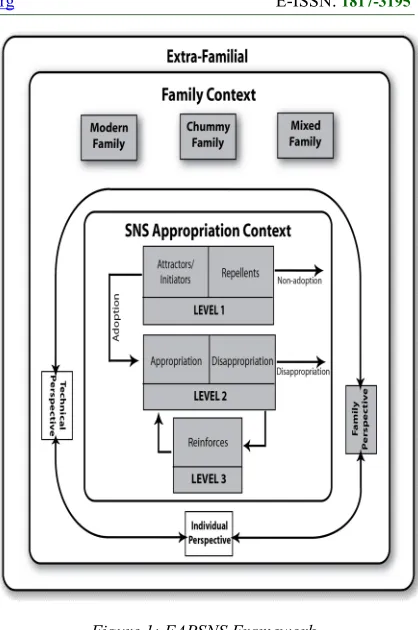
three levels: Level 1 – users’ first encounter with the technology. At this level, the outcome could be either the users are attracted to the technology and lead to the decision to adopt which initiates the process of appropriation, or they are not interested with the technology which results to non-adoption; Level 2 – deeper evaluation through using the technology. If the users are attracted by a technology, they will explore it through appropriation process. Two possible outcomes at this level are user continued to evaluate the technology or reject the technology; Level 3 – Reinforces or users’ persistent act to maintain use where the technology is considered stabilized. Technology appropriation has been studied in various including teenagers [27], education [28], organisation [29, 30] and rural area [31], but until now, studies in family context is still absent.
In addition, many extant research on communication technologies which include SNS have focused much on the outcomes of individual level, even when examined at a family level (e.g., Brandtzaeg [8]; Lanigan et al. [32]; Padilla-Walker et al. [33]). This makes the understanding of SNS appropriation process criteria in family context as a whole is still absent. Thus, MTA is extended with Family Intergenerational Solidarity [34] and Socio-Technical Theory [35] to develop a framework named Family Appropriation Process of Social Network Site (FAPSNS), as shown in Fig. 1. Social-Technical Theory emphasizes the interrelationship between user criteria and SNS criteria in understanding the family context. Thus, this research tends to fill the gap by studying the SNS appropriation criteria in order to not only understand the family perspective, but also the capacity of the individual and technical perspectives toward adoption and use.
affects the family as a whole [36]. Thus, Family Intergenerational Solidarity is applied to capture the types of family relationships namely tight-knit, sociable, intimate but distant, obligatory and detached. The researcher managed to group the family into three family groups named Modern, Chummy and Mixed families based on the identification of family relationship types. Families are grouped according to the majority of family types that have been identified for each of family members in a case study.
[image:3.612.316.525.81.396.2]According to Bengtson [3], Modern Family consists of family members that have tight-knit type of family relationships. Hence, Modern Family consists of case studies with very close relationships (affection – high), belief in family advices or having similar opinions (consensus – high), living fairly close to each other or family members are in a good health (structure – high), high frequency of contact (association – high), having high levels of sharing resources on SNS (functional – high), and high responsibilities toward family members (normative – high). While, Chummy family group is referring to the case studies with majority of family members who have sociable type of family relationships. It reflects the characteristics of having high emotional closeness (affection – high), belief in family advices or having similar opinions (consensus – high), living fairly close to each other or family members are in a good health (structure – high), interacting frequently (association – high), always sharing stories with family members (normative – high), but seldom share resources on SNS (functional – low). Lastly, Mixed family is referring to the case studies that have mixture types of family relationships. However, the focus of this paper is merely on SNS appropriation process criteria in family perspective which has been highlighted in Figure 1.
Figure 1: FAPSNS Framework
4. DATA ANALYSIS AND FINDINGS
Data analysis for family groups showed that three case studies were from Modern family, four case studies were from Chummy family and four case studies were from Mixed family. The analysis of SNS appropriation criteria is categorised into these three types of family groups in order to find the similarities, differences and pattern between them. The ‘√’ symbol represents the criteria has been mentioned by the respondents in the particular family group, while ‘-‘ indicates that the criteria has not been mentioned by the respondents in the particular family group.
Table 1: Comparative Analysis of Attractor Criteria
No. Criteria Family Groups
M
ode
rn
C
hum
my
M
ix
ed
1. Family Influences √ √ √
2. Perceived Family
Support √ √ √
3. Perceived Family
Sharing Resources √ √ √
4. Perceived Family
Awareness √ √ √
5. Family –
Geographically Distant √ √ √
6. Family – Control - √ √
7. Perceived Improve
Family Bonding - √
-1.Family Influences:Users from all family groups mentioned that influenced by their family members was the main attraction for them to adopt Facebook. This criterion also has been identified as an adoption criteria in the research area of family communication using technologies [e.g., 32, 37]. Majority of the users, especially among middle-age and younger-age generations mentioned that they were the one who invited their family members through email. Whereas, older-age generation usually being invited by their family members using word-of-mouth. Their close family members even helped them to register the Facebook account. They are willing to devote their time to learn Facebook functions as they do not want to be left out from the family group [38]. Patience during the process of teaching and learning usually will result to the continuously use among them [37].
2.Perceived Family Support: Receiving family supports was the second highest attractor criteria mentioned by Modern, Chummy and Mixed family groups. Initially, most of the users, especially older generation received technical support from their younger family members in terms of helping them to create the account as well as setting the privacy and fill up the information on their Facebook profile. This includes receiving support from family members who are planning to study abroad [13]. Some of the old-age users highlighted that they even did not have courage to change anything that have been set on Facebook and always leave it as it is. However, they would be more motivated to adopt Facebook if they could always receive technical
support from their family members who are staying together or nearby [39].
3.Perceived Family Sharing Resources:
Perceived family sharing resources including photos and information have initiated and attracted Modern, Chummy and Mixed family groups to adopt Facebook. Family members who are living distant from each other are likely to sharing photos with their family members in order to update about their activities [13]. Especially for Modern family as they always share stories and photos together although they frequently meet with each other. Occasionally, they would utilise Facebook to share information on family events such as family gathering and wedding invitations.
4.Perceived Family Awareness: The attraction of Facebook is about its sharing functions including status updates, social messages and photographs. Initially, the users from Modern, Chummy and Mixed family groups mentioned that Facebook is a good tool to receive myriad information about their relatives’ life. This has encouraged them to start adopting it as they become more aware about their family members’ condition. Most of the users especially among Mixed family prefer to become social surveillance with family members to whom they are not close with to check on their life circumstances [12]. Whereas, synchronous or asynchronous communications usually occurred among family members who they are close with [40]. They prefer to give comments on the photos or status that have been shared by their family members.
5.Family – Geographically Distant: Prior
6.Family – Control: Majority of parents, especially mothers from Chummy and Mixed family groups took the initiative to learn Facebook since they want to know about their children’s activities on this social platform. This is similar to Lim and Soon [44] and Madianou [45] studies which resulted that Asian mothers are very eager to learn computer and Internet with the purpose of monitoring their children’s online activities. Whereas, younger generation from Mixed group attracted to Facebook because they would be able to control the posted information from being viewed by the immediate family members. Apart from that, another attraction of Facebook that has been highlighted by Malay family members is that the users could control their inappropriate photos from being viewed by their non-mahram family members. In general, non-mahram could be explained as any relatives that a Muslim that is allowed to marry [46].
7.Perceived Improve Family Bonding: The bonding among family relationships perceives to improve after users from Chummy family group started to communicate together on Facebook. Moreover, Facebook statuses posted by family members could made users learn more about their family. They could also indirectly communicate by commenting or ‘like’ the photographs or statuses that have been uploaded by their family members which improve the relationships [47] especially among family members who are not close.
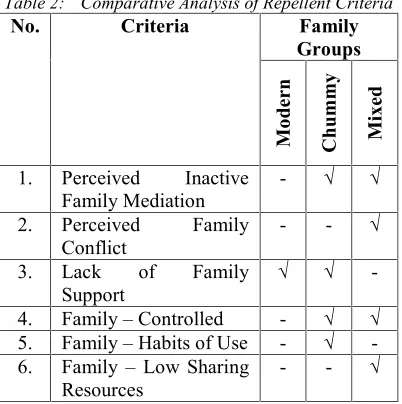
The list of repellent criteria using comparative analysis is summarised in Table 2
.
Table 2: Comparative Analysis of Repellent Criteria
No. Criteria Family Groups
M
ode
rn
C
hum
my
M
ix
ed
1. Perceived Inactive
Family Mediation - √ √
2. Perceived Family
Conflict - - √
3. Lack of Family
Support √ √
-4. Family – Controlled - √ √
5. Family – Habits of Use - √ -6. Family – Low Sharing
Resources - - √
7. Perceived Weak or
Sustain Family
Bonding
- - √
8. Family –
Geographically Local - √
-1.Perceived Inactive Family Mediation: The most commonly mentioned repellent criterion in family perspective is the inactiveness of participating in Facebook among the family members. Chummy and Mixed family groups stated that the lack of participation from family members in responding to the shared status on Facebook has caused them to stop sharing. Commonly older generations feel reluctant to give any feedbacks and prefer to become social surveillance. The efforts that have been made by the users in sharing the information with family members seems not to be appreciated and at the end they tend to repel from the family network [48].
2.Perceived Family Conflict: Existing conflicts that have already occurred among family members have influenced the users from Mixed family group to repel in adding their family members to become Facebook friends. They were not feeling comfortable to communicate with the family members either via online or face-to-face medium. Also, the conflict that arises during family interaction via Facebook could somehow lead to stress in family relationships. This is due to the fact that discussion through asynchronous communication always leads to the dissatisfaction among family members since they have less opportunity to get the complete stories and the questions answered [49].
3.Lack of Family Support:Lack of social support in terms of giving commitment of time and effort to search and add family members as well as sharing their current updates on Facebook makes the attraction of this social platform becomes low [48]. Modern and Chummy users felt a bit reluctant to promote Facebook to older family members such as parents, uncles and aunties, but not with their cousins. However, once the family members are interested with Facebook, the users would make the effort to teach them patiently. 4.Family Controlled: The feeling of being
[image:5.612.95.296.523.725.2]were cautiously control the shared status on Facebook so that it could not be viewed by their family members. On the contrary, sometimes they would feel uncomfortable to view inappropriate postings by family members which make them hide the posted status. The mismatched of sharing habits or communications have cause family conflict among them [50]. 5.Family – Habits of Use: The Chummy family
highlighted their preference in using current communication methods with family members such as through phone calls and face-to-face meetings. The lack of social cues in SNS unlike in face-to-face interaction and lack of immediate feedbacks makes them feel that this communication platform is useless, unnecessary and have no added values [51].
6.Family – Low Sharing Resources:Low sharing of information resources among family members arises when detached users are not interested to share their postings [52]. Initially, the post statuses are addressed to friends, but the users from Mixed family feels uncomfortable after his family members started to participate in the conversation by commenting on the post. Also, asking too much questions during family gathering makes the users felt indolent to entertain them. This has resulted the users to repel from the family network by controlling the privacy settings.
7.Perceived Weak or Sustain Family Bonding:
SNS could not help to improve family relationships among relatives who they are not close with especially for detached users in Mixed family. The lack of family closeness has resulted the family members to repel from being part of the family network on SNS [40].
8.Family – Geographically Local: The attraction of Facebook for family communication seems to be non-relevant among sociable users who are staying nearby. They prefer to see each other face-to-face which is high in communication cues and less effort in typing the messages [53]. One of the users from Chummy family mentioned that initially she adopted Facebook because she wanted to view her newly born grandson photos due to their geographical distance. But after her daughter’s family stay together with her, it seems that photo sharing on Facebook is not important anymore. This is similar to [48] study which highlighted that photo sharing are not important for family members who are staying nearby since they could meet with each other every day.
Table 3 summarised the list of appropriation criteria in family perspective using comparative analysis.
Table 3: Comparative Analysis of Appropriation Criteria
No. Criteria Family Groups
M
ode
rn
C
hum
my
M
ix
ed
1. Family Awareness √ √ √
2. Family Support √ √ √
3. Improve Family
Bonding √ √ √
4. Improve Family
Communication √ √ √
5. Family Sharing
Resources √ √ √
1.Family Awareness: The most common reason for the users from Modern, Chummy and Mixed family groups to appropriate Facebook is to become aware about family members’ activities. The chances of becoming social surveillance could help them to become more aware about their family conditions [12]. The users stated that their family members prefer to announce on Facebook first before telling their relatives via phone calls or face-to-face. It seems that information on Facebook is moving faster compared to other mediums. Additionally, few of the users said that Facebook has helped them to know about their extended family’s life developments although they are not directly in contact with each other. They also get to know more about their family members although they seldom meet. The positive feelings towards Facebook have influenced them to appropriate Facebook among family members.
her family members after she posted information about her business on Facebook. Most of her family members have hired her to become event’s photographer. Another user said he gives support to his family members who are doing online business by sharing information about it to his online friends.
3.Improve Family Bonding: The frequency of updating information to family members could improve the family bonding. Most of the Modern, Chummy and Mixed families prefer to view photographs as it provides sense of presence although they are far from each other [55]. The users also stated that they could communicate with a group either synchronously or asynchronously which makes the relationships become stronger as there are many resources such as photos, videos and texts that could be shared together. There are few family members who did not communicate much in the real world but very active in expressing their feelings on Facebook which helps the relatives to know more about them and help to strengthen the bonding. 4.Improve Family Communication: The
communication among family members have improved after they start to appropriate Facebook within the family network. Currently SNS such as Facebook is incorporated with sound and visual which could facilitate the communication [56]. The Modern, Chummy and Mixed families mentioned that Facebook have encouraged them to initiate communication with family members who are not close to them. After commenting on each other posts for few times, their relationships become closer although before this they did not interact with each other when they meet. Also the asynchronous function provided on Facebook could help respondents to control the communication by constructing proper sentenced before they send the messages [49]. The communication gaps usually happened due to the generation gaps between the family members. Hence, Facebook helps a lot especially for people who are reserved in the real world but could communicate actively in this social platform. 5.Family Sharing Resources: The persistence of
sharing photos within the family network has influenced Modern family to appropriate Facebook. While, although with less frequent of photo sharing, Facebook is also important for Chummy and Mixed family. The feeling of excitement especially among older generations after seeing their grandchildren photos on Facebook have made them feel contented although they are staying far from each other.
This sharing effort has contributed to the relationships preservation and preventing from blurring the family boundaries [52, 57]
.
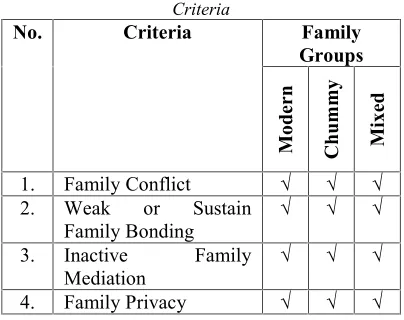
The list of disappropriation criteria in family perspective using comparative analysis is summarised in Table 4.
Table 4: Comparative Analysis of Disappropriation Criteria
No. Criteria Family Groups
M
ode
rn
C
hum
my
M
ix
ed
1. Family Conflict √ √ √
2. Weak or Sustain
Family Bonding √ √ √
3. Inactive Family
Mediation √ √ √
4. Family Privacy √ √ √
1.Family Conflict: Sharing too much information
on Facebook sometimes could lead to family conflict [58] among Modern, Chummy and Mixed families. The conflict could be categorised into three types. Firstly, conflict usually arises after the users expressed their dissatisfaction feelings toward their family members on Facebook. They tend to forget that they actually share the same network with their family members. Secondly, purposely wrote the family conflict publicly after they had an argument. And thirdly, the conflict that arises due to the misinterpretations in reading the shared status. After the conflict occurs, the users are either trying their best to solve the problems or stop using Facebook due to the feeling of stress or have been blocked by their family members or they prefer to ignore the conflicts.
2.Weak or Sustain Family Bonding: The
[image:7.612.317.519.184.344.2]Facebook friends are more towards their real friends compared to family members. Hence, the existence of Facebook does not bring any benefits toward family relationships which resulted to disappropriate of this communication platform.
3.Inactive Family Mediation: The preference of using other SNSs such as WhatsApp to communicate with family members have influenced Modern, Chummy and Mixed families to disappropriate Facebook. This is due to the lack of feedback that they have received on this social platform [48] since their family group have started to migrate to another SNSs that were more convenient for them to communicate. 4.Family Privacy: A teenager user from Mixed
family has set a privacy to her mother and siblings on Facebook as she felt that Facebook is a private platform for her to socialise with friends. She prefers to add her cousins as ‘online friend’ due to the similar interests. Furthermore she felt uncomfortable when her mother uses this platform to monitor her. According to Padilla-Walker, et al. [33] it is common for teenagers to set a boundary with their parents on Facebook. In addition, another user from Chummy family with the type of intimate but distant family relationship does not like to update about his activities with family members on Facebook. Hence, Facebook is just a platform for him to become social surveillance and not for communicating with his family members.
[image:8.612.92.299.495.597.2]Lastly, the reinforcers criteria is presented in Table 5.
Table 5: Comparative Analysis of Reinforcers Criteria
No. Criteria Family Groups
M
ode
rn
C
hum
my
M
ix
ed
1. Family Connectedness √ -
-1.Family Connectedness: Modern family has successfully reinforcers Facebook due to the feeling of connectedness that occurs after communicating with family members on Facebook. The family connectedness could be fostered by constantly communicating and sharing resources together on Facebook, especially for those who are staying distant among each other [52]. The users mentioned that sharing daily life activities on Facebook including sharing photos have made their family
members feel satisfied due to the sense of presence feelings that they received. The feeling of connectedness has increased after the family members continuously giving positive comments on the shared resources [33]. Only one tight-knit user from Chummy family has mentioned about family connectedness. But majority of the users from this family have disappropriated Facebook at Level 2. Hence, at this level, it could be interpreted that only Modern family has successfully reinforcers Facebook.
5. RESEARCH CONTRINUTIONS
The theoretical contribution of this study is in two-fold: the development of FAPSNS framework and the application of the framework through the identification of SNS appropriation process criteria in family context using case study methodology. Firstly, the integration and extension of models and frameworks in developing the FAPSNS framework provides a lens for richer and more comprehensive understanding of the appropriation process. It extends the MTA into a family context and add the socio-technical perspectives into the appropriation process. This is to differentiate the appropriation process of family perspective in order to understand the whole cycle of technology usage. This could help to identify the problems of not appropriating the technology at certain levels. Secondly, the FAPSNS framework is linked between the context and process that family members went through in using Facebook in their daily life. This framework is valued in Information System (IS) area as it could capture the criteria on how SNS is adopted, adapted and used by family members starting from the initial introduction of the Web-based system until the end of the appropriation process in a particular level. The exploration of family, individual and technical perspectives of SNS technology appropriation over time is useful especially in family context as it could draw attention to the expectations of family members and their actual use. The complexity of human-technology interaction on SNS in family context could be captured using the FAPSNS framework through the understanding the appropriation process criteria. Moreover, the identification of criteria from extra-familial context could help to understand further the outcome of adoption and use during the appropriation process.
quantitative approach to identify the factors of adoption, adaptation and use. Whereas, qualitative approach including semi-structured interview, observation and content analysis allow further exploration and understanding of the research context. Also, this approach helps to understand how different criteria emerge different times at different appropriation process levels which are more complex to be captured using quantitative approach. Secondly, the FAPSNS framework was conducted in multiple case studies and had allowed the identification of the appropriation process criteria in family perspective. This research approach is valuable for IS researchers who are examining technology use in family context. The framework is also useful in quantitative research. For future research, the criteria that have been found in the qualitative research could be used in quantitative method to make the appropriation process criteria become more generalise.
The research provides practical contribution towards family members, IS developers, policymakers and relevant agencies. Firstly, the development of FAPSNS framework helps policymaker and relevant agencies such as MCMC and CyberSAFE to know the extent of SNS appropriation process in family context. This could be achieved through the understanding of identified criteria throughout the SNS appropriation process. Secondly, the developers would commonly consider the users’ initial experiences of the new technology (Level 1) and it is unlikely to uncover medium and longer-term experiences (Level 2 and Level 3) [60]. Hence, the FAPSNS framework and identified appropriation process criteria could help developers gain some insights to consider more than the user’s initial experience. Besides the understanding of the SNS appropriation process would help to reduce the expectation gaps between the requirements from family and the functions that are provided by SNS designers. Hence in future, this would assist SNS designer to produce better SNS functions and interface in developing a healthy family communication.
6. RESEARCH CONCLUSION
The outcomes of cross-cases analysis of SNS appropriation levels could be compared according to three family groups. Firstly, Modern family have successfully reinforcers Facebook among their family members. Although the users have highlighted the repellent criteria in level 1 and disappropriation criteria in level 2, but they have took initiatives to resolve the issues since they want
to be part of the family network. Similar to Bengtson [3] study, tight-knit family members always want to get engaged with their relatives.
Secondly, Chummy family have disappropriated Facebook with their family members at Level 2 due to low exchange of resources on Facebook (e.g., photos and updates on daily activities) [61]. They prefer to communicate via face-to-face or phone calls rather than depending on Facebook. They even claimed that Facebook does not support in making the family relationships become improve since their relationships among family members already close before the emergence of Facebook.
Thirdly, due to the major disappropriation of Facebook among family members in family perspective, there were no obvious reinforcers criteria that have been mentioned by Mixed family. The mixture relationships within this family group somehow have influenced family members to become socially inactive with family members. They prefer to become silence reader in order to become more aware about their family conditions though they seldom contact with each other [12]. According to Silverstein and Bengtson [61], dependent daughters in the household are more likely to have tight-knit relationships with mothers since they could provide better child-rearing duties compared to fathers. In contrast with Silverstein and Bengtson [61] findings, dependent daughters in Mixed family seem did not have tight-knit relationships with family members. Hence, Silverstein and Bengtson [61] research might not be relevant for family members who are living in this technology era since the family conflict arise due to high usage of Facebook. Although prior studies have revealed that Facebook is suitable for weak ties [e.g., 8, 12], but it seems to be irrelevant for detached family relationships in Mixed family. Hence, Facebook appropriation process for detached types of family relationships among Mixed family stops at level 1 due to major repellent criteria that have been commented by them.
REFRENCES:
[1] T. Coenen, "Knowledge sharing over social networking systems," PhD. Thesis, Vrije Universiteit Brussel, 2006.
[2] D. Popenoe, "American Family Decline, 1960-1990: A Review and Appraisal,"
Journal of Marriage and the Family, vol. 55,
pp. 527-555, August 1993.
[3] V. L. Bengtson, "Beyond the nuclear family: the increasing importance of multi-generational bonds,"Journal of Marriage and
the Family,vol. 63, pp. 1-16, 2001.
[4] N. S. Hooi, Farah, and Rahman, "Schoolboys lured on Facebook with sex for sale," in The
Star Online, ed, 2011.
[5] I. Lokman, "Facebook, Twitter antara punca cerai," inBerita Harian Online, ed, 2012. [6] S. Looi, F. Y. Ping, and A. Raman, "Teen
dumped after sex threatens suicide," in The
Star Online, ed, 2011.
[7] D. M. boyd and N. B. Ellison, "Social network sites: Definition, history, and scholarship," Journal of Computer-Mediated
Communication,vol. 13, p. 23, Oct 2007.
[8] P. B. Brandtzaeg, "Bridging and bonding in social network sites - investigating family based capital," International Journal Web
Based Communities, vol. 6, pp. 231-253,
2010.
[9] S. A. Muhamad Sham, "The Use of Facebook to Increase Climate Change Awareness among Employees," presented at the International Conference on Social Science and Humanity, Singapore, 2011.
[10] thestar.com, "Survey: Malaysians have most Facebook friends," in The Star Online, ed, 2010.
[11] L. Little, E. Sillence, A. Sellen, and A. Taylor, "The Family and Communication Technologies,"International Journal
Human-Computer Studies,vol. 67, pp. 125-127, 2009.
[12] J. Wen, Y. M. Kow, and Y. Chen, "Online Games and Family Ties: Influence of Social Networking Game on Family Relationship,"
in International Federation for Information
Processing (IFIP)Lisbon, Portugal, 2011, pp.
250-264.
[13] N. Jomhari, V. M. Gonzalez, and S. H. Kurniawan, "Telling my Baby's Stories: Family Communication and Narative Practices of Young Mothers Living Abroad,"
in 20th Australasian Conference on
ComputerHuman Interaction Designing for
Habitus and Habitat OZCHI (2008), 2008.
[14] A. L. Williams and M. J. Merten, "iFamily: Internet and Social Media Technology in the Family Context," Family and Consumer
Sciences Research Journal,vol. 40, pp.
150-170, 2011.
[15] Brown and V. Venkatesh, "Model of Adoption of Technology in Households: A Baseline Model Test and Extension Incorporating Household Life Cycle," MIS
Quarterly, vol. 29, pp. 399-426, September
2005.
[16] C. Maier, S. Laumer, and A. Eckhardt, "Technology Adoption by Elderly People – An Empirical Analysis of Adopters and Non Adopters of Social Networking Sites," in
WIRTSCHAFTINFORMATIK 2011, 2011.
[17] M. Azilawati and Y. Mani, "Communication & Multimedia: Pocket Book of Statistics," MCMC Website2015.
[18] K. H. Eng, A. P. Dayang Aidah, and W. C. Yee, "Household Use of the Internet Survey " MCMC, MCMC Website2011.
[19] onlinesocialmedia.net. (2014, November 21).
Social Media Continual Growth Stats for
June. Available:
http://www.onlinesocialmedia.net/20140714/s ocial-media-continual-growth-stats-for-june/ [20] Socialbakers. (2014, 13thFebruary).Malaysia
Facebook Statistics. Available:
http://www.socialbakers.com/facebook-statistics/malaysia
[21] D. Gibson, "Communication for the Connected Generation," in The Star Online, ed, 2009.
[22] O. Kwon and Y. Wen, "An empirical study of the factors affecting social network service use,"Computers in Human Behavior,vol. 26, pp. 254-263, Mar 2010.
[23] Y. P. Chang and D. H. Zhu, "Understanding Social Networking Sites Adoption in China: A Comparison of Pre-Adoption and Post-Adoption," Computers in Human Behavior,
vol. 27, pp. 1840-1848, May 4 2011.
[24] J. D. Lanigan, "A Sociotechnological Model for Family Research and Intervention: How
Information and Communication
Technologies Affect Family Life," Marriage
and Family Review,vol. 45, pp. 587-609, 21
October 2009 2012.
[25] J. Carroll, S. Howard, F. Vetere, J. Peck, and J. Murphy, "Identity, Power and Fragmentation in Cyberspace: Technology Appropriation by Young People," in
Proceedings of the Twelfth Australasian
[26] J. Carroll, S. Howard, J. Peck, and J. Murphy, "From Adoption to Use: The Process of Appropriating a Mobile Phone," Australian
Journal of Information Systems (AJIS), vol.
10, pp. 38-48, May 2003.
[27] J. Carroll, S. Howard, J. Peck, and J. Murphy, "A Field Study of Perceptions and Use of Mobile Telephones by 16 to 22 Year Olds,"
Journal of Information Technology Theory
and Application,vol. 4, pp. 49-61, 2002.
[28] A. Mendoza, L. Stern, and J. Carroll, "Plateaus in Long-term Appropriation of an Information System," in 18th Australasian Conference on Information Systems (ACIS)
Proceedings, 2007.
[29] J. Fidock and J. Carroll, "The model of technology appropriation: A lens for understanding systems integration in a Defence context," in 17th Australasian Conference on Information Systems (ACIS)
Proceedings, 2006.
[30] A. R. Nor Zairah and A. Rose Alinda, "Multiple Perspectives Technology Appropriation: Analysis of Open Source Software Implementation Failure," in Pacific Asia Conference on Information Systems
(PACIS) Proceedings, 2010.
[31] A. K. Dey and E. S. De Guzman, "From Awareness to Connectedness: The Design and Deployment of Presence Displays," in ACM
HCI Proceedings, Montréal, Québec, Canada,
2006, pp. 899-908.
[32] J. D. Lanigan, M. Bold, and L. Chenoweth, "Computers in the Family Context: Perceived Impact on Family Time and Relationships,"
Family Science Review, vol. 14, pp. 16-32,
2009.
[33] L. M. Padilla-Walker, S. M. Coyne, and A. M. Fraser, "Getting a High-Speed Family Connection: Associations Between Family Media Use and Family Connection," Family
Relations,vol. 61, pp. 426-440, July 2012.
[34] V. L. Bengtson and S. S. Schrader, "Parent-Child Relations," in Handbook of Research
Instruments in Social Gerontology. vol. 2, D.
Mangen and W. Peterson, Eds., ed Minneapolis: University of Minnesota Press, 1982, pp. 115-185.
[35] E. L. Trist, Organizational Choice vol. 1. London: Tavistock Publications, 1963. [36] S. M. Coyne, A. I. Nathanson, and B. J.
Bushman, "Media and the Family: A Note From the Guest Editors," Family Relations,
vol. 61, pp. 359-362, July 2012.
[37] R. Kraut, T. Mukhopadhyay, J. Szczypula, S. Kiesler, and B. Scherlis, "Information and Communication: Alternative Uses of the Internet in Households," Information Systems
Research,vol. 10, pp. 287-303, 1999.
[38] J. I. L. Beckenhauer and J. Armstrong, "Exploring Relationships Between Normative Aging, Technology, and Communication,"
Marriage and Family Review, vol. 45, pp.
825-844, October 21 2009.
[39] T. Kang, "Gendered media, changing intimacy: Internet-mediated transnational communication in the family sphere,"Media,
Culture and Society, vol. 34, pp. 146-161,
April 19 2012.
[40] T. K. Judge, C. Neustaedter, S. Harrison, and A. Blose, "Family Portals: Connecting Families Through a Multifamily Media Space," inCHI '11, Vancouver, BC, Canada, 2011, pp. 1205-1214.
[41] K. M. Hertlein, "Digital Dwelling: Technology in Couple and Family Relationships,"Family Relations,vol. 61, pp. 374-387, July 2012.
[42] S. P. Wyche and R. E. Grinter, ""This is How We Do it in My Country": A Study of Computer-Mediated Family Communication among Kenyan Migrants in the United States " inComputer Supported Cooperative Work, Seattle, WA, USA, 2012, pp. 87-96.
[43] R. Furukawa and M. Driessnack, "Video-Mediated Communication to Support Distant Family Connectedness," Clinical Nursing
Research, vol. 22, pp. 82-94, January 10
2013.
[44] S. S. Lim and C. Soon, "The Influence of Social and Cultural Factors on Mother's Domestication of Household ICTs -Experiences of Chinese and Korean Women,"
Journal of Telematics and Informatics, vol.
27, pp. 205-216, August 2010.
[45] M. Madianou, "Migration and the accentuated ambivalence of motherhood: the role of ICTs in Filipino transnational families," Journal of
Global Networks, vol. 12, pp. 277-295, July
2012.
[46] A. R. Zaharuddin,Ledakan Facebook Antara
Pahala dan Dosa. Selangor, Malaysia: PTS
2012.
[47] R. Cornejo, M. Tentori, and J. Favela, "Enriching In-Person Encounters through Social Media: A Study on Family Connectedness for the Elderly,"International
Journal Human-Computer Studies, vol. 71,
[48] K. Tee, A. J. B. Brush, and K. M. Inkpen, "Exploring communication and sharing between extended families," Int. J.
Human-Computer Studiesvol. 67, pp. 128–138, 2009.
[49] L. H. Ganong, M. Coleman, R. Feistman, T.
Jamison, and M. S. Markham,
"Communication Technology and Postdivorce Coparenting," Family Relations, vol. 61, pp. 397-409, July 2012.
[50] D. E. Agosto, J. Abbas, and R. Naughton, "Relationships and Social Rules: Teens’ Social Network and Other ICT Selection Practices," Journal of the American Society
for Information Science and Technology, vol.
63, pp. 1108-1124, June 2012 2012.
[51] V. Lehtinen, J. Nasanen, and R. Sarvas, ""A little silly and empty-headed": older adults' understandings of social networking sites," in
BCS-HCI '09 Proceedings of the 23rd British HCI Group Annual Conference on People and
Computers: Celebrating People and
Technology, United Kingdom, 2009.
[52] A. J. Bernheim Brush, K. M. Inkpen, and K. Tee, "SPARCS: Exploring Sharing Suggestions to Enhance Family Connectedness," in CSCW, San Diego, California, USA, 2008, pp. 629-638.
[53] M. J. Stern and C. Messer, "How Family Members Stay in Touch: A Quantitative Investigation of Core Family Networks,"
Marriage and Family Review, vol. 45, pp.
654-676, October 21 2009.
[54] J. Vitak, N. B. Ellison, and C. Steinfield, "The Ties That Bond: Re-Examining the Relationship between Facebook Use and Bonding Social Capital," in 44th Hawaii
International Conference on System Sciences,
2011, pp. 1-10.
[55] J. Pettigrew, "Text Messaging and Connectedness within Close Interpersonal Relationships,"Marriage and Family Review,
vol. 45, pp. 697-716, October 21 2009. [56] S. G. B. Roberts and R. I. M. Dunbar,
"Communication in Social Networks: Effects of Kinship, Network Size and Emotional Closeness," Journal of the International
Association for Relationship Research, vol.
18, pp. 439-452, 2011.
[57] Mesch, "Family Relations and the Internet: Exploring a Family Boundaries Approach,"
Journal of Family Communication,vol. 6, pp.
119-138, 2006.
[58] P. Kerkhof, C. Finkenauer, and L. Muusses, "Relational Consequences of Compulsive Internet Use: A Longitudinal Study among Newlyweds," Human Communication
Research,vol. 37, pp. 147-173, 2011.
[59] B. H. Kaare, P. B. Brandtzæg, J. Heim, and T. Endestad, "In the Borderland between Family Orientation and Peer Culture: The Use of Communication Technologies among Norwegians Tweens," Journal of New Media
& Societyvol. 9, pp. 603-624, August 2007.
[60] J. Carroll, S. Howard, and F. Vetere, "Just what do the youth of today want? Technology appropriation by young people," in
Proceedings of the 35th Hawaii International
Conference on System Sciences, Big Island,
Hawaii, 2002, p. 131b.
[61] M. Silverstein and V. L. Bengtson, "Intergenerational Solidarity and the Structure of Adult Child-Parent Relationships in American Families," American Journal of
Sociology, vol. 103, pp. 429-460, September