Copyright © 2017, Scholarly Research Journal for Interdisciplinary Studies
A COMPARATIVE STUDY OF STUDENTS’ PREFERENCES FOR LEARNING
ENVIRONMENT ON THE BASIS OF SCHOOL TYPES.
Ms. Megha D’souza1 & Shefali Pandya2, Ph.D.
1
Assistant Professor, Smt. Kapila khandvala college of Education, Santacruz,
Mumbai- 54
2
Associate Professor, Department of Education, University of Mumbai, Kalina, Mumbai- 55
Education is a potent force in developing a child into skilled, effective, productive and law-abiding citizen. It is therefore imperative that the environment for the education of the child is conducive and congenial for his growth and development. The aim of the study was to compare students‟ preferences for learning environment on the basis of School Types. The study adopted the descriptive method of the Casual – Comparative type. The sample comprised of 574 standard VIII English medium students from schools. The tools used for the study were Preferred Learning Environment Scale by Fraser (1996) and Hemisphericity Dominance Test by Venkataraman. ANOVA and „t‟ test was used to compare students‟ preference for learning environment on the basis of hemisphericity and gender respectively. The findings are discussed in detail in the paper.
Keywords: Students‟ Preferences, Learning Environment, School types by Gender, School Types by
Management.
Introduction
Education is a potent force in developing a child into skilled, effective, productive and
law-abiding citizen. Education is one of the most vital pillars of the country. It is therefore
imperative that the environment for the education of the child is conducive and congenial for
his growth and development. There is positive correlation between educational environment
and student morale (Sharma, 1983).
There is significant difference in boys and girls on classroom environment scores (Patel,
1987).
Empirical evidence has linked learning environment with the achievement. Openness
of Learning Environment has been linked primarily to expressive characteristics in schools.
For example, the more open learning environment, the more committed, loyal and satisfied
Copyright © 2017, Scholarly Research Journal for Interdisciplinary Studies
the teachers are. Similarly the more open the learning environment; the less alienated students
tend to be.
(Solanki, 1992) found a relationship between the resource management system and the
organizational climate of the schools. Highly resourceful schools were inclined towards the
open range climate. Whereas the low-resourceful and very low-resourceful schools were
inclined towards the close range climate.
Education system needs to be tuned to the requirements of the nation. It should not
only emphasize on learning and memorization but also help the students to acquire the habit
of independent and innovative thinking. Education should encourage and help development
of creative abilities in educands. Education can help developmental changes to occur by
developing the creative abilities in human beings. Creative thinking leads to creative
production of substance.
The education system is therefore to function in such a way as to develop the creative
abilities of the students. To establish this function the educational system needs to cater the
desires and preferences of the students with respect to their learning environment.
If learning environment provided to the students is as per their preferences then it will
positively contribute to the overall development of the students. Also the students’
preferences may differ on the basis of the type of school they attend, which the researcher
found to be an influential variable in determining students’ preferences for learning
environment.
Aim of the study
To compare students’ preferences for learning environment on the basis of School types.
Objectives of the study
1) To compare students’ total preferences for learning environment and its dimensions
on the basis of school types by gender.
2) To compare students’ total preferences for learning environment and its dimensions
on the basis of School types by management
Null hypothesis of the study
1) There is no significant difference in the students’ total preference for learning
environment and its dimensions on the basis of school types by gender.
2) There is no significant difference in the students’ total preference for learning
Copyright © 2017, Scholarly Research Journal for Interdisciplinary Studies
Methodology of the Present Study
The present study has adopted the descriptive method of the Causal – Comparative type. This
method is adopted as the study aims to compare students’ preferences for learning
environment on the basis of school types.
Sample
In the present study the population comprised of VIIIth standard students of English medium
schools situated in Greater Mumbai, affiliated to the SSC board.
The sample selected for the present study consists of 574 students – both boys and girls from
standard VIII of English medium schools situated in Greater Mumbai.
Size and Composition of the Sample
The sample consisted of standard VIII students both boys and girls of schools affiliated to the
SSC board and situated in Greater Mumbai. Initially the sample size comprised of 610
students. After editing for completion of the tools, the total sample amounted to 574
students. 36 (5.90 %) forms were discarded on account of incomplete information.
The sample comprised of 183 (31.88 %), 190 (33.10%) and 201 (35.02 %) students from
south zone, north zone and central respectively. Also the sample consisted of 324 (56.45 %)
boys and 250 (43.55 %) girls.
Tools of Research
The following are a list of tools, which were employed by the researcher for the study:
1) Personal data sheet: It asked for information such as their name, name of their school,
standard and gender.
2) Preferred Learning Environment Scale: This tool was used to ascertain the students’
preferences for Learning Environment. This rating scale was originally developed by
Fraser (1996). This scale consists of 10 dimensions.
The dimensions are as follows:
i) Student Cohesiveness (vi) Co-operation
ii) Teacher Support (vii) Equity
iii) Involvement (viii) Differentiation
iv) Task Orientation (ix) Computer usage
Copyright © 2017, Scholarly Research Journal for Interdisciplinary Studies
This tool was prepared and employed for the study in western country. Hence the reliability
of the tool in India was established. The internal consistency reliability using Rulon’s formula
was found to be 0.86
Techniques of data analysis:
In the present study the following parametric techniques have been employed to compare
standard VIII students’ preferences for learning environment on the basis of their
hemisphericity and on the basis of gender of the students.
1) ANOVA: In the present study, this technique was used to compare students’ total
preferences for learning environment and its dimensions on the basis of school types
by Gender.
2) ‘t’ test: In the present study this technique was used to compare the students’
preference for learning environment on the basis of school types by management.
3) ω2est: It was used to ascertain the proportion of variance accounted for by school types
by gender and school types by management.
Testing of hypothesis
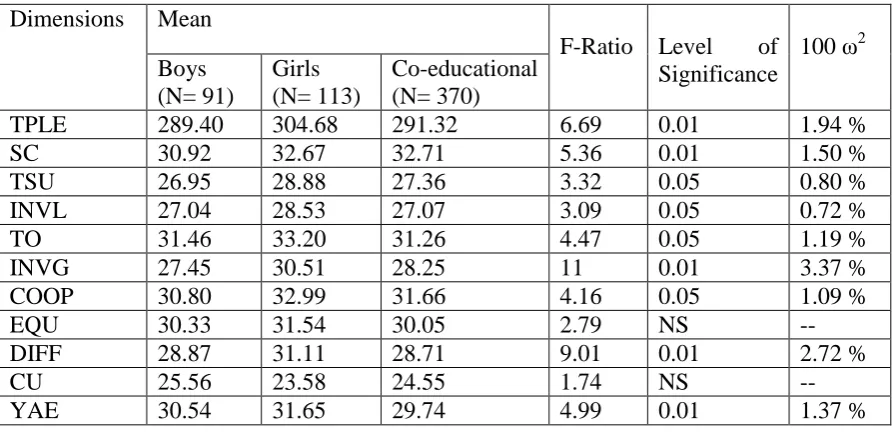
1) There is no significant difference in the students’ total preference for learning
[image:4.595.75.523.482.698.2]environment and its dimensions on the basis of school types by gender.
Table showing relevant statistics of Preferred Learning Environment scores of students
on the basis of School Types by Gender
Dimensions Mean
F-Ratio Level of
Significance
100 ω2
Boys (N= 91)
Girls (N= 113)
Co-educational (N= 370)
TPLE 289.40 304.68 291.32 6.69 0.01 1.94 %
SC 30.92 32.67 32.71 5.36 0.01 1.50 %
TSU 26.95 28.88 27.36 3.32 0.05 0.80 %
INVL 27.04 28.53 27.07 3.09 0.05 0.72 %
TO 31.46 33.20 31.26 4.47 0.05 1.19 %
INVG 27.45 30.51 28.25 11 0.01 3.37 %
COOP 30.80 32.99 31.66 4.16 0.05 1.09 %
EQU 30.33 31.54 30.05 2.79 NS --
DIFF 28.87 31.11 28.71 9.01 0.01 2.72 %
CU 25.56 23.58 24.55 1.74 NS --
YAE 30.54 31.65 29.74 4.99 0.01 1.37 %
For df = (2, 571), Tabulated F = 3.01 at 0.05 level,
Copyright © 2017, Scholarly Research Journal for Interdisciplinary Studies
Conclusion
There is a significant difference in Total Preferred Learning Environment of students on the
basis of school types by gender. The mean Total Preferred Learning Environment of students
from girls’ schools is the highest and is significantly greater than those from co-educational and boys’ schools.
Similarly, there is significant difference in students’ preferences for Student
Cohesiveness, Teacher Support, Involvement, Task Orientation, Investigation, Co-operation,
Differentiation and Young Adult Ethos dimensions of Preferred Learning Environment on the
basis of school types by gender. The mean Teacher Support, Involvement, Investigation,
Co-operation of students from girls’ schools is the highest followed by students from co-educational and boys’ schools.
However, the mean Student Cohesiveness of students from co-educational schools is
greater than that of students from girls’ and boys’ schools. The mean Task Orientation, Differentiation, and Young Adult Ethos of students from girls’ schools is highest followed by students from boys’ and co-educational schools.
There is no significant difference in students’ preferences for Equity and Computer Usage
dimensions of Preferred Learning Environment on the basis of school types by gender.
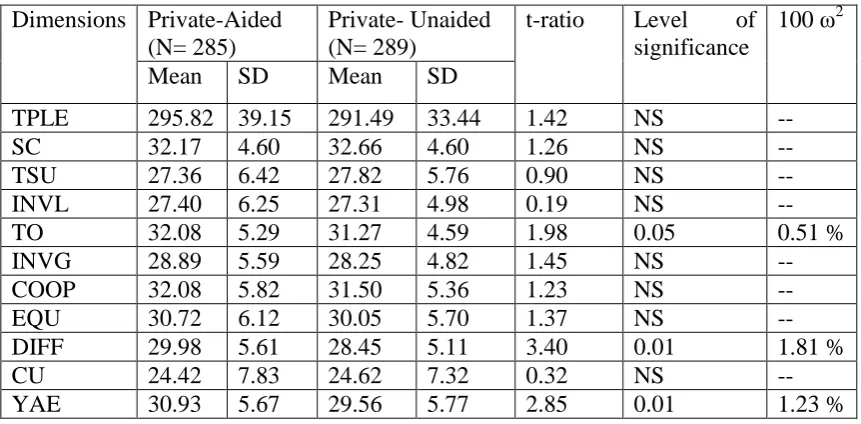
2) There is no significant difference in the students’ total preference for learning
[image:5.595.83.514.523.735.2]environment and its dimensions on the basis of school types by management.
Table showing relevant statistics of Preferred Learning Environment scores of students
on the basis of School Types by Management
Dimensions Private-Aided (N= 285)
Private- Unaided (N= 289)
t-ratio Level of
significance
100 ω2
Mean SD Mean SD
TPLE 295.82 39.15 291.49 33.44 1.42 NS --
SC 32.17 4.60 32.66 4.60 1.26 NS --
TSU 27.36 6.42 27.82 5.76 0.90 NS --
INVL 27.40 6.25 27.31 4.98 0.19 NS --
TO 32.08 5.29 31.27 4.59 1.98 0.05 0.51 %
INVG 28.89 5.59 28.25 4.82 1.45 NS --
COOP 32.08 5.82 31.50 5.36 1.23 NS --
EQU 30.72 6.12 30.05 5.70 1.37 NS --
DIFF 29.98 5.61 28.45 5.11 3.40 0.01 1.81 %
CU 24.42 7.83 24.62 7.32 0.32 NS --
Copyright © 2017, Scholarly Research Journal for Interdisciplinary Studies
For df = 572, Tabulated t at 0.05 level = 1.96,
0.01level = 2.59
Conclusion:
There is significant difference in students’ preferences for Task Orientation, Differentiation
and Young Adult Ethos dimensions of Preferred Learning Environment on the basis of school
types by management. The mean Task Orientation, Differentiation and Young Adult Ethos of
students from private-aided schools is significantly greater than those from private-unaided
schools.
However, there is no significant difference in students’ preferences for Total Preferred
Learning Environment, Student Cohesiveness, Teacher Support, Involvement, Investigation,
Co-operation, Equity and Computer Usage dimensions.
Discussion and findings:
The findings imply that the students from either girls’ schools or co-educational schools
prefer:
Student cohesiveness in terms of knowing other students, sharing of ideas and opinions
and helping others in difficult times.
Teacher’s help in difficulty and consideration for their feelings.
Sharing of ideas, involvement in discussion and asking questions
Co-operating with other students while doing academic work. They prefer sharing their
resources with each other.
Students from single sex schools prefer to understand tasks and complete the task on time;
Work on differential task as per their own speed and ability preferring being treated like
matured, responsible and independent young adults.
This could be perhaps because the nature and upbringing of the girls is such that their
preferences from ‘significant others’ in school regarding, teacher support, involvement, task
orientation, investigation, co-operation, differentiation, young adult ethos are likely to be
higher than the students coming from co-educational and boys’ schools.
The students from private-aided schools preferto understand tasks and complete the task
on time; prefer to work on different task as per their ability and their own speed; and Work at
their own speed and ability preferring being treated like matured, responsible and
Copyright © 2017, Scholarly Research Journal for Interdisciplinary Studies
This could be because students coming from private-aided schools have high aspirations,
high parental expectations, peer influence, also their home environment and socio-economic
status may influence their preferences. Thus their preferences in the school regarding task
orientation, differentiation and young adult ethos are likely to be higher as compared to those
from private-unaided schools.
Implications of the study:
Students spend a vast amount of their time in school; they are widely influenced by
the various experiences of the learning environment. Thus it is significant for the teacher to
take into account their preferences for learning environment in order to provide desirable
learning environment in classrooms. The study will help the teachers to design or modify the
learning environment according to the type of school students belong to.
Learning environment is such an effective determinant of school outcomes that creating
conducive and desirable learning environment will lead to increased effectiveness of the
school. If the learning environment is as per the preferences of the students it may not only
result in improved academic achievement of the students but also make them regular, curious,
committed and responsible in learning.
The present study suggests that:
Teachers need to cater to the higher preferences of students from girls’ school for
teacher support, involvement, investigation, cooperation, task orientation,
differentiation and young adult ethos
It also suggests that students from private- aided schools need to be given more
opportunities for task orientation, differentiation and young adult ethos.
References:
BOOKS
Aggarwal, D.D..(2004). Educational technology. New Delhi: Sarup and sons.
Best, J.W., & Kahn, J.V. (1986).Research in education (5thed). New Delhi: Prentice Hall of India Pvt
Ltd.
Best, J.W., & Kahn, J.V. (2003).Research in education (9thed).New Delhi: Prentice Hall of India Pvt
Ltd.
Fink, A. (1998). Conducting research literature review. New Delhi: Sage Publication India Pvt Ltd.
Fraser, B.J. (1986). Classroom enviroment.CroomHelm, Australia: Pvt Ltd.
Garrett, H.E., & Woodworth, R.S. Statistics in psychology and education. Mumbai, Maharashtra:
Copyright © 2017, Scholarly Research Journal for Interdisciplinary Studies
Guilford, J.P., &Fruchter, B. (1978).Fundamental statistics in psychology and education. Auckland,
New Zealand: The McGraw Hill Intl co.
Kothari, C. R. (1985). Research methodology-methods and techniques. New Delhi: Wiley Easter Ltd.
Koul, L. (1988). Methodology of educational research. New Delhi: Vikas Publishing House Pvt Ltd.
Majumdar, P.K. (2002). Statistics in psychology and education. New Delhi: Prentice Hall of India.
Mangal, S.K .(2002). Statistics in psychology and education. New Delhi: Prentice Hall of India.
Patel, R. N. (2004). Educational evaluation. Mumbai, Maharashtra: Himalaya Publishing House.
Seltiz, C. (1962). Research method in social relations.New York. Holt: Rhinehart& 2Winston.
Venkataraman, (1996). D. Education and hemisphericity. New Delhi: Reliance Publishing House.
ENCYCLOPEDIAS
Buch, M. B. (1987). Third Survey of Research in Education (1978-1983). New Delhi: NCERT.1986. Buch, M. B. (1991). Fourth Survey of Research in Education (1983-1988). Volume I. New Delhi:
NCERT.1991.
Buch, M. B. (1991). Fourth Survey of Research in Education (1983-1988). Volume II. New Delhi: NCERT.1991.
Buch, M. B. (1997). Fifth Survey of Research in Education (1988-1992). Volume I. New Delhi: NCERT.1997.
Buch, M. B. (1997). Fifth Survey of Research in Education (1988-1992). Volume II. New Delhi: NCERT.1991.
Clark, B.R. and Neave, G. R. (1992).The Encyclopedia of Higher Education. UK: Pregamon Press Ltd.
Deighton, L.C. (1971). The Encyclopedia of Education.The Macmillan Company and the free Press.Crowell Collier and Macmillan Inc.
Guthrei, J.W. (2003). Encyclopedia of Education (2nded). New York: Macmillan Reference USA. Husen, T. and Postlethwaite, T. (1985).The International Encyclopedia of Education. UK: Pregmon
Press ltd.
Sills, D. (1968). International Encyclopedia of the Social Sciences.The Macmillan Company and the Free Press.Crowell Collier and Macmillan Inc.
Smelser, N. and Baltes, P. (2001).International Encyclopedia of the Social and Behavioral Sciences. Amsterdam: Elsevier Science Ltd.
Venkataiah, S. (1999).Encyclopedia of Contemporary Education. New Delhi: Anmol Publications Pvt Ltd.
DICTIONARIES
Good, C. V. (1945). In Dictionary in Education (3rded). New York: McGraw Hill inc.
Mehndiratta, M. (1997).In Encyclopedia dictionary of Education.Volume I. New Delhi: Sarupans
Sons.
UNPUBLISHED M.ED DISSERTATIONS
Pandya, S. (1988).“A comparative study of the classroom climate in schools under different types of management and its effect on the attitude of students towards the schools.”Unpublished M.Ed
Copyright © 2017, Scholarly Research Journal for Interdisciplinary Studies
Halim, H. (2005). “A study of learning environment of secondary schools in relation to learner
autonomy.”Unpublished M.Ed Dissertation, University of Mumbai.
Varghese, J. (2005). “A study of learning and thinking styles of secondary school students and their