ENERGY EFFICIENT AND CONNECTIVITY BASED
CLUSTERING SCHEME FOR MULTICAST ROUTING IN
WIRELESS SENSOR NETWORKS
1E. MARIAPPAN, 2Dr.B.PARAMASIVAN
1
Assistant Professor & Head, Department of Information Technology, Jayaraj Annapackiam C.S.I College of Engineering, Nazareth,Tuticorin, Tamilnadu, INDIA
2
Professor and Head, Department of CSE, National Engineering College, , Kovilpatti, Tamilnadu,INDIA E-mail: [email protected], [email protected]
ABSTRACT
Wireless sensor networks s(WSNs) are the key technology for monitoring and communicating with the physical environment. Data aggregation is the key challenge to make energy constraints of sensor node to increase network life time. Since sensor nodes are densely deployed, redundant data may occur. Clustering the network provides effective solution for such issues and is an important way of managing large number of sensor nodes. We proposed a new Energy Efficient and Connectivity based Clustering scheme for multicast routing in wireless sensor networks named as E2C4. In E2C4, the cluster heads are elected by a probability based on the ratio between ensemble energy consumption of each node and the average energy of the network. The cluster-heads’ period will be different according to their initial and consumption energy rate. The nodes with high initial energy and less energy consumption rate will have more chances to be the cluster-heads than the nodes with low initial energy and high energy consumption. In the conclusion, the experimental result shows that E2C4 achieves longer lifetime and more effective messages than current important clustering protocols like LEACH and HEED
Keywords: Clustering algorithm, Data aggregation, Efficient energy consumption, Multicast routing, Wireless sensor networks
1. INTRODUCTION
Recent advances in miniaturization and low-power design have led to the development of small-sized battery-operated sensors with limited on-board signal processing and wireless communication capacities. WSNs become increasingly useful in various critical applications including ecological monitoring, smart offices, homes, Warfield surveillance, and transportation traffic monitoring. In order to achieve high quality and fault-tolerant capability, a sensor network composed of hundreds or thousands of unattended sensor nodes, which are often randomly deployed inside the interested area [1].Since WSNs is usually exposed to dynamic and unattended in harsh environments, it is possible to loss of connectivity of individual nodes. Conventional centralized algorithms need to operate with global knowledge of the total network and transmission failure of a critical node that cause a severe protocol failure. On the contrary, distributed algorithms are only executed locally within partial nodes, thus can
can be extremely successful in multicast and data query [5-8][15]. Cluster-heads are collecting the interested data within their own clusters and minimize the broadcast control messages among the nodes. The performance of the novel energy saving clustering algorithms for WSNs was studied and evaluated. Each node can transmit sensing data to the base station through a head. The cluster-heads are elected periodically by clustering algorithms, aggregate the data of their cluster members and send it to the base station. All the nodes of the sensor network are equipped with different amount of energy [9]. Following the views of LEACH, the proposed E2C4 allows each node expend energy uniformly by rotating the cluster-head role among all nodes. The cluster-cluster-heads are selected by a probability based on the ratio between ensemble energy consumption of each node and the average energy of the network. The number of round the rotating period of each node is varied according to its initial and consumption energy rate. The nodes with high initial and less energy consumption rate have more chances to be the cluster-heads than the nodes with low initial energy and high energy consumption that led to prolong the network lifetime and make stable networks Simulation shows that E2C4 achieves longer network lifetime and more effective data aggregation than other classical clustering algorithms.
The remainder of the paper is organized as follows. Section2 review the related work. Section3 describes the proposed solution. Section 4 shows the performance of E2C4 by simulations and compares it with LEACH and HEED. Finally, Section 5 gives concluding remarks.
2. LITERATURE REVIEW
In general, two kinds of clustering schemes are applied in homogeneous networks are called homogeneous schemes, and the clustering algorithms applied in heterogeneous networks are referred to as heterogeneous clustering schemes. It is difficult to devise an energy efficient heterogeneous clustering scheme due to the complicated energy configure and network operation. Thus most of the classical clustering algorithms are categorized such as LEACH [10], PEGASIS [11], TEEN [12], APTEEN [13], SEP [14] and HEED [15].
W. R. Heinzelman, A. P. Chandrakasan and H. Balakrishnan [10] proposed Low Energy Adaptive Clustering Hierarchy (LEACH) protocol. It is one
of the most popular hierarchical routing algorithms for sensor networks. The idea is to form clusters of the sensor nodes based on the received signal strength and use local cluster heads as routers to transmit the data to sink. This save energy since the transmissions will only be done by such cluster heads rather than all sensor nodes. Optimal number of cluster heads is estimated to be 5% of the total number of nodes.
S. Lindsey and C. Raghavendra [11] introduced Power Efficient Gathering in Sensor Information Systems (PEGASIS) protocol. It is an improved version of LEACH. Instead of forming clusters, it is based on forming chains of sensor nodes. One node is responsible for routing the aggregated data to the sink. Each node aggregates the collected data with its own , and then passes the same to the next ring. It employs multi hop transmission and selects one node allows to transmit the data. Since the overhead caused by dynamic cluster formation is eliminated, multi hop transmission and data aggregation is employed, PEGASIS outperforms the LEACH. However excessive delay is introduced for large networks and single leader can be a bottleneck.
A. Manjeshwar and D. P. Agarwal [12] proposed Threshold sensitive Energy Efficient sensor Network Protocol (TEEN) protocol. Closer nodes form clusters with separate layers. Cluster heads are allowed to transmit the collected data to one upper layer. Cluster heads are formed based on broadcast two threshold values including hard threshold and soft threshold. Hard threshold is a minimum possible value of an attribute to trigger a sensor node. Hard threshold allows nodes transmit the event, if the event occurs in the range of interest. Therefore a significant reduction of the transmission delay occurs. Unless a change of minimum soft threshold occurs, the node does not send a new data packet. Employing soft threshold prevents from the redundant data transmission. Since the protocol is to be responsive to the sudden changes in the sensed attribute, it is more suitable for time-critical applications.
and the transmission schedule to all nodes. Cluster heads are also responsible for data aggregation in order to achieve minimal energy consumption it decreases the size data transmitting. According to energy dissipation and network lifetime, TEEN gives better performance than LEACH and APTEEN because of the decreased number of transmissions. The main drawbacks of TEEN and APTEEN are overhead and complexity of forming clusters in multiple levels, implementing threshold-based functions and dealing with attribute based naming of queries.
In 2004, G. Smaragdakis, I. Matta and A. Bestavros [14] proposed Stable Election Protocol (SEP). It is a heterogeneous aware protocol that considered on weighted election probabilities of each node to become cluster head according to their respective energy. This approach ensures that the cluster head election is randomly selected and distributed based on the fraction of energy of each node which make uniform use of the node’s energy. They considered the two types of nodes and two level hierarchies.
O. Younis and S. Fahmy described[15] Hybrid Energy Efficient Distributed clustering Protocol (HEED) protocol which extends the basic scheme of LEACH by using residual energy as primary parameter and network topology features like Node degree, distances to neighbors to achieve power balancing. The clustering process is divided into a number of iterations, and in each iterations, nodes which are not covered by any cluster head double their probability of becoming a cluster head. Since these energy-efficient clustering protocols enable every node to independently and probabilistically decide on its role in the clustered network, they cannot guarantee optimal elected set of cluster heads.
3. PROPSED WORK
4.2 Network model and cluster formation algorithm
This section describes the network model and cluster formation. The following assumptions are made to form the clusters; there are Nnodes
sensor nodes, which are uniformly deployed within a MXM sized region, the nodes always have data to transmit to a base station, which is often far from the sensing area. This kind of sensor network can be used to track or monitor remote environment. Without loss of generality, it assumes that the base station is located at the middle of the MXM sized region. The network is organized into clustering
hierarchy, and the cluster-heads execute fusion function to reduce the correlated data produced by the sensor nodes within the clusters. The cluster-heads transmit the aggregated data to the base station directly. To avoid the frequent change of the topology, network model is designed the way that the nodes are micro mobile or stationary as supposed. This network model considers the two types of sensor nodes including superior nodes and normal nodes. The total initial energy of the networks is calculated by Eq.(1)
(1 cp)
I E C) (1 I NpE p) (1 I NE td
E = − + + = +
(1)
Where Etot – Total Energy of the network, Nnodes -
Number of nodes, EI – Normal node’s Initial energy
covers the radius R, p – fraction of the superior node, c times more energy than normal nodes, p N superior nodes equipped with initial energy of EI(1
+ c), and (1 - p) Nnodes normal nodes equipped with
initial energy of EI. The energy consumption of Ni
can be calculated based on the ensemble energy consumption for sensing, processing, communication and coverage estimation per bit transmission to multiple groups. The cluster is formed based on the ensemble energy consumption rate. In multicast routing each packet transmitted by a source to one or more receivers in its neighborhood, the energy is calculated as according to Eq.(2)
C CC D R
S
N
E
E
G
(NC
G)
E
E
E
E
i
=
+
+
−
+
+
(2)Where ES and ER represent the amount of energy
required to send and receive packets respectively, G is the group of nodes which should receive the packet, and NC is the total number of cluster neighbors in the transmission range R. ED quantifies the amount of energy required to decode the packet header. ECC denote the energy required
for determining the connectivity conscious and EC
is the communication cost of nodei. The
connectivity awareness can be calculated through the metrics of total packets send to group of receiver and the number of packets received by the destination group. The cost of a link between node Si and group of receivers R1 to RG is equal to the
(
)
+ =∑
∑
= = RX R S E R S E E E j i R G j j i S G j PD i CC 1 (
, 1 ,
1
(3)
In this section, ensemble energy consumption and coverage and connectivity aware clustering mechanism was formulated that binds all the nodes operating in a particular region. Each sensor has initial energy EI(1+cp) with coverage metric R.
Sensor consumes energy EC for communicating
with one hop neighbors. Single cluster is formed based on the constraints Eq.(4) to Eq.(7) which are used for finding a subset of the sensors that provides complete coverage of the region. Ensemble energy consumption for communicating with one hop neighbors and maximum power consumption of any node in the network can be limit as follows
∑
≤
i
i
E
EN
(4)
E
CE
toti
≤
∑
(5)
Efficient routing metric is used for updating the periodic status of each node automatically when the node leave or join the network. The proposed algorithm has defined the additional clustering metric in equation (6) for the dynamic environment. and also find the best sequence of coverage to maximize the life of the network and minimize the energy consumption.
∏
=⊂
1 C ε S i i I)
J(S
CA
(6)
Where CA is coverage area, J is energy consumed. A point in an area CA is said to be covered if it lies within the sensing range of at least one sensor. Amount of data to be transmitted between source to a group of clusters have constrained as follows
0
≤
D
RG≤
D
Si(7)
Constraint (7) limits the amount of data to be transmitted from the source Si to group of receiver
(DRG) that reduce the energy consumption.
4.2 Proposed Algorithm for Cluster Formation
Input : ENi, ECC, R, S, R;
Output : Ci;
1: Classifying the sensing range R and deployed location into CA disjoint regions
2: Correlate each sensor with a set of sub regions based on ensemble energy consumption, residual energy and connectivity conscious
3: While all the sensors are not covered do
4: Calculate the efficient sub region as C = min ∑SiЄCj ECC
5: From the covering region C choose the maximum value of residual energy Erei
6: For each sensors in the current coverage do 7: Erei = Erei - ENi
8: If (Erei < ENi) then
9: Drop the sensor from current coverage set 10: End
11: End
12: Update the values of the sub regions and their relationships.
13: End
4.2 Cluster Head Selection
In this network model, all the nodes cannot possess the equal residual energy. The proposed protocol chooses different ni based on the residual
energy Ere of nodes Si at round r. Let pi=1/ ni, as
average probability to be a cluster-head during ni
rounds. ni denote the number of rounds to be a
cluster-head for the node Si, and it referred as the
rotating period. When nodes have the same amount of energy at each rotating period, choosing the average probability pi to be popt can ensure that
there are popt N cluster-heads in every round. Nodes
with different amounts of energy, pi of the nodes with more energy should be larger than popt . Let
denote the average energy at round r of the network, which can be find out by Cluster-head is selected by average probability average energy at ni
rounds
∑
==
N i reE
N
E
11
(
8)This guarantees that the average total number of cluster-heads per round per epoch is equal to Eq.(9)
Ere re E N opt p N i
p
=∑
∑
1
1
(9)
It provides the optimal cluster-head number. The probability threshold of each node Si used to
determine whether itself to become a cluster-head in each round or not. It can be calculated by Eq. (10) − = otherwise G S if p pi S
T i irni i
Where G is the set of nodes that are eligible to be cluster-heads at round r. If node Si has not been a
cluster head during the most recent ni rounds. In
each round r, node Si itself eligible cluster head
which choose a random number between 0 and 1. If the number is less than threshold T (Si), the node Si
becomes a cluster-head during the current round. The nodes with high residual energy take more turns to be the cluster-heads than lower ones
4.2 Optimized route selection
Multipath Routing(MP) denote the maximum number of routes that exist between each source to destination pair, and l is the selected of in MP. Pow(Si,l) denotes the power consumed by node Si for transmitting data to the next node on
route l . Routing parameter depends only on the distance between the transmitting and the receiving node. Then, it associate with each route l an energy cost routing metric defined in Eq.(3). The proposed algorithm scans all the routes in MP and determines the least expensive route to reach the base station. A source node selects the route which has the least energy consumption. In order to obtain the optimal routes, base station broad cast a route discovery message to entire network. Upon receiving the broadcast message, each sensor node introduces a delay proportional to its cost and forwards the discovery message to the base station. In this way a message arrives at each node by minimum cost path. The cumulative cost of the routing path between base station and the node obtained which taken as energy aware routing cost as described in Eq.(3). Given MP available paths, the overall energy consumption per packet, E, can be calculated as
∑
=
=
MP
i L i
D
E
E
1
(11)
Where Ei is the energy consumption for one bit and
DL is the packet length in bits. The algorithm for
route selection is as follows
Algorithm
Input : ENi, ECC, R, Si, RG;
Output : Optimal routes from Si to RG that have the least energy consumption;
1: initialize the path counter to 1 2: initialize ECC = 0
3: For each path from Si to RG do
4: Repeat
5: Calculate Enew is use to store the minimal energy
consumption per bit with m paths and is assigned maximum value initially
6: Repeat
7: Calculate equation (3) and get the corresponding optimal energy distribution with respect to constraints defined in equations (4), (5), (6), (7). 8: Calculate equation (11)
9: Calculate the value of ECC and ECC new = ECC
10: Until (ECC new - ECC ) < Φ1 //threshold value1
11: Update the values of energy for each route discovery process as Enew = E
12: Until (Enew = E)< Φ2 //threshold value 2
13: End 14: j = j+1
15: Compare all paths using Ecc metric and select the smallest one
4.2 Multipath data Transmission
This phase is mainly concerned about the multipath data transmission after route selection process is over. The optimal path chosen in section 3.3 which consumes less energy and maximum coverage. But the potential problem in the conventional protocols is that once the optimal route is determined, it will be used for every transmission. Using the optimal path frequently leads to energy depletion of the nodes along selected path and may lead to network partition. To counteract this problem, the proposed algorithm used multipath data transmission along different paths. These paths are chosen by means of a probability based on low the energy consumption of each path. Due to the probabilistic choice of routes, it continuously evaluates along different routes and optimal paths are chosen accordingly as defined in section 3.3. Si, SR, Ni, Nj are the source, destination and intermediate nodes respectively while ECC is the routing metric. Initially the value of routing cost ECC is set to zero but it is updated as the data transmission takes place along the optimal path.
4. SIMULATION RESULTS
This system considers the heterogeneous sensor network with 100 sensor nodes are randomly distributed in the 100mX100m area. The base station is located at the centre (50, 50). Initially minimum probability of nodes becoming a cluster head (pmin) to 0.0001 and set the cluster head
probability for all the nodes is 0.05. The parameters used in our simulation are listed in the Table 1.
Table 1: Simulation parameters.
Parameter Value
Area 100x100
Base station At(50,50)
Node sensing range 25m
Initial node Energy 1J
Node aggregation Energy 5 nJ/bit/signal Energy consumed to
transmit at a longer distance
0.0013 pJ/bit/m4
Energy consumed to transmit at a shorter
distance
10 nJ/bit
Energy consumed to transmit or receive the data
50 nJ/bit
Size of a data packet 4096 bits Data transmission rate 4096 bits
popt 0.1
4.1 Efficient Energy Consumption
[image:6.595.312.508.444.553.2]Figure 1 shows the energy consumption of the proposed scheme with well known LEACH clustering protocol and HEED when the maximum transmission range is 25 m. The results demonstrate that the energy consumption of proposed neural network based clustering is smaller than HEED and LEACH. This is due to the fact that in the proposed scheme the cluster formation and routes are chosen according to the routing cost metric defined. This routing cost metric chooses only those routes those having least value of this metric and preserve the coverage and connectivity. Hence the mean residual energy in the proposed scheme is more than existing one that is the proposed scheme prolongs the network lifetime. Figure 2 shows that the total remaining energy of the network in each round. In this both LEACH and HEED, the energy depletes very fast at constant rate than proposed one
Figure 1:Energy Consumption Rate
Figure2: Total Remaining Energy at each round
4.2 Packet Delivery Ratio with network coverage ratio
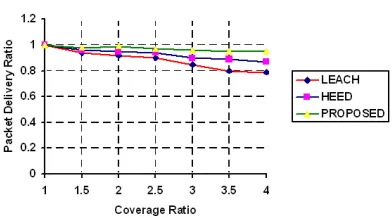
The impact of network coverage ratio on packet delivery fraction is plotted in Figure 3. The proposed scheme achieved 95% of packet delivery fraction with varying network coverage ratio compared to other schemes. This is due to the fact that routing paths are chosen depending upon the routing cost metric. The numbers of active nodes have direct impact on packet delivery fraction. Hence packet delivery fraction also increases in the proposed scheme compared to other schemes.
Figure 3: Packet delivery ratio vs. coverage ratio
4.3 Number of Packets Sent to the Base Station in each Round
[image:6.595.94.290.539.653.2]Figure 4: Coverage Ratio
REFRENCES:
[1] F. Akyildiz, W. Su, Y. Sankarasubramaniam, E. Cayirici, “A survey on sensor network”, IEEE communications magazine, Vol.40,No.8, August,2002, pp. 102–114.
[2] Adeel Akhtar, Abid Ali Minhas, and Sohail Jabbar, “Energy Aware Intra Cluster Routing for Wireless Sensor Networks”, International Journal of Hybrid Information Technology Vol.3, No.1, January 2010, pp. 29-48
[3] Ameer Ahmed Abbasi, Mohamed Younis, “A survey on clustering algorithms for wireless sensor networks”, ACM Computer Communications Vol.30, No.14-15, October 2007, pp.2826–2841.
[4] V. Mhatre, C. Rosenberg, D. Kofman, R. Mazumdar, N. Shroff, “Design of surveillance sensor grids with a lifetime constraint”,
Proceedings of European Workshop on
Wireless Sensor Networks (EWSN), January
2004, pp.263-275.
[5] G. Gupta, M. Younis,” Load-balanced clustering in wireless sensor networks,” International Conference on Communication (ICC 2003), vol.3, May 2003, pp.1848-1852. [6] S. Bandyopadhyay, E. Coyle, “An energy
efficient hierarchical clustering algorithm for wireless sensor networks”, Proceedings of Annual Joint Conference of the IEEE Computer and Communications Societies (INFOCOM
2003), San Francisco, California, vol.3, April
2003,pp. 1713-1723.
[7] S. Ghiasi, A. Srivastava, X. Yang, M. Sarrafzadeh, “Optimal energy aware clustering in sensor networks”, Sensors Magazine MDPI, vol. 2, July 2002,pp. 258–269.
[8] W.B. Heinzelman, A.P. Chandrakasan, H. Balakrishnan, “Application specific protocol architecture for wireless microsensor networks”, IEEE Transactions on Wireless Networking,vol. 1, Oct 2002,pp. 660-670.
[9] Wharneet Kour, Ajay K. Sharma, “Hybrid Energy Efficient Distributed Protocol for Heterogeneous Wireless Sensor Network”, International Journal of Computer applications, Vol. 4, No.6, July 2010, pp. 8881 – 8887. [10]W.R. Heinzelman, A.P. Chandrakasan, H.
Balakrishnan, “An application specific protocol architecture for wireless micro sensor networks”, IEEE Transactions on Wireless Communications .vol.1, Oct 2002,pp. 660–670. [11]S. Lindsey, C.S. Raghavenda, “PEGASIS:
power efficient gathering in sensor information systems”, IEEE Aerospace Conference, Big Sky, Montana.vol.3, March 2002,pp. 1125-1130.
[12] A. Manjeshwar and D. P. Agarwal, “TEEN: a routing protocol for enhanced efficiency in wireless sensor networks”, International Symposium on Parallel and Distributed
Processing, San Francisco, CA, (USA ),vol.3,
23-27 April 2001,pp.2009 – 2015.
[13] A. Manjeshwar and D. P. Agarwal, “APTEEN: A hybrid protocol for efficient routing and comprehensive information retrieval in wireless sensor networks”, Proceedings of International Conference on Parallel and Distributed
Processing Symposium IPDPS, Ft. Lauderdale,
FL, (USA) ,15-19 April 2001, pp. 195-202. [14] G. Smaragdakis, I. Matta, A. Bestavros,
“SEP: A Stable Election Protocol for clustered heterogeneous wireless sensor networks”,
Second International Workshop on Sensor and Actor Network Protocols and Applications
(SANPA), Nov 2004.