OPTIMIZED RESOURCE BLOCK ALLOCATION AND
SCHEDULING FOR REAL-TIME SERVICES IN LTE
NETWORKS
1KANAGASUNDARAM.K, 2G.M. KADHAR NAWAZ
1
Cisco Systems I Pvt Ltd, Bangalore, India 2
Director, Sona College of Technology, Salem, Tamilnadu, India
E-mail: [email protected]
ABSTRACT
In recent times, there has been a huge increase in the demand for real-time multimedia applications from mobile users. In this paper, we propose an Optimized Resource Block Allocation and Scheduling technique for real-time Services in LTE networks. This technique considers both the resource block allocation and the scheduling process. The resource block allocation considers the instantaneous data rate and the average data rate. It will allocate the resources that are required to perform the real-time connection. If the resources are busy then, the user connection is scheduled using the lower level of the scheduler. The scheduler has a timer based on which the user connections are updated. In the scheduling period, the available resources are assigned to the user. The advantage of this approach is that it is possible to assign the reserved blocks to real-time users so that average throughput is improved. By simulation results, we show that the proposed technique improves received bandwidth and fairness while reducing the delay and packet drops.
Key words: Long Term Evolution (LTE) Networks, Quality of service (Qos), Call Admission Control (CAC), Resource Block (RB) Allocation
1. INTRODUCTION
1.1 Long Term Evolution (LTE) Networks In the past few years, there is huge demand for new telecommunication service which involves increasing number of new applications and greater transmission capacity. Maintaining the Quality of service (QoS) is the challenging task in new technology since it increases the user satisfaction. Long Term Evolution (LTE) is the next generation wireless system and the evolution of mobile network technology standardized by 3rd Generation Partnership Project (3GPP) [1][2][3]
LTE adopt the new multiple access systems to the interface area to test its application and content services, such as Multimedia Online Gaming (MMOG), TV Mobile, Web 2.0, video streaming, music downloads and many others. LTE is mainly designed to increase the capacity, coverage and speed of mobile wireless networks.
LTE is a part of 3GPP release 8 and it has been standardized by 3GPP. LTE increases the data rate and improves the spectral efficiency by adopting Orthogonal Frequency Division Multiple Access (OFDMA) and Multiple-Input Multiple-Output
(MIMO) technologies. In the existing mobile communication networks, voice traffic is delivered through circuit switched networks, but in LTE, all kinds of traffic, such as voice, streaming, data, etc., are transferred through packet-switched networks based on IP.
The motivation to build the LTE is come from the huge traffic requirements of next generation mobile services such as high-speed internet access, multimedia online gaming, Fixed-Mobile Convergence (FMC), wireless DSL and mobile TV. The 3G evolution aimed at providing wireless broadband to support all these applications at reduced cost and better performance. Besides maintaining seamless mobility, service control and maximizing network capacity with limited spectrum resources [1]-[6].
1.2 Call Admission Control (CAC)
guarantee the QoS, we need some resource availability that is judged by the call admission control algorithm.
1.2.1 Call admission control in LTE networks The basis for admission control algorithm is eNodeB in LTE. The eNodeB is capable of operating separately on a per cell basis. The main aim of CAC is the congestion avoidance and the CAC scheme limits the number of ongoing connections in the system or denies new connection request so that QoS can be maintained and delivered to different connections at the target level.
In order to admit the user to network two conditions that is given below need to be satisfied in the CAC algorithm:
Resource availability in the selected eNB is the first condition. Available resources are checked by the eNB once the initial condition is checked. Large amount of physical resources between a minimum and maximum threshold are provided by the mobile.
Signal strength is the second condition and the eNB proved maximum signal, the mobile selects this node and shortage in coverage can be caused when signal goes below a certain threshold. The mobile may get blocked in this situation. [6][7][8]
1.2.2. Issues of call Admission control
They are so many issues in designing an efficient Call Admission Control (CAC), in that important issues are,
It is quite irritate for a user when an ongoing call is dropped while handed over than when a fresh call is rejected initially. Thus, it is important for the LTE system to accept the handover calls prior to the fresh calls.
Diverse QoS requirements for delay-sensitive and delay-tolerant applications, and the heterogeneous traffic patterns of calls originating from different applications makes the design of efficient admission control algorithms more challenging.
The CAC algorithms are classified into two categories, namely, static and dynamic. Static CAC algorithms reserve resource for handoff calls. Dynamic CAC algorithms perform admission control through the estimation of radio channel state and available resources. Since dynamic CAC algorithms assume that all requested calls have the same QoS requirement, they cannot directly adapt to LTE system that provides various kinds of services. [6][7][8]
1.3 Multi Class in LTE
Multi class in LTE involves all kinds of traffic, such as voice, streaming, data, etc. Trends in mobile data traffic show that multimedia applications such as online gaming, web television and video calling account for the majority of global data traffic. The traffic is divided into two categories: real time traffic and non real time traffic.
Real time traffic is typically modeled by a fixed delay deadline for each packet The non real time traffic is modeled by a concave increasing utility function. The concave increasing utility function is an average rate experienced by flow. More common scheduling rule where potentially multiple users can be scheduled simultaneously has been considered. Most of the above work assumes that the queues have infinite backlogs, i.e., packets are always available in the buffers of all the queues; extensions to finite queues are provided. The proportional fair algorithm where all the resources are allocated to the flow with the maximum ratio of instantaneous spectral efficiency (which depends on the channel gain) to the average rate has been analyzed. [7][8][9]
1.4 Resource Block (RB) Allocation
In LTE Networks, the resource block allocation plays an important role. The two-dimensional time-frequency resource allocation gives more chances to obtain multi-user diversity gain and frequency diversity gain. The lower level scheduler is mainly concentrated on resource block allocation based on users channel state information such as traffic queue information and QoS requirements. It should provide support for different QoS profiles with consideration of fairness among users experiencing different channel conditions.
1.5 Problem Identification
The approach proposed in [11] is a novel Radio Admission Control (RAC) scheme for multiclass services in LTE systems. It aims at optimizing system capacity while guaranteeing QoS constraints of each service class. An objective function of maximizing the number of admitted users is proposed to evaluate the system capacity. To optimize the system capacity, they adopt a service degradation scheme in case of resource limitations in our RAC scheme. System performance is evaluated by using a K-dimensional Markov Chain Model.
1.A call is blocked if there is no sufficient bandwidth so that the probability of total system also increases.
2.They are not considering the call when handover occurs.
The approach proposed in [14] is a an optimized scheduling approach that exploits multiuser diversity by considering each user’s instantaneous downlink conditions and QoS information when distributing resources. The proposed scheme aims to satisfy the application quality of service requirements and improve overall system throughput by exploiting multiuser diversity.
Bandwidth is not allocated dynamically for the connection during a specified period that is the major drawback of this method. When the resources are full, they are not scheduling the user for the next resource allocation.
2. LITERATURE REVIEW
Haipeng LEI et al., [6] have proposed a resource allocation algorithm and a connection access control scheme (CAC) for LTE systems. The proposed allocation algorithm introduces a transmission guard interval that gives high priority to real-time (RT) service packets approaching the delay deadline. The proposed CAC can adaptively adjust the threshold according to the network condition. Simulation results show that the proposed CAC scheme can not only balance the ongoing connections of different classes of traffics but also be easy to reserve resource and support handover users potentially.
Bilal Sadiq et al., [9] have proposed a practical LTE downlink scheduler and characterized its performance for three traffic scenarios, namely, full-buffer, streaming video (loose delay constraint), and mixed streaming and live video (tight delay constraint). Through analysis and numerical results for different traffic models, they illustrate the various design choices (e.g., the specifics of the tradeoff mentioned earlier in this section) that need to be made while selecting a scheduling policy. They demonstrate that queue and channel-aware schedulers lead to significant performance improvements for LTE. Such schedulers not only increase the system capacity in terms of the number of QoS flows that can be supported but also reduce resource utilization.
Mostafa Zaman Chowdhury et al., [10] have proposed an efficient Call Admission Control (CAC) that relies on adaptive multi-level
bandwidth-allocation scheme for non-real-time calls. They are using the queuing analysis for the new call blocking probability and handover call dropping probability. While the proposed scheme blocks more new calls instead of dropping handover calls, the scheme also reduces the number of handovers and the average call duration as compared to the non-prioritized bandwidth-adaptive scheme.
Manli Qian et al., [11] have proposed novel radio admission control (RAC) scheme is proposed for handling multiclass services in Long Term Evolution (LTE) systems. An objective function of maximizing the number of admitted users is proposed to evaluate the system capacity. To solve the optimization problem, we present a combined complete sharing (CS) and virtual partitioning (VP) resource allocation model and develop a service degradation scheme in case of resource limitations in the proposed RAC scheme. Call blocking probability, system resource utilization and system capacity are used as performance metrics and are evaluated by using a K-dimensional Markov Chain model.
Mauricio Iturralde et al., [12] have proposed a two level resource allocation scheme is proposed to enhance the Quality of Service (QoS) for multimedia services in LTE downlink system. It corresponds to a solution that combines cooperative game theory, a virtual token mechanism, and the EXP-RULE algorithm. By using cooperative game theory such as bankruptcy game and Shapley value, the proposed mechanism works by forming coalitions between flow classes to distribute bandwidth fairly. EXP-RULE algorithm has been modified to use a virtual token mechanism to improve its performance. By taking into account constraints such as Shapley value fairness and the virtual token robustness, the proposed mechanism can increase remarkably the performance for real time flows such as video and VoIP in downlink system.
infrastructure, the flexibility of the scheme allows the adaption in other similar technologies as Long Term Evolution (LTE).
Joel Makara et al., [14] have proposed an optimized scheduling approach that exploits multiuser diversity by considering each user’s instantaneous downlink conditions and QoS information when distributing resources. They propose an approach towards the management of resources in the LTE downlink that fully exploits multiuser diversity.
3. PROPOSED SOLUTION
3.1 Overview
To overcome the problems mentioned in section 1.5, we proposed an Optimized Resource Block Allocation and Scheduling approach for real-time services.
In the proposed method, the approach will allocate the resource to the real-time users using the Resource Block (RB) allocation [6]. In the RB allocation, it will allocate the resources that are required to perform the real-time connection. A time constant is used to update the average rate that is allocated to the users and Q(t) factor is used to support different class of QoS.
If the resources are busy then the approach will schedule the user connection using the lower level of the scheduler [15]. The scheduler has a timer based on this the user connections are updated. In the scheduling period, the available resources are assigned to the user.
The main advantage of this method is that we can assign the reserved RBs to real-time users so that average spectrum efficiency and average cell throughput will be improved and we are using the schedulers to assign the resource to the users more effectively.
Figure.1. Flow chart of the proposed approach
The proposed approach basically consists of two main parts, namely, resource block allocation and the lower level scheduler, where the instantaneous data rate and the average data rate will be considered. When a new call is initiated in the LTE systems, the resource block allocation will be implemented where a block of resource will be allocated. If the resource block is busy then the lower level scheduler will be implanted and schedule the call in the LTE systems.
3.2 Resource Block (RB) Allocation Algorithm Resource block allocation is based on users channel state information, traffic queue information and QoS requirements by the LTE systems. It also supports different QoS profiles by considering fairness among users with different channel conditions.
We consider instantaneous data rate for user on the particular sub channel and on the particular slot.
(1) ) ( ) ( dr (n) dr
N
1 sc
, sc i,
i
∑
= •
= n
β
isc nwhere, dri(n) is the total available instantaneous data rate of user i at the nth slot, dri,sc is the achievable instantaneous data rate for user i on sub-channel (sc) at the nth slot, βi,sc(n) is an allocation
index variable where,
=
otherwise 0
i user to allocated is slot n at the s subchanel e when th 1 ) (
th c ,scn
i
After updating the average rate of user i at the end of each slot, the equation for the total available instantaneous data rate and average data rate of user becomes (2) (n) dr T 1 (n) )DR T 1 -(1 1) (n DR i c i c
i + = +
where, DRi(n) is the average data rate of user i at the nth slot, after updating the average rate of user i at the end of each slot. Here if the user i is not served by any sub-channel in the nth slot, then ri(n) will become equal to zero. Tc is the time constant.
In real time traffic, the different classes of QoS have to be supported. For this, a QoS satisfaction indicator function Q(t) is introduced.
(3) )]} ) ( ( exp[ , 1 max{
Q(t)= δ W t +∆T+T
where,
δ
is the delay weight factor, W is the delay of HOL (head of line), ΔT is the transmission guard interval and T is the maximum allowed packet delay.δ
is set to be zero for delay insensitive traffic.The packet delay W of HOL (head of line) is given by delay allowed maximum the reached delay e when th T T, -T satisfied are ts requiremen delay e when th T -T 0, W ∆ ∆ ∈
From (1), (2) and (3), we get (4) to apply Proportional Fair (PF) algorithm for each user i on each sub-channel j at the nth slot
(4) 1 (t), Q ) ( ) ( ) ( max arg ) ( i ,
1 DR n s N
n REQ n dr n i c i i sc i I
i ≤ ≤
= ≤ ≤
where, dri, sc is the achievable instantaneous data rate for user i on sub-channel j at the nth slot. REQi (n) is the requested service rate of user i.
If the QoS satisfaction indicator function Q(t) in equation (3) fails to satisfies and support the real time traffic in the LTE systems, then the lower level scheduler which is described in the section 3.3.1 gets implemented in order to schedule the initiated call in the LTE systems.
3.3 Scheduler in LTE systems 3.3.1 Lower level scheduler
The lower level scheduler allocates the RBs to real time flows for each of the ten TTIs forming a frame. The PF algorithm [6] [15] has been used in the lower level scheduler in order to achieve a high level of fairness among multimedia flows. The main advantage of this PF algorithm is that it allocates approximately the same number of resources to all users. It also tries to allocate resources in any given scheduling interval to a user whose channel condition is good. It achieves high
throughput and maintains proportional fairness among all users. The link adaptation module estimates the maximum instantaneous data rate for each user in particular for every Transmission Time Interval (TTI) in each sub-channel. The estimated value is computed using feedbacks on channel quality sent by the user in the previous TTI. The RBs have been assigned to the downlink connections by the PF algorithm belonging to users with the best ratio R. This ratio is computed by the instantaneous available data rate over the average data rate with the reference to the ith user in the scth sub-channel.
The essence of this algorithm is to allocate approximately the same number of resources to all users (averaged over a period) and to allocate resource in any given scheduling interval to a user whose channel condition is near its peak.
(5) ) ( ) ( Ri,sc ,
n DR n dr i sc i =
where, Ri,sc is the ratio between the assigned RBs and the PF algorithm, dri,sc(n) is the achievable instantaneous data rate for user i on sub-channel (sc) at the nth slot, DRi(n) is the average data rate of user i at the nth slot.
The value of DRi(n) is updated on every TTI using a weighted moving average formula by considering the transmitted frames within the LTE system. (6) 1) -(f 2 . 0 1) -(f 8 . 0 (f)
DRi = DRi + DRi
where, DRi(f) is the data rate of the f frame of the ith user, DRi(f-1) represents the data rate achieved by the ith users during the previous sub frame.
4. SIMULATION RESULTS
In this section, we simulate the proposed Optimized Resource Block Allocation and Scheduling for Real-time Services (ORAS) scheme using Network simulator (NS-2) [16] which is a general-purpose simulation tool that provides discrete event simulation of user defined networks. We have used the LTE/SAE implementation model for NS2.
Table 1: Simulation Parameters
No of eNB 2
No. of UEs 18
Traffic Types Exponential and VoIP Traffic Rate 10 to50 kb
VoIP Codec GSM.AMR
No. of VoIP frames per packet
2
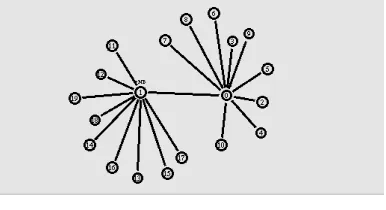
In the simulation settings, we have one server to provide HTTP, FTP and signaling services, two eNB to provide flow control information and eight UEs. The simulation topology is given in the following figure 2.
Figure. 2. Simulation Topology
We compare the ORAS with the novel radio admission control (RAC) scheme [11].
Case-1 Video Traffic
A.Based on Rate
In this experiment, we vary the data sending rate from 10 to 50Mb to measure the received throughput, fairness, packet drop and delay.
Rate Vs Throughput (Video)
0 2 4 6 8
10 20 30 40 50
Rate(Mb)
Mb
/s ORAS
[image:6.612.98.291.291.396.2]RAC
Figure.3. Rate Vs Throughput
Rate Vs Delay(Video)
0 5 10 15
10 20 30 40 50
Rate(Mb)
D
el
ay(
S
ec)
ORAS
RAC
Figure.4. Rate Vs Delay
Rate Vs Drop(Video)
0 1000 2000 3000
10 20 30 40 50
Rate(Mb)
Pk
ts ORAS
RAC
Figure.5. Rate Vs Packet Drop
Rate Vs Fairness(Video)
0 0.005 0.01 0.015 0.02
10 20 30 40 50
Rate(Mb)
F
ai
rn
ess ORAS
RAC
Figure.6. Rate Vs Fairness
From figure 3, we can see that the received bandwidth of our proposed ORAS is 29% higher than the existing RAC method.
From figure 4, we can see that the delay of our proposed ORAS is 17.5% less than the existing RAC method.
From figure 5, we can see that the packet drop of our proposed ORAS is 29% less than the existing RAC method.
From figure 6, we can see that the fairness of our proposed ORAS is 14.3% higher than the existing RAC method.
B. Based on Number of requested Users
[image:6.612.104.286.540.643.2]No. of Users Vs Throughput (Video)
0 0.2 0.4 0.6 0.8 1 1.2
3 6 9 12 15
Users
Mb
/s ORAS
[image:7.612.102.423.68.599.2]RAC
Figure 7: Users Vs Throughput
No. of Users Vs Delay (Video)
0 2 4 6 8
3 6 9 12 15
Users
D
el
ay(
S
ec) ORAS
RAC
Figure. 8: Users Vs Delay
No. of Users Vs Drop(Video)
0 100 200 300 400 500 600
3 6 9 12 15
Users
Pk
ts ORAS
RAC
Figure. 9: Users Vs Packet Drop
No. of Users Vs Fairness (Video)
0 0.001 0.002 0.003 0.004 0.005 0.006 0.007
3 6 9 12 15
Users
F
ai
rn
ess ORAS
RAC
Figure. 10: Users Vs Fairness
From figure 7, we can see that the received bandwidth of our proposed ORAS is 4.7% higher than the existing RAC method.
From figure 8, we can see that the delay of our proposed ORAS is 20% less than the existing RAC method.
From figure 9, we can see that the packet drop of our proposed ORAS is 28% less than the existing RAC method.
From figure 10, we can see that the fairness of our proposed ORAS is 21% higher than the existing RAC method.
Case-2 (VoIP)
B. Based on Rate
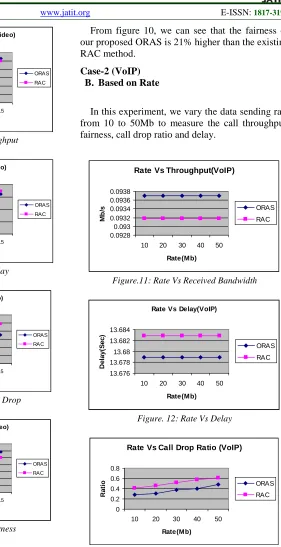
In this experiment, we vary the data sending rate from 10 to 50Mb to measure the call throughput, fairness, call drop ratio and delay.
Rate Vs Throughput(VoIP)
0.0928 0.093 0.0932 0.0934 0.0936 0.0938
10 20 30 40 50
Rate(Mb)
Mb
/s ORAS
RAC
Figure.11: Rate Vs Received Bandwidth
Rate Vs Delay(VoIP)
13.676 13.678 13.68 13.682 13.684
10 20 30 40 50
Rate(Mb)
D
el
ay(
S
ec) ORAS
RAC
Figure. 12: Rate Vs Delay
Rate Vs Call Drop Ratio (VoIP)
0 0.2 0.4 0.6 0.8
10 20 30 40 50
Rate(Mb)
R
at
io ORAS
[image:7.612.233.514.69.616.2]RAC
[image:7.612.320.514.223.627.2]Rate Vs Fairness(VoIP)
0.0116 0.01165 0.0117 0.01175
10 20 30 40 50
Rate(Mb)
F
ai
rn
ess ORAS
RAC
Figure.14: Rate Vs Fairness
From figure 11, we can see that the received bandwidth of our proposed ORAS is 0.5% higher than the existing RAC method.
From figure 12, we can see that the delay of our proposed ORAS is 0.02% less than the existing RAC method.
From figure 13, we can see that the packet drop of our proposed ORAS is 28.5% less than the existing RAC method.
From figure 14, we can see that the fairness of our proposed ORAS is 0.5% higher than the existing RAC method.
5. CONCLUSION
In this paper, we have proposed an Optimized Resource Block Allocation and Scheduling for Real-time Services in LTE systems. This approach considers both the resource block allocation and the scheduler process. The resource block allocation considers the instantaneous data rate and the average data rate. The RB algorithm will allocate the resources that are required to perform the real-time connection. If the resources are busy then we will schedule the user connection using the lower level of the scheduler. The scheduler has a timer based on the timer the user connections are updated. In the scheduling period, the available resources are assigned to the user. The advantage of this approach is that it is possible to assign the reserved RBs to real-time users so that average spectrum efficiency and average cell throughput will be improved and we are using the schedulers so that we can assign the resource to the users more effectively.
REFERENCE
[1]Mr. J Vijay Franklin and Dr. K Paramasivam, “Efficient Channel State Based Call Admission Control for Non Real Time traffic in LTE (3GPP) Networks”, IJCSI International Journal
of Computer Science Issues, Vol. 9, Issue 2, No 2, March 2012.
[2]Ananias Neto, Allan Costa, Augusto Neto, Eduardo Nakamura, Antônio J. G. Abelém and Eduardo Cerqueira, “Adaptive Call Admission Control in Long Term Evolution System Based on Fuzzy Logic”.
[3]S. M. Chadchan and C. B. Akki, “Priority-Scaled Preemption of Radio Resources for 3GPP LTE Networks”, International Journal of Computer Theory and Engineering, Vol. 3, No. 6, December 2011.
[4]J Vijay Franklin and K Paramasivam, “Hybrid Adaptive Call Admission Control Mechanism for Ensuring QoS in 3GPP: LTE Networks”,
International Journal of Computer Applications
Volume 42– No.21, March 2012.
[5]Sueng Jae Bae, Jin Ju Lee, Bum-Gon Choi, Sungoh Kwon, and Min Young Chung, “A Resource-estimated Call Admission Control Algorithm in 3GPP LTE System”.
[6]Haipeng LEI, Mingliang YU, Anjun ZHAO, Yongyu CHANG, Member and Dacheng YANG, Member, “Adaptive Connection Admission Control Algorithm for LTE Systems”, IEEE, 2008.
[7]Joel Makara and Neco Ventura, “Downlink Packet Scheduling for Variable Bitrate Traffic in LTE Networks”.
[8]Ch. Sreenivasa Rao, Dr.K.Chenna Keshava Reddy and Dr.D. Srinivasa Rao, “Power Control Technique for Efficient Call Admission Control in Advanced Wireless Networks”, International Journal on Computer Science and Engineering (IJCSE), Vol. 4 No. 06 June 2012.
[9]Bilal Sadiq, RiteshMada and Ashwin Sampath, “Downlink Scheduling for Multiclass Traffic in LTE”, Hindawi Publishing Corporation, 2009. [10]Mostafa Zaman Chowdhury, Yeong Min Jang,
and Zygmunt J. Haas, “Call Admission Control based on Adaptive Bandwidth Allocation for Multi-Class Services in Wireless Networks”,
IEEE, 2010.
[11]Manli Qian1, Yi Huang, Jinglin Shi, Yao Yuan, Lin Tian and Eryk Dutkiewicz, “A Novel Radio Admission Control Scheme for Multiclass Services in LTE Systems”, IEEE, 2009.
[13]A. Antonopoulos, C. Skianis and C.Verikoukis, “Traffic-Aware Connection Admission Control Scheme for Broadband Mobile Systems”, IEEE, 2010.
[14]Joel Makara and Neco Ventura, “Downlink Packet Scheduling for Variable Bitrate Traffic in LTE Networks”, 2011.