863
APPLICATION OF ANALYTIC HIERARCHY PROCESS IN
P.E. TEACHING EVALUATION SYSTEM
DACHUN ZHANG
Physical Education Department, Heihe College, Heihe 164399, Heilongjiang, China E-mail: [email protected]
ABSTRACT
P.E. teaching evaluation system is an important mean and method to measure the general proficiency of P.E. teachers teaching profession. Traditional evaluation method is highly influenced by subjective factors and is not able to reflect teachers’ practical level factually. This study builds a P.E. teaching evaluation model based on analytic hierarchy process. The results show that the weight of teaching effect, teaching method and teaching attitude are 0.21, 0.20 and 0.20 accordingly, and these three factors have the greatest impact on the result of P.E. teaching evaluation while teaching content and scientific research have a less impact (the weights are 0.12 and 0.10). It is verified through an example that the P.E. teaching evaluation result based on analytic hierarchy process is reasonable and in accordance with P.E. teaching laws. In conclusion, it is suggested that this evaluation model can be popularized and applied in P.E. teaching evaluation.
Keywords: Analytic hierarchy process, P.E. teaching, Evaluation, Model
1. INTRODUCTION
Analytic hierarchy process (AHP) is a easy, flexible and practical multi-criteria decision method first put forward to by Professor T.L. Saaty, a operation researcher from USA, in the early 1970s. It is a simple method for certain more complex and fuzzy problems, and especially appropriate for those questions hard to realize completely quantitative analysis. When conducting problems from social, economic and scientific management fields, people usually are faced with a complex system consisted of lots of interrelated and interacted factors and short of quantitative data. Analytic hierarchy process provides a new, simple and practical model building method for the decision-making and sequencing of this kind of problem.
There are mainly two problems when doing research in analytic hierarchy process: how to come up with a appropriate hierarchical structure abstractly in line with the practical situation; how to quantify certain qualitative value more closer to the actual quantity. Analytic hierarchy process conducts processing and sorting of people’s thinking process and provides convincing basis for scientific management and decision-making by putting forward a set of systematic problem-analysis methods. However, limitation exists in analytic hierarchy process and is reflected mainly in: AHP depends on people’s experience to a large
extent and greatly influenced by subjective factors, i.e. unable to overcome the possible serious one-sidedness from the decision-makers, although that it can get rid of the serious inconsistency in thinking process. Compare and judge process is relatively rough and is not suitable for decision-making problems of high accuracy requirement. AHP can be recognized as a semi-quantitative method (or qualitative and quantitative combined method). Numerous scholars have made certain improvement and perfection aiming at the shortcomings of AHP method during several decades’ development. Some new theories and methods is formed, such as the theory of group decision, fuzzy decision and feedback system, and these has become a new research hotspot in the field in recent years.
864 P.E. teaching work is very different from other theoretical courses. P.E. teaching is carried out on the athletic field and faced with students from all majors and layers of the whole school, so the influential factors in teaching evaluation are hard to be determined. And it is not realistic to quantize all the factors once determined. Therefore, a qualitative and quantitative combined method is used to conduct the P.E. teaching evaluation. To avoid the shortcomings of traditional evaluation methods, this study conducts the P.E. teaching evaluation by means of analytic hierarchy process, which is a kind of fuzzy evaluation method. The evaluation results can be more accurate and fair as this evaluation method reduces the impact of subjective factors effectively.
2. BASIC STEPS OF ANALYTIC
HIERARCHY PROCESS
When analyzing decision-making problems in AHP, the first step is to build a stratified structure model with the motorization and hierarchy of the studied problem. In this model, the complex problem is divided into groups of factors and these factors can form several layers according to the attribute and mutual relationship. And factors on the upper layer have dominating effect on factors on the lower layer as a standard. These layers can be divided into three classes:
(1) The top layer: there is only one factor and it usually means the intended target or ideal result of the discussing problem, so it is also named as target layer;
(2) The middle layer: it includes all the intermediate links involved in the goal achieving process and is composed by several different layers, including the required criterion and sub-criterion, so it is also named as criterion layer;
(3) The bottom layer: it includes all the selective measures and decision schemes to achieve the target, so it is also named as measure layer or scheme layer.
(4) The layers of recursive hierarchy structure are related with the problem’s complexity and analytic detailed ness required. Usually the layers are not strictly limited.
There are mainly four steps when building model in analytic hierarchy process:
(1) Build a recursive hierarchy structure model;
(2) Construct all the judgment matrixes in every layer;
(3) Hierarchical single ranking and consistency test;
(4) Hierarchical general ranking and consistency test;
As AHP is a system analysis method combined with qualitative analysis and quantitative analysis, the systematization, quantization and modeling of a complex issue is easy to be accomplished. The complex issue is firstly divided into several elements, which can further break up into more explicit, specific and quantizable little factors, i.e. indexes. The weight is determined by the degree of importance of each index on each layer and a multi-objective and multi-layer statistic model is formed connected by the weights in each layer. The fundamental steps are as follows:
(1) Build a multi-layer recursive structure and form a target tree diagram; AHP model contains three layers in general, as the top layer, the middle layer and the bottom layer, shown in Figure 1. the top layer is the target layer, which means the general objective for analytic hierarchy process research; the middle layer is also called restraint layer and contains the several main factors affecting the general target; the bottom layer is also named as measure layer, meaning the final measures to solve the problem that are all quantizable indexes.
Figure 1: Model structure in AHP
(2) Construct a pair-wise comparison judgment matrix and calculate the weight.
865 The major difficulties encountered in the determination of specific weight of various indexes that impact the factor is that it is often difficult to quantify the specific weight. In addition, when the indexes affecting certain factor are in large number and directly considering the impact of each on the factor, it is often due to incomplete consideration or attending to one thing and losing sight of another that policy maker often proposes a data not consistent with the actual important degree he believes and even possible to put forward a set of implicit contradictory data.
Supposing to compare the impact of
n
indexes
X
=
{
x
1,
,
x
n}
on factorZ
, how toconduct it to provide authentic data? It is suggested by Saaty et al. that it can be achieved by constructing a pair-wise comparison judgment matrix of the indexes. Namely, get two indexes
i
x
and
x
jeach time, anda
ijexpressed the ratio ofindex
x
i andx
jeffect on
Z
. All comparisonresults are presented in matrix
A
,A
=
(
a
ij)
n×n, andA
is named as the pair-wise comparisonjudgment matrix between
Z
−
X
(judgment matrix in short). It is easy to see that if the effect ratioof
x
i andx
jon
Z
isa
ij , the effect ratioof
x
jandx
ionZ
should be ij jia
a
=
1
.
Based on Saaty’s method of weight, the first step is to compare and grade all the indexes, and the standard for evaluation is shown in Table 1. Each index will get a grade after compared with another and build a judgment matrix based on the grades. Then calculate the weight of each index, and the approximate weight of each is shown as follows:
m
a i i i a a im
W = 1 2
(1)
The next step is the uniformization of each weight according the formula:
∑ =
1 =
m
i i i i
W W
W (2)
And each component is the weight.
Table 1: Standard for evaluation in AHP
Importance scaleaij Degree of relative importance
1 Equally important
3 Slightly important
5 Basically important
7 Really important
9 Absolutely important
2,4,6,8 Median of two contiguous importance degree
reciprocal
If the importance degree ration of index i and index j isaij, then the importance degree of index j
and index i is
ij ji a a = 1 .
(3) Consistency test
The feature vector
W
corresponding to the maximum eigenvalue of the judgment matrix is a reflection of sequencing weight of the relative importance of the index in a layer to the corresponding index in the above level after normalization, which process is called as hierarchical single ranking.By means of constructing pair-wise comparison judgment matrix, it can reduce the interference of other indexes and more objectively reflect the difference of the pair of indexes’ influence.
However, when all the results of the comparison are integrated, it will inevitably involve a degree of non-uniformity. If the comparison result is completely the same before and after the comparison, then the elements of the matrix
A
should also meet the following requirement:ik jk ij
a
a
a
=
,
∀
i
,
j
,
k
=
1
,
2
,
,
n
The consistency index:
1
-= max
m m λ
866 = 1 ∑ /
1 = max m i i m λ n
λ (4)
= ∑
1
= /
m
j ijW W i a j i
λ (5)
If CI<0.1, there is considered to be no logical error and to calculate the weight by the above formula is acceptable.
(4) Use product method to calculate combination weight. Combination weight is the calculated coefficient by multiplying the weighted weight of all indexes in each layer.
(5) Calculate the comprehensive evaluation index. Supposing that the measured value of the number i index is Pi and the total
number of evaluation index is m, and the combination weight is Ci , then the
comprehensive evaluation index is:
= ∑
1 =
m
j i i
P C
GI (6)
The judgment of stand or fall of the evaluation object can be realized based on the value of the comprehensive evaluation index.
3. THE ESTABLISHMENT OF P.E.
TEACHING EVALUATION SYSTEM BASED ON ANALYTIC HIERARCHY PROCESS
3.1. Selection of Evaluation Index
P.E. teaching evaluation system in institutions of higher learning is very complex and the factors affecting it are in large number. Therefore, the construction of P.E. teaching evaluation system in institutions of higher learning is a huge engineering project and the selection of evaluation index is a key factor to determine whether the chosen evaluation system is appropriate. To select the indexes of P.E. teaching evaluation system in institutions of higher learning more comprehensively, systematically and scientifically and increase the accuracy of the system evaluation, the selected indexes should be scientific and practical feasible. In the process of the selection of indexes, based on the basic principles of goal-oriented, scientific, integrity, objectivity and practicality and combined with the basic theory of the P.E. teaching evaluation, factors like teaching, the operational capacity of teachers, students’ learning and teaching effectiveness are selected as
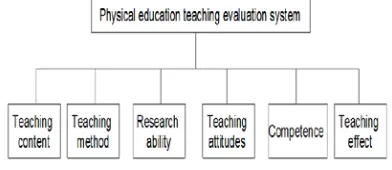
[image:4.612.323.519.279.364.2]the basic indexes affecting the P.E. teaching evaluation system in accordance with the actual situation of the P.E. teaching and the essence of the P.E. teaching evaluation. After the initial selection of indexes, professors who have long been engaged in the sports teaching, experts who have long been engaged in the teaching management and experts who have long been engaged in the research work of sports theory are all consulted for advice. Combined with their suggestions, ultimately teaching content, teaching methods, research capacity, teaching attitude, professional competence and teaching effectiveness are chosen as the indexes for P.E. teaching evaluation system and the formed target tree diagram is shown in Figure 2.
Figure 2: Model structure chart of P.E. teaching evaluation system
3.2. Establish judgment matrix
Built the judgment matrix as follows based on the evaluation standard of Sati’s method of weighting. = 1 2 5 1 3 7 2 1 1 1 8 4 1 1 5 1 1 1 9 5 7 1 8 1 9 1 1 6 1 7 1 3 1 4 5 1 6 1 5 1 7 1 1 7 1 7 5 1 B
3.3. Consistency test
Apply formula ( 3 ) and calculate the consistency index CI=0.08; as the value of CI<0.1, it can be seen that there is no logic error.
3.4. Calculate the weight
867 shown in Table 2. As can be told in Table 2, teaching effectiveness, teaching methods and teaching attitude have an important impact on the
P.E. teaching evaluation, while the research capacity of P.E. teachers have much less impact on it.
Table 2: weight value of all evaluation indexes
Teaching
contentC1
Teaching
methodsC2
Research capacityC3
Teaching attitudeC4
Professional
competenceC5
Teaching effectivenessC6
0.12 0.20 0.10 0.20 0.17 0.21
The teaching effectiveness is the most important factor in the P.E. teaching process. For example, a P.E. teacher teaches student the youth long-fist. The best effect can be achieved when the students can master all the basic movement in class and keep frequent practice after class to guarantee a proficient master of youth long-list and to be useful means to work out as well. The teacher’s teaching attitude and methods are very important too. The teaching attitude is a reflection of the teacher’s professionalism. The teaching effectiveness is certainly very poor in cases like P.E. teacher’s unserious or payable teaching. Therefore, P.E. teachers should correct their teaching attitude and throw themselves into the P.E. teaching work in order to achieve better teaching effectiveness. The teachers’ teaching method is of great importance too. Students’ final learning outcomes with the same content can be really different in different teaching methods. If the teaching method is more preferable and receptive to the students, the students could often learn the teaching content faster and better. Whereas, students may have psychological conflict or even skipping the class if the teachers teach in the traditional indoctrination or paternalistic approach, both of which are not conducive to the smooth development of the sports teaching. P.E. teacher’s professional competence is
a reflection of the quality of the teacher himself. The students may produce the idea of worship toward the teacher and are more willing to attend courses of such teacher if the teacher’s professional competence is very strong. However, a teacher’s professional competence is often possessed before entering the workplace and it is more difficult to improve the professional competence after taking jobs. Teaching content and teacher’s research capability has relatively small impact on P.E. teaching. Yet the P.E. teachers should try to choose teaching content that students are willing and easy to learn. Only the students receive the teaching content from the heart can the teaching effectiveness be better more easily. Strong scientific research ability indicates that the teacher has dogged into the professional work intensively and in-depth. As a result, it is much easier to contact with a number of advanced teaching methods and teaching content more suitable for the students and also affect the P.E. teaching to some extent.
4. CASE ANALYSIS
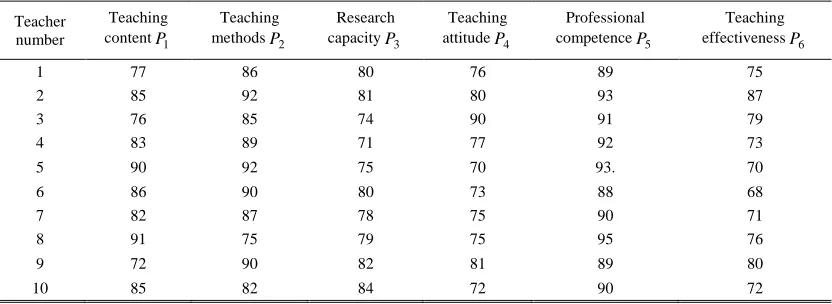
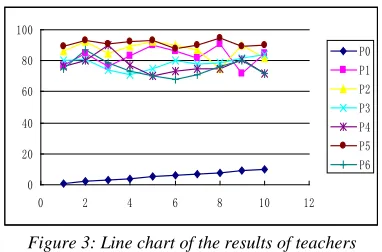
[image:5.612.103.519.571.723.2]10 P.E. teachers in a college participated in the test in 2011 as an example, evaluate the various factors based on AHP model and the teachers’ scores are shown in Table 3 and Figure 3.
Table 3: the ten P.E. teachers’ scores participated in 2011
Teacher number
Teaching contentP1
Teaching
methodsP2
Research capacityP3
Teaching attitudeP4
Professional
competenceP5
Teaching effectivenessP6
1 77 86 80 76 89 75
2 85 92 81 80 93 87
3 76 85 74 90 91 79
4 83 89 71 77 92 73
5 90 92 75 70 93. 70
6 86 90 80 73 88 68
7 82 87 78 75 90 71
8 91 75 79 75 95 76
9 72 90 82 81 89 80
868
0 20 40 60 80 100
[image:6.612.102.293.105.231.2]0 2 4 6 8 10 12 P0 P1 P2 P3 P4 P5 P6
Figure 3: Line chart of the results of teachers participated
Judging from Table 3 and Figure 3, the scores in teaching content, teaching methods, research capacity, teaching attitude, professional competence
and teaching effectiveness are very different among teachers. Some teachers have a better teaching attitude, others have a better teaching method, and some possess strong professional competence. On the basis of traditional evaluation method, the evaluation sequence varies greatly with different appraiser, which cannot reflect the authenticity and fairness favorably.
Calculate the weight of every index in accordance with the newly built evaluation system and it helps to evaluate each teacher’s situation more objectively.
[image:6.612.102.339.314.483.2]Calculate every teacher’s overall appraisal results according to formula (6) and make a ranking list, shown in Table 4 and Figure 4.
Table 4 the teachers’ overall appraisal results and rankings
ranking 1 2 3 4 5 6 7 8 9 10
order number 2 3 9 4 5 8 1 7 6 10
inner profile 86.78 83.58 82.97 81.23 81.21 80.93 80.52 80.25 80.16 79.82
Results
76 78 80 82 84 86 88
1 2 3 4 5 6 7 8 9 10
Results
Figure 4: Line chart of teachers’ overall appraisal results
As can be seen from Table 4 and Figure 4, after integrating the weights of all indexes for each teacher, the results of teacher in number 2 is the highest; the results of teachers in number 3 and 9 are in the second place; the results of teachers in number 6 and 7 are much lower; and the results of teacher in number 10 is the lowest. This ranking reflects the evaluation of the teachers’ working in teaching content, teaching methods, research capacity, teaching attitude, professional competence and teaching effectiveness and the evaluation results is more scientific and reasonable.
5. CONCLUSIONS
This research builds a P.E. teaching evaluation system based on analytic hierarchy process. The evaluation indexes include teaching content, teaching methods, research capacity, teaching
attitude, professional competence and teaching effectiveness. The weight coefficient value of each index reflects the corresponding effect on the P.E. teaching evaluation. As can be seen from the modeling result, teaching effectiveness, teaching methods and teaching attitude have an important impact on P.E. teaching evaluation; P.E. teachers’ research capability has little impact on P.E. teaching evaluation. In the management process of P.E. teachers’ teaching, it should be focused on to increase the teachers’ teaching effectiveness, to improve their teaching methods and to correct the teaching attitude, in order to comprehensively improve the teaching level of P.E. teachers.
869
6. ACKNOWLEDGMENT
Fund Project: The research projects of the social science and humanity. Fund of the ministry of Education in Heilongjiang province No:12512197.
REFERENCES:
[1] Fang Q, “Study on the AHP of Evaluation System of PE Teaching Quality in Universities”,
Journal of Guangzhou Sport University, Vol. 30, No. 3, 2010, pp. 109-112.
[2] Zhang N, “Applied research in the physical education teachers’ teaching evaluation system based on the Analytic Hierarchy Process”,
Science & Technology Information, Vol.26, 2010, pp.148-149.
[3] Gao X.J, Ma C., “Study on AHP model of classroom teaching quality evaluation system”,
Education and Teaching Forum, Vol.26, 2012, pp.112-113.
[4] Han Z.G. Methods and applications of mathematical modeling [M].Beijing: Higher Education Press, 2005:34-78.
[5] Sun B.C, Tang C., “Set up Sports Teaching Evaluation System Model of University and College and Research on Excessive Member Mathematics Model”, Journal of Nanjing Institute of Physical Education (Social Science), Vol.20, No.1, 2006, pp.69-72.
[6] Li C.L., “On strategy of improving aggressive defense capability at basketball game”, Journal of Weinan Teachers University, Vol.26, No.10, 2011, pp.83-85.
[7] M. Klusemann, T. Fay, et al., “Relationship between functional movement screens and physical performance tests in junior basketball athletes”, Journal of Science and Medicine in Sport, Vol.14, No.1, 2011, pp.109-110.
[8] Shahzad T. B, Mehdi S., “The Effect of Instructional and Motivational Self-Talk on Performance of Basketball's Motor Skill”,
Procedia - Social and Behavioral Sciences, Vol.15, No.1, 2011, pp.3113-3117.
[9] Yeshayahu H, Anat C.G, Shunit R., “Psychosocial effects of reverse-integrated basketball activity compared to separate and no physical activity in young people with physical disability”, Research in Developmental Disabilities, Vol.34, No.1, 2013, pp.579-587.
[10]Claudio R, Sabina G, Maria A. D'A,et al., “Relationship between biological markers and psychological states in elite basketball players across a competitive season”, Psychology of Sport and Exercise, Vol.13, No.4, 2012, pp.509-517.
[11]Song L., “Discussion on the basketball players' individual defensive ability and its cultivation”,
Journal of Shandong Institute of Commerce and Technology, Vol.11, No.2, 2011, pp.95-96. [12]Chang Y.T, Pei X.P, Xia Q.H., “Study on
basketball offensive defense under new rules”,
Journal of Changsha Railway University (Social Science), Vol.13, No.1, 2012, pp.127-128.
[13]Chen Y.Q., “On the Strategy of Defenses by Attacking in Basketball Matches”, Journal of Huaihai Institute of Technology (Social Sciences Edition), Vol.9, No.23, 2011, pp.119-121.