ISSN: 1992-8645 www.jatit.org E-ISSN: 1817-3195
481
FACTORS SUPPORTING TEAMWORK COMMUNICATION
IN CLINICAL PATHWAYS: SYSTEMATIC LITERATURE
REVIEW
1WASEF MATER, 2ROLIANA IBRAHIM
1
Department of Information System, Faculty of Computing, Universiti Teknologi Malaysia (UTM) 2
Department of Information System, Faculty of Computing, Universiti Teknologi Malaysia (UTM)
E-mail: [email protected], [email protected]
ABSTRACT
This systematic review presents the factors that influence teamwork communication, when using clinical pathways, and the relationships between these factors. These factors will support and promote teamwork communication when using clinical pathways. Extensive research was conducted on four databases, including Medline, Scopus, science direct, and Google scholar. From this search, we identified three dimensions of factors that influence teamwork communication, namely (teamwork, tasks and context) and every dimension has its own factors. A set of indicators and factors influence teamwork communication, and these factors are classified into three dimensions based on the systems theory, namely input, process and output. The factors that are investigated in this study have a positive influence on teamwork communication, and these factors will be used as guidelines for developing a framework for implementing clinical pathways that support teamwork communication in the healthcare domain.
Keywords: Teamwork Communication, Clinical Pathways, Factors and Indicators
1.
BACKGROUNDTeamwork communication in the healthcare domain is an essential process required for delivering a high quality of healthcare, and there are three dimensions of factors that influence teamwork communication. These include Teamwork, Task and Context [1]. A report of the Institute of Medicine (IOM) shows that 70% of medical errors relate to teamwork communication, and 30% relate to other factors [1-3]. Teamwork communication is a complex process in the healthcare sector, because of the dynamic context
of healthcare. Teamwork communication can be
defined as “the process by which information is exchanged between individuals or computers, through the use of a commonly accepted set of
symbols”[4]. There is a relationship between
healthcare quality and an improvement in teamwork communication, and this relationship has
a positive impact on patient outcomes [3, 5].
Teamwork in healthcare is defined as a dynamic process linking two or more health professionals with complementary backgrounds and skills, sharing common health goals, and exercising concerted physical and mental effort in assessing, planning, or evaluating patient care [6]. Teamwork
is described and explained by the system theory
based on input, process, and output. The effectiveness of teamwork can be shown as an interaction between teamwork input, teamwork processes and teamwork output [7].
In this paper we investigated the factors that have an effect on teamwork communication in the healthcare domain, based on the systems theory model (Input-Process-Output) [3, 5, 8].
Task is one of these dimensions of factors that
affect teamwork communication. Task has
attributes, and these have influence on teamwork communication, especially on familiarity, urgency, congruence, stability, risk, and certainty[1]. Well-structured tasks will support the certainty of
decision making processes. A task has two
processes based on types of conflicts, one for content and another one for task processes, and
tasks processes effect the patient outcomes[1, 7].
ISSN: 1992-8645 www.jatit.org E-ISSN: 1817-3195
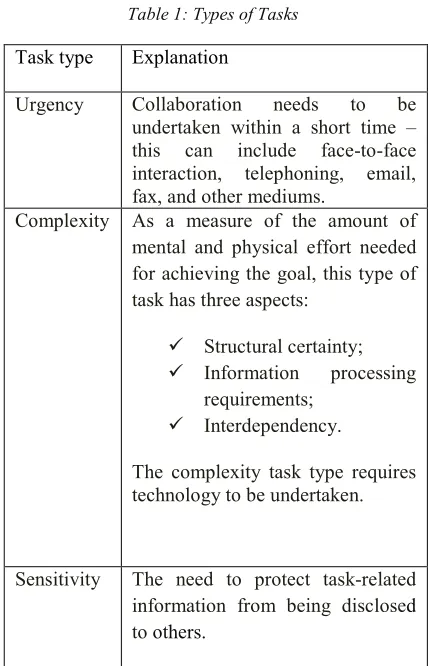
[image:2.612.88.302.92.425.2]482 Table 1: Types of Tasks
Task type Explanation
Urgency Collaboration needs to be
undertaken within a short time –
this can include face-to-face
interaction, telephoning, email, fax, and other mediums.
Complexity As a measure of the amount of mental and physical effort needed for achieving the goal, this type of task has three aspects:
Structural certainty;
Information processing
requirements; Interdependency.
The complexity task type requires technology to be undertaken.
Sensitivity The need to protect task-related
information from being disclosed
to others.
The identification of task types is needed, in order to explain how every type of task will be performed and achieved, and which factors and indicators affect the tasks.
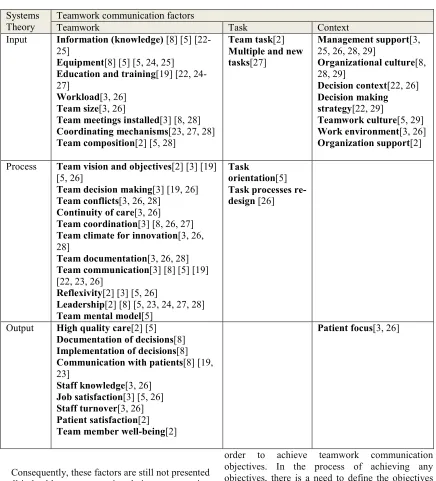
Context is another dimension of factors that affects teamwork communication. The context dimension has its factors and indicators, such as equipment, management support and others, that are explained in Table 2. Reliability is one of the most important characteristics of tasks. Reliability means that task information should be available, accessible, and accurate for patients’ information. In this situation, hospitals must offer other options for teamwork communication and collaboration [9-12]. There are few studies on teamwork communication within the healthcare domain. Therefore there is a need to study teamwork communication, and to identify the suitable types of communication between teams needed to improve healthcare quality [13][13]. Moreover, healthcare providers have to deploy advance technologies and solutions for teamwork communications. The two types of communication, namely Synchronous and
Asynchronous, are poor mediums of
communication that the teams need in order to support their tasks, because effective teamwork communication needs complete knowledge about patient situations. For that reason, there is a need for new media for communication between teams, based on new trends of ICT (Information and Communication Technology). Clinical pathways are a tool that can be used to support and promote teamwork communication within the healthcare domain.
The HISs currently in use is not able to and was
not originally designed to support teamwork activities. Moreover, they do not support any sort of process formalization. They lack information in regards to the logic of the treatment, and are therefore unable to undertake any actions that support the treatment flow, and provide potential routing of the treatment processes if adjustments are
needed [10, 14]. They also lack information about
the causes involved in reaching the current stage, and the possible consequences.
Communication between clinicians should be undertaken manually or via electronic means, in order to make a decision regarding every point of
the patient treatment flow. An electronic
information system with a robust Infrastructure will lead to improved teamwork communication. Communication is one of the success factors for teamwork in healthcare [15], and teamwork communication in healthcare should be studied effectively based on structure and process [16]. Teamwork structure is about teamwork models and teamwork communication techniques.
Teamwork communication can be improved using clinical pathways that may play a key role in improving healthcare quality, and in reducing related costs. In addition, clinical pathways support and promote multidisciplinary teamwork, and support and improve communication among medical staff. Very little research has been undertaken into factors that improve teamwork when using clinical pathways. One of these factors is multidisciplinary teamwork, which is a big issue
[17], while the other factors have not been studied.
ISSN: 1992-8645 www.jatit.org E-ISSN: 1817-3195
483 be designing and developing the Health Information System (HIS) [21]. These factors and indicators are studied from three dimensions, specifically Input, Process and Output, dimensions that make up the structure of any system to be designed and implemented. These investigated factors and indicators especially support Clinical Pathways, in terms of teamwork communication in a systematic way and during a specific period, because there are few studies like this particular investigated study [3]. This study adds a set of factors and indicators to this knowledge, from the three dimensions of Input, Process and Output.
To understand these factors, the following questions were addressed:
1. What are the factors that influence
teamwork communication, when using clinical pathways?
2. What is the relationship between factors in
supporting the success of the teamwork
communication, when using clinical
pathways?
2.
METHODS2.1 Search Strategy
To identify related research works, we searched three online databases, namely Medline, Science Direct and Scopus, for papers published between January 2010 and December 2013. These studies were selected based on three factors that affect teamwork communication, specifically Teamwork, Task, and Context. Most of the literature concentrates on the Teamwork concept, and few studies concentrate on the other factors. Task and Context factors have an effect on Teamwork, and there are few studies that focus on the team in healthcare as a multidisciplinary team. We want to
study all factors that affect teamwork
communication, and explore the factors and indicators that can make teamwork communication successful. The following search study was used to obtain related literature [1, 3, 5].
Key words and phrases searched for included ‘clinical pathways’, ‘critical pathway’, ‘integrated care pathway’ or ‘care map’, ‘communication’, and ‘teamwork’ or ‘team’. The searched period was from January 2010 to December 2013, and was limited to ‘English language’, ‘abstract’ and ‘full text’. For Medline, the search string produced 446 hits, for Scopus the search string produced 186 hits, for Science Direct the search string produced 1 hit,
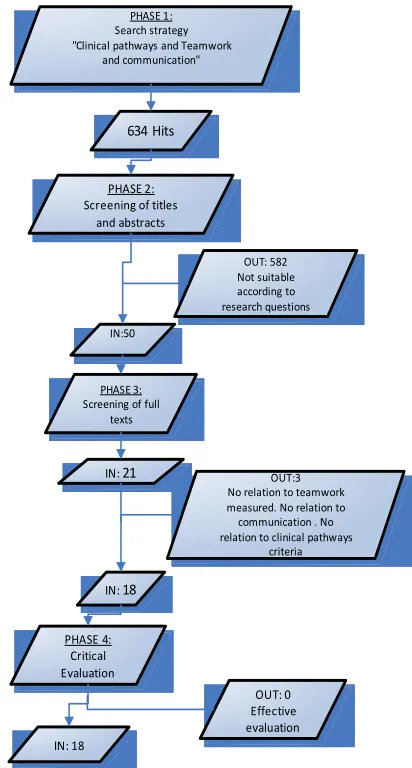
and Google scholar produced 1 hit. The total number of studies found through the search strategy was 634. Figure 1 presents the systematic literature review protocol.
PHASE 1: Search strategy "Clinical pathways and Teamwork
and communication"
634 Hits
PHASE 2: Screening of titles
and abstracts
OUT: 582 Not suitable according to research questions
IN:50
PHASE 3: Screening of full
texts
IN: 21
IN: 18
OUT:3 No relation to teamwork measured. No relation to communication . No relation to clinical pathways
criteria
PHASE 4: Critical Evaluation
IN: 18
[image:3.612.321.527.162.546.2]OUT: 0 Effective evaluation
Figure 1: Steps for the Literature Review Selection Procedure
2.2 Selection of Studies
ISSN: 1992-8645 www.jatit.org E-ISSN: 1817-3195
484
3.
RESULTThere are 18 studies in this systematic review, and we identified three factors that affect teamwork
communication [1]. These factors include
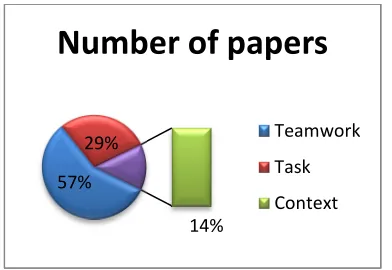
teamwork, task and context. Nine of these studies focused on teamwork indicators and factors that influence teamwork communication when using clinical pathways. This means that 57% of these studies focused on teamwork as a core factor in teamwork communication. Five of these studies focused on barriers and facilitators which effected teamwork communication when using clinical pathways. 29% of these studies focused on barriers and facilitators, and the last three studies focused on the other factors.
[image:4.612.98.294.352.487.2]Therefore, 14% of these studies focus on factors such as tasks, organizational culture, social and political factors. The number of factors can be seen in Table 2.
Figure 2: Number Of Papers on Factors that Influence Teamwork Communication
The numbers of factors in the input stage are more than those involved in the process and output stages. This means that these areas are still in the initial phases of their development, and more research is required to establish good teamwork communication for clinical pathways, in order to support teamwork activities. Figure 2 explains this trend of studies. The input presents the structure of any system. The system structure should be built in a rigorous way, in order to facilitate the designing of the system’s processes, and thereby achieve an output that reflects the system’s outcome. Figure 2 presents the number of factors for each stage.
4.
DISCUSSIONThis systematic review explores the factors that have an influence on teamwork communications, when using clinical pathways based on the systems theory (Input-Process-Output).
First question: What are the factors that influence teamwork communication, when using clinical pathways?
The answer of this question is given in Table 2. We have classified the factors that have an influence on teamwork communication into three factors, namely Teamwork, Task and Context. Moreover, these factors are classified into Input, Process, and Output, as based on the system theory [30]. Based on our investigation, we found that teamwork and the related indicators for teamwork play a key role in teamwork communication, when using clinical pathways. Most of the studies concentrate on teamwork and related indicators [2, 3, 5]. The most effective factors that are summarized in the table are as follow:
Input: input factors represent infrastructure and
establish an environment for teamwork
communication, because while any system needs equipment, knowledge is also needed to support communication. Also, any new system needs training and education.
Process: any organization needs to identify a vision
and goals (objectives) for success. These objectives will be accomplished by a good team, and with strong leadership.
Output: the objective of clinical pathways is to
improve the quality of teamwork communication, and outputs in this regard will be in the form of improved job satisfaction and communication with patients.
Analyzing factors in table 4, with input that can represent the structure of any system, the factors in the input can be categorized into three groups. These include knowledge, which represents the soft ground of the process, along with equipment, which represents the hard ground of the process, and finally education and training, which represents the human factors. Based on this decision making process, there is a need for a rigorous system that can be aligned between these factors, in order to build a good structure.
57% 29%
14%
Number of papers
Teamwork
Task
ISSN: 1992-8645 www.jatit.org E-ISSN: 1817-3195
[image:5.612.89.525.105.586.2]485
Table 2: Teamwork Communication Factors
Systems Theory
Teamwork communication factors
Teamwork Task Context
Input Information (knowledge) [8] [5] [22-25]
Equipment[8] [5] [5, 24, 25]
Education and training[19] [22,
24-27]
Workload[3, 26]
Team size[3, 26]
Team meetings installed[3] [8, 28]
Coordinating mechanisms[23, 27, 28]
Team composition[2] [5, 28]
Team task[2]
Multiple and new
tasks[27]
Management support[3,
25, 26, 28, 29]
Organizational culture[8,
28, 29]
Decision context[22, 26]
Decision making
strategy[22, 29]
Teamwork culture[5, 29]
Work environment[3, 26]
Organization support[2]
Process Team vision and objectives[2] [3] [19] [5, 26]
Team decision making[3] [19, 26]
Team conflicts[3, 26, 28]
Continuity of care[3, 26]
Team coordination[3] [8, 26, 27]
Team climate for innovation[3, 26,
28]
Team documentation[3, 26, 28]
Team communication[3] [8] [5] [19]
[22, 23, 26]
Reflexivity[2] [3] [5, 26]
Leadership[2] [8] [5, 23, 24, 27, 28]
Team mental model[5]
Task
orientation[5]
Task processes
re-design [26]
Output High quality care[2] [5]
Documentation of decisions[8]
Implementation of decisions[8]
Communication with patients[8] [19,
23]
Staff knowledge[3, 26]
Job satisfaction[3] [5, 26]
Staff turnover[3, 26]
Patient satisfaction[2]
Team member well-being[2]
Patient focus[3, 26]
Consequently, these factors are still not presented well in healthcare systems, in relation to supporting teamwork communication.
Four factors have been identified as the most significant, as based on process. These factors
include team vision and objectives, team
coordination, team communication, and leadership. All factors in the process are related to teamwork in healthcare. This analysis has emphasized that teamwork in healthcare is still in its infancy stage, and there is still a need for a lot of study [16]. These factors need to be studied, and there is a need for new technology and rigorous infrastructure, in
order to achieve teamwork communication
objectives. In the process of achieving any objectives, there is a need to define the objectives which are presented here within teamwork vision and objectives, and then how to support and
improve teamwork coordination and
communication. These factors need to be studied well, and supported and improved through a rigorous info-structure and infrastructure.
ISSN: 1992-8645 www.jatit.org E-ISSN: 1817-3195
[image:6.612.314.521.230.458.2]486 Table 3 presents the most influential factors related to teamwork communication.
Table 3: Factors with the Greatest Influence on Teamwork Communication
Teamwork communication factors
Factor References
Input
Information (knowledge)
[8] [5] [22-25]
Equipment [8] [5] [5, 24, 25]
Education and training
[19] [22, 24-27]
Process
Team vision and objectives
[2] [3] [19] [5, 26]
Team coordination [3] [8, 26, 27] Team
communication
[3] [8] [5] [19] [22, 23, 26] Leadership [2] [8] [5, 23,
24, 27, 28]
Output
Job satisfaction [3] [5, 26] Communication
with patients
[8] [19, 23]
Tasks are one of the main factors of teamwork communication. Four task factors are mentioned in the literature, which include team tasks, multiple and new tasks, task orientation, and task processes
re-design. All of these factors have to be considered
within teamwork communication.
Context is the third factor that has an influence on teamwork communication. In this context, there are indicators that should be considered within teamwork communication. These indicators include patient focus, management support, organizational culture, teamwork cultures, decision making strategies, and decision context. The context factor
presents the teamwork communication
environment. Moreover, this factor is also an important factor, because it is comprised of other
factors, and because teamwork is a part of the
environment (context).
Second question: What is the relationship between factors in supporting the success of the teamwork communication, when using clinical pathways?
There are three factors that influence teamwork communication, namely teamwork, task, and context. These factors have strong relationships between each other, as context represents the environment, or organization, while teamwork is an element of this environment, and tasks are the activities of the team within the organization.
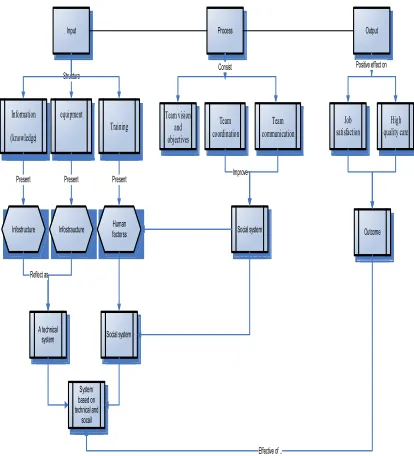
The analysis of the relationship between these factors is based on the systems theory, which is specifically Input-Process-Output, and this theory can give us a clear understanding of the relationship between these factors. Diagram 3 explains these relationships.
The following diagram presents the relationship between these factors. This relationship shows a trend when studying these factors, which are considered effective within the healthcare domain.
Input Process Output
Information (knowledge)
equipment Team vision and objectives
Team coordination
Team communication Consist
Job satisfaction
High quality care Structure
Training
Infostructure Infostraucture Human factorss Present Present Present
A technical system Reflect as
Social system
System based on technical and
socail
Social system Improve
Outcome
Effective of ..
Positive effect on
Figure 3: The Relationship between Factors
High quality care and patient satisfaction are key outputs, which represent outcomes in healthcare.
These outcomes [31, 32] need sufficient
information and knowledge, and this information and content are considered the content of clinical pathways, which support medical information for staff, and in particular include physicians and nurses. In order to achieve these outputs, a set of processes is needed for team coordination and communication.
In order to support and build staff knowledge,
education and training are needed as an input. In
this case, a process of continuity of care is also needed.[26].
Job satisfaction comes from a good
organizational culture, and this culture needs good
leadership and a good team mental model.[3].
ISSN: 1992-8645 www.jatit.org E-ISSN: 1817-3195
487 making, and team visions and objectives, all have a relationship with each other. This is essential in achieving the outcomes and quality of care, and the objectives of clinical pathways. [31, 32] [3, 26].
The factors which have an influence on teamwork communication, namely Teamwork, Task, and Context, present two social and technical aspects which need to be considered when clinical pathways need to be designed, adopted and implemented.
5.
CONCLUSION AND FUTURE WORKThis systematic review provides an overview of the relationship between teamwork, tasks, and context, in regards to teamwork communication, when using clinical pathways. There is a lack of studies in this domain. Therefore, in order to identify factors, indicators and aspects that influence teamwork communication, a systematic literature review was conducted to achieve the goal [3, 33]. These indicators should be considered during the design and implementation of the Clinical Pathways, in order to support and improve
teamwork communications.
This study refers to some studies related to the aim of this study, in order to obtain detailed information about these studies. Appendix A presents these studies, and gives some directions for new research, based on the gaps in each study.
There is a need for more studies in regards to teamwork, in order to define the characteristics of teamwork as based on real team characteristics. Moreover, there is a need to study and identify the characteristics of clinical pathways that have a good influence on teamwork. Teamwork tasks need more studies, in order to identify correct tasks. In this context there is a need to understand the organizational culture and mechanisms used to enhance the collaboration of teamwork, in order to
improve the decision making process.
REFRENCES:
[1] M. Smith, J. Higgs, and E. Ellis, "Factors influencing clinical decision making," Clinical reasoning in the health professions, pp. 89-100, 2008.
[2] M. A. West and J. Lyubovnikova, "Illusions of team working in health care," Journal of health organization and management, vol. 27, pp. 134-142, 2013.
[3] S. Deneckere, M. Euwema, P. Van Herck, C. Lodewijckx, M. Panella, W. Sermeus, et al.,
"Care pathways lead to better teamwork: Results of a systematic review," Social Science & Medicine, vol. 75, pp. 264-268, 2012. [4] M. A. Musen and J. H. Bemmel, Handbook of
medical informatics: MIEUR, 1999.
[5] S. Deneckere, N. Robyns, K. Vanhaecht, M. Euwema, M. Panella, C. Lodewijckx, et al., "Indicators for Follow-Up of Multidisciplinary Teamwork in Care Processes Results of an International Expert Panel," Evaluation & the Health Professions, vol. 34, pp. 258-277, 2011. [6] A. Xyrichis and E. Ream, "Teamwork: a
concept analysis," Journal of advanced nursing,
vol. 61, pp. 232-241, 2008.
[7] M. A. West, D. Tjosvold, and K. G. Smith, The essentials of teamworking: International perspectives: John Wiley & Sons, 2005.
[8] B. Lamb, J. Green, C. Vincent, and N. Sevdalis, "Decision making in surgical oncology,"
Surgical oncology, vol. 20, pp. 163-168, 2011. [9] H. Pirnejad, Communication in Healthcare:
Opportunities for information technology and concerns for patient safety: Instituut Beleid en Management Gezondheidszorg-Health policy and management (iBMG), 2008.
[10] H. Alsalamah, "Supporting integrated care pathways with workflow technology," Cardiff University, 2012.
[11] D. Sands, "Challenges in Healthcare Communications: How Technology Can Increase Efficiency, Safety, and Satisfaction,"
Cisco Internet Business Solutions Group IBSG,
2008.
[12] E. Coiera, "Communication systems in healthcare," Clinical Biochemist Reviews, vol. 27, p. 89, 2006.
[13] C. E. Kuziemsky, "A model for representing formal, informal and hybrid communication in the clinical communication space," in ITCH, 2011, pp. 311-315.
[14] A. Skilton, "Supporting the information systems requirements of distributed healthcare teams," Cardiff University, 2011.
[15] E. Salas, D. E. Sims, and C. S. Burke, "Is there a “Big Five” in teamwork?," Small group research, vol. 36, pp. 555-599, 2005.
[16] Y. Xiao, S. H. Parker, and T. Manser, "Teamwork and collaboration," Reviews of human factors and ergonomics, vol. 8, pp. 55-102, 2013.
ISSN: 1992-8645 www.jatit.org E-ISSN: 1817-3195
488
Advanced Materials Research, vol. 662, pp. 957-960, 2013.
[18] M. Thatcher, "IT Governance in Acute Healthcare: A Critical Review of Current Literature," in eHealth: Legal, Ethical and Governance Challenges, ed: Springer, 2013, pp. 349-370.
[19] T. McConnell, P. O'Halloran, S. Porter, and M. Donnelly, "Systematic Realist Review of Key Factors Affecting the Successful Implementation and Sustainability of the Liverpool Care Pathway for the Dying Patient,"
Worldviews on Evidence‐Based Nursing, 2013. [20] N. Staggers, "A systematic review on the designs of clinical technology: Findings and recommendations for future research," ANS. Advances in nursing science, vol. 32, p. 252, 2009.
[21] C. E. Kuziemsky, E. M. Borycki, M. E. Purkis, F. Black, M. Boyle, D. Cloutier-Fisher, et al., "An interdisciplinary team communication framework and its application to healthcare'e-teams' systems design," BMC medical informatics and decision making, vol. 9, p. 43, 2009.
[22] Z. Y. Zhuang, C. Wilkin, and A. Ceglowski, "A framework for an intelligent decision support system: A case in pathology test ordering,"
Decision Support Systems, 2012.
[23] A. Hogden, D. Greenfield, P. Nugus, and M. C. Kiernan, "Engaging in patient decision-making in multidisciplinary care for amyotrophic lateral sclerosis: the views of health professionals,"
Patient preference and adherence, vol. 6, p. 691, 2012.
[24] I. S. Hassan, "Knowledge translation through clinical pathways: Principles for practical development and successful use," Saudi Journal of Kidney Diseases and Transplantation, vol. 24, p. 351, 2013.
[25] S. Evans-Lacko, M. Jarrett, P. McCrone, and G. Thornicroft, "Facilitators and barriers to implementing clinical care pathways," BMC Health Services Research, vol. 10, p. 182, 2010. [26] E. Salas, H. B. King, and M. A. Rosen, "Improving teamwork and safety: Toward a practical systems approach, a commentary on Deneckere et al," Social Science & Medicine,
vol. 75, pp. 986-989, 2012.
[27] A. Bleetman, S. Sanusi, T. Dale, and S. Brace, "Human factors and error prevention in emergency medicine," Emergency Medicine Journal, vol. 29, pp. 389-393, 2012.
[28] S. Deneckere, M. Euwema, C. Lodewijckx, M. Panella, W. Sermeus, and K. Vanhaecht, "The European quality of care pathways (EQCP) study on the impact of care pathways on interprofessional teamwork in an acute hospital setting: study protocol: for a cluster randomised controlled trial and evaluation of implementation processes," Implementation Science, vol. 7:47, 2012 2012.
[29] N. Dubuc, L. Bonin, A. Tourigny, L. Mathieu, Y. Couturier, M. Tousignant, et al., "Development of integrated care pathways: toward a care management system to meet the needs of frail and disabled community-dwelling older people," International Journal of Integrated Care, vol. 13, 2013.
[30] D. Baker, S. Gustafson, J. Beaubien, E. Salas, and P. Barach, Medical teamwork and patient safety: the evidence-based relation: Citeseer, 2005.
[31] H. Yang, W. Li, K. Liu, and J. Zhang, "Knowledge-based clinical pathway for medical quality improvement," Information Systems Frontiers, vol. 14, pp. 105-117, 2011.
[32] F. Shoji, T. Yano, A. Haro, T. Yoshida, K. Ito, Y. Morodomi, et al., "Assessing a clinical pathway to improve the quality of care in pulmonary resections," Surgery Today, vol. 41, pp. 787-790, 2011.
[33] S. Deneckere, M. Euwema, C. Lodewijckx, M. Panella, T. Mutsvari, W. Sermeus, et al., "Better interprofessional teamwork, higher level of organized care, and lower risk of burnout in acute health care teams using care pathways: A cluster randomized controlled trial," Medical care, vol. 51, pp. 99-107, 2013.
[34] S. Mickan, S. J. Hoffman, and L. Nasmith, "Collaborative practice in a global health context: Common themes from developed and developing countries," Journal of Interprofessional Care, vol. 24, pp. 492-502, 2010.