ISSN: 1992-8645 www.jatit.org E-ISSN: 1817-3195
A DYNAMIC BANDWIDTH ALLOCATION ALGORITHM IN
EPON NETWORKS
YINGHUIQIU
School of Electrical and Electronic Engineering, North China Electric Power University, Beijing, 102206,
China
ABSTRACT
With the rapid development of Internet technology, there have been many new services which require high bandwidth. EPON (Ethernet Passive Optical Network) has become one of the best technologies in the next generation broadband access network because of their high-bandwidth and low-cost. Dynamic bandwidth allocation (DBA) is one of the most critical issues in EPON network. In this paper, a new DBA algorithm is proposed to support QoS and to get higher performance. The proposed algorithm could avoid bandwidth wastes result from dynamically allocation from differentiated services and unused bandwidth. Detailed simulations are performed to verify the effectiveness of the proposed DBA algorithm.
Keywords: Ethernet Passive Optical Network, Dynamic Bandwidth Allocation, Broadband Network
1. INTRODUCTION
With the advancement in networking and multimedia technologies enables the distribution and sharing of multimedia content widely. In the meantime, piracy becomes increasingly rampant as the customers can easily duplicate and redistribute the received multimedia content to a large audience. Insuring the copyrighted multimedia content is appropriately used has become increasingly critical.
In recent years, the communications backbone has gone through rapid growth. However, the changes in the access network do not advance as drastically in comparison. Hence, the system upgrade of access network becomes an urgent issue under discussion.
Among several new technologies of access network which have been proposed, Ethernet passive optical network (EPON) is taken as an attractive solution that contains numerous benefits. A passive optical network (PON) is a point-to-multipoint optical access network with no active elements in the signal path from source to destination. All transmissions are transacted between an optical line terminal (OLT) and several optical network units (ONUs). An OLT is located at the central office which connects the optical access network to the rest of the Internet. ONUs are located at end user position either building (fiber-to-the-building, FTTB) or home (fiber-to-the-home FTTH). Transmissions from the end user to the OLT ought to be delivered through an ONU and
vise versa. An EPON is a PON that carries data encapsulated in Ethernet frames and hence is compatible with the existing IEEE 802.3 standard and is consistent with current network architecture.
ISSN: 1992-8645 www.jatit.org E-ISSN: 1817-3195
minute to minute than a fixed one. A fixed approach easily wastes a large quantity of bandwidth because of the characteristic of burst traffic. Dynamic bandwidth allocation is taken into account so as to improve the system utilization and performance. With the growth of network capacity, EPON is undoubtedly expected to support differentiated services. Priority queuing is one of the most common approaches which differentiate the network flow into specific queues. Each queue has one individual priority and the determination of transmission (intra-ONU scheduling) is according to these priorities. However, simple priority queuing results in starvation of low priority queues owing to the increase the delay. Besides some bandwidth wastes occur as the left bandwidth is not enough for next packet because of the indivisibility of Ethernet .packet. Consequently, a dynamic bandwidth allocation scheme should consider the following properties: the fairness among each ONU , better performance and utilization of the whole system, good support for differentiated services [1].
This work is organized as follows. Section Ⅱ
reviews related work on DBA algorithms in EPON networks. The propose DBA algorithm is detailed in section Ⅲ. Computational results are presented
in section Ⅳ. Some concluding remarks and perspectives are given in section Ⅴ.
2. RELATEDWORKS
In [2], the author proposed a polling scheme called interleaved polling with adaptive cycle time (IPACT). IPACT uses an interleaved polling scheme that the OLT poll each ONU in a round-robin scheme, and next ONU is polled before current ONU finished its transmission. To decrease the bandwidth and get the best utilization of channel resource, the OLT take the RTT time of each ONU into consideration. The OLT assigns appropriate start time of transmission so that the OLT receive data from the later ONU right after the former one without collisions. As distributing bandwidth to each ONU, IPACT adopt limited approach that OLT grant the amount bandwidth which ONU requested but not exceed a maximum boundary. Considering intra-ONU scheduling, IPACT divides traffic into three types and each has an individual priority.
Higher priority traffic is able to preempt the granted bandwidth of lower priority traffic. While in [3], the author proposes a bandwidth allocation
algorithm that supports differentiated services by employing priority queuing concept to cope with intra-scheduling. This algorithm distributes excessive bandwidth for lightly loaded ONUs to other highly loaded ONUs so as to achieve better channel utilization. Later in [4], the authors propose a 2 sub-cycle policy that differentiated services are arranged into two sub-cycles such that the jitter performance of specific traffic (such as GF) is more feasible under the control of the algorithm. However, these algorithms we introduced above do not resolve bandwidth wasting problem owing to packet indivisibility. This overhead is still a issue that affects the performance of EPON access network.
A two-stage queue scheme with CoS consideration is proposed in [5]. There is a priority queue system in the first stage consists a numerous buffers with different priority. The second stage consists of a single first-come-first-serve (FCFS) queue with the size of WMAX.
In [6], a novel Early Dynamic Bandwidth Allocation (E-DBA) algorithm is proposed to reduce idle period in traditional DBA scheme. The E-DBA mechanism also incorporates with a prediction-based fair excessive bandwidth allocation (PFEBA) scheme to ensure the fairness of each ONU and improve the overall network performance.
Finally, there is another scheme in [7] suggesting the use of a different kind of PON architecture. The full request contention multiple-access (FULL-RCMA) protocol required two fibers between the splitter and every ONU, one for upstream and downstream traffic and another for detecting request contention. Although it is an interesting idea, it significantly deviates from the standard EPON architecture and is not really comparable to other DBA schemes. It is included here to give reference to readers interested on different physical implementations of EPON.
3. PROPOSEDSCHEME
ISSN: 1992-8645 www.jatit.org E-ISSN: 1817-3195
To support QoS, this algorithm adopts the polling method with fixed cycle time Tcycle which is
important for performances of the EPON network. In this paper, there are three types of traffic: high priority traffic, medium priority traffic and low priority traffic. The high priority is Expedited Forwarding (EF) traffic, which supports voice traffic that requires bounded end-to-end delay and jitter specifications. Medium priority is the Assured Forwarding (AF) traffic that supports video traffic that is not delay sensitive but requires bandwidth guarantees. Finally, the low priority is Best Effort (BE) traffic that supports data traffic and is not sensitive to end-to-end delay or jitter. The OLT determines the bandwidth allocation, when receiving all report messages.
Denote Tcycle to be the length of polling cycle.
Denote Wi to be SLA factor of different business in
EPON. Denote Bgrant to be bandwidth allocated by
OLT to ONUs. Denote Bmin to be grant value
allocated by OLT when there are no traffics need to be transmitted, in order to guarantee all businesses can apply for bandwidth in the next polling cycle. Denote Rq to be amount of traffics in the current
registered ONU. Denote BSLAEF to be stipulated
grant timeslot for EF traffic in EPON. Denote
BSLAAF to be stipulated grant timeslot for AF traffic
in EPON. Denote BSLABE to be stipulated grant
timeslot for BE traffic in EPON. Denote Bex to be
grant time slot every type of traffic obtained besides of stipulated grant time slot. Total upstream bandwidth is Btotal. So we have the formula as
following.
Bex=(Btotal- BSLAEF- BSLAAF- BSLABE)*Wi (1)
The proposed DBA algorithm is described in detail as follows:
Step 1: bandwidth allocation to EF traffic
Based on the queue occupancy and the total bandwidth of the fiber link, the allocated bandwidth to EF traffic is given by formula (1).
( )
( )
q q SLAEF
grant
SLAEF ex q SLAEF
R R B
B
B B R B
<
=
+ >
(2)
where:
- - - EF
ex total SLAEF SLAAF SLABE
EF AF
W
B B B B B
W W
= ×
+
( )
(3)
If there is no EF traffic, then
min
grant
B =B
(4)
Step 2: bandwidth allocation to AF traffic
Based on the amount of AF traffics with problem of delay requirement, the amount of AF traffic with problem of dropping probability requirement and the residual bandwidth of the fiber link, the allocated bandwidth to AF traffics is given by formula.
( )
( )
q q SLAAF
grant
SLAAF ex q SLAAF
R R B
B
B B R B
<
=
+ >
(5)
where:
- - - AF
ex total SLAEF SLABE SLAAF
EF AF
W
B B B B B
W W
= ×
+
( ) (6)
Step3: bandwidth allocation to BE traffic:
Based on the amount of BE traffics with problem of delay requirement, and the residual bandwidth of the fiber link, the allocated bandwidth to BE traffics is given by formula (7) .
( )
( )
q q SLABE
grant
SLABE q SLABE
R R B
B
B R B
<
=
>
(7)
If there is no BE business
Bgrant =Bmin (8)
4. SIMULATIONRESULTS
ISSN: 1992-8645 www.jatit.org E-ISSN: 1817-3195
0.0 0.2 0.4 0.6 0.8 1.0
0.0 0.2 0.4 0.6 0.8 1.0
B
a
n
d
w
id
th
u
ti
liz
a
ti
o
n
r
a
te
[image:4.612.93.513.72.241.2]Traffic load Proposed BP
Figure 1: Bandwidth Utilization Rate Versus Traffic Load.
Three kinds of traffic are considered in the system: voice, video, and data. The voice traffic is transmitted with the highest priority, and is generated by a two-level MMDP. To emulate T1 connection, in a ONU, there are 24 channels in a T1 link. The ONU aggregates the traffic of each channel. During ON state, the generate rate is decided by the number of channels which are at ON state. The mean durations of talk spurts and silence periods are assumed to be exponentially distributed with 1/α = 1 sec. and 1/β = 1.35 sec.,
respectively. The packet size is fixed to 70 bytes, and the generation rate is constant bit rate (CBR), during ON state (talk spurts), but none during OFF state (silence). On the other hand, the video and data packets are modeled by ON/OFF Pareto-distributed model in order to generate self-similar traffic. An extensive study shows that most network traffic (i.e., http, ftp, variable rate (VBR) video applications, etc.) can be characterized by self-similarity and long-range dependence (LRD) [14]. This model is used to generate highly bursty video and data packets, and packet sizes are uniformly distributed between 64 and 1518 bytes.
Figure 1 illustrates the bandwidth utilization rate versus traffic load in EPON. It can be found that the bandwidth utilization rate in the proposed DBA is better than that in DBAM. It is because that the bandwidth in the proposed DBA algorithm is allocated step by step to different class rather than set a maximum window to each class in advance. In addition, because the dropping probability of video packets is high, and the maximum window does not always meet the actual traffic condition, the bandwidth utilization is low. It also can be found that when traffic load is in 0.1 to 0.9, the proposed DBA can improve the bandwidth utilization rate.
0.1 0.2 0.3 0.4 0.5 0.6 0.7 0.8 0.9 0
1 2 3 4 5 6 7 8
E
F
t
ra
ff
ic
d
e
la
y
(m
s
)
Traffic load BP
Proposed
Figure 2: EF Traffic Delay Versus Traffic Load.
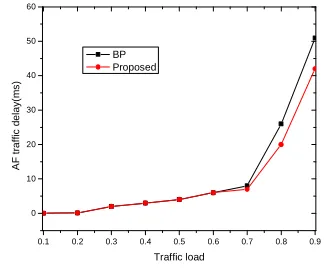
Figure 2 shows the average EF traffic delay time versus traffic load in EPON. It can be found that the average EF traffic delay time in both two algorithms increases with the increasing of traffic load in EPON, because the maximum window does not meet the real requirement of data packets, and the burst arrival cannot be served quickly. However, in DBAM, when traffic load exceeds 0.5, the average delay increased greatly because the system does not have enough bandwidth to support burst arrival.
0.1 0.2 0.3 0.4 0.5 0.6 0.7 0.8 0.9 0
10 20 30 40 50 60
A
F
t
ra
ff
ic
d
e
la
y
(m
s
)
Traffic load BP
Proposed
Figure 3: AF Traffic Delay Versus Traffic Load.
[image:4.612.342.504.432.566.2]ISSN: 1992-8645 www.jatit.org E-ISSN: 1817-3195
0.1 0.2 0.3 0.4 0.5 0.6 0.7 0.8 0.9 0
20 40 60 80 100 120 140 160
B
E
t
ra
ff
ic
d
e
la
y
(m
s
)
Traffic load BP
[image:5.612.97.291.73.244.2]Proposed
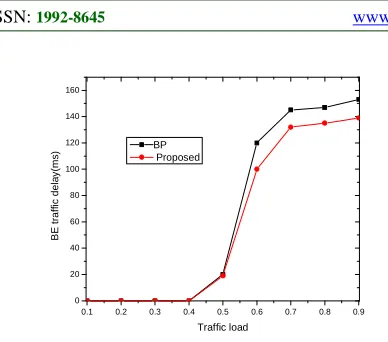
Figure 4: BE Traffic Delay Versus Traffic Load.
Figure 4 shows the average BE traffic delay time versus traffic load in EPON. It can be found that the average EF traffic delay time in both two algorithms increases with the increasing of traffic load in EPON. It can be found from the figure that there is no obvious difference between the two algorithms when traffic load is less than 0.4, because BE traffic is best effort traffic, both of the two algorithms can provide available bandwidth for BE traffic. When traffic load exceeds 0.4, the average BE traffic delay increased greatly, and the performance of the proposed DBA is better than that of DBAM. It is because that the bandwidth is allocated step by step, and there does not have a limitation like that in DBAM.
5. CONCLUSIONS
In this paper, we have studied the problem of dynamic bandwidth allocation algorithm in EPON networks. In this paper, we proposed a new dynamic bandwidth allocation algorithm to obtain higher performance and decrease waste of resources and to support differentiated services. Detailed simulations are performed to verity the effectiveness of the proposed DBA algorithm.
ACKNOWLEDGEMENTS
This work was supported by “the Fundamental Research Funds for the Central Universities”.
REFERENCES
[1] G. Kramer, B. Mukherjee, G. Pesavento, “Ethernet PON (EPON): Design and Analysis of an Optical Access Network”, Photonic Network Communication, Vol. 3, No. 3, 2001, pp. 307-319.
[2] G. Kramer, B. Mukherjee, G. Pesavento, “IPACT: A Dynamic Protocol for an Ethernet PON (EPON)”, IEEE Communications Magazine, Vol. 40, No. 2, 2002, pp. 74-80. [3] C. M. Assi, Y. Ye, S. Dixit and M.A. Ali,
“Dynamic Bandwidth Allocation for Quality-of-Service Over Ethernet PONs”, IEEE Journal of Selected Areas in Communications, Vol. 21, No. 9, 2003, pp. 1467-1477.
[4] A. Shami, X. Bai, C. M. Assi, N. Ghani, “Jitter Performance in Ethernet Passive Optical Networks”, IEEE Journal of Lightwave Technology, Vol. 23, No. 4, 2005, pp. 1745-1753.
[5] G. Kramer, B. Mukherjee, S. Dixit, Y. Ye, and R. Hirth, “Supporting Differentiated Classes of Service in Ethernet Passive Optical Networks”, Journal of Optical Networking, Vol. 1, No. 8&9, 2002, pp. 280-298.
[6] I. S. Hwang, Z. D Shyu, L. Y Ke, C. C. Chang “A novel early DBA mechanism with prediction-based fair excessive bandwidth allocation scheme in EPON”, Computer Communication, Vol. 31, No. 9, 2008, pp. 1814-1823.
[7] C. H. Foh, L. Andrew, E. Wong, M. Zukerman, “Full-RCMA: A High Utilization EPON”, IEEE Journal of Selected Areas in Communications, Vol. 22, No. 8, 2004, pp. 1514-1524.