5
IV
April 2017
Technology (IJRASET)
Emerging Scope and Trends of Intelligent
Materials for Humanity
Satyendra Pratap Singh1 , Vishwajeet Singh2, Pragya Tiwari3, Anviti Singh4 1
Mechanical Engineering Department, 2Student(Mechanical Engineering), 3Student(Electronics & Communication Engineering), 4
Student(Computer Science Engineering),
Rajarshi Rananjay Sinh Institute of Management and Technology, Amethi (U.P), 227405, India Dr. APJ Abdul Kalam Technical University, Lucknow, Uttar Pradesh (AKTU)
Abstract: Smart materials are designed materials that have one or more properties that can be significantly changed in a controlled fashion by external stimuli, such as stress, temperature, moisture, ph, electric or magnetic fields. We’re on another precipice of dramatic innovation as we get closer to closing the gap between technology and physical object. Smart materials are opening up new ways to communicate, connect and automate our lives.
Essentially, smart materials detect changes in their environment and react to them – such as detecting a shift in temperature and responding by changing colour, ink that conducts electricity, heat-reactive materials that change shape or colour based on temperature, reactive materials that change shape or colour based on uv rays, fabrics that light up, shape memory polymers that ‘remember’ a shape they were moulded into.
Keywords - smart materials, super elasticity, austenite, martensite, anti-attack, fatigue
I. INTRODUCTION
Shape-memory alloy (SMA, smart metal, memory metal, memory alloy, smart alloy, muscle wire) is an alloy that "remembers" its original shape & size & returns to its pre-deformed shape when heated again. It is lightweight, solid-state alternative to conventional actuators such as hydraulic, pneumatic or motor-based systems.
The two main types of shape-memory alloys are copper-aluminium-nickel & nickel titanium (Nitinol). SMAs can also be created by alloying zinc copper gold etc. Although iron-based and copper-based SMAs, such as Fe-Mn-Si, Cu-Zn-Al and Cu-Al-Ni, are commercially available and cheaper than Nitinol, Nitinol based SMAs are preferable for most applications due to their stability, practicability and superior thermo-mechanic performance. SMAs can exist in two different phases, with three different crystal structures and six possible transformations.
Fig 1. Example of Smart Material
Nitinol alloys change from austenite to martensite upon cooling.
Mf is the temperature at which the transition to martensite completes upon cooling. Accordingly, during heating Asand Af are the temperatures at which the transformation from martensite to austenite starts and finishes. Repeated use of the shape-memory effect may lead to a shift of the characteristic transformation temperatures (this effect is known as functional fatigue, as it is closely related with a change of micro structural and functional properties of the material).
The maximum temperature at which SMAs can no longer be stress induced is called Md, where the SMAs are permanently deformed.
Technology (IJRASET)
Fig 2. ξ(T) represents the martensite fraction.
The difference between the heating transition and the cooling transition gives rise to hysteresis where some of the mechanical energy is lost in the process. The shape of the curve depends on the material properties of the shape-memory alloy, such as the alloying & work hardening.
A. One-Way Vs. Two-Way Shape Memory
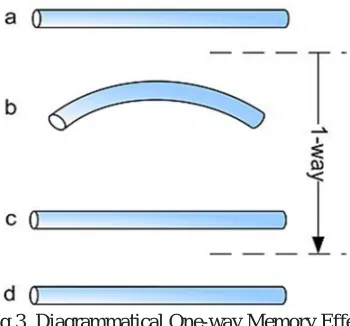
Shape-memory alloys have different shape-memory effects. Two common effects are one-way and two-way shape memory. A schematic of the effects is shown below.
Fig 3. Diagrammatical One-way Memory Effect
1) One-Way Memory Effect: When a shape-memory alloy is in its cold state (below As), the metal can be bent or stretched and will
hold those shapes until heated above the transition temperature. Upon heating, the shape changes to its original. When the metal cools again it will remain in the hot shape, until deformed again.
[image:3.612.255.358.605.700.2]With the one-way effect, cooling from high temperatures does not cause a macroscopic shape change. A deformation is necessary to create the low-temperature shape. On heating, transformation starts at As and is completed at Af (typically 2 to 20 °C or hotter, depending on the alloy or the loading conditions). As is determined by the alloy type and composition and can vary between −150 °C and 200 °C.
Technology (IJRASET)
2) Two-Way Memory Effect: The two-way shape-memory effect is the effect that the material remembers two different shapes: one
at low temperatures, and one at the high-temperature shape. A material that shows a shape-memory effect during both heating and cooling is said to have two-way shape memory. This can also be obtained without the application of an external force. The reason the material behaves so differently in these situations lies in training.
Under normal circumstances, a shape-memory alloy "remembers" its low-temperature shape, but upon heating to recover the high-temperature shape, immediately "forgets" the low-high-temperature shape. A shaped, trained object heated beyond a certain point will lose the two-way memory effect.
B. Superelasticity
SMAs also display super elasticity which is characterized by recovery of unusually large strains. Instead of transforming between the martensite and austenite phases in response to temperature, this phase transformation can be induced in response to mechanical stress. When SMAs are loaded in the austenite phase, the material will transform to the martensite phase above a critical stress, proportional to the transformation temperatures. Once the stress is released, the martensite transforms back to austenite, and the material recovers its original shape. As a result, these materials can reversibly deform to very high strains – up to 8 percent.
II. HISTORY
The first reported steps towards the discovery of the shape-memory effect were taken in the 1930s. According to Otsuka and Wayman, Arne Olander discovered the pseudo elastic behaviour of the Au-Cd alloy in 1932. Greninger and Mooradian (1938) observed the formation and disappearance of a martensitic phase by decreasing and increasing the temperature of a Cu-Zn alloy. The basic phenomenon of the memory effect governed by the thermo elastic behaviour of the martensite phase was widely reported a decade later by Kurdjumov and Khandros (1949) and also by Chang and Read (1951). The nickel-titanium alloys were first developed in 1962–1963 by the United States Naval Ordnance Laboratory & commercialized under the trade name Nitinol. Their remarkable properties were discovered by accident. One of the associate technical directors, Dr. David S. Muzzey, decided to see what would happen if the sample was subjected to heat. To everyone's amazement the sample stretched back to its original shape. There is another type of SMA, called ferromagnetic shape memory alloy (FSMA), that changes shape under strong magnetic fields. These materials are of particular interest as the magnetic response tends to be faster and more efficient than temperature-induced responses. Metal alloys are not the only thermally-responsive materials Shape Memory Alloys have also been developed, and became commercially available in the late 1990s.
III. CRYSTRAL STRUCTURE
The special property that allows shape-memory alloys to revert to their original shape after heating is that their crystal transformation is fully reversible. A reversible transformation does not involve diffusion of atoms, instead all the atoms shift at the same time to form a new structure. At different temperatures, different structures are preferred and when the structure is cooled through the transition temperature, the martensitic structure forms from the austenitic phase.
IV. MANUFACTURING
Shape memory alloys are typically made by casting, using vacuum arc melting or induction melting. These are specific techniques used to keep impurities in the alloy to a minimum & ensure the metals are well mixed. The ingot is then hot rolled into longer sections & then drawn further to turn it into wire. Johnson Matthey Medical Components’ shape memory alloys are formed by blending the alloy & then induction melting in an inert atmosphere vacuum chamber. Further processing is done to form wire, ribbon, sheet, or laser machined components.
Once processed to its finished form, shape memory alloys are “trained” to exhibit the specific properties required by the clients SMA application. The shape memory training process determines the shape that the alloy will recall & revert to when subjected to a specific heat point. In Johnson Matthey Medical Components’ Nickel Titanium shape memory alloys, the temperature at which the
SMA members its high – temp form can be adjusted by heat treatment & variations in the alloy composition from 0°C to +105°C
maximum. The shape recovery happens over a range of just a few degrees, with shape recovery start/end points controllable within a few degrees centigrade.
V. PROPERTIES
Technology (IJRASET)
manufactured to almost any shape and size. The yield strength of shape-memory alloys is lower than that of conventional steel, but some compositions have a higher yield strength than plastic or aluminium. The yield stress for Nitinol can reach upto 500 MPa. The high cost of the metal itself and the processing requirements make it difficult and expensive to implement SMAs into a design. As a result, these materials are used in applications where the super elastic properties or the shape-memory effect can be exploited.
One of the advantages to using shape-memory alloys is the high level of recoverable plastic strain that can be induced. The maximum recoverable strain these materials can hold without permanent damage is up to 8% for some alloys. This compares with a maximum strain 0.5% for conventional steels.
VI. HOW SHAPE MEMORY ALLOYS WORK, & HOW THE SMA’s are "TRAINED"
The way in which the alloys are "trained" depends on the properties wanted. The "training" dictates the shape that the alloy will remember when it is heated. This occurs by heating the alloy so that the dislocations re-order into stable positions, but not so hot that the material recystallizes. They are heated to between 400 °C and 500 °C for 30 minutes, shaped while hot, and then are cooled rapidly by quenching in water or by cooling with air.
Heating is the only way that most memory metals retain their original shape. Since heat is the property that determines the shape of the metal, heat is the first property used for manipulation for formation. If an alloy is subjected to the same heating and deformation, the alloy will begin to acquire two-way training. The treatment for a Nitinol wire is,
A. The wire is hot/cold worked (stretched) by 3% when it is in the martensite phase
B. The wire is then heated to austenite finish (AF) to recover its shape
C. The wire is then cooled to martensite
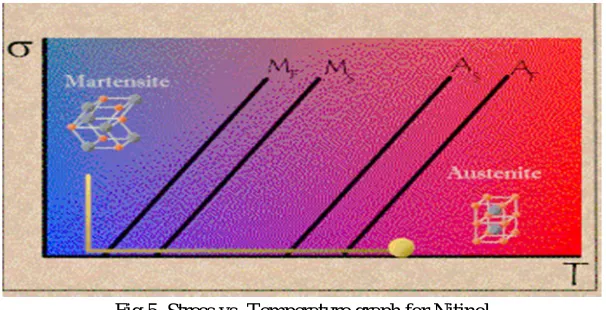
[image:5.612.155.458.462.617.2]Memory transfer temperatures can be altered by slight changes in composition, and by slight changes in heat treatment. Shape memory alloys display two distinct crystal structures or phases. Temperature and internal stresses (which play a part in super-elasticity) determine the phase that the SMA will be at. Martensite exists at lower temperatures, and austenite exists at higher temperatures. (Click here to learn more about martensite and austenite). When a SMA is in martensite form at lower temperatures, the metal can easily be deformed into any shape. When the alloy is heated, it goes through transformation from martensite to austenite. In the austenite phase, the memory metal "remembers" the shape it had before it was deformed. From the stress vs. temperature graph below, one can see that at low stress and low temperature, martensite exists. At higher temperature and higher stress, austenite exists.
Fig 5. Stress vs. Temperature graph for Nitinol
Memory alloys also demonstrate great rates of super-elasticity. For example, eyeglass frames are in a martensite phase. Bending the arms in half (at room temperature) introduces a phase change at the bend to austenite. Austenite is not stable at room temperature, and because systems always seek lower energy states, the austenite will change back to the martensite phase, and to do this, the arm must bend back.The most common memory metal is called Nitinol, consisting of equal parts of nickel and titanium.
Technology (IJRASET)
Alloys Composition
{ Atomic or Weight %age }
Transformation {Temperature Range (Celsius)}
Ag – Cd (44/49)% Cd -190 to -50
Au – Cd (46.5/50)% Cd 30 to 100
Cu - Al – Ni (14/14.5)% Ni -140 to 100
Cu – Sn Approx 15% Sn -120 to 30
Cu – Zn (38.5/41.5)% Zn -180 to -10
Cu – Zn – (Si , Sn , Al) Few Wt %age of (Si , Sn , Al) -180 to 200
In – Ti (18/23)% Ti 60 to 100
Ni – Al (36/38)% Al -180 to 100
Ni –Ti (49/51)% Ti -50 to 110
Fe – Pt Approx 25% Pt Approx -130
Mn – Cu (5/35)% Cu -250 to 180
The memory transfer temperature is the temperature that the memory metal or alloy changes back to the original shape that it was before deformation. This temperature can be very precise, within 1 or 2 degrees of the desired temperature.
VII. PRACTICAL LIMITATIONS
SMAs have many advantages over traditional actuators, but do suffer from a series of limitations that may impede practical application.
A. Response Time and Response Symmetry
SMA actuators are typically actuated electrically, where an electric current results in Joule Heating. Deactivation typically occurs by free convective heat transfer to the ambient environment. Consequently, SMA actuation is typically asymmetric, with a relatively fast actuation time and a slow deactuation time. A number of methods have been proposed to reduce SMA deactivation time, including forced convection,& lagging the SMA with a conductive material in order to manipulate the heat transfer rate.
Novel methods to enhance the feasibility of SMA actuators include the use of a conductive lagging. This method uses a thermal paste to rapidly transfer heat from the SMA by conduction. This heat is then more readily transferred to the environment by convection as the outer radii is significantly greater than for the bare wire. This method results in a significant reduction in deactivation time and a symmetric activation profile. As a consequence of the increased heat transfer rate, the required current to achieve a given actuation force is increased.
Technology (IJRASET)
B. Structural Fatigue and Functional Fatigue
SMA is subject to structural fatigue – a failure mode by which cyclic loading results in the initiation and propagation of a crack that eventually results in catastrophic loss of function by fracture. The physics behind this fatigue mode is accumulation of microstructural damage during cyclic loading. This failure mode is observed in most engineering materials, not just SMAs. SMAs are also subject to functional fatigue, a failure mode not typical of most engineering materials, whereby the SMA does not fail structurally but loses its shape-memory/superelastic characteristics over time. As a result of cyclic loading, the material loses its ability to undergo a reversible phase transformation. This is often accompanied by a significant change in transformation temperatures. Design of SMA actuators may also influence both structural and functional fatigue of SMA, such as the pulley configurations in SMA-Pulley system.
C. Unintended Actuation
SMA actuators are typically actuated electrically by Joule Heating. If the SMA is used in an environment where the ambient temperature is uncontrolled, unintentional actuation by ambient heating may occur.
VIII. APPLICATIONS
A. Bones
Broken bones can be mended with shape memory alloys. The alloy plate has a memory transfer temperature that is close to body temperature, and is attached to both ends of the broken bone. From body heat, the plate wants to contract and retain its original shape, therefore exerting a compression force on the broken bone at the place of fracture. After the bone has healed, the plate continues exerting the compressive force, and aids in strengthening during rehabilitation. Memory metals also apply to hip replacements, considering the high level of super-elasticity. The photo below shows a hip replacement.
B. Anti-Scalding Protection
Temperature selection and control system for baths and showers. Memory metals can be designed to restrict water flow by reacting at different temperatures, which is important to prevent scalding. Memory metals will also let the water flow resume when it has cooled down to a certain temperature.
C. Aircraft and Spacecraft
Boeing, General Electric Aircraft Engines, Goodrich Corporation, NASA & all other Nippon Airways developed the Variable Geometry Chevron using a Nitinol SMA. Such a variable area fan nozzle (VAFN) design would allow for quieter and more efficient jet engines in the future. In 2005 and 2006, Boeing conducted successful flight testing of this technology. SMAs are being explored as vibration dampers for launch vehicles and commercial jet engines. The large amount of hysteresis observed during the superelastic effect allow SMAs to dissipate energy and dampen vibrations. These materials show promise for reducing the high vibration loads on payloads during launch as well as on fan blades in commercial jet engines, allowing for more lightweight and efficient designs. SMAs also exhibit potential for other high shock applications such as ball bearings and landing gear. There is also strong interest in using SMAs for a variety of actuator applications in commercial jet engines, which would significantly reduce their weight and boost efficiency. However, to increase the transformation temperatures and improve the mechanical properties of these materials before they can be successfully implemented.
D. Robotics
There have also been limited studies on using these materials in robotics. Recently, a prosthetic hand was introduced by Loh, that can almost replicate the motions of a human hand. Weak points of the technology are energy inefficiency, slow response times & large hysteresis.
E. Telecommunication
The second high volume application was an autofocus (AF) actuator for smartphones. There are currently several companies working on an optical image stabilisation (OIS) module driven by SMA wires.
F. Medicine
Technology (IJRASET)
properties of Nitinol alloys manufactured to BTR (Body Temperature Response), have provided an attractive alternative to balloon expandable devices in stent grafts where it gives the ability to adapt to the shape of certain blood vessels when exposed to body temperature. On average, 50% of all peripheral vascular stents currently available on the worldwide market are manufactured with Nitinol.
G. Optometry
Eye glasses made from titanium-containing SMAs are marketed under the trademarks Flexon & TITANflex. These frames are usually made out of shape-memory alloys that have their transition temperature set below the expected room temperature. This allows the frames to undergo large deformation under stress, yet regain their intended shape once the metal is unloaded again. The very large apparently elastic strains are due to the stress-induced martensitic effect, where the crystal structure can transform under loading, allowing the shape to change temporarily under load. This means that eyeglasses made of shape-memory alloys are more robust against being accidentally damaged.
H. Orthopaedic Surgery
Memory metal has been utilized in orthopaedic surgery as a fixation-compression device for osteotomies. The device, usually in the form of a large staple, is stored in a refrigerator in its malleable form and is implanted into pre-drilled holes in the bone across an osteotomy. As the staple warms it returns to its non-malleable state and compresses the bony surfaces together to promote bone union.
I. Essential Tremor
Traditional active cancellation techniques for tremor reduction use electrical, hydraulic, or pneumatic systems to actuate an object in the direction opposite to the disturbance. However, these systems are limited due to the large infrastructure required to produce large amplitudes of power at human tremor frequencies. SMAs have proven to be an effective method of actuation in hand-held applications, and have enabled a new class active tremor cancellation devices.
J. Engines
Experimental solid state heat engines, operating from the relatively small temperature differences in cold and hot water reservoirs, have been developed since the 1970s, including the Banks Engine, developed by Ridgway Banks.
Fig 7. Different sizes of Nitinol tubes
IX. MATERIALS
A variety of alloys exhibit the shape-memory effect. Alloying constituents can be adjusted to control the transformation temperatures of the SMA. Some common systems include the following:
A. Ag-Cd 44/49 at.% Cd
B. Au-Cd 46.5/50 at.% C
C. Cu-Al-Ni 14/14.5 wt% Al and 3/4.5 wt% N
D. Cu-Sn approx. 15 at% Sn
E. Cu-Zn 38.5/41.5 wt.% Z
F. Cu-Zn-X (X = Si, Al, Sn)
G. Fe-Pt approx. 25 at.% P
H. Mn-Cu 5/35 at% Cu , Fe-Mn-S
I. Co-Ni-Al , Co-Ni-Ga , Ni-Fe-G
J. Ti-Nb, Ni-Ti approx. 55–60 wt% N
Technology (IJRASET)
X. CONCLUSION
The recent advances in the design of smart materials have created novel opportunities for their applications in bio -medical fields. The numerous applications they have been put to, no wonder tells us that these “smart materials” hold a real good promise for the future. Current sensor development is tending toward increased complexity in sensor systems. Networking of large sensor systems can provide improved spatial and temporal sampling in low-cost, low-maintenance systems. Sensor research and development lends itself to dual use and commercialization efforts.
XI. RESULTS
It has been keenly observed that intelligent or shape memory alloy has an unlimited scope & wide use for the humanity. Importantly, it can be used in the defence for anti-attack mechanism. It can be used for smart attacks on the enemy that would also ensure the safety of self. Also it can also be used for space operations, the heavy operational budget & infrastructure can be minimized to a great extent. The efficient use of smart materials can be ensured to use in secret military & development operations. Also the smart use of these materials can be used for rescue operations in accident proned areas or during natural calamities.
The smart metals should be effectively used in making tunnels and underground operations, that can minimize the loss of humans to much extent. The studies are going on to search the influential use of these intelligent materials in curing of brain tumour & brain haemorrhage.
XII. ACKNOWLEDGEMENT
We take this opportunity to express our deep sense of gratitude & whole hearted thanks to our Institution “Rajarshi Rananjay Sinh Institute of Management & Technology, Amethi” for inspiring and encouraging us to explore ourselves. The Incubation Centre of the Institute, Is a beehive of intellectual and innovative activities. Under the effective guidance of our seniors, we have completed the final draft on Shape Memory Alloy.
Our Institute has always focused on providing us a framework for better future for mankind. Also in shaping us to become effective, skilled professionals in coming future. We are very thankful to the Institute’s Management & our Director Sir for his kindness, constant encouragement, influential leadership & for the valuable time which he devoted to us. Also, thanks to our family & friends who directly & indirectly helped, supported & motivated us along the due course of completion of this research paper.
REFERENCES
[1] Wilkes, K. E. Liaw, P. K. Wilkes, K. E. (2000). "The fatigue behavior of shape-memory alloys".
[2] Cederström, J. Van Humbeeck, J. (1995). "Relationship Between Shape Memory Material Properties and Applications" (PDF). Le Journal de Physique [3] Huang, W. (2002). "On the selection of shape memory alloys for actuators". Materials & Design.
[4] Sun, L. Huang, W. M. (2010). "Nature of the multistage transformation in shape memory alloys upon heating". Metal Science and Heat Treatment [5] "Fundamental characteristics and design method for nickel-titanium shape memory alloy". Periodica Polytechnica, Mech Engg
[6] Shape Memory Materials, K Otsuka, CM Wayman, Cambridge University Press, 1999 ISBN 0-521-66384-9
[7] Wu, S Wayman, C (1987). "Martensitic transformations and the shape-memory effect in Ti50Ni10Au40 and Ti50Au50 alloys". Metallography.
[8] Filip P (1995). "Influence of work hardening and heat treatment on the substructure and deformation behaviour of TiNi shape memory alloys". Scripta Metallurgica et Materialia.
[9] Huang, S; Leary, Martin; Attalla, Tamer; Probst, K; Subic, A (2012). "Optimisation of Ni–Ti shape memory alloy response time by transient heat transfer analysis". Materials & Design.Miyazaki, S.; Kim, H. Y.; Hosoda, H. (2006). "Development and characterization of Ni-free Ti-base shape memory and superelastic alloys". Materials Science and Engineering.
AUTHORS PROFILE
Technology (IJRASET)
Vishwajeet Singh is persuing the B.Tech in Mechanical Engineering from Rajarshi Rananjay Sinh Institute of Management & Technology, Amethi. Currently, He is a student of Second Year (B. Tech). He has published 3 International papers till date with International Journal of Science & Research. He has also received an award for academic excellence by INDUS Foundation in International Indo-American Summit September, 2016 in New Delhi.
Ms. Pragya Tiwari is persuing the B.Tech in Electronics & Communication Engineering from Rajarshi Rananjay Sinh Institute of Management & Technology, Amethi. Currently, She is a student of Second Year. She has published 2 International papers till date with International Journal of Science & Research. She has also received an award for academic excellence by INDUS Foundation in International Indo-American Summit – 2016 in New Delhi.