6
I
January 2018
Soil Stabilisation using Lime
Sai Harshita M M1
1
Assistant Professor, Department of Civil Engineering, Einstein College of Engineering, Tirunelveli
Abstract: Soil stabilization is a mean to enhance the engineering properties of soil such as shear strength, shrink-swell property and bearing capacity of the soil. It can be used to treat a wide range of soil from expansive clay to granular materials. The present investigation is to study the specific gravity, atter berg limits, shear strength, compaction behavior and bearing capacity of the soil using lime powder. Lime is the traditional material that had been used as a construction material. The mechanism of using lime as a stabilization material involves cation exchange which leads to the flocculation and agglomeration of soil particles. In this study, addition of lime was made between percentages of 0-10 and a optimum increase in the properties were obtained at the percentage of 8% lime in soil.
Keywords: Soil stabilization, specific gravity, Atterberg limits, shear strength, bearing strength
I. INTRODUCTION
For any structure, a strong foundation is very important to support the superstructure and thereby safely transfer the loads to the soil. Hence the properties of the soil on which any structure is placed should be strong and stable. The process of soil stabilization helps to achieve the required properties in a soil needed for the construction work. In India, the modern era of soil stabilization began when there occurred a general shortage of petroleum and aggregates, it became necessary for the engineers to look at means to improve soil other than replacing the poor soil at the building site. Many areas of India consist of soils with high silt contents, low strengths and minimal bearing capacity[1]. Soil stabilization was used but due to the use of obsolete methods and also due to the absence of proper technique, soil stabilization lost favor. With the availability of better research, materials and equipment, it is emerging as a popular and cost-effective method for soil improvement. It is very expensive to replace the inferior soil entirely soil[2]. The stabilization process can result in higher resistance values, reduction in plasticity, lower permeability, reduction of pavement thickness etc. Stabilization of expansive soils with admixtures controls the potential of soils for a change in volume, and improves the strength of soils[3]. Instead of borrowing a suitable soil from a long distance it was proposed to use the locally available clay after stabilization with lime powder[4].
On the other hand, in the world, lime production amount was increased from 21.7 million tons to 51 million tons in 10 years. Increasing demand for Lime product rises the generation of waste Lime material. The proportion of lime discharged as waste during block production at the quarries is equal to 40-60% of the overall production volume.
Large pieces of lime waste can be used as embankment or pavement material. But only small portion of lime products are stored economically and most of them are stored on lands. Increasing the usage of lime will eliminate the harmful effects on environment.
II. MATERIALS
In order to examine the suitability of soil for this treatment, distributed samples are normally adequate for this purpose. The normal practice followed in the field is to take three samples in a stretch of one kilometer along the alignment of the road if the same type of soil is found throughout. In case of soil type changes earlier, at least one sample is taken from each new stretch of soil.
The soil sample was collected from Nanguneri area of Tirunelveli district. The soil collected was such that it passed through 425 micron sieve not less than 15% and it must have a uniformity coefficient of not less than 5.
Lime was collected from the industries of Tirunelveli and it was in the form of quick lime . The geotechnical properties of the soil is tabulated as below,
Table 2.1 Geotechnical Properties Of Soil
PROPERTIES TEST VALUES
Specific gravity 2.04
Liquid limit 42
Plastic limit 30
Plasticity index 12
Uniformity coefficient 5.6
Mix proportion: Basically 4 types of percentage for stabilizing the soil is used and the following percentage were used to stabilize the soil.
4% Lime by the weight of soil, 6% Lime by the weight of soil, 8% Lime by the weight of soil, and 10% Lime by the weight of soil
III. TESTING PROCEDURE
The following experiments are conducted based on IS codes
A. Determination of soil specific gravity
B. Particle size distribution by sieve analysis
C. Determination of soil index properties (Atterberg Limits
D. Liquid limit by Casagrande’s apparatus
E. Plastic limi
F. Determination of maximum dry density (MDD) and the corresponding Optimum Moisture Content (OMC) of the soil by standard proctor compaction test
G. Determination of shear strength by Unconfined compression test (UCC).
IV. EXPERIMENTAL INVESTIGATION A. Atterberg Limits
The liquid limit and the plastic limit tests were carried out on a unreinforced soil and the soil with varying percentages of lime from 1%-10%.
[image:3.612.79.541.415.471.2]Finally, the plasticity index is calculated from the difference between liquid limit and plastic limit values. The following table shows the decrease in liquid limit with increase in lime content in the soil.
Table 4.1 Variation In Liquid Limit
The following table shows the decrease in plastic limit with increase in lime content in the soil.
Table 4.2 Variation In Plastic Limit
The following table shows the variation in plasticity index with increase in lime content in the soil.
[image:3.612.108.535.645.715.2]It could be observed that with increase in percentage of lime, there is a significant decrease in liquid limit, plastic limit and thereby plasticity index.
The variations in various Engineering characteristics are as discussed below,
[image:4.612.125.507.128.374.2]B. Standard Proctor Compaction Test
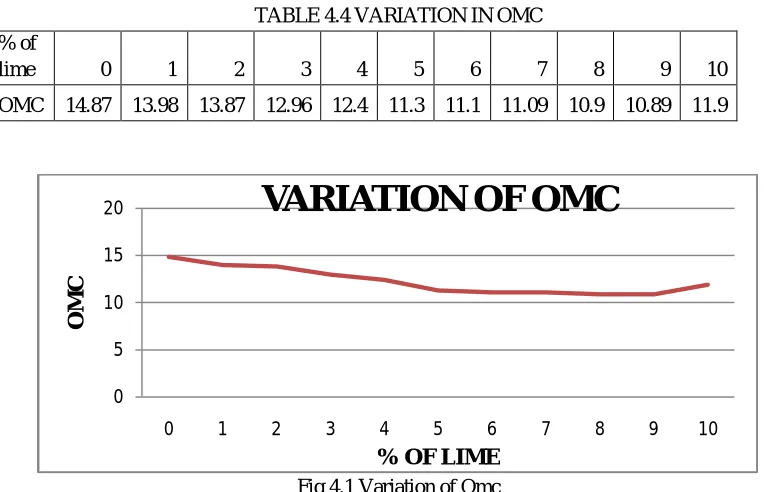
TABLE 4.4 VARIATION IN OMC % of
lime 0 1 2 3 4 5 6 7 8 9 10
OMC 14.87 13.98 13.87 12.96 12.4 11.3 11.1 11.09 10.9 10.89 11.9
Fig 4.1 Variation of Omc
[image:4.612.97.514.453.720.2]From the above graph, it is evident that the optimum moisture content (OMC) decreases from 14.87% to 10.89% with increase in percentage of lime from 0% to 9%. Beyond that there is a slight increase in OMC.
Table 4.5 Variation In Mdd
FIG 4.2 VARIATION OF MDD 0
5 10 15 20
0 1 2 3 4 5 6 7 8 9 10
O
M
C
% OF LIME
VARIATION OF OMC
1.55 1.6 1.65 1.7 1.75 1.8 1.85 1.9 1.95
1.67 1.71 1.72 1.745 1.768 1.774 1.8 1.84 1.91 1.9 1.89
M
D
D
% OF LIME
VARIATION OF MDD
% OF
LIME 0 1 2 3 4 5 6 7 8 9 10
The above graph indicates that the maximum dry density value increases from 1.67 % to 1.9% when the percentage of lime increases from 0% to 9%.
C. Unconfined Compressive Strength
[image:5.612.78.535.132.390.2]TABLE 4.6 VARIATION IN UCS
Fig 4.3 Variation OfUcs
[image:5.612.87.517.433.722.2]D. California Bearing Ratio
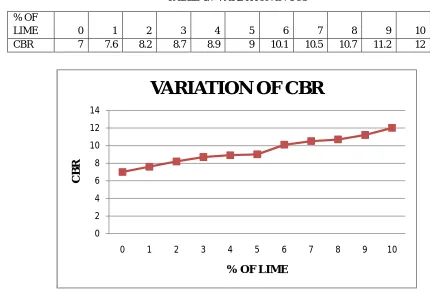
TABLE 4.7 VARIATION IN UCS
Fig 4.4 Variation Of Cbr 0
10 20 30
0 1 2 3 4 5 6 7 8 9 10
U C S X 10^ -2 M P a
% OF LIME
VARIATION OF UCS
0 2 4 6 8 10 12 14
0 1 2 3 4 5 6 7 8 9 10
C
B
R
% OF LIME
VARIATION OF CBR
% OF
LIME 0 1 2 3 4 5 6 7 8 9 10
UCS (1 DAY) X
10^-2 5.55 5.67 5.98 6.12 6.23 7.45 8.12 10.12 15.45 16.12 19.32
% OF
LIME 0 1 2 3 4 5 6 7 8 9 10
From the above graphs, it is clearly depicted that the unconfined compression strength and California Bearing Ratio increases from 0.056 MPa to 0.193 MPa in one day with increase in lime % from 0% to 20% and from 7 to 12 with increase in lime % from 0% to 10%.
IV. CONCLUSION
A. Based on the results of the investigation, the following conclusions are drawn.
1) Lime is used as a stabilizer for improving the geotechnical characteristics of Yellowish clay Soil. Addition of Lime significantly improves the index properties, compaction and strength characteristics of Yellowish clay Soil under study. The effects of Lime treatment vary depending upon the quantity of Lime that is mixed with the study of Yellowish clay Soil sample.
2) The liquid limit and plastic limit of the soil decreases with the addition of Lime which indicates a desirable change as the soil mixed with Lime mix can gain strength at an early stage than the virgin soil with the change in the water content. The relative decrease in the plasticity index of the soil is another favorable change since it increases the workability of the soil. The shrinkage limit of the soil increases with the addition of Lime.
3) Addition of Lime brings in an improvement in the compaction parameters of the study soil, by increasing the maximum dry
density of the soil with decrease in the corresponding values of optimum moisture content. The unconfined compressive strength of the soil increases upon the addition of Lime. The trend of improvement in the unconfined compressive strength is observed to be more pronounced with the curing of the soil mixed with Lime. A curing period of 1 day is observed to yield the maximum enhancement in the unconfined compressive strength. This suggests that, it can be effectively used in bulk as base and sub-base materials for road construction works.
REFERENCES
[1] G.F.Sowere, A.Vesic and M.Grandolfi, “Penetration tests for liquid limit”, Proceedings of a Symposium on Atterberg Limits., ASTM No. STP 254,
PP.216-224.
[2] F.G.Bell, “Stabilization and Treatment of Clay Soil with Lime-Part 1-Basic Principles”, Ground Engineering, Vol.21, No.1, pp. 10-15., 1988
[3] F.G.Bell, “Stabilization and Treatment of Clay Soil with Lime-Part 2-Some Applications”, Ground Engineering, Vol.21, No.2, pp. 25-29., 1988b
[4] I.S: 2720 (Part XVI)-1965: “Indian standard for laboratory determination of CBR”, Bureau of Indian Standards Publications, New Delhi.
[5] B.C.punamiya and A.K.Jain, “Soil mechanics and engineering property”.
[6] C.E.G.Justo and S.K.Khanna, “ highway engineering
[7] S.Z. George et al (1992) Effect of temperature on Lime-soil stabilization. Journal of Construction of Building Materials, Volume 6, 247-252.
[8] F.G. Bell (1996) Lime Stabilization of Clay minerals and soils. Journal of Engineering Geology, ELSEVIER, 223-237.
[9] Bell, F.G. (1988). Stabilization and treatment of clay soils with Lime. Part 1. Basic principles. sGround Engineering, 21, 10–15
[10] Determination of liquid limit and plastic limit. Indian standard methods for testingof soils-IS2720 (a) Indian standard Institution, New Delhi, India, part 5, pp
109-144,1985
[11] Amir Ali Al-Rawasa, A.W. Hagoa, Hilal Al-Sarmib (2005), “Effect Of Lime, cement and Sarooj (artificial pozzolanic) on the swelling potential of an expansive soil from Oman.” Building and Environment 40, 681–687.
[12] Balasubramaniam, A. S., Bergado, D. T., BuensucesoJr, B. R and Yong, W. C. (1989). Strength and deformation characteristics Of Lime- treated soft clays.