Technology (IJRASET)
Adaptive Facial Detection & Recognition
Algorithm for Partially Occlude Images
Priya Matte1, Rohit Raja2 Department of Computer Science,
Shri Shakracharya Technical Campus,(SSGI, SSCET-FET) 490009
Abstract: In the present study we present an innovative approach towards countering the problem of partial occlusion in face recognition scenario. The partial occlusion can be caused by various objects such as scarfs, sunglasses etc., and its effects are confounding in the performances of the recognition rates. The framework tends to mathematically model the curvature and other essential features of the face such as micro-expression and the curves of the facial regions. This, significantly enhances the probability of matching the parent image to that of the occlude image. The proposed algorithm is tested over Extended Yale B & CMU PIE standardized datasets.
Keywords: Facial Recognition, Face detection, Algorithm Design & Analysis.
I. INTRODUCTION
The past decades have essed the emergence of the semi-automated facial recognition system which is widely used in surveillance scenarios such as criminal identification or in other international security agencies. But the problem with the method is that it requires a fair amount of manual intervention for the localization of the facial features and thereupon the algorithms are required to find the match based on its closeness in appearance with the other images in the database which is primarily based on feature extraction and information discrimination. Based on the type of classifiers used the face recognition systems for occlude images are classified as:
A. Geometric Feature Based Method
B. Template Based Method
C. Correlation Based Method
D. Matching Pursuit Based Method
E. Singular Value Decomposition Based Method
F. Dynamic Link Matching Method
G. Other Learning Based Recognition Methods
Since, such methods has its own pros and cons and are often drop in recognition rates for occlude images have been reported [1,2]. Among the best known approaches for face recognition, Principal Component Analysis (PCA) is considered one of the techniques with better results and has been object of much interest in the research domain of face recognition [3,4]. PCA involves the recognition framework based on the representation of the facial images by using eigenfaces [4-16]. The principal logic behind PCA method is to derive sets of orthogonal vectors (also called eigenfaces) which optimally represent the data distribution in form of the root mean square (rms) sense [17-25]. Therefore, in the study we presented a learning based approach independent of the variations like that of varying light illumination, pose estimation and the occlusion problem. The technique proposed in this paper is morphologically modeled extension of the PCA approach where several subsets of images are created through logical networks. In each subset, the images used in the training and recognition stages are masked in those regions where significant modifications are expected to occur as a consequence of occlusion or expression change.
II. METHODOLOGY
study CMU PIE facial image database (table 1) as test images [26,27]. The images in the study consist of two types namely the one occluded by glasses or sunglasses and the one occluded by hats or disguise.
Table.1. List of database used in the recognition test.
Database Subjects Images Per Person Occlusion Type Total
Extended Yale B
CMU PIE 40 70 4 7 Hats/Disguise Glass/Sunglass 160 490
B. Methodology: Algorithm For Encoding Facial Features From Occluded Images
The idea relies over the idea to map the topological features from the given facial image and thereby coding it in logical sequence with the help of cascaded neural network; since in previous study such attempt has already been quite successful in decoding the face recognition patterns involved with human brain and then training the neural nets to mimic such process [28]. Therefore, the underlying processing steps to reduce the effects posed any poor or uncontrolled lighting environment. The proposed pre-processing steps begin with the color transformation of the given facial image in order to normalize the light illumination field. The latter steps dynamically adjust the contrast of the image by breaking down the wavelets in logical association with spatial colorized pixel field. This ensures the optimization of the reflectance field derivative from the pixel values. Hence, making it easy to perform computational operations over optimized values. Such that, the given RGB standard image is to be normalized into rg scheme by using the following pre-processing algorithm:
Algorithm: Pre-Processing Algorithm Input: × RGB standard Image
Where, m & n are the row & column of the given image. Output: rg normalized color scheme
Loop: for i to m
Loop: for j:n //RGB normalization to rg scheme
, =( + + )
, =( + + )
end end
Check & Segment:
if ( ≤ ∑ ( , , , )) //To adjust contrast
{
= ( | , ) //for sampling skin texture else
= ( | , ) //for sampling background light //illumination field
}
Where, the value M represents the model of skin color, which is embarked as low intensity pixels after the pre-processing. &
Technology (IJRASET)
Figure.1: The sample results of each pre-processing steps and histogram Plot of various sections of the image after pre-processing (A) Intermediary steps of Pre-processing and final output of pre-processing (B) Shows that of the distribution of sampled skin pixels for the normalized rg-color scheme (C) Shows that of the distribution of sampled non-skin pixels or other background extracted pixels in pixel set .
(c) The error rate in learning ( , ).
Given the segmented data sets derivable from the above algorithm in form of each rg-color scheme is given as: ( , ), ( , ), …, ( , )∈ × [1,0]. Let be the set of displacement vectors for each of the neighboring nodes . Such nodes represent the positioning of the feature sets. Therefore, in order to sequence the features of the facial image from the reconstructed
rg-color scheme we use the following Pyramidal Section Algorithm (PSA) algorithm; for which its face recognition process is depicted in figure 2 below.
Algorithm: Pyramidal Section Algorithm (PSA) Input: ( , ), ( , ), …,( , )∈
Output: ( , )
Step 1: while l ≤min (∑ ( , )) //D is the displacement vector
Step 2: Evaluate the feasible value of target nodes :
= ( , )
Step 3: Create target vectors for feasible neighboring nodes:
Loop: for 1 to
( , )≤
Step 4: Using Lagrange multiplier for the activation function of the cascaded neural network [15]:
for 1 to m
for 1 to n
( , ) = ( ( , ) + ( , )) + ( , )
,
,
( , ) = ( , )−
| ( , )| //
end end
end for loop
end while loop
Technology (IJRASET)
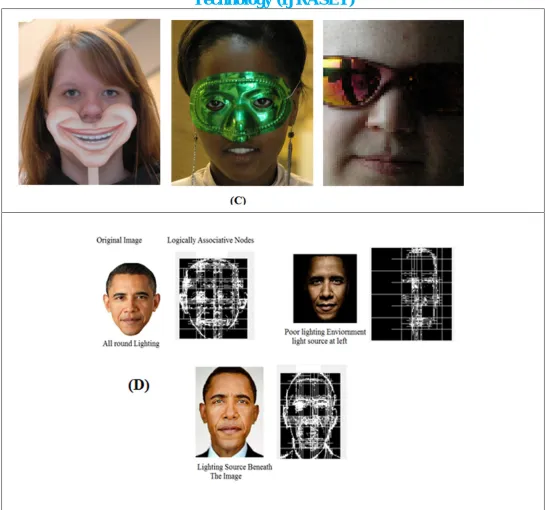
Figure 2: (A) The sample results of the PSA algorithm showing the recognized IDs of the test images with occluded sub spaces during the training period of the cascaded neural network. (B) Sample images from the four test categories. (C) Images from the category of disguise and sunglasses which fails in the PSA cascading network in aligning with the trained datasets resulted in inappropriate classification. (D) Results of the formation of associatively cascaded logical blocks with the curvature of the face in the given facial images with different positioning of light source.
[image:7.612.33.578.68.578.2]Technology (IJRASET)
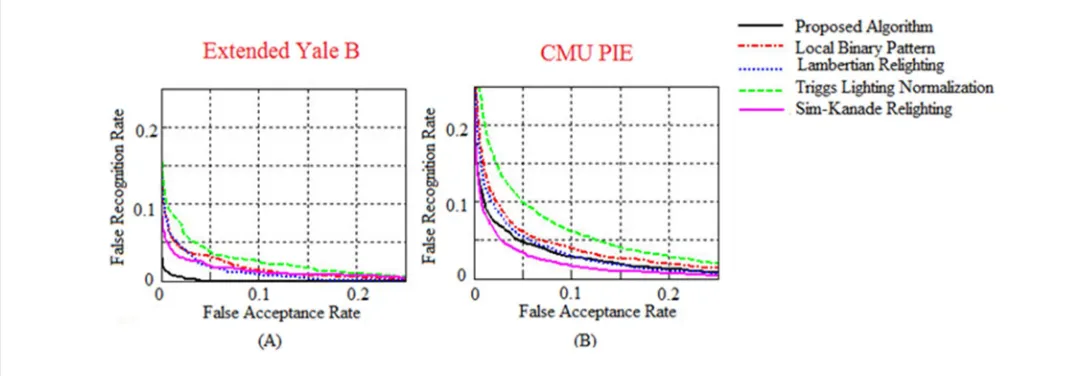
Figure.3: The comparison plot of the proposed PSA algorithm with that of the other principal cited methods for solving occlusion problem in the literature.
As shown in the figure 3 above the plot depicts the comparison of the several methods of face recognition relatively with the proposed PSA algorithm. The result is plotted between the two results i.e., false recognition rate & false acceptance rate. Here, the false acceptance rate represents the matching points chosen by the algorithm to be used for matching whereas false recognition rate is the matching points which are matched with the criteria chosen with the designated algorithms. As can be concurred from the above plot the error rates has been minimal from rest of the methods as only unique match points is selected by the algorithm & latter used it to render over the other similar images which gives the higher correct match acceptance rate in nominal rate. This, detection method gives us an advantage over the present existing methods which indulges in pointless computation & matching of the pixel sets with numerous data entries. Our method has reduced this redundancy to a higher limit & is promises to be useful in industrial applications. The issues with the other methods are that they heavily relies on the visual cues for face detection and thus are time consuming. This method proposes a scalable algorithm with cascaded neural network for logically associative defining nodes of the facial feature sets & thus the searching of match properties is reduced to a very fine scale. Also, for lower resolution images PSA works fine from coarse to fine scales of visual cues in context of skin color and textures. Recognition of facial images from different plane shall be pursued in the near future hat will add depth to the current PSA algorithm.
Table 2: Recognition rates performance of the proposed algorithm on real database for all categories of the significant occlusion types.
Database Type Normal Glasses Sunglasses Hats Disguises Extended Yale B 91.5 90.3 83.4 59.2 42.3
CMU PIE 99.2 98.5 76.8 45.5 39.5
As shown within the table 2 above; the bestowed rule has effectively tries to address the matter of partly occluded faces within the four completely different classes and sequent variations. The results have shown that the performance of the face recognition rule is hyperbolic by the effective utilization of the cascaded neural networks. the most advantage with this methodology is that the machine price of process is considerably reduced as compared to the opposite strategies and thereby giving a minimal set of errors in false recognition rate, although the rule fails at places wherever quite fifty six of the facial region is roofed or stopped-up. this methodology can create real implementation of the face recognition system for viable.
and Recognition, 2001
[3] M. A. Turk, A. P. Pentland, “Face recognition using eigenfaces”, Proceedings of the IEEE Computer Society Conf. on Computer Vision and Pattern Recognition, pp. 586-591, Hawaii 1991.
[4] J. Zhang, Y. Yan, M. Lades, “Face recognition: eigenface, elastic matching, and neural nets”, Proceedings of the IEEE, Vol. 85, No. 9, pp. 1423-1435, Sept. 1997.
[5] W. Zhao, R. Chellappa, P. J. Phillips, and A. Rosenfeld, “Face Recognition: A Literature Survey” ACM Computing Surveys (CSUR). Vol.35, pp 399-458, 2003 [6] J. Rurainsky, P. Eisert, "Eye Center Localization using Adaptive Templates", in Proc. of the 1st IEEE CVPR Workshop on Face Processing in Video, Washington
DC, USA, June 2004.
[7] E. Candes, M. Wakin, and S. Boyd. Enhancing sparsity by reweighted `1-minimization. Journal of Fourier Analysis and Applications, 14(5):877–905, 2008. [8] V. Cevher, , M. F. Duarte, C. Hegde, and R. G. Baraniuk. Sparse signal recovery using markov random fields. In NIPS, 2008.
[9] A. Georghiades, P. Belhumeur, and D. Kriegman. From few to many: Illumination cone models for face recognition under variable lighting and pose. PAMI, 23(6):643–660, 2001.
[10] H. Jia and A. Martinez. Face recognition with occlusions in the training and testing sets. In FGR, 2008. [11] H. Jia and A. Martinez. Support vector machines in face recognition with occlusions. In CVPR, 2009.
[12] J. Kim, J. Choi, J. Yi, and M. Turk. Effective representation using ICA for face recognition robust to local distortion and partial occlusion. PAMI, 27(12):1977– 1981, 2005.
[13] V. Kolmogorov and R. Zabih. What energy functions can be minimized via graph cuts? PAMI, 26(2):147–159, 2004.
[14] K. Lee, J. Ho, and D. Kriegman. Acquiring linear subspaces for face recognition under variable lighting. PAMI, 27(5):684–698, 2005. [15] A. Leonardis and H. Bischof. Robust recognition using eigenimages. CVIU, 78(1):99–118, 2000.
[16] S. Li, X. Hou, H. Zhang, and Q. Cheng. Learning spatially localized, parts-based representation. In CVPR, 2001.
[17] P. Maragos and R. Schafer. Morphological filters. Part i: Their set-theoretic analysis and relations to linear shift in variant filters. IEEE TASSP, 35:1153–1169, 1987.
[18] A. Martinez. Recognizing imprecisely localized, partially occluded, and expression variant faces from a single sample per class. PAMI, 24(6):748–763, 2002. [19] A. Martinez and R. Benavente. The AR face database. CVC Tech. Report No. 24, 1998.
[20] A. Pentland, B. Moghaddam, and T. Starner. View-based and modular eigenspaces for face recognition. In CVPR, 1994.
[21] F. Sanja, D. Skocaj, and A. Leonardis. Combining reconstructive and discriminative subspace methods for robust classification and regression by subsampling. PAMI, 28(3), 2006.
[22] M. Turk and A. Pentland. Eigenfaces for recognition. In CVPR, 1991.
[23] A. Wagner, J. Wright, A. Ganesh, Z. Zhou, and Y. Ma. Toward a practical face recognition system: Robust pose and illumination via sparse representation. In CVPR, 2009.
[24] J. Wright and Y. Ma. Dense error correction via `1- minimization. preprint, 2008.
[25] J. Wright, A. Yang, A. Ganesh, S. Sastry, and Y. Ma. Robust face recognition via sparse representation. PAMI, 2009. [26] T. Sim, S. Baker, and M. Bsat. The CMU Pose, Illumination, and Expression database. IEEE PAMI, 25(12):1615–1618, 2003.
[27] R. Gross, I. Matthews, J. Cohn, S. Baker, and T. Kanade. The CMU Multi-Pose, Illumination, and Expression (Multi-PIE) face database. Tech Rep TR-07-08, CMU, 2007.
[28] A. Rai, Characterizing Face Encoding Mechanism by Selective Object Pattern in Brains Using Synthetic Intelligence and Its Simultaneous Replication of Visual System That Encode Faces, Research & Reviews: Journal of Computational Biology, Vol 3, Issue 2, 2014.
[29] Richa Shukla, Rohit Raja.,” Grid Based Multiple Features Based On Image Mosaicing” International Journal of Advanced Research in Computer Engineering & Technology (IJARCET)Volume 2, Issue 2, February 2013
[30] Yamini Chouhan, Rohit Raja.,” Face Recognition with 3D Head Pose Estimation and Land Mark extraction Using Gabor Wavelets” International Journal of Science, Engineering and Technology Research (IJSETR) Volume 2, Issue 5, May 2013
[31] Tilendra Shishir Sinha, Devanshu Chakravarty,Rajkumar Patra and Rohit Raja.,” Modelling and Simulation for the Recognition of Physiological and Behavioural Traits Through HumanGait and Face Images” Computer and Information Science » Numerical Analysis and Scientific Computing » "Discrete Wavelet Transforms - A Compendium of New Approaches and Recent Applications",: February 6, 2013 Chapter 5
[32] [email protected]; [email protected].,” An Efficient Face Recognition using PCA and Euclidean Distance Classification” IJCSMC, Vol. 3, Issue. 6, pg.407 – 413,June 2014.