Technology (IJRASET)
Designing a High- Pass FIR Digital Filter by Using
Bartlett Window and Blackman Window
Technique
Rahul Suryawanshi1, Nikhil Agrawal2, Vikki Pandey3, G Laxmi Sagar4, Pranay Kumar Rahi5
1,2,3,4,5
Department of Electrical & Electronics Engineering, 5Guru Ghasidas University, Bilaspur, Chhattisgarh
Abstract—Theaim of this paper is to design FIR filter of the Window function methods. This paper presents the importance of filter in signal processing. Digital filter are of two types (1)FIR (2)IIR. Design of FIR filer is done in MATLAB. MATLAB programming processes are used to Designing a High- Pass FIR Digital Filter by Using Bartlett Window and Blackman Window Techniquecharacterize the magnitude and phase response Digital filter plays an important role in today’s world of communication and computation. Without digital filter we cannot think about proper communication because noise occurs in channel.
Keywords— FIR Digital Filter, Window Function, FDA tool inMATLAB
I. INTRODUCTION
The various techniques for improving the accuracy and reliability of digital communications is known as Digital Signal Processing (DSP). A High Pass Filter rejects the frequency components below the threshold value. A Digital Filter takes a digital input, gives a digital output, and consists of digital components. A Finite Impulse Response (FIR) Filter is a filter structure that can be used to implement almost any sort of frequency response digitally.
II. APPLICATIONSOF DSP
Digital signal processing techniques are used in various areas such as RADAR, SONAR, BIOMEDICAL, SPEECH P ROCESSING, IMAGE PROCESSING, etc.
These techniques are applied analyzing the signal in radar tracking system, linear periodic system, speech synthesizers etc.
III. WINDOWTECHINIQUES
In this method the desired frequency response specification Hd(ejω) corresponding unit sample response hd(n) is determined using
the following relation
Hd(ejω) = ℎ ( ) …(1)equation hd[n] =1/2π ∫ ℎ ( ) …(2)equation
In given a frequency response specification Hd(ejω), we can compute hd[n] from eq.(2) and determine the transfer function Hd(z). For
most practical applications, the desired frequency response is piecewise constant with sharp transitions between bands; the corresponding impulse response sequence {hd[n]} is of infinite length and noncausal.
A. Bartlett Window Function
The weighting function for the Bartlett window is given by
WR(n) =
1 | |≤
0, ℎ ...(3) equation B. Blackman Window Function
Technology (IJRASET)
C. Simulation And ResultPARAMETER VALUES Sampling Frequency(Fs) 1750
Cut off Frequency(Fc) 350
Order(N) 10 Table1: Parameter Specification
D. Figures and Tables
Filter coefficient
h(n)
Window Techniques
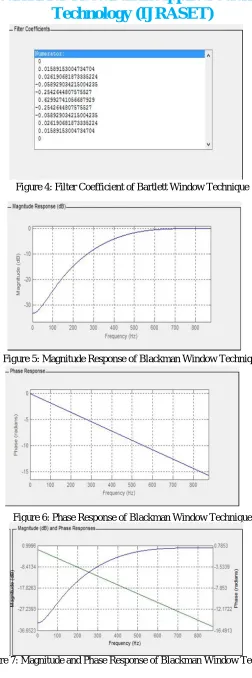
Bartlett Blackman h(0)=h(10) 0 0 h(1) =h(9) 0.015891530047347 0.003043903340 h(2)= h(8) 0.02619068187333 0.012523222453 h(3)= h(7) 0.05892903421500 0.047697662795 h(4)= h(6) 0.25426448075755 0.257129032473 h(5) 0.629927410566876 0.60009589886 Table2: Filter coefficients of Bartlett& Blackman Window Techniques
Figure 1: Magnitude Response of Bartlett Window Technique
Technology (IJRASET)
Figure 4: Filter Coefficient of Bartlett Window Technique
Figure 5: Magnitude Response of Blackman Window Technique
Figure 6: Phase Response of Blackman Window Technique
Technology (IJRASET)
[image:5.612.192.428.239.419.2]Figure 8: Filter Coefficient of Blackman Window Technique
Figure 9:Magnitude and Frequency plot of Bartlett Window Technique
Figure 10:Magnitude and Frequency plot of Blackman Window Technique.
IV. CONCLUSIONS
The proposed design FIR filter using Bartlett and Blackman window technique of order 10. The analyses of magnitude and phase response of proposed FIR high pass filter are performed using MATLAB simulation. Digital filter can play a major role in speech
0 5 10 15 20 25
1 2 3 4 5
M a gn itu d e (d B ) Frequency(KHz) 0 5 10 15 20 25 30
1 2 3 4 5
[image:5.612.196.429.460.639.2]Technology (IJRASET)
Kaiser window gives the minimum.
V. ACKNOWLEDGMENT
I would like to acknowledgewith gratitude, the contribution of several individuals. I wish to thankMr.Pranay Kumar Rahi(Registrar & Assistant Professor, Department of Electrical & Electronics Engineering, I.T.Korba) for her guidance, encouragement and supervision during the period of this work. The authors would thank the Electrical and Electronics EngineeringDepartment of the Institute support and facilities to be provided during the research and simulation work.
REFERENCES
[1] Neil H. E. weste, David Harris and Ayan Banerjee, “CMOS VLSI Design”, Pearson Education, Third Edition, pp. 345-356, 2006. [2] Wayne Wolf, “Modern VLSI Design”, Pearson Education, Third Edition, pp. 350-359, 2008
[3] S Salivahanan, C Gnanapriya, second edition, Tata McGraw-Hill Education.
[4] AbdolhamidSohrabi, AzimRezaeiMotlagh, HabibRostami and AyatAkbari, “High Performance Current-Mode Multiplier Circuit”, International Journal of Innovative Technology and Exploring Engineering (IJITEE) ISSN: 2278-3075, Volume-3, Issue-5, pp. 119-122, October 2013.
[5] A.Daniel Raj, S.Vijayalakshmi and P.Sathyamoorthy, “Efficient Design of 4-bit array Multiplier using GDI low power cell”, International Journal of Computer Technology and ElectronicsEngineering (IJCTEE) Volume 2, Issue 6, pp. 47-51, December 2012.
[6] Sanjit K Mitra “digital signal processing computer-based approach third edition McGraw Hill. [7] S Salivahanan ,CGnanapriya “Digital Signal Processing” McGraw Hill, second edition, p.p.731,747,761 [8] Sanjit K Mitra “digital signal processing computer-based approach second edition McGraw Hill.
[9] Sen. M Kuo, Bob H Lee “Real-Time Digital SignalProcessing” copy right © 2001 by John Wiley &SonsLtd.pp.399
AUTHOR DETAILS
Pranay Kumar Rahireceived the Bachelors of Technology degree in Electronics and Telecommunication Engineering from Government Engineering College, Guru Ghasidas University, Bilaspur, Chhattisgarh, India in 2004, working as an Assistant Professor in Electrical and Electronic department of Institute of Technology Korba since 2008 and pursuing Masters of Engineering in Electronics and Communication Engineering from National Institute of Technical Teacher’s Training& Research, Punjab University, Chandigarh, India.
Rahul SuryawanshipursuingBachelor of Engineering in Electrical and Electronics Engineering in 8th semester, fromInstitute of Technology Korba, Chhattisgarh Swami Vivekananda Technical University, Chhattisgarh, India
Nikhil Agrawalpursuing Bachelor of Engineering in Electrical and Electronics Engineering in 8th semester, from Institute of Technology Korba, Chhattisgarh Swami Vivekananda Technical University, Chhattisgarh, India.
G Laxmi Sagar pursuing Bachelor of Engineering in Electrical and Electronics Engineering in 8th semester, from Institute of Technology Korba, Chhattisgarh Swami Vivekananda Technical University, Chhattisgarh, India.