M E T H O D
Open Access
OPERA-LG: efficient and exact scaffolding
of large, repeat-rich eukaryotic genomes
with performance guarantees
Song Gao
1,2,3†, Denis Bertrand
1†, Burton K. H. Chia
1and Niranjan Nagarajan
1*Abstract
The assembly of large, repeat-rich eukaryotic genomes represents a significant challenge in genomics. While long-read technologies have made the high-quality assembly of small, microbial genomes increasingly feasible, data generation can be expensive for larger genomes. OPERA-LG is a scalable, exact algorithm for the scaffold assembly of large, repeat-rich genomes, out-performing state-of-the-art programs for scaffold correctness and contiguity. It provides a rigorous framework for scaffolding of repetitive sequences and a systematic approach for combining data from different second-generation and third-generation sequencing technologies. OPERA-LG provides an avenue for systematic augmentation and improvement of thousands of existing draft eukaryotic genome assemblies.
Background
The field of sequence assembly has witnessed a signifi-cant amount of mathematical and algorithmic study of the problem [1–4]. Yet many assembly programs in use do not have a clear objective function that they optimize, relying on heuristics and/or manually tuned parameters to piece genomes together to variable degrees of success [5–7]. As there is a wide array of heuristics and param-eter choices to try, the right combination that works well across a range of datasets may not always be apparent and new assembly tools run the risk of being tuned for the datasets on which they are benchmarked. Recent as-sembly competitions such as GAGE [8], Assemblathon [9], Assemblathon2 [10], and a recent scaffolder bench-mark [11] have thus played an important role in galvan-izing the community and in highlighting the drawbacks of existing tools.
The prevalence of heuristic choices in assembly owes its origins partly to several well-known early results re-garding its computational complexity [1, 2] (and further confirmed by recent studies [3, 4]) which suggest that most formal definitions of various assembly problems (such as contiging and scaffolding) are computationally
intractable (NP-hard). Notably, though, most complexity results have been limited to worst-case analysis and rela-tively little has been said about average-case or paramet-ric complexity of various assembly problems [1, 4, 12]. For example, while the problem of constructing contigs from read data (typically formulated as a path-finding problem) has been shown to be NP-hard in terms of worst-case complexity [3, 4], in practice, the problem is usually under-constrained in the absence of ultra-long reads and trivially computable, fragmented contig as-semblies are the best we can do [4, 12]. The use of paired-end and mate-pair reads to scaffold contigs thus plays a vital role in assembly projects to significantly boost assembly quality [13–16]. While worst-case ana-lysis for the scaffolding problem also suggests that it could be computationally expensive to solve exactly, sur-prisingly, it is possible to design exact algorithms that require runtime polynomial in the size of the scaffold graph [13]. These algorithms guarantee a scaffold assem-bly that minimizes discordance with the input data and thus provide an internal “quality control” for their re-sults. As shown in Gao et al. [13] using experiments on small genomes, an exact algorithm for scaffolding simul-taneously leads to more accurate as well as contiguous assemblies.
As the sequencing process is stochastic, in principle, probabilistic models and objective functions provide a
* Correspondence:[email protected]
†Equal contributors
1Computational and Systems Biology, Genome Institute of Singapore, Singapore 138672, Singapore
Full list of author information is available at the end of the article
natural approach for assembly and scaffolding [16–20]. Methods such as Genovo [19] and SOPRA [16] are based on such models and provide an alternative ap-proach that is particularly powerful when sequencing coverage is low and read information uncertain. When sequencing coverage is high (>20×, as is often the case for short-read genome assembly projects) noise from random chimeric reads is easier to filter. Correspond-ingly, scaffold assembly is frequently formulated as a combinatorial graph problem and this is the approach followed in this study.
Based on the scaffold assembly formulation from Huson et al. [21], this study proposes extensions to an exact algo-rithm [13] that make it feasible for scaffolding large, repeat-rich genomes in a time and memory-efficient man-ner [22, 23]. The new approach, termed OPERA-LG, was extensively evaluated against state-of-the-art scaffolders (SSPACE [14], SOPRA [16] and BESST [24]) and assembly pipelines (SOAPdenovo [25] and ALLPATHS-LG [26]) on simulated and real datasets. In the presence of multiple and large fragment (>4 kbp) mate-pair libraries, OPERA-LG was seen to provide a several-fold increase in contiguity metrics and/or reduction in scaffold errors. Improvements with a single short-fragment mate-pair library were limited but OPERA-LG provided consist-ently good assemblies in these cases as well (among the top three scaffolders).
OPERA-LG incorporates several features useful for pro-ducing high quality draft assemblies for large, repeat-rich genomes. These include the ability to simultaneously use data from multiple libraries [27] as needed in large assem-bly projects, an improved edge-length estimation algo-rithm, and an exact extension for scaffolding repetitive sequences that typically confound assembly tools. OPERA-LG’s ability to be sequencing platform-independent was evaluated using PacBio and ONT data and compared with scaffolders such as SSPACE-LongRead [28] and LINKS [29].
Results Overview
The algorithmic core of OPERA-LG is adapted from the approach described in Gao et al. [13] (summarized in Additional file 1: Figure S1) and is based on (i) a mem-oized search to find a scaffold that minimizes the num-ber of discordant read-derived links connecting contigs (Additional file 1: Figure S1a), (ii) a graph contraction technique that allows for localizing the search for an op-timal scaffold without losing the guarantee of a globally optimal scaffold (Additional file 1: Figure S1b), and (iii) a quadratic programming formulation to compute gap sizes that best match mate-pair-derived distance con-straints [27] (Additional file 1: Figure S1c). To enable it to produce long and accurate scaffolds for large, repeat-rich
genomes, OPERA-LG incorporates several novel features and improvements, including (a) optimized data struc-tures to improve its scalability, (b) refined edge-length es-timation and the ability to simultaneously use multiple libraries to improve scaffolding accuracy, and (c) exten-sions that allow for the scaffolding of repeat sequences. Algorithmic details for each of these features and im-provements in OPERA-LG can be found in the“Methods” section.
Scalability and multi-library scaffolding Scalability
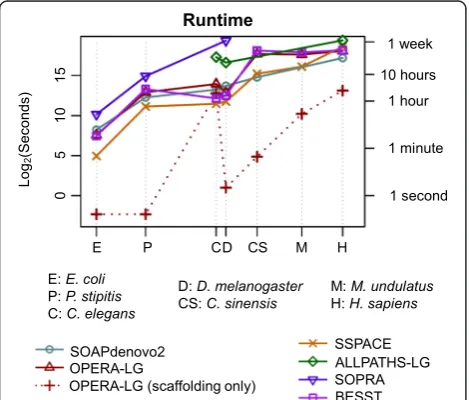
Runtime and memory optimizations in OPERA-LG (see “Methods”) are key to its scalability as shown in Table 1. In particular, while the method in Gao et al. [13] was un-able to scaffold the full D. melanogaster dataset due to excessive memory usage, OPERA-LG takes a few sec-onds and a few hundred megabytes of memory (largely for storing read mapping information). For genomes where the previous method was feasible, OPERA-LG is typically >10 times faster and requires significantly less memory (roughly one-half to 1/20th of the requirements for Gao et al.). Across datasets, OPERA-LG’s runtime was found to be comparable to that of SOAPdenovo2 and the scaffolders BESST and SSPACE, while requiring less runtime than SOPRA (runs on C. elegans and the three largest genomes were stopped after 10 days) and ALLPATHS-LG (Fig. 1). In addition, for small genomes OPERA-LG’s runtime is dominated by the preprocessing step, while runtime for the core of the algorithm (“OPERA-LG (scaffolding only)” in Fig. 1) may not ne-cessarily increase in proportion to the genome size (i.e., may be determined by intrinsic features of the genome, such as repeat lengths and distribution). Overall, OPERA-LG’s runtime was less than 1 day (on a single processor) using <60 GB of memory for all the datasets tested here (including the human genome), establishing its feasibility for scaffolding large genomes and retaining the potential for further improvement with parallelization.
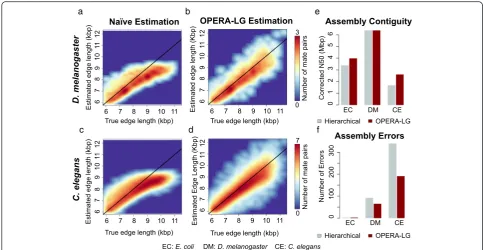
Edge length estimation and multi-library analysis
edges, though the bias observed here was not as severe as observed previously [30]. Secondly, OPERA-LG’s ability to handle multiple libraries simultaneously was found to provide a clear benefit over the commonly employed hierarchical approach (Fig. 2e, f ). The simul-taneous approach not only led to fewer assembly errors (Fig. 2f ) but also provided improved assembly contiguity (measured by corrected N50; see “Methods”) as a by-product (Fig. 2e). Note that the results for C. elegans may be more indicative of the performance boost that can be expected as theE. coliand D. melanogaster data-sets had high-quality assemblies to begin with.
Improvements in assembly contiguity and correctness Benchmarking with synthetic datasets
To evaluate the performance of OPERA-LG, it was first benchmarked on several synthetic datasets as these pro-vide the critical flexibility to vary parameters and assess their effect on the method (Table 2). The synthetic datasets contain multiple mate-pair libraries as well as large fragment libraries, representing a typical scenario for the assembly of large genomes where such informa-tion is critical (Table 2). OPERA-LG was assessed at two levels: (a) its scaffold quality by comparing against a recently published method (BESST) and the top three best performing scaffolders from a recent benchmarking paper [11], i.e., SOAPdenovo2’s scaffolding module (S2), SSPACE (SS), and SOPRA, evaluated with a common set of input contigs from SOAPdenovo; and (b) overall assembly quality (contiging and scaffolding), using SOAPdenovo as a contig assembler and OPERA-LG as a scaffolder (OP), when compared with ALLPATHS-LG (AP) and SOAPdenovo2 (S2) as representatives of state-of-the-art assembly pipelines (i.e., using their contiging and scaffolding modules; see Additional file 1: Table S1 for contig and scaffold statistics).
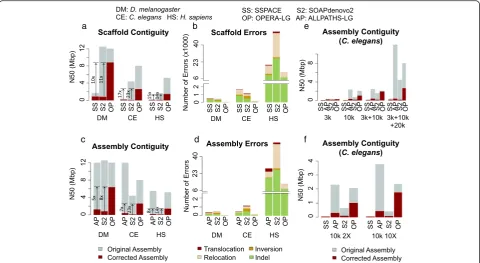
At the scaffold level, while the corrected N50 values for SSPACE, SOAPdenovo2, SOPRA, and BESST were typic-ally comparable (Additional file 1: Table S2), OPERA-LG produced assemblies that were significantly more contigu-ous, regardless of the genome being assembled (5–10× im-provement in corrected N50; Additional file 1: Table S2; Fig. 3a). In addition, scaffolds produced by OPERA-LG contained fewer errors in general (Additional file 1: Table S2; Fig. 3b), though on the human genome BESST was ob-served to have fewer indel and relocation errors. Manual inspection of scaffolding errors from OPERA-LG indicate that they were often due to local ordering errors in regions of the scaffold graph that were not sufficiently constrained by scaffold edges (relocations) and gap size estimation errors due to lower read coverage (scaffold indel errors; see“Methods”). In particular, OPERA-LG had few trans-location errors, where distant regions of the genome were incorrectly brought together. Results from others scaf-folders show that they lead to a large number of transloca-tion as well as inversion (where the orientatransloca-tion of contigs is incorrectly determined) errors compared with
OPERA-Fig. 1Runtime as a function of genome size. Note that both thex-axis
[image:3.595.60.540.99.170.2]andy-axisare log-scaled and the results for various genomes are indicated at the corresponding genome size. For all standalone scaffolders, runtimes include the mapping stage. For SOAPdenovo2 and ALLPATHS-LG we report the runtime of the full assembly pipeline (including contig assembly).OPERA-LG (scaffolding only)shows the runtime of the scaffolding algorithm in OPERA-LG, excluding preprocessing, to highlight that it can take a fraction of the overall runtime and is influenced more by the repeat complexity of the genome than the size of the genome. Due to its library-size restrictions, ALLPATHS-LG could be run on only a few of the datasets shown here. SOPRA runs did not complete after 10 days forC. elegansand the three largest genomes
Table 1Scalability comparison between the exact method in Gao et al. and OPERA-LG
E. coli S. cerevisiae D. melanogasterchromosome X D. melanogaster
Gao et al. Runtime (s) 1.1 1.3 2.6
-Memory (Mb) 95 62 265
-OPERA-LG Runtime (s) <0.1 0.1 0.1 2.4
Memory (Mb) 5 34 26 635
[image:3.595.57.292.392.592.2]LG (Additional file 1: Table S2; Fig. 3b). As such errors can significantly impact downstream analysis, this repre-sents an advantage for scaffolds produced by OPERA-LG. It also suggests that the global optimization employed in OPERA-LG may be more effective in eliminating such er-rors. Overall, OPERA-LG had≤1 inversion or translocation error for theD. melanogasterandC. elegansassemblies and less than a 100 such errors for theH. sapiensgenome.
For the assembly level comparisons, while ALLPATHS-LG and SOAPdenovo2 had comparable or larger original N50s, corrected assembly N50s were significantly lower compared with OPERA-LG scaffolds based on SOAPde-novo contigs (Fig. 3c). This was despite the fact that SOAPdenovo contigs were typically more fragmented and
thus provided a challenging starting point for the scaf-folder. A likely explanation for the improvements seen is the generation of fewer assembly errors compared with ALLPATHS-LG and SOAPdenovo2 (Fig. 3d; Additional file 1: Table S3). Similar results were seen in experiments with longer reads (Additional file 1: Table S4), indicating that the results are invariant to read length.
[image:4.595.55.539.87.337.2]OPERA-LG’s performance as a function of the informa-tion provided to it was assessed by further studying results for various combinations of libraries as input. Overall, as expected, OPERA-LG was seen to introduce fewer errors when more mate-pair libraries were provided (though this was not necessarily the trend for other methods; Additional file 1: Figure S2a). For example, incorporation of a 3-kbp
Table 2Statistics for synthetic datasets
D. melanogaster C. elegans H. sapiens
Assembly ID GCF_000001215.2 GCF_000002985.5 hg19
Genome size (Gbp) 0.1 0.1 3.2
Chromosomes 7 6 24
Paired-end librariesa 80 bp, 140 ± 10 bp, 40×
Additional paired-end librariesa NA NA 80 bp, 700 ± 70 bp, 10×
Mate-pair librariesa 50 bp, 3 ± 0.3 kbp, 2×; 50 bp, 10 ± 1 kbp, 2×; 50 bp, 20 ± 2 kbp, 2× Additional mate-pair librariesa 50 bp, 10 ± 1 kbp, 10×
50 bp, 10 ± 1.5 kbp, 2× 50 bp, 10 ± 2 kbp, 2×
50 bp, 10 ± 1 kbp, 10× NA
a
Library details are specified in the format: read length, insert size, base pair coverage (NA, not applicable)
Fig. 2Improvements in multi-library scaffolding.a–dThe improved correlation between empirical estimates and true edge lengths when using
[image:4.595.58.543.594.723.2]mate-pair library, in addition to a 10-kbp library, was seen to consistently help eliminate local scaffolding errors in under-constrained regions of the scaffold graph (see “Methods”; Additional file 1: Figure S2a). Correspond-ingly, both original and corrected N50s improved as OPERA-LG was provided with more libraries (Fig. 3e). A similar trend was seen with increasing sequencing depth, with OPERA-LG reporting fewer assembly er-rors (Additional file 1: Figure S2b) and providing consistent improvement in corrected N50 (Fig. 3f ) with higher read coverage.
Finally, the robustness of OPERA-LG to the quality of the sequencing library (measured by standard deviation in library size, with lower values implying higher quality) was assessed. Within a reasonable range of quality, OPERA-LG (and most assemblers) produce very similar assemblies in terms of assembly contiguity (Additional file 1: Figure S3a). However, degrading library quality led to an increase in the number of assembly errors (Additional file 1: Figure S3b). Despite this, OPERA-LG was observed to be more robust to library quality (with fewer errors and better N50 in the worst case than the best-case scenario for
other methods; Additional file 1: Figure S3b), confirming its utility for analyzing low quality input data.
Comparisons on real datasets
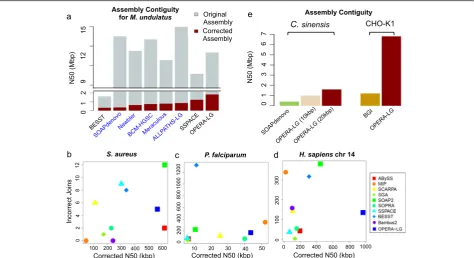
Evaluation of scaffolding performance on real datasets can be influenced by the lack of gold-standard references or limited availability of data. Based on evaluation on six sequenced datasets, OPERA-LG was observed to per-form consistently well and provide significant scaffold improvements when multiple and large-fragment librar-ies were provided as input. For example, for the exten-sively sequenced parrot genome datasets (M. undulatus, estimated genome size = 1.2 Gbp, with 2-, 5-, 10-, 20-, and 40-kbp mate-pair libraries), which were assembled as part of the Assemblathon2 competition [10], the cor-rected N50 obtained using OPERA-LG (with SOAPde-novo contigs) was 2.2× the best reported Assemblathon2 assembly (ALLPATHS-LG; Fig. 4a). This was despite the original N50 for OPERA-LG being slightly smaller than that for other Assemblathon2 programs, such as ALLPATHS-LG. Notably, OPERA-LG’s results were based on more conservative contigs from SOAPdenovo
Fig. 3Boosting assembly contiguity and correctness with OPERA-LG.a,bScaffold contiguity and correctness for various scaffolders on different genomes starting from common sets of contigs (generated by SOAPdenovo). The final assemblies were only corrected for scaffold errors. Results for BESST and SOPRA were comparable to those for SSPACE and are reported in Additional file 1: Table S2.c,dCorresponding overall assembly metrics for various assembly pipelines (that were provided all read libraries as input). The final assemblies were corrected for both contig and scaffold errors to allow for a fair comparison.Arrowshighlight fold improvement in corrected N50 using OPERA-LG. ALLPATHS-LG analysis on the
[image:5.595.58.539.88.351.2]and using default parameters, while Assemblathon2 re-sults were from the best submissions by their respective teams. In comparison with other standalone scaffolders (that shared the same contig set), OPERA-LG’s corrected N50 was 5.8× that of BESST and 1.5× that of SSPACE (Fig. 4a). SOPRA could not be evaluated as it did not complete its analysis even after 10 days of runtime.
Similar results were obtained for the assembly of a sweet orange genome (C. sinensis, genome size = 367 Mbp, with 2-, 10-, and 20-kbp mate-pair libraries) [31], where OPERA-LG’s corrected N50 was 2.5× that of the best performing alternative (SOAPdenovo2, 178 vs 68 kbp) and with less than a third of its scaffolding errors (1492 vs 5455; Additional file 1: Table S5). SOPRA was unable to run to completion on this dataset after 10 days, while BESST and SSPACE had corrected N50s <60 kbp. In the case of a well-assembled yeast genome (P. stipitis, genome size = 15.4 Mbp, 3 kbp mate-pair library), SOPRA ran to completion and was similar to OPERA-LG in terms of producing few scaffold errors (eight vs one; Additional file 1: Table S5). On the other hand, SOAPdenovo2’s scaffolds were comparable to those of OPERA-LG in terms of corrected N50 (299 kbp vs 320 kbp) but with many more scaffold errors (61 vs 1; Additional file 1: Table S5). OPERA-LG’s scaffolds
improved over SSPACE, BESST, and SOPRA in terms of corrected N50 (1.4–3×) and had fewer errors than SSPACE and BESST (Additional file 1: Table S5). In comparisons on the M. undulatus, C. sinensis, and P. stipitis genomes, the contigs provided as inputs to the scaffolders were not corrected for assembly errors and thus these evaluations should better reflect scaffolder performance in real genome assembly projects. In all three cases, OPERA-LG improved corrected N50 signifi-cantly, while having fewer scaffolding errors, compared with the next best standalone scaffolder (1.5× SSPACE forM. undulatus, 3.5× SSPACE forC. sinensis, and 1.4× SOPRA forP. stipitis).
To compare OPERA-LG with a wider range of scaf-folding programs, we evaluated it on three additional datasets from a recent benchmarking study [11]. Contigs used in this study were corrected for assembly errors providing a more idealized setting for comparing scaf-folders. Overall, OPERA-LG was consistently one of the top three methods in terms of corrected N50 across datasets (Fig. 5b–d). No other method exhibited simi-larly consistent performance. For the two smaller ge-nomes (S. aureus and P. falciparum), the datasets contained a single mate-pair library (2.8 and 3.6 kbp, re-spectively) and OPERA-LG had slightly lower corrected
Fig. 4Assembly improvements on sequenced genomes using OPERA-LG.aResults for theM. undulatusgenome, comparing OPERA-LG against
[image:6.595.61.536.88.346.2]N50 than the best performing methods (1.1–1.2× im-provement for MIP and ABYSS, respectively). Two mate-pair libraries (3 and 35 kbp) were available for the third experiment (H. sapiens chromosome 14) and OPERA-LG provided significantly improved corrected N50 compared with other methods in this setting (>2×; Fig. 5d). In terms of the number of incorrect joins (used to measure scaffolding error), no single method per-formed consistently well. Using an alternative metric [11] that takes the number of correct scaffold joins as a proxy for assembly contiguity and computes a weighted sum with the number of incorrect joins to obtain a“ nor-malized score”, SOPRA was observed to be the best method in two out of three datasets (Additional file 1: Figure S4). Note that the number of correct joins does not correlate well with assembly contiguity (e.g., OPERA-LG and SOPRA have a similar number of correct joins on the H. sapiens chromosome 14 dataset but OPERA-LG provides a corrected N50 that is five times that of SOPRA; Additional file 1: Figure S4e; Fig. 5d). Thus, the normalized score from Hunt et al. [11] provides an alternative measure of scaffold quality compared with widely used measures of assembly contiguity (a primary goal for genome assembly) such as corrected N50.
Another aspect to note here is the incorporation of “skipped tags” (contigs omitted from a scaffold) as a component in the normalized score from Hunt et al. [11]. As the position of small contigs (default <500 bp) in a scaffold is frequently under-constrained, OPERA-LG omits them to avoid scaffold errors (Additional file 1: Figure S4), while still scaffolding most of the sequence (>94 % of the genome for datasets from Hunt et al.). More importantly, the exclusion of very small contigs does not diminish the ability to cor-rectly recover complete genes from OPERA-LG as-semblies compared with the best asas-semblies based on the normalized score (Additional file 1: Figure S5). Para-doxically, the“normalized score” for OPERA-LG can im-prove using the complete set of contigs, even when corrected N50 and the number of incorrect links becomes worse (P. falciparumdataset; Additional file 1: Figure S4d; assembly size increase of 3 %).
Application I: scaffolding of repeat sequences
Assembly of repeat sequences is typically the most error-prone stage of many assembly pipelines as was observed in the results for the GAGE [8] and Assemblathon [9] competitions (e.g., the gap-filling stage in SOAPdenovo).
[image:7.595.57.539.89.345.2]They are often handled in a post-scaffolding, gap-filling stage. Algorithmic extensions in OPERA-LG allow it to simultaneously scaffold unique and non-unique regions of the genome and thus more appropriately scaffold repeat-rich genomes—a feature that is not available in other scaffolders which filter repeats during their preprocessing stage. Evaluation of scaffold correctness for OPERA-LG in the presence of repeat contigs showed that repeat contigs were placed in the correct order (as suggested in the refer-ence genome; Fig. 5a) in more than 80 % of scaffold gaps (regions with no unique contigs). In addition, more than 90 % of repeat contigs in gap regions were placed in OPERA-LG scaffolds (Fig. 5a), highlighting the complete-ness of scaffolds despite the conservative placement of repeats in OPERA-LG (see“Methods”).
Repeat contigs scaffolded by OPERA-LG were found to be frequently part of large gaps in the scaffold (forD. melanogaster, about half of the gaps were longer than 5 kbp; Fig. 5b). Large scaffold gaps present a challenging scenario for many gap-filling programs [32]. As no other scaffolder allows scaffolding of repeat sequences, we assessed OPERA-LG’s utility by testing the ability of three gap-filling programs (GapCloser, which is part of the SOAPdenovo package, GapFiller [33], and the re-cently published program Sealer [34]) to determine the sequence for scaffold gaps where repeats were placed by OPERA-LG. For E. coli and to a lesser extent the P. stipitis genome, GapCloser was able to provide the cor-rect sequence for most of the scaffold gaps (>60 %; Fig. 5c, d). GapFiller did not correctly fill many gaps (1 %) with repeats placed by OPERA-LG (it typically re-ported sequences for gaps <800 bp long), and Sealer was not able to complete after 10 days on any of the five data sets. Sealer’s results were surprising but potentially due to the complexity of the assembly graph around repeats and the exhaustive search that it needs to identify the correct sequence. These results show that the placement of repeat contigs in large genomes by OPERA-LG fre-quently provides information that is not available from gap-filling programs (Fig. 5c, d).
Application II: assembly augmentation and hybrid assembly
With the increasing availability of new sequencing tech-nologies and additional sequencing datasets at reduced costs, improvement of older draft genome assemblies in a systematic fashion is an area of increasing interest in the field. As the underlying algorithms in OPERA-LG are conservative and intended to minimize discordance with data, the use of OPERA-LG as an assembly augmentationtool is attractive and was explored further in two recent genome assembly projects. In the first pro-ject, for the assembly of a sweet orange genome (C. sinensis) [31], all available Illumina sequencing datasets
were used with SOAPdenovo to generate a preliminary draft assembly (N50 of ~430 kbp). This assembly was then augmented using OPERA-LG with SOAPdenovo scaffolds as starting sequences and by reusing the larger mate-pair libraries (10 and 20 kbp). The final N50 ob-tained by this process was four times larger (~1.6 Mbp; Fig. 4e) and the assembly was validated to be of high-quality using BAC-end sequences, genetic linkage maps, and cytogenetic analysis [31]. In another project, an existing reference genome assembly for a Chinese ham-ster ovary cell line (CHO-K1) [35] was augmented with newly generated Illumina sequencing datasets (300-bp li-brary at 61× and 10-kbp lili-brary at 16× base pair cover-age). The resulting assembly boosted N50 sixfold (1.2 to 6.9 Mbp; Fig. 4e) with >90 % of the genome assembled into ~500 scaffolds. The scaffolds were also used to close gaps in silico, filling >130,000 gaps, and scaffold correct-ness was confirmed using alignments of the transcrip-tome to the assembly (Yusufi et al., in preparation).
for this dataset, OPERA-LG improved corrected N50 by 4–9× depending on how scaffold edges were con-structed (Additional file 1: Table S6). Runtime for OPERA-LG and LINKS was at most 6 h and 1 h, respect-ively, while SSPACE-LR took >5 days for genomes longer than 100 Mbp. OPERA-LG’s results provide a proof-of-concept for this application and refinements in mapping and scaffold edge construction could further improve results for low coverage datasets.
Discussion
For many bioinformatics problems it is either hard to formalize a clear objective for algorithm design or the formalized objective is computationally intractable. Benchmarking of a novel algorithm is thus the norm for demonstrating the algorithm’s utility and advance over state-of-the-art. Due to resource limitations, however, benchmarks will always be limited in nature. Moreover, consensus on a standardized and comprehensive bench-mark can be elusive in many areas, though recent efforts have provided valuable resources for benchmarking scaffolders and assemblers. Where feasible, algorithms that have a clear optimization criterion provide users reason to believe that the algorithm will work on a new dataset. This is the motivation behind OPERA-LG, where the algorithm is guaranteed to produce a minimal-repeat scaffold that globally minimizes the number of discordant scaffold edges. This is by no means the only optimization criterion though and algorithms such as SOPRA optimize very similar criteria in a probabilistic setting.
Results for OPERA-LG on synthetic and real datasets indicate that it is well suited for scaffolding datasets where multiple mate-pair libraries or large-fragment libraries are available. In such settings, OPERA-LG reported the best corrected N50s compared with other scaffolders and assemblers. With fewer libraries or smaller fragment libraries, the improvements seen were more limited, though OPERA-LG provided consistently good results. While corrected N50 is widely used to evaluate scaffolds and assemblies [8–10], other metrics may prefer alternative scaffolders (e.g., SOPRA using “normalized score” [11]). Deciding which method to use in an assembly project would thus likely depend on the specific requirements of the project.
OPERA-LG relies on the presence of sufficient mate-pair information to constrain the scaffold graph and re-port an optimal scaffold. When this is feasible, it provides scaffolds with fewer errors compared with other methods, particularly translocation and inversion errors. However, availability of only a single mate-pair library and limited sequence coverage can under-constrain the scaffolding problem in some regions, especially in the presence of short contigs. There can be multiple optimal scaffolds in such situations, thus leading to mis-assemblies with
OPERA-LG. OPERA-LG tries to mitigate this issue by selecting a solution based on approximate distance information from scaffold edges (see “Methods”). Add-itional strategies, such as post-processing to detect regions of the scaffold that are under-constrained and local analysis to correct misassemblies, or the assignment of a confidence score to different regions of the scaffold, deserve further consideration.
A common concern and criticism for exact algorithms for assembly and scaffolding has been that they are slow, not practical for large datasets, and cannot handle complicated scenarios (e.g., for scaffolding repeats). An important contribution of this work is to show that these challenges are surmountable in a specific deterministic scaffold assembly framework with appropriate algorithm design and engineering. Our results show that large and repeat-rich genomes are amenable to assembly using exact algorithms and that the efficiency of OPERA-LG is comparable to other scaffolding methods. Methods such as SOPRA and OPERA-LG could thus allow users to obtain consistently high quality scaffolds, depending on the scaffold quality metric of choice.
Conclusions
As characteristics of sequencing technologies continue to improve, particularly in read length, assembly quality is also expected to benefit [37, 38]. Recent improvements in protocols for the generation of large mate libraries (e.g., 40-kbp libraries from the NxSeq technology: http:// www.lucigen.com/NxSeq-DNA-Sample-Prep-Kits/) fur-ther emphasize the need for effective scaffolding methods that can use this information. However, genome assembly will continue to be a trial-and-error process until assembly and scaffolding algorithms fully exploit the power of the data. Assembly errors continue to plague downstream biological sequence analysis, affecting almost every aspect of modern bioinformatics, and a full assessment of their impact has yet to be performed [6]. Our analysis suggests that commonly used assembly tools such as SOAPdenovo and SSPACE can introduce hundreds to thousands of errors during scaffolding. As these programs have been used to construct hundreds of draft eukaryotic genomes, they may benefit from re-assembly and assembly augmen-tation using newer assembly tools. As we move to an era where assembled sequences potentially guide medically relevant decisions, tolerance for assembly errors is likely to be even more limited. Improved assembly tools are thus needed, such that fully phased and complete quality-guaranteed assemblies are the norm in the future.
Methods
Constructing the scaffold graph in OPERA-LG
three-staged process to combine library information to construct a scaffold graph (with contigs as nodes and scaf-fold edges, which define the constraints on order, orienta-tion, and distance between adjacent contigs, linking them). Firstly, instead of relying on user input for library proper-ties such as mean and standard deviation of insert sizes, as well as read orientation, by default, OPERA-LG directly estimates them from read mappings on large sequences (>2× the insert size, as estimated from a set of 1000 read pairs). The read orientation of a library is set by default to the majority orientation of all read pairs mapped to the same contig and these are then used to calculate the mean insert length and standard deviation. To avoid biases due to outliers (from mis-assemblies, mis-mapping, or sequen-cing errors), read pairs with distance less than Q1−3IQ R or greater than Q3þ3IQR were ignored, where Q1 andQ3are the first and third quartiles, respectively, of dis-tances between read pairs on a contig andIQR¼Q3−Q1.
Refined edge length estimation
Secondly, OPERA-LG combines information from read pairs in a single library to get a library-specific estimate of edge length for each scaffold edge. Let the gap length between two contigs begandCbe the sum of the contigs length andg. To account for the fact that the observed read pairs are from a truncated distribution [30] (in the range [g, C] as shown in Additional file 1: Figure S6), a reverse lookup table is used to estimate g(gap size) from the ob-served mean ofS^ (defined as the length of contig sequences that overlap with the insert region of the paired reads; Additional file 1: Figure S6). As noted in Sahlin et al. [30], this is an important step to avoid biases in edge length estimation that could lead to incorrect ordering of contigs and we propose a novel approach for bias correction. Specifically, given g and the overall distribution of insert lengths I (as determined by the read mapping on large sequences), we computeE S^asE I½g;C
−g (whereI½g;C
is the random variable for the truncated distribution indi-cated in Additional file 1: Figure S6b) for every value ofgin the range [0,L] (whereLis an upper bound of the library insert size, by defaultμ+ 6σ). To reduce runtime, OPERA-LG pre-computes such a lookup table for l (the sum of contig lengths) in the range ½g; Q3þ3IQR at 500-bp intervals and returns the value of InlineEquationE S^that corresponds to the value of E(Ŝ) closest to the observed mean of S^ (using the appropriate lookup table for the current value of l). Note that the pre-computation for a lookup table is quite efficient as it can be done in linear time (as a function of the library size) using cumulative sums.
Multi-library scaffolding
Thirdly, scaffold edges obtained from different libraries are combined to form a unified scaffold graph in
OPERA-LG. To do this, OPERA-LG uses the mean (as obtained above) and standard deviation [21] estimates for all edges connecting a pair of contigs (in the same orientation) to cluster and merge edges, starting at each stage with the edge with the largest standard deviation and identifying other edges whose means are within k(6 by default) standard deviations of this edge to merge into a single edge. In the case where more than one edge remains at the end of the process, OPERA-LG uses the edge supported by the most paired reads and discards other edges (for assembly of polyploid sequences all edges will be discarded and for repeat contigs all edges will be retained).
Since libraries with very different insert sizes (say 200 bp vs 40 kbp) provide largely orthogonal information for scaffolding, it is possible to consider them in groups of similar insert sizes. OPERA-LG therefore allows the user to combine libraries in a staged fashion (<1, 1–10, and >10 kbp, by default) for greater runtime efficiency.
Scaffolding of unique sequences
OPERA-LG is based on Opera [13], which is restricted to the scaffolding of unique sequences. In this section, we briefly describe the main concepts that are common to Opera and OPERA-LG. We begin with a few definitions. We define ascaffold(without repeats) as being given by a signed permutation (where the sign denotes orientation) of unique contigs as well as a list of gap sizes between adjacent contigs. A scaffold edge e¼<c1; c2> is a concordant edge ifc1andc2 in the scaffold can satisfy the distance and orientation constraints imposed by e and otherwisee is marked discordant. Given a scaffold graph G¼ðV; EÞ, a partial scaffold S0 is a scaffold on a subset of the contigs and the dangling set,D Sð Þ, is composed of0 edges fromS0toV−S0. The active regionA Sð Þ0 is given by the shortest suffix ofS0such that all dangling set edges are adjacent to a contig in it. A partial scaffoldS0is considered validif all edges in the induced subgraph are concordant.
Definition 1 (scaffolding problem without repeats)
Given a scaffold graphG, find a scaffoldSof the contigs that maximizes the number of concordant edges.
This problem is analogous to that in Huson et al. [21] (where the problem is defined in terms of individual paired reads) and, therefore, the proof there can be adapted in a straightforward way to show that the deci-sion verdeci-sion of the scaffolding problem is NP-complete.
Lemma 1
If S01 and S20 are two valid partial scaffolds where A Sð Þ10 ;D Sð Þ10
ð Þ ¼ðA Sð Þ20 ;D Sð Þ20 Þ, then (1) S01 and S20 contain the same set of contigs and (2) both or neither of them can be extended to a valid complete scaffold.
Hence, the scaffolding algorithm of Opera without any discordant edges (as defined in Gao et al. [13]) requires O Eð jj jVjwÞ time, where w as an upper bound on the
number of contigs that can be spanned by a paired read. Treating the total number of discordant edgespin the scaffold graph as a constant, we can extend the previous algorithm and still maintain a runtime polynomial in the size of the graph. To do this, we extend the notion of equivalence class by keeping track of discordant edges from the partial scaffold (denoted by X Sð Þ0 for a partial scaffoldS0. We also redefine the notion of a dangling set to only contain concordant edges. As the scaffold is only extended to the right of the active region, given a certain active region it is possible to collect all edges connecting to its right side. Thus, the dangling set is obtained by subtracting the discordant edge set from all edges adja-cent to the active region. The following lemma is then a straightforward extension of Lemma 1.
Lemma 2
IfS10 andS20are two partial scaffolds with less thanp discord-ant edges andðA Sð Þ10 ;X Sð Þ10 Þ ¼ðA Sð Þ20 ;X Sð Þ20 Þ, then (1)S10 and S20 contain the same set of contigs and (2) both or neither of them can be extended to a valid complete scaffold.
The extended scaffolding problem with p discordant edges can be solved in O Eðj jpþ1jVjwÞ time as shown in Gao et al. [13].
Additional file 1: Figure S1 shows the core common fea-tures of Opera and OPERA-LG. The memoized search for an optimal scaffold based on Lemma 2 treats all contigs as possible starting points (Additional file 1: Figure S1a). Such a search can be localized using a graph contraction ap-proach to reduce runtime. The basic idea here is that a suc-cessful contig assembly would frequently produce contigs that are much longer than the paired-read library thresh-old(s). If we label such contigs asborder contigs and note the fact that a valid scaffold will not have concordant library edges spanning a border contig, then for a scaffold graph G¼ðV;EÞwe can define G0¼ðV0; E0Þ as a fenced subgraph if edges inEfrom V−V0 toV0 are always adjacent to a border contig. The search can then be localized in this fenced subgraph without losing the guarantee of a globally optimal scaffold [13] (Additional file 1: Figure S1b). After the order and the orientation of contigs in a scaffold have been computed, the size of intervening gaps is determined based on constraints imposed by the paired reads. As scaffold edges can span multiple gaps,
imposing competing constraints on their sizes, a maximum likelihood approach was adopted to compute gap sizes opti-mizing a clear likelihood function while taking all scaffold edges into account [13] (Additional file 1: Figure S1c).
Scaffolding of repeat sequences
OPERA-LG relies on the read coverage of contigs to identify potentially repetitive contigs in the assembly (as well as poly-ploid sequences, as detailed in Additional file 1: Note 1). More sophisticated approaches that use the graph structure to do this (as is done in the Celera Assembler) could poten-tially yield more accurate and sensitive results (especially in low coverage settings) and will be explored in future versions of OPERA-LG. Since coverage estimates may not always be provided directly by the assembler (e.g., ALLPATHS [26]) or can be inaccurate (e.g., SOAPdenovo k-mer coverage values are bounded at 63), OPERA-LG computes these directly from user-provided read mappings. For haploid genomes, OPERA-LG identifies sequences with coverage less than a multiple (1.5 by default1) of the genomic average asunique. Here, we describe how the search procedure in Gao et al. [13] can be extended to simultaneously scaffold repeat se-quences and unique sese-quences. There are two assumptions for handling repeats in our algorithm: (1) repeats cannot be used to extend scaffolds—this is to avoid ambiguous exten-sions to the scaffold; and (2) the concordance of edges be-tween repeats is ignored as these cannot be verified without assuming that all repeat instances have been scaffolded.
Definitions
To incorporate repeat contigs, we slightly extend definitions presented in the previous section: a scaffold is given by a signed permutation of the contigs (in which repeat contigs are allowed to occur multiple times) as well as a list of gap sizes between adjacent contigs. An edge e¼<c1; c2>is a concordantedge if any pair of instances of c1 andc2 in the scaffold can satisfy the distance and orientation constraints imposed bye and otherwiseeis discordant. For a scaffold graph G¼ðV;EÞ and a given partial scaffold S0, the dangling edge set DD Sð Þ0 is the set of edges from unique contigs in S0 to all contigs in V−S0. When the distance between a repeatrand the tail of S0 (measured as sum of contig lengths in the partial scaffold) is larger than the upper bound of the paired-read library, r is said to be confirmed(in the sense that it will not be removed from the partial scaffold constructed by OPERA-LG). Then we de-fine theactive region A Sð Þ0 as the shortest suffix of S0 (in-cluding all unconfirmed repeats) such that all concordant dangling edges are adjacent to a contig in A Sð Þ. Also, we0 use the notationu Gð Þandu Sð Þto refer to the subgraph of Gand the subset ofScomposed of unique contigs only.
Definition 2 (minimal-repeat optimal scaffold)
Given a scaffold graph G¼ðV;EÞ and a scaffold S that minimizes the number of discordant edges in the graph,S is considered a“minimal-repeat optimal scaffold”, if remov-ing any occurrence of a repeat from S will increase the number of discordant edges.
Correspondingly, we have the following updated formu-lation of the scaffolding problem with repeats.
Definition 3 (scaffolding problem with repeats)
Given a scaffold graphG, find a minimal-repeat optimal scaffoldSof the contigs.
Note that the criterion for including repeats is inherently conservative and would, for example, favor the placement of a single copy of a tandem repeat, where feasible. Suitable post-processing scripts would therefore be needed to esti-mate and expand-out copies of a tandem repeat region. We next describe how OPERA-LG’s search procedure is de-signed to guarantee a scaffold that minimizes discordance with paired read-derived scaffold edges while parsimoni-ously including repeat contigs in the scaffold.
Construction of a minimal-repeat optimal scaffold
As is the case for unique sequences, OPERA-LG extends partial scaffolds only to the right of the active region and all contigs are tried as potential starting points. Also, as before, the search in OPERA-LG is limited to an updated equivalence class of partial scaffolds as follows.
Lemma 3
Given a scaffold graph G and two valid partial scaffoldsS10 and S02 with k1 and k2 discordant edges, respectively, if
A Sð Þ10 ;D Sð Þ10 ; k1
ð Þ ¼ðA Sð Þ20 ;D Sð Þ02 ; k2Þ, then (1)S10 andS20 contain the same set of unique contigs; and (2) both or neither of them can be extended to a solution with equal or less thankdiscordant edges (∀k∈ℕ).
Proof. For (1), since the dangling edge set defines a cut in u Gð Þ, D Sð Þ ¼10 D Sð Þ20 defines the same cut and since A Sð Þ ¼10 A Sð Þ20 , S10 and S20 must be on the same side of this cut and thus contain the same set of unique contigs.
For (2), letS00 be any scaffold extension ofS01such thatS10 S00has≤kdiscordant edges. ThenS20 S00would also be a valid scaffold as u Sð Þ ¼00 u V−Sð 10Þ ¼u V−Sð 20Þ. Also, since the active regions are identical, any newly discordant edge inS10 S00(i.e., not discordant inS10) that is adjacent to a contig inS0 0 will also be newly discordant inS0
2S00 (i.e., not discordant inS20) and vice versa. The corresponding number of discord-ant edges inS02S00is≤k2þðk−k1Þ ¼k
During the memoized search in OPERA-LG (Additional file 1: Figure S1a), a minimal-repeat optimal scaffold is obtained based on the following definition and lemma.
Definition 4 (essential repeat instance)
A repeat instancerin a partial scaffold is considered es-sential if no extension of the partial scaffold can be opti-mal ifris removed.
Lemma 4
(a) A repeat instancerin a partial scaffoldSis essentialiff (b) removing rincreases the number of discordant edges when r is being confirmed (i.e., in the process of being tested to see if it should be marked confirmed).
Proof. Let the partial scaffoldS0 be obtained by removingr fromS. (1) To prove ð Þa ⇒ð Þ, for the sake of contradiction,b let a repeat instancerin a partial scaffoldSbe essential such that removingrdoes not increase the number of discordant edges whenris being confirmed. Then, if there exists an opti-mal extensionTofSwithpdiscordant edges, the scaffold S0 T also has at mostpdiscordant edges (as the status of edges connecting toTcannot change fromSTtoS0T, from the def-inition of a confirmed repeat) and is therefore also optimal. Hence,ris not essential, giving a contradiction. (2) To prove
b
ð Þ⇒ð Þ, suppose removing a repeat instancea rincreases the number of discordant edges whenris being confirmed. Then for any extension T of S0 such that S0T has pdiscordant edges, the scaffoldSTwill have less thanpdiscordant edges (as before, the status of edges connecting to T cannot change) and, hence, S0T can never be optimal. By Defin-ition 4, therefore,ris essential inS.
Note that, by definition, non-essential repeat instances should not be included in a minimal-repeat optimal scaffold. Correspondingly, based on Lemma 4, the algorithm ScaffoldWithRepeat presented in Additional file 1: Figure S7 is guaranteed to report a minimal-repeat optimal scaffold.
The runtime complexity for ScaffoldWithRepeat is established in the following theorem.
Theorem 1
Consider a scaffold graph G¼ðV; EÞ Let p be the maximum allowed number of discordant edges andwbe the maximum number of contigs in the active region. The algorithm ScaffoldWithRepeat runs inO p Vj jwj jEpþ1time.
bounded by Oðð2j jVÞwj jEppÞ ¼O p Vð j jwj jEpÞ. For each equivalence class, confirming repeats and updating the active region, the dangling set, and the number of discordant edges in steps 6–11 takesO Eð Þ|) time.j j
As is the case for scaffolding unique sequences, we use the concept of fenced subgraphs and graph contraction to improve the runtime of OPERA-LG in practice, without affecting its guarantee of finding an optimal scaffold. Note that since repeats are not used for extending scaffolds, we can construct fenced subgraphs on the unique subgraph u
G
ð Þin the same manner as for unique sequences. Then, the fenced subgraph with repeats can be obtained by adding back repeat contigs with edges to unique contigs in a sub-graph. The results on unique sequences can then be ex-tended trivially to show that finding minimal-repeat optimal scaffolds on fenced subgraphs with repeats will lead to a global optimum on the entire graph. For polyploid genomes, OPERA-LG uses an intuitive (but untested) approach to accommodate for repeats and thus avoid the scaffolding errors that they can induce (Additional file 1: Note 1).
Scalability and optimized data structures
Due to the computational intensity of the search proced-ure employed in OPERA-LG [13], engineering issues such as code optimizations and data structures play an import-ant role in enabling its application to large genomes. To allow for greater control over runtime and memory opti-mizations, OPERA-LG is implemented in C++ with custom data structures designed to allow for a smaller memory and runtime footprint by exploiting the depth-first structure of the search [13]. Specifically, as shown in Additional file 1: Figure S1a, the search procedure in OPERA-LG needs to keep track of a partial solution S during its search by recording the corresponding active re-gionA Sð Þand a set of discordant edgesX Sð Þ. Since partial scaffolds that are related in the search tree (sayS1 andS2) can overlap in their respective active regions and discor-dant edge sets, OPERA-LG avoids duplication of this information by only recording the difference in these sets (i.e., A S1ð ÞΔ A S2ð Þ and X S1ð ÞΔ X S2ð Þ. In addition, as shown in Additional file 1: Figure S1a, the search avoids unnecessary computation by keeping track of partial scaffolds that have already been explored (memoization). While this can be done in a straightforward way using a hash table, memory requirements for this approach can be significant. In OPERA-LG we implemented a prefix tree data structure to store active regions (these are lists by defin-ition) and corresponding discordant edges (an arbitrary order was imposed to convert these sets into lists) as shown in Additional file 1: Figure S8. This allowed for a significant reduction in the memory footprint of OPERA-LG (Table 1) while allowing for lookups in time proportional to the size of the active region and the discordant edge set.
While the runtime requirements for OPERA-LG were typically found to be modest and in particular aided by the graph contraction step shown in Additional file 1: Figure S1b, the search time for some subgraphs can be signifi-cantly longer than average. Correspondingly, OPERA-LG allows the user to bound the number of partial scaffolds enumerated on any one subgraph (default value is one mil-lion), switching to solving the problem with an increased edge size threshold (default step size of 1) when the max-imum is reached. This hybrid-exact option in OPERA-LG (default setting) allows for the user to benefit from an exact algorithm for most of the assembly (>90 % of the genome in all datasets tested here) while relying on a reasonable heuristic (edges with few supporting reads are less reliable) when an exact approach is not directly feasible. Though the rate of incorrect scaffold joins for such subgraphs was found to be comparable to that of the rest of the graphs (0.5 % in both cases), OPERA-LG conservatively flags such scaffolds to the user for further investigation.
Finally, to improve correctness on large genomes with shallow read coverage, the search procedure in OPERA-LG explores contig extensions in increasing order of their esti-mated distance from the end of a partial scaffold (line 4 in Additional file 1: Figure S7). To estimate these distances, it employs a breadth-first search (visiting each scaffold edge only once) and uses a weighted mean (down-weighting by the number of edges) for a contig that can be reached by more than one path. This ordering of contig extensions does not impact the performance guarantees in OPERA-LG (i.e., its ability to find an optimal scaffold) but typically generates more accurate scaffolds in regions with ambigu-ous extensions.
Hybrid assembly and scaffolding with long reads
from long reads) inferred by SSPACE-LongRead as input (see Additional file 1: Note 2 for an alternative approach). For each contig link we fixed the standard deviation in dis-tance as 10 % of the disdis-tance estimated by SSPACE-LongRead (to account for indel errors in PacBio and ONT reads), grouped links into synthetic mate-pair libraries (with estimated distances in the range [0–300], [300– 1000], [1000–2000], [2000–5000], [5000–15,000] and [15,000–40,000]), and provided the synthetic libraries as input to OPERA-LG to construct scaffold edges and link contigs together into scaffolds.
Evaluation on synthetic datasets
All paired-end and mate-pair read libraries for synthetic datasets were generated using Metasim with default Illumina sequencing settings [39]. In addition to the three small ge-nomes (E. coli, S. cerevisiae, and D. melanogaster chromo-some X) analyzed in Gao et al. [13], we generated libraries and benchmarked on three larger genomes as well, i.e.,D. melanogaster,C. elegans, andH. sapiens(reference genomes from NCBI with details in Table 2). PacBio reads were gener-ated using PBSIM v1.03 [40] (using–data-type CLR, i.e., long reads with high error rate) to mimic a library of 3-kbp mean read length (maximum read length of 25 kbp) and give ~7× coverage of theD. melanogasterandC. elegansgenomes.
For the large synthetic datasets, the GAGE pipeline was used to evaluate the final assemblies [8] for contig errors and scaffold errors (indels longer than 5 bp, inversions, relocations, and translocations). As the terminology can be confusing, it is important to note here that scaffold indel errors in GAGE are defined as regions between two contiguously scaffolded contigs A and C, where a contig B larger than 200 bp could be placed and where the gap esti-mation between A and C is not within 1 kbp of the size of B. Corrected assemblies were produced by splitting the final assemblies produced by all programs at contig and scaffold errors (for evaluating the overall assembly) or only scaffold errors (for scaffold-level evaluation) to compute the cor-rected N50(N50 is defined as the fragment length such that >50 % of the genome is in fragments of equal or longer length). For handling scaffolds with repeats, read mappings produced by the GAGE pipeline were further analyzed. A mapping position was considered correct if both coverage and identity were found to be greater than 90 %. For each repeat, all correct positions were considered for correctness and completeness analysis. To evaluate the correctness of gap-filled sequences, we aligned them to the corresponding reference sequence (using MAFFT with default parameters [41]). A gap was considered correctly filled if similar-ity was >95 % and length difference <5 %.
Benchmarking on sequenced genomes
Publicly available data from seven sequenced and published genomes were further used to benchmark scaffolders and
assemblers in this study: a bacterial genome (S. aureus, 2.8 Mbp) [8, 11], two yeast genomes (S. cerevisiae, 12 Mbp andP. stipitis, 15.0 Mbp) [42], a parasite genome (P. falciparum, 23 Mbp) [11], a mammalian chromosome (H. sapiens chromo-some 14, 100 Mbp) [11], a fruit genome (C. sinensis, 367 Mbp) [31], and a bird genome (M. undulatus, 1.2 Gbp) [10].
Due to the availability of a high-quality reference forP. sti-pitis(NCBI accession number NZ_AAVQ01000000) andS. cerevisiae (http://www.yeastgenome.org/strain/S288C/over-view) assemblies were evaluated using the GAGE pipeline. For S. aureus, P. falciparum, and H. sapienschromosome 14, assemblies were evaluated using scripts provided by Hunt et al. [11] and corrected N50 values were computed by breaking assemblies at incorrect joins. For other ge-nomes, the assemblies were evaluated for errors using REAPR [43] (used as part of the evaluation pipeline for Assemblathon2 [10]). ForC. sinensisandM. undulatus, all reads from the 10- and 20-kbp mate-pair libraries, respect-ively, were used for REAPR evaluation (mapped using –i 15000). ForM. undulatus, PacBio reads were mapped onto the assemblies to recognize contig errors, defined as regions not covered by any PacBio reads and having more than three split-mapped reads within 100 bp of the putative breakpoint. Reads were aligned to the assembly using Nucmer v3.23 (with –maxmatch) and the best mapping position for each read was selected using delta-filter v3.23 with default parameters. This approach resulted in only one false-positive break on a simulated dataset with 7× coverage of the SOAPdenovo contig assembly for M. undulatus. Corrected assemblies were produced for all datasets by split-ting the final assemblies produced by all programs at contig and scaffold errors (for evaluating the overall assembly) or only scaffold errors (for scaffold-level evaluation) to com-pute the corrected N50.
Parameter settings
Contigs produced by SOAPdenovo (with -K 41 -d–D) were provided as input for SSPACE, BESST, SOPRA, and OPERA-LG (except for datasets from Hunt et al. [11]). Read mappings for OPERA-LG and SSPACE were generated using BWA (0.7.10-r789) (samse -n 1) [44]. Read mapping for SOPRA and BESST were performed using the script provided in their respective packages and the same version of BWA. Assemblies from Assem-blathon2 produced by Meraculous, BCM-HGSC, and Newbler-454 were used for comparison as they were re-ported to be the best assemblies forM. undulatusbased on several criteria [10]. For datasets from Hunt et al., read mappings for OPERA-LG and BESST were per-formed using BWA (0.7.10-r789) (samse -n 1) on the assemblies provided [11]. As multiple mappers were used to assess the performance of other methods, we conservatively used the best reported assembly.
For the gap-filling analysis, parameter settings were as follows. GapCloser (version 1.12): default parameters. GapFiller (version 1.10): -m 30 -o 2 -r 0.7 -n 10 -d 50 -t 10 -g 0 -i 1 (recommended parameters). Sealer (version 1.9.0): -P 10 -k90 -k80 -k70 -k60 -k50 -k40 -k30 (recom-mended parameters) -j 20 (20 threads) -F 15000 (to allow filling of gaps up to 15 kbp long).
For scaffolding using PacBio and ONT reads we used SSPACE-LongRead (version 1.1) and LINKS (version 1.5.2) with default parameters. For low coverage datasets (simulatedD. melanogaster,C. elegans, and M. undalatus) OPERA-LG’s edge support threshold was set to 1, as chimera rates are expected to be low for contig links derived from PacBio reads. For ONT data, we ex-cluded the template and complement reads of corre-sponding 2D reads.
Availability of data and materials
Source code and executables for OPERA-LG are available from its SourceForge website (MIT license; http://source forge.net/projects/operasf/). Simulated datasets and assemblies presented (except the ones that were down-loaded from Assemblathon 2 and Hunt et al.) are available at the following ftp site: ftp://ftp2.gis.a-star.edu.sg/opera-lg/. Published sequencing datasets were accessed based on in-formation from the following websites: (1) forM. undula-tus, accession numbers in the Additional file 5 from http:// gigascience.biomedcentral.com/articles/10.1186/2047-217X -2-10 were used to download data from the Sequence Read Archive (http://www.ncbi.nlm.nih.gov/sra); (2) forP. stipitis, sequencing data were downloaded from ftp://ftp.jgi-psf.org/ pub/JGI_data/meraculous/; (3) for C. sinensis, sequencing data were downloaded from http://citrus.hzau.edu.cn/ora nge; (4) forS. aureus, data were downloaded from http:// gage.cbcb.umd.edu/data/index.html; (5) forP. falciparum, data for the runs ERR034295, ERR163027, ERR163028, and ERR163029 were downloaded from http://
www.ebi.ac.uk/ena; (6) for human chromosome 14, data were downloaded from http://gage.cbcb.umd.edu/data/ index.html; (7) forS. cerevisiaeW303 raw ONT sequences were from http://schatzlab.cshl.edu/data/nanocorr; (8) for D. melanogaster, PacBio sequences were from https:// github.com/PacificBiosciences/DevNet/wiki/Drosophila-sequence-and-assembly.
Ethics approval
No ethical approval was required for the project.
Endnotes 1
Note that the A-statistic [27], with coverage modeled as a Poisson distribution, gives rise to a similar threshold (≈1.44).
Additional file
Additional file 1:Contains supplementary notes, figures and tables. (DOCX 2996 kb)
Competing interests
The authors declare that they have no competing interests.
Authors’contributions
SG, DB, and NN participated in designing the algorithm. SG implemented OPERA-LG. SG, DB, and BC conducted the experiments and analysis with guidance from NN. SG, DB, and NN drafted the manuscript. All authors read and approved the final manuscript.
Acknowledgements
This work was supported by the IMaGIN platform (project number 102 101 0025) through a grant from the Science and Engineering Research Council as well as funding to the Genome Institute of Singapore from the Agency for Science, Technology and Research (A*STAR), Singapore.
Author details
1Computational and Systems Biology, Genome Institute of Singapore, Singapore 138672, Singapore.2NUS Graduate School for Integrative Sciences and Engineering, Singapore 117456, Singapore.3South Australian Health & Medical Research Institute, North Terrace, Adelaide 5000, SA, Australia.
Received: 27 October 2015 Accepted: 13 April 2016
References
1. Kececioglu JD, Myers EW. Combinatorial algorithms for DNA sequence assembly. Algorithmica. 1993;13:7–51.
2. Peltola H, Soderlund H, Tarhio J, Ukkonen E. Algorithms for some string matching problems arising in molecular genetics. Proceedings of the International Federation for Information Processing 9th World Computer Congress. Paris, France: 1983. p. 59–64.
3. Medvedev P, Georgiou K, Myers G, Brudno M. Computability of models for sequence assembly. Algorithms Bioinformatics. 2007;4645:289–301. 4. Nagarajan N, Pop M. Parametric complexity of sequence assembly: theory
and applications to next generation sequencing. J Comput Biol. 2009;16:897–908.
5. Nagarajan N, Pop M. Sequence assembly demystified. Nat Rev Genet. 2013; 14:157–67.
6. Salzberg SL, Yorke JA. Beware of mis-assembled genomes. Bioinformatics. 2005;21:4320–1.
7. Birney E. Assemblies: the good, the bad, the ugly. Nat Methods. 2011;8:59–60. 8. Salzberg SL, Phillippy AM, Zimin A, Puiu D, Magoc T, Koren S, et al.
9. Earl D, Bradnam K, St John J, Darling A, Lin D, Fass J, et al. Assemblathon 1: a competitive assessment of de novo short read assembly methods. Genome Res. 2011;21:2224–41.
10. Bradnam KR, Fass JN, Alexandrov A, Baranay P, Bechner M, Birol I, et al. Assemblathon 2: evaluating de novo methods of genome assembly in three vertebrate species. Gigascience. 2013;2:10.
11. Hunt M, Newbold C, Berriman M, Otto TD. A comprehensive evaluation of assembly scaffolding tools. Genome Biol. 2014;15:R42.
12. Bresler G, Bresler M, Tse D. Optimal assembly for high throughput shotgun sequencing. BMC Bioinformatics. 2013;14 Suppl 5:S18.
13. Gao S, Sung WK, Nagarajan N. Opera: reconstructing optimal genomic scaffolds with high-throughput paired-end sequences. J Comput Biol. 2011;18:1681–91.
14. Boetzer M, Henkel CV, Jansen HJ, Butler D, Pirovano W. Scaffolding pre-assembled contigs using SSPACE. Bioinformatics. 2011;27:578–9. 15. Pop M, Kosack DS, Salzberg SL. Hierarchical scaffolding with Bambus.
Genome Res. 2004;14:149–59.
16. Dayarian A, Michael TP, Sengupta AM. SOPRA: scaffolding algorithm for paired reads via statistical optimization. BMC Bioinformatics. 2010;11:345. 17. Ghodsi M, Hill CM, Astrovskaya I, Lin H, Sommer DD, Koren S, et al. De novo
likelihood-based measures for comparing genome assemblies. BMC Res Notes. 2013;6:334.
18. Rahman A, Pachter L. CGAL: computing genome assembly likelihoods. Genome Biol. 2013;14:R8.
19. Laserson J, Jojic V, Koller D. Genovo: de novo assembly for metagenomes. J Comput Biol. 2011;18:429–43.
20. Medvedev P, Brudno M. Maximum likelihood genome assembly. J Comput Biol. 2009;16:1101–16.
21. Huson DH, Reinert K, Myers EW. The greedy path-merging algorithm for contig scaffolding. J ACM. 2002;49:603–15.
22. Salmela L, Makinen V, Valimaki N, Ylinen J, Ukkonen E. Fast scaffolding with small independent mixed integer programs. Bioinformatics. 2011;27:3259–65. 23. Lindsay J, Salooti H, Zelikovsky A, Măndoiu I. Scalable genome scaffolding using integer linear programming. In: Proceedings of the ACM Conference on Bioinformatics, Computational Biology and Biomedicine. Orlando: ACM; 2012. p. 377–83.
24. Sahlin K, Vezzi F, Nystedt B, Lundeberg J, Arvestad L. BESST–efficient scaffolding of large fragmented assemblies. BMC Bioinformatics. 2014;15:281. 25. Li R, Zhu H, Ruan J, Qian W, Fang X, Shi Z, et al. De novo assembly of
human genomes with massively parallel short read sequencing. Genome Res. 2010;20:265–72.
26. Gnerre S, Maccallum I, Przybylski D, Ribeiro FJ, Burton JN, Walker BJ, et al. High-quality draft assemblies of mammalian genomes from massively parallel sequence data. Proc Natl Acad Sci U S A. 2011;108:1513–8. 27. Myers EW, Sutton GG, Delcher AL, Dew IM, Fasulo DP, Flanigan MJ, et al.
A whole-genome assembly of Drosophila. Science. 2000;287:2196–204. 28. Boetzer M, Pirovano W. SSPACE-LongRead: scaffolding bacterial draft
genomes using long read sequence information. BMC Bioinformatics. 2014;15:211.
29. Warren RL, Yang C, Vandervalk BP, Behsaz B, Lagman A, Jones SJ, et al. LINKS: Scalable, alignment-free scaffolding of draft genomes with long reads. Gigascience. 2015;4:35.
30. Sahlin K, Street N, Lundeberg J, Arvestad L. Improved gap size estimation for scaffolding algorithms. Bioinformatics. 2012;28:2215–22.
31. Xu Q, Chen LL, Ruan X, Chen D, Zhu A, Chen C, et al. The draft genome of sweet orange (Citrus sinensis). Nat Genet. 2013;45:59–66.
32. Gao S, Bertrand D, Nagarajan N. FinIS: improved in silico finishing using an exact quadratic programming formulation. Algorithms Bioinformatics Lect Notes Comput Sci. 2012;7534:314–25.
33. Boetzer M, Pirovano W. Toward almost closed genomes with GapFiller. Genome Biol. 2012;13:R56.
34. Paulino D, Warren RL, Vandervalk BP, Raymond A, Jackman SD, Birol I. Sealer: a scalable gap-closing application for finishing draft genomes. BMC Bioinformatics. 2015;16:230.
35. Xu X, Nagarajan H, Lewis NE, Pan S, Cai Z, Liu X, et al. The genomic sequence of the Chinese hamster ovary (CHO)-K1 cell line. Nat Biotechnol. 2011;29:735–41.
36. Sovic I, Sikic M, Wilm A, Fenlon SN, Chen S, Nagarajan N. Fast and sensitive mapping of error-prone nanopore sequencing reads with GraphMap. Nat Commun. 2016;7:11307.
37. Bashir A, Klammer AA, Robins WP, Chin CS, Webster D, Paxinos E, et al. A hybrid approach for the automated finishing of bacterial genomes. Nat Biotechnol. 2012;30:701–7.
38. Koren S, Schatz MC, Walenz BP, Martin J, Howard JT, Ganapathy G, et al. Hybrid error correction and de novo assembly of single-molecule sequencing reads. Nat Biotechnol. 2012;30:693–700.
39. Richter DC, Ott F, Auch AF, Schmid R, Huson DH. MetaSim: a sequencing simulator for genomics and metagenomics. PLoS One. 2008;3:e3373. 40. Ono Y, Asai K, Hamada M. PBSIM: PacBio reads simulator–toward accurate
genome assembly. Bioinformatics. 2013;29:119–21.
41. Katoh K, Misawa K, Kuma K, Miyata T. MAFFT: a novel method for rapid multiple sequence alignment based on fast Fourier transform. Nucleic Acids Res. 2002;30:3059–66.
42. Chapman JA, Ho I, Sunkara S, Luo S, Schroth GP, Rokhsar DS. Meraculous: de novo genome assembly with short paired-end reads. PLoS One. 2011;6:e23501.
43. Hunt M, Kikuchi T, Sanders M, Newbold C, Berriman M, Otto TD. REAPR: a universal tool for genome assembly evaluation. Genome Biol. 2013;14:R47. 44. Li H, Durbin R. Fast and accurate short read alignment with
Burrows-Wheeler transform. Bioinformatics. 2009;25:1754–60.
• We accept pre-submission inquiries
• Our selector tool helps you to find the most relevant journal
• We provide round the clock customer support
• Convenient online submission
• Thorough peer review
• Inclusion in PubMed and all major indexing services
• Maximum visibility for your research
Submit your manuscript at www.biomedcentral.com/submit