ISSN: 2306-9007 Hsu & Nguyen (2016) 1485
I
www.irmbrjournal.com December 2016I
nternationalR
eview ofM
anagement andB
usinessR
esearchVol. 5 Issue.4
R
M
B
R
Service Quality, Customer Satisfaction, and Customer
Loyalty of Internet Banking in Vietnam.
YI HSU
Associate Professor, Department of Business and Administration, National Formosa University, Huwei, Yunlin, Taiwan
Email: [email protected] Tel: +886 958872228
THI MAI NGUYEN
Graduate Student, Department of Business and Administration, National Formosa University, Huwei, Yunlin, Taiwan
Email: [email protected] Tel: +84 936253439
Abstract
At the present time, the Internet plays an important role in people’s daily lives, and it should be considered as a service delivery channel that provides and maintains the service quality. In particular, the convenience of banking through the Internet that not only allows cost reduction for customers but also provides a quick and efficient service. The key purpose of this study is to find out the impact of factors relating to the service quality on customer satisfaction, and to test the relationship between the effect of the Internet banking service, customer satisfaction, and customer loyalty in Vietnam. Respondents numbering 293 from Vietnam were selected and interviewed in this study. Regression analysis was used to test the six research hypotheses. The results indicated that five of the six hypotheses were supported and reliability, fulfillment, efficiency, and website design, had a positive influence on the satisfaction of customers and customer satisfaction has been a significant influence on customer loyalty. Lastly, to propose effective measures on how to enhance the quality of the Internet banking service in Vietnam.
Key Words: Internet Banking, Service Quality, Customer Satisfaction, Customer Loyalty, Vietnam.
Introduction
ISSN: 2306-9007 Hsu & Nguyen (2016) 1486
I
www.irmbrjournal.com December 2016I
nternationalR
eview ofM
anagement andB
usinessR
esearchVol. 5 Issue.4
R
M
B
R
banks, 28 joint-stock commercial bank, four joint venture banks, five foreign owned banks, two policies banks, 49 foreign bank branches (http://www.sbv.gov.vn). They are to provide customers with the ability to bank from anywhere at their most convenience via a safe and secured system. Customers can view their account balances, make a transfer request from their home, office, or even whilst on vacation.
In this booming trend of technology applications and highly competitive markets, the banks itself must take advantage of all these to increase their service quality, apply new technologies to attract customers, thereby being able to meet their demands, whilst expecting more from experience. Thus, each bank is not only encouraged to create good quality products, but also to satisfy the non-financial needs of customers so that they will remain loyal.
This study attempts to identify factors of Service Quality that affect Customer satisfaction, and the relationship between Customer satisfaction and Customer loyalty, in the Internet Banking system of Vietnam. There are some benefits from this study. Firstly, based on the results, banks can identify which are the key factors that effect to the satisfaction and loyalty of their customers. As such, the researchers and developers can enhance their service quality towards customers’ satisfaction. Secondly, the results enable Vietnam’s local banks to successfully improve their quality of banking service to compete with foreign banks. Specifically, banks can now effectively change the habit of performing financial transactions of their customers online.
Literature Review
Internet Banking and Benefits
Internet Banking is known as e- banking or online banking. It is an electronic payment system that allows customers of banks and financial institutions to perform many financial transactions via the Internet (https://en.wikipedia.org). Thus, the incredible growth of information technology is providing for new service offerings in a more accessible, convenient, and productive ways. More recently, people have also seen the rapid growth of the Internet, resulting in a more highly competitive electronic market. Accordingly, companies are also rapidly changing their business strategies to generate both customer satisfaction and loyalty. The banking industry is no exception, as the emergence of Internet Banking has changed their way of doing their business in several main areas such as distribution, production, and payment (Llevwellyn, 1997). In addition, Daniel (1999) defined Internet Banking services as the major information services of a bank and always available via the Internet, as it enables consumers to make their usual banking transactions on a computer, whether on desktop or tablet, which is equipped with an Internet connection (Fox, 2006). Many authors also defined that Increases in Internet usage have been accompanied by an increased need to make online financial transactions, such as transferring money between accounts, payments that include international accounts, and credit card transactions (Liao, Chang, Wu and Katrichis, 2011; Meerkerk, Eijnden and Garretsen, 2006). Internet Banking is open 24 hours a day, seven days a week, and can make convenient conditions for banks to provide their customers with numerous services, giving them the freedom to do more banking online, as and when required and usually offer successfully accurate transactions. With the benefits of new, simple, updated features and trouble-free application processes, a variety of funding options and minimal account deposit requirements, Internet Banking has become successful in enhancing the higher consumer satisfaction (Methlie, 1998), improving customer intention to repurchase, and loyal customers, by providing more positive words of mouth about the bank and their customers (Pham, 2010).
ISSN: 2306-9007 Hsu & Nguyen (2016) 1487
I
www.irmbrjournal.com December 2016I
nternationalR
eview ofM
anagement andB
usinessR
esearchVol. 5 Issue.4
R
M
B
R
responses, enhances opportunities for advertising and branding, facilitates self-service and service customization, and improves customer communication and relationship (Gaura, 2002). Internet Banking has been developed to help deliver services and products better and more efficiently, as well as providing their customers with the opportunity to use a faster banking and transactions speed than traditional banking (Liao and Cheung, 2002).
However, considering the Internet as a service delivery channel will also be highly challenging in providing, maintaining, and improving the quality of service. Furthermore, because, the Internet is comparable to the different service offerings, and thereby the switching of costs are lower. Therefore, it is easier for customers to change service providers (Santos, 2003). This has motivated banks worldwide to offer many types of services to their customers. All these features have made Internet Banking ideal for customers who make regular financial transactions on a daily basis.
Service Quality
Service quality is defined as “a measure of how well a delivered service matches the customers’ expectation” (Lewis and Boom, 1983). Whilst other authors defined service quality as referring to the customer’s perception of the difference between the expected and the actual service (Gronroos, 1983). All these definitions are about traditional service quality when referring to the quality of all the non-Internet-connected customer interactions and experiences with companies. However, the growth of Internet usage by individuals and business organizations has changed the field of competition, which is quite unique and significantly different from the traditional markets.
According to the authors who developed the E-SERVQUAL to measure the electronic service quality, and to investigate how customers judge E- Service quality (E-SQ), defined that E-SQ is “the extent to which a website facilitates efficient and effective shopping, purchasing and delivery of products and services” (Zeithaml, Parasuraman and Malhotra, 2000). Another definition of E-SQ relates to the consumers overall assessment and judgment of the excellence and quality of the electronic service offering in the virtual marketplace (Santos, 2003). Wolfinbarger and Gilly (2003) defined E- Service quality as “the beginning to the end of the transaction including information search, website navigation, order, customer service interactions, delivery, and satisfaction with the ordered product”. Therefore, E- Service quality is defined as the difference between the service that is expected by customers and the one actually provided to customers by the particular web-site. Measuring service quality is a better way to demonstrate as to whether the services are good or poor and whether the customers will be satisfied or dissatisfied with these services and products. One of the main reasons for the improvement of E-Service quality is that customers have the opportunity to access the company’s website at any time. On the other hand, companies have more opportunities to attract and develop their relationship with customers on a global basis.
Service Quality Instrument
ISSN: 2306-9007 Hsu & Nguyen (2016) 1488
I
www.irmbrjournal.com December 2016I
nternationalR
eview ofM
anagement andB
usinessR
esearchVol. 5 Issue.4
R
M
B
R
service quality. For example, Saha and Zhao (2005) identified nine service quality dimensions in Internet Banking, which are reliability, communications, efficiency, responsiveness, fulfillment, privacy, personalization, technology update, and logistic/technical equipment. The first five dimensions were tested as core dimensions in Internet Banking. Specifically, this study indicated that there are many benefits for customers using Internet Banking and many people are increasingly using this service today. Therefore, if the Internet Banking service can offer the high E- Service quality to increase customers’ e-satisfaction, it could enhance customers to do more businesses with the banks, recommend the sites to other people, consider the sites as their first choice anytime they want to make their Internet Banking transaction, and choose these sites in preference to competitors (Ribbink, Riel and Streukens, 2004). Most of the e-Service Quality (e- SQ) studies indicate that the e-SQ is the foundation of E- Customer satisfaction (Szymanski and Hise, 2000), and it has a significant and positive influence on the satisfaction of customers of the Internet Banking services (Fassnacht and Kose, 2007).
This study provides a hybrid model with five service quality dimensions that are used to recur in prior studies: (1) reliability, (2) efficiency, (3) fulfillment, (4) private/security, and (5) website design, which examined the influence of these factors on customer satisfaction of Internet Banking Vietnam. These concepts are described as follows:
Reliability: Zeithaml, Parasuraman, and Malhotra (2000), defined this as follows: “Reliability is associating with correct technical functioning of the site and the accuracy of service promises (having items in stock, delivering what is ordered, delivering when promised), billing, and product information”. Moreover, this also refers to the promptness of delivering the requested service in an accurate way (Parasuraman, Zeithaml and Berry, 1985; Jun and Cai, 2001; Yang, Jun and Perteson, 2004).
Efficiency: Parasuraman et al., (1985), defined efficiency as being associated with the simple structure, be easy to access, and use of the site.
Security/privacy: Parasuraman et al., (1985), defined security/privacy as the autonomy from danger, risk or doubt. Considering the security aspect in the context of Internet Banking, it may also be associated with the safe processing of online transactions, in addition to preventing unauthorized access to bank accounts and personal information (Yang et al., 2004).
Fulfillment: Fulfillment is the extent to which the website’s promises about the delivery of a product, service, and item availability (Parasuraman, 2005).
Website design: Wolfinbargera and Gillyb (2003), defined Website as a design that includes some elements related to the design of a website (such as: navigation, information search, order processing) as well as an item dealing with personalization and product selection.
Customer Satisfaction
Neal (1998), defined customer satisfaction as the attitude resulting from what customers believe should happen (expectations), when compared to what they believe did happen (real experience). Besides, customer satisfaction is also related to a customer’s evaluation of products and services after buying as opposed to their expectation (Oliver, 1997). Many other researchers (Oliver, 1981; Lovelock, Patterson and Walker, 2001) defined this as an individual’s feeling of pleasure or displeasure resulting from the comparison of a product’s perceived performance with their expectations.
ISSN: 2306-9007 Hsu & Nguyen (2016) 1489
I
www.irmbrjournal.com December 2016I
nternationalR
eview ofM
anagement andB
usinessR
esearchVol. 5 Issue.4
R
M
B
R
influenced by critical customer expectations and their perceptions changing over time, based on new consumer experience and knowledge (Ziethaml, 2002). The ability of an organization or a company to satisfy customers is vital for a number of reasons. Although there are many advantages which the Internet offers not only to banks but also to their customers in terms of increased productivity and reduced costs, it also hides a lot of risks and challenges for the service providers. Therefore, an understanding of customer satisfaction will create favorable conditions for companies to maintain customer satisfaction for their products or services, and along with creating a good impression (Anderson and Srinivasan, 2003). Conversely, delivering high e-SQ requires fully understanding of the Internet service quality dimensions that are considered as the foundation for retaining, and even producing, very satisfied customers.
Customer Loyalty
Customer loyalty, is defined as “a deeply held commitment to re-buy or re-patronize a preferred product offering consistently in the future, despite situational influences and marketing efforts having the potential to cause switching behavior” (Oliver, 1997). Loyal customers are less likely to switch to a competitor brand just because of price and/or other special promotions, bring in new customers through positive word-of-mouth, and they are less expensive to maintain (Yoo & Bai, 2013). Customer loyalty has also been identified as a major source of competitive advantages which has a significant influence on performance. Reichheld and Sasser (1990) found that a light increase in loyal customers can lead to a significant improvement in the profitability of a business, and a 5% increase in customer retention resulted in a 125% increase in profitability. Hence, it is important that organizations take steps to identify factors most valued by customers, and allocate resources accordingly to encourage loyalty among their customers (Sayani, 2014).
Hypothesis
Reliability is a dimension of the service quality that refers to the technical functioning of the site and that the information provided is accurate (Zeithaml et al., 2002; Saha and Y. Zhao, 2005). Arasli, Smadi and Katircioglu (2005) found that reliability has the highest effect on customer satisfaction. Furthermore, Zaim and Bayyurt (2010) found that reliability is important for customer satisfaction. Following on, Mai, Aris and Yuen (2013), found that reliability also positively influences on customer satisfaction in the retail banking sector in Hong Kong. Therefore, this study suggests that:
H1: Reliability has a positive influence on Customer satisfaction.
Fulfillment is the extent to which the website’s promises about the delivery of the product, service, and item availability (Parasuraman, 2005). Besides, fulfillment also refers to the accuracy of service promises, delivers the product in the promised time (Saha and Zhao, 2006), whilst also indicating that fulfillment has a strong impact on customer satisfaction in Internet Banking. Therefore, this study suggests that:
H2. Fulfillment has a positive influence on Customer satisfaction.
Efficiency refers to the ease as well as the speed of accessing and using the site (Parasuraman, 2005). In addition, Saha and Zhao (2006) defined that efficiency is the ability of the customer to acquire a website, find their desired product and the information associated with it and indicated that fulfillment has a strong impact on customer satisfaction in Internet Banking. Mohd, Farnaz, Norhayati and Nawawi (2013) defined that efficiency is rated highly in terms of delivery of the Internet Banking services to users satisfaction. Therefore, this study suggests that:
ISSN: 2306-9007 Hsu & Nguyen (2016) 1490
I
www.irmbrjournal.com December 2016I
nternationalR
eview ofM
anagement andB
usinessR
esearchVol. 5 Issue.4
R
M
B
R
In an Internet Banking setting, Chou and You (2005) found that security of the banks’ Internet Banking did positively influence online customer satisfaction. Further, the study of Saha and Zhao (2006) indicated that security/privacy also had a strong impact on customer satisfaction. Therefore, bank managers need to especially concentrate on these e- Service quality dimensions that have a high impact on e- satisfaction. Nonetheless, there have been growing numbers of hacking and abuse of personal information globally (Gerrad, and Cunningham, 2003; Khamseh, Sobhanifard, and Akhavan, 2008). On the other hand, the banks are doing their best to make sure that there is zero possibility of problems regarding these security issues and to satisfy their customers accordingly. Therefore, this study suggests that:
H4: Security/privacy has a positive influence on Customer satisfaction.
In general, the website’s attractiveness and appearance are the key factors shaping the customers first interpretation of a company website (Ki-Han Chung and Jae-Ik Shin (2008). Moreover, website design refers to the visual appeal of web links as being organized and customized search functions, as well as fast access and ease of error correction (Zeithaml et al., 2002). Hence, banks need to constantly improve these items to be able to attract both new and satisfied customers. Therefore, this study suggests that:
H5: Website design has a positive influence on Customer satisfaction.
Horstmann (1998) defined that there is a strong and positive relationship between customer satisfaction and customer loyalty. Shanka (2012) suggested that there is a strong theoretical foundation for an empirical exploration of the relationship between customer satisfaction and customer loyalty. According to these literatures, a higher customer satisfaction leads to a higher level of loyalty. Tee (2012) found a significantly positive relationship between customer satisfaction and customer loyalty. Therefore, this study suggests that:
H6: Customer satisfaction has a positive influence on Customer loyalty.
Methodology
Procedure
We gathered the data for this study through a consumer survey to understand not only the effect of factors of service quality on customer satisfaction but also the relationship between customer satisfaction and customer loyalty for Internet Banking in Vietnam. Responders were interviewed randomly through Face-book, email, face to face interviews, and online websites. Furthermore, the Internet provides additional opportunities to conduct surveys far more efficiently. All responders were Vietnamese who had experienced using, and/or knowledge of Internet Banking. The survey questionnaire for the study was designed in English and Vietnamese, and was randomly released to participants and then the 293 completed questionnaires were collected. The questionnaire consisted of seven sections and all the items were measured on a 5- point Likert scale, except for the demographic variables.
Data Analysis
ISSN: 2306-9007 Hsu & Nguyen (2016) 1491
I
www.irmbrjournal.com December 2016I
nternationalR
eview ofM
anagement andB
usinessR
esearchVol. 5 Issue.4
R
M
B
R
for two or more independent variables to predict the outcome, while the linear regression method is just used for one independent variable.
Multiple regression equation: Y1 = β0 + β1X1 + β2X2 + β3X3 + β4X4 + β5X5
Linear regression equation: Y2 = β7 + β6 X6
In which:
Y1: Customer satisfaction; Y2: Customer loyalty; X1: Reliability; X2: Fulfillment; X3: Efficiency; X4:
Private/ Security; X5: Website design; X6: Customer satisfaction; β0, β7: the intercept; βi (i= 1, 2, 3, 4, 5, 6):
the slope;
Results
Demographic Analysis
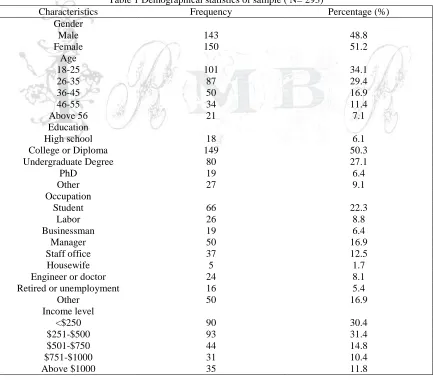
The attributes of respondents consist of five major control variables including (1) Gender, (2) Age, (3) Occupation, (4) Education, (5) Income level as Table 1.
Table 1 Demographical statistics of sample ( N= 293)
Characteristics Frequency Percentage (%)
Gender
Male 143 48.8
Female 150 51.2
Age
18-25 101 34.1
26-35 87 29.4
36-45 50 16.9
46-55 34 11.4
Above 56 21 7.1
Education
High school 18 6.1
College or Diploma 149 50.3
Undergraduate Degree 80 27.1
PhD 19 6.4
Other 27 9.1
Occupation
Student 66 22.3
Labor 26 8.8
Businessman 19 6.4
Manager 50 16.9
Staff office 37 12.5
Housewife 5 1.7
Engineer or doctor 24 8.1
Retired or unemployment 16 5.4
Other 50 16.9
Income level
<$250 90 30.4
$251-$500 93 31.4
$501-$750 44 14.8
$751-$1000 31 10.4
ISSN: 2306-9007 Hsu & Nguyen (2016) 1492
I
www.irmbrjournal.com December 2016I
nternationalR
eview ofM
anagement andB
usinessR
esearchVol. 5 Issue.4
R
M
B
R
According to able 1, the rate of male and female respondents is not much different (48.8% and 51.2%). Most of respondents are between eighteen to twenty five years old, followed by those of twenty six to thirty five years old. More than fifty percent of respondents had or in the progress to get college diploma. Most of respondents are students or managers, the rest number equally work in positions of officers or labors, being engineer or retired. More than thirty percent respondents have a salary or supported finance grade at around $251 to $500, while more than eleven percent are above $1000, most of them are businessmen and have PhD.
The Result of Regression Analysis
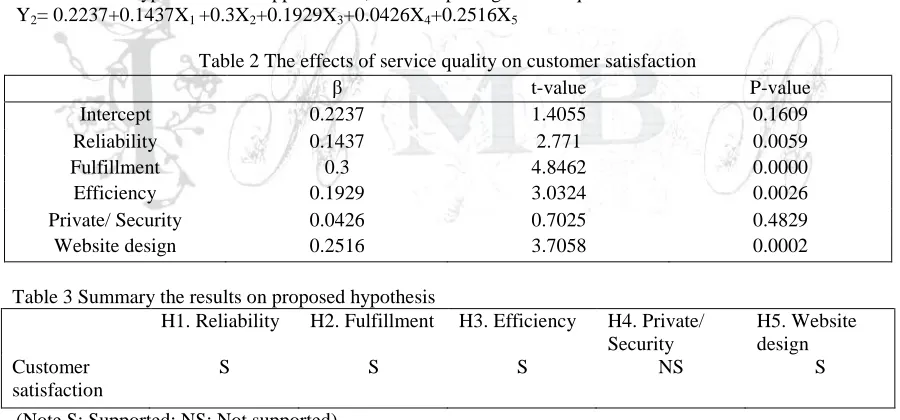
The results about the effect of the factors of service quality on customer satisfaction are illustrated in table 2. Firstly, the effect of reliability (β= 0.144, P< 0.05) on customer satisfaction is significant. It means that there are positive relationship between reliability and customer satisfaction in Internet Banking in Vietnam. The hypothesis 1 is supported. Similarly, the effect of fulfillment (β= 0.3, P<0.05) on customer satisfaction is significant. There is a positive relationship between fulfillment and customer satisfaction in Internet Banking in Vietnam. The hypothesis 2 is supported. The effect of efficiency (β= 0.2, P<0.05) on customer satisfaction is significant. There is a positive relationship between efficiency and customer satisfaction in Internet Banking in Vietnam. The hypothesis 3 is supported. Following, the effect of private/security (β= 0.04, P=0.48) on customer satisfaction is significant. There is a negative relationship between private/security and customer satisfaction in Internet Banking in Vietnam. The hypothesis 4 is not supported. Finally, the effect of website design (β= 0.25, P<0.05) on customer satisfaction is significant. There is a positive relationship between website design and customer satisfaction in Internet Banking in Vietnam. The hypothesis 5 is supported. So, the multiple regression equation for this research was:
Y2= 0.2237+0.1437X1 +0.3X2+0.1929X3+0.0426X4+0.2516X5
Table 2 The effects of service quality on customer satisfaction
β t-value P-value
Intercept 0.2237 1.4055 0.1609
Reliability 0.1437 2.771 0.0059
Fulfillment 0.3 4.8462 0.0000
Efficiency 0.1929 3.0324 0.0026
Private/ Security 0.0426 0.7025 0.4829
Website design 0.2516 3.7058 0.0002
Table 3 Summary the results on proposed hypothesis
H1. Reliability H2. Fulfillment H3. Efficiency H4. Private/ Security
H5. Website design Customer
satisfaction
S S S NS S
(Note S: Supported; NS: Not supported)
Table 4 The Effects of service quality on customer satisfaction
Multiple R R2 Adjusted R2 F-value P-value
Reliability Fulfillment
Efficiency 0.802 0.6432 0.637 103.51 0.00**
ISSN: 2306-9007 Hsu & Nguyen (2016) 1493
I
www.irmbrjournal.com December 2016I
nternationalR
eview ofM
anagement andB
usinessR
esearchVol. 5 Issue.4
R
M
B
R
Table 5 The effects of service quality on customer satisfaction
SS df MS F P-value
Regression analysis 141.05 5 28.21 103.509 0.00
Residual value 78.218 285 0.2725
Total 219.268
Table 6 The effects of customer satisfaction on customer loyalty
Multiple R R2 Adjusted R2 F-value P-value
Customer
satisfaction 0.8013 0.6421 0.6409 522.2183 0.00**
(Note: **P<0.01)
Besides, Statistical version 10.0 was used to perform linear regression analysis using one-way Analysis of Variance ANOVA test that whether factors of service quality positively influences on customer satisfaction.
Table 5 demonstrates the results from ANOVA one way test. It is easy to observe the significance of this test since at the alpha = 0.05, P-value < 0.05. From these statistical evidences it could be implied that there is a significantly effect of factors of service quality on customer satisfaction.
The table 6 shows the results of effects of customer satisfaction on customer loyalty in Internet banking in Vietnam. Adjusted R2 is the measure of the amount of reduction in the variability of customer loyalty by using the regression variables of factors of service quality in the regression model. The adjusted R- square and multiple R are close to 1 which demonstrates significantly of the estimation of the regression model.
Table 7 The effect of customer satisfaction on customer loyalty
β t-value P-value
Intercept 0.8263 6.0923 0.00**
Customer satisfaction 0.8062 22.8521 (Note: **P<0.01)
In table 7 illustrated that the effect of customer satisfaction (β= 0.8263, P<0.05) on customer loyalty. It means that there is a positive relationship between Customer satisfaction and Customer loyalty. So, the hypothesis 6 is supported. So, the linear regression equation for this research was: Y1= 0.8263+0.8062X6
Table 8 The effects of customer satisfaction on customer loyalty
SS df MS F P-value
Regression analysis 142.5143 1 142.5143 522.2183 0.00
Residual value 79.4144 291 0.2729
Total 221.9287
(Note: **P<0.01)
Table 8 demonstrates the results from ANOVA one way test. It is easy to observe the significance of this test since at the alpha = 0.05, P-value < 0.05. From these statistical evidences it could be implied that there is a significantly effect of customer satisfaction on customer loyalty.
Discussions and Conclusions
ISSN: 2306-9007 Hsu & Nguyen (2016) 1494
I
www.irmbrjournal.com December 2016I
nternationalR
eview ofM
anagement andB
usinessR
esearchVol. 5 Issue.4
R
M
B
R
summarize the following conclusions and suggestions for future studies. The information is summarized in Table 3 displayed that the hypothesis 1, 2, 3, 5 were supported and the hypothesis 4 were rejected. That strongly proved the existence of the reliability, fulfillment, efficiency and website design effect on customer satisfaction. In addition, we also successfully prove customer satisfaction positively influences on customer loyalty. However, rejected proposed hypothesis 4 in this study can be explained by following reasons. According to Lewis and Soureli (2006), defined that trust as “a feeling of security, based primarily on the belief that one party's behavior is guided by favorable intentions towards the best interest of the other” as such on the context of Internet banking in Vietnam, trust is related to risk and insecurity among online customers when they perform financial activities. In Vietnam, customers feel safer to using cash and make directly transaction in bank counters than via Internet, they don’t want to solve the error by themselves as well as customers really worried about that their personal and security information was leaked to others. Specially, it is difficult to change the habits of Vietnam customers who are the slowest to adapt to new technology. The overall findings on the factors affecting customer satisfaction with Internet banking services show that customer expectations towards the quality service have an effect on their satisfaction and loyalty. This would mean that emphasizing in service quality, its convenience and ease of transfers between accounts in the same bank or even cross-bank transfers, accurate transaction, free-error and so on has a significant effect on customer satisfaction. A more satisfied customer means a more loyal customer, which eventually flows through to the bank’s profit (Reichheld and Sasser, 1990). Combined these are key to operating a successful service business. Using these factors to further develop Internet banking system would not be a waste of resources, since commercial banks would see clearly the factors that would lead to meeting customer needs and thus customer satisfaction.
Recommendations
I suggest keeping researching on Internet Banking in Vietnam so Vietnamese can be habituated on latest technology as well as banks developed day by day. We still wish that the Internet connectivity at each corner of Vietnam and it safely uses everywhere. Besides, working with larger population sample may get more improved results. All of the major banks that are operating in Vietnam should take necessary steps to make Internet Banking more reliable, efficiency as well as more security that will definitely enhance the trust of customers and get higher profits from loyalty customers. More specifically, the items that corresponded to security/private were confidence, safety, the customer authentication, trust and so on. Following these items, the banks are doing their best to make their customers sure that there is free- error relating to security issues. This means banks must effort to keep up to date their security system. In addition, in general, the website attractiveness and website appearance are key factors shaping the customers awareness of company website (Ki-Han, Jae-Ik 2008). Therefore, banks need to constantly improve these items to make customers have more new experiences and attract customers. Last but not least, according to Mundorf and Bryant (2002), there are for items related to this dimension were User-friendly interface, website accuracy, on-time reaction and Bank's Accurate Response. Therefore, banks need to take advantages from these aspects to consider and develop website that can expand the numbers of users work easily and efficiently with it.
References
Arasli, H., Smadi, S.M. & Katircioglu, S.T. (2005). Customer service quality in the Greek Cypriot banking
industry. Managing Service Quality, 15(1), 41-56. http://dx.doi.org/10.1108/09604520510575254.
B. Lewis, & M. Soureli. The antecedents of consumer loyalty in retail banking. Journal of Consumer Behaviour, 5(1), p15-31, 2006.doi:10.1002/cb.46.
Brady, M. K., & Robertson, C. J. (2001). Searching for a consensus on the antecedent role of service
quality and satisfaction: An exploratory cross-national study. Journal of Business Research, 51(1), 53–
60.
Chou, W.X., & You, X.Y. (2005). The study about Internet banking service quality, relation quality and
ISSN: 2306-9007 Hsu & Nguyen (2016) 1495
I
www.irmbrjournal.com December 2016I
nternationalR
eview ofM
anagement andB
usinessR
esearchVol. 5 Issue.4
R
M
B
R
Daniel, E. (1999). Provision of electronic banking in the UK and Republic of Ireland. International Journal of Bank Marketing, 17(2), 72-82.
Decision No. 2453/QD-TTG of December 27, 2011, approving the scheme to step up non-cash payment in Vietnam -period 2011 – 2015. http://www.chinhphu.vn/.
Fox, S. (2006). Online banking jumps 47% in 2 years. Pew Internet and American life project. Online Available: http://www.pewInternet.org/pdfs/PIP_Online_Banking_2005.pdf.
Gaura, C. (2002). E- banking in Transition Economies: the Case of Romania.
Gerrad, P. & Cunningham, B.J. (2003).The diffusion of Internet banking among Singapore consumers. International Journal of Bank Marketing, 21(1), 16-28.
Grönroos, C. (1983) Strategic Management and Marketing in the Service Sector. Marketing Science Institute, Cambridge, Massachusetts, USA.
Horstmann R (1998). Customer Satisfaction and Loyalty: an empirical assessment in the service industry. J. Appl. Manage. Entrepreneurship. 4: 39 -54.
Khamseh, Karim; Sobhanifard, Yaser, Akhavan, & Maryam (2008). An Investigation on Internet banking
adoption in Iran. 2th International Conference on Internet Banking; Tehran, pp. 38-49 (in Persian).
Ki-Han Chung & Jae-Ik Shin (2008). The Relationship among Retailing Attributes, Satisfaction and
e-Loyalty. Management Review, 3(1). 23-45.
Koike Yuichi (2015). An Advanced Electronic Payment System toSupport Enhanced Service Provision.
Special Issue on Enterprise Solutions to Support a Safe, Secure and Comfortable Life. NEC Technical
Journal. Vol.10 No.1. December, 2015.
Lee, G.G., & Lin, H.F. (2005) “Customer Perceptions of e-Service Quality In Online Shopping,” International Journal of Retail and Distribution Management, Vol. 33(2): 161-176.
Le, A.T. (2011). Exploring Factors That Influence Customer’s Use of E- Banking in Vietnam. Master Thesis.
Lewis, R.C. & Booms, B.H. (1983) “The Marketing Aspects of Service Quality,” Emerging Perspectives on Services Marketing, Vol. 65(4): 99-107.
Liao, Z. & Cheung, M. T. (2002). Internet- Based & Consumer Attributes: An Emperical Study. Information & Management, 39, pp. 283-295.
Liao, S.H., Chang, W.J., Wu, C.C. & Katrichis, J.M. (2011). A survey of marketing orientation research
(1995-2008). Industrial Marketing Management. 40(2), 301-310.
Llevwellyn, D. T. (1997). Banking in the 21st century: The transformation of an industry. Bulletin Economic and Finance, 49(11), 5-27.
Lovelock, C. H., Patterson, P. G., & Walker, R. H. (2001). Services Marketing: An Asia-Pacific Perspective. 2nd Ed. Australia: Prentice Hall.
Mei, M.L., Ronnie, C., Aris Y. C. L. & Yuen, T.C (2013). Measuring Service Quality in the Banking
Industry: A Hong Kong Based Study. Contemporary Management Research Pages 263-282, Vol. 9, No.
3, September 2013.
Meerkerk, G.J., Eijnden, R.J.J.M.V.D. & Garretsen, H.F.L. (2006). Predicting compulsive internet use: it’s
all about sex! CyberPsychology & Behavior. 9 (1), 95-103.
Methlie, L. B. (1998). A business model for electronic commerce. Bergen, Norway: Norwegian School of Economics and Business Administration.
Mesay Sata Shanka (2012). Bank Service Quality, Customer Satisfaction and Loyalty in Ethiopian Banking Sector. Journal of Business Administration and Management Sciences Research Vol. 1(1), pp. 001-009, December, 2012.
Mundorf N. & Bryant J. (2002). Realizing the social and commercial potential of interactive technologies. Journal of Business Research; 55(8), August 2002, Pages 665-670.
Neal, W. D. (1998). Satisfaction be damned, value drives loyalty. Paper presented at the ARF Week of Workshops, New York. Paper retrieved from http://www.sdr-consulting.com/article4.html.
Oliver, R. L. (1981). Measurement and Evaluation of Satisfaction Processes in Retail Settings. Journal of Retailing, 57(3), 25–48.
ISSN: 2306-9007 Hsu & Nguyen (2016) 1496
I
www.irmbrjournal.com December 2016I
nternationalR
eview ofM
anagement andB
usinessR
esearchVol. 5 Issue.4
R
M
B
R
Pham, L. (2010). A conceptual framework for e- banking service quality in Vietnam. Accept to be published in The Business Studies Journal.
P. Saha & Y. Zhao (2005). Relationship between online Service Quality and Customer Satisfaction. Lule University of Technology MSc Program me in Electronic Commerce (2005).
Ribbink, D., Riel, A., Liljander V., Streukens, S., (2004). Comfort your Online Customer: Quality, Trust
and Loyalty on the Internet. Managing Service Quality, 14(6), 446-456.
Reichheld, F.F. & Sasser, W.E. (1990). Zero defections: Quality comes to services. Harvard Business Review, 68, 105-111.
Santos, J. (2003). E-service quality: a model of virtual service quality dimensions. Management Service Quality, 13(3), 233-46.
Saha Parmita & Zhao Yanni (2006). Relationship between online service quality and customer satisfaction,
a study in internet banking. Master Thesis, Lulea University of Technology.
Sayani, H. (2014). Customer satisfaction and loyaltyin the United Arab Emirates banking industry. International Journal of Bank Marketing, 33, 351-375. http://dx.doi.org/10.1108/IJBM-12-2013-0148 S.S. Srinivasan, R.E. Anderson, & K. Ponnavolu. (2002). Customer loyalty in e-commerce: An exploration
of its antecedents and consequences. Journal of Retailing, 78(1), p41-51, 2002.
The State Bank of Vietnam. System of Credit Institutions. 07/27/2016. http://www.sbv.gov.vn/.
Wolfinbarger, M.F., and Gilly, M.C. (2003). Shopping Online for Freedom, Control and Fun. California Management Review, 43(2), 34-55
Yoo, M., & Bai, B. (2013). Customer loyalty marketing research: A comparative approach between
hospitality and business journals. International Journal of Hospitality Management, 33, 166-177.
Zaim, H., Bayyurt, N. & Zaim, S. (2010). Service quality and determinants of customer satisfaction in hospitals: Turkish experience. The International Business & Economics Research Journal, 9(5), 51-58. Zeithaml, V.A., Parasuraman, A. & Malhotra, A. (2000). A Conceptual Framework for understanding
e-Service Quality: Implications for Future Research and Managerial Practice. Marketing Science
Institute Monograph: 115.
Zeithaml, V., Parasuraman, A., & Malhotra, A. (2000). A Conceptual Framework for Understanding
e-Service Quality: Implications for Future Research and Managerial practice. Working Paper,
Cambridge M.A, Marketing Science Institute, Report Number 00-115, (2000).
Zeithaml, V. (2002). Service Excellence in Electronic Channels. Managing Service Quality, 12(13) 135 138.
Zeithaml, V., Parasuraman, A., & Malhorta, A. (2002). Service Quality Delivery through Web Sites: A
Critical Review of Extant Knowledge. Journal of the Academy of Marketing Science, 30(4), 362-375.