Review On- Automated Placement Process Using
Graph Database
Sharad Deshmukh1, Shubham Memane2, Mayuri Sahane3, Kaushal Sonawane4, Dr. Prof. K. C. Nalavade5
1,2,3,4 U. G. Scholars Computer Engineering, Sandip Institute of Engineering & Management 5Head Of Department, Computer Engineering, Sandip Institute of Engineering & Management
Abstract: Placement Activity is an important part of any educational society in which most of the work till now is being done in manually. The main aim of this project is the automation of placement process. The system is an android application for placement activity. The main feature of this project is automated placement relevant notification generation. In this placement officer will feed the company details and sent to the eligible students. Students can directly apply for the company using the system. The application also provides facility of maintaining details of students along with the placement records of the student. The project will provide maximum optimization, abstraction and authentication along with minimum manual work and no data loss. The project will be helpful in faster management of the placement related activities in the college campus.
Keywords: Distributed Systems, File organization, Record classification, Information Search and Retrieval, Query formulation, Graph-database.
I. INTRODUCTION
The use of smart phones, Internet and World Wide Web revolutionized the provision of information for the user to take action on the information gained. The use of Internet enables users to manage placement process. This lead to a Internet based placement management system developed specifically by the placements officers and the software developer to become an automated Placement system.
This system is an application that can be accessed by the students and the high authorized person (Admin, Student coordinator) through their smart phone as an android application with proper login provided. The student information regarding placement activity can be managed by Training and Placement Officers(TPO) by using this system . Students logging in will be able to upload their information in the form of resume, Personal details and Academic details. Student should register themselves for placement, access company information, search and apply for jobs. Admin provides approval of student and student coordinator registration and updating, sending email to the eligible student, feeding the notification.
This system provides information about the company which is to be visited to the institute for the recruitment, also institute placement policy, information about placement activity so that students may view and access their opportunities and should not miss any opportunity.
This system is designed to improve the working of existing system. Improve accuracy in result as well as access the data faster. This system has user-friendly interface. It provides the facility of keeping the details of the students secure and easily accessible whenever required. This system can play a vital role for institute to manage the student information concerning placement.
II. SYSTEM ARCHITECTURE
A system architecture or systems architecture is the conceptual model that defines the structure, behavior, and views of a system. An architecture description is a description and representation of a system, organized in a way that supports reasoning about the structures and behaviors of the system.
“Figure 1. System architecture”
The students will register and upload their personal information in the database. The company will send their information and requirement criteria to the admin. After storing all the information the system will perform pattern matching and notify the student which satisfies the criteria. The will get all the information about the company as well as the drive venue through notification. After every drive round the shortlisted student will get notified every time. Admin will assign some student coordinators and provide information to assist the company.
III. MATHEMATICAL MODEL
Mathematical modeling is used for measurement of how the system is implemented mathematically. It provides flexible i.e. mathematical thinking and use of concepts of set theory.
Formal set of notation description, informal English description (Set of all inputs) gives:
A. System Description
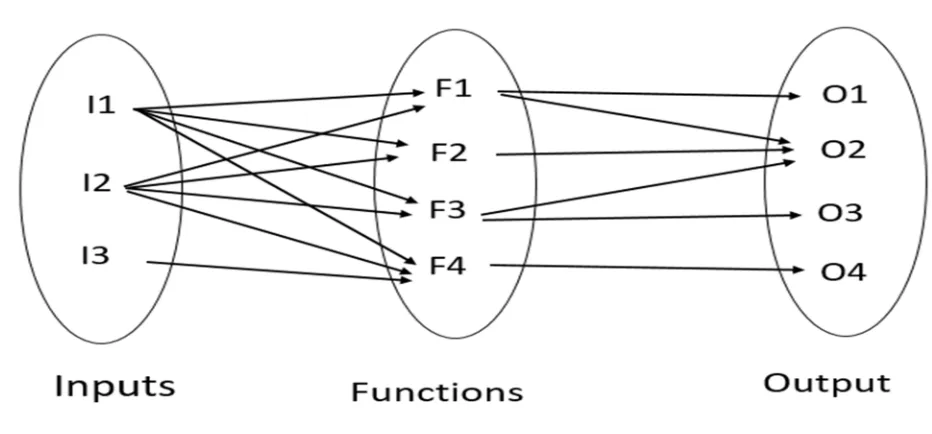
Input: Student Data(I1), Company Information and Criteria(I2), Student Coordinator information(I3). Output: Sorting Result(O1), Notification(O2), Next Round Information(O3), Student Selection(O4) . Functions: Searching(F1), Profile Matching(F2), Sorting(F3), Query Processing(F4),etc.
S={I,O,F} Input: {I1,I2,I3}
Output: { O1,O2,O3,O4 } Functions: { F1,F2,F3,F4 }
Success Conditions: Proper Output for Given Input and Updation Of Data In Database. Failure Conditions: Internet disconnected.
Figure 2. Venn Diagram
As shown in the figure 2 the functions like searching, profile matching, sorting, query processing are performed on the inputs students data and company information and criteria, etc and outputs like sorted student list, notification to students, next round information for students are generated.
IV. LITERATURE SURVEY
Shilpa Bilawane et al. [1], Now a days in colleges student information is gathered manually. The student separate records are time consuming task. All these records are needed to be referred and updated. Chance for more manual errors is more. As use of mobile devices have been increased. There appears a new trend to release all kinds of campus information by smart mobile terminals. We can refer this as a network for distributing campus information among students and student coordinators. The idea behind this is developing campus information system through which student can access data at any time, at any locations using MySQL database Cornelia Gyr ̈odi et al. [2], In this paper we will try to present a comparative study of non-relational databases and relational databases. We mainly focus our presentation on one implementation of the NoSQL database technology, namely MongoDB, and make a comparison with another implementation of relational databases, namely MySQL, and thus justifying why MongoDB is more efficient than MySQL. We will also present the comparison between a non-relational database and a relational database, integrated in the field of personal and professional development. The NoSQL database used to develop the forum is MongoDB, and was chosen from a variety of non- relational databases.
Pallavi Madan et al. [3], This paper covers NOSQL databases. With the increase in internet users and applications it is more important to learn graph databases, it is the future of data management. Basic architecture of graph databases has been discussed to know their working and how data is managed in the form of graph structure and relationships.
ustin J. Miller et al [4], Graph databases (GDB) are now a viable alternative to Relational Database Systems (RDBMS). Chemistry, biology, semantic web, social networking and recommendation engines are all examples of applications that can be represented in a much more natural form. The comparisons will be find out between relational database systems and graph databases focusing on feature such as data structures, data model features and query facilities.
Hongcheng Huang et al [5], Neo4j database based on graph model is different from other database on implementation. Firstly, this paper explores the architecture of the system and its internal mechanism. Neo4j offers three ways to query, and express its query performance from several ways: data size, query complexity, query number, etc. The results show that there are obvious difference in performance under different scenarios. This paper analyzes the experimental results and selection suggestions of query ways are recommended later. A reference of query performance optimization for specific business applications is provided by it.
requirements of current applications has lead the development of new database technologies. The database communities are always attracted by graph databases because it is trendy , the extraction of worthy information depends on processing the graph-like structure of the data.
V. CONCLUSION
Thus hereby we conclude that the proposed system removes all the drawbacks of existing system and enhanced with the automatic e-mail system and dynamic notification system. The proposed system gives the automation in all the processes like registration, updating and searching. It provides the detailed solution to the existing system problem. We are going to develop this application i-os compatible. The application will provide notification of government job. The application will provide the nearby company location. The system will provide the notifications of government exams and different competitions
REFERENCES
[1] Shilpa Bilawane And Pranali Jambhulkar,” Information System Based On College Campus.”, International Journal Of Engineering And Computer Science [2015] Page10852-1085
[2] Cornelia Gyr ̈odi, Robert Gyr ̈odi, George Pecherle And Andrade Olah, ”Study: MongoDB vs MySQL.”, International Conference on Engineering of Modern Electric Systems (EMES),978-1-4799-7650-8[2015]
[3] Pallavi Madan And Anuj Saxena, ”Review: Graph Databases.”, International Journal of Advanced Research in Computer Science and Software Engineering, [2014]
[4] Justin J. Miller,”Graph Database Applications and Concepts withNeo4j.”,Southern Association for Information Systems Conference, Atlanta, GA, USA., [2013]Page141-147
[5] Hongcheng Huang And Ziyu Dong,” Research on architecture and query performance based on distributed graph database Neo4j.”,IEEE. ,978-1-4799-2860-6[2013] Page533-536