6
I
January 2018
International Journal for Research in Applied Science & Engineering Technology (IJRASET)
ISSN: 2321-9653; IC Value: 45.98; SJ Impact Factor :6.887 Volume 6 Issue I, January 2018- Available at www.ijraset.comDesign and Development of Automation System for
J&K State Board of Technical Education
Shakeel Ahmad Dar1
1
IT Cell Incharge, J&K State Board of Technical Education
Abstract: Today in this fast moving technological era, time is an important asset and automation is the key. The Jammu and Kashmir State Board of Technical Education is entrusted with the primary responsibilities of registration of students, conduction of examinations and evaluation of students pursuing diploma courses in various engineering and non-engineering fields at Polytechnic and ITI Levels across the entire state of Jammu and Kashmir. Thus the workload of Board is very huge and hence the need for automating all processes to make them effective and timely. The automation system has various stakeholders viz, students, institutes, evaluators board officials like deputy registrar, registrar, secretary and other date entry operators. The processes are broadly categorized into registration and Result Processing. The Different layers of the Automation System are the backend database that is developed in MSSQL, the front end user interface in html and using JavaScript and CSS for scripting and styling and the middleware web server, script for which is written in PHP. In this paper Automation System was developed for JKSBOTE in order to achieve efficiency of the overall processes in terms of cost and time.
Keywords: The Jammu and Kashmir State Board of Technical Education (JKSBOTE); Data base; Model; User interface.
I. INTRODUCTION
The Jammu and Kashmir State Board of Technical Education (JKSBOTE) came into being as an individual entity under the Directorate of Technical Education in 1981. It has now been transformed into an autonomous body by an Act of 2002, of the J&K State Legislature. The volume of the work of the JKSBOTE has increased manifold over the years with the increase in the number of courses offered by the Polytechnics and also the increase in the number of Institutions/Seats. The primary responsibilities of the JKSBOTE are the affiliation of institutes, conduction of examinations and result processing and certification of candidates who are declared successful in the various Programmers at Polytechnic/ITI Levels of J&K State.The Examination Conduction Process starts from creating different examination centers, then issuance of datasheets and then paper setting followed by issuance of examination material to the concerned centers. The answer scripts are then sent back to the board for evaluation. Then the answer scripts are coded with the student detail part hidden to prevent any kind of mischief/ bias for fair evaluation. The evaluators submit the marks and prepare the award rolls(through portal now).The marks are verified again by another checker. Then the process of decoding starts wherein the roll numbers of students are submitted against the codes. The Registrar then links and confirms the two and then the result is generated and declared. In the present paper automation system was developed for JKSBOTE which will ease out the processes of Registration, Examination Form Submission, Admit Card Issuance, Result Processing and Reevaluation Processes. All processes involving huge paper work and manual intervention will be eliminated upto the maximum level possible and will make the system much more transparent, efficient, and convenient and fast for all stake holders.
II. METHODOLOGY
Fig.1-ER Model of JKSBOTE
The user interface is an important part of the overall design. User Interface (UI) Design focuses on anticipating what users might need to do and ensuring that the interface has elements that are easy to access, understand, and use to facilitate those actions. UI brings together concepts from interaction design, visual design, and information architecture. User Interface should go to hand to hand with the user needs. The User Interface for the Project is built using HTML with CSS. In addition JavaScript Features and AJAX were added at many places to make it convenient for different types of users. The different users of the system include admin, Student(For Next Phase),Institute(For Next Phase), Deputy Registrar, Registrar, Secretary, Evaluator, Operator, Decoder. Each of the users of the system has a common interface for login and depending upon the type of user, after successful login, they get the home page as per the role. The Common Interface is shown as in Fig.2. As Shown in the Figure, the main part is the central one which asks for Username and Password. The User enters his/her credentials and depending on the credentials, he is able to login into the system. There is a Common Header and Footer in across all pages of the system. A Sub header is created for individual type of user.
International Journal for Research in Applied Science & Engineering Technology (IJRASET)
ISSN: 2321-9653; IC Value: 45.98; SJ Impact Factor :6.887 Volume 6 Issue I, January 2018- Available at www.ijraset.comIII. RESULTS AND DISCUSSIONS
The development of data base model is described below:
[image:4.612.61.548.133.372.2]Admin:The administrator is an important user of the system. The interface for admin user mainly comprises of three types of functions viz. Institute/Subject/Programme Administration and hence addition of new institutes, programmes or a new subject in a Programme is entirely controlled by admin. Fig.3 shows the interface which was developed for user through database management.
Fig. 3: Institute/Subject/Programme/Branch-Interface for User
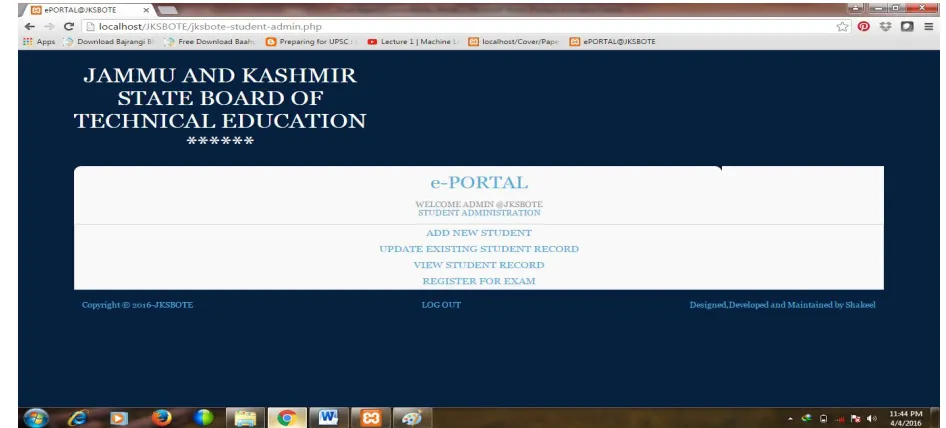
This Part of the Admin User interface deals with the Student part. As there are already number of students already registered ,so this feature has been added to register those previously existing students. As new students register only in the months of July/August,it was mandatory to keep this option at admin end only at this point of time . The admin enters the student record (Necessary and Sufficient Data ) for successul compilation of result.The Options that the admin has in Student Administration are ,adding new student, adding record of a student , viewing the record and registering the student for semester exams.(Fig.4).In Adding Interface,the admin gets the option of selecting Institute from Drop Down menu and depending upon this selection , the programmes offered in that particular institute are automatically populated. The javascript alongwith Ajax are used for the same.(Fig.5).Besides other details like provisional /Verified Registration ,Lateral Entry /Regular Admission etc are important features. After the admin fills the data ,the flow goes to the admin handler,which contains the bussiness logic.
[image:4.612.67.540.510.724.2]Fig.5: Adding New Student
After Successful Submission of Basic Record, an automated page displays in which the list of subjects for that programme in which student is registered is displayed along with its all components.
Fig.6:Registering Student for Semester Exam
International Journal for Research in Applied Science & Engineering Technology (IJRASET)
ISSN: 2321-9653; IC Value: 45.98; SJ Impact Factor :6.887 Volume 6 Issue I, January 2018- Available at www.ijraset.comIV. CONCLUSION
The project started with an idea and it has been successfully implemented (Phase-I). Earlier a 3rd Party used to be engaged for Result Processing System and the manual system was there for the same at the board’s end. Now that is eliminated with the introduction of this much needed system. The data is an asset. Earlier Students were asked a dozen of times to provide the same data during their tenure of studies for applying to various examinations now that all is eliminated, data once supplied will be used and re-used, which would not only save lot of time and energy for all the stakeholders but also will make the system efficient in terms of errors and discrepancies.
REFERENCES
[1] Codd, E. F. (1970). A Relational Model of Data for Large Shared Data Banks Retrieved on June 12, 2012,from
http://www.seas.upenn.edu/zives/03f/cis550/codd.pdf
[2] Sumathi, S., Esakkirajan, S., (2007). Fundamentals of Relational Database Management Systems. (pp. 96-97).Springer-Verlag Berlin Heidelberg.
[3] King, C. (2012). SAP Innovation Day - Setting a Standard for the Next 40 Years. Retrieved on October 14,2 0 1 2 f r om h t t p: / / www. ecommerce times. com/story/75896.html
[4] Bachman, C. (1965). Integrated Data Store." DPMA Quarterly, January.
[5] Kroenke, D.M., & Auer, D.J., (2012). Database processing: Fundamentals, design, and implementation.(12 ed.). Pearson:Boston. [6] Brock, D. (2006). Understanding Moore's Law: Four Decades of Innovation, (pp. 25-37). Chemical HeritageFoundation: Philadelphia, PA.
[7] Borka, J. B., &Chien A., (2011). Communications of the ACM, Vol.54 No. 5, Pages 67-77, The Future ofMicroprocessors. Retrieved from http://cacm.acm.org/magazines/2011/5/107702-thefuture-of-microprocessors/fulltext#T1
[8] Missbach, M., Hoffman U. (2001). Sap Hardware Solutions: Servers, Storage, and Networks for Mysap.Com (pp. 120-121, 162). Hewlett-Packard Company, PrenticeHall: Upper Saddle River, NJ.
[9] Education Solutions Unlimited (2006). Introduction to Computer Science (p.126). Dorling Kindsersley (India) Pvt. Ltd.
[10] Vey, G., Krutov, I., (2012). SAP In-Memory Computing on IBM eX5 Systems. Retrieved on October 9, 2012, from h t tp ://www . redbooks. ibm.com / redpapers / pdfs/redp4814.pdf
[11] Plattner, H., Zeie, A., (2011). In-Memory Data Management: An Inflection Point for EnterpriseApplications (pp.1-2). Springer-Verlag Berlin Heidelberg: London, New York.
[12] Pettey, C., & Tudor, B. (2010). Gartner Survey Shows Data Growth as the Largest Data CenterInfrastructure Challenge. Retrieved from http://www.gartner.com/ it/page.jsp?id=1460213
[13] Dumbill, E. (2012). Volume, Velocity, Variety: What You Need to Know About Big Data. Retrieved on October 14, 2012, from http://www.forbes.com/sites/oreillymedia/ 2012/01/19/volume-velocity-variety-what-you-need-toknow-about-big-data/
[14] Stagge, C. (2011). Four Use Cases of SAP HANA. Retrieved on September 29, 2012 , from http://en.sap.info/teched-2011-madrid-sikka-keynotehana/59111 [15] Rowe, N. (2012). In-memory Computing: Lifting the Burden o f Big Data Retrieved fromhttp://www.aberdeen.com/Aberdeen-Library/7377/RAbig-