Volume: 04 Issue: 07 | July -2017 www.irjet.net p-ISSN: 2395-0072
A novel method for Content Based Image retrieval using Local
features and SVM classifier
Mr. Yogen Mahesh Lohite
1, Prof. Sushant J. Pawar
21
Department of Electronics and Telecommunication Sandip Inst. of Tech. & Research Centre
Nasik, India
2
Department of Electronics and Telecommunication Sandip Inst. of Tech. & Research Centre
Nasik, India
---***---
Abstract -
Retrieving images from the large amount ofdatabase based on their content are called content based image retrieval. It is a basic requirement of retrieve the relevant information from huge amount of image database according to query image with better system performance. With increasing volume of digital data, search and retrieval of relevant images from large datasets in accurate and efficient way is a challenging problem. Color texture and edge feature of image is most widely used feature to analyze the image in the CBIR. In this paper we present a novel approach for retrieval of images based on this features and have also optimized the results using the SVM classifier. The proposed system is implemented in matlab and efficiency of the is calculated on the parameters like accuracy, sensitivity, specificity, error rate and retrieval time. The results shows that the proposed system outperforms well than other technique.
Key Words: Content Based Image Retrieval; TextBased Image Retrieval ; Feature Extraction; Manhattan distance, SVM,
1.INTRODUCTION
Image retrieval in general and content based image retrieval in particular are well-known research fields in information management. The large numbers of images has created increasing challenges to computer systems to search & retrieve relevant images efficiently[1]. Researchers are gaining more interest in CBIR as it is one of the hot image processing field which is having big range to work out the novel ideas that will produce the promising results. Core phases of CBIR where the research contribution is desired, are feature extraction based on image contents, Similarity measures used for comparison and the performance evaluation using various parameters. [2]
The main consideration of image retrieval is the structure of images in image database, Here, the database images are stored in structured manner. The scenario of CBIR is mainly indexing images in image database and retrieval. Firstly,
using multiple features generates the feature vectors and those are accordingly stored in an index correlated to the database images. And then, based on the similarity measure between database images and query image the relevant images will be retrieved. [3]
Initially, Content-Based Image Retrieval (CBIR) systems were introduced to address the problems associated with text-based image retrieval. CBIR is a set of methods for retrieving semantically-relevant images from an image database based on automatically-derived image features. The main goal of CBIR is efficiency during image indexing and retrieval, thereby reducing the need for human intervention in the indexing process. In other words, visual contents are used in CBIR to search images from large scale image databases based on users’ interests. It becomes an active and fast advancing research area. Image content may include both visual and semantic content. Retrieving images on the basis of automatically-derived features such as color, texture and shape is the basic way of CBIR. These techniques includes several areas such as image segmentation, image feature extraction, representation, mapping of features to semantics, storage and indexing, image similarity-distance measurement and retrieval which makes CBIR system development as a challenging task.
Implementation of a CBIR system using one content feature doesn’t give sufficient retrieval accuracy [4]. To overcome this problem, we combine multiple features for the image like color, texture, & edge. The objective is to work on collection of images & retrieve similar images based on features in response to pictorial queries. Despite the vast amount of review work exists for image retrieval methods but after assaying the work, lack of systematic literature review & performance evaluation of existing techniques for CBIR is realized. It will explore the research gaps & statistical knowledge for future researches. Traditionally, text based image retrieval also known as concept based image retrieval is the most common retrieval system, where the search is based on annotation of images. The term CBIR was coined by Kato in 1992 in his research article “Database architecture for content base image retrieval”, for the
Volume: 04 Issue: 07 | July -2017 www.irjet.net p-ISSN: 2395-0072
automatic retrieval of the images from a database based on the color and the shape [5].
CBIR is an interface between a high level system (the human brain) and a low level system (a computer). The human brain is capable of performing complex visual perception, but is limited in speed while a computer is capable of restricted visual capabilities at much higher speeds. In a CBIR, visual image content is represented in form of image features, which are extracted automatically and there is no manual intervention, thus eliminating the dependency on humans in the feature extraction stage. These automated feature extraction approaches are computationally expensive, difficult and tend to be domain specific . In this paper we present a novel approach for retrieval of images based on this features and have also optimized the results using the SVM classifier.
texture and color attributes are computed in a way that model the Human Vision System (HSV) [11].
The Texture semantics is retrieved using Gabor wavelets. Shape feature is extracted using Gradient Vector Flow fields. It shows an accuracy of 60.7% by the authors in [12] but the disadvantage is that it has very low accuracy. In [13] the authors proposes a method which uses Color features of an image to form a feature vector. These features are then used by machine learning classifiers to classify the images, but Texture and shape features are not considered.
2.1 CBIR Architecture
The basic fundamentals of content based image retrieval are divided into three parts feature extraction; feature matching and retrieval system design. The proper organization of the generated large amount of images is also needed in CBIR system.
2. LITERATURE REVIEW
(CBIR) is a method that is used to look at image features like (color, shape, texture) to find a query image from database. The difficulties of CBIR lie in reducing the differences of contents based feature and the semantic based features. This problem in giving effective retrieval images and channelize the researchers to use (CBIR) system ,to take global color and texture features to achieve, the good retrieval, where others used local color and texture features[6].
The method in [7] presented the holistic representation of spatial envelop with a very low dimensionality for making the incident image. This approach presented an outstanding result in the scene categorization. The method in [8] proposed a modern approach for image classification with the open field design and the concept of over-completeness methodology to achieve a preferable result. As reported in [8], this method achieved the best classification performance with much lower feature spatiality compared to that of the former schemes in image classification task.
Tiwari et al developed a CBIR system [PATSEEK] for US based patent database as a patent always consists of an image along with textual information. For similarity search [9]the user need to enter keywords along with the query image that might appear in the text of patents. Krishnan et al developed CBIR based on color, based on the rife colors in the foreground image which gives only the semantics of the image. Dominant color identification by using foreground objects alone is able to retrieve number of similar images considering the foreground color irrespective of size. Higher average precision and recall rates compared to the traditional Dominant Color method were obtained successfully [10].
In another system the image is represented by a Fuzzy Attributed Relational Graph (FARG) that describes each object in the image, its attributes and spatial relation. The
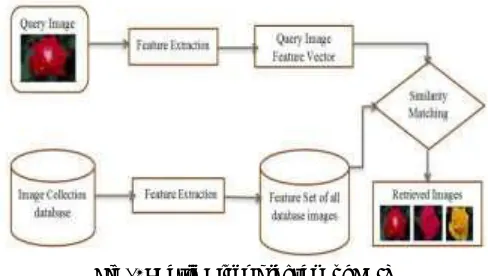
Fig -1: Basic Block diagram of CBIR The CBIR system has following steps:
1. Create a database: Store images in a database to prepare own database for testing purpose or use inbuilt databases.
2. Input Query Image: Input query image for which similar images for database are needed to be retrieved.
3. Feature Extraction: Extracting the important features of database images and query image based on various image features like color, texture, edge features etc.
4. Feature Matching: Measure similarity between query image and stored database images based on Manhattan distance, Euclidean distance, chisquare distance etc. is checked and the features which are closer to the query image features the corresponding image of that features are retrieved.
[image:2.595.312.556.323.461.2]Volume: 04 Issue: 07 | July -2017 www.irjet.net p-ISSN: 2395-0072
3.
Proposed Approach
3.1 Feature Extraction
The proposed system design is given in two phases. Training Phase: Feature extraction applied for image database is a backend process which is independent from user extraction.The extracted features are smaller than actual image and then they are stored as feature database in the form of matrix for similarity measures later on. The collection of feature vectors is termed as feature database of the images in the database.
Testing Phase: This phase is also known as front end starts when user gives a specific query request by giving an example image. Then, features of query image are also extracted in same manner as database image features are extracted and stored as a feature vector. Then similarity is measured based on chosen distance metrics and based on least distance set of most similar images is obtained as result. HSV
During this step following actions are done, Color Space Conversion, Color Quantization and Compute Histogram. In color space conversion, Translate the representation of all colors in each image from the RGB space to the HSV space. A color histogram is a representation of the distribution of colors in an image.Each component is quantized with non-equal intervals: H: 8 bins; S: 3 bins and V: 3 bins. Finally we concatenate 8X3X3 histogram and get 72-dimensional vector. Color Moment
Color moments are measures that can be used differentiate images based on their features of color.The most important moments are Mean, Standard deviation and Skewness. The first order (mean), the second (standard deviation) and the third order (skewness) color moments have been proved to be efficient and effective in representing color distributions of images. In RGB, each channel will be 3-values vector. In total we have 3 x 3 = 9 3-values for each image.
3.2 Proposed Algorithm
Image DatabaseThe database of collection of 300 images is being used. Images are divided into different categories like horses, aero planes, cars, roses, monuments, players etc. of JPEG format and each category contains similar type of images. To reduce the number of calculations at run-time, every image in the database should be pre-computed.The following algorithm will train the database and store extracted features as feature database for further use.
Algorithm for Training Phase
Phase1 (Training Phase): The proposed algorithm for feature extraction and storage is:
OUTPUT: Feature based representation of database images
Step 1: Read an Image from the database
Step 2: Quantize the image into Hue, Saturation and Value(HSV) into 8x3x3 value.
Step 3: Compute the HSV Histogram.
Step 4: Extract first 3 color moments from each Red, Green and Blue Planes of image.
Step 5: Convert image to Gray Scale image. Step 6: Apply
Gabor Wavelet (no. of scales = 4 and no. oforientation = 6) to calculate mean squared energy and mean amplitude. Step 7: Apply Wavelet moment to calculate first 2 moments of wavelet coefficients i.e. mean coefficient and standard variation coefficient.
Step 8: Apply edge gradient using sobel edge detection tocalculate gradient magnitude or edge strength. Step 9: Apply 1 to 7 on all images stored in a database andstore features as feature database.
Algorithm for Testing Phase
Phase2 (Testing Phase): The proposed algorithm for image retrieval from storage is:
INPUT: Query image.
OUTPUT: Similar images retrieved from the database Step 1: Load the query image.
Step 2: Extract features for query image (As given in Training
algorithm steps 2 to 8).
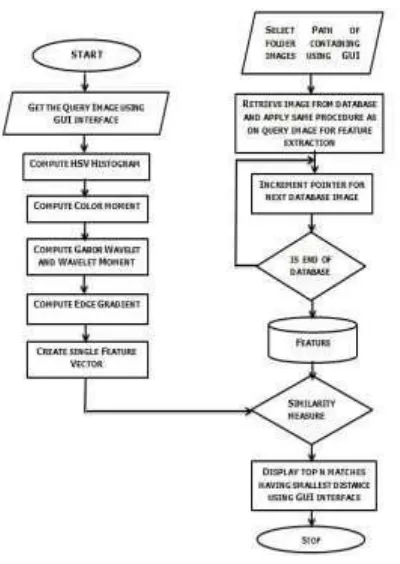
Step 3: Create the feature vector by combining selected features, that is, HSV histogram, color moment, Gabor wavelet, Wavelet moment and Edge gradient
Step 4: Compute the matches between feature vector ofquery image and feature vector of each of the images in the database using distance metrices.
Step 5: Retrieve the top n images based on the order ofminimum distance using all distance metrices.
Volume: 04 Issue: 07 | July -2017 www.irjet.net p-ISSN: 2395-0072
AC = Sensitivity + Specificity/2
Retrieval Score: A retrieval score was computed for each query, the system returned the n closest images to the query, including the query image itself .Its formula is:
Retrieval Score =100 × [1− (mismatches/n)] %
Retrieval Time: It gives total time after giving source image to get similar images from database. It is measured in seconds. Error Rate: It gives error value occur in retrieval process.Its formula is:
Error Rate = 1 - Accuracy
4. RESULTS
Qualitative Evaluation: To perform evaluation and comparison studies of experiments are set up in MATLAB 8.10.604 (R2013a) on i3 Processor and proposed system is tested on various parameters.
Fig -2: Flow Chart of Proposed System
3.3 Evaluation Metrics
Traditional framework of evaluation consists of Sensitivity, Specificity, Accuracy, and Error Rate.
True Positive: This term tells us number of matchedimages which are correctly identified.
False Negative: It is reverse of true positive i.e. it gives number of matched images which are not correctly identified. It considers matched images as not matched.
True Negative: It indicates number of images which are not matched and those are correctly identified.
False Positive: It gives us number of not matched images which are not correctly identified. It consider not matched images as matched images
Sensitivity: By this parameter we can find the value of number of images is correctly matched. It can be calculated by Sensitivity = TP / (TP+FN)
Specificity: It gives us the value of number of images which Are not matched. It is calculated by a formula given as: Specificity = TN / (TN+FP)
Fig -3: GUI without selecting any database or test image
Fig -4: Image Dataset
Accuracy: It simply provides us the average of sensitivity and specificity and is calculated as:
[image:4.595.52.252.95.377.2] [image:4.595.303.566.353.504.2] [image:4.595.308.566.534.684.2]Volume: 04 Issue: 07 | July -2017 www.irjet.net p-ISSN: 2395-0072
Fig -5: Test Image and Similar Images retrieved bymanhattan
Fig -6: Test Image and Similar Images retrieved byChebychev
Fig -6: Test Image and Similar Images retrieved byCityblock
[image:5.595.358.507.132.275.2]Quantitative Evaluation:It is the systematic computation and empirical investigation of statistical metrics for CBIR
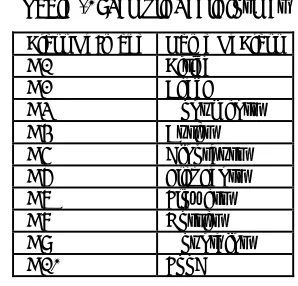
Table -1: Sample Table format
Class Of Image Name Of Class
C 1 Africa
C 2 Beach
C 3 Monuments
C 4 Buses
C 5 Dinosaurs
C 6 Elephants
C 7 Flowers
C 8 Horses
C 9 Mountains
[image:5.595.36.577.254.785.2]C 10 Food
TABLE -2. Experimental results for parameters ofProposed cbir system
Class of Accuracy Sensitivity Specifi Error Retrieval
Image city Rate Time
C 1 86.12% 0.89 0.79 0.14 1.052310
sec
C 2 82.86% 0.67 0.78 0.17 1.064574
sec
C 3 83.67% 0.76 0.81 0.16 1.009583
sec
C 4 83.27% 0.76 0.74 0.17 1.044011
sec
C 5 83.27% 0.85 0.70 0.17 1.016916
sec
C 6 82.45% 0.85 0.57 0.18 1.045035
sec
C 7 84.29% 0.78 0.64 0.16 1.116216
sec
C 8 85.31% 0.76 0.74 0.15 0.992197
sec
C 9 84.69% 0.93 0.75 0.15 1.029994
sec
C 10 86.33% 0.89 0.69 0.14 1.071573
sec
[image:5.595.306.575.308.535.2]Average 84.23% 0.81 0.72 0.15 1.044
TABLE -3. Experimental results for comparison ofDifferent similarity measures
Volume: 04 Issue: 07 | July -2017 www.irjet.net p-ISSN: 2395-0072
3. CONCLUSIONS
An novel method is proposed for retrieval based on combination of color, texture & edge features of image with svm classifier for optimization of results. Performance evaluation of proposed technique is done using parameters like Sensitivity, Specificity, Retrieval score, Error rate and Accuracy. Experimental results on 10 categories of images each with 50 images demonstrate that proposed technique along with 11 distance parameters as similarity measure with average accuracy 0.844 outperforms other techniques.
Our sincere thanks go to SITRC for providing a strong platform to develop our skill and capabilities. We would like to thanks all those who directly or indirectly help us in presenting the paper. We hereby take this opportunity to express our heartfelt gratitude towards the people whose help is very useful to complete our project. We would like to express our heartfelt thanks to my guide Prof. Sushant J. Pawar whose experienced guidance became very valuable for us.
REFERENCES
[1] M. Kaur and N. Sohi, "A novel technique for content based image retrieval using color, texture and edge features," 2016 International Conference on Communication and Electronics Systems (ICCES), Coimbatore, 2016, pp. 1-7. [2] Kekre, H. B., & Sonawane, K. (2014, April). “Comparative
Study of Color Histogram Based Bins Approach in RGB, XYZ, Kekre's LXY and L′ X′ Y′ Color Spaces”, In Circuits, Systems, Communication and Information Technology Applications (CSCITA), 2014 IEEE International Conference Mumbai, pp. 364-369.
[3] Jenni, K., & Mandala, S. (2014, September). “Pre-processing Image Database for Efficient Content Based Image Retrieval”, In Advances in Computing, Communications and Informatics (ICACCI), 2014 IEEE International Conference 24-27 Sept. 2014, New Delhi pp. 968-972.
[4] Bodhke, “Content Based Image Retrieval System”, Journal of Signal & Image Processing, 2012
[5] Sandhya R. Shindeet al., “Experiments on Content Based Image Classification using Color Feature Extraction”,IEEE, 2015.
[6] R. Datta, D. Joshi, J. Li, and J. Z. Wang, “Image retrieval,” ACM Comput. Surv., Vol. 40, no. 2, Apr. 2008, pp. 1–60. [7] A. Oliva and A. Torralba, “Modeling the shape of the
scene: “A holistic representation of the spatial envelope,” Int. J. Comput. Vis., vol. 42, no. 3, pp. 145– 175, 2001.
[8] Y. Jia, C. Huang, and T. Darrell, “Beyond spatial pyramids: “Receptive field learning for pooled image features,” in Proc. IEEE Conf. Comput. Vis. Pattern Recognit. (CVPR), Jun. 2012, pp. 3370–3377.
[9] A. Tiwari and V. Bansal, “PATSEEK: Content Based Image Retrieval System for Patent Database”, Proceedings of international conference on electronic business, pp. 1167-1171 2004.
[10]N. Krishnan, M.S. Banu and C. Callins Christiyana, “Content Based Image Retrieval Using Dominant Color Identification Based on Foreground Objects”, International
Conference on Computational Intelligence and
Multimedia Applications, Vol. 3, pp. 190-194, December 2007.
[11]Heba Aboulmagd Ahmed, Neamat El Gayar, Hoda Onsi “A New Approach in Content-Based Image Retrieval Using
Fuzzy Logic” INFOS2008
[12]Majid Fakheri et al., “Gabor wavelets and GVF for feature extraction in efficient contentbased color and texture images retrieval”, IEEE, 2011.