© 2017, IRJET | Impact Factor value: 5.181 | ISO 9001:2008 Certified Journal | Page 1594
Data Hiding in Images using Dynamic Programming considering
Human Visual System
Anshu Baghel, Mrs.Suchitra Pandey
Department of Electronics and Telecommunication Engineering Bhilai Institute of Technology, Durg (C.G.)
Asst.Prof. Department of Electronics and Telecommunication Engineering Bhilai Institute of Technology, Durg
(C.G.)
---***---Abstract - Data hiding is a technique in which stego data is
embedded on to the host data according to some set of rules and at the receiver end the same data is recovered with or without some distortion. Payload capacity, fidelity and robustness are the parameters to evaluate the performance of steganographic system. There is always a trade-off between payload capacity and output image quality. This paper proposed a hybrid method to increase payload capacity while maintaining image quality as well as increase fidelity of steganographic system. Relationship between adjacent pixel is calculated based on pixel potential which is called as energy. Dynamic programming is used to calculate cost based on energy. This cost and energy is used to select pixels randomly using dynamic programming. The input data is then embedded on selected pixel based on human visual system parameters hence increase payload capacity while maintaining image quality. Proposed method is simulated and mean square error and peak signal to noise ratio is calculated.
Key words
—Data hiding, HVS, dynamic
programming
.1. INTRODUCTION
DATA hiding is the good technique to be used for secure
communication. A Data hiding system involves three
main elements Sender, Channel and Receiver. Data
hiding procedure expects to insert some classified data
into a carrier signal by adjusting the unimportant parts
for copyright assurance or secret correspondence. Data
hiding the term itself makes it clear that making the
host signal imperceptible or keeping fact secret that
some information is embedded into the image or
signal[4-6]. In image stegnography secret data in the
form of the sequence of bits is embedded in the image
termed as cover image. Secret data when embedded
into the cover image, the output image is called as stego
image. Stego image should be kept similar to the input
image to avoid any speculation in the others mind.
Many techniques have been proposed for hiding secret
data into host image. Least Significant bit replacement
is the common approach in image stegnography.
Payload capacity and security is always a concern in
LSB method of data hiding. Lee and Chen[8] proposed a
high capacity LSB data hiding technique using Human
Visual System(HVS) property and maintained the
fidelity of the process. Wang and Lin[9] proposed a
method of embedding binary image in the host by using
genetic algorithm and local pixel adjustment feature
which improves the quality of stego image. Wu and
Tsai[10] presented a paper of LSB embedding by
modifying quantization scale using human visual
system for good quality image. Chen and Chang[11]
presented improvement in the method presented by
wang using optimal pixel adjustment process.
ThienandLin[13] presented a paper which improves
imperceptibility of output image by embedding data
digit by digit using modulus function. Liu and Chen[16]
presented a paper which uses variable depth LSB
substitution and applied some processing to avoid
significant changes in stego image. Method presented
by Wu and Tsai uses Human visual system in optimal
way for reducing effect of data hiding.
Chen and Chang[17] presented a data hiding process
using LSB substitution with Optical Pixel Adjustment
Process(OPAP). Pixel Value Differencing(PVD) is also
used in several methods. Paper presented by Wu and
Tsai[18] improves their previous work by combining
LSB substitution and Pixel Value Differencing.
Lee and Tsai [19] used dynamic programming based on
human visual system for better payload capacity and
reduce distortion minimization.
© 2017, IRJET | Impact Factor value: 5.181 | ISO 9001:2008 Certified Journal | Page 1595
without being compromise with the quality of the stego
image. HVS model helps to estimate usable bits in every
pixel of cover image for bit substitution.
1.1.HVS propoerties for depth measurement
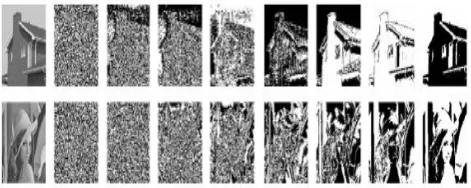
[image:2.595.54.290.332.426.2]In gray scale image,each pixel intensity is represented by eight bits. Image represented by each bit of particular bit plane is called binary image. Significance of each bit reduces as bit moves to lower order i.e. MSB to LSB. Figure 1 shows the binary images of different sample images. The LSB bit plane is looking completely haphazard, data inserted in the LSB bit will do negligible change in the image. But if we look at the MSB bit plane it contains dominantly large information hence any change in the MSB bit plane will change image considerably. Horizontal data hiding is the process of hiding in the order of LSB to MSB in contrast to vertical data hiding which hide data from MSB to LSB. Horizontal data hiding produce less distortion in the stego image.
Figure 1: Sample images and their bit planes(left to right; input image; bp0,bp1,…..bp7)
Embedding the data into the bit planes directly can considerably damage the edges in the image. [19]uses perception property of the human visual system which we explain future. Two HVS properties can be used for reducing the distortion in result images.
Human vision perception is more responsive to grayscale vales in smooth areas than in texture areas.
Human vision perception depends on relative luminance rather than absolute luminance.
Data embedding must take these two factor. For the first factor, Let the pixel value is , grayscale value is , denote the maximum value of grayscale, denote the minimum value of grayscale. Then maximum difference in
gray scale values will be . To maintain the
smoothness in the stego image the new grayscale value after data embedding should be restricted to a range . Then maximum number bits D a pixel can embed is
For the Second factor, let denote the luminance of a pixel p and value of f ranges between 1 and 100. Relative luminance
property in HVS is expressed by contrast value where value of c is between 0 and 100. According to the principle of Just Noticeable Difference weber law says that value of contrast change then effect will be noticeable. Then maximum number of data bits that can be embedded in 8 bits of grayscale value can be computed differently.
Maximum luminanace change for the permissible
maximum contrast change ( ) will be
Hence following condition can be written as
For grayscale image luminance is in the range of [1 100] and grayscale value g is in the range [0 255]. Thus linear
mapping gives relationship as
. It is rewritten as . Following relationship can be derived for maximum gray scale value change:
Where is maximum grayscale value change to avoid detectable change in stego image. For number allowable bit change in any grayscale value consider if 5 bits are used to embed in the grayscale data then maximum grayscale change . According to above condition grayscale value must be larger than 319 which is out of the range of grayscale value. It means 5 or more than five bits cannot be changed in the grayscale value. If four least significant bits of grayscale value will be changed then . Then from the above condition it can
be derived that .
Considering value 153 as grayscale value it can be represented as 100110012. If four values of be changed value may become one between the value 100100002and 100110002, which is lower than 153 so to fulfill above factor the grayscale value condition must be change to . It can be said that four bits in the gray scale value can be changed if grayscale value of image is greater than or equal to 160. Similarly, other conditions can be set as
© 2017, IRJET | Impact Factor value: 5.181 | ISO 9001:2008 Certified Journal | Page 1596
1.2.Data Embedding Procedure
To embed secret data into an image randomly, dynamic programming can be used. In dynamic programming decision is taken based on some factors. Following section explains the method to use dynamic programming and data embedding using this dynamic programming.
A. Calculation of Energy Matrix
Markov Random Field(MRF) is used many vision applications. Vision treats MRF as a tool for modeling image data. Images are cut into group of nodes that correspond to pixels. Joint probabilistic model is built over the values of pixel in image.
Seam Carving, a well-known strategy for substance aware image resizing uses the property of vitality of pixels to characterize the optimality for an eight connected path of the image pixel. There is a need to detail a energy function which might be used to evaluate the relationship between the different pixels in the image. Despite the fact that, there are numerous vitality capacities accessible, the one which gives us the most ideal relationship between the pixels. Minimization of energy ought to be a definitive objective of the function being utilized. Extend the energy work used to get an ideal arrangement and in the meantime interchange energy are given which can remarkably adjust the ultimate result[2].
Consider an 4X4 image matrix, where every matrix element is an 8 bit image pixel ranges between 0 to 255.If I(x,y, formula for energy pixel is given by:
This function gives the best relationship between the pixel and its neighborhood. The relationship has been discovered in both the directions. Consolidate all E(x,y) to get the Energy matrix E. The energy outline is hence acquired for the image. Gradient of the image pixels in both directions can further mean square of the same can be viewed as another energy formulation.
B. Calculation of Cost Matrix
A DP is an algorithmic system which is normally in light of a repetitive formula and one (or a few) beginning states. A sub-arrangement of the issue is developed from already discovered ones. DP arrangements have a polynomial many-sided quality which guarantees a considerably speedier running time than different systems like backtracking. Dynamic programming has an immediate application in the finding of cost matrix (C) and to scan for the path containing the maximum cost which is gotten from the cost matrix itself[3]. The cost matrix is presently gotten from the matrix E be spoken to as C. For a given pixel E(x, y) we search for its
neighboring pixels in the vertical direction and along these lines locate another value for that specific pixel and oblige every single such values to frame another matrix which is known as the cost matrix (C).
For a pixel having energy E(x, y) we check for the pixels energy E(x-1,y-1) , E(x,y-1) and E(x+1,y+1). Among these three pixels, take the estimation of the pixel which has least energy. Presently, increase the value of E(x, y) to get the cost of the pixel with position (x, y) as C(x,y). For the top most pixel column the cost esteem C(1, y) is same as the energy esteem E(1,y). This system is taken after for the whole energy matrix E and therefore we compute the cost matrix C.
C. Finding Pixel Path
Pixel path for embedding data into it can be find by passing through the cost matrix C. A DP algorithm is used for finding the path through cost matrix. Consider a pixel with the spatial directions C(x, y). For the highest line of pixels with spatial directions C(1,y) the pixel with most astounding cost esteem is chosen. Y has a place can have any an incentive among 1, 2, 3 or 4. Let at y=3 we get the most noteworthy estimation of cost in the primary column. Next, search for the most noteworthy cost an incentive among the three closest neighbors of C (1,3) in the following column (here, second line) viz. C(2,2) , C(2,3) and C(2,4). Let C(2,2) have the most noteworthy cost an incentive among these three pixels. Once more, search for the most astounding cost an incentive among the three closest neighbors of C (2,2) in the following line (here, third line).The pixels so acquired in each column which aggregates four are the required pixels. Mystery data as bits are implanted in these four pixels.
D. Data Embedding Procedure:
To increase the data hiding capacity we used HVS based criteria for data embedding. We formulate three limits for the optimum data embedding. The criteria for data embedding depends upon the outcome of section 2. On HVS property of Just Noticeable Difference we embed data in following manner:
Where B is number of bits and g is pixel gray scale value. Data embedding is done starting from LSB to optimum number of bits.
2. Data Embedding and Extraction Algorithm
This section explains the data embedding and extraction algorithms.2.1 Data Embedding Algorithm
Data embedding is done in following steps:© 2017, IRJET | Impact Factor value: 5.181 | ISO 9001:2008 Certified Journal | Page 1597
is the data which is to be embed in the cover image. Data isa stream of ones and zeros.
2. Let the input image is a 256x256 matrix. Segment cover image into blocks of 64x64, where each block is having 16 pixels of 4x4 matrix.
3. Calculate energy matrix and cost matrix for each of the blocks.
4. Find the path using cost matrix by dynamic programming.
5. Out of 16 pixels four pixels are selected for data embedding
6. embed the data using the criteria mentioned in the section D of section III.
2.2
Data Extraction Algorithm
Data extraction is done in following steps:1. Receive the stego image of size 256x256. 2. Segment this received image into 64x64 blocks. 3. Calculate energy matrix and cost matrix of the these
blocks.
4. By the use of dynamic programming in the cost matrix traverse through the path of pixels in which data is embedded.
5. Find the number data bits from the pixels by the conditions mentioned in embedding algorithm and extract them to find secret data.
3. R
ESULTand D
ISCUSSIONA data hiding method has been proposed which for 2D images which embed the data with reduced distortion and increased capacity. Dynamic programming and HVS model properties are used to find the desired output. Energy function and cost function is calculated on the set functions and then by dynamic programming select the random path of the pixels. In these pixels by the use of HVS model embedding procedure is done.
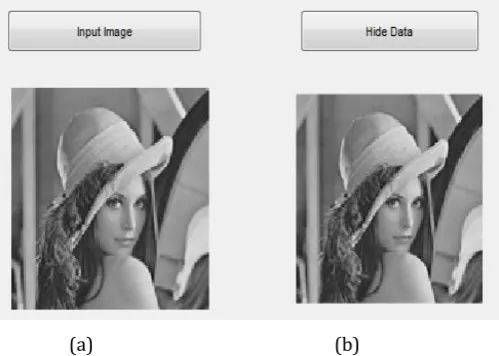
Proposed method is implemented using MATLAB. Figure 2 shows the input and output of the data hiding process. Performance of proposed method is evaluated using two parameters PSNR and hiding capacity. The quality metric PSNR used to assess the nature of the stego-image. The PSNR measures the appraisals of the nature of stego-picture regarding the first picture and it is usually utilized metric to gauge picture reliability or congruity. The formula for the PSNR can be written as follows
Where W and H represents the width and height of the image. is the value of pixel in original image at the coordinate (i,j) and is the value of pixel in the output image at the coordinate (i,j).
Table 1 shows the PSNRof the proposed method compared with other methods
Table-1 Method
DP-HVS(DPA) [19]
DP-HVS (Gready Search) [19]
DP- HVS(1-LSB)[19]
Proposed Method
PSNR 55.40 54.59 51.11 57.63
Comparison of the PSNR shows that proposed method improves the performance in terms of quality of stego image. As Human Visual System accommodate more number of bits in a single pixel while maintaining the image features; proposed method improves the performance in terms of data capacity also.
4.
C
ONCLUSIONIn the proposed work, Dynamic Programming helped in the improvement of an Image steganography plot which offers high security against enemy attack in a computerized correspondence channel, because of the irregularity of data hiding in the cover image. Human visual system properties are used to exploit the bit depth in the data embedding process which increases the data hiding capacity without being compromise in the quality of stego image.
[image:4.595.310.560.565.743.2](a) (b)
© 2017, IRJET | Impact Factor value: 5.181 | ISO 9001:2008 Certified Journal | Page 1598
References
[1] W. Hong, T. Chen, and H.Wu, “An improved reversible data hiding in encrypted images using side match,” IEEE Signal Process. Lett., vol. 19, no. 4, pp. 199– 202, Apr. 2012.
[2] Shai Avidan and Ariel Shamir. 2007. Seam Carving for Content-Aware Image Resizing. In Proceedings of ACM SIGGRAPH. 26(3): Article No. 10.
[3] Thanikaiselvan ,V., P.Arulmozhivarman, S. Subashanthini, and Rengarajan Amirtharajan. 2013. A Graph Theory Practice on Transformed Image : A Random Image Steganography. Sci. World J., Vol. 2013. 10.1155/2013/464107.
[4] Amirtharajan,R. and J.B.B. Rayappan, 2013. Steganography - time to time: A review. Res. J. Inform. Technol., 5: 53-66.
[5] Amirtharajan, R., K. Karthikeyan, M. Malleswaran and J.B.B. Rayappan, 2013a. Kubera kolam: A way for random image steganography. Res. J. Inform. Technol., 5: 304-316.
[6] Chan, CK and L. M. Cheng. 2004. Hiding data in images by simple LSB substitution. Pattern Recognition. 7: 469– 474.
[7] W.N.Lie,L.C.Chang, Data hiding in images with adaptive numbers of least significant bits based on the human visual system, in:Proceedings of IEEE International Conference on Image Processing, Taipei, Taiwan, vol.1,1999,pp. 286–290.
[8] Y.K.Lee,L.H.Chen,Highcapacity image steganographic model, in : IEEE Proceedings on Vision, Image Signal Process,vol.147,no.3,June2000.
[9] R.Z.Wang,C.F.Lin,J.C.Lin, Hiding data in images by optimal moderately-significant-bit replacement ,IEEE Electronics Letters36(25)(2000)2069–2070.
[10] D.C.Wu, W.H.Tsai, Spatial-domain image hiding using animage differencing in: IEE Proceedings on Vision, Image, and Signal Processing, vol.147,no.1, 2000, pp.29–37.
[11] C.K.Chan ,L.M.Cheng, Improved hiding data in images by optimal moderately-significant-bit replacement ,IEEEEl ectronics Letters37(16)(2001) 1017–1018.
[12] C.C.Chang ,J.Y.Hsiao, C.S.Chan, Finding optimal least-significant-bit substitution in image hiding by dynamic programming strategy, Pattern Recognition 36 (2003) 1583–1595.
[13] C.C.Thien,J.C.Lin,Asimpleandhigh-hiding capacity method for hiding digit-by-digit data in images based on modulus function ,Pattern Recognition 36 (2003) 2875– 2881.
[14] S.Lyu,H.Farid,Detecting hidden message susing higher - order statistics and support vector machines ,in:Lecture Notes in Computer Science, vol.2578, 2003, pp.340–354.
[15] C.K.Chan,L.M.Cheng, Hiding data in images by simple LSB substitution, Pattern Recognition 37(2004)469– 474.
[16] S.H.Liu, T.H.Chen H.X.Yao, W.Gao, Avariable depth LSB data hiding technique in images, in:Proceedings of third International Conferenceon Machine Learning and Cybernetics, Shanghai, PRChina, 2004,pp.3990–3994. [17] Chan, CK and L. M. Cheng. 2004. Hiding data in
images by simple LSB substitution. Pattern Recognition. 7: 469– 474.
[18] Wu, H.C., N. I.Wu, C. S. Tsai, and M. S. Huang. 2005. Image steganographic scheme based on pixel-value differencing and LSB replacement methods. IEE
Proceedings Vision Image and Signal Processing. 152(5): 611–615.
[19] I-Shi Leea, Wen-Hsiang Tsaia "Data hiding in grayscale images by dynamic programming based on a human visual model" Pattern Recognition 42(2009)1604—1611.